Balls on the Outcrops

Ball cactus (Escobaria vivipara) are not only extremely rare, they’re also apparently rather shy in showing off their magnificent stark red and yellow blossoms. Catching them in their full glory has been a personal quest come June for several years, so imagine both my surprise and delight the other day when we climbed onto one of the granite outcrop flats at Big Stone National Wildlife Refuge and found not one, but literally dozens in full bloom.

After several moments of looking for different angles and light possibilities, my eye caught a minute bright red spot on a neighboring granite flat about 20 meters away that was perhaps surrounded by some of the other rare plants of this ancient biome to grasp my interest. How fortune seemed to have blessed me in this particular moment, for it was there I found an almost perfect image of the blooms. 

This trio of ball cactus blooms caught my eye from a distant outcrop.

We are actually quite blessed to have such a wonderful and beautiful resource near us, from the outcrops to increasingly rare birds like bob-o-links and nighthawks, and to all the water-friendly species who find this patch of ancient prairie, stocked with bedrock outcrops, such a haven. Almost every trip around the circular drive yields nice imagery for me to photograph, and I seem to be drawn here several times a week and usually come home with what in the old film days would be three or four rolls of film. Finding the balls in bloom, though, just about tops the list.

About the size of half a tennis ball, with long protective spikes, the small cacti seem to cluster in packs in a unique ecosystem that has somehow survived several thousands of years since the dam broke on glacial Lake Agassiz to form the glacial River Warren, which scoured the valley and exposed some of the oldest rock in the world bringing along a small collection of quite rare plants. Those with knowledge say that the ball cacti are found only in a small two to three mile area, and only in the crevices and kinks of the original granite bedrock exposed by the ancient river.
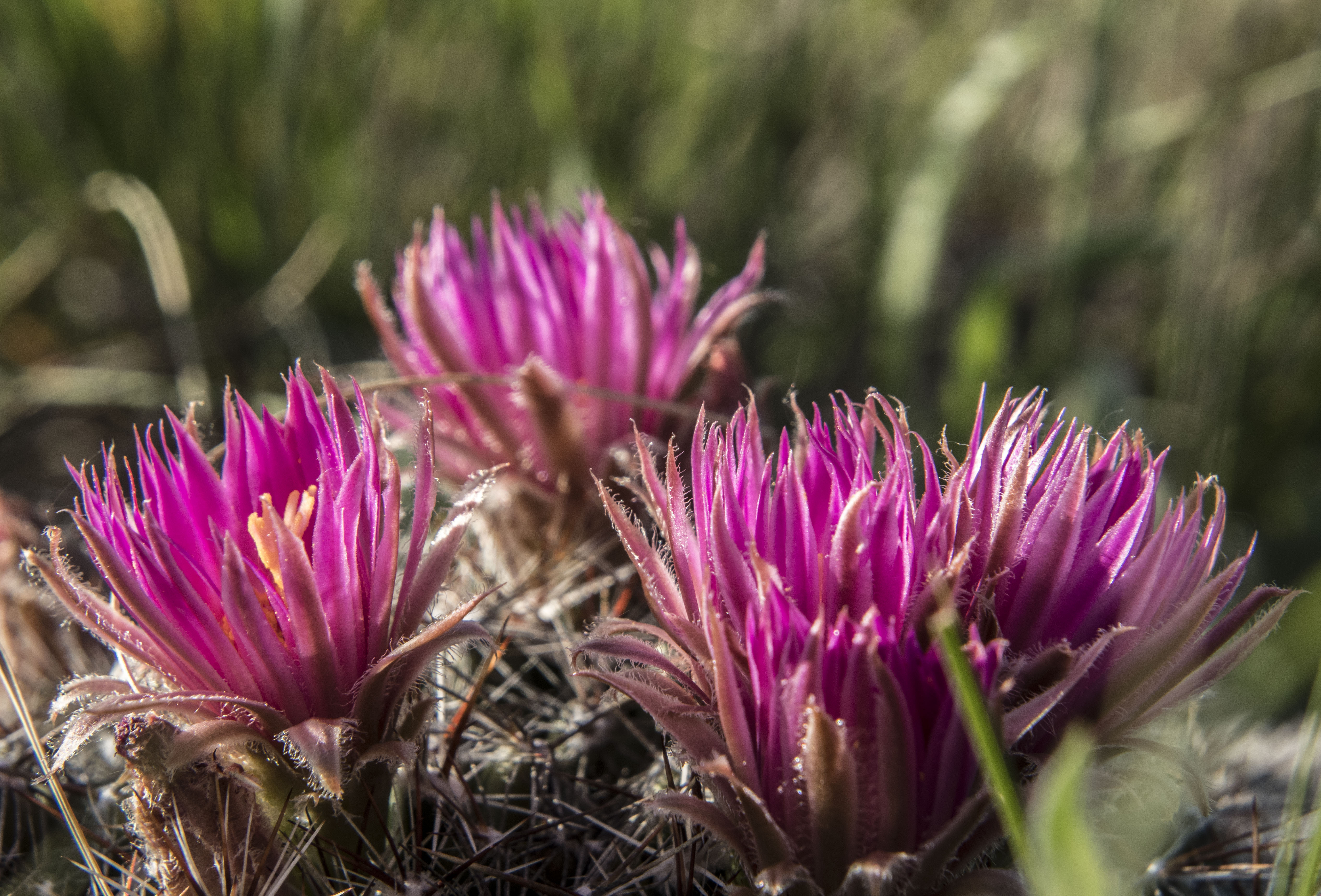
Small clusters were found across the flats of the outcrops to add incredible beauty to the hard granite outcrops.

Although small, the cacti might be huge for the security of these sacred and holistic outcrops between the Refuge and the town of Ortonville, for their vulnerability may be the only hope remaining to prevent the gravel mining company that purchased this area from creating a new, deep gravel pit mining operation that will basically destroy a rare and beautiful relic of glacial history. It was while writing stories on what was known as the Strata Conflict about a dozen years ago that a local historian, Babou Don Felton, pointed out my first viewing of a small cluster of ball cactus on a hike across the acreage. At the time I doubt that any of us realized just how powerful that rare little cacti might be.

Nor did I realize back then the beauty of their blooms, and wouldn’t until a few years ago when State Park Manager Terri Dinesen published her photograph of one of the blooms from the refuge on a social media site. Since then I’ve been hooked, so much so that when Madison Eklund, the first kayaker and first solo woman to paddle the Canoeing with the Cree trip to the Hudson Bay, was resting here for a few days, we made trips in hopes of seeing the blossoms. We were “skunked.”

Since several dozen trips have been made to the Refuge in search of the blooms, a quest that started a few days after Terri made her post. Yet, I had northing. After several attempts, sometimes making three trips in a day to the Refuge hoping for the just the right circumstances of light and heat or whatever, I sent her samples of my images in frustration to which she suggested I might have been too late. That the blooms were already gone.

According to the Center for Plant Conservation, ball cactus (one of three native cacti in Minnesota) was probably found more frequently and on a broader basis on drier, thinly vegetated prairie habitat, but it was eventually reduced to only undisturbed granite surfaces like found just south of Ortonville and into the refuge. 

According to its website, “Granite and quartzite outcrops in Minnesota are home to ephemeral pool habitats – shallow depressions where water can pool for a few weeks each year. These accumulate biotic matter and host several plants rare to the state, including Bacopa rotundifolia and Heteranthera limosa (both state Threatened). With only one ball cactus population left in Minnesota, it is hard to generalize about its preferred local habitat, but it appears to favor moss shields that occupy some of the same kinds of shallow depressions that form ephemeral pools. The plants also hug cracks in the granite and may even anchor an accumulation of duff and moss material around them as prairie winds blow over the rocks.”
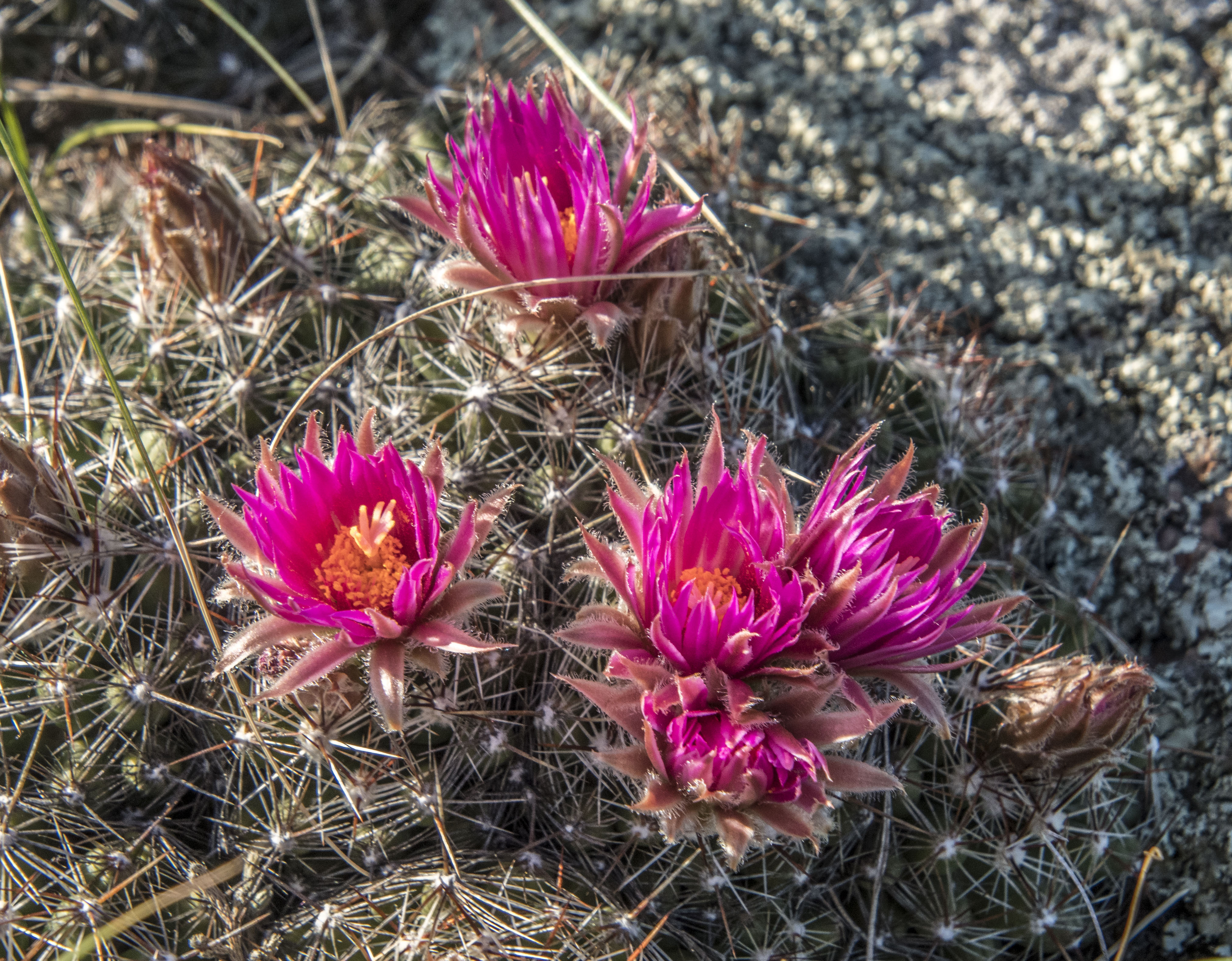
A few days after catching the height of the bloom, the party ended. It was delightful while it lasted!

The Center applied for and received a grant to collect seeds from a nearby quarry site and since has received germination rates to over 70%. “As a result, we will eventually be planting roughly 2000 cacti seedlings across the three recipient sites over a several year period,” read the report.

So there may be hope for a future for this rare species. 

For me, finding the balls in their full glory was a dream come true. Interestingly, a day or so ago we stopped back and wandered onto the flat to find that the outcrop nearly reminded me of what my apartments looked like a day or so after a party, when the balloons have withered and the festivity’s merely a memory. Those blooms were now but a memory, and had clasped tightly together to appear much like they had in the images I’d sent to Terri Dinesen a few years ago. Yet, we were there for the fun, the glory and the beauty. How can one be disappointed?

A Backstory of Momentary Prairie Luck

Here is what I remember from that late afternoon in August a few years back. We were heading toward one of those moments I believe seems most common in the prairie for I don’t recall experiencing what Sophia, the grown daughter of friends in the Cities who had ventured out to the prairie to work on an organic farm, called a   “rainbow sky.” This is that fleeting post-sundown moment when the prairie horizon gathers in a magical grandeur of pastel colors, graduating from orange to pinkish to violet to blue and eventually into a heavenly darkness. Such a poetic term for a fleeting moment.

A rainbow sky won’t happen every evening, and it seems no two are exactly alike. I’m not alone by being drawn to them when they occur, and on this particular afternoon, one among hundreds of such afternoons, nature called me to a wonderful patch of big bluestem to capture the rapidly maturing “turkey foot” seed heads silhouetted against such pleasing pastel colors.

While big bluestem grows abundantly in my home prairie here at Listening Stones Farm, another great patch can be found about a mile or so from here at the hilly Steen Wildlife Management Area  …  if those who oversee it haven’t taken mower and baler to the grasses. The prairie at Big Stone Lake State Park, at the lower end of our gravel road, also beckons, as it did on this particular afternoon. 

Here is the 2024 State Park windshield sticker made from a prairie saunter a few years ago in Big Stone Lake State Park.

My simple goal was to somehow capture one or several of those turkey foot seed heads silhouetted against Sophia’s rainbow sky. Not knowing what nature might offer, I was ambling through the grasses with a smaller zoom lens, one that offers unlimited and minute degrees of focal length options ranging from 28mm to 300 mm. This is rather common practice for me, for as a photojournalist I’m typically looking and reacting rather than planning and orchestrating an image. My goal was to simply find pleasing compositions that work well with the light and the ambient color being offered, featuring this iconic prairie grass. 

Surely there were numerous raw images made, although I remember selecting but two for my permanent files: One was a ghostly multi-dimensional image of numerous seed heads; and a second of a lone dragonfly perched on a strand of big bluestem. Prints were made, matted and framed for the annual Upper Minnesota River Arts Meander. That ghostly image has been made into canvases to grace a few walls. 

Life went merrily along after those few moments on a prairie photographic foray. Years, in fact. Then came an interesting email last summer involving Big Stone Lake State Park Manager, Terri Denisen, and Veronica Jaralambides, a marketing consultant with the Minnesota Parks and Trails. Apparently Parks and Trails was planning to feature the local, Big Stone Lake State Park, on its 2024 State Park windshield sticker. Locally, Terri knew I had numerous images taken at both the Meadowbrook and Bonanza portions of the park. With the park so close I’m in either one section or the other numerous times a week throughout the year. For years.

This “ghostly” image of bluestem “turkey track” seedheads was made moments after the dragonfly image, both blessed by a pastel “rainbow sky.”

The initial request was for an image that blended the beautiful and haunting oak savannas and the mature prairie of the Bonanza area, so a handful of those images were chosen and sent via email to Veronica. Then, having second thoughts, I sent another grouping that included a handful of more individually focused nature subjects including my two bluestem images. Almost immediately Veronica emailed me back to say she absolutely loved the image of the dragonfly, and that she wished to take it to her committee. She would get back to me. A week or so later came the word, that the dragonfly would grace the sticker. There was one major request … I had to be sworn to secrecy. 

So for six months I had to “bite my tongue” all while remembering my thoughts through the years of other nature artists who had a trout, pheasant or waterfowl image chosen for fishing and hunting stamps. Then, finally, late last year the 2024 sticker was introduced, and yes, they hadn’t changed their mind. The dragonfly on the bluestem against the rainbow sky was no longer a secret. 

Parks and Trails had these beautiful cups commissioned featuring the image.

Since the secret was out I’ve been blessed with wonderful press. My long time friend, canoeing and fishing buddy, Tom Cherveny, did the initial honors for the West Central Tribune and Forum Publications, then a call came from WCCO-TV for what turned out to be a fabulous multi-minute piece on an afternoon news program called The Four that used several of my images along with an interview. Other interviews followed and stories published. 

Among the questions asked, of course, was when and what circumstances were involved with capturing the image. What could I say? When your sauntering through a big bluestem prairie and you just happen to see a lone dragonfly silhouetted against a rainbow sky, you simply react by quickly focusing, framing and capturing the image. Not a whole lot of excitement there other than a pleased smile in the moment after checking to see if all those intricate connections worked in the image; nothing like the story of the murderous bear in the Colorado mountains that ended up with an artist’s rendition for a cover and several of my images being published in Outdoor Life Magazine back in the 1970s. Who am I to argue or complain? I’ve had a wonderful journalist career that has been mutated a bit since I’ve been granted entry into the magical world of prairie art.  

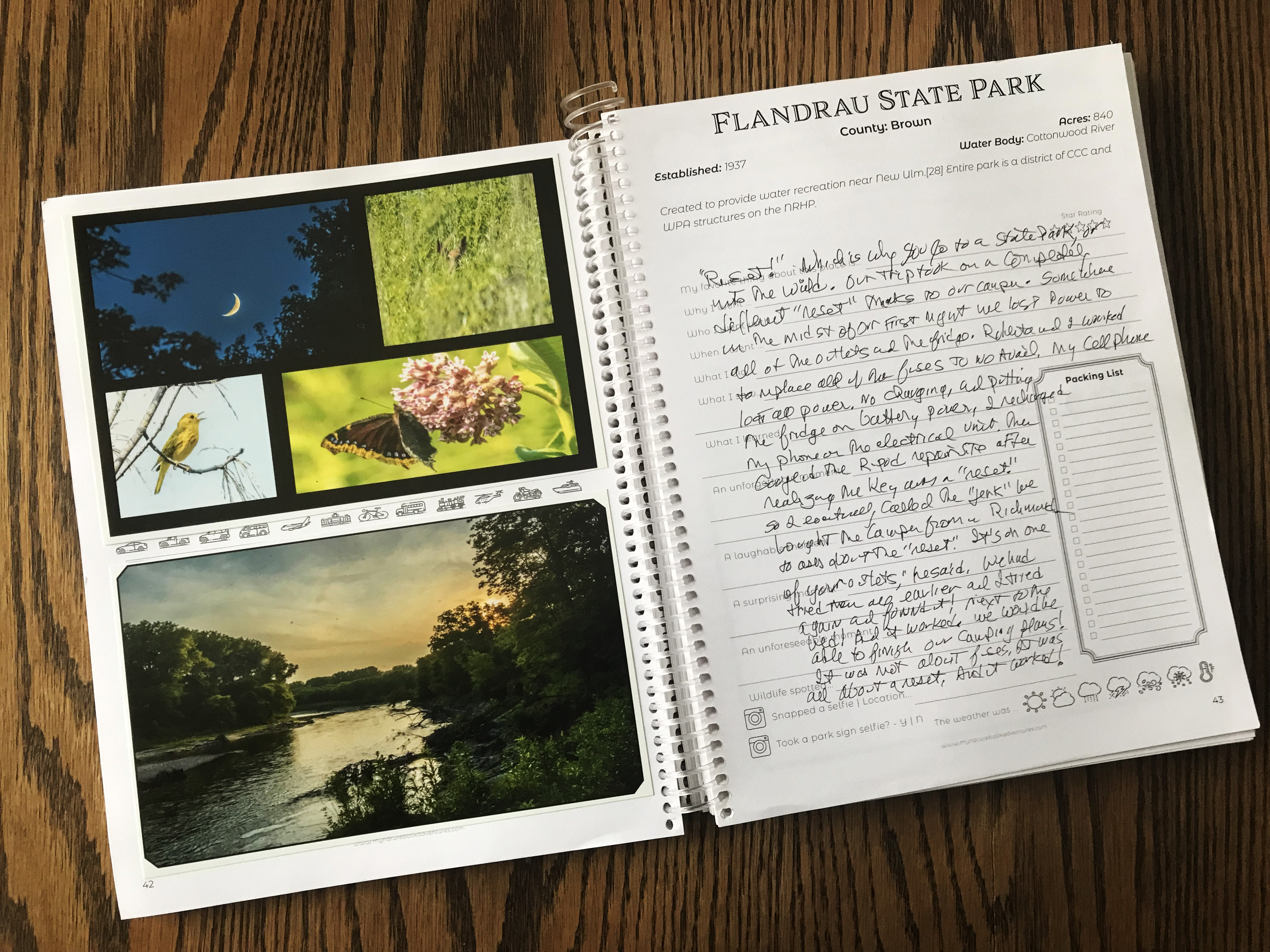
My personal quest is to complete this photographic journal of the 66 state parks in Minnesota, and so far 39 have been added to the journal.

I suppose making up some glorified murderous bear-like story might have been more entertaining and exciting, although I’ve never known of anyone being stalked, chased down and battered to death by dragonfly wings. I was simply doing what a photojournalistic nature photographer would do. I went for an ambient light foray with a camera, captured an image and was simply fortunate enough know the right Park Manager. Adding to that was being so fortunate that my image resonated with Veronica at Parks and Trails. 

This luck came two years after Parks and Trails shocked me by choosing three of my photographs in their annual photographic contest, two of which made their annual calendar.

Minnesota’s beautiful State Parks are quite important to me, and I’m now continuing my work on completing a photographic journal of each of the 66 parks along with my volunteering as a Minnesota Master Naturalist. To date I’ve visited 39 parks, although a few visits were before the photo-journaling began. So the adventures continue, this time with the knowledge that all those vehicles we’ll now pass in the State Parks will have displayed on the passenger-side corner of their windshields a dragon fly silhouetted on a stem of big bluestem in Sophia’s rainbow sky. I couldn’t be more pleased.