On Wings of Magic

We were all children on that beautiful August morning, seemingly bringing to life Thomas Wentworth Higginson’s lovely poem, “Ode to a Butterfly,” penned some 120 years ago. We were filled with mystery and delight, of magic and colorful beauty, of joy on a sunny summer morning basking in nature. 

Around us in flights as beautiful as twirling ballerinas, all basking in colors so vividly bright in contrast to the bright blue skies, our smiles of wonder and delight crossed our faces. Oranges, blacks, whites and yellows, delicately worn as the air dancers slipped above and around the prairie flora equally as beautiful. In our hands were broad and cottony nets, soft to the touch to protect our prey, beautiful butterflies flying uncharted flights.

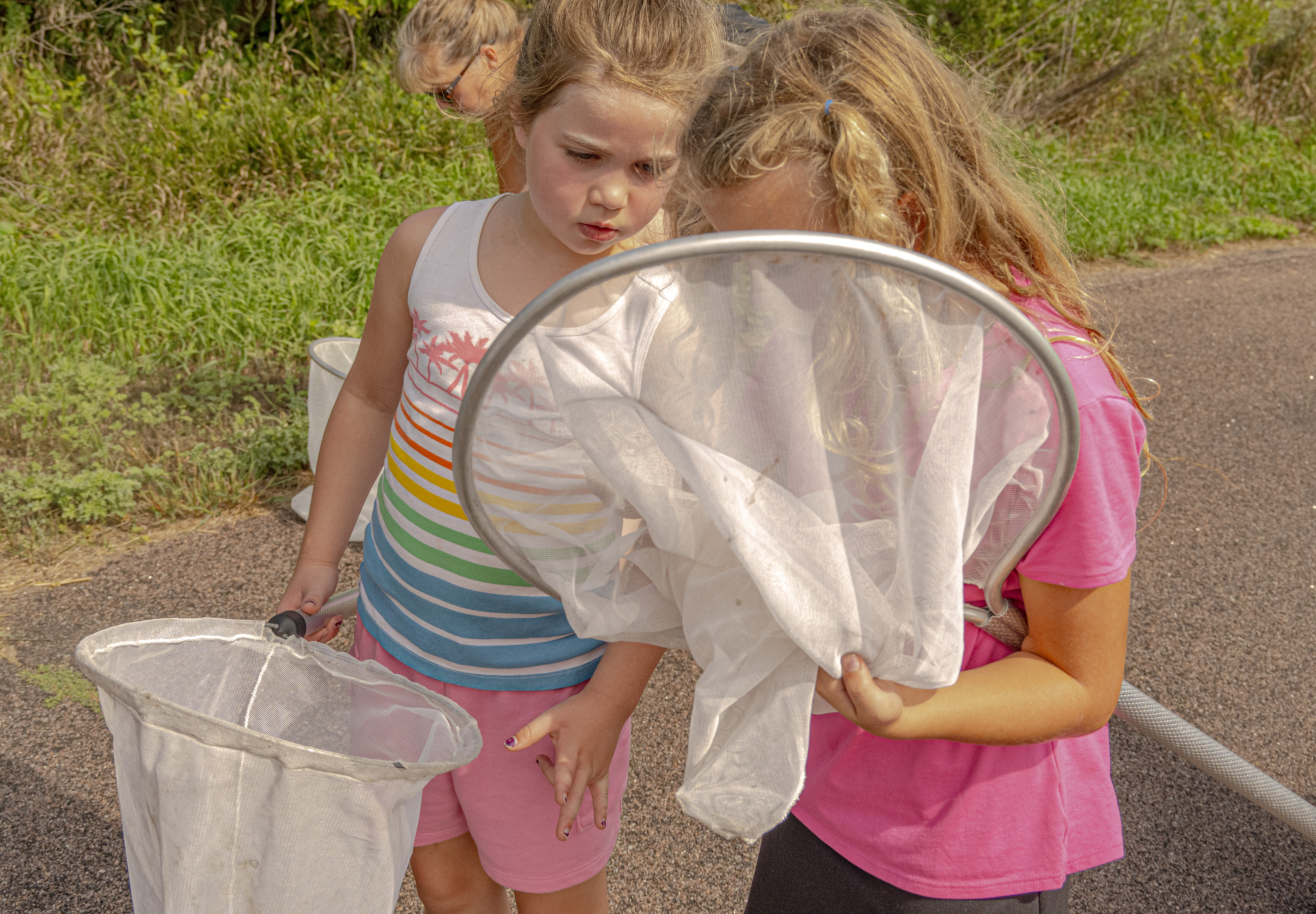
Some 30 or us had gathered at Big Stone National Wildlife Refuge, half of us who were actual children, to roam through the hills and stately oaks, climb over granite shoulders of ancient stone and stalk through blankets of native prairie flowers in hopes of gently laying a net over our elusive prey. Monarchs. Yellow and black swallowtails. Red admirals. Cloudy sulfers. Skippers. And some most of us couldn’t identify, and some no larger than a common quarter.
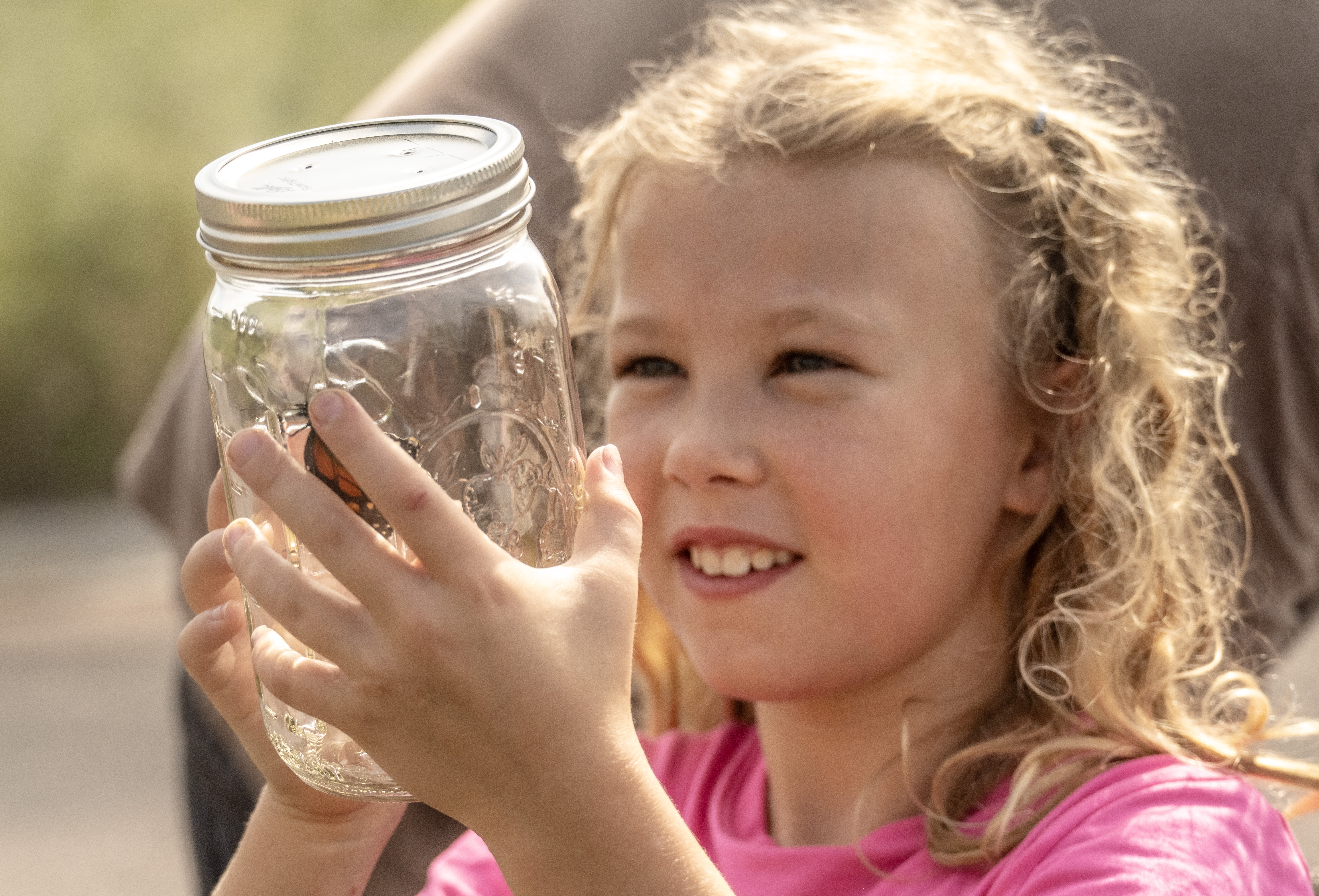
An expression of delight holding onto a jar of magic.

Jason Frank, naturalist and head librarian of our local Ortonville Public Library, along with Grace Carruthers, environmental education intern with the Refuge this year, and Mike Cagley, retired botanist from nearby Madison, helped arrange the outing and were busy keeping detailed records of the captured butterflies, placing pinky-fingernail sized tags on the side of the wings as they were brought in often by gleeful children, their captured magic flitting about in quart-sized Mason jars with punctured lids for fresh air, jars held tightly as if holding a Genie with a lifelong wish. The three naturalists were free in offering information to all who would listen that included hope that one of their monarchs would make it thousands of miles away to the Mexico highlands bearing their tag. 

As they worked, looks of concentration replaced those profiles of previous portraits of wonder and delight, followed by a sense of joy as a tagged monarch wandered up a bare arm before suddenly magically, lifting off to resume an unscripted flight one could never in a million years attempt to chart. It wasn’t a moment for one with a stiff neck! 
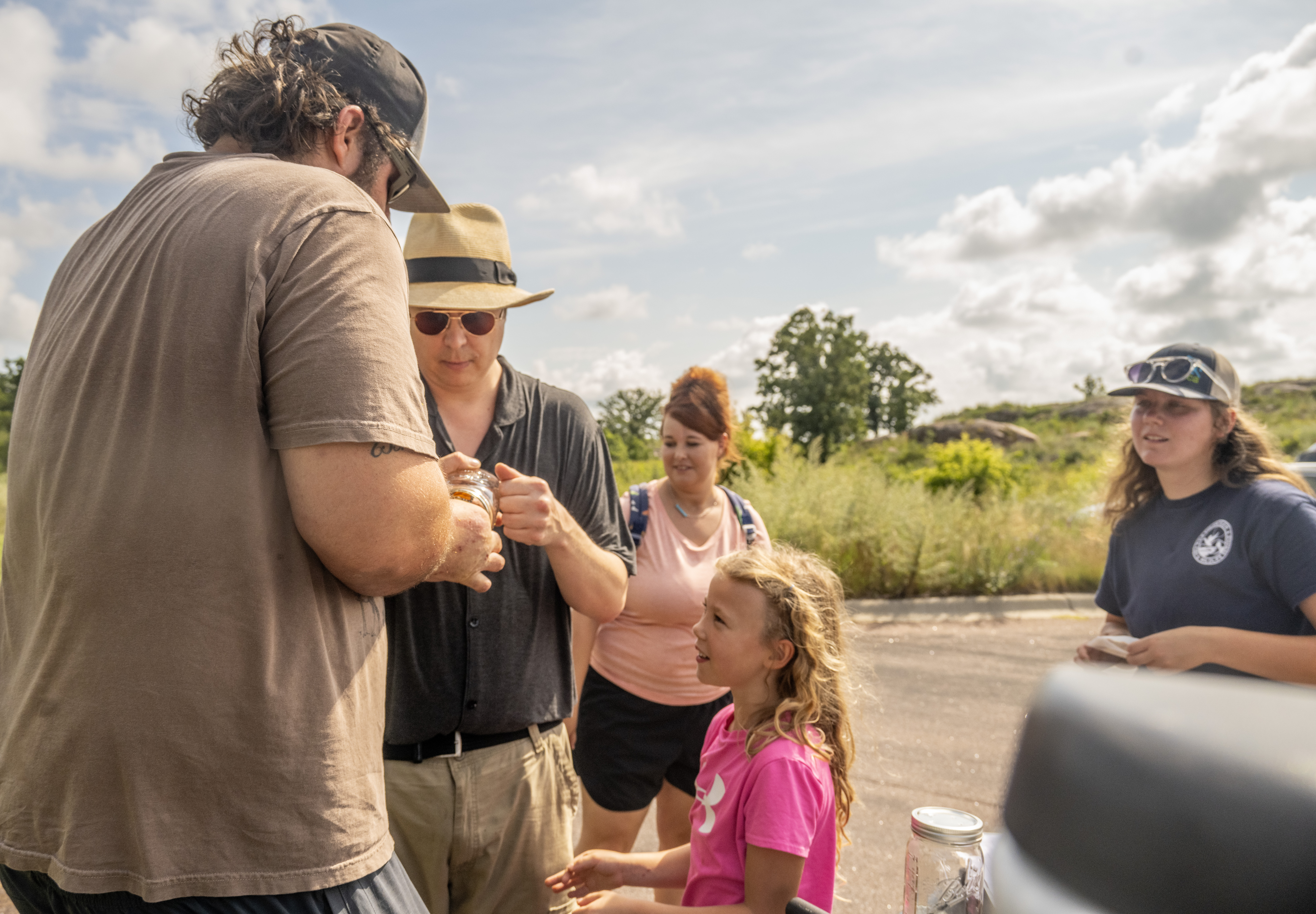
Jason Frank and crew work to tag a monarch captured on the Big Stone National Wildlife Refuge.

Isn’t that part of the joy of butterflies? For me, a man who came with the camera instead of a net, those flights are as tantalizing as they are frustrating. Just as you’re about to hopefully capture all that colorful magic clinging to a flower it is suddenly vacant of such magic, and you wonder if those flights if ever straightened might reveal just how fast a butterfly might travel. 

Somehow skippers were clocked at 37 mph, while monarchs and swallowtails piddle along at between 5 and 12 mph. I would suggest that the clockers perhaps had about as much luck calculating such speed as I have in capturing one for a split second perched on a Blazing Star in my home-based pollinator garden. We have a black swallowtail here that makes an extremely brief appearance and has yet to allow me a single image all summer. While blessed in capturing any number of wild animals, flowers, pollinators and birds, black swallowtails and mighty moose have both forever escaped my lens!
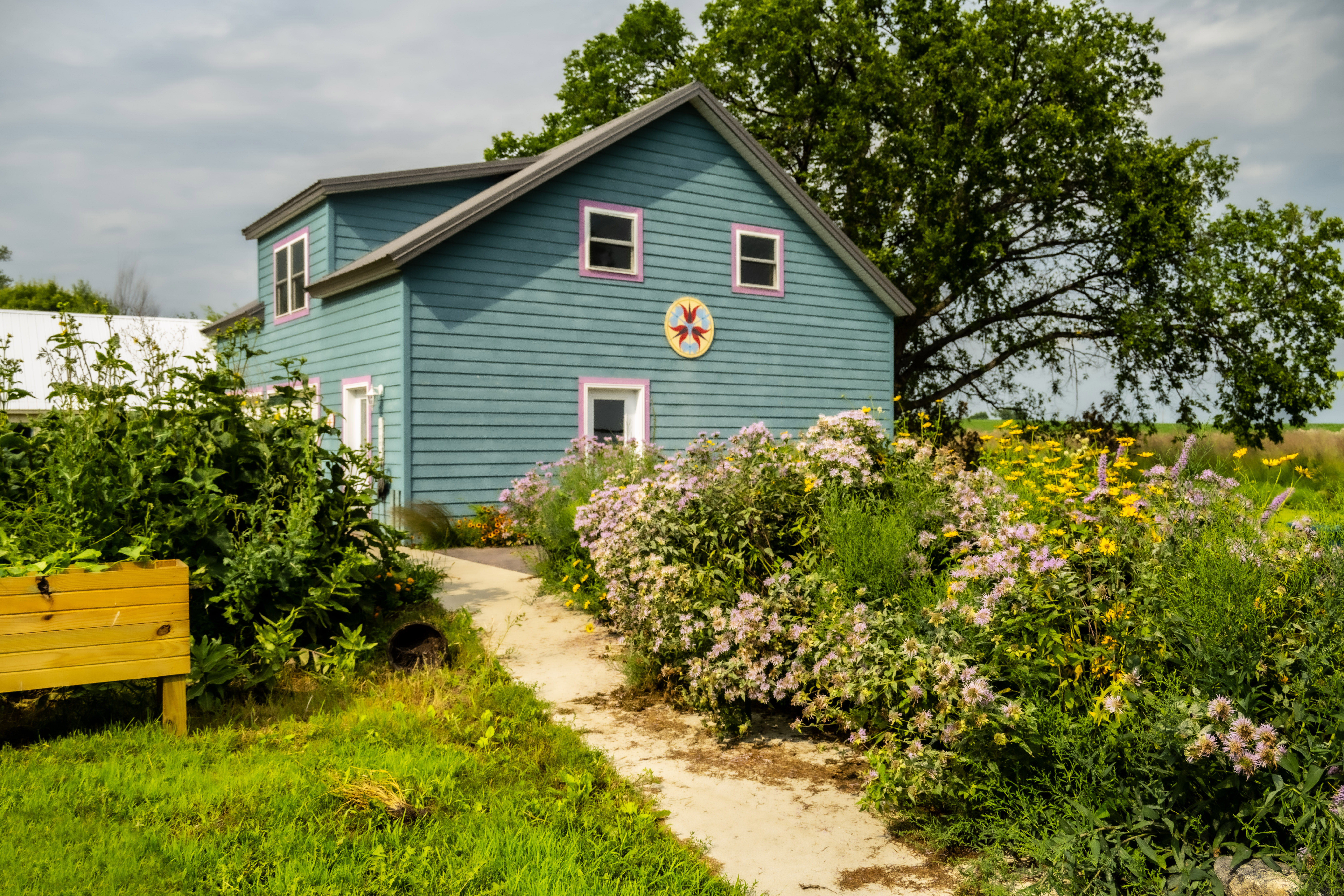
Ah, but those flights. Perhaps it’s mundane to call them flights of fancy? Here on Listening Stones we have worked for years in creating pollinator-friendly gardens. Our first lawn “remodel” was in creating both the terrace garden along the road-facing facade of the house followed by what we called the triangle garden. Initially that was a beautiful butterfly haven with a variety of native forbs including three Prairie Smoke plants, one of my favorite of all native flowers. Over the years Cup Plants have overtaken the triangle and mostly crowded out all the others except for a couple of Babtisia plants and a handful native Milkweed that peek through. Last month a big patch of Cup was cut down beneath one of the crab apple trees, seeds deposited initially by bird droppings. This is perhaps the issue here in the small patch as well. And the butterflies? Butterflies spread joy, not seeds!

Two summers ago the Lac qui Parle SWCD office offered packages of pollinator plantings and we bought three. One for shaded areas, one for the septic mound, and the third for open sun. Our shaded plantings require a lot of work, yet the butterflies and other pollinators love the few surviving plants. Those were planted within a number of wild pinkish columbines that came with the place. 
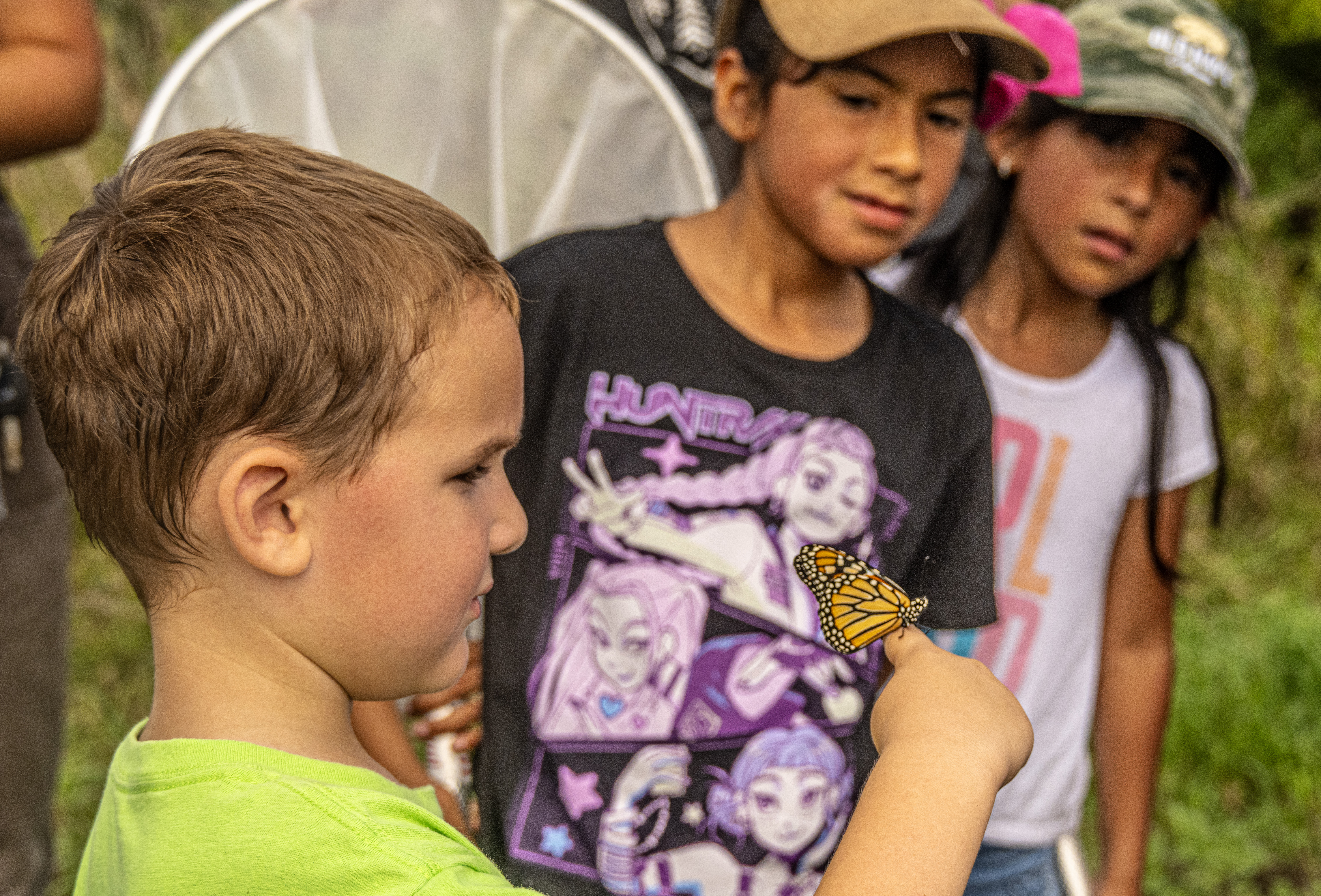
Moments before liftoff! Will his tagged monarch make it to Mexico?

The mound planting has struggled to survive while the open sun has exploded with summer-long beauty flush with the hum of bees and the flights of numerous butterflies, magic that seems to have blessed us. We don’t need to head to the Refuge or anywhere else, actually, to see and capture images of butterfiles. It would be nice, however, if that black swallowtail wasn’t so shy, or perhaps, sly! Yet sharing the moment with the other children on that August morning in the Refuge was a blessing I’ll long remember, and especially all those mixed facial expressions.

Once again I’ve been fortunate to have captured a bounty of beautiful butterfly images, and like the children in the Refuge, I can’t seem to have too many, or enough butterfly portraits. Perhaps the experiences allows my inner child to emerge and there is nothing wrong with that. Oh, and here is the opening stanza of Higginson’s poem that I felt so perfectly explained the moment:

Thou spark of life that wavest wings of gold,

Thou songless wanderer mid the songful birds,

With Nature’s secrets in thy tints unrolled

Through gorgeous cipher, past the reach of words,

Yet dear to every child

In glad pursuit beguiled,

Living his unspoiled days mid flowers and flocks and herds!

Prairie Harmony

A delightful hum is providing us new music here at Listening Stones Farm. It comes from near a sidewalk from four years ago, and it comes from a native prairie garden we created beside the sidewalk a year ago. Across the adjacent patio are a pair of “strip” gardens of native plants where “blanket” flowers have created a mid-summer dominance, Across the patio is our “triangle” prairie garden where compass plants have for years bullied their way to crowd out nearly everything else. Tall and rising from the square stems are the yellow blossoms.

Bees and other pollinators have come in droves to feast on the multitudes of pollen from these plantings. Before all of this color and blissful natural harmony our lawn, a boring landscaped carpet of green covered our yard. We would have a few weeks of sparkling yellow dandelions dotted with bees. That was about it other than our nearby prairie restoration.

Initially elusive, the yellow swallowtail eventually allowed some photographic moments!

Adding to these gardens are a couple of shaded pollinator plantings alongside the house where in the past we would have had an early flush of beautiful red columbines. Initially these native plants hugged the north side of the house, then I took a spade and transplanted a few inside a little space existing inside an ancient sidewalk someone years ago laid into the soil next to our solarium. I don’t know how far the sidewalk extends. When planting the shade-friendly prairie plants we purchased from the Lac qui Parle SWCD last summer I realized a lot of the sidewalk was buried beneath the lawn, and that the concrete walkway reached at least to where our rooted horseradish dominates.

We also have our terrace garden that stretches along the west side of the house that faces the county road. Huge granite boulders were plugged into the landscaped rise where various prairie natives were planted in a narrow nook of exposed soil that is separated from the lawn with landscape fabric. Like a prairie, every year is different, and like the other plantings, weeding is constant chore.

A pair of monarchs tantalized before landing near one another.

So we have bees and other buzzing pollinators completely surrounding our home. That’s the music we hear. A hum of a natural orchestra highlighted by a variety of songbirds, from wrens to a pair of yellow warblers with a catbird and mourning doves adding a sense of sweet percussion.

Yet, I’ve not even mentioned the butterflies, whose flights might be inaudible to human ears. At least mine. 

Right now we have numerous monarchs flitting around that were recently joined by a beautiful Eastern tiger yellow swallowtail. It seemed the red admirals settled in first, sneaking in quietly, along with a variety of fritillary species. Other random species have been in and out, and I’ve found it difficult to keep up with all these beautiful visitors. Dainty cabbage whites, with their little dots displayed on the wings, have sneaked in as well

A view of three of the gardens … our new one to the right planted a year ago, the “triangle” to the left with the tall compass plants, and the peeking strip garden next to the studio.

So many of the native flowers are now in bloom that our eyes feast on color from yellow to white, bright orange to glittery purple, so when you add all of these flitting, flying colorful blossoms of butterfly wings with the hum created by the variety of bees, it is all a wonder to behold.

As mentioned, we also have eight acres of grassy prairie basically surrounding our home, although since a misguided though “helpful” neighbor mistakingly mowed down a post-burn incredible flush of flowering natives years ago, some of the joy is missing. Those flowering plants have never recovered. Oh to have retained all that incredible color within the mix of both cool season and warm season prairie grasses, our prairie would be a wonder. This was an unfortunate mistake that has haunted me ever since.

Red admirals were our first butterflies in our new pollinator plot.

Hopefully we aren’t done with our pollinator efforts. A house-long narrow strip of lawn exists between the house and terrace garden that is begging to be converted. This section is barely wide enough for the mower and simply looks awkward and, well, a bit naked. This has been a transformative strip for years. Initially a couple of large bushes existed beneath the kitchen window that we pulled out to make way for blueberry bushes. Those new plantings never caught hold, and it’s been barren except for lawn grasses ever since. 

Hopefully someday one of my favored native prairie plant friends will come for a visit to offer advice for selection and placement of plants for that area. My reaching out hasn’t worked so far, although I’m still hopeful. Why? One only needs to look at our newest pollinator plantings along the sidewalk to understand why. Because of my ignorance that patch is completely backwards. Huge bushy plants are so dominate along the sidewalk that many of the smaller species have been crowded out, or are hidden in the background. Anyone with knowledge of those plants would no doubt guffaw as did a carpenter who witnessed my first attempts at hanging drywall. 

While the butterflies add joyous color, the bees and other pollinators create the hum of the orchestra.

Fortunately the butterflies and bees don’t mind, even if we humans are crowded off the sidewalk en route to my art studio. Yet, there are those moments utter joy. 

Earlier this week I took a momentary break on our newly refurbished deck with a cup of cold sun tea when I noticed the swallowtail hovering over the blossoms. Over the past weekend I had noticed it and went to fetch the camera, though when I stepped off the deck with camera in hand it lifted quickly to fly in flitting defiance to parts unknown. Now it was here, painstakingly maneuvering through the blossoms. A pair of monarchs were traipsing between the various enclaves, and I caught sight of a red admiral on the closer blossoms.

This strip of lawn just above the terrace garden will hopefully be transformed into another vast prairie planting yet this late summer or fall.

So I fetched my camera. This time all of the butterflies were cooperative, including the moody swallowtail, and so were some bees. Our plants? They seem to bask in their respective glory, posing time after time. Eventually a round was made to each of the various gardens as a lovely calmness eased over me. With it came with the realization that over a short period of time we have created so much more than that springtime flush of dandelions, and that we can now count on hearing the hum of pollinator music over and over again, accented with our bevy of birds, creating a natural symphony as sweet and soothing as a Bach’s concerto.

Isn’t that what it’s all about?