Crossing the Roof

When we first boarded the Oslo to Bergen train in Hokksund, the anticipation was one of joy and relaxation. A calm, laid back five or six hours of mountainous beauty. Three years ago was our first trip on what is often described as the most beautiful train ride in the world. From Oslo you pass through outer suburbs of the city into the greenish countryside, gliding through beautiful valleys, centuries’ old farms and picturesque villages until you reach the “crossing of the roof” to enter a completely different vista of an Arctic tundra near Finse, riding high over fjords and rivers that beg for a kayak. It was after passing that roof, though, that our trip was suddenly filled with the pure raw nature of the highlands!

It was, in short, an unforgettable and powerful experience.

Before that passage, though, and even afterwards, we were aware of calm waters. In lakes and fjords, along the ocean and on all of the rivers of the three countries we had previously visited. Before Norway, we traveled from Graz to Vienna near lakes and rivers, then we rode the rails though the beautiful Czech Republic countryside, vistas we were warned would lack much beauty until after we had passed through Prague and had rolled up into the mountains. However, it was impossible to deny the beauty of the rolling hills, picturesque valleys and small, tree-lined rivers of the CR. Streams with water poetically rolling over and around stones. I found myself wanting to scream, “Stop the train! I wanna take some photos!” One river in particular so caught my eye that I was sad for several miles, then another scenic view appeared to vanish the sadness.
Riding the rails is a most beautiful means of travel, one that we in the States have mostly lost with exception of a few Amtrak routes. Which is astonishingly sad, and a product of political maneuvering back in the 1950s and 60s by the oil and auto industries pushing for a nationwide Interstate Highway system over the use of passenger trains. My mother in the 19-teens and twenties had better rural commuter access then than we as a nation have had since the late 1960s. Which passed through my thoughts as we crossed through my 26th country, many of which have included train travel.

We were on a two-week jaunt through Europe and Norway, starting with a wedding of former exchange student Jakob Bevcar. We had departed from Vienna on that train en route to Dresden, Germany, to visit yet another former exchange student, Luise Hille. After a flight to Oslo, Norway, Erlend Langbach, who we also hosted, awaited to fetch us off the plane. After a couple of days he would drive us to Hokksund where we would hop onto that beautiful rail route to Bergen where my son, Aaron and his wife, Michelle, live.
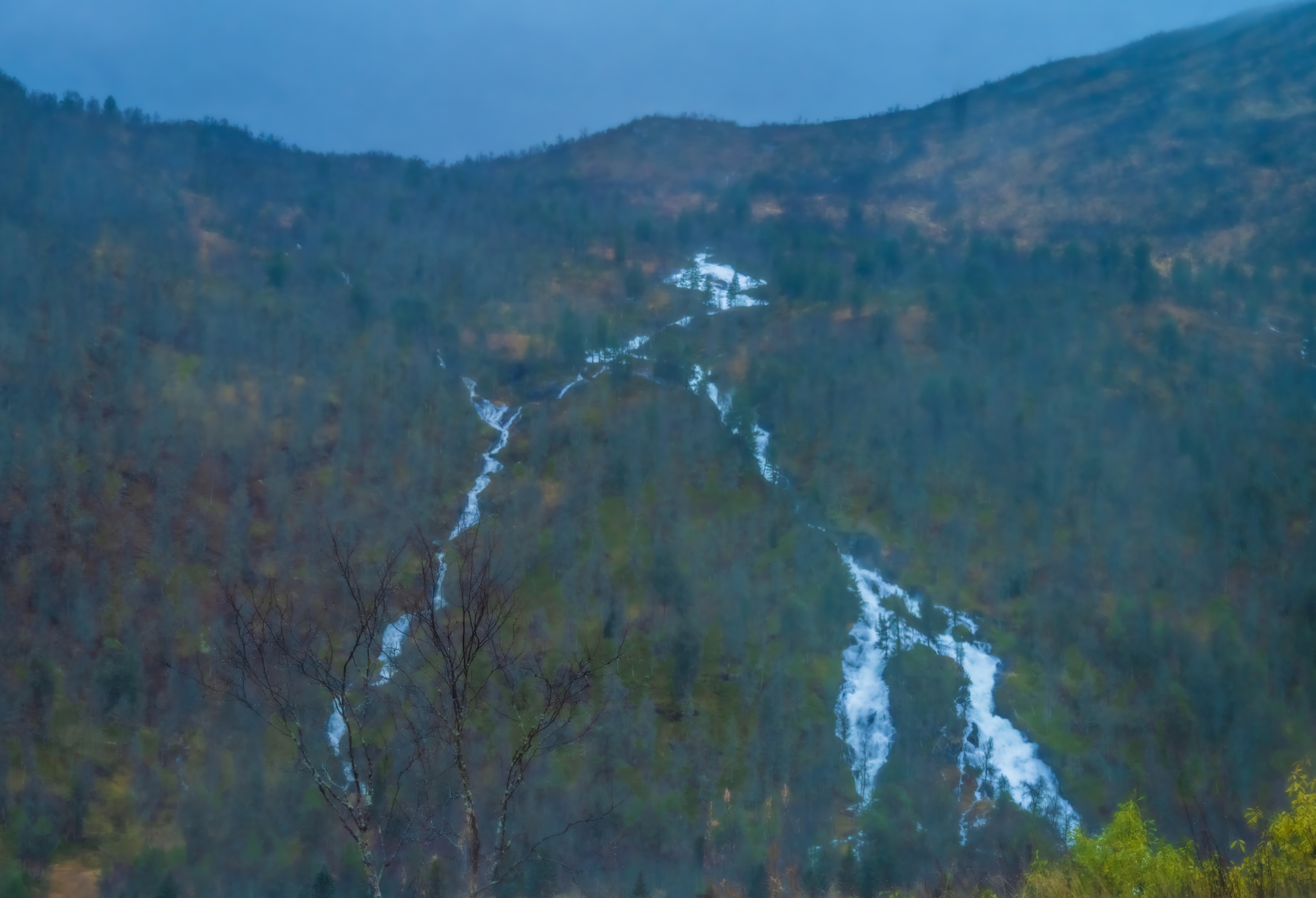
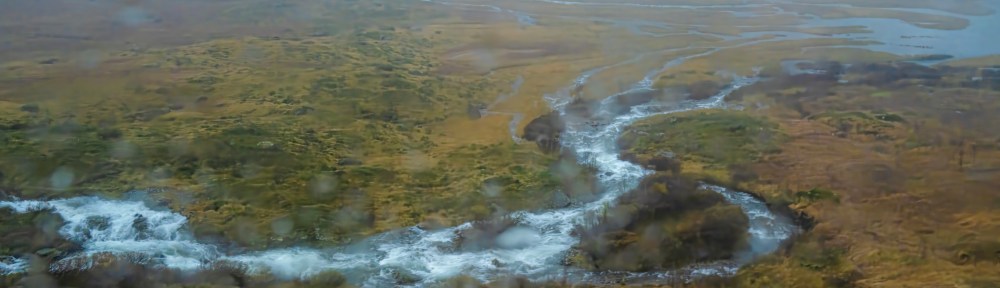
Yes, we had ridden this incredible train trip from Oslo to Bergen before and my anticipation to do it again was incredibly high. Almost to the level of a child on Christmas Eve. Despite that high level of excitement, what we would see after crossing that alpine “roof” couldn’t have been anticipated. We had crossed from a beautiful sunny day with calm waters on the two lakes we stopped at on the way to meeting the train. Now we suddenly found ourselves with gray stormy skies and a rain that pelted the windows of the train for mile after mile. One could barely see through the rain-splashed windows. A rain that wouldn’t ease up. As we passed deeper into the high mountain range we started seeing the falls, one after another, as water cascaded in torrents down from the high mountain tops to the rivers below.

It was all high energy. These were not the expected waterfalls common to the region, but rather water escaping from the heavenly alpine reaches. Almost every towering mountain seemed to have at least one waterfall. From our seats it was easy to see the force as thousands of gallons of rainwater crashed against and through the steep rocks and timbers. Below, rivers raged with a breathtaking fury with surely a thundering turbulence as it rounded bends, rolling with a roar that went unheard inside our car. Yet, you knew it was there, that it was loud, that it roared with deadly danger.
Such fury was as unexpected as it was hypnotic, for little could have survived either such a fall or river’s rush. An occasional house was seen alongside the river, and one could only imagine the feelings one might have living there. No, this was certainly not the calm quiet of the previous train ride through the Czech Republic, or even our earlier ride before the crossing. On our first trip I had trained my camera on reindeer in the bush and was thrilled at capturing mountain goats in the high, alpine reaches. This time it was all about water. Alpine waterfalls dropping thousands of feet from the mountain tops down to the roaring and deadly roar of untamed rivers.

Eventually we passed through the worst of the storm, and a day or two later Aaron would drive us into the same mountains around the fresh water lakes and fjords, and I couldn’t help looking up at the tall bluffs of the mountains wondering if these were the ones we had passed through. Now they were simply tall and rugged mountains with an occasional waterfall falling beautifully. We were actually driving alongside the same tracks of the Oslo to Bergen train. And the rivers? Calm and poetic in nature. An easy paddle with predictable rapids.
Yes, it was wonderful seeing old family members, of our blood or from our home so long ago. A couple of students we helped place came for brief visits, too, so we had some hugable moments filled with catching up and the sharing of wonderful memories. Our two train trips, too, will long be remembered. One so calm and picturesque ambling through the Czech Republic, the other offering a harrowing exposure to the extreme forces of nature after crossing the roof.
An Unexpected Feeling of Joy

Our day came with a thick fog, so dense the glow of the sun was absent. Although we are deep into the bird migrations, with many species already off to the south, a foggy morning is typically a draw for me and I am often off into nature with my camera and a couple of lenses. This morning was no different. 

My goal was to head north past a series of prairie potholes to a hunter’s cabin up the road a few miles before making a turn to the west for another couple of miles, also passing by a few wetlands. There a paved road that would take me past the Clinton Prairie.  A county highway heading west eventually took me to Bonanza Education Center, a jewel of a Nature Conservancy prairie nestled within a beautiful oak savanna. Picturesque oaks stand tall on either side of a series of ravines that cut into the prairie.

As anticipated, there were only a few silhouetted ducks about on the wetlands. Sadly, there were no cranes or egrets. Shorebirds that frequent these shallow waters were apparently long gone. Bonanza yielded a couple of fine images of softened foggy savannas within those ravines, craggy limbs framing the stark, flaming reds of autumn sumac seemingly blasting through the grayness. No deer appeared, which was somewhat surprising. 

As I was driving up the hill out of the valley I noticed Big Stone Lake was shrouded in the fog as was the distant shore of South Dakota. Was there a chance of finding a hillside of color on this side that would contrast the foggy distance? With just enough detail to actually offer contrast? So goes willful thinking.

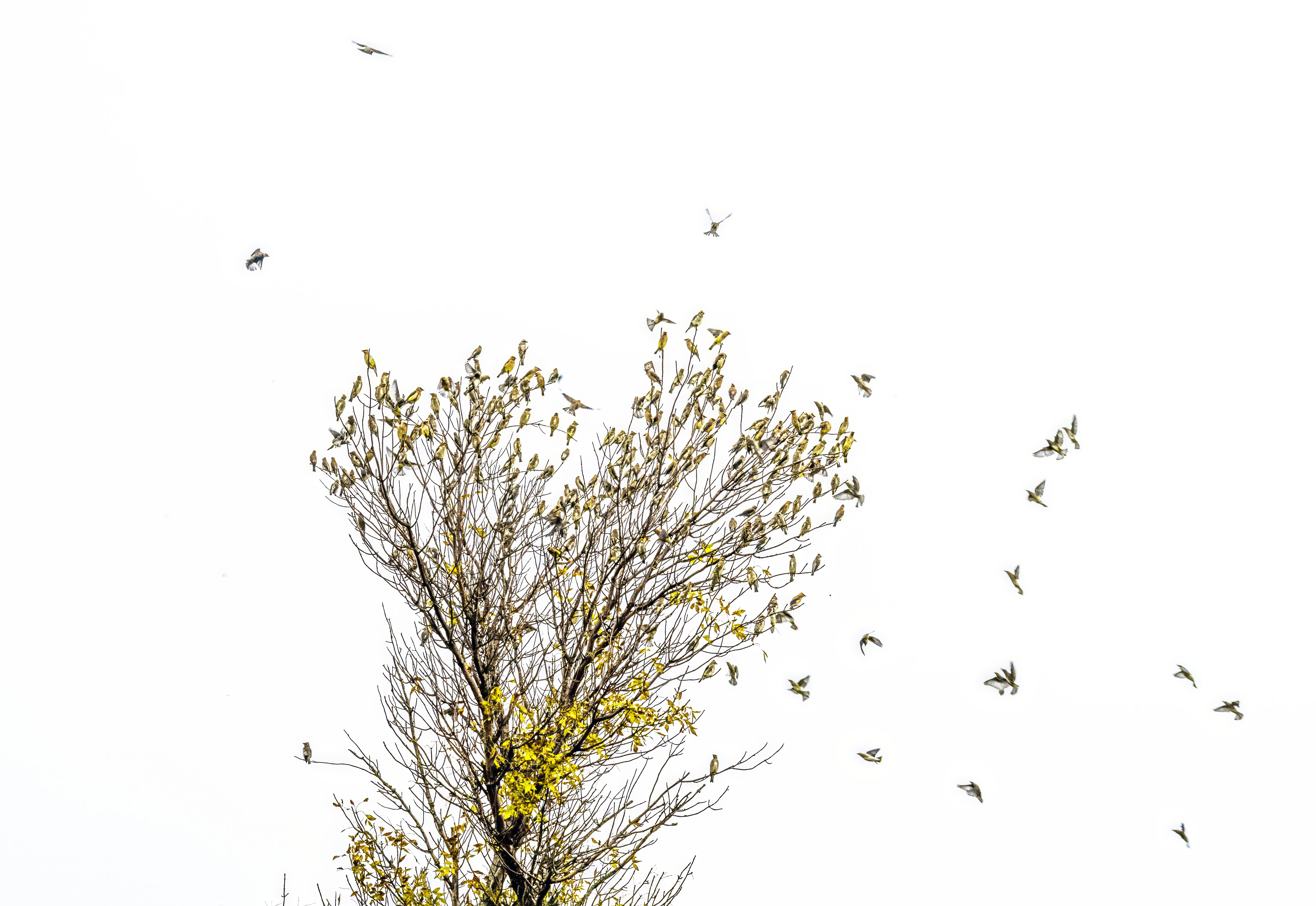
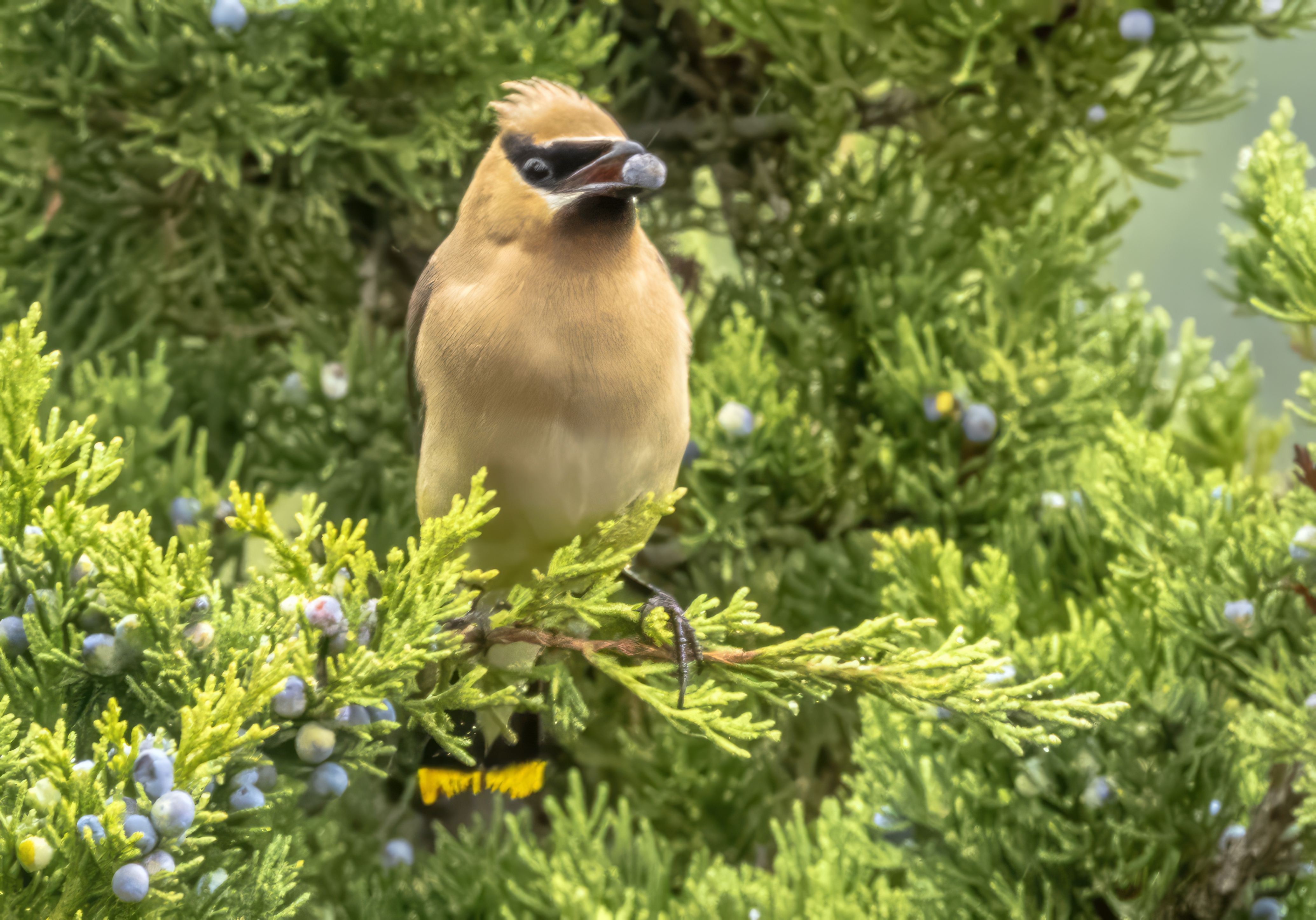
Back onto the highway a decision was made to pull into a quaint overlook designated as a roadside picnic spot blessed with several cedar trees. We’ve been here for nature outings and classes in the past, and even a picnic or two. I can recall an afternoon of photographing an incredible thunderstorm a few years ago, and even at this height white caps of the windblown waters could be seen. A convenient picnic table centers the earthen and rutted roundabout. Within seconds of pulling into the area my eyes were instantly drawn to a cascade of fluttering birds, shimmering like autumn leaves painted with a brownish hue with hints of yellow.

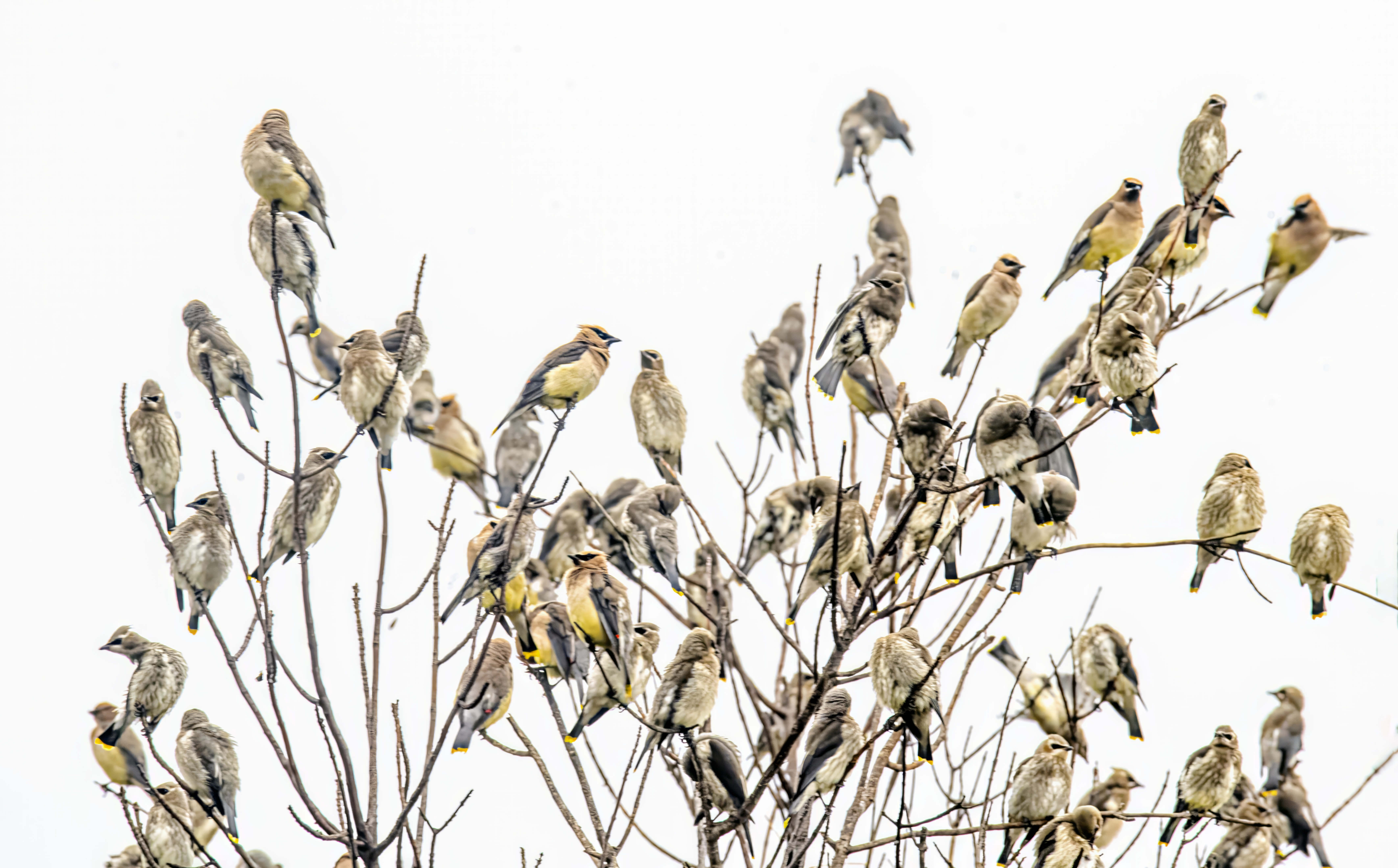
Once I jumped out of the car with the camera I realized these were Cedar Waxwings, one of my favorite of all the avian species. When I was a child my mother gave me a special coloring book for Christmas with large outlines of various birds with an accurate coloring guide along with instructions to “color within the lines!” This served as my actual introduction to this beautiful bird. 

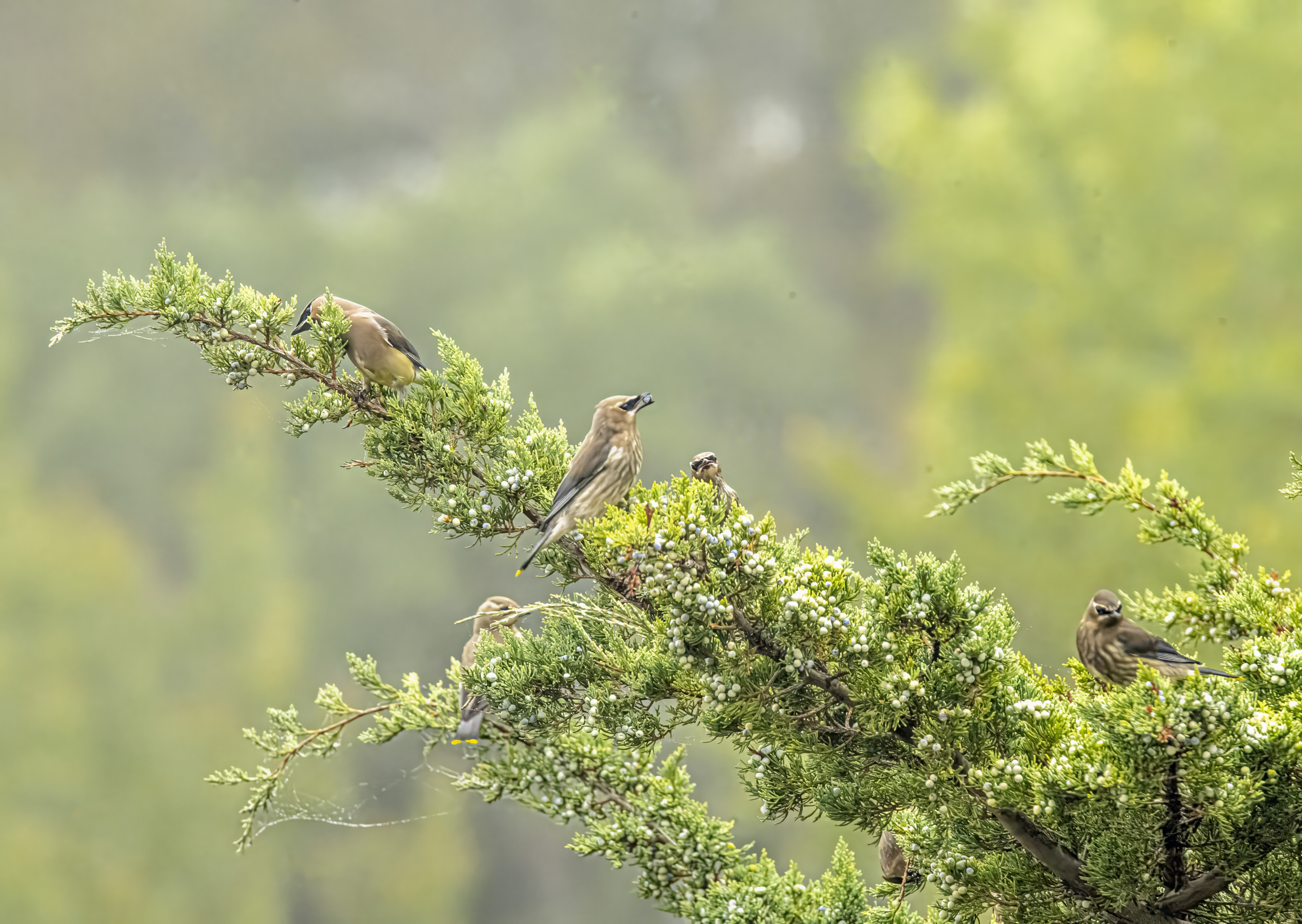
Waxwings were not a common species around our Northeast Missouri farm and I can’t recall seeing them at that time in my life, yet their coloring and the sheen of their feathers were instant attractions. Those colors, that telltale black mask, yellow-tipped tails and those bright red, wax-like droplets on its wing feathers were fascinating to a young farm boy back in the early 1950s.

Actually, it wasn’t until I was in my early 50s that I actually saw my first live Cedar Waxwings. A dear friend, Patrick Moore, and I were looking through a second story window of the boardroom of his iconic and politically-based coffee haven and saw a flock devouring berries from a courtyard tree. There were about a dozen waxwings, moving quickly from branch to branch and I was captivated. In the real they were extremely more beautiful than any of the pictures I’ve seen of them.

Since then I’ve seen them on various occasions. Another buddy and I were at the International Crane Foundation outside of Baraboo, WI, in the Whooping Crane pod where waxwings flew across the wooden-benched arena, hardly patient enough for a quick photo. Several of the birds seemed on constant movement, and afterwards we saw more of them in the trees as we took a short hike into the adjacent prairie. 

But here in this overlook of Big Stone Lake at the picnic pullout, seeing them was so unexpected and incredibly special on a mono-colored morning. I was alone with this large flock that was perhaps holing up for their migration. They were anxious as they were outside of Baraboo, flitting from tree to tree … from trees barren of leaves to the cedars, so much so that the waxwings actually appeared as autumn leaves themselves. As I walked along the ridge overlooking the valley, the birds flew between the cedar trees to devour the seedpods. Not only was I able to make some very nice closeups of individual birds, but the flock was providing me with ample opportunities to create some interesting images. It was a special moment! 

Often I found myself lowering the lens just to take in the special moment. Sometimes you just have to commune within “the moment” when you’re in nature, and this was such a moment. Such moments have happened in the past, especially while photographing the dancing towers of light during an Aurora Borealis, or during an awe inspiring sunrise, or in seeing the ambient colors during the afterglow of a sunset. Times that seem to shout: “Stop! Celebrate the colors! This vividness!”

As I walked between the various trees, nearby waxwings would arise from one tree to move to the next, sometimes parting to fly in different directions. Mentally it was like watching an overhead jewel show as their glistening wings glowed through the softness of the foggy morning. At one point I did stop to capture a couple of the images of the autumn vista that had encouraged me to stop at the picnic pullout, yet the birds seemed to pull my attention back to their colorful flights.

Often it seems that I have an idea in mind when I leave Listening Stones only to discover something entirely different and unexpected. Jewels of a moment in time, and this was one of those instances, and I couldn’t have felt more blessed. In moments like these I yield to one of my favorite poets, Mary Oliver, who suggested, “If you unexpectedly feel joy, don’t hesitate. Give in to it … whatever it is. Don’t be afraid of its plenty. Joy is not made to be a crumb.”

Nor to be diminished. This was certainly a “whole loaf” moment and way past that of a simple and singular crumb. In that, I was thoroughly blessed.