That Notice of Peace

As my dear friend, Steve Bruns, began piecing together his final thoughts and stories for his family, the deeply religious man began with a simple statement: “I’m learning how to die.” His aim was in providing his thoughts about his personal view of eternity and how he now faces what remains of what has been and continues to be a full and vivid life. 

Among his thoughts were these: “The older I get, the more I notice colors. Maybe because life itself feels more precious now. Maybe because suffering sharpens your awareness of beauty. When you understand life is fragile, you stop rushing past sunsets. You stop overlooking robins’ eggs. You notice frost-blue snow early in the morning before footprints disturb it. You notice chickadees flashing blue-gray wings in winter trees. You notice the reflection of clouds in a quiet lake. You notice peace wherever you can find it.”

Although we’ve been friends for a quarter century, I hadn’t considered Steve a poet. An inventor. A creator. A story teller without par. A freind. Now I humbly stand corrected. Like Steve, though, I too notice peace.
A few months after learning his cancer had spread and is basically untreatable, Steve was encouraged by his beautiful and supportive wife, Jill, and his family to share his thoughts, to give his perspectives on his four sons and their families, to place in black and white those wonderfully entertaining stories his friends and family have enjoyed and laughed at over the years. They found a computer program that allows him to tell his stories as he always has and the words are printed as if he had written them. That moment of poetry was among his spoken thoughts.

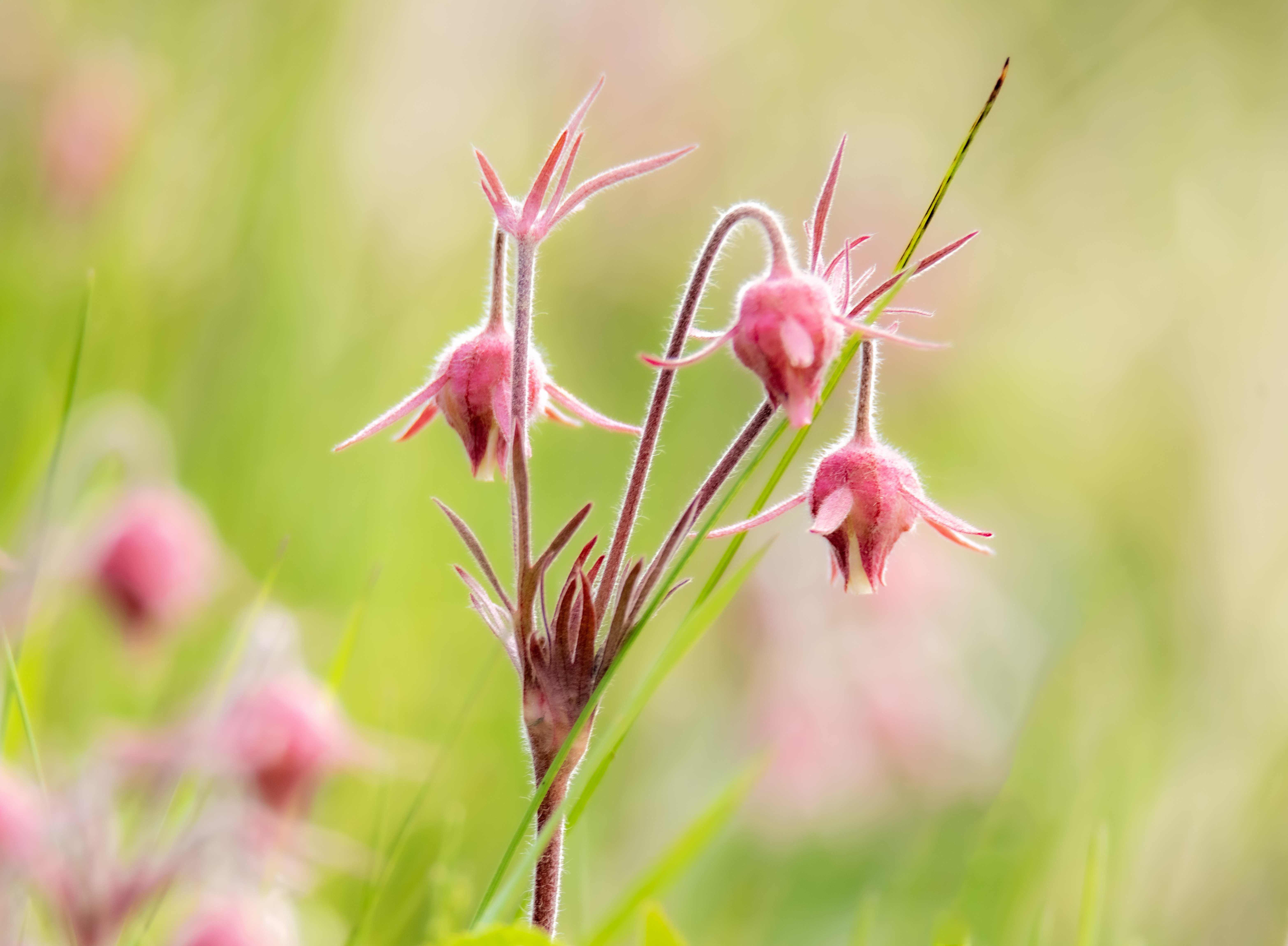
His thoughts of peacefulness and colors resonated with me as I laid in the crunchy browned prairie duff focusing on one of my favorite and most interesting prairie forbs, Prairie Smoke. This “awareness of peace and beauty” was at the Lake Johanna Esker north of Sunburg and a bit east of the tallgrass Ordway Prairie. Such vivid colors, of such interesting shapes, mingled naturally with other May flowers on a haze-blessed sunny afternoon.

While Steve has found his peace in the color of blue, mine is more universal, more defined by the moment, and certainly as he stated, such moments seem more precious with age. For years Prairie Smoke has attracted my interest, an affection that has not waned with age.  
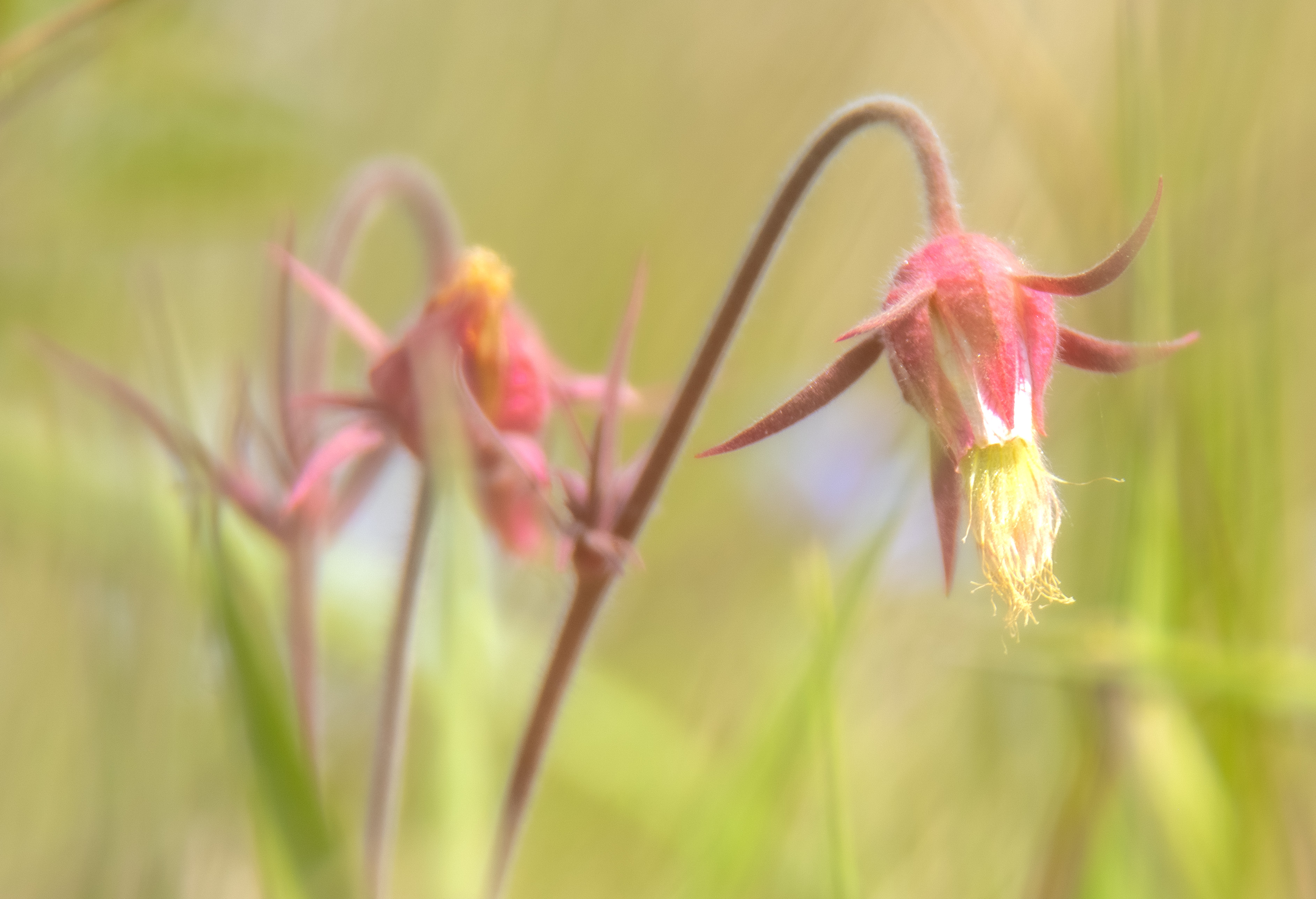
My discovery of Prairie Smoke began when we first moved here to Listening Stones Farm in 2013, moving into a house that Steve and I had labored to convert into the modern era with new insulation, wiring and plumbing, working seven days a week and long past “eight hour shifts.” A few weeks after he returned home to Hector, my soon-to-be (and long divorced) wife and I were rummaging through the nearby native Clinton Prairie when we came across my first sighting of Prairie Smoke. Immediately hooked, I would return time after time to find various angles of portrayal until the “smoke” eventually disappeared.

A few years later word came about a broad blanket of the spiky flowers existing at the Esker where acres of them brighten that virgin prairie with such color, beauty and joy. Our trip this past weekend was one of many over the years and once again added both peace and joy. Our adventure began by spotting several Prairie Blue-Eyed Grass blossoms just inside the fence, yet the pinkish allure of Prairie Smoke beckoned from the nearby rise, the pink vividness arching in contrast to the blooming White Pussy-toes and speckles of Blue-Eyed Grass. A bountiful floral vision!
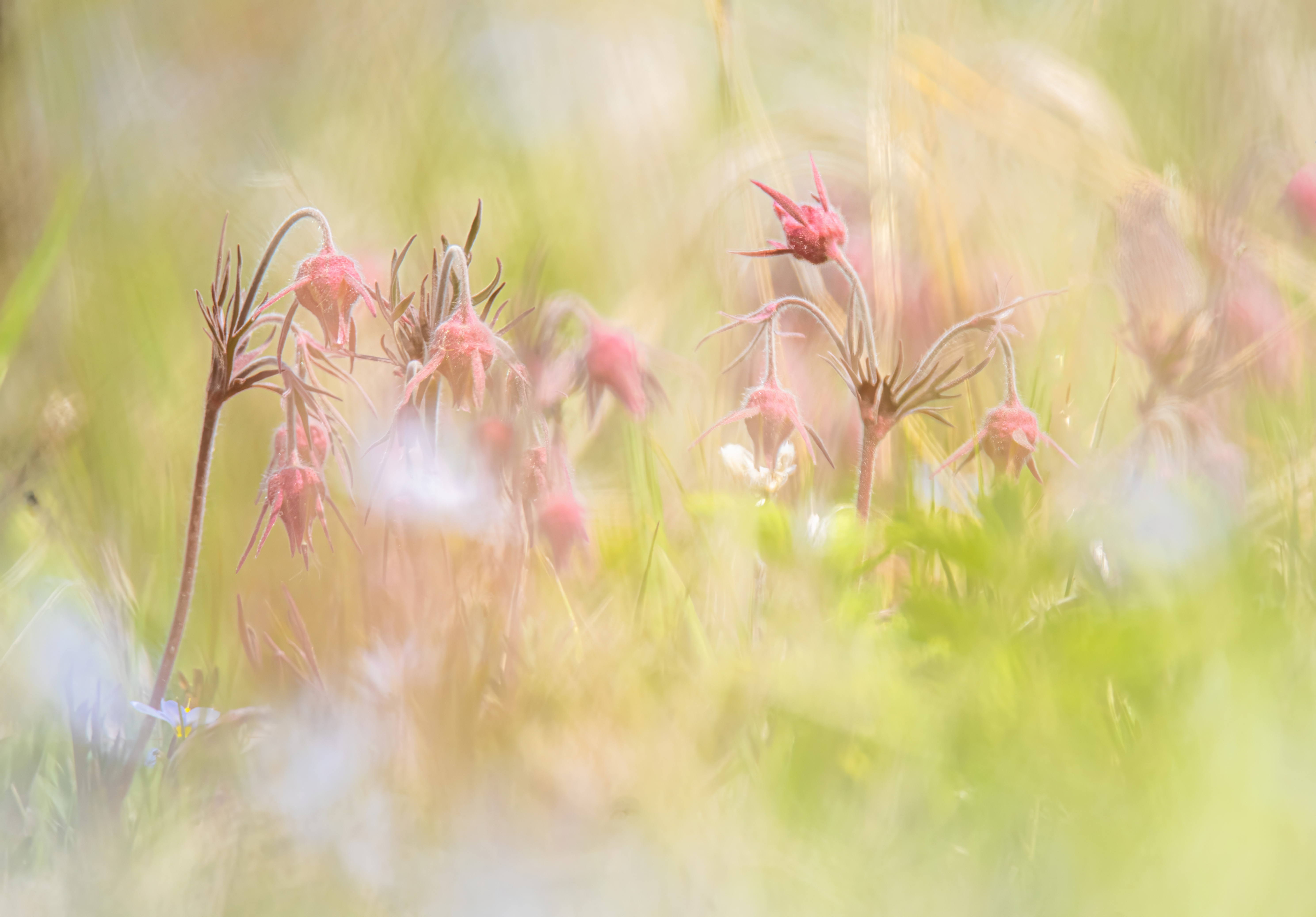
This is such precious geological remnant, for an esker is basically a rocky stream bed created within a glacier, and that mound of historical wonder dominates the landscape. Such an esker is a rare find nowadays for many have been destroyed for gravel mining. In the prairie below was where the colorful carpet lay. And it didn’t take much hesitation to find just enough space to lay with a camera to search through the emerging “jungle” of greenery and colorful blossoms for interesting imagery. And Steve’s bit of poetry rang true for every moment I lay prone and in awe. Prone and in peace.

Prairie Smoke has long been one of my annual “photographic seasons” that begins with Steve’s favorite blues ­— beginning with post-melt Pasque Flowers and ending with that of autumn Asters. Since that first sighting of Prairie Smoke I’ve captured it throughout it’s short lifespan, and yes, we’ve even purchased plants from the nearby Morning Sky Nursery in Morris to plant in our native prairie gardens. Unfortunately, the “bully” Compass Plant has all but crowded out almost everything in that particular garden including our three Prairie Smoke plants.
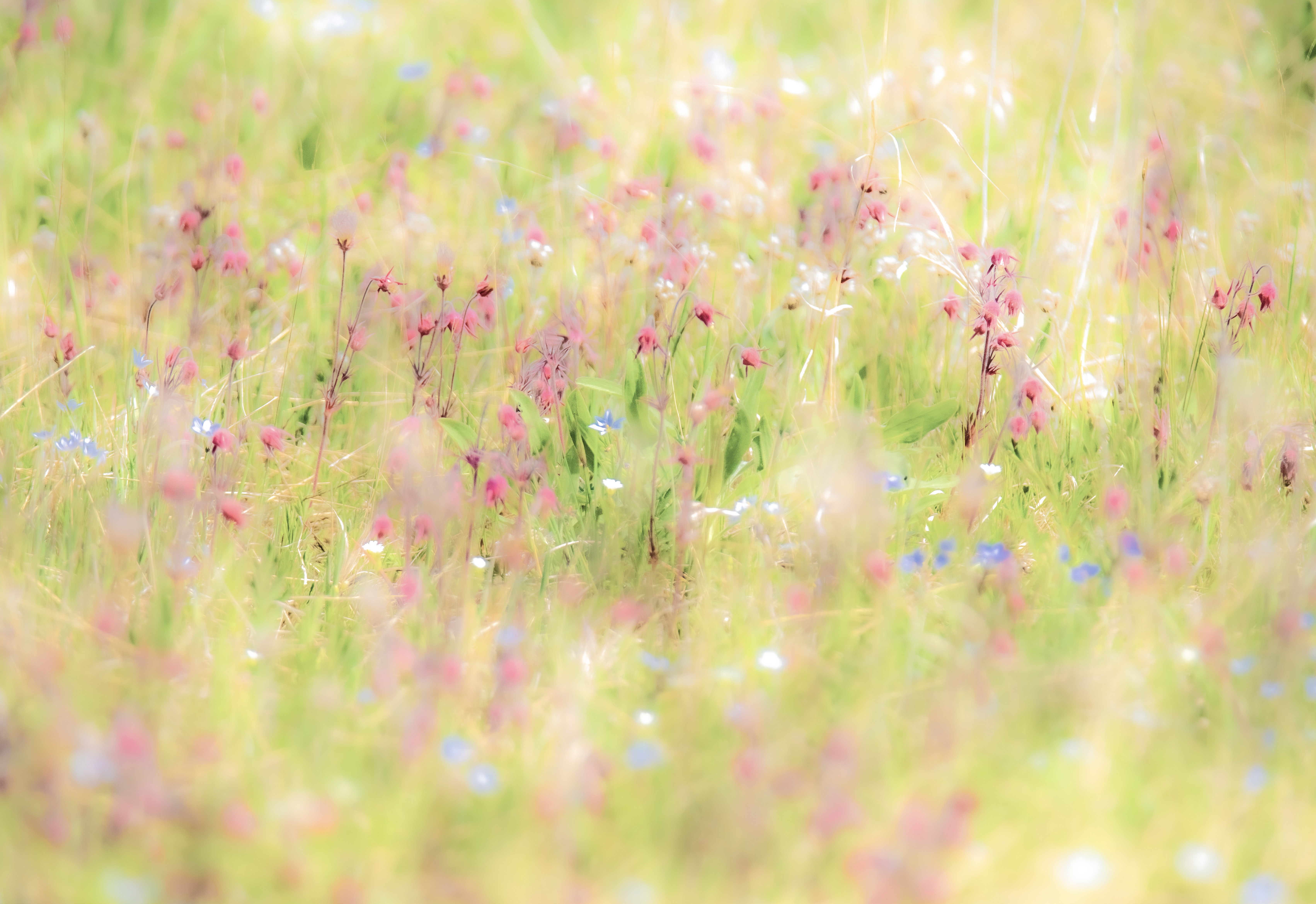
So, yes, I suppose there are ample images stored in my files, so many I probably have no need for more. Ah, but there’s that difference between “need” and “want!” Yet, there is always a quest of perhaps capturing a perfect moment or image. If such a moment or image should exist.

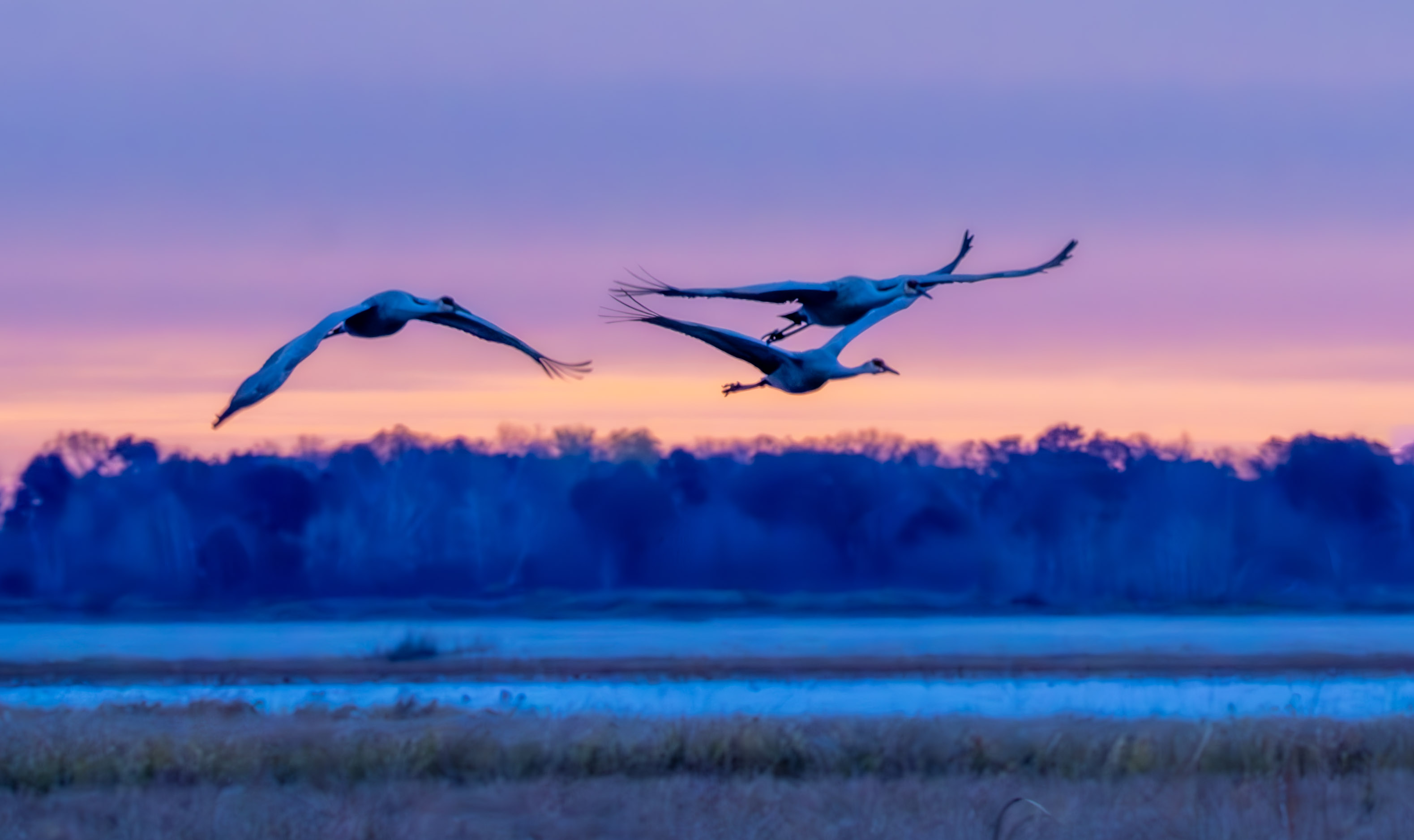
Then there are the unexpected moments that have come along in those numerous quests: An unexpected fly-over of a pair of Sandhill Cranes offering a rare glimpse of timelessness for an image that was surreal geologically; or that muted blueness of pre-dawn light in such contrast to the softened pinkishness of the Prairie Smoke; or that explosive blast of a setting sun searing through silhouetted spikes; or the standing fluff of “smoke” from three individual blossoms made at sunrise that appeared as beautifully splendid and fanned widely as would a trio of fluffing peacocks. And, on and on. 
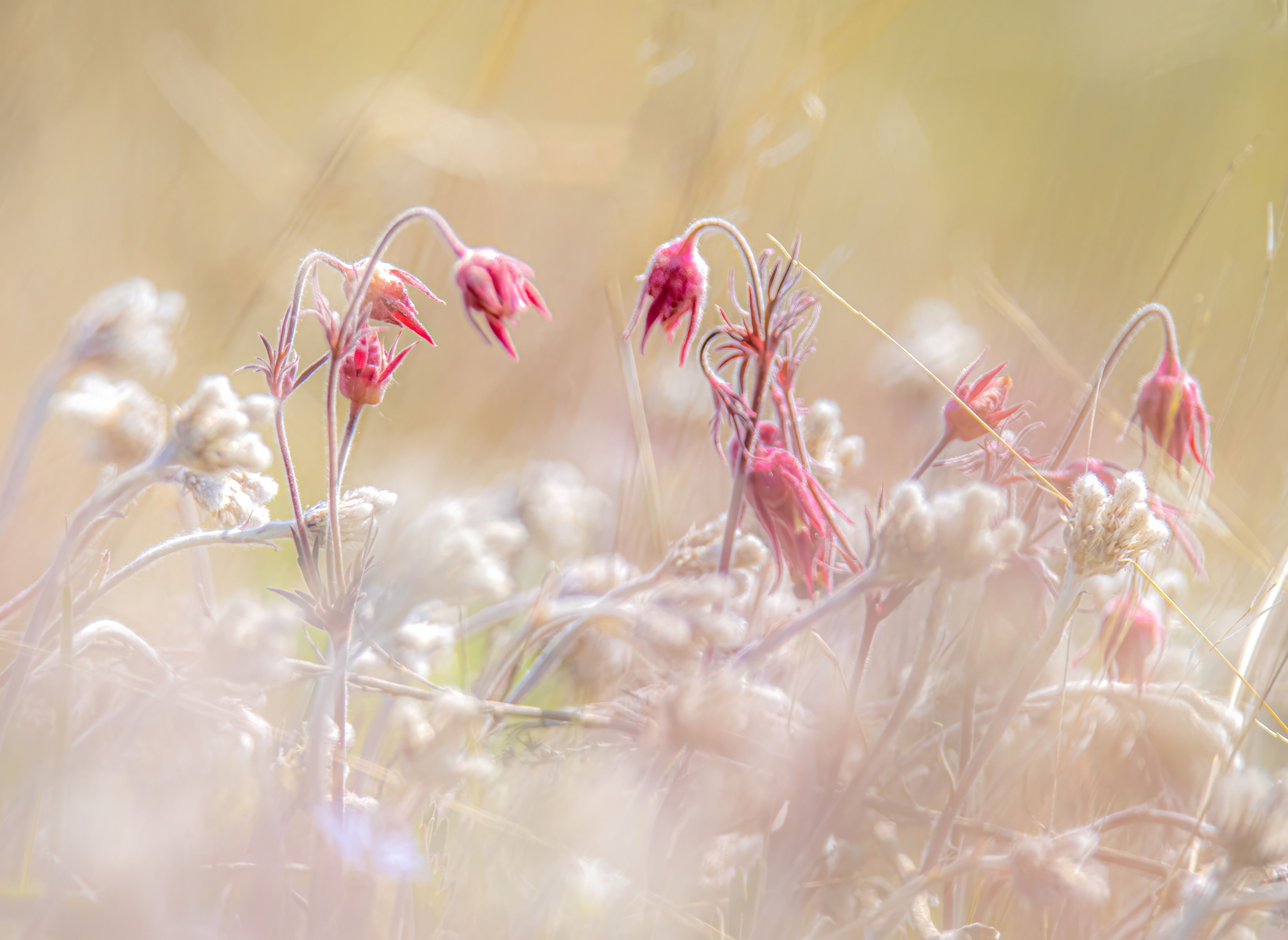
Which leads me back to another touch of poetry from my dear friend as he faces his conclusion of a full and beautiful life, one where he fears not his path toward eternity though he does his actual act of dying: 

“Back home on the prairie, the sunsets may still be my favorite. There is a moment just before darkness arrives when the entire sky becomes layered with oranges, pinks, purples, and deepening blues. The fields grow quiet. The wind softens. Trees become silhouettes. Sometimes the clouds catch the sunlight so perfectly it feels like heaven cracked open for a few minutes just to let us peek inside.”

Peeks into a heaven where he awaits a calmness in finding. A notice of eternal peace.
The Gracefulness of Being

Perhaps it was the title: “How to Age Gracefully.” I was hopeful that this was a question more so than a statement for I’m not getting any younger, and now in my 80s, a time when many of my peers have sequestered themselves into a recliner or couch, I sense a need to keep charging forth creatively with an intense fear that my slowing down is the first step toward the grave. Following, perhaps, a lengthy time of acute boredom!

For the past few weeks hours have been spent in my wood shop and studio preparing items for the area Christmas Markets, and then an old friend, Dale Pederson, arrived with a pickup full of pre-cut timbers to install a planned canopy over our studio door to keep snow and ice away from the entrance. We were both fighting the calendar and weather.

In trying to balance all of that, by bedtime for three straight nights my mind and body was a wreck. There was nothing graceful about it, or me, and yes, on one of my ventures into the wood shop to rip a board on our last afternoon a misstep sent me sprawling across the concrete floor. Grace? Hardly. Fortunately my head missed a standing concrete block that was off to one side. Does that count as an old man’s fall? 

Grace is what I sometimes find in nature …

A few days later at the library while returning a great nonfiction book called “Sea of Grass,” an in depth portrayal of the complete destruction of American’s vast prairie between the Smokies and Rockies by Dave Hage and Jo Marcotty, this new book … “How to Age Gracefully” … seemed to jump off the shelf and into my waiting hands. 

Like Hage and Marcotty, the author, Barbara Hoffbeck Scoglic, was also a former reporter for the Star Tribune. My wonder was if my quest for grace was irrational, if not impossible; is there an emerging path for my unstoppable aging? Scoglic’s was an interesting read, though basically she wrote a day by day journal of her moving into an assisted living senior center. Now in a wheelchair, and being completely unreliable on her feet, Scoglic recounted various conversations and personal memories along with a morning ritual of coming off the elevator to see who might have survived for another night.

Perhaps I missed the “graceful” piece. No, her’s was not a “how to” effort. So my venture continues as I wander down a different path. 

Grace … a moment of tenderness of a burly bison cow with her newborn calf …

While I was working with Dale, and on various pieces for the Christmas Markets, an old conversation from years ago kept cropping up. It was on a cold, windy and snowy day “way back when” that I unloaded my collection of items from my van into one of Montevideo’s Chippewa Village historical buildings to discover my display partner was a 91-year-old man, a flat-plane wood carver and painter of Norwegian trolls, gnomes and Ole and Lena farm characters. After our introductions and getting set up, I asked the elderly artist about his work  and what kept him going.

“At my age,” he said with a wry smile, “what else would I do?”

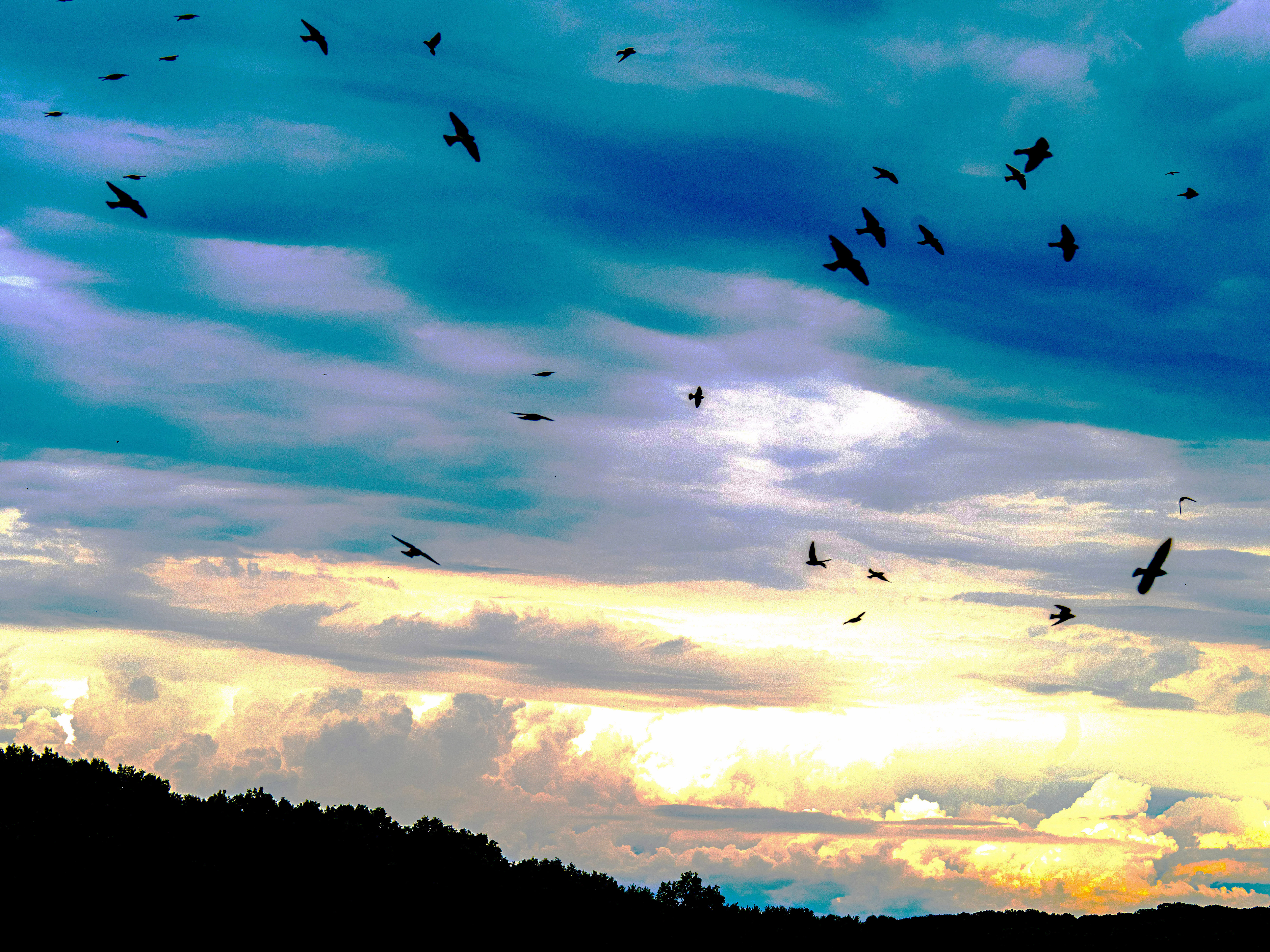
Grace … when unexpected swallows appear to give ambience to an image …

Often I think of him, and have told that story to other artists who confide that they’re thinking of retiring, of giving up. Nowadays I sometimes wonder about myself. It’s not so much about aging gracefully, whatever that means, rather than wondering what else would I do? The walls and panels in my studio are full of canvases, and I make numerous smaller items featuring my photographic work. Over these past few weeks I’ve poured through a few thousand images created over the past 15 or so years, from when I retired from the country weekly to begin my efforts of portraying the last one percent of an ancient and nearly completely destroyed original prairie pothole biome. 

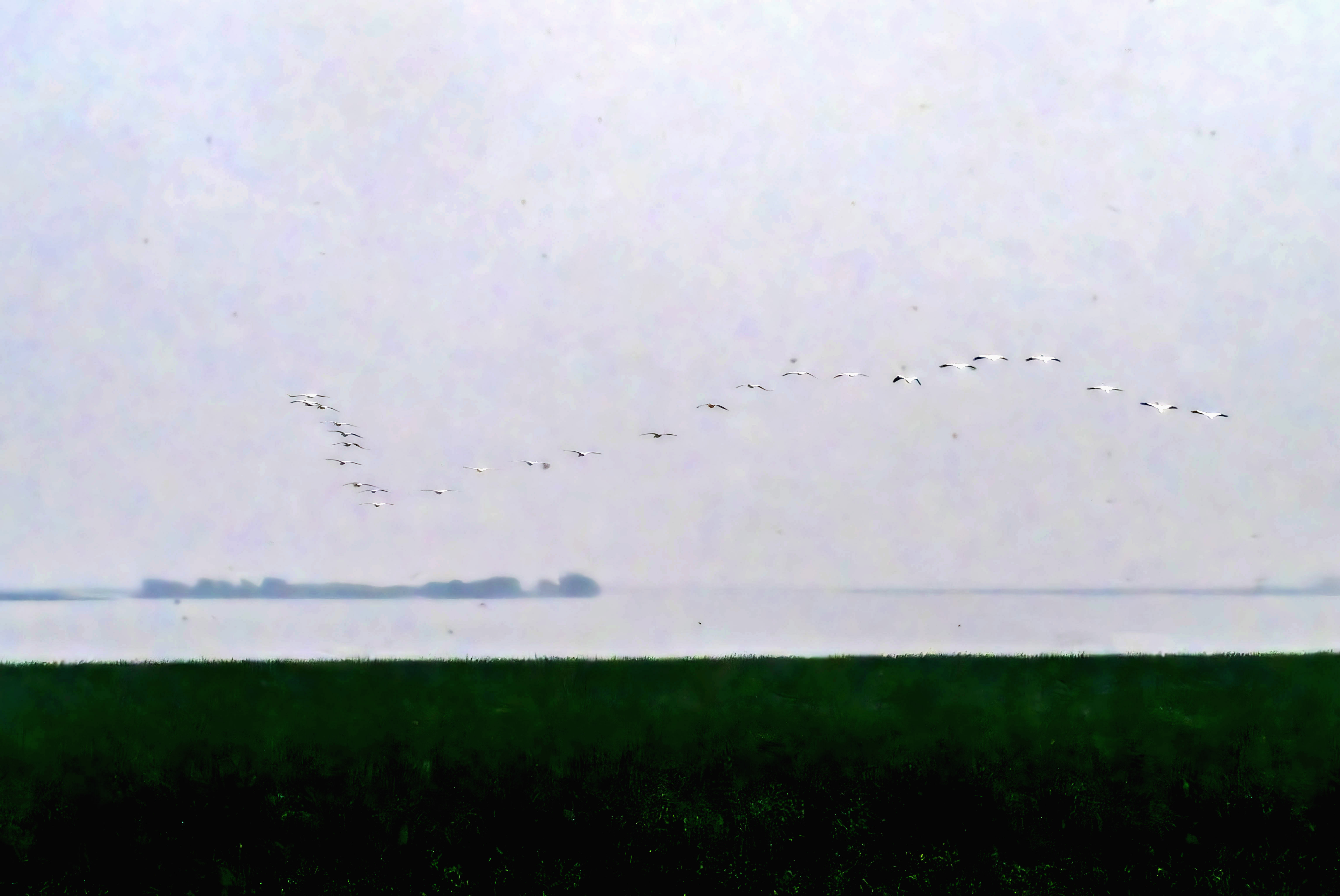
In so doing I sometimes find a choice image previously overlooked, or marvel at something long ago printed onto canvas and sold, and still hopefully hanging on someone’s wall. I also have thoughts of why continue? Do I need more images? Yet, quitting seems so unreasonable since I still throughly enjoy working with the magic of natural light, composition, ambient colors and those quirky surprises your find in nature. Those valued moments of internal celebrations when all those artistic elements come together … like when a trio of Sandhill Cranes flew over me recently at Crex Meadows in the ambient softened colors of a prairie sunrise. Yes, a portrait of grace. Color. Movement. Poetry. Nature. Perhaps finding grace in the imagery is more than can be expected. Then there’s this: What else would I do?

Grace … when poetry of nature blesses you with a memorable moment …

I still find magic in the prairie, in the skies, the timberlands, the BWCA, the mountains and in those sweeping landscapes all around. I find joy in the wild beings, in an unexpected flush of birds over a prairie meadow, or a poetic surprise of birds suddenly appearing in an otherwise mundane landscape; the immense poetry of trees, of their hefty, spreading limbs, of how a single tree within a forest can portray such stark individualism, of how the symmetry of autumn leaves can bring a smile; plus the wonder of the beyond, be it a breathtaking full moon coursing light across water or a sea of prairie grass, or offering a special moment to silhouette a crane or heron, or the fluid aerial ballet of an Aurora Borealis offering graceful waves of heavenly beauty; or even that of my dog, Joe Pye, ambling through our tall grass prairie at Roberta’s side sniffing at mysteries I’ll shall never know, of his pure excitement of simply being alive and free.

Yes, alive and free, of an ability to create and hopefully capture beauty that so long ago was basically erased from our collective consciousness. Hopefully in my aging I’ll continue to embrace those joys of capturing natural poetry more so than in my seeking some sense of personal grace. My fear is if I don’t note that discovery of natural poetry with my art that I will no longer find joy or the magic in life. Without that magic and joy, what would be the point? What else would I do?

Oaken Moments

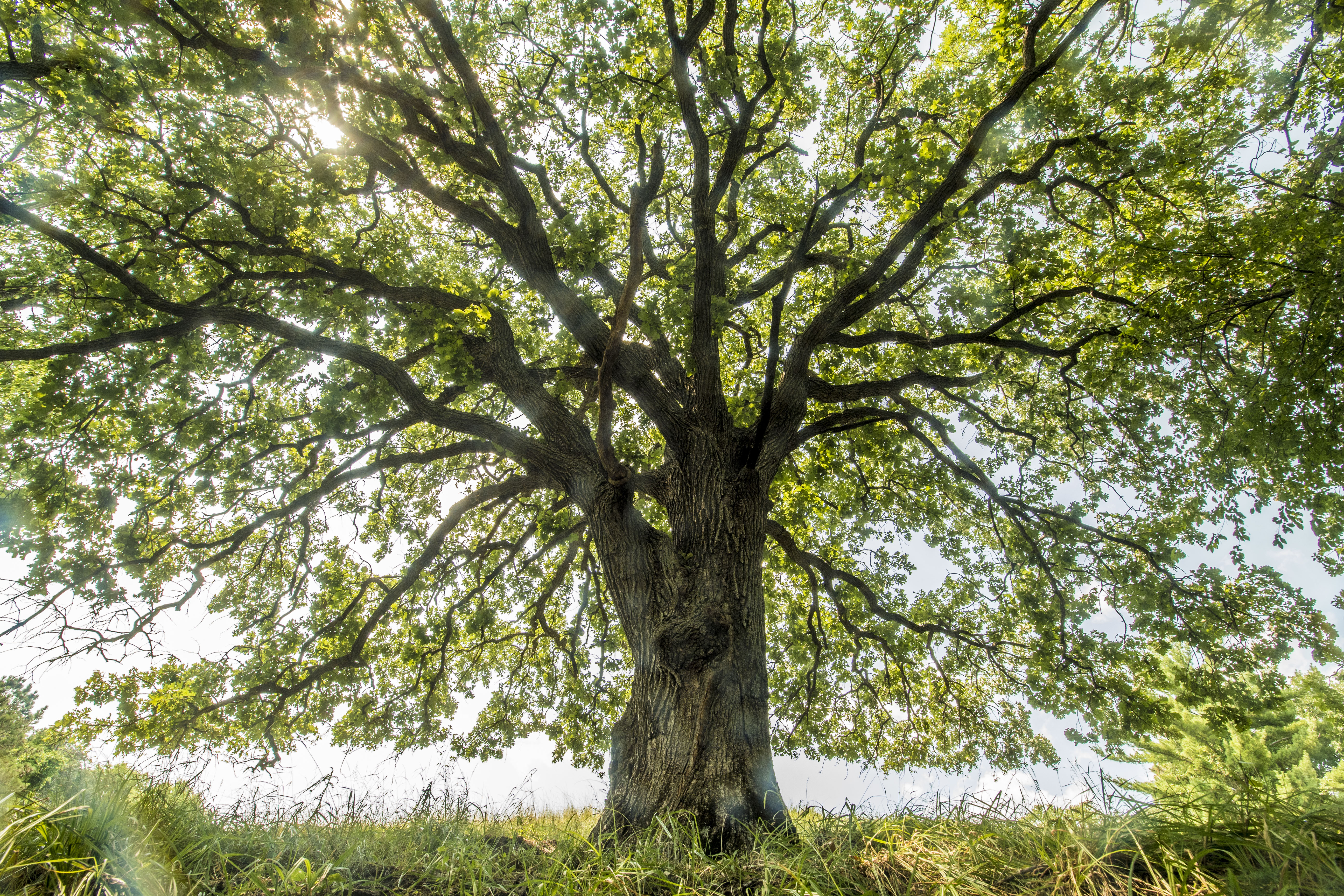
Two women stood in front of a canvas I’d titled “Oaken Umbrella.” They conversed somewhat secretly it seemed, sometimes raising fingers to perhaps camouflage their conversation. Other Meander customers were coming forth with credit cards offered and various images in hand. 

After glimpsing the two leave the image, then return, time after time, again speaking in huddled conference, I finally found a moment to chat with them. “Would you like to take it down to move it into better light?” I offered.

No, said one. “We love this but it’s more than we can spend,” said the other.

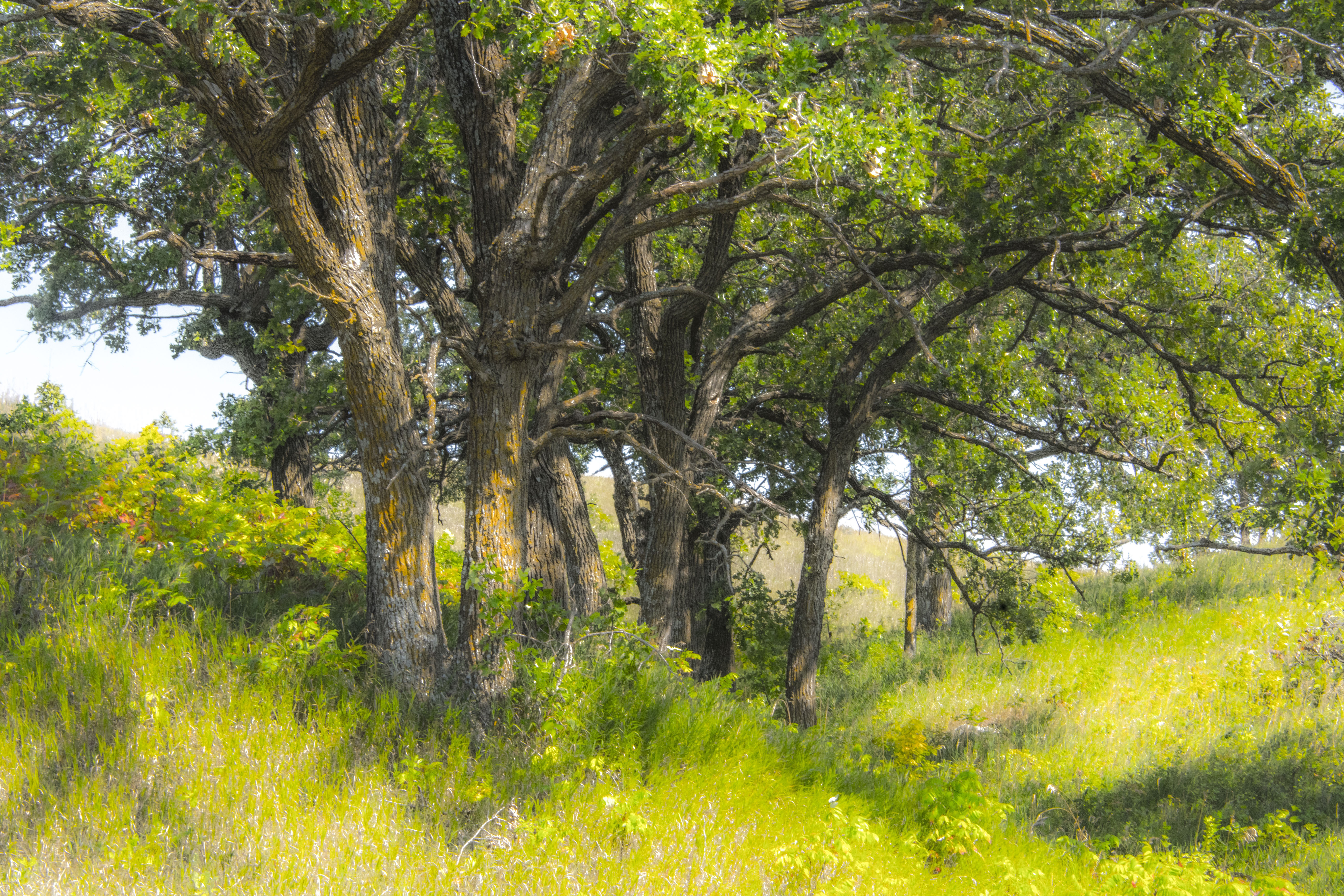
I briefly remembered the moment the picture was taken. This beautiful oak was on the Griffin Land on a hillside overlooking Lake Gilchrist, with its wide and staunch limbs stretching protectively wide to encompass the undergrowth along with thoughts and memories of this and other proud and stately oaks. It was much like the Heath Gunn poem of “The Spreading Oak” … broad and thick, and handsome trunk, supports the mighty branches, arching, spanning, spreading as if like Medieval lances … “

This image, Oaken Umbrella, served as a memorial for a woman who embraced oak trees.

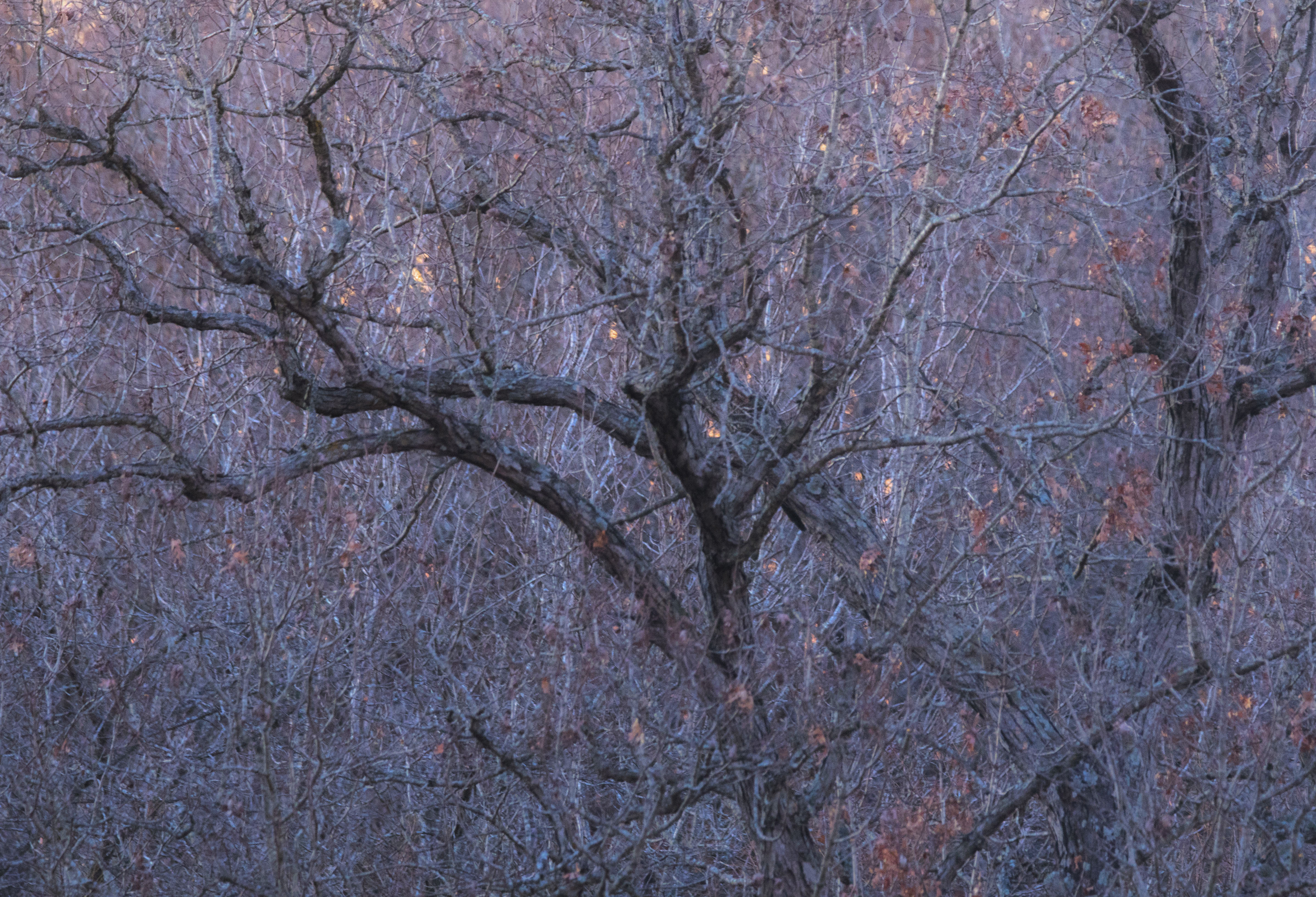
That is the thing about oak trees, which my partner, Roberta, refers to as “Halloween Trees” thanks to the often ghostly looking stark limbs that seem to jut from the trunks, limbs that are quite visible about now as the late fall has denuded many of the trees. Gnarly and stately trunks of especially the older trees, some dating more than a century in age, offer forms of visual poetry that nearly always grasps my eye.

About 11 years ago the Bonanza portion of Big Stone Lake State Park was introduced to me by a young woman friend, a night when a full moon beckoned in the sky far above the hillside prairie of the park. There, standing all alone away from a small oaken savanna in an abbreviated ravine, was an oak I’ve since photographed numerous times. By now the tree is an old friend, one you feel you should reach out to now and then just to see how things are going.

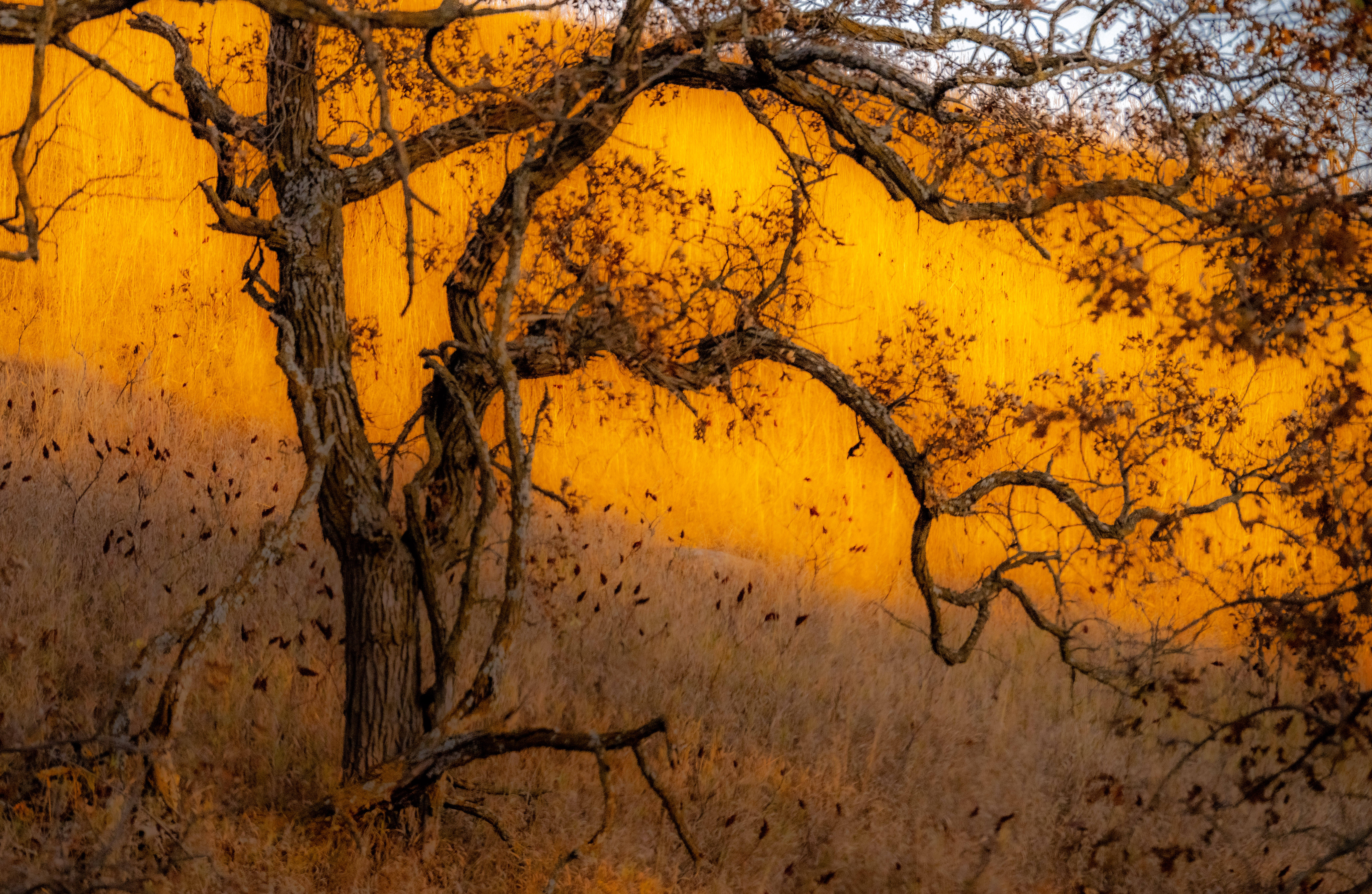
There it stood, a “Halloween Tree,” the grasses golden in the prairie beyond.

Stoic and strong, standing in the text of time, there isn’t much of a shared conversation. Yet, even one-sided I can feel the strength and independence of the lone oak. A few years ago a devastating derecho came in off Big Stone Lake to raise havoc with many of the aged-old oaks both along the lakeside and there in the ravines of the prairie hillside. All that damage is still quite visible as most was left in place thanks to this being a “natural act of nature.” Yet, this single oak suffered no damage.

Just a few days ago we were ambling through the Bonanza searching for possible deer images when the afterglow of the prairie sunset painted an incredible orangish blaze in the grasses beyond the limbs of yet another old oak nearby. Roberta’s “Halloween” look of the old limbs snaked poetically from the trunk, somewhat silhouetted against the vivid color of the late sun-kissed prairie grasses that provided a splendid background. 

Emerging leaves from the staunch limbs on trees in a small oak savanna during a Master Naturalist hike near Redwing caught my eye.

Oaks have long sought my eye. Where I was raised in the hilly northeastern portion of Missouri,  the oaks on our farm were as dynamic to me as the shagbark hickories, and both were so unique and visually beautiful. Sometimes I would stop my horse to rein in that picturesque beauty, or if I was on a tractor mowing the hillsides, I would momentarily stop in awe. Now deep into retirement I still find an excuse to drive back onto the land now farmed by my nephew just to soak in the views of those old trees once again. And yes, most still grace those grassy hillsides all these years later.

On a Thanksgiving weekend evening a few years back, one of those old oak trees defied its  forestal surroundings with broad shouldered limbs defining its existence, limbs emerging from the dabbing of purplish leaves all around. My camera was raised to record this moment of late afternoon beauty. 

Back on the family farm in Missouri, this old oak stood apart from its forestal surrounding.

It didn’t take much imagination for me to close my eyes and have a running mental “film” rush though my memory of dozens of other encounters with various oak trees besides this one on the Griffin Land. Not long after my introduction to forest bathing a few years ago, that mix of nature with meditative breathing and awareness, i was on a Master Naturalist field trip in a Driftless forest near Redwing, MN, when I realized I was standing beneath an incredible theatre of oaken beauty. Leaning against a trunk and looking upwards into the branches and twigs, small immature leaves were starting to break from the buds. Almost involuntarily my breathing slowed and the meditation and kinship eased over me. 

Yes, I lifted the camera to take a few images of the canopy, and moments later trying to catch up with the rest of the tour, I found myself turning to gaze back at what was now stoic and strong old friends, taking different pictures of the oaks from various angles, even from a distant hill where the leader had taken us. I wasn’t a very attentive student, I’m afraid, although my guess was that the guide would have thoroughly understood.

The Bonanza ravines provide a home to small oak savannas that draw me in.

So the two women were back at the canvas of the Griffen oak when one said, “We looked through all your matted prints for a smaller one, something closer to our budget and couldn’t find one.”

“You see,” added the other woman, “a few months ago a dear friend of ours died of MS, and to her there was nothing more beautiful and meaningful than an old oak tree. Like this one. We were considering this as a memorial tribute to her.”

I asked if they had a few moments, that I would run down to my workbench and make them a print. As much as they seemed pleased with the gesture, there was a sense of kinship with someone I didn’t know who must have understood the lure of the beauty of such strong, stately and beautiful trees … the oaks.