Good Timing

Call it maturing, or perhaps a sign of graying, for among the “life” things I’ve discovered is that it is more fruitful if not more relaxing to solve the world’s problems in the bow of a canoe rather than on a bar stool.

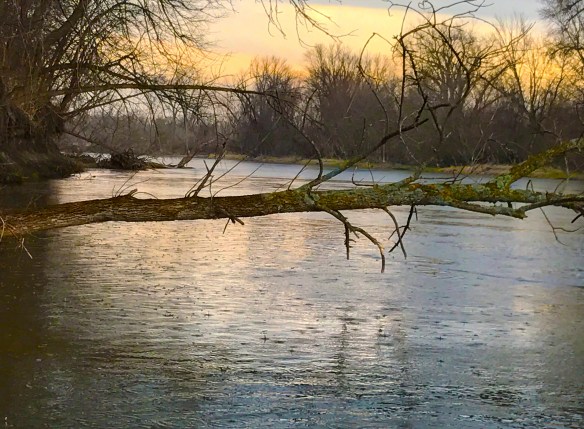
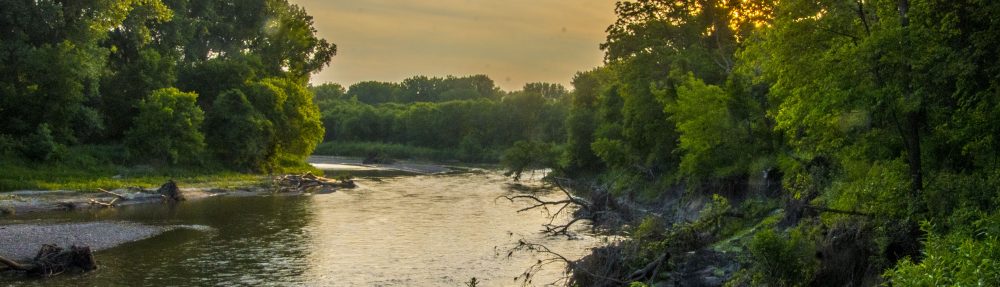
More evidence of that realization came Sunday while mixing a little catfishing with canoeing and bird watching on the Minnesota River with long-time friend, Tom Cherveny. Although our put-in at Kinney’s Landing south of Granite Falls was somewhat delayed with a misplaced tackle box, once we were on the river life and conversation seemed to ease right along with the natural flow of the passing waters.

Who could ask for more? Well, a stringer of catfish didn’t seem to hurt, either.

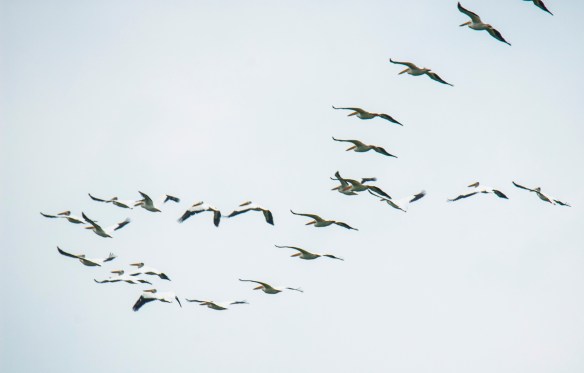
Although we weren’t serenaded by the continual blasts of Canadian geese, which is a somewhat common sound of the early trips on prairie rivers within the vast Mississippi Flyway, we had ample bird life to admire. Especially wonderful was watching the spiraling glides of the recently returned white pelicans high above us. Belted kingfishers traversed between riverbank perches, and an occasional eagle added interest to the paddle.
6.14.16 refuge2a
We skipped from deadfall to deadfall, anchoring in the deeper holes, dropping weighted and baited offerings to the depths of the muddy waters. One of the highlights of river fishing is not knowing until a hooked fish breaks water alongside the canoe just what you might have on the line. Besides the tasty catfish, we also brought into the canoe several carp of various sizes, buffalo and freshwater drum. “We should smoke these,” we kept telling one another before releasing them back into the river.

Our trip just happened to mark the 20th anniversary of the 1997 flood, when waters kissed the treetops we were paddling beneath. Since I was busy doing stories and occasionally helping with sandbagging efforts on Hawk Creek, a tributary upriver of the Minnesota, Tom was covering the efforts in Granite Falls. As we passed the former Firefly Casino grounds, he explained the efforts the native Dakota went through to secure their homes and businesses.

We talked of subsequent trips we had made that spring after the flood waters had receded, of pointing out to others the rafts of grasses still entangled high in the treetops; of how canoers, especially exchange students, would look up at the high tufts then back down to the river, mentally measuring the differences of depth.

Oh, the subsequent trips. We have typically done a paddle not long after ice out. This year it was the first Sunday of March. We talked of fishing on that trip since a young friend had told me he had been catching channel cats all winter long due to the rivers being open.

Earlier trips are often referenced on our paddles. One I’ll never forget was several year ago when I took my kayak and Tom paddled with his son, Eric. The Minnesota was particularly high that day with a massive and dangerous  backup of waters from the Granite Falls dam … for several miles back upriver. I’ve never been so frightened. Not before, nor since. The river was a mass of spinning whirlpools, and my only motive was to paddle from one whirlpool to the next without spilling, keeping the bow headed as straight downriver as possible. A misplaced paddle causing a flip in that churning water would have been disastrous.
OLYMPUS DIGITAL CAMERA
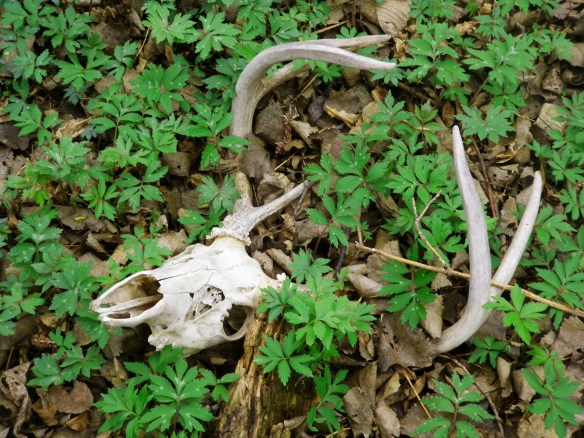
Another early season trip was more fun, one in which we recorded both photographical and written reports on the state of the official DNR Minnesota River designated camping sites from north of Montevideo down to Frederickson’s, an island just above our pull-out on Sunday. At the first, which was overgrown in buckthorn and a fire-pit mounded with siltation, we found the skeleton of a deer that we surmised had hidden from a hunter only to die of wounds within a “fort” of buckthorn. I retrieved the skull that hangs here in my office. Between Churchill Dam on the Lac qui Parle Lake down to Morton there are five such designated riverine campsites, at least two found on remote islands. Our reports were logged before the 50 year anniversary of the making of the campsites so crews could do the cleanups and necessary refurbishing.

Not unlike the barstool conversations, our conversation treaded on politics, issues that created the incredible siltation of the river, chiding while offering encouragement of a catch, pointing out wildlife and bird sightings to one another, and so on. As we neared our take out we passed the third such campsite, then pulled between two deadfall for our final dunking of worms. As we waited rain began to fall. Off to the west came the intermittent roar of thunder.
4.9.17 riverrain
“Looks like we have good timing,” said Tom.

We caught a few more fish, and watched the skies. Finally we reeled in and padded a few hundred yards to the take out. Moments after we were out of the canoe and on dry land, lightning suddenly broke through the clouds just above us. It was still better than a bar stool.

Bliss in a Blind

Yesterday I was thinking about Tuesdays, which for a long number of years were “headache” days. Tuesdays were deadline days of my country weekly for 20 plus years. Tuesdays nights were city council meetings. Before that Tuesdays were years of nights on the road when the excitement of yet another business trip had waned and Friday seemed so far away from flying home. Lest I not forget, for a few years Tuesdays were men’s bowling league nights, a sport I tolerated because of friendships, cold beer and an occasional strike.
4.4.17 refuge4
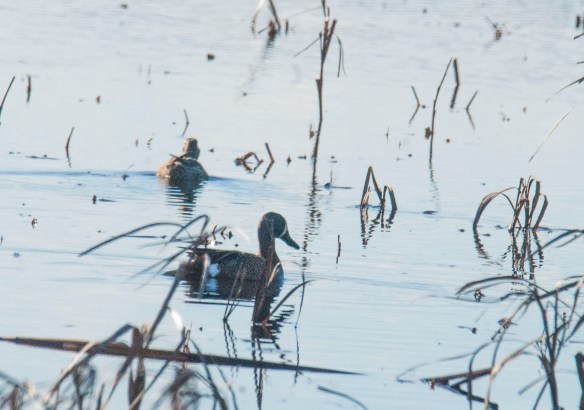
So where was I this past Tuesday? Cocooned inside my pop-up “outhouse” photography blind on the edge of a wetland in the Big Stone National Wildlife Refuge listening to the first of the spring peepers, watching an industrious muskrat working a raft of cattails, waiting for ducks to not just fly in, but edge closer to within camera range. Perhaps most of all, simply enjoying an intermittent warm breeze on a sunny afternoon as small, puffy clouds floated by on a palette of deep, blue spring sky.

There I sat with two unzipped windows facing the south and west as the sun made a slow passage toward the horizon enjoying both the solitude and my peaceful existence. Time for deep, unlabored breathing. Time for reflection. Time for nothing but waiting and watching. Time on a breezy and sunny afternoon.
4.4.17 refuge9
An occasional car would venture slowly around the bends of the auto tour road doing as I’ve done dozens of times myself since moving here. Windshield observations, and most of the time serving as a “movable blind” with the camera at hand.

At the distant southern edge of the wetland was where it seemed the ducks congregated, and as I’ve seen from behind the windshield, as soon as a car approached all pushed frantically away from the road or burst away in flight. Once in the air they flew west away from the road before turning back to fly high overhead toward the dammed backwaters of the Minnesota River, only to circle back and glide back into the same pool moments after the car had eased safely away. Time after time. A cheap mystery solved.
4.4.17 refuge12
Time made me wonder if my camouflaged blind was too tall, or too visible, or if the pool in front of me was too shallow. Often when placed in the woods it takes a long half hour or so before the sounds of nature begin to fully return; when squirrels and woodland birds ease fully back into nearby branches. Was it the same here at the wetland? And if so, how long would it take? In the hours that passed, little changed. Those ducks stayed beyond camera range. Refuge employee Jason Ballard had told me that putting up the blind was fine as long as it came down by the end of the day, or that I could do what others had done … create a hiding space within what nature offered on site.

Then an interesting moment came. Off in the distance came the sound of motorcycles. That broken muffler sound common to Harley’s. Due to the location of the wetland, in the valley below Highways 7 and 75, traffic noise for the louder vehicles melded with the peepers, especially that from the random motorcycle and semi. This was steadier and easing closer. As the sound neared, many of the ducks and a pair of geese rose from the waters in flight. Then suddenly two motorcycles appeared over the rise, moving slowly. One with a hard rock radio station blaring. One of the riders then shouted loudly to the others, “Isn’t it great being in nature?”
4.4.17 refuge14
Ironically, most of the nature had flown away before they motored into view, although I’m sure the ride through the Refuge was blissfully beautiful on such a lovely Tuesday afternoon. To each our own.

A runner with his dog jogged along the distant roadside before passing behind me about ten minutes later. Earlier, not long after I had set up, a young woman on roller blades swish-swished by. I’d passed her as she was starting off from the parking lot just outside the entrance gate and was amazed in both the distance she had covered as well as the speed in which she had done it. Interestingly, the distant ducks simply skirted further from the roadside when both the roller blader and runner passed by. Observations on a breezy and sunny afternoon.

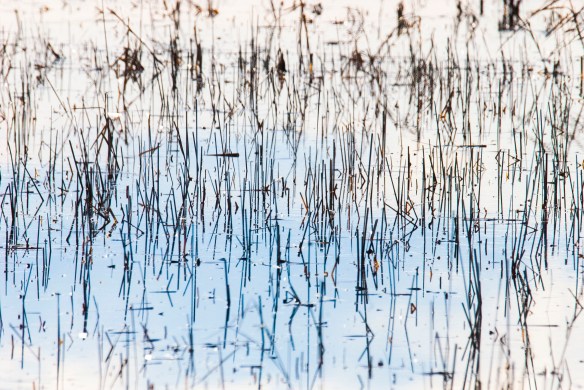
To break those occasional moments of monotony I raised the camera to take photos of the ducks flying over on those frequent escapes, or the shimmering sun-fed glaze of the pool in contrast to the silhouetted swamp grasses. I had watched a distant eagle float in invisible towers of air currents over the distant native prairie. Then there was my buddy, the muskrat, who wasn’t shy about his frustration and disgust in not being able to climb aboard the floating mass of cattails right in front of the blind. Oblivious to my being there, it has swam and dived around in front of the blind for much of the afternoon.
4.4.17 refuge11
My initial plan was to sit until sunset, which would have been another couple of hours longer. Then, as I focused on another flock of ducks, wings spread in descent, lowering toward the distant waters, my camera battery died. Suddenly I was as frustrated as the muskrat. With a final deep breath, I stood to fold the blind and make my way back to the car. All told, though, it was a beautiful afternoon. An incredible Tuesday afternoon.

A time for reflection. A time for nothing but waiting and watching. Time spent on a breezy and sunny afternoon.

March Madness

One of the joys of living is learning from others their personal signs of Spring. Seems as if robin sightings are high among the signals of this refreshing break from the holds of winter, as evidenced at a St. Patrick’s Party last night, even if climate change has convinced these beautiful orange-breasted yard hoppers to stick around for most of the winter.

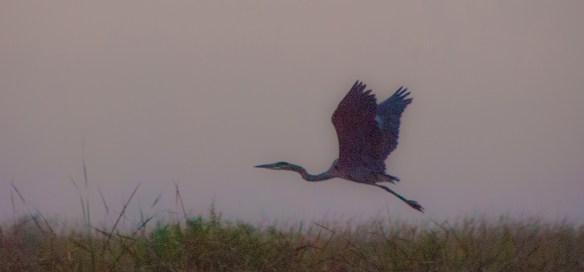
Everyone seems to have their own sighs of relief signaling the change of seasons. My late wife, Sharon, kept her eyes on the few wetlands of Chippewa County in search of great blue herons. When asked why herons, she said, “Because when they’re here it’s usually warm.”
refugemorning7
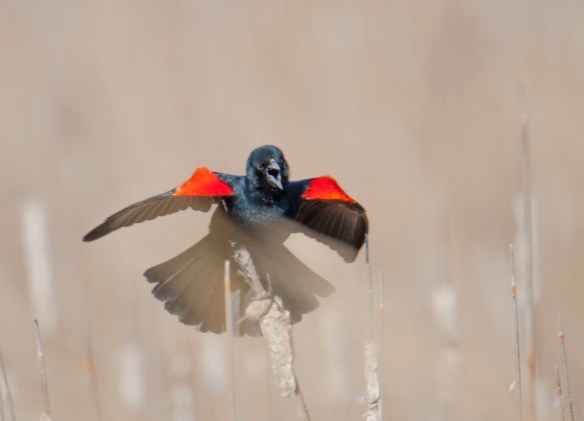
Many of us also search the wetlands for redwing blackbirds, for they usually start perching on the area cattails in early March. They’re traditionally one of the first migrating arrivals, soon followed by the graceful flying Forster’s terns, which I spied for the first time this year on the wetland ice this morning. Courtships of wild turkey?

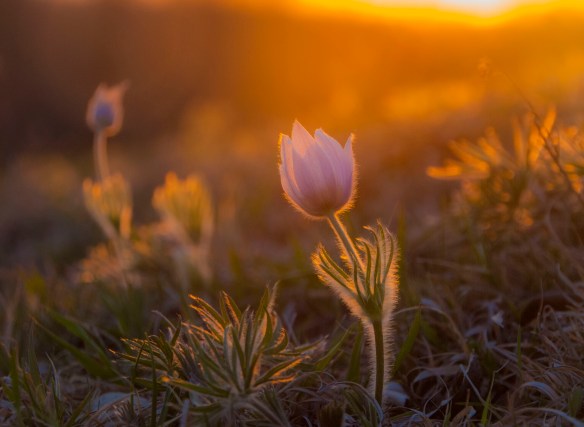
Birds are not the only hints given by nature. An appearance of pasque flowers is a signal of seasonal change for many. Pasque flowers are also called “mayflowers” by many, although they begin peaking out on the prairie hillsides much earlier. Even as early as March. Ramps peeking from the leafy carpets excites some, although the asparagus in the road ditches comes later … a sight viewed by some as a true sign of spring. How about morels? Dutchman’s britches? We’re all different, and have our own signals of change.

10.11.15 headwater11
Ah, but come March! Sports tournaments aside, nature’s March “Madness” is quite apparent in the countryside right now. Open rivers are corridors of multiple geese species and ducks that crowd the ridge ice along the banks. For years my friend, Tom Cherveny, and I canoed down the Minnesota River from Wegdahl to Granite Falls on the first weekend after ice out, usually in March. This year he made the trip in mid-February with another friend, Scott Tedrick, although Tom and I hooked up the first weekend of March on a 70 degree Sunday afternoon for a paddle down the Chippewa River and its confluence with the Minnesota. Again, we shared the river with squawking geese and ducks, with surprised deer running along the banks just ahead of us, and numerous eagles soaring aloft in the rising air currents.

On these trips we usually recall a trip we made several years ago, the year Sharon and I hosted Jinyoung Hwang of South Korea, which was also the virgin paddle on the river for Scott, a young writer then new to the area. We pushed off from Wegdahl in the early afternoon, and the trees lining the river were full of song of birds. Their chirping and songs were nearly deafening. Because of the high water we actually paddled across a field of native prairie to avoid the traffic sounds of nearby State Highway 7, and encountered hundreds of geese and ducks. We came around a bend down river where three mature bald eagles perched in a tree suddenly swept from the branches just yards in front of our canoes to take flight. “Wow!” screamed Jinyoung.
earthday8
Wow, indeed. I cannot recall ever being closer to an eagle, and witnessing the vast wing spans as they glided off the branches was something you can’t easily forget. Count eagle migrations as another sign of seasonal change.

Scott surmised that this was a normal paddle on the river, and that he had come across an incredible slice of unexpected natural beauty. True, although the bird life on that paddle had not been equaled in our previous spring paddles, nor since. This was truly an special and actual moment of March Madness.

Here in the age old Prairie Pothole biome of western Minnesota, we often point to the near poetic choreography of the murmurations of redwings and other black bird species, or the skeins of geese venturing from the lakes, wetlands and Big Stone National Wildlife Refuge to feed in the untilled stalk fields. Spring is indeed a renewal of life in the natural world around us, and comes in many forms. It seems much of the awakening comes in the month of March. All of which brings a smile onto the faces of old men and women, for we have survived another grayish winter and so appreciate a reawakening of the natural world around us whether by wing or blossom.

4.16.15 pasque1

Truly, this is a March Madness that is so welcomed.

Trips in the Refuge

Yes, there are taxes to do. I could be bent over the jig building a spin fishing rod I had promised a friend for an upcoming fund raiser. Instead I’m looking out over the prairie where winds are pushing snows to a near whiteout and thinking of birds. In this wind-blown snow black shapes clamor for sunflower seeds or their turn at the pork fat, and none seem worse for wear in this intermittent blizzard.

refugemorning8

Wild birds are a long time passion of mine, even if I’ve not been adept at keeping a running Audubon log of those I’ve seen over the years. Yet, until old age takes a grasp of my memory, I can still remember specific first sightings. My first curlew up in a wetland near Clinton three springs ago, slowly striding the edge of the water with its long, turned-down beak. Or the scarlet tanager at a park along the Concord River west of Boston. Perhaps my first cedar waxwings in the tree branches outside of an upstairs window of Java River Coffee House before a board meeting of an environmental group; of being surprised at how small they were. There was the excitement, too, of the brilliance my first red-breasted grosbeak perched on a branch, and unfortunately just passing through. I could go on. Maybe I’ve made my point.

6.16.refuge5a7.22.15 refuge20a7.27.15 fog34a

For the second time in my life my home is along a recognized flyway. The first was at our home across the highway from the Little Vermillion River east of Hastings. An area called Prairie Island, this land mass stretches from lower-town Hastings between the Little Vermillion and the Mississippi down to Redwing, and it’s a backwater, wooded paradise. A bird feeder just outside our dining room allowed us to sit for hours at the table watching the comings and goings of a vast number of bird species. Many new sightings along with obvious renewals of song birds I had seemingly forgotten on my 12 year Midwestern hiatus while living in Denver.

Those backwaters were tremendous gathering spots for waders like the egrets and herons. Seemingly every year a “Louisiana” heron hung around two large backwater “ponds” we visited across from the house. High spring waters left behind fish trapped in the pools.

refugemorning13

After Hastings we settled into a small prairie town about two hours southeast of here where I ran a country weekly, an area lacking of much avian variety beyond red finches and house sparrows.

Then my now ex-wife and I bought this small prairie farm just up the hill from Big Stone Lake, on a “branch” of the Mississippi flyway, and once again there is an abundance of bird life. More varieties and numbers of geese than I could have ever imagined, and thanks to the last remnants of the pothole prairie, murmurations of red wing blackbirds, starlings and other “black” birds that are as frequent as they are mesmerizing each spring and fall. Terns drift in the wind currents on summer afternoons, and we’re serenaded by songs from the wetlands over the hill each spring. Swallows dart around over the prairie all summer, and gold finches mingle with grosbeaks, jays, brown thrashers and the many woodpecker species, and pheasants “bark” from the native prairie surrounding our house.

7.22.15 refuge22a7.22.15 refuge257.14.15 wetland1a5.15.15 woodie3

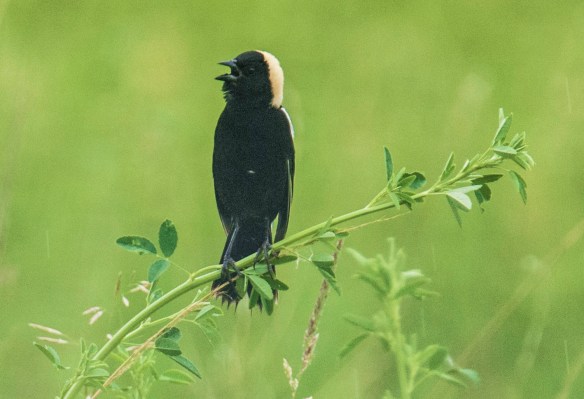
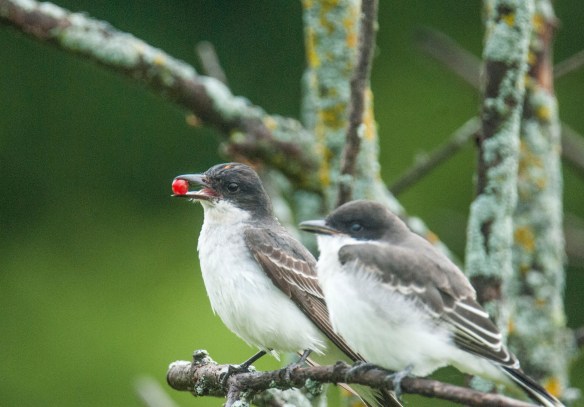
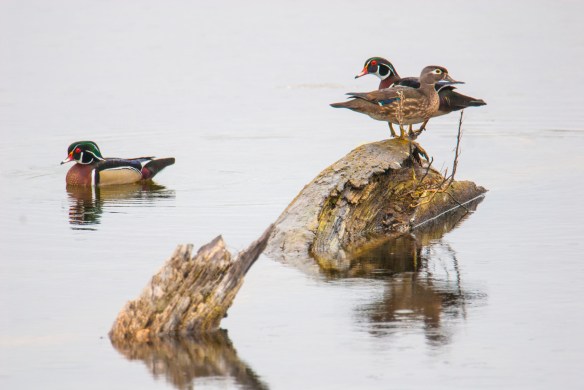
One of the real treasures, and interestingly one that isn’t mentioned much to either newcomer or tourist, is the motor trail winding through the nearby Big Stone National Wildlife Refuge. What a birder’s paradise, and one that seems to offer a constantly changing population of winged characters depending on the season. Damming of the Minnesota River has created a swampy shallow stopover for hundreds of thousands of geese, swans, species of ducks, shore birds and waders in the spring and fall, and acres of prairie grasses create food and nesting homes for bobolinks, meadowlarks and other prairie grass loving birds that have been forced out of our lives (and their’s) by modern agricultural practices. Oh, there is also ample woody terrain for kingbirds, orchard orioles, warblers and others.

6.14.16 refuge25

Beyond the driving loop, owls, eagles and huge hawks perch and glide through the exterior of the nearly 12,000 acres of the Refuge. To break it down, nearly 1,700 acres of the refuge is in prairie grasses and other native plants. Some 4,250 acres of water are there for the birds thanks to the Highway 75 Minnesota River dam. Perhaps one of the most beautiful aspects of the park are the natural outcrops … nearly 100 acres in all of granite mounds bared by the Glacial River Warren, washed out of the prairie earth by the aftermath of the breaking of the huge ice dam of the glacial Lake Agassiz. While naturalists are attracted to the rare and native ball cactus and the other narrow window of native plants specific to this rare and interesting ecology, the outcrops attract nighthawks and other birds.

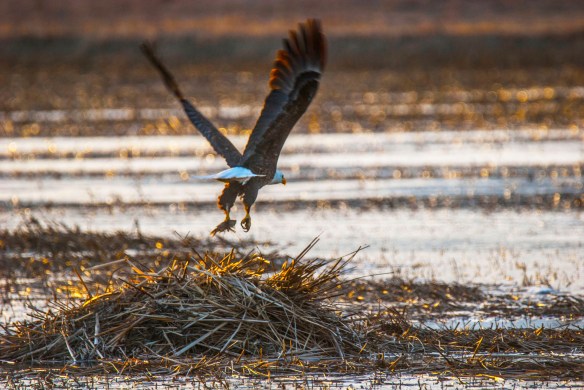
A drive on the loop most times of the year will provide nature lovers and birders ample sightings, and it seems no two drives ever offer a diet of the same winged species. No one should be shocked at the chance surprises, such as a bald eagle crashing into the water before departing with a fish secured in its talons, or the sudden appearance and flight of the quite rare “upside down” bobolink. American avocets drop in temporarily, as do the yellow legs. I could go on and on.

3.8.17 refuge12

So the blizzard offers a partial white out, and the taxes and rod awaits. I can smell the pork chops and sauerkraut simmering in the crock pot, and despite it all I almost pine for a quick trip through the Refuge just to see what is there to see. My feeder, though, offers a warm refuge for the likes of this old guy, so most likely I’ll simply stay put.

Prayers for the Prairie

Ah, yes, the wind. Gales. Gusts. Lulls. Then, more of the same. All we’re missing is the popping of the sails. Rather, on this remote Minnesota farm, chimes dance beneath anchoring limbs, adding tingling percussion to the seemingly constant low roar.

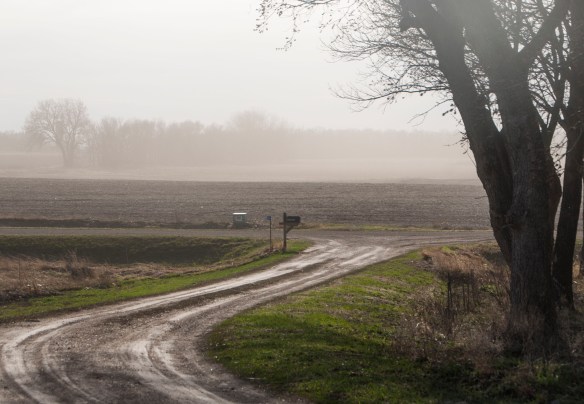
This is the prairie, after all, where grasses once grew. And the winds continue to blow. In the near distance nowadays, a softness of color hangs along the low horizon just above farm fields. Especially in areas where the grasses are long gone and the fields were tilled bare months ago. Some fields were worked last July and August following wheat harvest, meaning they will have been exposed to the prairie winds for 10 or 11 months before a new crop emerges enough to protect what is left of the soil. Most of the ground was worked after corn, soybean and sugar beat harvests in November. And that softness along the horizon? Dirt, aloft in the winds, misplaced, adrift and gone. Forever.
3.6.17 wind2
At a showing of my “Art of Erosion” images at the traveling Smithsonian “Water Ways” exhibit last summer, a man asked why he doesn’t see dirt along the ditch banks beyond the winter months. “It’s there,” I explained. “It’s the snow that provides contrast, making it easier to see.”

That contrast is an integral part of a showing of the “Art of Erosion” now displayed on the brick walls of Java River Coffee House in Montevideo, which will hang through March. An artist’s reception is scheduled for this Friday, March 10, with the wonderful women’s musical group, Homemade Jam, providing entertainment. We’re calling the event “Prayers for the Prairie.” This will be the first public display of the “Art of Erosion,” which has made the rounds at many sustainable and organic farming conferences, plus the Smithsonian exhibit at the Prairie Woods Environmental Learning Center, over the past three years. Common comments fall into the “beautiful but sickening” genre.
java deal
Choosing to hang the 19 canvases and call-out boards came about with much thought and discussion, especially considering the political climates in both St. Paul and Washington, D.C., where a political party seems intent on loosening regulations without much concern for the health of the planet. Consider this a protest display, if you wish, for it is certainly meant as a statement. The “Art of Erosion” was made possible by a manifestation of failed farm policy and a neglect by individual farmers of healthy soil stewardship practices. The images were made on a Sunday, January morning after returning from a trip to Marshall the previous day and seeing the miles upon miles of “snirt” — a colloquialism describing the combination of snow and dirt — along the entire trip. All were made in an area of Lac qui Parle, Chippewa, Swift and Big Stone Counties, and beyond minimal cropping, were not enhanced in any way with computerized post production software.

Interestingly, this idea came on top of a longer drive home from Missouri the previous Thanksgiving when we witnessed snirt along the highways from Missouri through Iowa and into the former prairie region of Minnesota. Hundreds of million tons of dirt, all blown away. Online research showed that Land Grant universities in much of the Midwest, and even into Canada, were concerned enough to post instructions on how to protect our valuable croplands from being misplaced by the winds. Simplest and least expensive was simply holding off tillage until spring. Indeed, that is evident along our roadsides, where ditches along stalk fields remain quite clean.
4.12.15 brownout2
Thankfully there has been a lot of conferences and efforts since to convince farmers to plant cover crops, explaining multiple benefits such as a softening of the hard pan, better moisture retention and the addition of crop nutrition elements. All on top of preserving a key component of life … our soil.

Numerous soil experts such as Rick Cruise, professor at Iowa State University and the director of the Iowa Water Center, points that besides cover crops, no-till, terraces, grassed waterways and any number of practices can contribute to saving soil in row-cropping enterprises. He emphasizes that some landscapes are sustainable only under an agronomic system that includes perennial crops – trees, prairie and pasture.

snirt50
David Montgomery, author of “Dirt—The Erosion of Civilizations”, points out that the earth’s “last frontier” of farmable lands are now being cultivated, and once that thin layer of life sustaining food production is eroded away, then what? Erosion has brought an end to man-made civilizations throughout history. Will snirt be end of ours? Does anyone care? Aren’t farmers and others aware of what is being allowed to happen to this soil?

After a recent Water Quality Conference, a Minnesota State Representative who has since introduced legislation to eliminate a soil saving buffer strip initiative, was quoted as saying that farmers in his district were “great stewards of the land.” A quick trip down Minnesota Hwy. 28, which was the likeliest route for his way home from the gathering in Morris, showed miles upon miles of blown dirt in the ditches and road banks, and several places where windbreaks had been dozed from the ground, eliminating even more protection for this “last frontier” of farmable soil.

Which led to a friend to ask, “What? I wonder which route he took on his drive back home?”

Spring in the Potholes

Spring in the western prairie region of Minnesota comes alive in some special venues, though none more lively and boisterous than in the wetlands.

Ah, but what a term. Some who grew up here look askance at you when you say, “wetlands.” More common to them is the term, “slough.” Technically they’re the “potholes” of what ecologists call the “prairie pothole” biome. These are the remains of the last glacialization some 12,000 years ago, and if you happen to see one, or if you are more fortunate than most by living near one, you are near a rare moment of earth time.
flight3
Here is why: since John Deere’s plows came to the prairie with the encroachment of European settlers, 99 percent of the potholes have been drained to make way for what we call commodity crops. Corn and soybeans, mainly, but also sugar beets, potatoes, edible beans and sweet corn. A “prairie” is a really a misnomer since all but one percent of these former grasslands that stretched from mid-Canada into Texas remain, sectioned off into mile-wide squares. In the early to mid-1900s, there were typically four quarter-section farms. No more.

Before the plow and eventual underground tile drainage and ditching, there were thousands upon thousands of potholes dotting the former prairie. Several in each quarter section. Ghosts of those wetlands typically appear each spring when the frozen subsoils prevent the spiderwebs of drainage tiles to move off the surface waters. In time, perhaps, the ghosts will return, for as a dear friend and naturalist, Tom Kalahar, preaches, “Nature always wins!” We can only hope, though none of will likely see this in our life times.
2-20-17-raindrops22
After living in the industrialized “black desert” of farming for the first twenty-some years of my prairie life, moving into Minnesota’s “Bump” has been a revelation. For all around our Listening Stones Farm are many natural potholes. A large one can be seen from the upstairs rooms of this old farmhouse just over the rise to the east, and a smaller one is up and across the road from our upper prairie. Thanks to a recent hint we have discovered a jewel box of potholes just north of the “Clinton Road” just three miles from the mailbox. Big Stone County is perhaps the closest county in all of the former Minnesota prairie pothole region of resembling the original, post glacial landscape. Indeed, many federal and state sponsored restored native plantings surround some of the wetlands, allowing you to almost visualize how the natives saw the land pre-plowed back in the 1800s.
2-26-17-wanda3
Best of all, living nature seems to agree. For those of us fortunate enough to reside here, spring is truly a special season. A recent trip north toward Barry found about 20 bald eagles resting on the ice of a frozen pothole. A month after moving here I saw my first Curlew on a nearby wetland. We’ve already seen several pairs of geese on the smaller wetlands, presumably scouting for nesting possibilities. Within a few weeks male Redwing Blackbirds will arrive to stake out territories on cattails now frozen along the edges.
redwing2
Back in my country weekly days I was often amused by phone calls from readers excitedly describing their first viewing of spring Robins. Sorry, folks, I’d suggest, but the true sign of spring already happened two months ago in a nearby slough when the Redwings appeared as suddenly as they had disappeared last July, their feet securing balance on a browned and bouncing stalk of wind-blown cattail, nervously alert while staking territory.

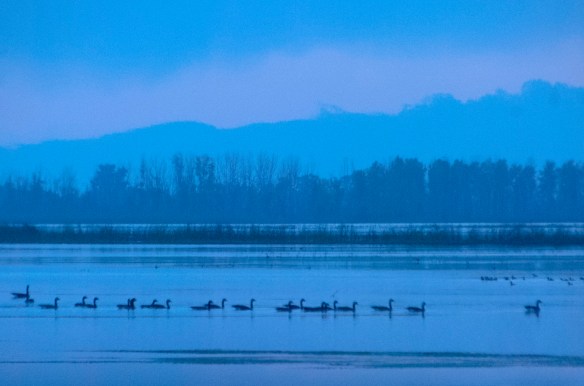
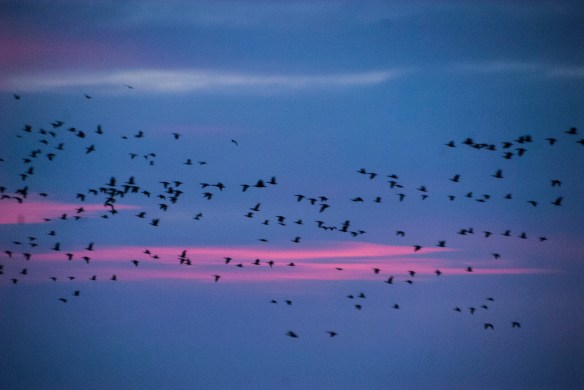
Just being outside right now gives witness to skein upon skein of Canadian and Snow Geese flying over, announcing their flights in seemingly joyful chorus. And friends sitting around a late afternoon bonfire will look skyward following the sound, searching for “vees,” faces fixed in smiles. Early mornings as the sun rises, you can hear geese either over the hill or feeding in one of the unplowed corn fields nearby. As the potholes thaw, more and more will alight in rest and the sounds will dominate spring air. Literally thousands of geese at a time will hole up in the wetland to the east. It is a sight and sound I’ve thoroughly welcomed in my life and anticipate with glee.
3-27-15-wetland2
Spring in the potholes is just as alive and vibrant as any I’ve found while canoeing the nearby prairie rivers. Be they Swans, geese and the many species of ducks, when the potholes come alive, spring has finally arrived.