Faith
Reply
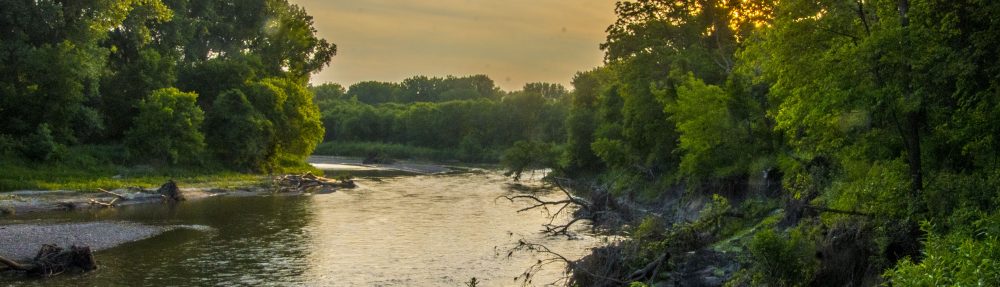

Moments like these give me cause to believe I may be a man of faith. So begins a writing that may see the light of day … since its being published depends on the beaming up of our internet. I’m happy to report that yesterday we were connected most of the day, which was the first time we’ve enjoyed a full day of service in what seems like weeks. “Months” might be more accurate, but I write as a man of forgiving faith.
Despite becoming on a first name basis with our designated service rep, Chad, we awake each morning wondering if life on our farm will reach beyond our small prairie. We are at the mercy apparently of a universe beyond our blue planet, as explained by Chad. Sun spots. And this: “If you can see the Northern Lights, forget the internet.” I haven’t seen them here on the farm, yet we still lack a worldly connection. So sun spots and Northern Lights are among the culprits. So, too, are tree limbs, rain and fog, and the other day, the talkative young man suggested we keep the modem out of the sunlight. We moved it from the top of the printer where we had anxiously monitored the status lights, which blink like a Dallas disco … all except for the little designated light of wonder, which barely and rarely comes to a full summer green.

Among the culprits of our outlandish internet issues is the sun … on the modem, spots out in the universe, and the cosmic rays producing Northern Lights!
Chad and I took a walk through the lawn that morning when he was here, and it was still early enough we collected a drenching dew on the toes of our boots. He studied the angle of the technological arrow protruding from the corner of our solarium and the distant tower, then eyed the tree line that had previously been deemed perfectly fine. “Leaves. Look at those leaves,” he said, pointing toward the tower. “I see interference.”
When the system was installed the sight-line was deemed as perfect. Back in the day he and another tech rep both considered the signal so strong they somehow toned it down, fearing perhaps that my iMac might explode from the overwhelming wealth of beamed, wireless data. A few weeks ago, on a rather frustrating Sunday morning just after returning from the BWCA … where the lack of technology was a blessing, I might add … the crisis line fellow took me through all sorts of technological guts to measure something he called “pings.” Making it simple for such a technological moron, he painted a picture for me of watering my garden when 53 percent of the water had leaked from the hose before reaching the nozzle. “I’ll make a report to the office,” he generously offered.
Apparently his report was lost in the email … provided the company’s crisis center uses its own internet service to communicate between their offices. Since I’m a man of faith, this seems a logical possibility … sans sun spots, the Aurora Borealis, errant tree branches, a non-shaded modem, or that our nearest neighbor a mile and a half to the south baking a cherry pie.
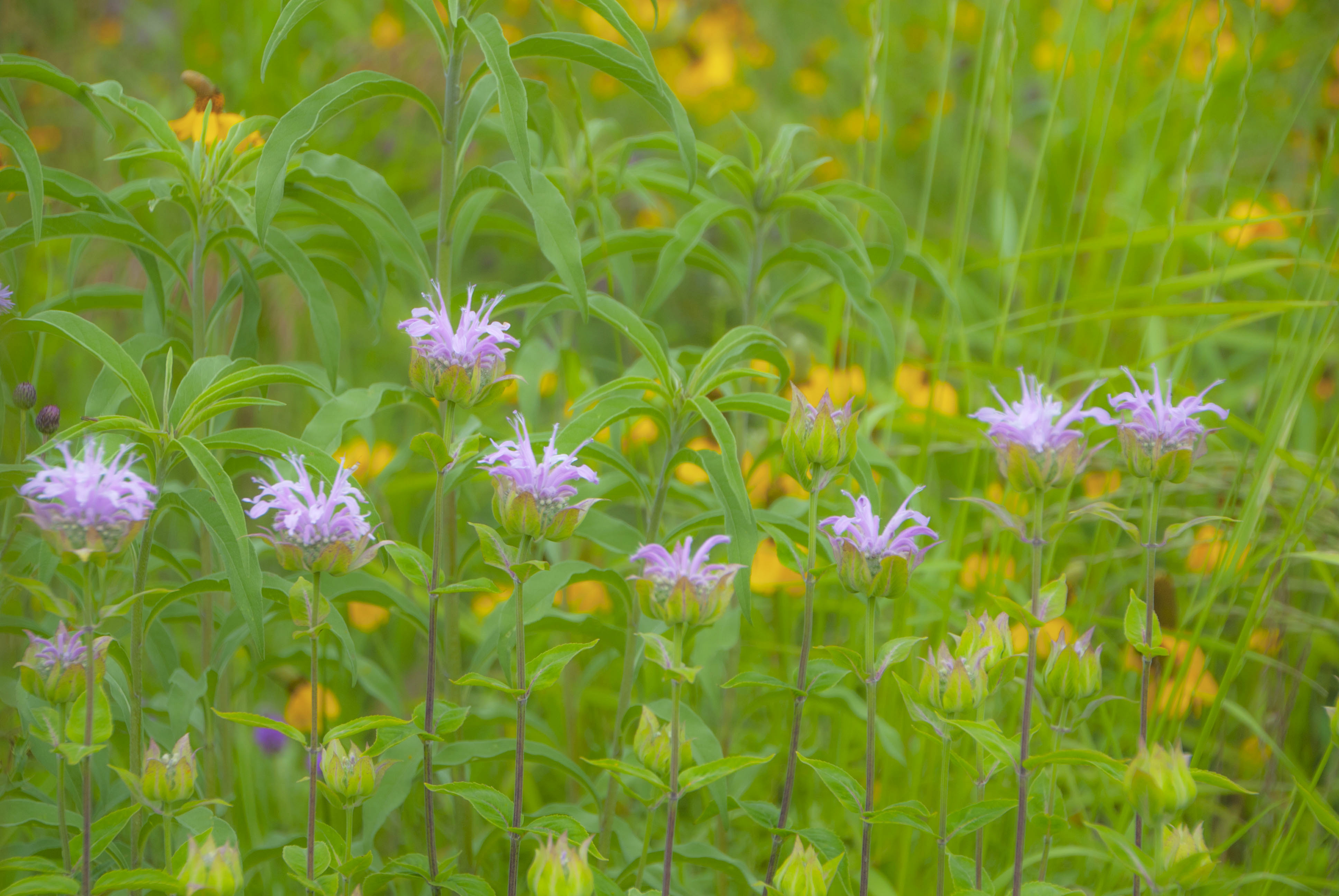
So far, the bee balm in the prairie have escaped scrutiny.
I told Chad I would saw off those wayward limbs from three of the trees. “Don’t do the evergreen,” he interrupted. “I love evergreens.”
Ash, elm and basswood must offer more interference than spruce, which pleases me, for like Chad, I also love evergreens.
Meanwhile we “limp” along with our “smart” phones. We could probably survive our social media addictions and email with the phones, although they’re a bugger when you’re trying to read the morning papers. Yes, I do subscribe to the papers, so when the internet isn’t up, those cyber dollars reek of a bad investment. Rebecca does the majority of her office work here on the farm, and how she can manage her anger so well is beyond my limited faith.
For me it seems I’m always doing some sort of research. For example, yesterday I spent a good portion of my day trying to repair our rider mower by making Google searches for such things as owner manuals, mechanical repair sites and You Tube repair videos. Time was also spent seeking information on making stainless steel table tops for Rebecca’s commercial kitchen, and in looking for greeting card stands and other ideas of photographic marketing. Every day seems to bring new ideas ripe for necessary research, and since I lived in a small Minnesota town with a state-of-the-art fiber optic internet system, perhaps I arrived here on our little spot of prairie hopelessly spoiled. Like most who lived in the drive-past berg, the town’s system was certainly taken for granted.

Yes, fog is suspected!
Indeed, when we bought and moved to our farm here in the Minnesota Bump we didn’t even think to inquire about internet services. While I can’t speak for Rebecca, my assumption was that the entire state was equally blessed with broadband speed. We both were given an abrupt wakeup call, and in our first full year here we tried three services before we found one that was functional. It was owned locally by a middle aged fellow with severe physical limitations due to his many falls from his towers, and who basically relied on his sweet mother for the business side. His last tumble was rather seriously disabling, and more than he could handle pain-wise, and he simply wrote a letter to his customers saying that by the end of whatever month it was, he was shutting the system down.
Who could have guessed that his service was the best of the rest. This time we did a more thorough search. It came down to one area phone co-op with a rock-solid reputation and the Dish Network. Since we could “bundle” with Dish, we went that way. Their system was installed on a Tuesday, with the technician patting the iconic gray disc with pride while telling us our internet issues were certainly a thing of the past. On Thursday, less than two days from his paternal patting, the router began blinking. On Friday the lights went out all together. Calls were made to the company. On Tuesday, exactly one week later, that tech still had not returned to take care of the problem, so we called again and canceled the service.
The next day we contacted the local co-op, which is actually a multi-county co-op, to sign up for their wireless service, since they had not hardwired this portion of the county. We celebrated that night with a fine wine and a delicious dinner. Our internet issues were supposedly behind us. Oh, how my faith has been tested since. We were advised that they were one of the rural internet services being considered for a huge broadband grant within the state, and amazingly, a year later they were chosen. After another delicious dinner with celebratory wine, we began our latest wait for connecting with the world beyond our plat lines.

In the BWCA, technology wasn’t even a thought.
Then a letter arrived from the co-op admitting that their wireless system was severely inadequate. They offered to lower our monthly fee against a blindfold allowance out of the three-year contract we had signed. With great adherence to faith, we stuck with them and have since become ever closer to dear, talkative Chad.
And, come each early morning as the sun rises above the bluestem, I’ll turn on the system to watch the blinking beacons of communication. I’ve still not seen the Northern Lights, so I comfort my soul by watching our modem blink instead. Chad excitedly says the hard wiring in our half of the county has begun, starting in a small town six miles northeast of our farm. Instead of heading this way, however, the crews are spider-webbing across the former prairie toward the northwest — that top half of the Bump.
“You’ll get it,” he promises. “It might be late next summer or fall, and certainly by the following spring of ‘17. Once you have it, it’ll be beautiful.”
So, if you happen to have seen this writing, realize that for one blessed moment that single status light was beaming bright and beautifully green. And, that my friends, is the essence of my faith … a single tiny green light about the circumference of the cross section of a broken-in-half round toothpick.
Later this week I’ll saw off those errant limbs before kneeling on the prayer rug.
A few weeks ago a friend wondered why patches of established prairie were set ablaze each spring. She worried about the birds and animals, and hinted this seemed such a waste of time and energy. Her question came shortly after she had attended an Earth Day Celebration at Prairie Woods Environmental Learning Center where visitors were greeted with an amply charred hillside as they turned into the facility.
Yes, it could have been considered ugly … unless you had an understanding of the process and reasoning.

A controlled burn a few years ago on a Renville area prairie lit the night sky.
Thankfully I have many who have helped me with both, beginning with Audrey Arner and Kylene Olson. Several years ago, just as I was in the early stages of gaining an appreciation for this last one percent of native grassland, Arner hosted a prairie walk on her Moonstone Farm in early July on a small patch of prairie that had been torched just a few months earlier. We rode a hay wagon from the house to this nearby field that was lush with growth. This wasn’t a “tired” prairie. Thick prairie grasses provided ample carpet and support for the prairie forbs popping out all over. A common question among we visitors was, “You really burned this land this spring?” As the group waded through the greenery, Olson, executive director of the Chippewa River Watershed Project and a prairie plant specialist, provided identifications of various grasses and flowers, and she gave us all an education on the beauty of and the aftereffects of the burn. At one point a rare butterfly appeared, fluttering through to land on bright orange blossoms peeking through the greenery.
Few of us recognized the butterfly, or even knew it of its endangerment, which like the formerly ever present prairie chicken, is due to the loss of prairie habitat. Yet the reaction of Olson and Arner in seeing it flutter from flower to flower was just as intriguing as it was exciting. Indeed, the entire experience was enlightening, as if an entirely new world had opened up. Well, in fact, it had.

Reminiscent of the ancient Peruvian Nazca “air strips” are the game trails revealed on this recently burnt prairie.
Among the others who have helped with this journey of education were Tom Kalahar, now retired from the Renville County SWCD; Kurt Arner, Audrey’s brother and a long time fire crew member; and Dennis Pederson, who for years headed burning crews for Pheasants Forever in the Upper Minnesota River watershed. This journey of discovery basically coincided with the beginning of the Conservation Reserve Enhancement Program (CREP) that restored a few thousand acres of prairies and wetlands to the former prairie pothole biome. Kalahar was instrumental in evolving that program in Renville County, and would switch over to “personal time” as a frequent prairie fire crew member. The three kindly called to tell me of a planned fire, and Pederson and Kalahar, in particular, spent much quality time in explaining the cautions taken and the reasoning behind the timing.
Wind speed and direction, location, optimal burning conditions, and nesting seasons were all key in their burning decisions. If conditions were wrong, a burn was called off. As for the animals that make a particular prairie their home, there is ample time for escape to safer pastures and nearby groves.
Burning a prairie is all about the soil and the native prairie plants. A prairie is often described as an upside down forest due to extensive root systems which not only anchor the plants in the soil, but also creates an entire soil-based ecological environment and allows for the storage of often limited water resources. Those same roots allow the plants to withstand the intense heat of a searing prairie fire. Since prescribed burns typically are planned in the spring, the brown duff and leafy matter are dead and useless to the plant. Before Euro-American settlement, when tillage, ditching and later, drainage tile, converted the vast millions of acres of natural grasslands to fields for commodity crop farming, prairie fires were mostly a natural consequence of nature. Lightning set most of the fires, although fires were also set by Native Americans to refurbish a prairie to attract wandering herds of buffalo.
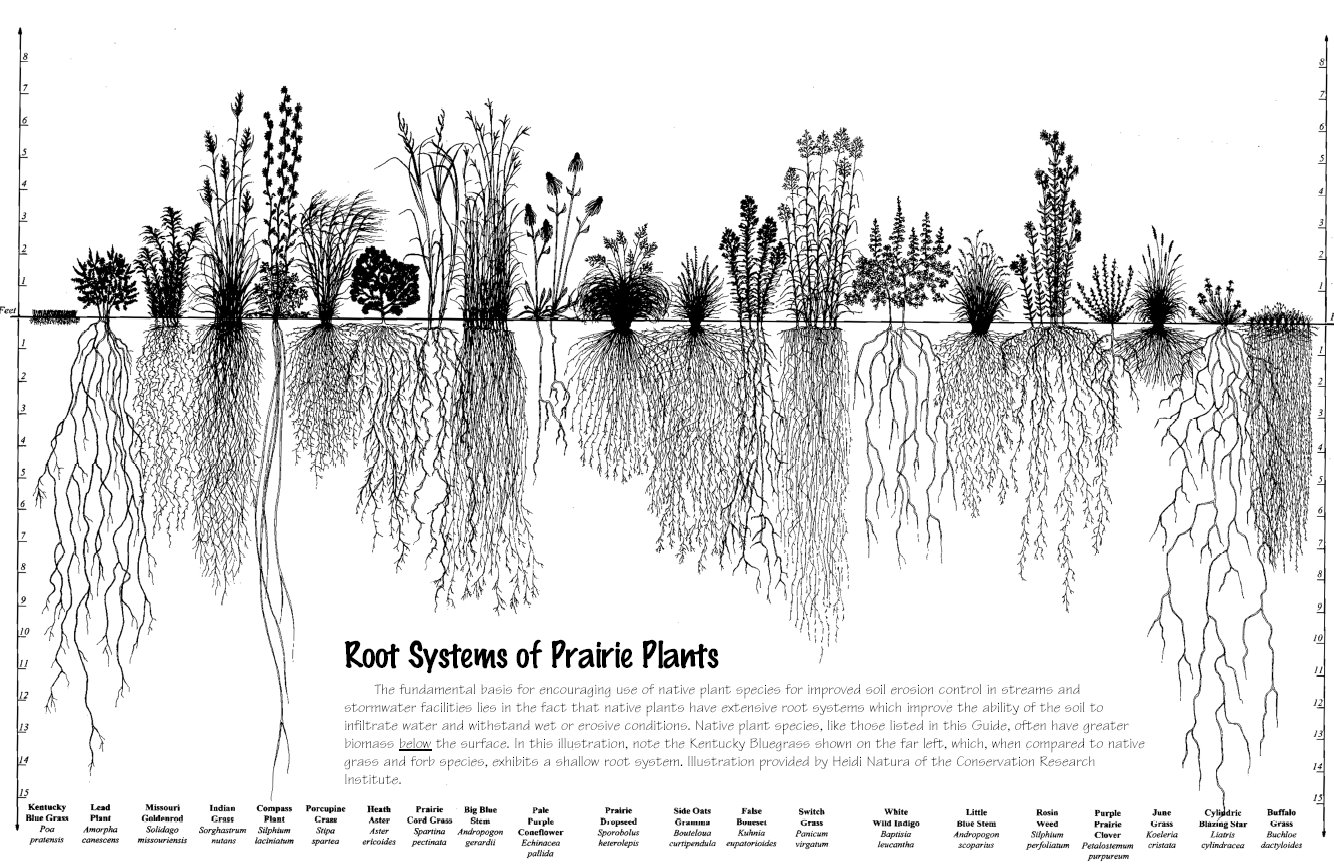
This poster shows how roots from native prairie grasses and forbs run deep … creating an “underground forest” that allows them to survive the surface fires.
“Refurbishing” is the key word. Over time that duff and dead leafy matter cause prairies to become clogged, or bogged down, choking out more and more species, especially perennial forbs and flowers. With the ash adding nutrients, and with choking duff burned away, dormant seeds and freed roots are given new freedom to sprout and flourish. Grass species seem flush with more vigor, too. Besides this regrowth, there is another benefit. Fires also help reduce invasive wood species such as Eastern Red Cedar … which, if you’ve visited the area around and south of Granite Falls, you will notice acres upon acres of the small evergreen trees that have completely overwhelmed the prairie grass hillsides.
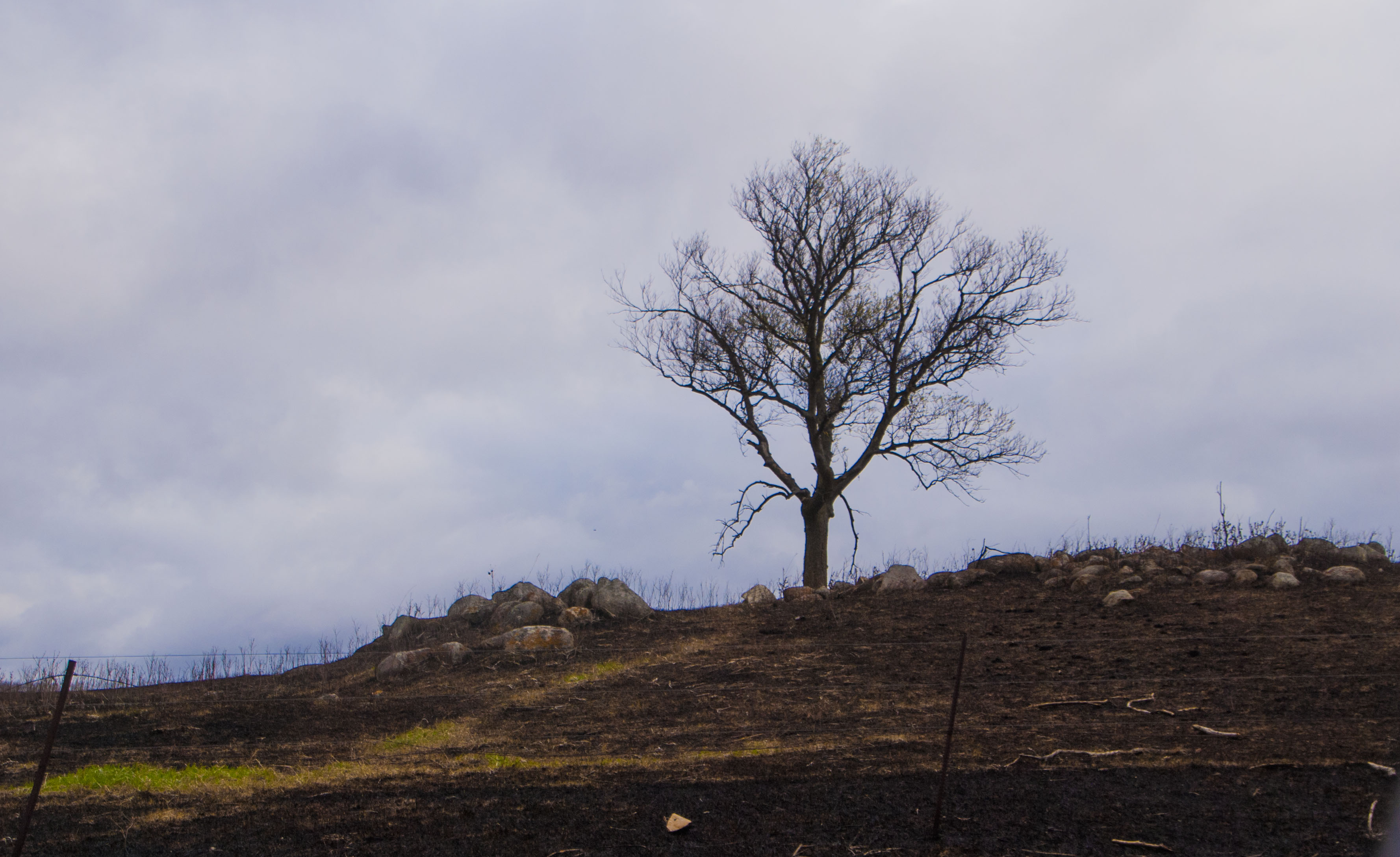
A lone tree after a recent prairie burn …
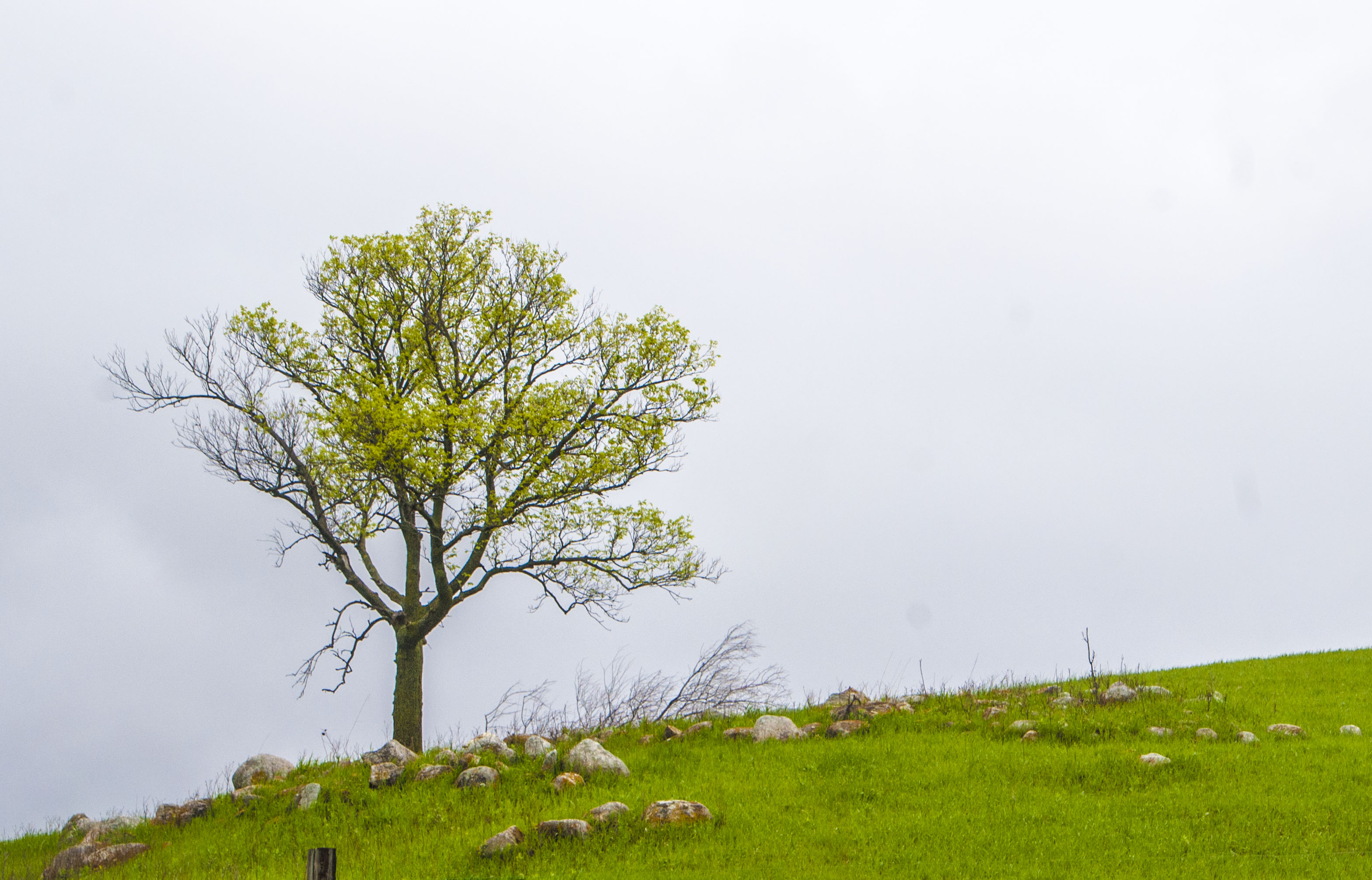
… and later, the greening prairie emerges.
A friend with a beautiful prairie near Montevideo complains, however, that recent fires did little to stop a cottonwood invasion in her grasses, although we are anticipating a fire on our prairie will hopefully put an end to the weedy elms that are thick in patches. Students of prairie ecology know, too, that burr oak, which will cluster in savannas on the shaded northern slopes of native prairies, escape damage due to deep rooting and thick bark growth.
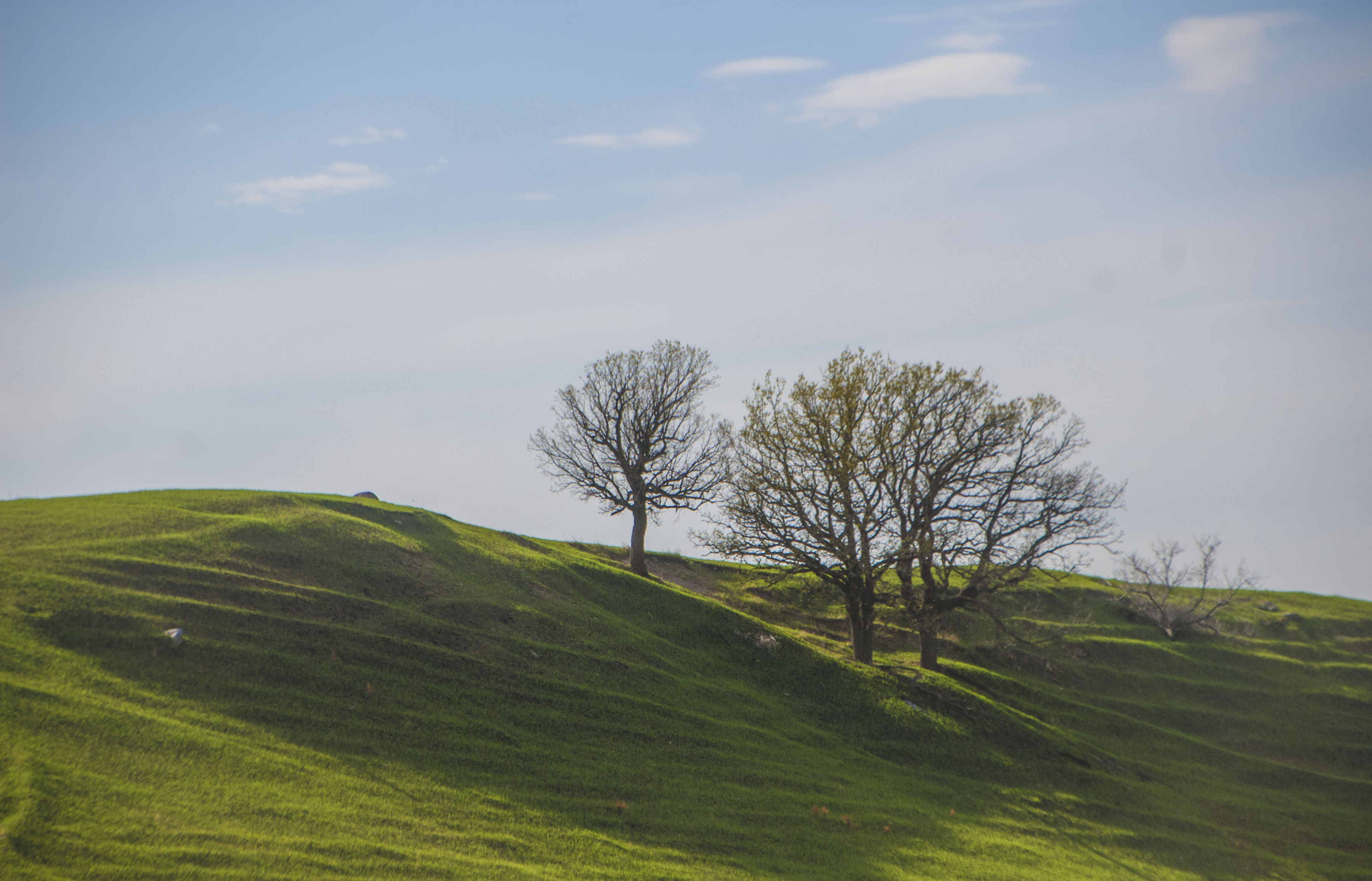
An oak savanna on the lip of a refurbishing prairie that was burned earlier this month.
In reality, we have an eye on a prescribed burn here at Listening Stones Farm. We’re at least two years out from our first burn, yet Rebecca mentioned a “window” for planting specific native flowers she hoped would have ample time to set root before a necessary burn. “Next year will be too late,” she said when returning with her digging trowel. Having a native prairie is a moveable feast of nature, for as yellow as our eight acres of prairie was last summer, we haven’t a clue what to anticipate this summer … or the next, or even in the year following that when we expect to do a burn.
It’s fun and educational to watch a controlled prairie grass burn. Thanks to their kindness, I’ve watched these professionals at their craft, and I’m still amazed at how well they do their work. It is perhaps more of an art than craft, for after a burn you can see how they have completely contained their burn area, working delicately around homesteads and fences right down to the “nth” degree with back burns and fire breaks. We can see evidence of their “art” just down the road from our farm, where odd shaped, long neglected prairies were burned for the first time in many years these past couple of weeks. Driving past the charred hillsides has given me renewed respect for their precision and work. One of those fields is already flush with life in ways we’ve not seen since we’ve lived here.
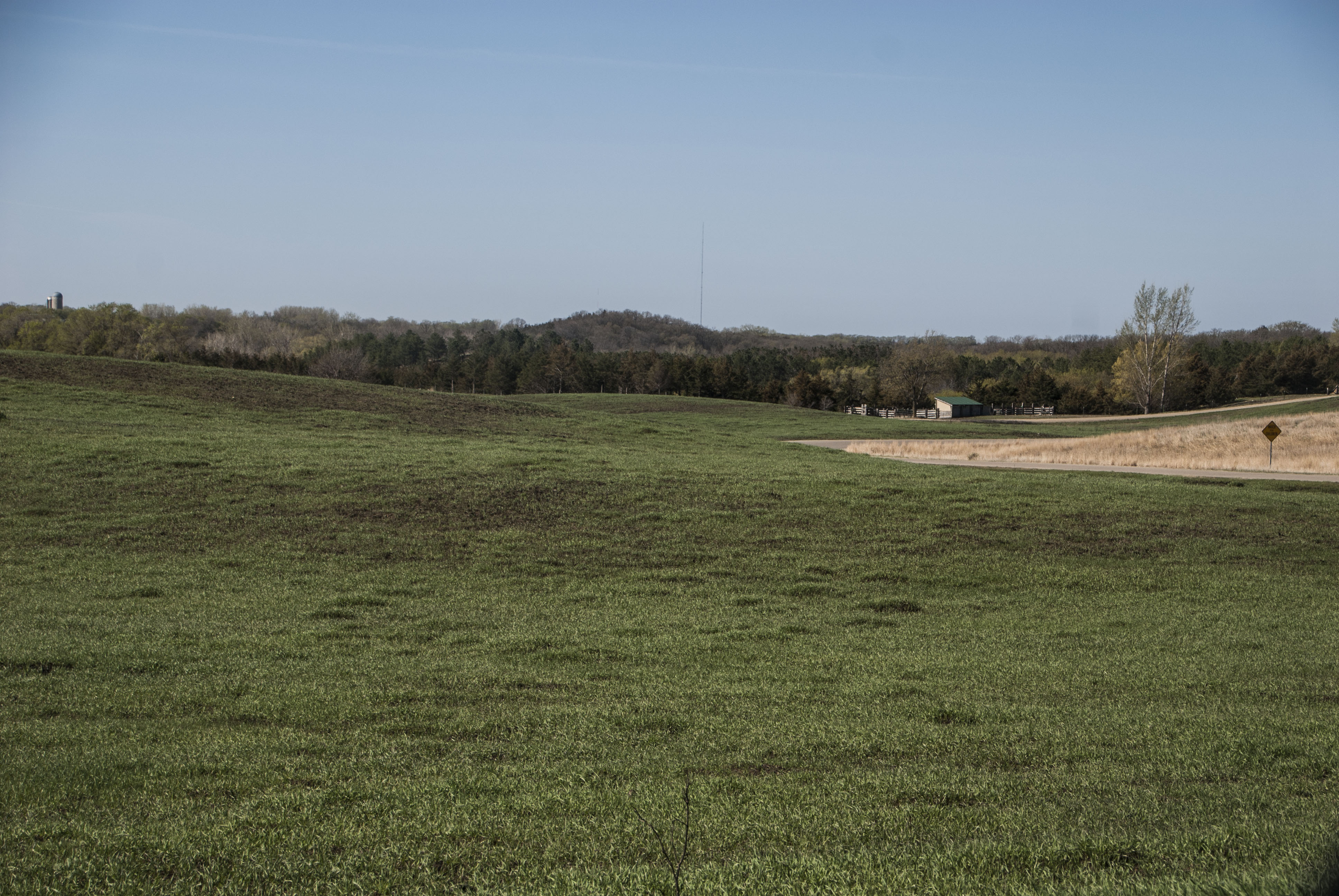
It didn’t take long for this burn to green at Prairie Woods Environmental Learning Center in April. Notice how the burn sweeps around the remaining, unburned prairie to the right.
Oh, and that patch of burnt prairie at Prairie Woods ELC? A few days after her comments I sent her a picture showing the greening on the charred hills that had caused her questions and concern … a greening that came within days of the initial burn.
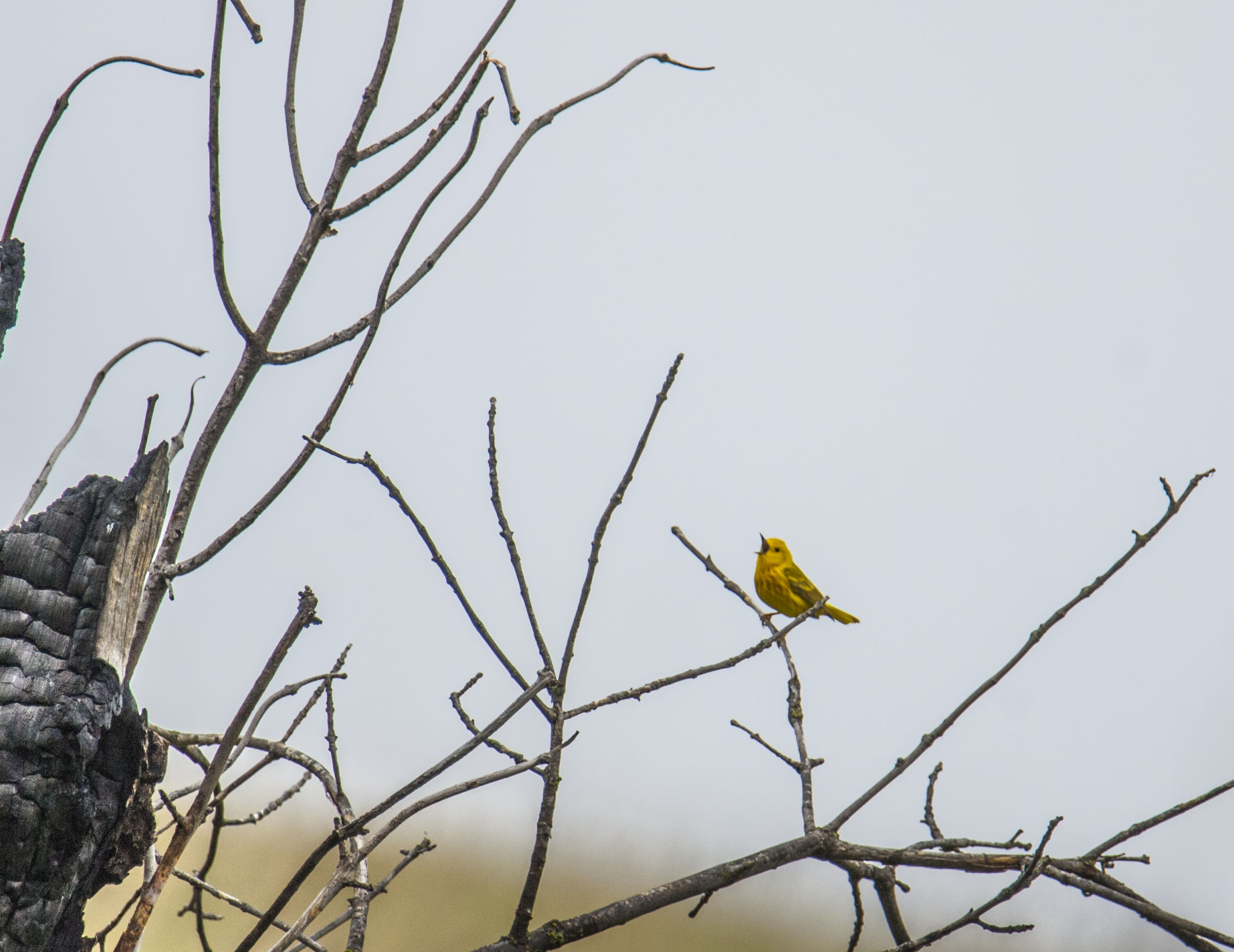
A Yellow Warbler sings on a charred snag from a two year old burn at the Bonanza section of Big Stone State Park … life from the fire.
Her reaction isn’t unique, for like most of us alive today, the millions upon millions acres of native prairie was gone long before she were born. Indeed, less than a percent of the original prairie remains in one of the most thorough conversions of a natural landscape anywhere on earth, all within less than a century of human settlement. While prescribed burns may seem harsh, in reality these fires are breaths of fresh air to the ancestral plants native to our land. From such fire comes life.
As the recent Clean Up the River Environment (CURE) annual meeting was winding down, I had a conversation with a long time friend and farmer who had ambled up. “Like to say those are nice pictures,” he said, nodding toward the row of canvases on the wall. They’re not, just for the record.
He was referencing my Art of Erosion show that had been featured as a backdrop during the all-day event for the clean water advocacy group at the Maynard Event Center. His comment was not uncommon nor unexpected, for many find themselves equally astounded and disturbed by the natural beauty created by the wind and black dirt on the clean white snow. Which is precisely the reason behind focusing my camera on what is commonly called “snirt” here in the prairie, all taken along roadsides in three western Minnesota counties. This was the third hanging, with the fourth coming up this weekend, and that “bipolar” response between the beauty of the artful patterns and the ugliness of the wind-blown dirt has caused many to simply stare at the images.

When my friend faced this situation on his farm a generation ago, he sought to change his cropping practices … eventually turning his nearly 600 acres into a commodity crop organic operation.
“My dad told me when I first started farming many years ago that the key to controlling thistles and pigweeds was to keep the soil black,” he told me. “That first winter my ditch banks looked just like your pictures. That spring, before planting, I took my tractor and front end loader out and scraped the dirt out of the ditches and back into the fields. It was a harsh lesson and my field edges haven’t looked like these pictures since.”
He and his family, including his son and son-in-law, farm just under 600 acres in the midst of the “black desert” in Chippewa County. Because we were in a conversation rather than a formal interview, he will remain nameless. Back when I was an editor of the country weekly in Clara City, he was the subject of several stories. He seemed to come up with interesting ideas, including once leaving his corn crop unharvested through the fall and winter because of high moisture content and incredibly high propane costs. In the end he figured he came out ahead since the spring price of corn is typically higher than he would have fetched in the fall, and he didn’t believe he had lost as much ear and kernel drop as he anticipated.
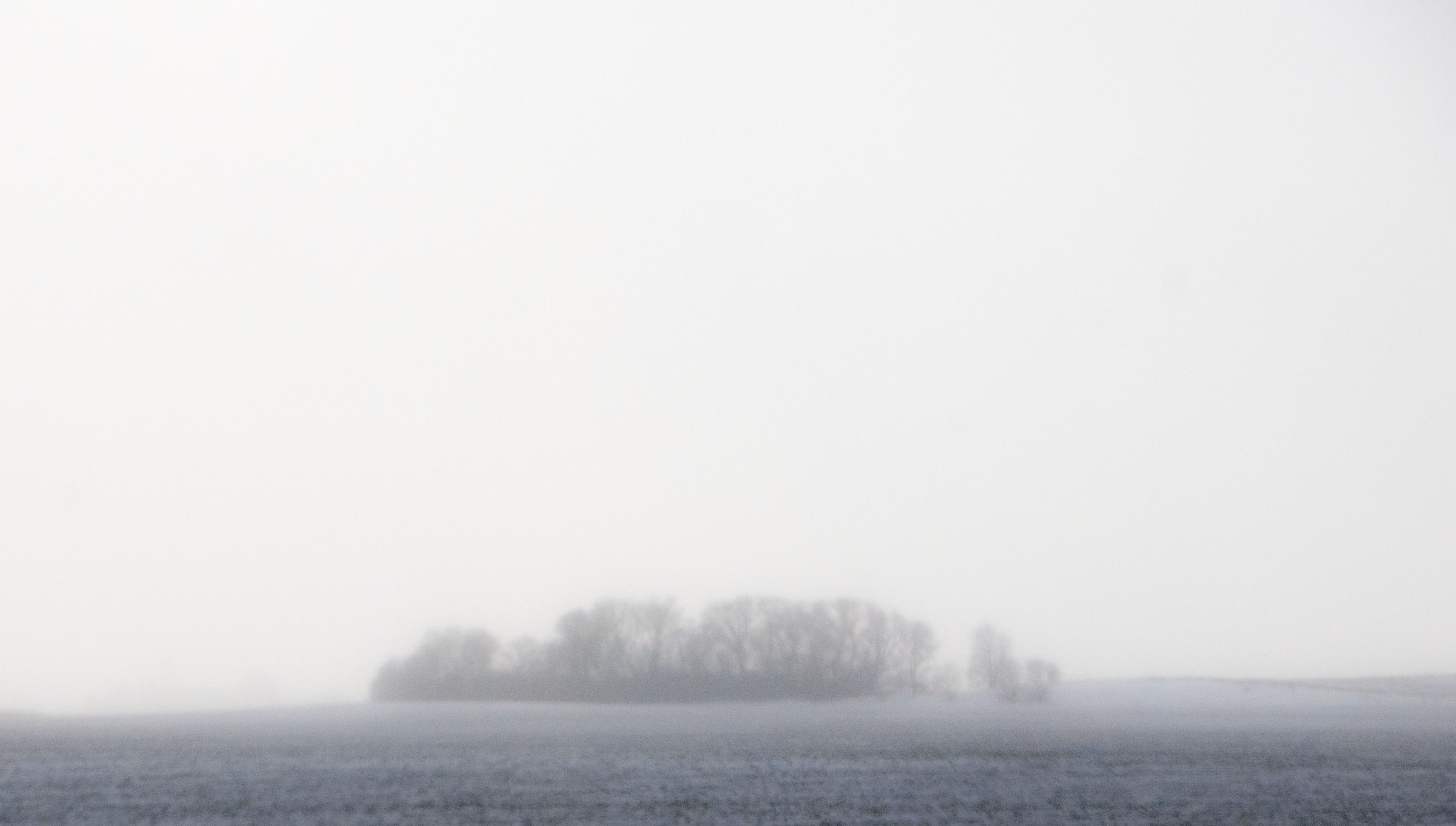
In February, winds whipped up the snow and dirt in Chippewa County … had there been more snow on the ground, more snirt. Note that this is a full color photography, not black and white.
This was before his son returned from a college basketball career with a wife and new born son in tow, and before his daughter’s husband joined the family business. Their collective decisions to join in created one of those “ah ha” moments with the realization they had to do something different if their farm was to survive. Land prices were escalating right along with both machinery and crop input costs. It was a time when neighbors were coming to grips with having to join the USDA rat race or hire an auctioneer. What they decided to do instead was go organic. “We didn’t know what we were doing,” he said. “But we learned. Right now we’re supporting three families, and we’ve put two kids through college with two more almost through, and none with a college loan. After this batch we have two more. We couldn’t have done it if we’d stayed conventional. We just couldn’t have afforded to keep going in that direction.”
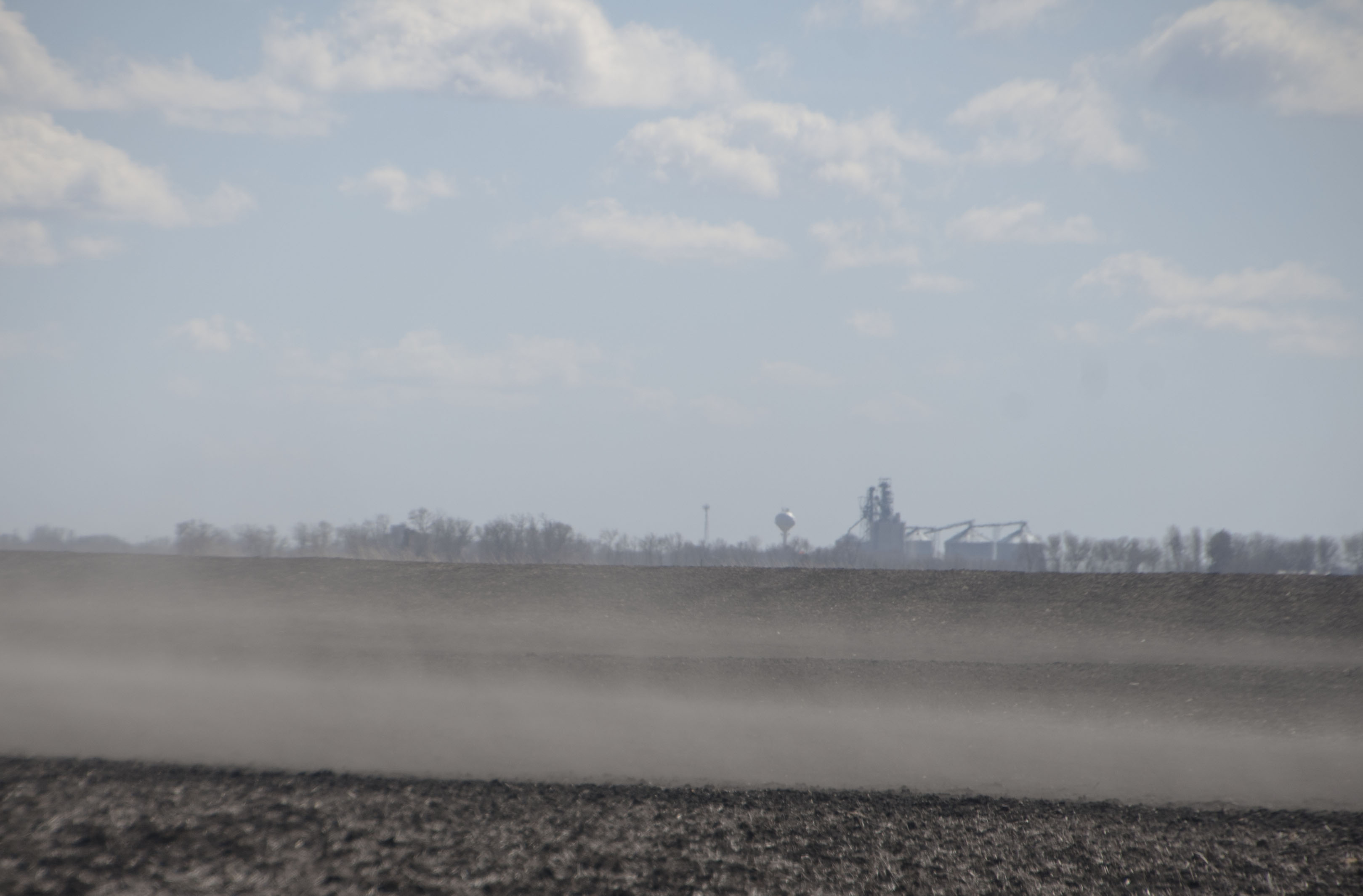
In March, winds whipped up the unprotected soils north of Clara City … you can see the “skyline” in the background.
When they first went into organic production, and obviously before certification, he was reluctant to share his story. “I get in enough trouble around my neighbors,” he told me at the time. Those first years were tough, especially with the weed infiltrations. Going organic meant that the family had to learn not only how to farm, but also how to market. Financial survival meant the end of “plant and dump” marketing. Saying “no” to Round Up farming meant developing cultural farming practices practiced by a very few organic commodity crop farmers, who like his family, raises corn, soybeans and sunflowers.
They did find sources of information and peers, and eventually settled into very productive crop rotations that have virtually eliminated weed issues while helping with natural fertility. “Our soils are totally different now. We can hold moisture like we couldn’t before. It is more pliable and alive. This past harvest we had the best soybean crop ever, averaging almost 60 bushels per acre. We beat our next door neighbor who farms conventionally by 25 bushels an acre. The key is learning the right rotation. Like that real estate slogan, it’s ‘rotation, rotation, rotation.’”

One of the scenes from my Art of Erosion series, showing the effect caused by wind blown dirt.
He told of attending a recent meeting over the buffer strip controversy going on in Minnesota and found many of the comments made by those attending bordering on asinine. My word, not his. “One guy asked why we needed buffers to keep nitrates out of the rivers when there is more nitrogen in the air than in the soil. ‘What are they going to do,?’ he asked. ‘Make us buffer the sky?’ This was met with a round of laughter and cheers. Finally one guys stands and suggests that as farmers we need to do something, that continuing to drain and let the runoff ruin the rivers just wasn’t neighborly or sustainable. The place was completely silent, so I clapped, then another two or three others clapped. You should have seen the hatred of those toward us.” He paused. “For us, we maintain 100 foot buffers on either side of our ditches. not the 50 feet the governor (Minnesota Governor Mark Dayton) is proposing.”
Obviously going organic isn’t for everyone, yet he made some interesting points. One hundred foot buffers. Supporting three families, including two with college-aged children, on just under 600 acres of tillable land. Rotation, rotation, rotation. Pliable soils with good moisture holding capacity. Significantly reduced crop and machinery inputs. Learning how to both farm and market what is raised..

An example of an effective buffer strip in Chippewa County.
“This ‘snirt’ situation is getting worse each year around here,” he said, once again nodding toward the canvases. “I’ve taken pictures of it, too. Used to be you could count on having snow cover, which we haven’t had for the past couple of winters. We don’t fall till, so our soils are staying put. But as farmers we need to do something different, whether it’s leaving stalks in the field until spring or planting cover crops. Soils all around us have blown all winter, and with this dry spring the winds are picking up even more of it. Bottom line, we have to take better care of our soils.”
My goal with the Art of Erosion photographs was to spark conversations by showing the ugly beauty created by the snow and wind. Hopefully some of those conversations will lead to change. Our civilization is farming the last of the earth’s tillable soils, and once those soils are eroded by both wind or water, where will those farmers of future generations find resources to grow food? How will humans eat?
Many years ago a dear friend and fellow nature photographer, Greg Ryan, and I were invited by a nature loving Cajun friend to visit the Sabine National Wildlife Refuge near Hackberry, LA, late one afternoon. As the sun settled over the coastal wilderness, the Sabine came alive with gorgeous sounds, of which our naturalist did all he could to identify what we were hearing.
“There,” he would say, “alligator!”
After awhile, he simply gave up. Herons, alligators, frogs and all the rest turned the Sabine into an audio jungle as darkness settled over the grassy wilderness, so much so that ever since I’ve used this as the high water experience for wilderness audio moments.

By clicking on an arrow at the extreme right corner, you can “blow up” this great image taken by Rebecca to better see the number of geese inside the clouds.
Since moving to our farm, stepping out onto the porch roof or into the yard at night this time of year is a near equal. No, we don’t have alligators nor herons, nor many of the hundreds of other nocturnal denizens that created such an euphonic chorus on that humid night in the Delta, but we have our geese. Thousands of them. Just over the hills to the east and north of us, thanks to a couple of wetland sloughs neighboring farmers have generously not drained. This time of year a third “ghost” of a wetland is also found just to the west of us.
In the late afternoon sun we can watch as we cook dinner as skeins of geese ease from the sky down to the temporary lake. This means we’re basically surrounded by various species of geese and ducks that follow the Flyway and make the many wetlands all around us, as well as the nearby National Big Stone National Wildlife Refuge and Big Stone Lake, stopping off places en route to permanent homes far north of us. Of course, some of the geese are now pairing up and claiming portions of the smaller wetlands for nesting sites, but the majority are just passing through.

The darkened “island” is actually made of congregated geese.
Although we can hear and see the nearly constant population of geese during daylight hours, our trees are just as likely to serve as temporary hosts to the clouds of murmurating blackbirds. Having a murmuration suddenly descend onto the farmyard isn’t unlike hearing a huge soccer or football stadium suddenly fill of fans. When one landed the other day, I rushed inside to catch the attention of Dale Pederson, who has been here finishing his work on our Taj Magarage. We both stepped outside just to listen for a moment, both of us smiling in appreciation.
Yet, it’s at night when the sounds of the geese ratchet to decibels not unlike that night in the Sabine. Though not nearly as varied and exotic, this sound is nearly as rich in spirit and verve. Many nights we will stand outside just to listen to the stereophonic chorus that surrounds us. “We live here,” one of us will say. We say that a lot, especially this time of year.  We both take pictures, and are still hoping for a really good one. Rebecca’s image into the sun and cloud banks the other night was incredible, for once lightened just a little, the skies were literally full of flying geese. This morning, like many mornings here on our farm, clouds of geese circled over the wetland in the rising sun just to the east of us. We both had our cameras out taking pictures, and I even sneaked one in of her looking out our bedroom window.

You can see the dots of flying geese in the sky past Rebecca as she looks through the window.
Yes, there were hundreds of arcs and vees above in the sky, but inside the wetland an entire darkened island contained of thousands of geese. So dense that only the occasional movement of a head gave witness that this was an island of life, of birds, rather than some dense “jungle” of aquatic prairie plants. And, of course, there was the sound. Though not as loud as it can be after dark, the songs were still amazing.  As we look around in the trees and shrubs around the farm we can identify many different song and prairie birds we know are simply passing through. We see them on the feeders, too, and secretly wish some would stick around for awhile. We just took several moments to watch a bald eagle that had landed in the tall cottonwood on the corner of our grove. Eagles, though still a treat to see, are actually fairly common in our area close to Big Stone Lake and the Minnesota River. We often take a drive through the Big Stone National Wildlife Refuge, and the other night as the sun was setting, Rebecca excitedly shouted for me to stop. Over one of the beautiful outcrops she noticed five bald eagles in a tree, silhouetted by a beautiful, red-tinted sky.

Above the trees looking south from our deck.
Spring is a lovely time on our farm. Yes, we have varied and usually beautiful sunrises and sunsets throughout the seasons, and many nights we stare through our plate-glass window in the kitchen as we sip on a glass of wine and make our dinner as the sun wanes in the west. Soon the acrobatic swallows will arrive, along with the thrashers and other birds from the annual migrations. Come fall the geese will return, but the occasional reports of the sporting shotguns offer interruptions of silence unknown in the spring. Yes, this is the season when our neighboring wetlands come to life visually and audibly. It’s spring, and a lovely time here on our farm.
Yes, we live here.
Rarely do I come home from an agricultural conference feeling as if much good has come of it since there seems to be so much negativity involved with the overwhelming crush of monoculture intent. Last winter it seemed it was all about pollinators and Bt-flavored GMOs. The year before there was a whole round of climate change fears starting with presentations by Will Steger and continuing on into last spring when a University of Minnesota forestry professor forewarned us about deciduous understory growth that is already supplanting what we know as the great North Woods. So it goes.
This year water has come to the topic table. The corporate buy up of water rights by Nestle in California, or fears that Los Angeles and southern California and even San Paulo in Brazil, two of the world’s largest human residencies, will be out of water by October. Here in Minnesota we fear for what the mining of fracking sand for the oil fields will do to our underground aquifers, and to be truthful, what horrific pollution is being caused when those same sands are pumped into the oil fields to contaminate underground water sources in many parts of the North American continent. Now there is talk of a huge, undeveloped tar sand oil field in northern Mexico … meaning we can expect even more contamination of water resources.
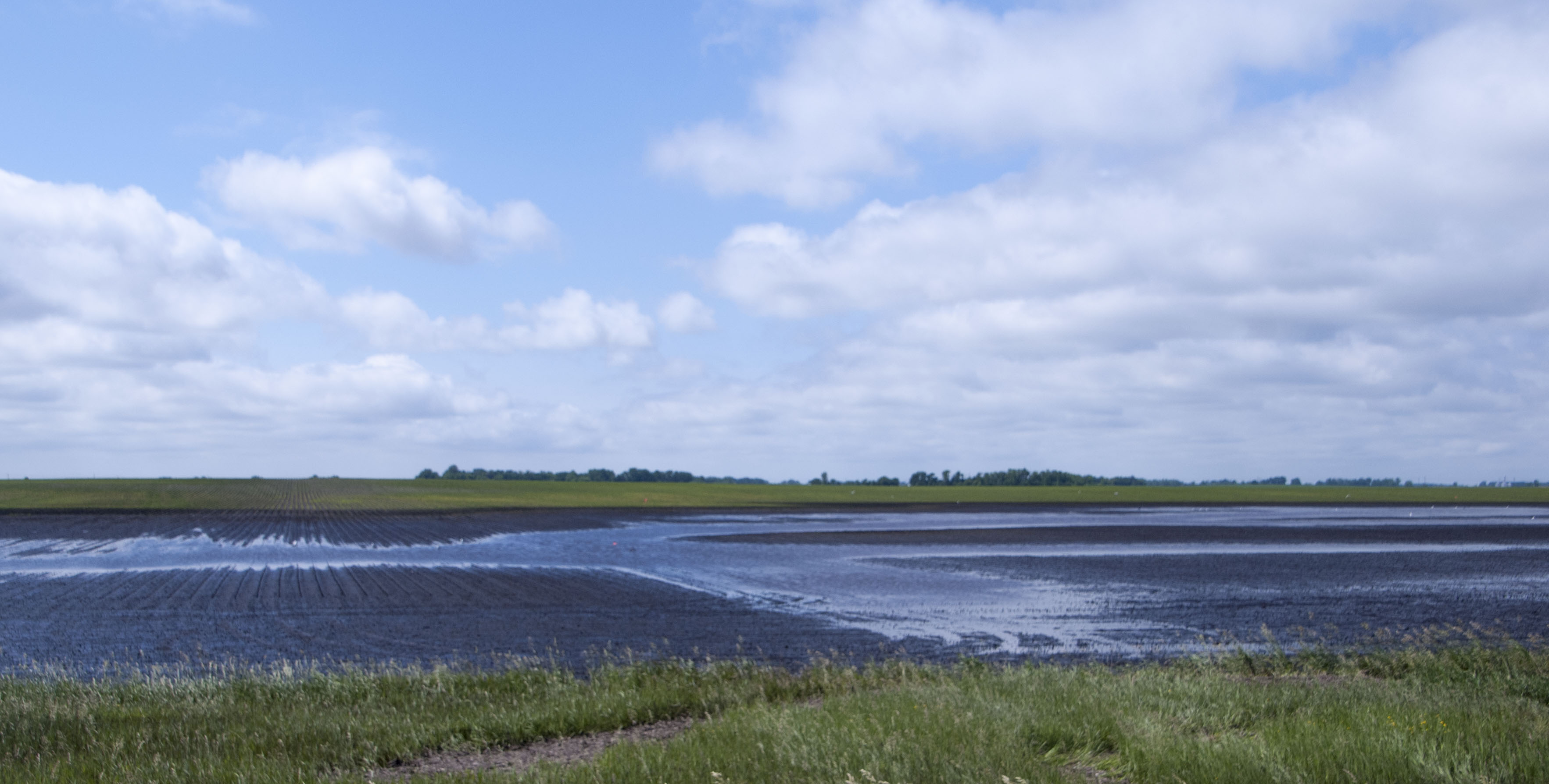
Though temporarily fill, drained wetlands like this one no longer allows for a recharging of the prairie aquifers.
At the conference we were told of how those water friendly tensiometers that measure crop moisture stresses under center pivot systems in the High Plains began beeping like Vegas jackpot machines last summer … for all the wrong reasons. It seems the evapotranspiration rate was so high there that irrigating farmers actually shut off their pumping of water from the diminishing Ogallala Aquifer because the cost of “keeping up” was simply too expensive.
We have our own water issues right outside our windows here on the former prairie. Yes, our farmers continue to add more efficient, pattern-tiled drainage to better flush excess spring melt and early season rainfall from their fields and into the prairie rivers. But wait. Global climate change has also introduced a rather recent trend of choking droughts following the initial spring moisture feed, often around Independence Day. Meaning that in a given year a crop producer can experience both the drowning of a crop due to incredibly high moisture levels and a crop-starving drought in the same field in the same year.

Climatologist Mark Seeley said changing climatic conditions such as high spring moisture coupled with mid-summer through fall droughts will change farming cultural practices.
So those drainers who can’t wait to flush excess rainwater downriver from their cropland are now tapping into groundwater and adding center pivot irrigation rigs on those same fields to sustain commodity crops like corn, soybeans and potatoes. Groundwater that’s not being recharged at anything close to its historic rate due to wetland removal and tile drainage systems. Remember, it’s a rare instance when any of the drained water is stored, and repeated efforts of attempting to have those who are installing patterned tile upgrades with water table management devices have gone unheeded. While this drainage/irrigation situation is perplexing, it is also becoming ever more common. Indeed, since the conference a friend told of receiving a letter asking permission for the wells on his rural home site to be monitored because an outside investor has purchased a farm within a two mile radius and has sunk an irrigation well onto the property for a center pivot.
“I don’t want my well monitored,” said my friend. “I just want my water.”
Are you wondering about that “feel good” yet? Yes, it has to do with water and farming.
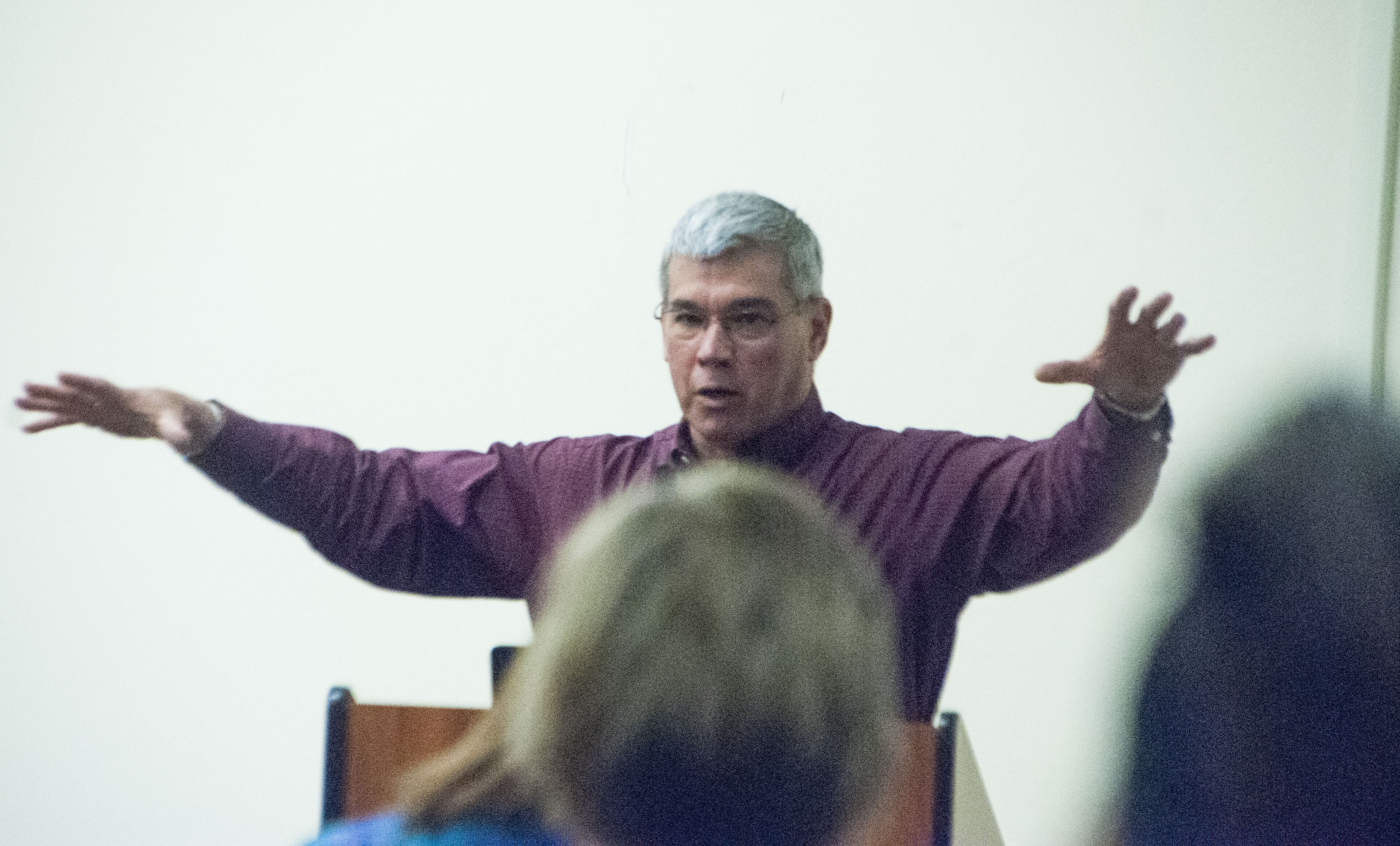
Jerry Hatfield, director of the USDA/ARS National Laboratory for Agriculture and the Environment, discussed the changing seasonality and intensities of precipitation, and suggested the time might be right for new cropping mixtures.
It happened during the recent Farmers Lead the Way conference held at the Southwestern Minnesota Research Station to explore innovative ag practices designed to adapt to the changing climate and weather conditions. I had been invited to hang my Art of Erosion show during the conference, and was invited to participate as well. In the morning speakers like Mark Seeley talked about the effects of climate change on cropping patterns, then after lunch several breakout sessions were held around the large conference room. That is where I heard Grant Breitkreutz, a Redwood, MN, farmer, talk about, of all things, cover crops.
We have both been interested in cover crops for specific reasons, Rebecca with her work with the Land Stewardship Project, and us both with how cover crops might reduce “snirt” problems that are increasingly severe and heightened by a climatic change of reduced snow cover many farmers have failed to address with crop cultural practices. Breitkreutz has, and offered some rather unexpected benefits by doing so. Ironically and by coincidence, he began toying with cover crops about the same time new drainage tiles were installed on his farm … both about a decade ago. He uses a tractor-bourne seeder, or an aerial seeder if it’s too wet, to interseed a mixture of legumes, rye grass and vegetable root crops like radishes and turnips into his row crops of corn and soybeans.

Combining the arts, including my Art of Erosion canvases, with science was an effective and interesting way of handling a touchy subject matter.
“Once we figured out what we were doing, our tiles have been dry. Meanwhile, we’re actually rebuilding our soil. Running a no-till planter through our fields is like planting into a garden,” he explained. His soils have come alive and have water holding capacity while reducing crop inputs. All without diminishing yields, and perhaps as importantly, without added machinery costs. Consequently, his soils are not blowing nor is he needing irrigation because of the increased carrying capacity of soil moisture due to the deep rooting action of his cover crop mix.
“My neighbors initially thought we were nuts. Now they’re driving into the yard asking us what we’re doing. I don’t have time to teach them all, which is why I do these meetings. Cover crops have been a total win-win for our farm,” he said.
It is always refreshing to hear a positive story, and especially one coming in the face of so many destructive resource management practices. Cover crops are likely not a panacea for every ill-conceived production practice, yet they certainly should give pause to those who have seen those telltale dirt dunes along the roadways … and perhaps even for those who are thinking of sinking hard earned cash into an irrigation rig and deep well. We can only hope.
Overnight our prairie changed. Apparently while we were snuggled warmly beneath a pile of quilts, a cold, blustery wind rolling like a freight train across land left a ridge of snow dunes and snirt along the fringe of our prairie from our neighbor’s bare-plowed field. Deep, two to three foot drifts were caught by the prairie grasses.
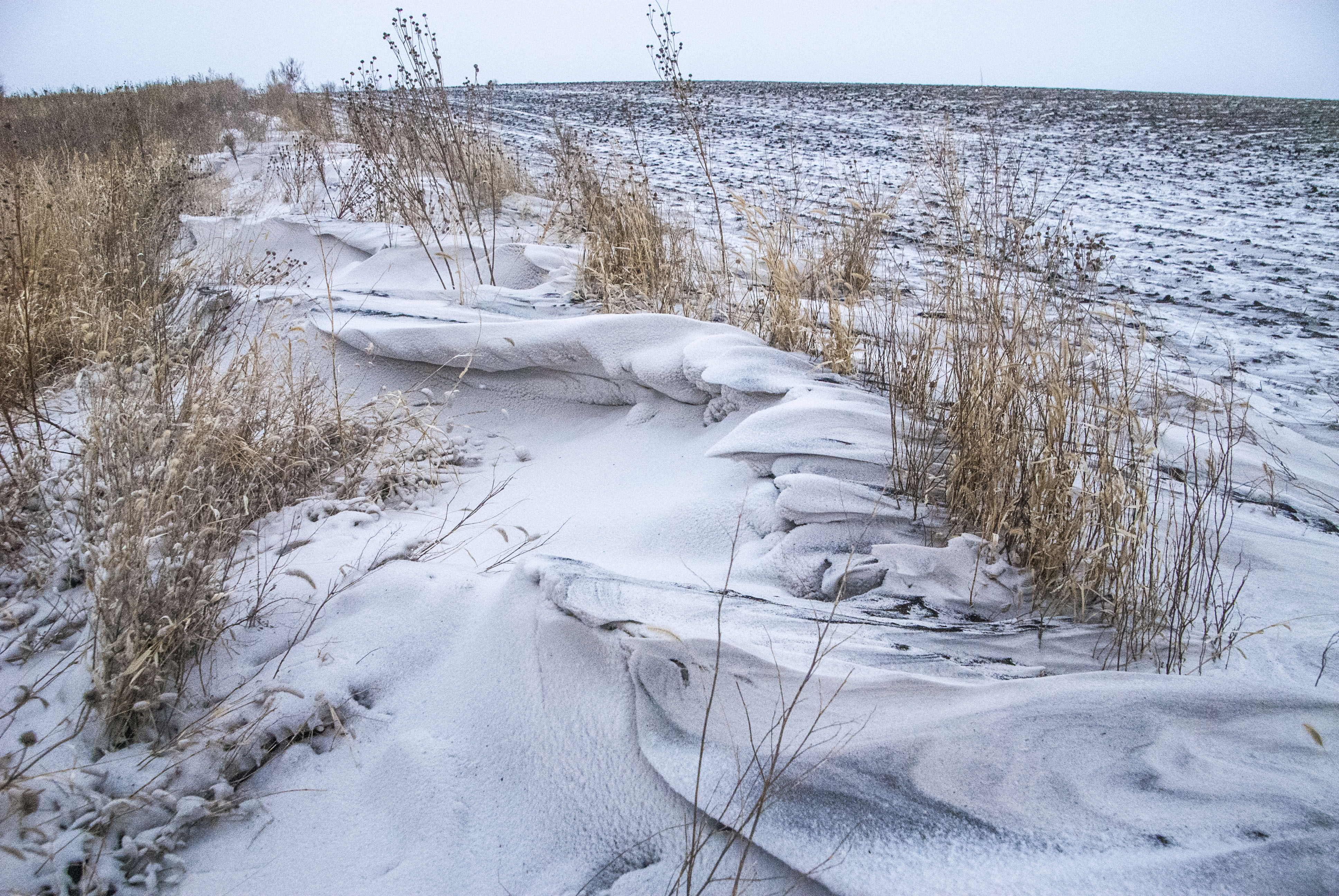
Our snirt dune, and the adjacent field that was so generous.
Wind is a significant part of living here, and accounts of wind seem to harass prairie writers as fog does in the novels of London. You don’t have to read too many accounts from the early settlers of the prairie to read of how they gained such a hatred of the wind. Some wrote accounts of losing their minds from the constant wail of the wind. While it is difficult to say how many of us “modern” prairie inhabitants are so afflicted, there will likely (or should) be some farmers concerned enough about the dirt being blown from their fields to do something about it. While we’ll happily take what they’re offering, for it’s free to us, the legacy they’re allowing to blow away puts their finances at peril on the short term, and humanity’s ability to survive at greater risk in the long term.
Yes, the wind is part of the prairie. With each windbreak cut, dozed and burned, and with every spare inch of sod turned into commodity cropland, we lose rather than commune with the wind. Little has changed in the natural forces over those years except for the treatment of the prairie soils we were so blessed with after the last glacier. We have ripped it open, ditched it to drain the water from the wetlands before we laid tile to empty soil moisture for earlier planting. Ninety-nine percent of it. Now a more recent generation of farmers, heaped under high production and equipment costs and land prices, are working to convert more land into crops, and to re-tile with more “efficient” pattern tiling. Yet, the wind still blows, and with it, the product of their decisions … the soil on which they farm.

We can almost guarantee these constants will not change: The wind is going to blow, winds that are often harsh and constant; and with it, soils that become roadside and ditch borne dirt.
Learning of the harshness of prairie winds has been a revelation. My first 20 some years of living in the Minnesota prairie was on the edge of a small prairie town. We joked that if we wanted to feel urban we could simply look through the front windows where a picturesque postcard scene of tranquility came from an overhanging canopy of mature trees and older, comfortable looking houses. Across the room, though, the view was of the federal version of Hawk Creek and the prairie beyond. It was, in our minds at the time, a perfect collision of town and country. We did notice a wind, especially just before a blizzard when it seemed to reside above the roof tops in a distant roar. You could hear it, and watch as the tops of the trees waved their naked branches, but you couldn’t feel it. With non-blizzard winds, there were just too many houses and, yes, urbanity, to feel the full force of a prairie wind.

Joe Pye found the snirt dune to his liking!
Now, having since moved to our Listening Stones Farm, we can hear it, feel it, and if you watch the prairie grasses nearby, you can see it. William Least Heat Moon wrote of how the wind gives prairie grasses the freedom to dance while those same grasses give face to the wind. If you lived here, lived within an actual planting of prairie grasses, you would identify with his description.
In our first year here my goal was to walk to the end of the section and back, a two mile hike on a gravel road. On one of those first hikes the trip down to the corner was brisk and easy, and I was feeling pretty chipper for my age. When I turned to return, and once past the abandoned and protective grove at that end of the section, it was a struggle make progress against what was actually a staunch breeze. By the time I made it to the protection of our grove I was worn out and working to breathe. Against a full blowing northwest wind you are simply pleased to make progress. After a year of this, a membership was purchased at a nearby gym with a couple of wind-free treadmills.

Using the wind in a photograph of a blue stem prairie.
Like most of the farm homes on the prairie, our house is surrounded by a dense grove. That first year the buckthorn was too thick to get through. Those walks on the gravel road in the open prairie was enough to gain a deep appreciation of the trees. Even the buckthorn. Our biggest concern of clearing the buckthorn the following year was how the new “openness” would translate with a cold wind. Our sawyer, Kurt Arner, suggested we not worry, that the windrows of downed buckthorn would still provide enough protection. He was right. Our mailbox, set just past the protection of the grove, serves as a sobering reminder of the worth of the woodland.
Last year after a cleansing of the vast buckthorn along with many of the damaged and diseased trees, including some with the telltale burnt brown “zipper” stripe caused by lightning, we planted 70 bareroot trees and countless shrubs. Some were fruit trees in our new orchard, but the rest were planted inside the canopy of the standing grove where Kurt had left “holes.” Recently Rebecca has been stewing over our next order of trees. Kurt has also returned to take down some offensive elms, buckthorn and other weed trees on the south and east portions of the yard.

Cone flower pods accented by prairie grasses moved by the wind.
In a short time we’ve learned to commune with the wind. Fighting it is futile. We raise chimes to create wind music, and I’ve learned how to use the wind in my photography. Our prairie grasses on our eight acres of tillable land protects the soil. An east wind will cause our water lines to freeze upstairs, so yes, we’re conscious of it. We’re equally conscious of the effects of the wind on the fields of our neighbors. Those who have left stubble in their corn fields have clean ditches. Those who plowed, even minimally, do not.
Although we have eight acres of replanted prairie, the two of us … migrants from tree-blessed states of Vermont and Missouri … love our few acres of trees, and actually bless them on nights when you can hear the steady “lullaby” of the prairie wind. Last night, as that gusty lullaby of prairie music played and partied, a horrible hangover of particles of blown snow along with minute molecules of our neighbor’s dirt were left in drifts along the fringe of our prairie, choking the dance.
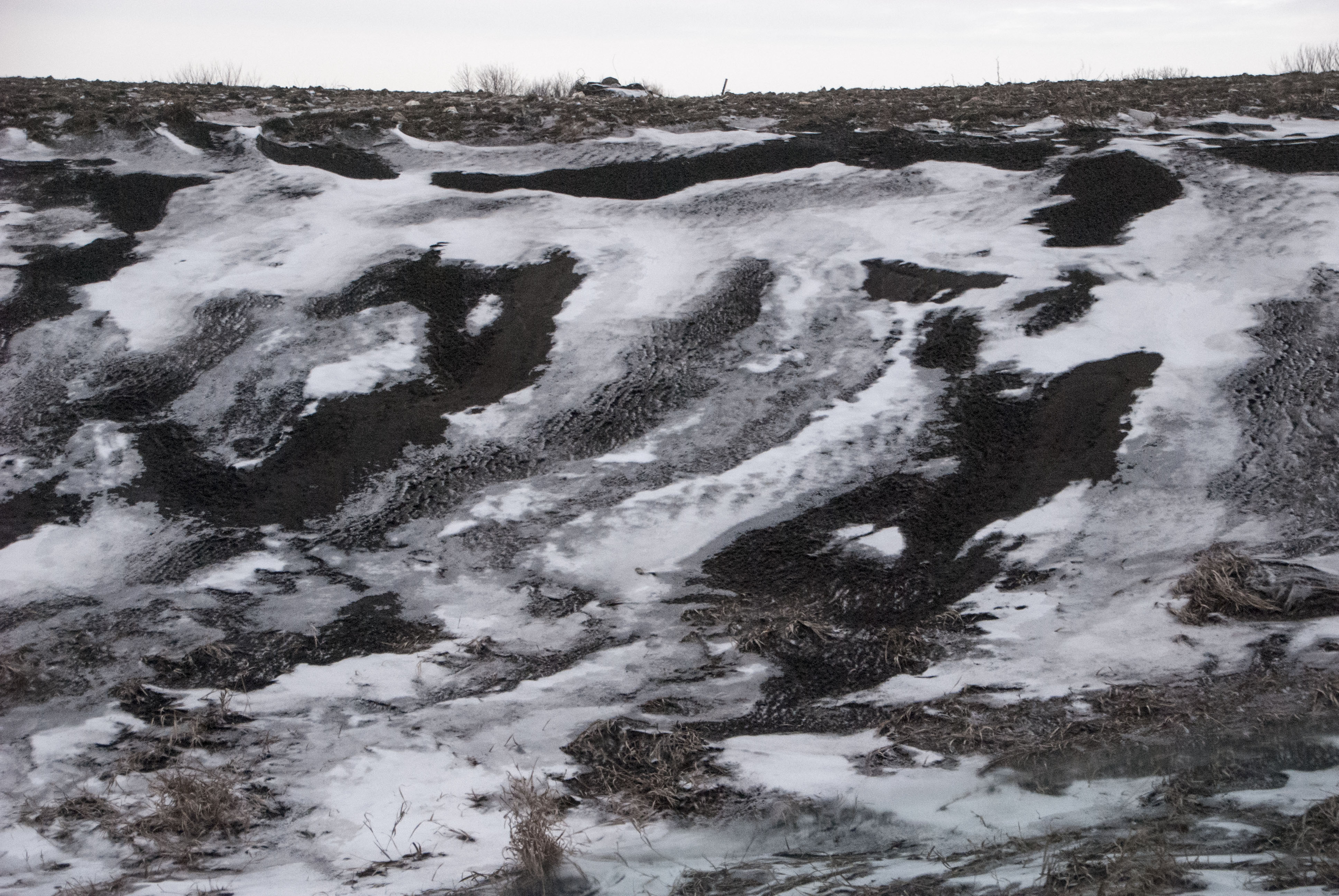
Just down the road apiece is a prime example of the horrendous issues with wind-blown dirt … all of which will wash into Big Stone Lake in the melt and spring rains.
 Listening Stones Farm