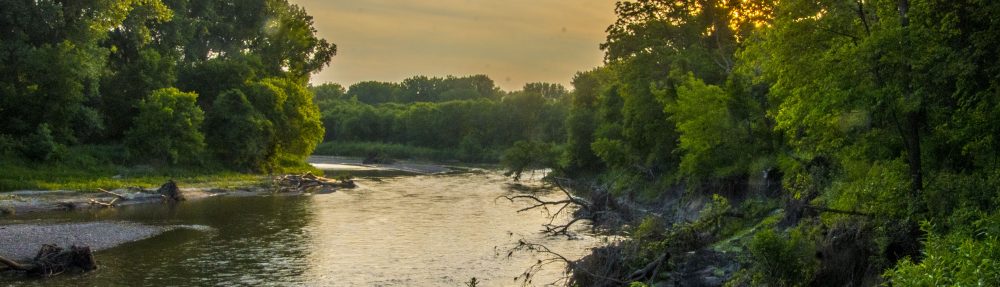
Bathing at Bonanza

At first I thought she might be joking; that I could be so clever and imaginative, that I could come up with something as ever reaching as “forest bathing.” Now I wish of having had my camera at hand to capture the look on Roberta’s face when former exchange student, Lucy Hille, grew suddenly excited about the possibility of doing some forest bathing like she does on occasion in her native Germany. My suggestion was meant as a possible highlight on a forthcoming saunter along the lake-side trail in the Bonanza portion of Big Stone Lake State Park.

“Really?” Roberta asked in surprise. “You have forest bathing in Germany?”

“Oh, yes,” Lucy answered. “In German we call it waldbaden. It’s where you can get away from the city to go into the woods to meditate away from fast life and noise.” She backed that up by saying it was being practiced by cultures around the world thanks to the Japanese practice they call “shinrin-yoku.” Of course, this has nothing to do with a bar of soap, nudity (although that is certainly possible) or fluffy towels. It is most simply a mind game.

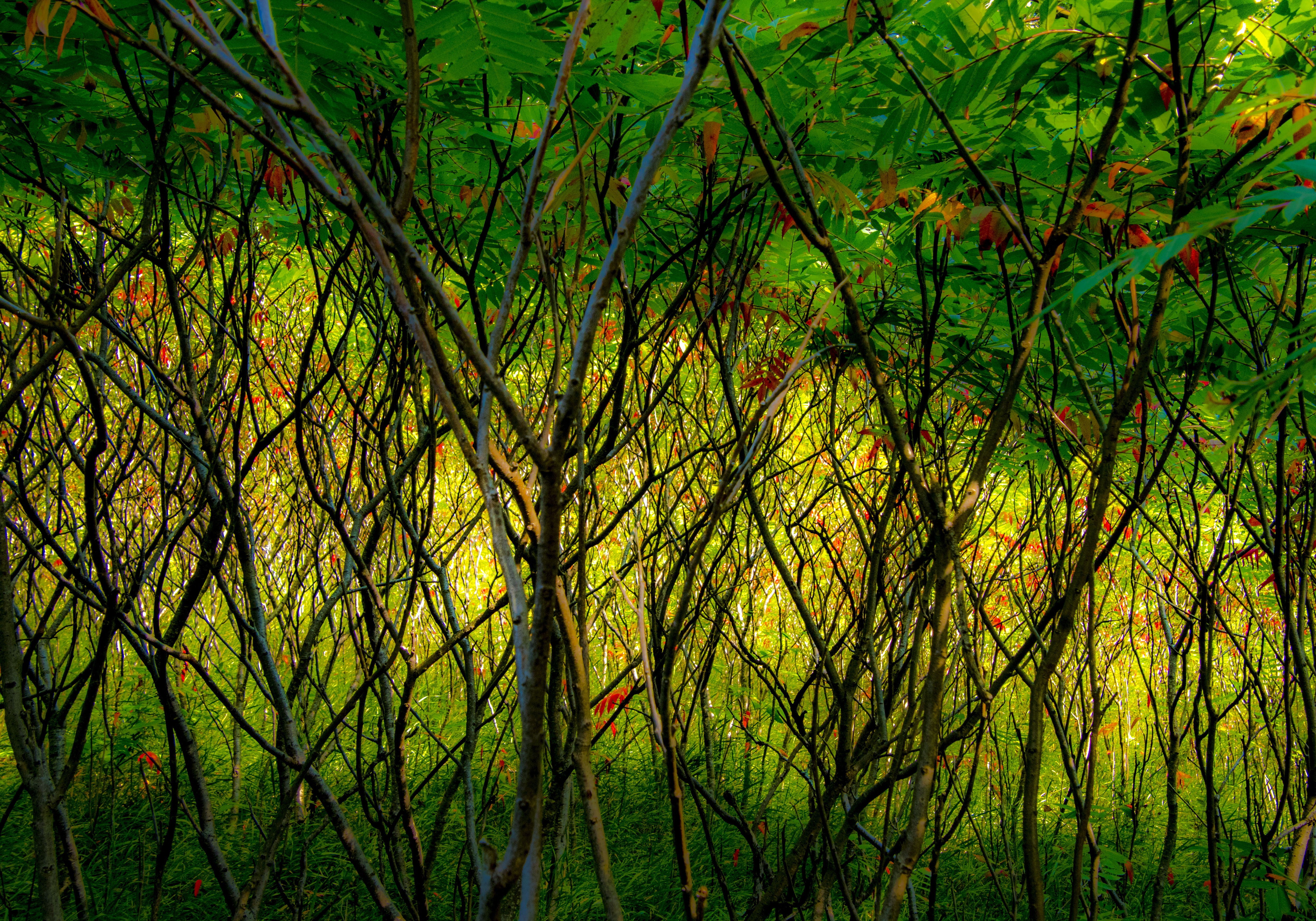
Roberta call the oak limbs “Halloween trees” and they offer a splendid visual aspect to forest bathing, or what Lucy said is called “waldbaden” in her native Germany.

So waldbaden, or forest bathing, is learning to meditate in nature, and became part of our beautiful, sunny summertime morning. Next to us the waters of the 26 mile long Big Stone Lake were calm, with very little boat traffic. A slight breeze seemed to ease through the trees although there was a calmness to the lake surface. We were barely into the woods, yet far enough along that the car wasn’t visible through the leaves, when I brought our little progression to a brief halt.

That is when I stopped us to suggest we simply close our eyes and breath deeply, to push aside any tension we might feel, to ease it down our spine and backbones, to let any troubles we might be feeling to ease over our ribs like water trickling through a rocky stream. A yoga instructor used that visual metaphor nearly 50 years ago and I still use this mental image in my meditation. Although hearing is my weakest sense and sight my strongest, sometimes I fail to bring out sensory touch and smell. “Taste,” I teased, “will happen back home with a round of chocolate chip and mint cookies.”

We were blessed with the beginning of color thanks to the invasive staghorn sumac. Lucy and I pulled seeds from a surviving head to roll in our palms, allowing a slight breeze to whisk away the broken testa.

Lucy, of course, thought that would be a wonderful closure of her brief visit prior to venturing off to a week in the BWCA, her fourth visit to the wilderness mecca.

 On this saunter we began channeling in sound, sight and touch, with special thanks to feeling the breeze. Although sights on this trail were tampered significantly with the derecho last summer with so much dead and decaying oak trees, it is still a beautiful hike. Along the way a tree that had been battered by a pileated woodpecker was pointed out, and the wren “compound” that was defended so feverishly just weeks before, was incredibly quiet as we passed by. Indeed, silence seemed to dominate both in the timber and in the lake. Typically bird songs from the overreaching canopy escorts you through the entire lakeside trail. Not on this morning. Perhaps the migration was further along than we had noticed.

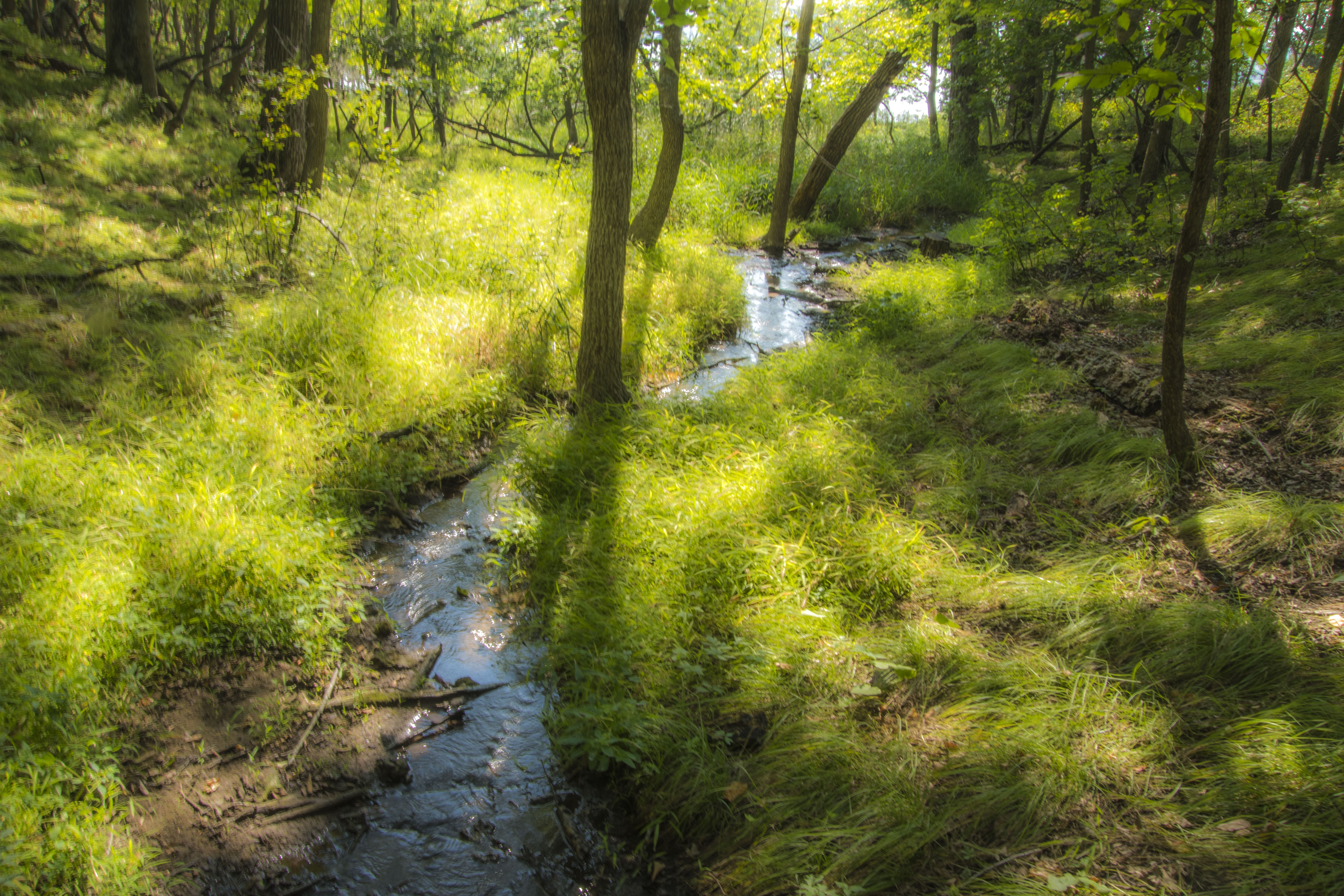
Ah, but the other sounds came to us. A small rivulet that typically stops us even in the depths of a frigid winter morning did so once again. Roberta sat on the small wooden bridge as the spring-fed waters waxed poetically beneath her feet, and we all seemed to close our eyes to soak in the soothing sound. If my introduction to our bathing had been dismissed, here it was vivid and beautiful. Like ocean waves, the small spring-fed rivulet seemed to ease the soul.

A small spring-ed rivulet meanders through the oak savanna offering a pleasing sound for soothing meditation.

Elevating out of the ravine and up a steep hillside, we then encountered a huge acreage of invasive staghorn sumac. Lucy and I stopped to pull seeds from a remnant seed head to roll the tiny balls of succulent flavor in our palms with our fingers. The outer testa coatings eased from the seeds and were caught in the breeze to leave the hard seeds in our palms. Had we wished we could have ran our fingers over roughened tree trunks and broken limbs, yet the sumac seeds seemed to do the trick.

As for our other senses, one would have needed to bend to catch any aroma from the few mushrooms we encountered, or from the few blossoming flowers along the trail. Overwhelming the sense of smell was the scent of algae along the nearby shore. When we reached the upper end of the trail to sit momentarily on a picnic table, the algae scent was quite strong.

I took a moment to remind us to once again close our eyes and renew our deep breathing. Doing so never hurts when you’re deep in the woods and bringing alive so much of the sensory options around you. Mentally resetting tends to take you even deeper into the meditation, and when I’m alone forest bathing I often stop to “re-set” the meditation. 

While there is much visual damage thanks to the derecho, there is ample beauty to be found in the oak savanna. Bonanza rarely fails in my efforts of mental relaxation.

As we began our saunter back down the trail the momentary conversations were done so quietly, almost under breath, it seemed. Since my familiarity with this trail was so vivid I was sorry for the near utter silence, for hearing the songs of birds seem so typical of such hikes and this time it seemed the popping of stepped on acorns dominated. Such moments reminds me of the quote attributed to Heraclitus, “No man ever steps in the same river twice, for it’s not the same river and he’s not the same man.”

That was our trail for this moment in time, and Lucy and Stepan were there for their first time. For Roberta, perhaps her second or third such saunter. Sometimes you have to remind yourself of such truths, and truthfully, over the years no two saunters have ever been the same. Different things to see and hear, to smell and touch, along with our individual levels of meditation. 

Wrens of Bonanza

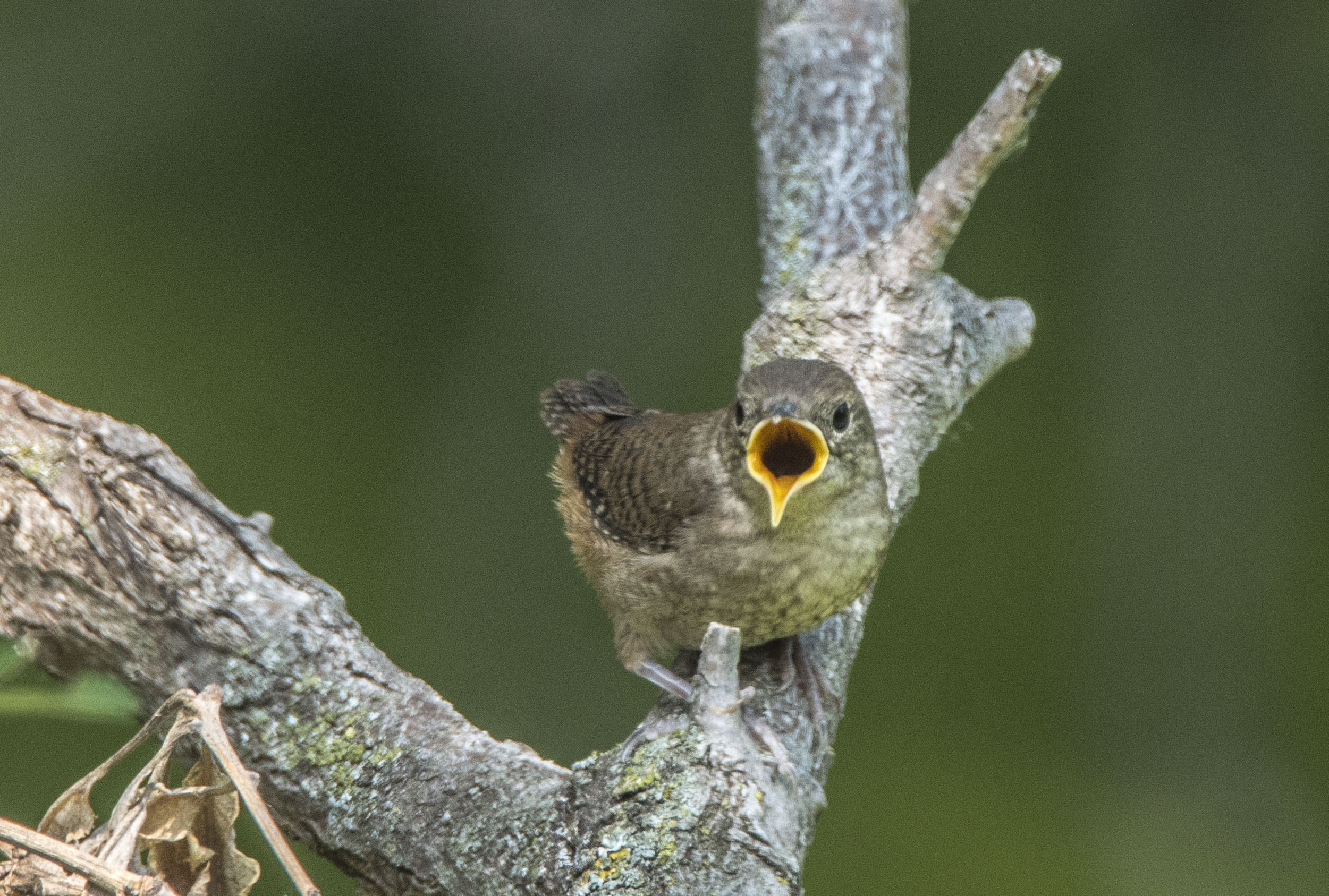
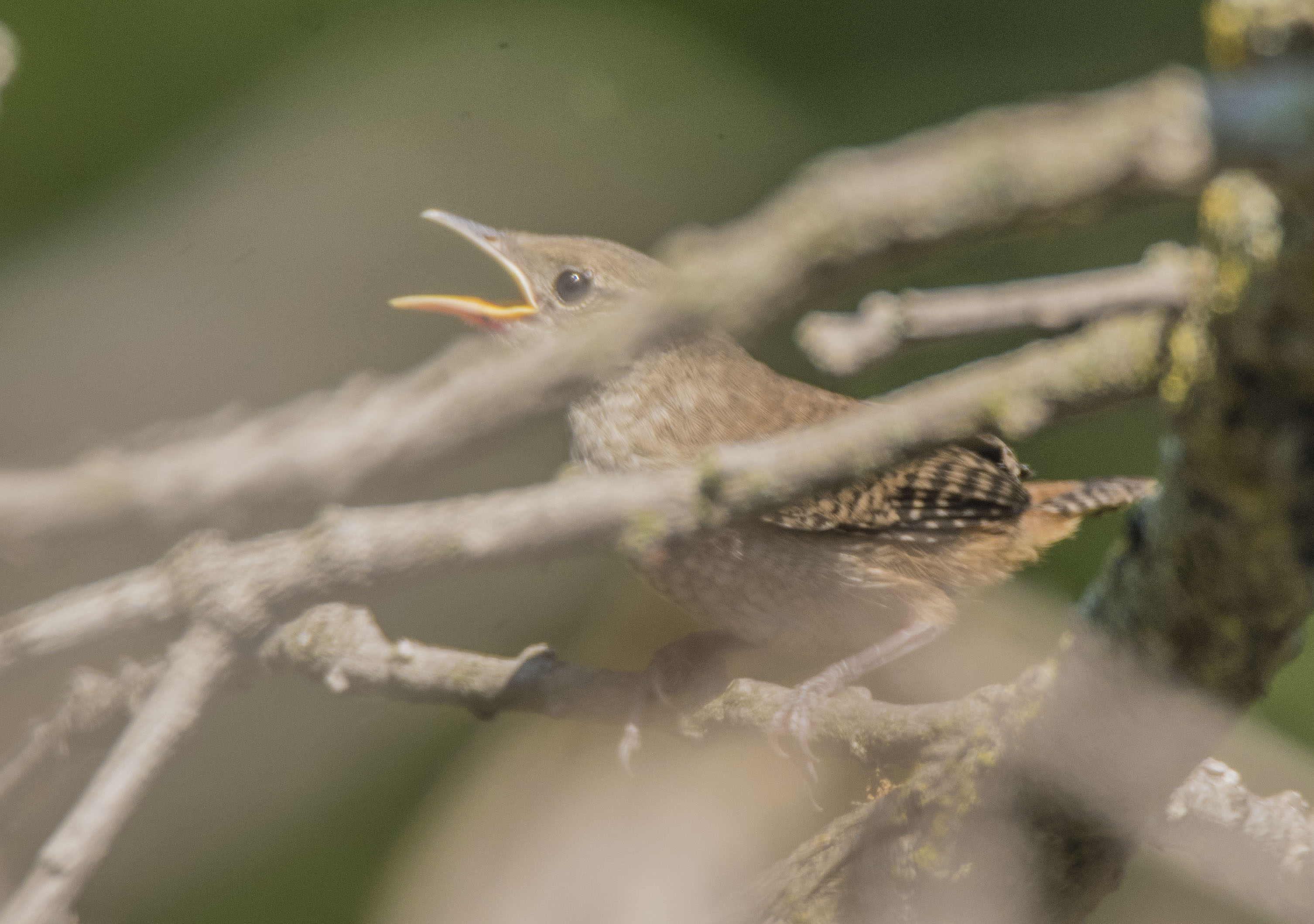
Jakob Becvar came to visit with what he called his “safari eyes.” Those eyes sure came in handy on a saunter we made on the lakeside trail at Bonanza Education Center earlier this month. Seems we had unwittingly entered the sacred territory of a pair of house wrens, and they fearlessly and adamantly let us know of their displeasure.

You couldn’t help by hear their loud “tseett” protests, yet as much as I scanned the broken down and browned leaves of tree death, I simply couldn’t find them until Jakob pointed them out. “You need to sharpen your safari eyes,” he said.

Now, for a minor disclosure of my abilities to see; it isn’t rare to be sauntering along with a friend with my stopping every several feet to focus on something no one else has observed be it a leaf draped over a twig or the poetic bend of a cone flower reaching for the sky. Over the years I’ve taught several classes on recognizing composition within the offerings of nature, beginning at the Denver Free University back in the 1970s to Minnesota Master Naturalists’ annual Gathering Partners in recent years. I’m no slouch of observation.

Be it his age, of my being considered by Jakob an “old man” which he started harping about when we hosted him as an exchange student about a dozen years ago, or my lack of “safari eyesight,” those wrens were quite good at visual deception. Seems the recent college graduate back in his home country of Austria, and just a few days from his first post-graduate professional position, was taken on a couple of photographic safaris in Africa which Jakob claimed taught him the nuances of how to see in nature. 

Please allow me to set the scene: This walking trail was until a few years ago the gem of hiking trails in our section of Minnesota. Meandering along the eastern shore of Big Stone Lake, the trail eased along the hillsides through a beautiful oak savanna and meadows of invasive staghorn sumac. Those oak limbs, of what my partner Roberta calls  “Halloween trees”, were staunch, bold and strong. Some will argue that oaks are among the toughest and sturdiest of trees, and these along the trail were all native burr oak. Trunks were solid and bold, a circumference of enough breadth to take two humans with arms outstretched to hug the trunk. In fact, the Hardwood Manufacturers Association claims that oaks rank as the third most hardiest trees in the land behind hickory and hard maple.

Then came the July, 2022, a derecho with straight line winds knifing across the shallow but long, 26 mile lake, at speeds estimated to be more than 100 mph; winds that swept down from the heavens without the rotation common to tornadoes, shearing off trunks as well as those sturdy, Halloweenish limbs. Many of those staunch oaks were battered to the ground through the savanna and were no match for the winds. Park employees, for Bonanza Education Center is part of Big Stone Lake State Park, simply took chainsaws to whatever blocked the trail, leaving behind the broken trunks and limbs to weather and wither away. And what had been so stately and strong, now splintered and broken, has since become a home for birds like the wrens.

This pair was making sure that we recognized and respected what they now deemed as their own. After all, even Shakespeare was enamored by the diminutive and fearless birds as he penned: “ … wrens make prey where eagles dare not perch.” Here on the battered oak along the Bonanza trail they leapt from one broken limb to another, to the broken and gnarled stump to what remained of the prone trunk. Although the Latin translation of their family name, Troglodytidae, is of “cave dwellers,” wrens are seemingly anything but. They’re expert foragers in tight spaces including thickets, tangles, tree-falls and rocky crevices … all sites that supports an abundance of insects, millipedes, spiders and their eggs. 

These wrens offered no ground without a fight, and you know you’re in one when their shrill “tseett” warnings come in such a rapid cadence, and when you have both the male and female defending their broken tree, it’s nearly deafening. Years ago an old friend sat on his deck on the edge of the Driftless with a cocktail as we watched a male wren chat at us as it bounced from the small birdhouse to a trellis to an overhanging limb. “I really respect that bird,” said Harland. “A few weeks ago the female was still feeding the last of the first batch, by then fully grown, with captured insects. The old guy, there, wasn’t having none of that. Eventually when she left for more food he got into the face of the youngster and wouldn’t let up until it finally had enough and flew away. Order was restored.”

“Do you mean that it was suddenly peaceful?”

“It’s hard to put ‘wrens’ and ‘peace’ into the same sentence,” he quipped before taking a sip.

I suspect there is a lot of truth to that, and it certainly seemed that way on the trail with Jakob and Roberta. As we sauntered on down the trail you could still hear the chatter as we moved away. 

This trail is a beauty for birdwatchers, with the piles of chips beneath long dead trees thanks to the work of Pileated woodpeckers, or the bouncing treetop branches as warblers and cedar waxwings scamper through the canopy. Those birds are reasons why I so thoroughly enjoy “forest bathing” here, for once you have meditated to that point of magical bliss the sounds of birds becomes the overall dominate sense even before the more recent move in by the wrens. Meditative calmness, however, isn’t something I’d equate with roused wrens! 

Actually, until the damage caused by the derecho I can’t recall ever seeing a wren along the lakeside trail. That damage is in keeping with the philosophy of maintaining the workings of the wild within its own natural time. Those damaged trees will most likely remain for eternity, and now that the wrens have dropped in to grab this particular piece of real estate on the trail, we saunterers had best be prepared for these bombastic blasts when we near their claimed space.

I’m reminded of what Wendell Berry so eloquently wrote of the tiny battler: “The question before me, now that I am old, is not how to be dead, which I know from enough practice, but how to be alive, as these worn hills still tell, and some paintings of Paul Cezanne, and this mere singing wren, who thinks he’s alive forever, this instant, and may be.”

Indeed. As we learned on our short saunter along the lakeside trail of Bonanza, some of those songs of wrens are not of pleasure but of warnings; and wrens are not shy nor in fear of eagle, hawk, man nor perhaps, as Berry expresses, even death!  Bless the little pugilists! 

Sensing Spirituality at Sherburne

When artist and bird photographer extraordinary, Terri Robichon, suggested Sherburne I doubt if either of us anticipated a spiritual experience. It began innocently enough when she recently posted some nice images of sandhill cranes near her New London home, and being a crane chaser myself, I reached out to Terri who was kind enough to offer an idea of where to find them near a lake close to her home. “You might have better luck at Sherburne, though,” she said.

Ah, Sherburne National Wildlife Refuge. Yes, Sherburne has long been a summertime home for the sandhill cranes and the idea of driving over seemed like a real possibility, even if it was six hours and counting for a round trip. A few years ago I made the trip for the same reason only to find the gates to the seven mile Prairie’s Edge Wildlife Drive shut and locked. That drive was late in the season, early November in the midst of the Covid pandemic, and near fall migration. Although birders had posted pictures on a social media birder’s page, there were thoughts that it would all work out. It didn’t.

Back in real time: when Terri posted an image of a pair of sandhills with their colts, the name given to their newly hatched offspring, my quest revved up significantly. As if fate has a hand in the land of the fortunate, Roberta and I were headed to the St. Paul suburb of White Bear Lake over the weekend for the 50th birthday of her son. “What if on the way back we head through Sherburne to see if we can find sandhill cranes?” I asked.

This pair was our first sighting less that a quarter mile into Sherburne.

Since she seems to enjoy our photographic forays it was a go, so mid-afternoon on the way home we veered off onto a connecting highway, a winding adventure through numerous road closures and small towns to reach Sherburne. Once we pulled onto the wildlife drive around four in the afternoon, we stopped to organize the car seats and camera equipment and immediately found some interesting clumps of purple vetch and butterfly weed to photograph. 

Then, not 100 meters further down the road we spotted our first pair of sandhill cranes slowly ambling through the prairie. What a great start, and not even a quarter mile into the 7.3 mile nature drive. This was a nice prelude since it would become even better with dozens of other birds and wildflowers awaiting us. This was the Sherburne I envisioned.

The huge 30,000 acre refuge is between the Twin Cities and St. Cloud within the St. Francis River Valley. Established in 1965, it includes numerous wetlands, oak savannas and open prairie. The vast majority of the refuge is off limits to the public and is designated as a wildlife sanctuary to allow an amazing array of wildlife the freedom to breed and raise their young without human disturbance. Only the wildlife drive, the numerous hiking trails and a designated canoe route are open to the public. 

While his colt did a playful dance, the male continued his search for food.

Our forays are often stop and go affairs, and our Sherburne drive was no different. Having one goal in mind … continuing my seemingly endless chasing of the cranes … was taken care of even before we reached the first observation deck less than a mile from the entrance. That pair was only the beginning for there would be much more, and amazingly so. We would also happen upon a green heron stalking reeds and cattails of a marsh. A cowbird, brown crown and all, posed for us. Flycatchers, sparrows, warblers and even an operatic dickcissel added to the mix. Not to mention the wildflowers, including Roberta’s first viewing of wild purple iris.
Yet the stars of the show were the numerous swans and sandhills. Seemingly around every nook and corner. Swans sat stationary as if on nests, paddled poetically across stilled surfaces, and some were with cygnets. These were ample artistic moments filled with grace and beauty. Meanwhile we were cautiously on the lookout for those telltale lumps of brown, and fate was certainly on our side as those “lumps” were most often bent and feeding sandhills. This was certainly a “rush and miss” adventure as evidenced by the number of cars passing by us.

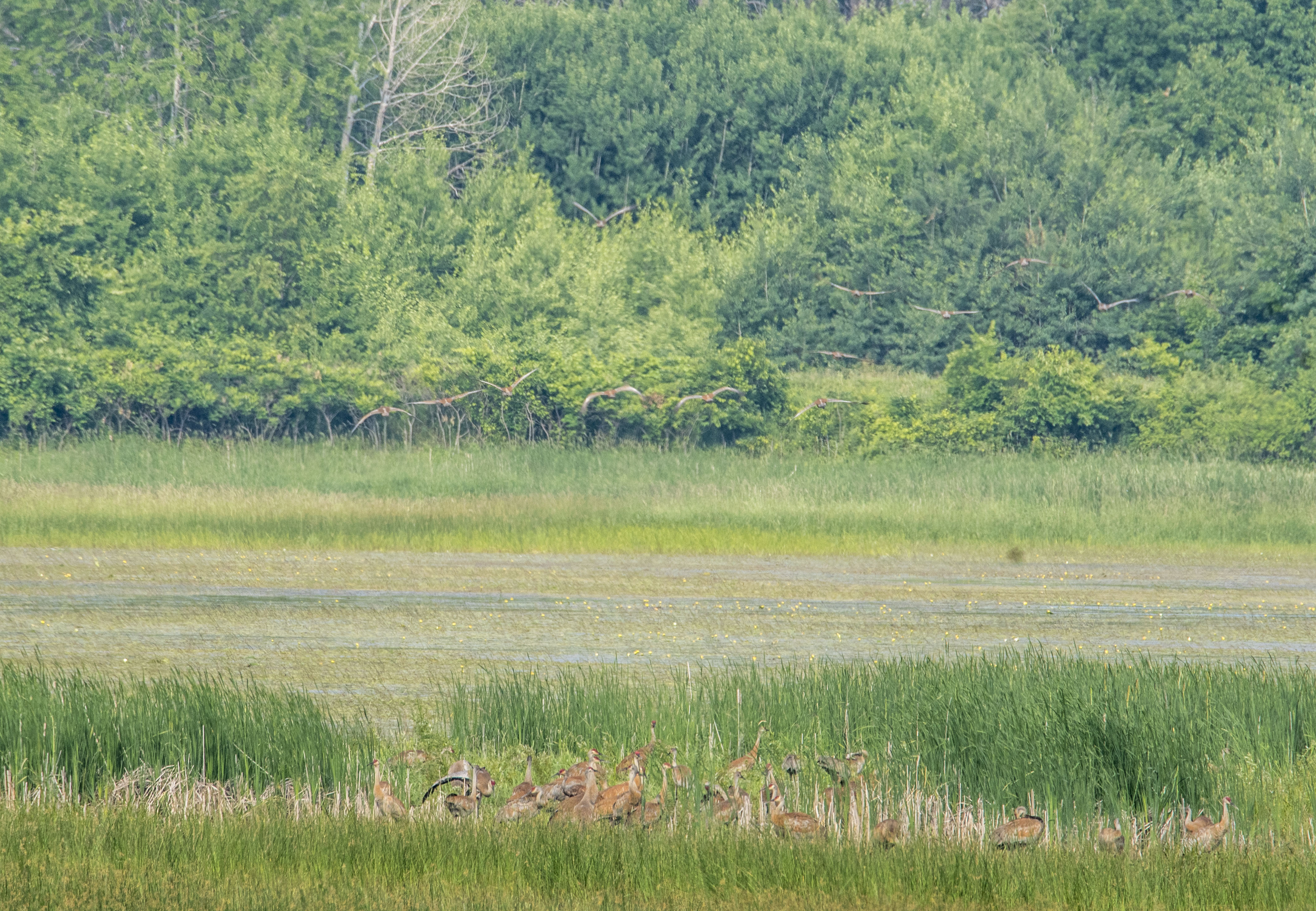
Within the panoramic view of the prairie a “spot” of brown revealed numerous sandhill cranes near a wetland.

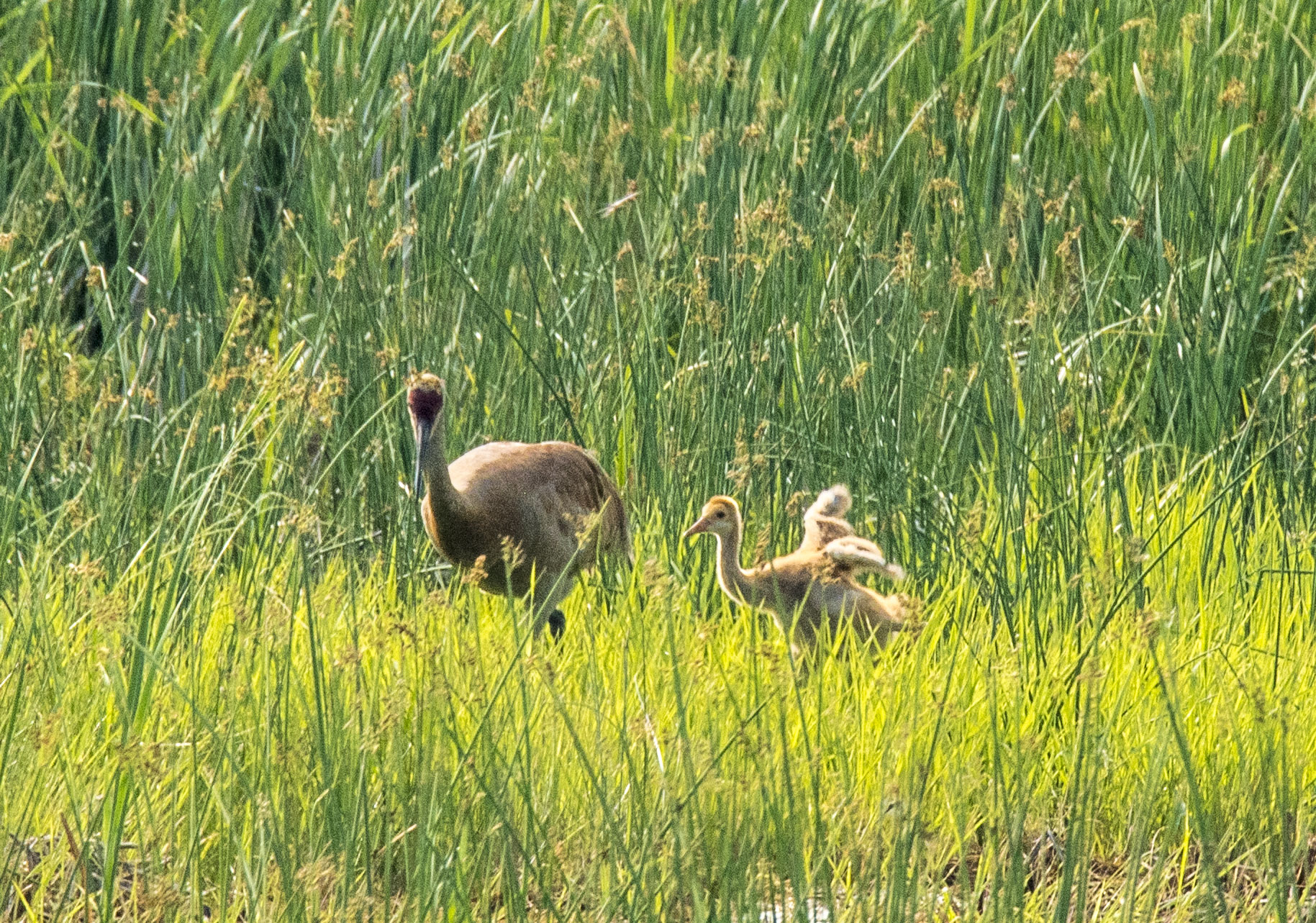
At one wetland we came upon a pair with their colts, slowly feeding along the reedy edge. At one point one of the colts broke free and acted its age, although the parent bird continued to pace along, head down, grabbing food. Its mate seemed to be teaching two other colts the available menu. 

Eventually we moved along only to stop less than a mile away when I heard that telltale bugling sound that the late naturalist and essayist Aldo Leopold called the “trumpet in the orchestra of evolution.” When you hear the unique call, you must stop and search for the birds. And, we did.

It took a bit before we found a pair nearby, then another, although looking around the panoramic view of this vast wetland we spied other solitary singles and pairs. And swans. The view was a living diorama an artist could never emulate at the Bell Museum. More of “church” than you may find in any building despite the artistry of Gaudi. As I looked around I found myself being drawn to a huge brownish patch where the long lens revealed dozens of sandhills grouped together. While it wasn’t March in Nebraska, we were facing into a very large gathering of sandhills. Fortunately for us we had been patient and curious, and I give Roberta credit for her appreciation of those traits.

Swans added grace to the beauty of Sherburne, joining the beauty of the cranes and other birds, and certainly with the array of wildflowers in bloom.

This was a truly spiritual moment for me, and caused me to think of Leopold’s quote from his Marshland Elegy: “Our ability to perceive quality in nature begins as in art with the pretty. It expands through successive stages of the beautiful to values as yet uncaptured by language. The quality of cranes lies, I think, in this higher gamut, as yet beyond the reach of words.” 

How true, and perhaps the grasp of my quest.

Lest I forget, here is the full contest of Leopold’s earlier quote: “When we hear his call we hear no mere bird. We hear the trumpet in the orchestra of evolution. He is the symbol of our untamable past, of that incredible sweep of millennia which underlies and conditions the daily affairs of birds and men.”

Almost as magical as the sandhills with their colts, the swans with their cygnets. all part of the beautiful panoramic view of the prairie. An amazing experience.
Moments like these bring to life my devotion to Leopold and his Sand County Almanac, a book of his poetic essays I first read back in college in the 1960s … a copy I still own. Which might explain the roots of my passion of chasing the cranes, a passion I rarely find tiresome. Especially on this little seven mile “wildlife drive” through Sherburne. While we didn’t head to Sherburne with spirituality in mind, you could hardly not feel it at that moment in that particular vast panorama of wetland and prairie. 

If the cranes offered the trumpets, the swans granted us an uncommon grace. Adding to this was the colorful blossoming popping from the prairie-land grasses and varied songs aired by the dickcissel and assorted warblers. As much as I struggle to adequately describe the feeling, I realize fully that there is a higher gamut beyond the reach of words. 

Smoke Stained Skies

Where are you, Irving Berlin, now we so desperately need those blue skies you penned and pined over so many years ago, those “blue skies from now on” lyrics sung by a variety of singers from Jackie Wilson to Willie Nelson. Here we are in the second week of June and our skies are mostly smoke stained and I feel hard-pressed to recall a day when we had actual blue skies. So smoky gray, and we cannot see past a mile across the prairie. 
Last week many events were shut down from New York City and along the East Coast because of dense smoke. Smoke so thick you couldn’t see halfway up a skyscraper. Down in DC, the top half of the Washington Monument was invisible. Here in Western Minnesota our skies are gray to hazy blue from dawn to dusk. Acidity scented smoke gives you a raw throat.
Just for the record, we are now in an air quality alert that will exist through three more days. This is nothing new. If there is anything positive we do have some interesting sunrises and sunsets. Yet, you cough and your throat is raw, and you cannot escape the smell of smoke. There are the pictures, though. Yes, there are the photographs. Some even stunningly beautiful.

One of my first images made in smoke stained skies called “August,” made in 2015. Not much has improved since thanks to the drought-ladened forests out west and into Canada.

Meanwhile fires in Canada and the Western United States continue to scorch the timbers and prairies, heightened by a drought that seems to have spread continent wide. A new wildfire broke out on the Gunflint Trail in the BWCA this week, so it’s even closer to home. 

Western reservoirs are drying up as Arizona, California and Nevada fight over water allotments. Those fantastic fountains in Las Vegas must recycle used waters, and the rich are restricted from filling their pools from Phoenix to Fresno. Worldwide desertification is running rampant, and the UN suggests that more than 24 billion tons of fertile soil disappears every year. All caused by man made causes … global climate change. Today two-thirds of the earth is undergoing a process of desertification described as an area equivalent to the entire arable land of India. All will be lost by 2050 if changes are imminent.

Our plastic choked oceans are warming so quickly scientists have warned that commercial fishing will be a thing of the past by mid-century. Thanks to farm country runoff, the hypoxia zone in the Gulf of Mexico continues to grow, meaning there is basically no sustainable life in affected waters. The lifeless zone is now larger than the land mass of Rhode Island and Delaware combined.

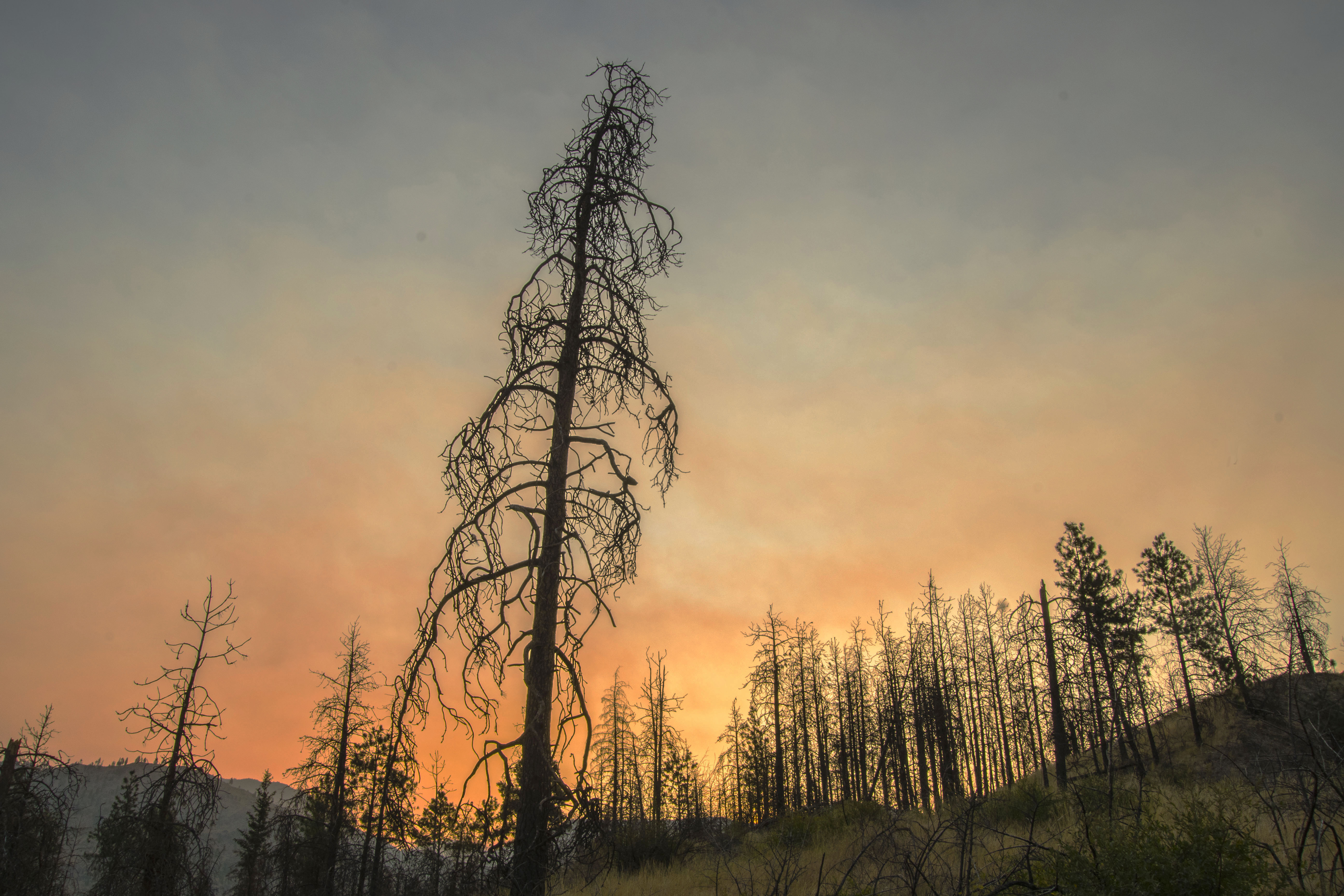
From the Lake Chelan wildfire four years ago in Central Washington.

While we’re in a severe drought, we aren’t in a desertification strait here in Minnesota, although our grasses appear as if it was August and the cracks in the soil average about an inch in width. Brown has replaced green nearly throughout. Browned and crunchy. Perhaps having our largest city and the nation’s capitol shrouded in smoke will convince the naysayers and the depth of the Republican Party to believe that global climate change is both real and worsening. Many are the experts who concede that we’ve passed the tipping point. A planet on alert.  

Our leaders on either political party at our nation’s capitol are no better at legislating change and corrective actions than those in China and India. For every young Greta there are seemingly hundreds of greedy capitalists pushing for expansions of the uses of fossil fuels, deep-gorge mining, managing highway traffic, spewing chemicals and letting their best soils blow or wash away, and so on. The UN warned earlier this week that half of the expected carbon budget has been eliminated in less than three years. Adding to the misery is that we have an incoming El Nino that will give us an extra kick of heat this summer and into the coming year.

While we’re had six major mass extinctions, the first was identified some 66 million years ago when a six mile wide asteroid crashed into what is now Mexico’s Yucatán Peninsula to create a mile-high tsunami wave that wiped out three-fourths of the earth’s plant and animal life, including all but the flying dinosaurs. Our birds. Scientists now  conclude we’re well into our seventh and this one is far less dramatic. This one is being caused by you and me, and billions of common folks just like us. We are all contributing to global warming, and to be honest, not many of us are doing much to abate the issue. And we’re not getting much help from government and industry.

A mourning dove silhouetted in a muted, smoke stained sun through the trees here at Listening Stones.

Oh, I’m certainly more conscious about making a 20 miles impromptu trip to town for a jar of mayo or whatever. If possible my meetings are streamed online to my computer here in the office. Years ago at a Master Naturalist’s Gathering Partners presentation on global warming we were told that making these sorts of decisions, while seeming mundane and perhaps even silly considering the overall impact of global climate change, yet each such decision still has an impact. Taking a bus or light rail to work. Streaming meetings or work on the computer. Taking a cloth bag to the supermarket.

Then there are the pictures. My first smoke hazed image I can recall was one I call “August” for it was made here in my home prairie in August 2015. Since I’ve become conditioned that come August we’ll have those forlorn ghostly sunsets and a smoky fog come morning. I’ve photographed ashened forests out west, and barely missed a couple of wildfires in the state of Washington. Yes, there are the pictures.

Will there come a time in the future, if and when someone happens upon one of these images, to remark, “Wow! Look at how light the sky looks. What a beautiful gray.”

“Oh, and you can actually see the sun,” adds a friend. “I think that’s a sun. So red and just barely breaking through the grayness.”

No “blue skies from now on” except in perhaps an old MP3 recording by Willie. Were the images from New York City and Washington, D.C. skies of the future? A future for a planet on fire?

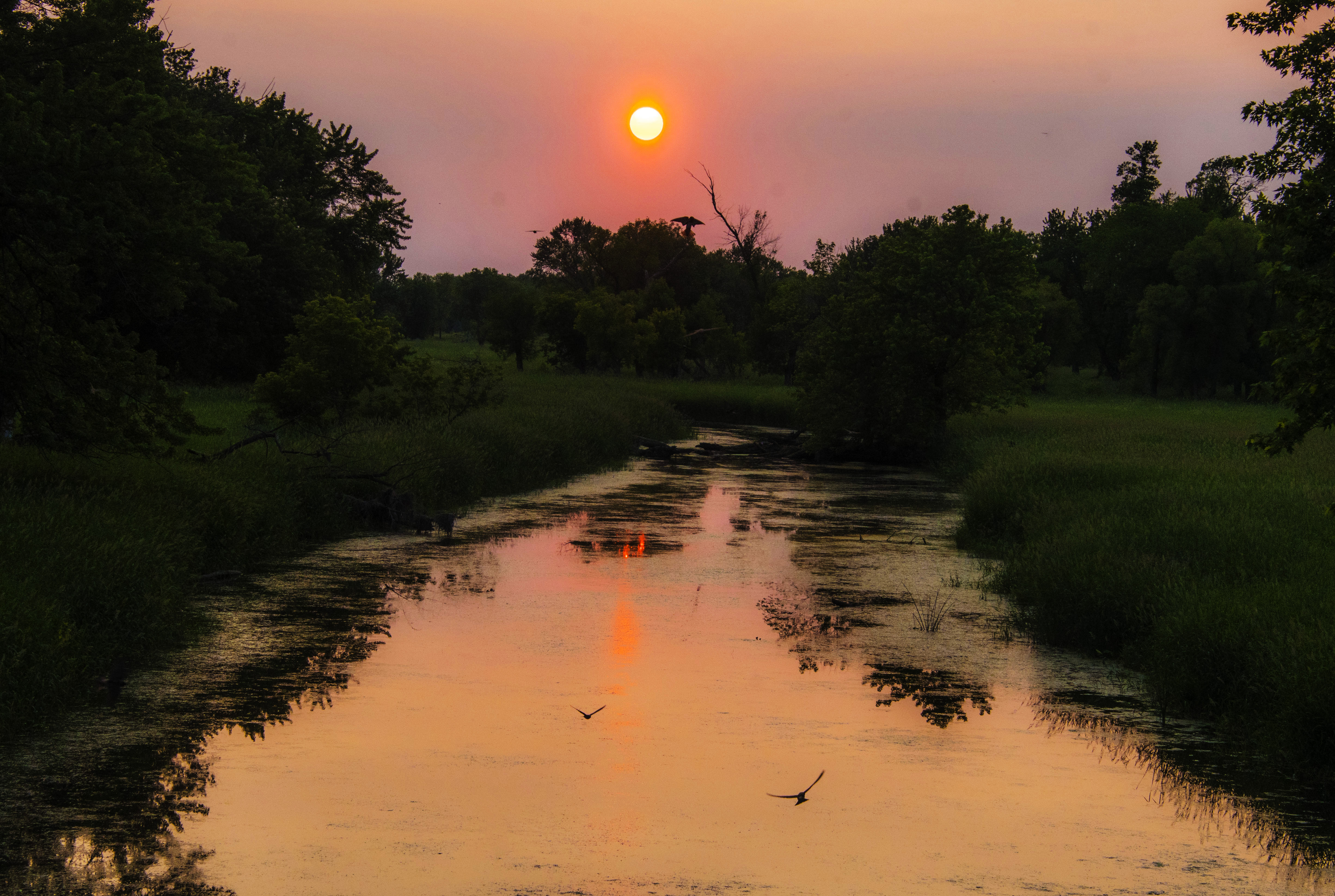
An image made of the Minnesota River just a few miles from the headwaters earlier this week, with help from a couple of cliff swallows that nest beneath a bridge.

So goes some of my thinking nowadays. It’s difficult to stay positive, not with two sons now in their 40s. I think a lot about their future, and I become incredibly concerned when I see a baby in its young mother’s arms. What kind of life will that child face in ten years? Twenty? Will he or she reach my age before the turn of the century on a planet than now seems on fire, now as global warming refugees are more and more commonplace? What about its mother? So young and hopeful … 

A week or so ago we were at Itasca State Park making images in a muted light thanks to smoke stained skies. Back then the smoke was less dense than it is now, and the scent of acidic smoke was certainly less than it is now. This week my images were made around here, all with that red-ball sun peeking through dense grayness. Some of the images were striking and beautiful. A pretty poison, someone once said. So I keep making pictures … those of reddish suns and smoke stained skies.

A Mayfly Moment

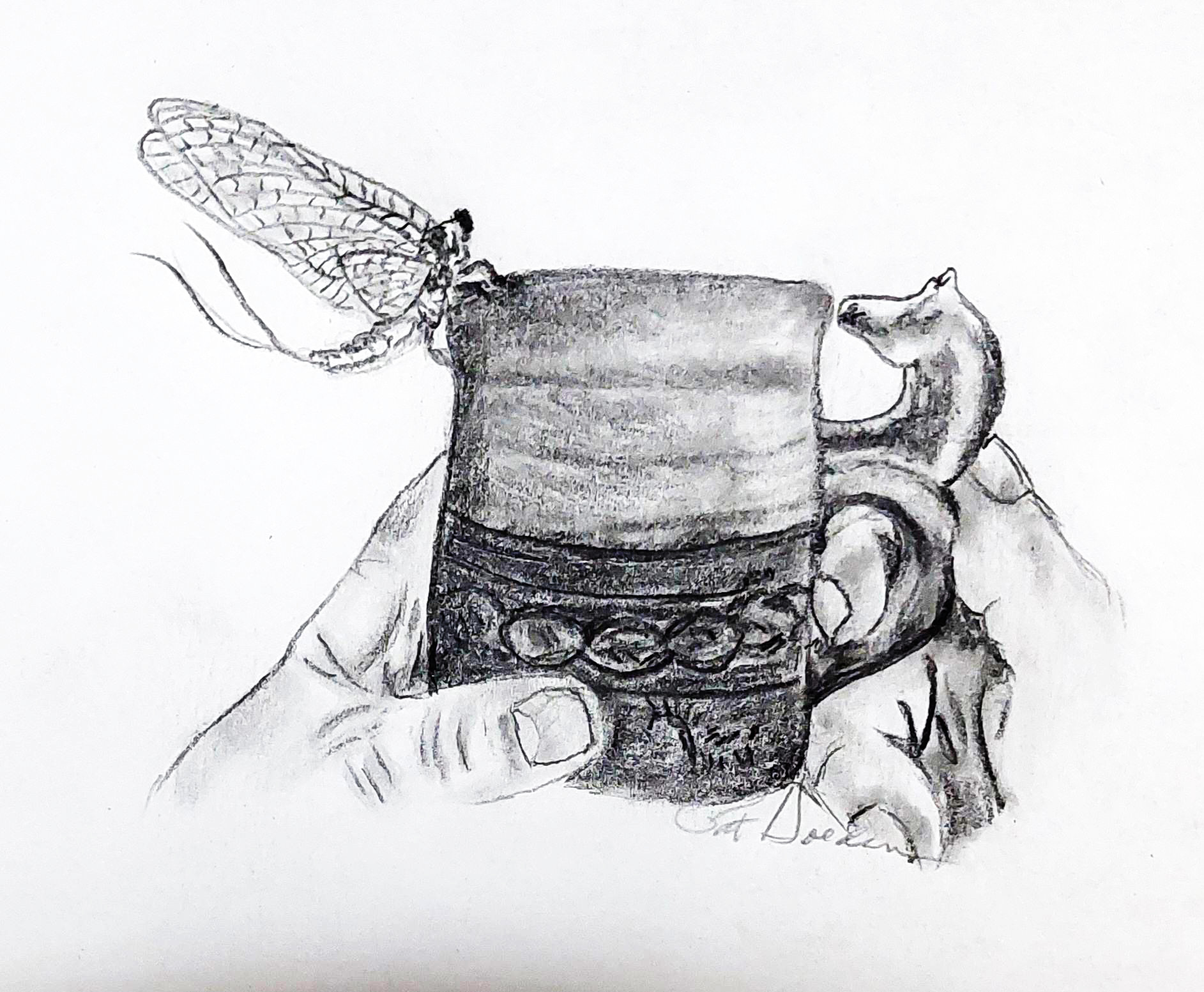
Ever so quietly, so unexpectedly, it appeared, perching on a peaceful morning as warblers serenaded from complete camouflage within the leaves towering high above. Suddenly, and from seemingly out of nowhere, the mayfly appeared on the edge of my mug of tea, posing beautifully across the breadth of kilned clay from the Norge Horse handle of Gene Tokheim’s beautiful mug.

What wasn’t there to like? An early morning seated comfortably with tasty tea mere meters away from a dense deciduous timber. A slight breeze dancing across the campground grasses, with the fresh morning sun warming my back in the coolness of the shade. A collective moment of peace and quiet as I studied Gene’s artistry, one with the Norge Horse handle, a cup I’ve used for my morning tea since it was gifted to me many years ago as an appreciation gift for the years of serving on the Clean Up the River Environment (CURE) board of directors.

Thanks to my artist friend, Pat Doeden, who sketched my brief mayfly moment.

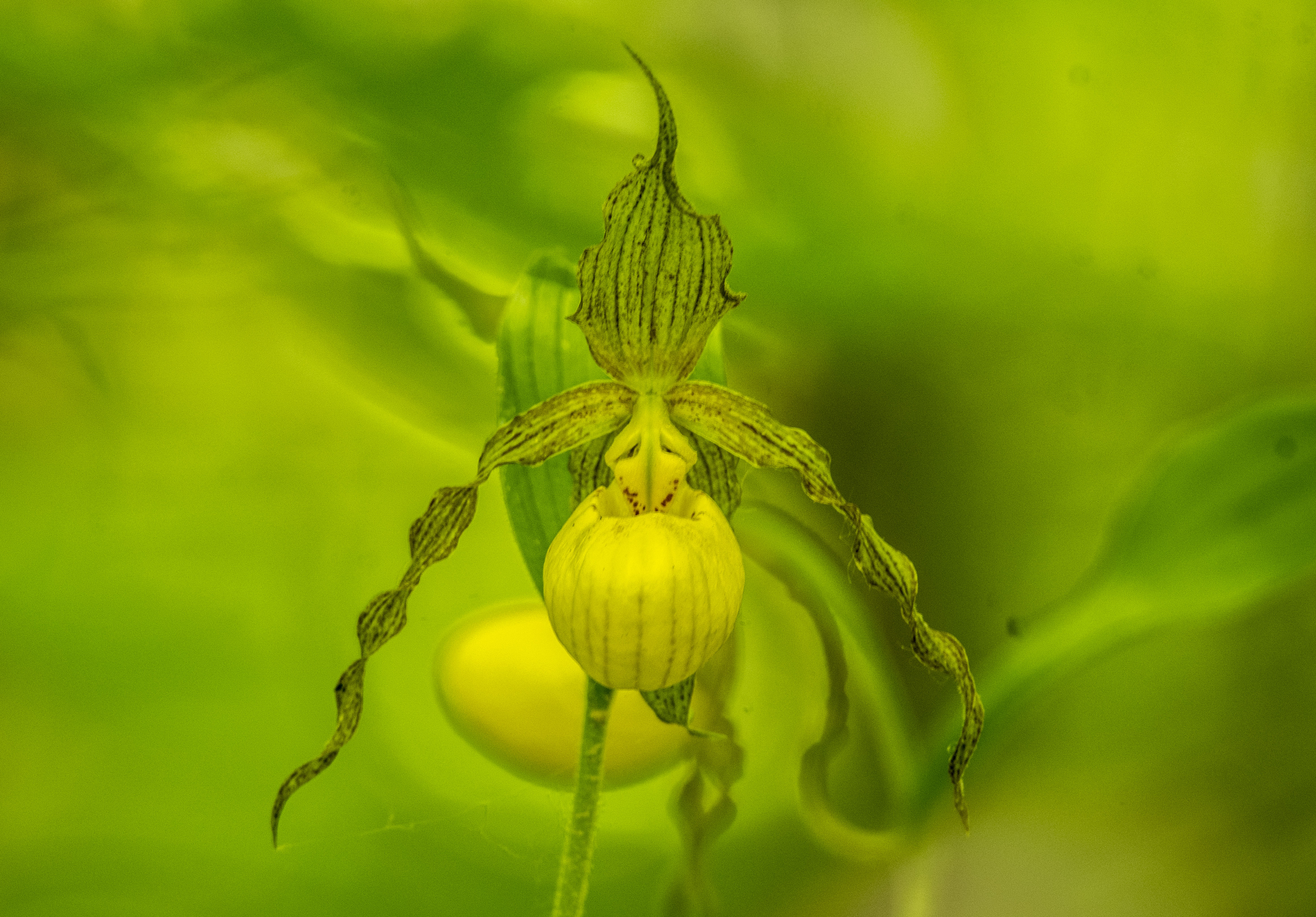
Briefly I wished for my camera knowing that even the slightest movement would end the magic moment shared with the delicate mayfly. So I simply sat, still and stilled, enjoying a brief and magical moment amid thoughts from our brief camping trip. This was our last morning at Itasca State Park, Minnesota’s oldest and largest of 66 state parks. Itasca was a last moment decision, one that came with the social media announcements of the “yellows” being in bloom. “Yellows” would be yellow ladyslippers, one of about a half dozen of the uniquely shaped native orchids within our borders, and an instant draw. “We’re going to Itasca if I can find a spot,” I warned Roberta. “The yellows are in bloom.”

Although I have files of the pot-bellied orchids in the archive, as I have with so many other wildflowers, orchids and birds, there is yet this sense of counting and courting emerging seasons. Seemingly hundreds within a given year. That’s just how it is and I offer no apologies.

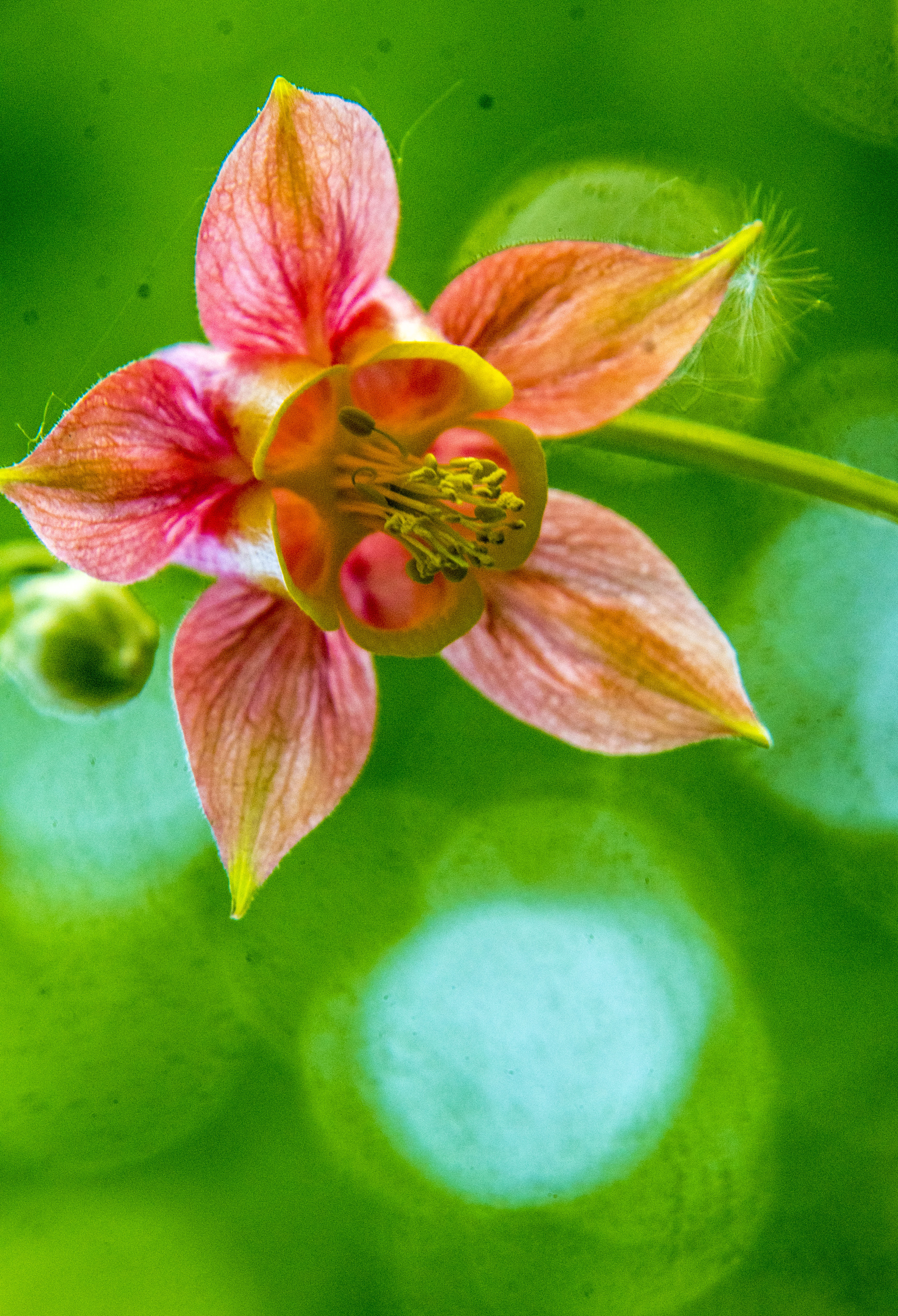
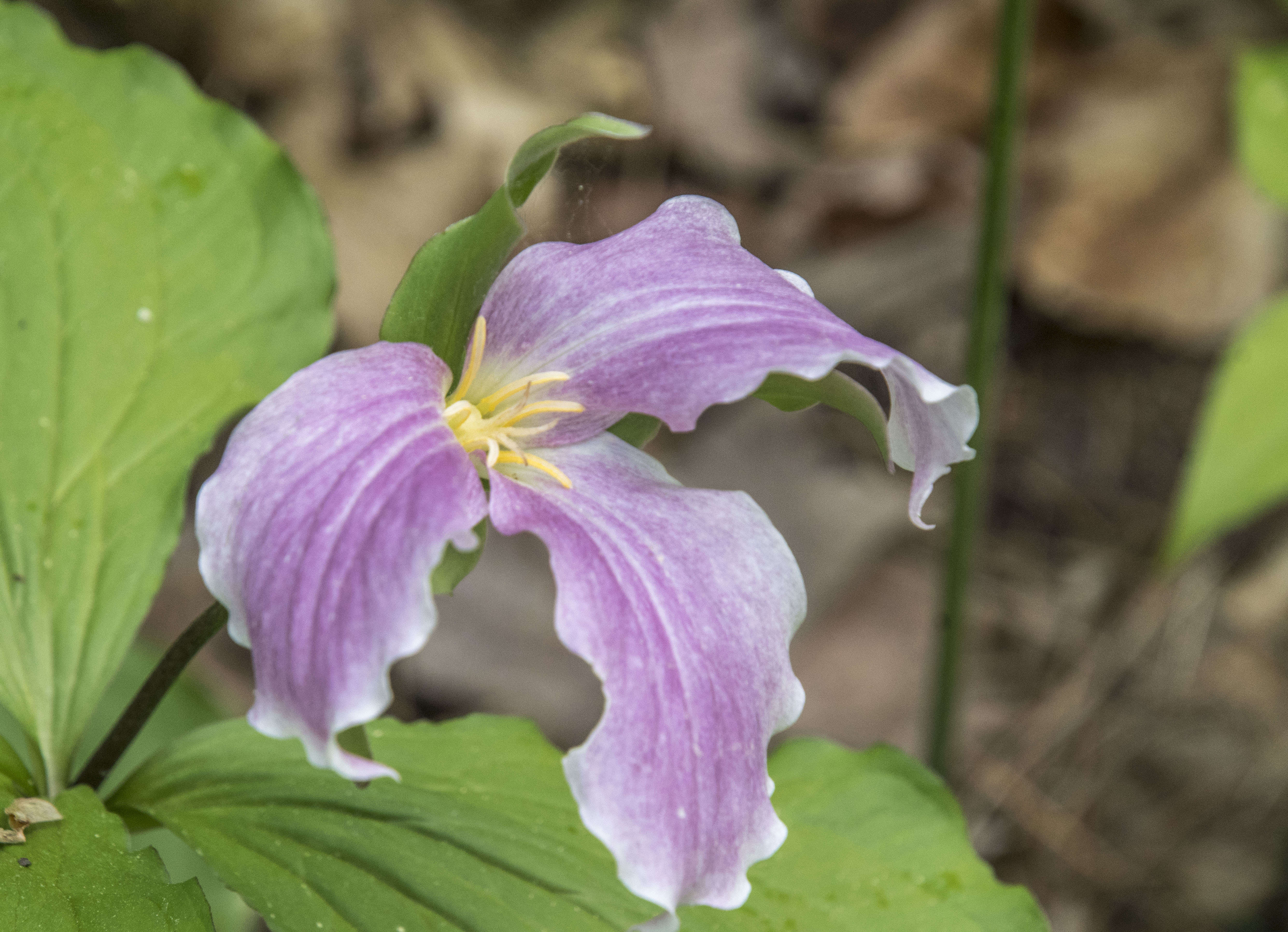
On the afternoon of our arrival we had driven the one-way paved road around the western edge of Itasca where we edged along ever so slowly, often stopping so I could climb out with my old Nikon to capture ever more images. Of reddish columbines (commonly called “honeysuckle”, it seems), bluebeard, bellwort, spent and purpled trilliums and, of course, the yellow ladyslippers. This is obviously an abbreviated list. Our’s was a long, slow and eventful motor tour filled with numerous wildflowers along with a few scenics, including a huge, shallow lake dotted with yellow lillypad blossoms and those plate-sized circular leaves afloat on the surface. 

We came for the yellow ladyslippers, and they didn’t disappoint.

The following morning we made our way to a trail recommended by a park employee, for perhaps there was a chance for some bog images. Initially we had thought of making the 30 mile trip up to Lake Bemidji State Park where I’ve photographed numerous bog plants over the years. “We likely won’t have what you saw at Bemidji, but we do have a boardwalk and bogs on the Dr. John Lewis Trail,” she said.

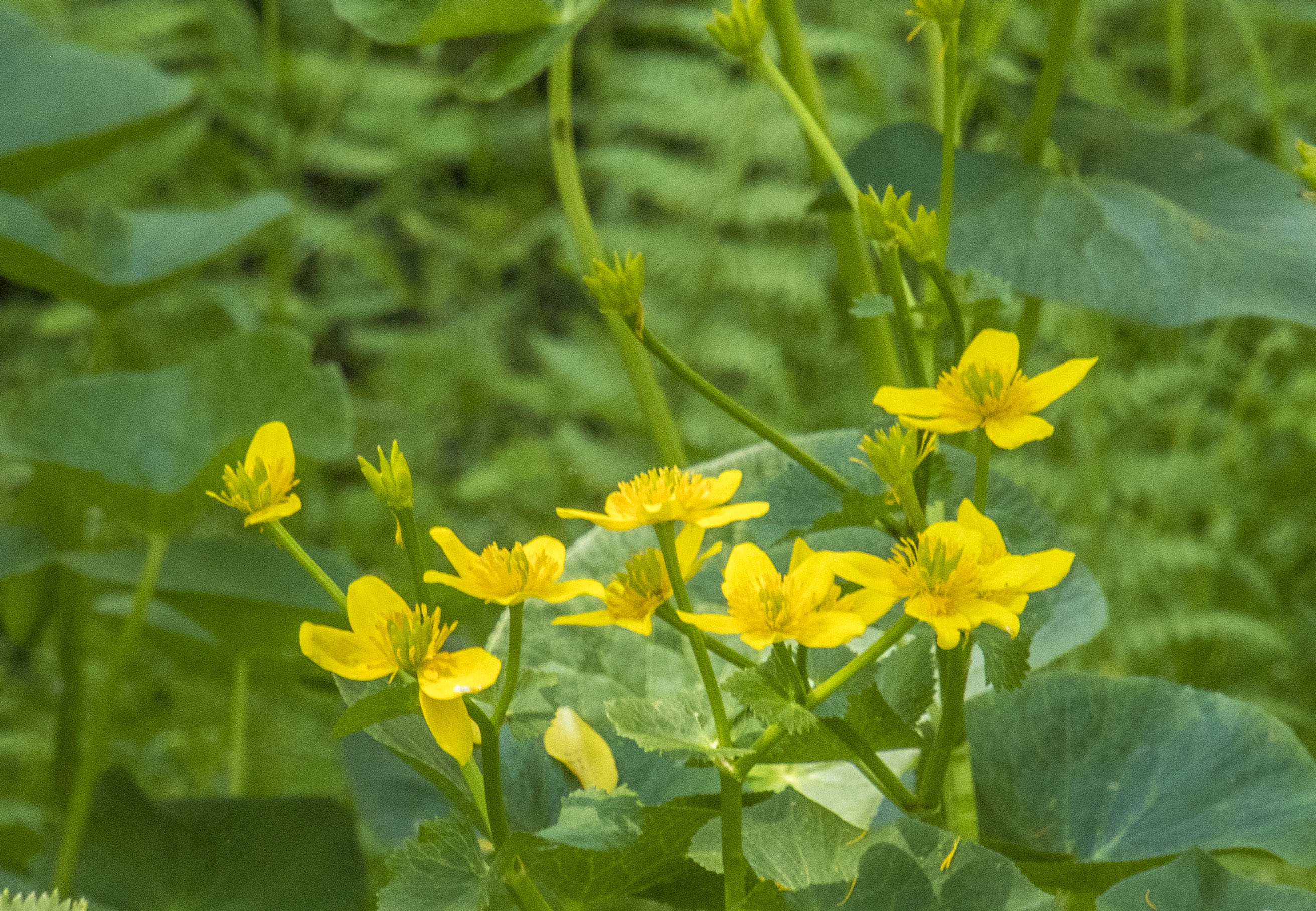
With Joe Pye on leash we headed out on what would become a quite hilly and challenging trail. While we didn’t see any stemless ladyslippers or pitcher plants, marsh marigolds greeted us from all corners of the boggy part of the forest floor path. Marigolds formed a bright yellow carpet stretching up the foot of the hills amidst aged-old and gnarly trees. Beyond the boardwalk and into the dense timber we found dozens of other wild flowers … and fleeting warblers way too high to see let alone photograph. 

As the mayfly sat, with no indication of movement, I thought once again of the headwaters, the site where the waters of Itasca Lake eases over what has become the stepping stones for generations of millions of families, our’s included. They were just five or so miles up the road. It took a couple of nights before we would walk the quarter mile path past the start of the river I’ve spent so many of my years living alongside. Funny how thoughts come and go. 

I am now working on a state park photographic journal and my thoughts coming here, besides the yellows, was finding a creative moment there at the headwaters, working with waters that within a few years will flow through Minneapolis toward Hastings, a ten year home back when I was raising a young family. Then it would flow past Reads Landing, then Winona and Prairie du Chien, all holding fond memories, and later Dubuque, where I landed for two years at the beginning of a long photojournalistic career. On downriver to Mark Twain’s Hannibal, about 50 miles from my childhood home, then past St. Louis and the Missouri Bootheal into Delta Region. Ribs and old friends in Memphis. Those first fried pickle chips in Natches served as a side with pan fried catfish, and finally skirting the Atchafalaya Basin and eventually New Orleans … a city froth with memories. Career wise, and personal-wise. It all begins here at the headwaters.  

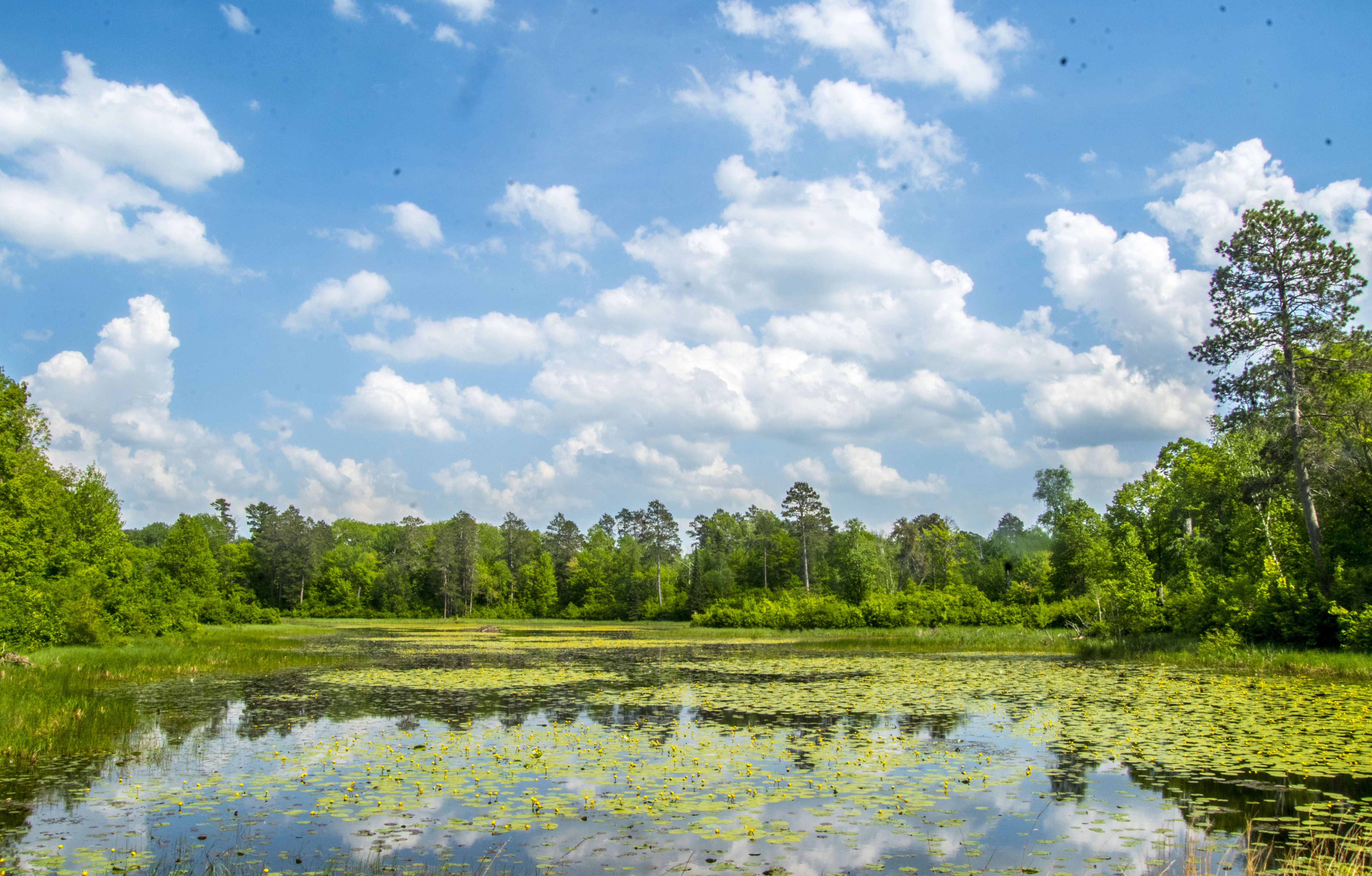
This shallow lake on the “one way” was filled with lillypads.

We were mostly successful with just a handful of tourists who wouldn’t hang around long. Photographically we weren’t so fortunate. A smoky sky and cloud cover to the west would likely diminish any ambient sunset colors,  although there was a beautiful late sun reflecting off a distant towering bank of clouds. About a half dozen older couples ambled in and out during our hour or so at the site, including a 60-ish fellow who attempted to tiptoe over the headwater rocks and nearly did a face plant just two stones from the end, all captured on his wife’s cell phone. 

Then a family arrived by bicycle and a near teenage boy did what the older fellow couldn’t. His baby sister simply found a cooling spot rich with stones and simply sat right in the midst of my hopeful image. My goal of a humanless sunset image seemed to be in jeopardy. Eventually, though, they collected themselves and biked back down the trail. Left alone, a mallard couple flew into stilled Lake Itasca just beyond the stepping stones. It was just us and the mallards. Then, like the humans, the drake began to amble from rock to rock in harmony with the bubbling waters. 

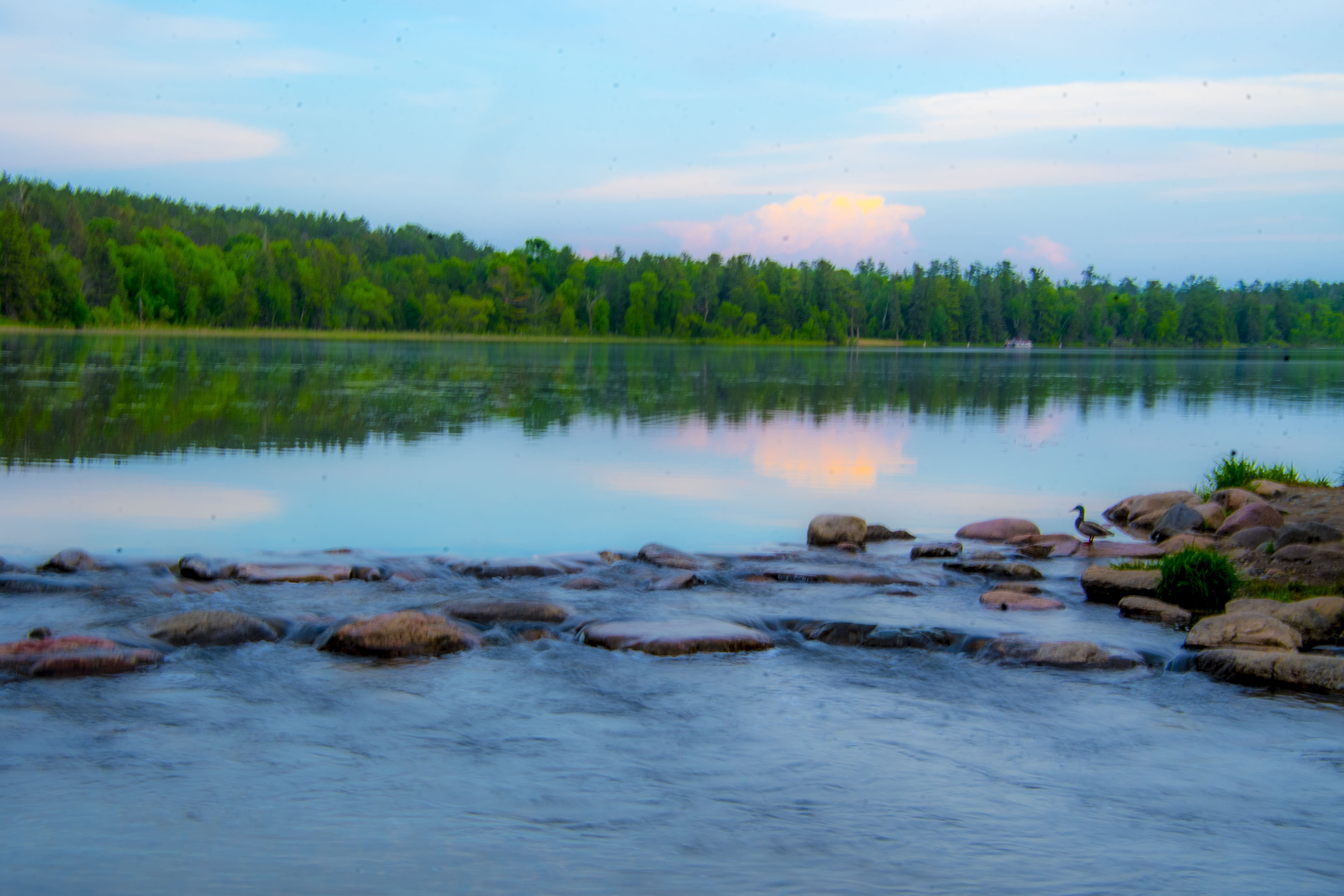
A mallard drake checks out the stepping stones across the Mississippi River headwaters from Lake Itasca.

So there I sat, hours later on a quiet and dewy morning, facing the forest and sipping tea from Gene Tokheim’s beautiful mug while mentally recalling our collective imagery and experiences. Then the mayfly came to perch in perfect profile across from Gene’s Norge Horse. What a beautiful and peaceful way of bringing this short yet eventful camping experience to a conclusion.

For several moments we sat quietly, me in my camping chair, the mayfly on the mug, enjoying a moment of shared serenity. When I turned to catch sight of a flash of color, likely from a noisy and darting yellow rumped warbler, the mayfly must have flown for the mug was suddenly and unfortunately naked. Despite the number of nice images captured and the beautiful sights we had seen and shared, that brief moment with the mayfly was perhaps my fondest moment of all. Sometimes it’s just the small and simple things, and this was one of those times.

Tamarac Trails and Tales

Oh, Tamarac. Have you ever failed me? Not even once that I can recall. Be it summer or fall, and now, early in spring, when so little was seasonally correct thanks to our long and lingering winter and shortened spring. Yet you once again shed away the intricacies of life from your tree-filled valleys and hills, those rocky, reed blessed shores surrounding your placid and picturesque lakes; those sneaky reflection pools hidden in little pockets that surprised us with those bright yellow marsh marigolds! 

What a beautiful surprise, as if you had decorated the dining room table with a bouquet of beauty. You also offered us colorful dainty forest flowers within the tree leaf duff, just below the warblers and fleeting colors of that chorus of birds. Then you added the suspense of swan domination intermingled with such grace and style. Then there was the photographic “poetry” in the greening of the forest as a new spring came to life around us. 

We drove the three hour trip after setting an alarm for 5 a.m., which was somewhat shocking in itself. My partner, Roberta, had intended to wake me a few days earlier for this trip I seemingly just had to make. On this more successful waking morning when the alarm went off we both jerked awake from our pillows with shock in instant consciousness as did poor Joe Pye. My ever hopeful hound didn’t quite know what to make of it, looking from the blaring old clock radio to us. Although it took a bit to gather ourselves, including making our tea and coffee, we were out and on the road in about 45 minutes. Through Graceville, Herman, Pelican Rapids and finally Detroit Lakes. As we turned onto U.S. 34 we were mere minutes from our goal: Tamarac National Wildlife Refuge.

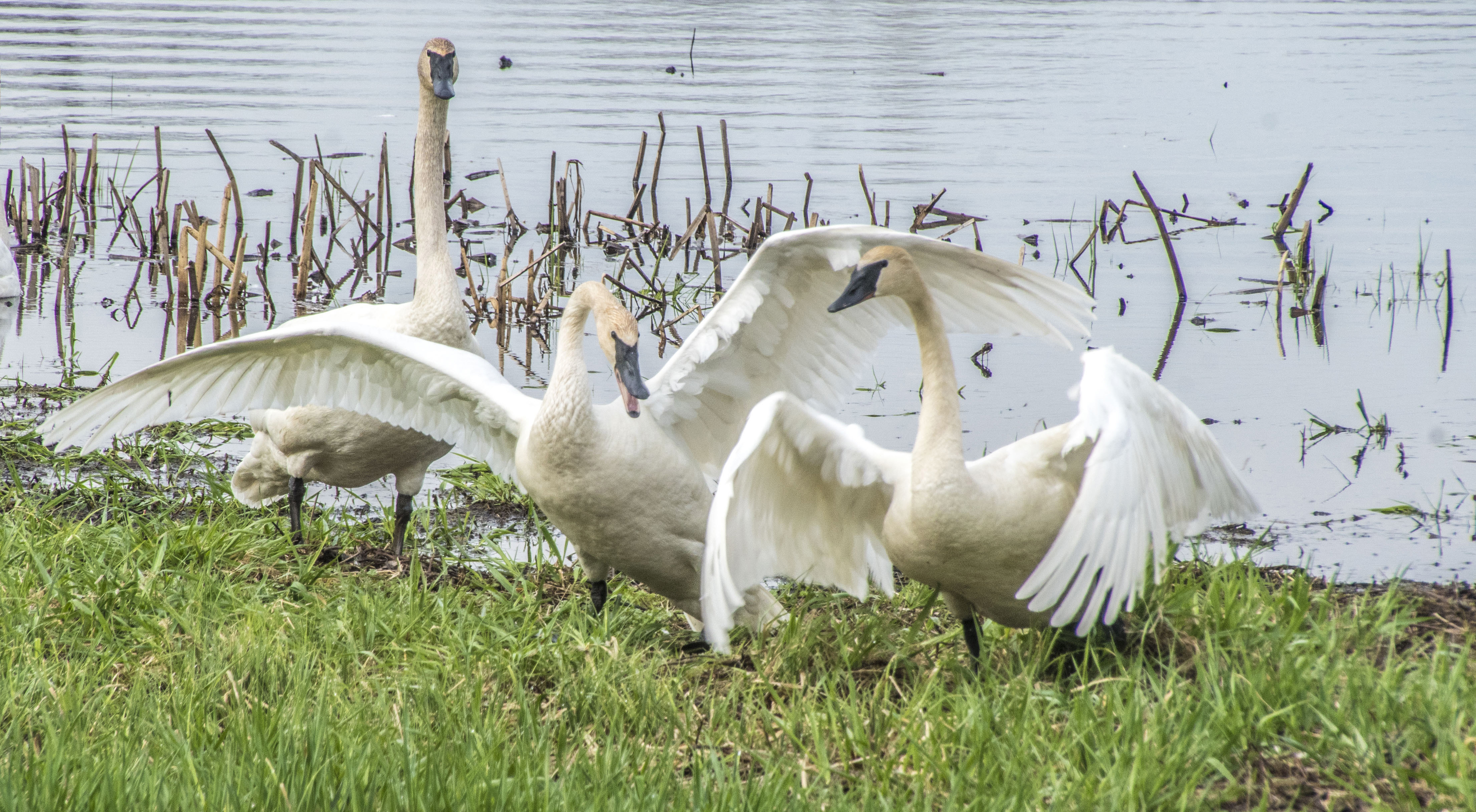
On the edge of Tamarac we caught perhaps a fight over a pecking order on a small wetland.

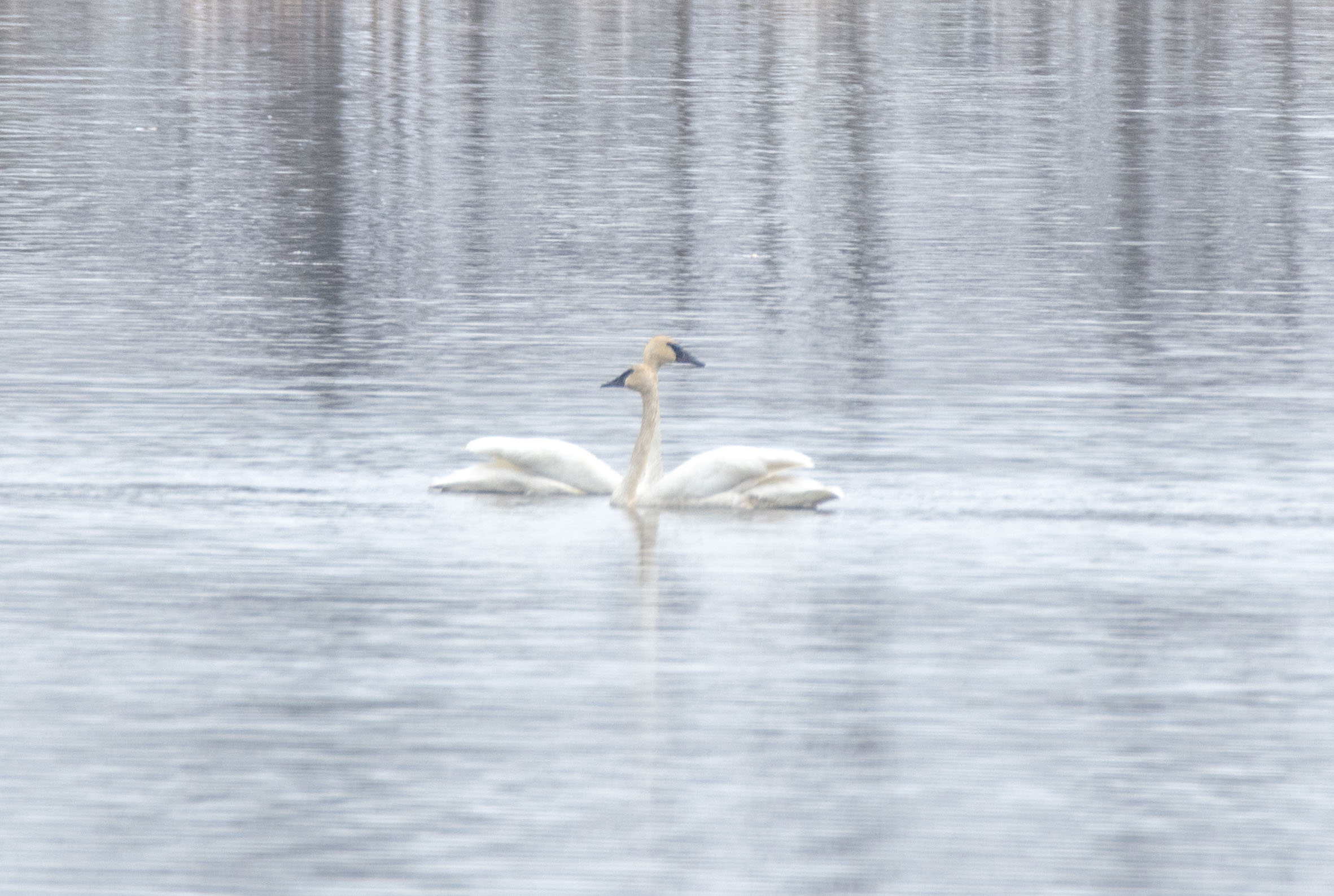
We were blessed even before we reached Blackbird Trail, the gravel thoroughfare through this North Woods paradise. We began passing swans huddled in stalk fields a few miles before the park entrance that included several on a small wetland that were in some sort of ritual, one that included a bit of a dust up followed by ritualistic rising and lowering of their necks. We guess we had witnessed an establishment of a pecking order of young, unattached swans for there were a couple already on nests. Their mating rituals are seemingly quite different for that occurs in water, with a beautiful neck and head movements between the male and female, an almost ballet-like ceremony of artful lust.

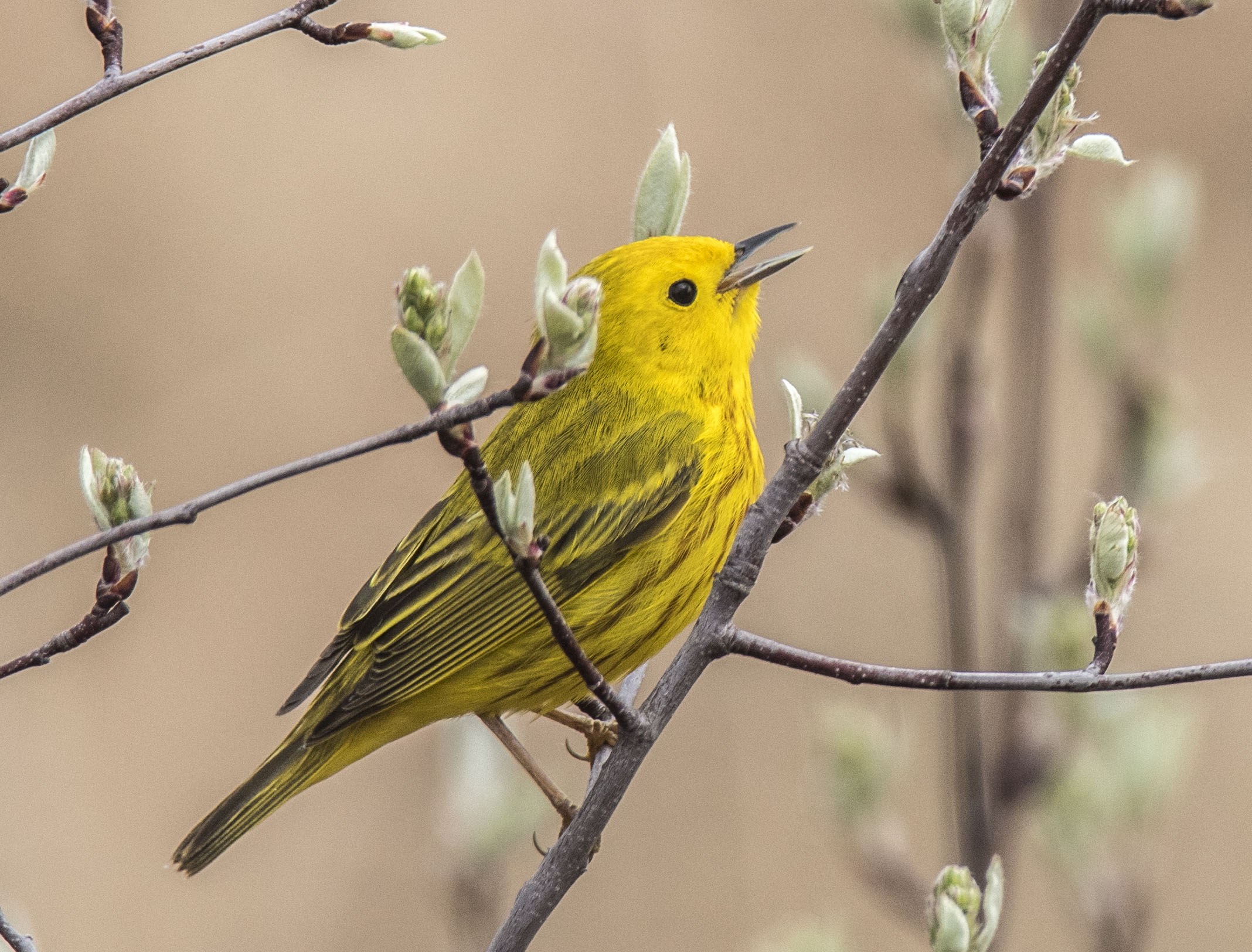
Yellow Warblers were amazingly common, although we also caught Yellow Rumped and Chestnut sided in the Refuge.

What we witnessed was decidedly less serene and beautiful. Nonetheless, swans provide us with one of the beautiful successful rebound stories in nature. The numbers have increased significantly over the years, for when I was young they were extremely rare. I recall being on a trip to Christchurch, New Zealand, in the 1970s where I kayaked through more black swans than of all the native white swans I’d seen in my lifetime to that point. Now they’re fairly common, including some that nest in our nearby prairie wetlands. Swans are such a beautiful bird. So elegant and figurant, so graceful and poetic in form. I never tire of photographing them. 

Moments later we pulled into a broad turnoff to pick up some literature, we lingered at the overview to look at the lake below. Suddenly we caught a flash of yellow and we were suddenly immersed in one of those hide and seek games with Yellow Warblers. Fortunately we were high above the trees for a change, making the game even more fun. While I was working for warbler images, Roberta had spied a large wading like bird in the shallows below. I could see it briefly and captured a few images, although reviewing the images both on the camera and later on the computer, the identity remained mysterious.

A little “photographic poetry” helps the soul …

Tamarac has usually offered a beautiful bouquet of flowers. While we didn’t see the beautiful blue flag iris blooms that have enchanted me in the past we saw numerous bellwort, hepatica, violets and wood anemone. A few years ago that five mile stretch took nearly three hours as I was constantly in and out of the car with the camera, bending over and actually laying on my belly in seeking different angles. Now, just months shy of reaching the ripe age of 80, I am feeling somewhat limited in seeking those same and similar camera angles. And it seemed that just as I was about to push the shutter there would be a nearby flutter, and my eyes would roam from the flowering offering to the nearby brush or canopy. Such joy. Such beauty. 

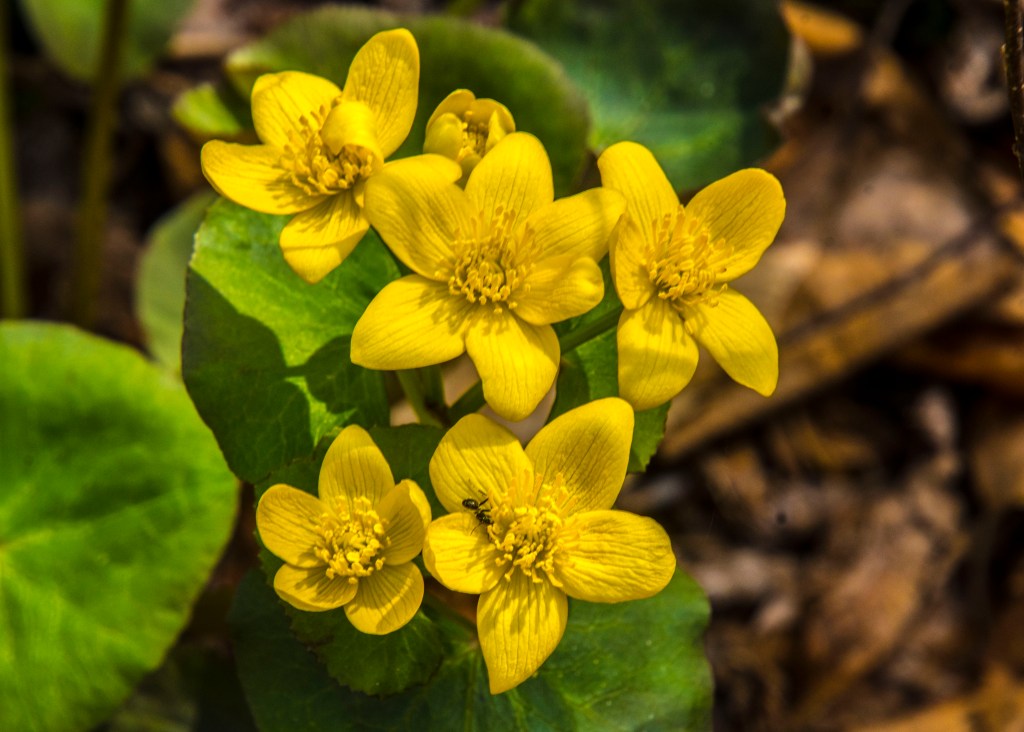
Between the warblers and forest-friendly wildflowers, it would be awhile before we came upon one of those “little pockets” of marshy waters and the jewel-like marigolds. What a startling sight! On the ridgetops of ankle to knee deep drops, they beckoned like stars in the night. Our stop there lasted long enough that a park ranger drifted in, the only vehicle and human we had seen in the nearly two hours of traversing Tamarac. She was soon out of the pickup and bending over with Roberta as they chatted about the wild range of hepaticas. Meanwhile, I was shutter happy. The marigolds were like icing on a cake, to use a metaphor. 

As we gathered ourselves another sense was awakened. That of sound, and the sound was the rapid rat-a-tat-tat of drumming Ruffed Grouse. Interestingly, although we had been in and out of the car numerous times we hadn’t heard the drumming until then. And, from multiple directions. The ranger said grouse were common and acted a bit surprised that we hadn’t encountered on our drive. 

Shortly thereafter we reached the gravel portion of Hwy. 29, and decided we should head back for the second third of our journey, one that would include Maplewood State Park and the rookery in Fergus Falls. There was some wonder if the rest of our day-long adventure would measure up to Tamarac, and although the other places were interesting in their own rights, Tamarac was once again inspirational and beautiful. Once again this sanctuary of wildness, here since 1938, was a special delight. It has yet to let me down whether I’m looking for wildflowers, feathery inhabitants or photographic poetry.  

Bucket List Birds

As we gathered for the potluck offerings for the launch of the 45th Salt Lake Birding Weekend, an older woman sitting across the table spoke of her drive out from Minneapolis to our far “west coast” of Minnesota. “For years,” she said, looking across at her birding buddies, “I’ve always wanted to see my first White-faced Ibis. We drive out here and they’re everywhere. I’m guessing we’ve seen 30 or 40 of them already … just this afternoon.”

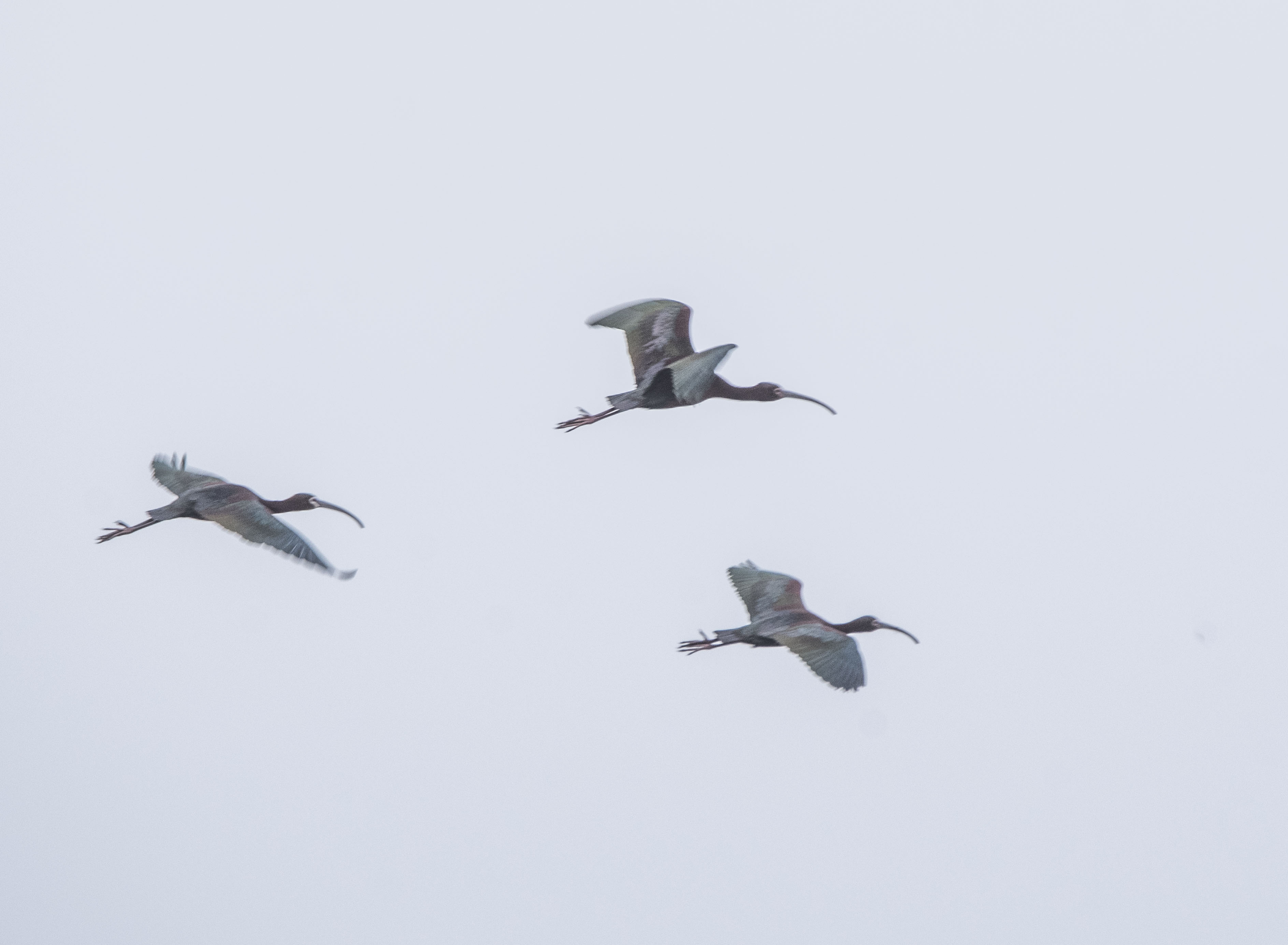
The interestingly and colorful Ibis arrived in the area a week or so before. Initially after moving here 11 years ago I mistook them for Curlews, which I’d seen in the deep south. That first spring I spotted one in a wetland a few miles from Listening Stones, and I would eventually identify them as the Ibis after seeing and photographing them en route to the Sand Lake National Wildlife Refuge between Sisseton and Houghton, SD. A grouping of about a dozen seemed to congregate in the same flooded farm field each spring. 

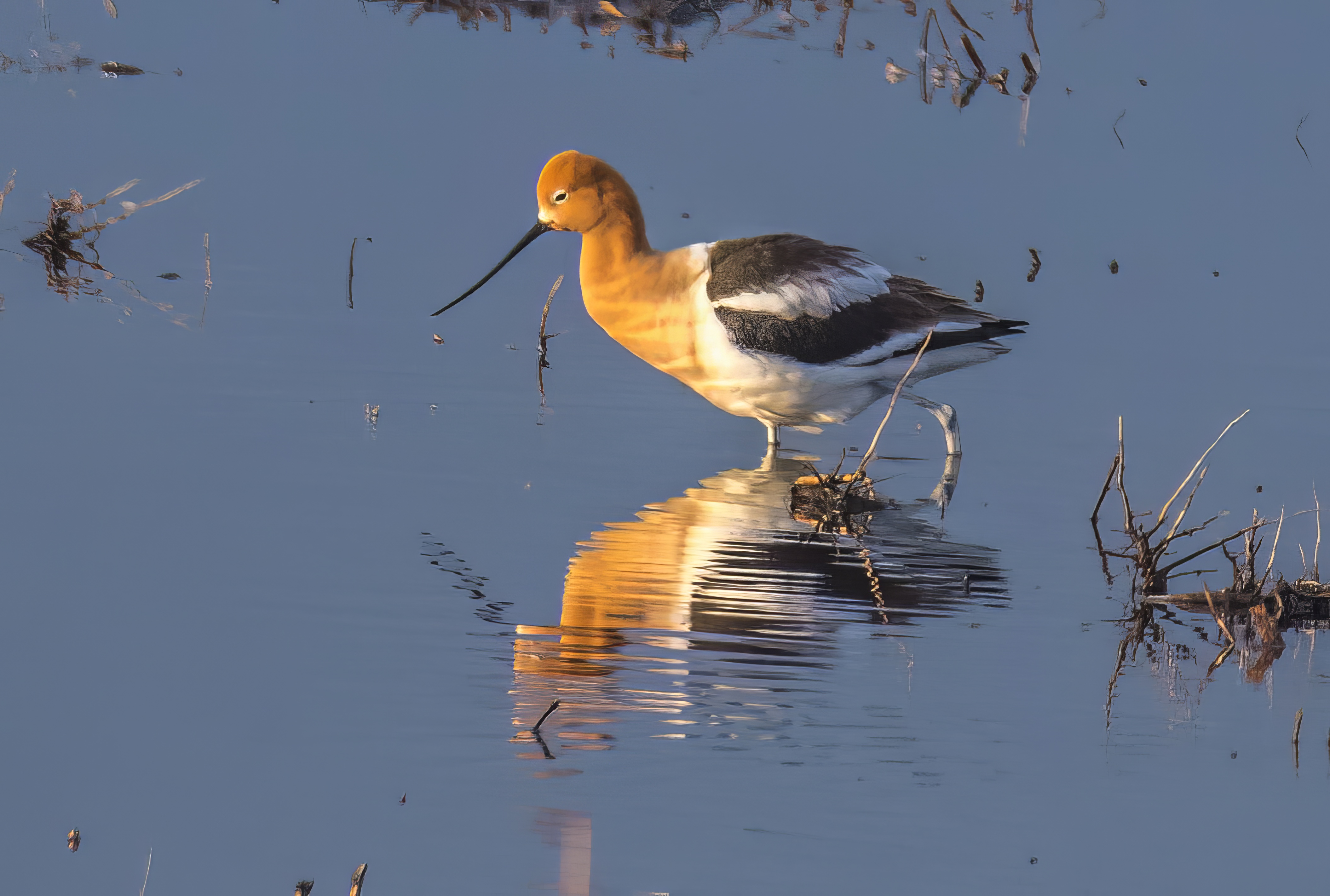
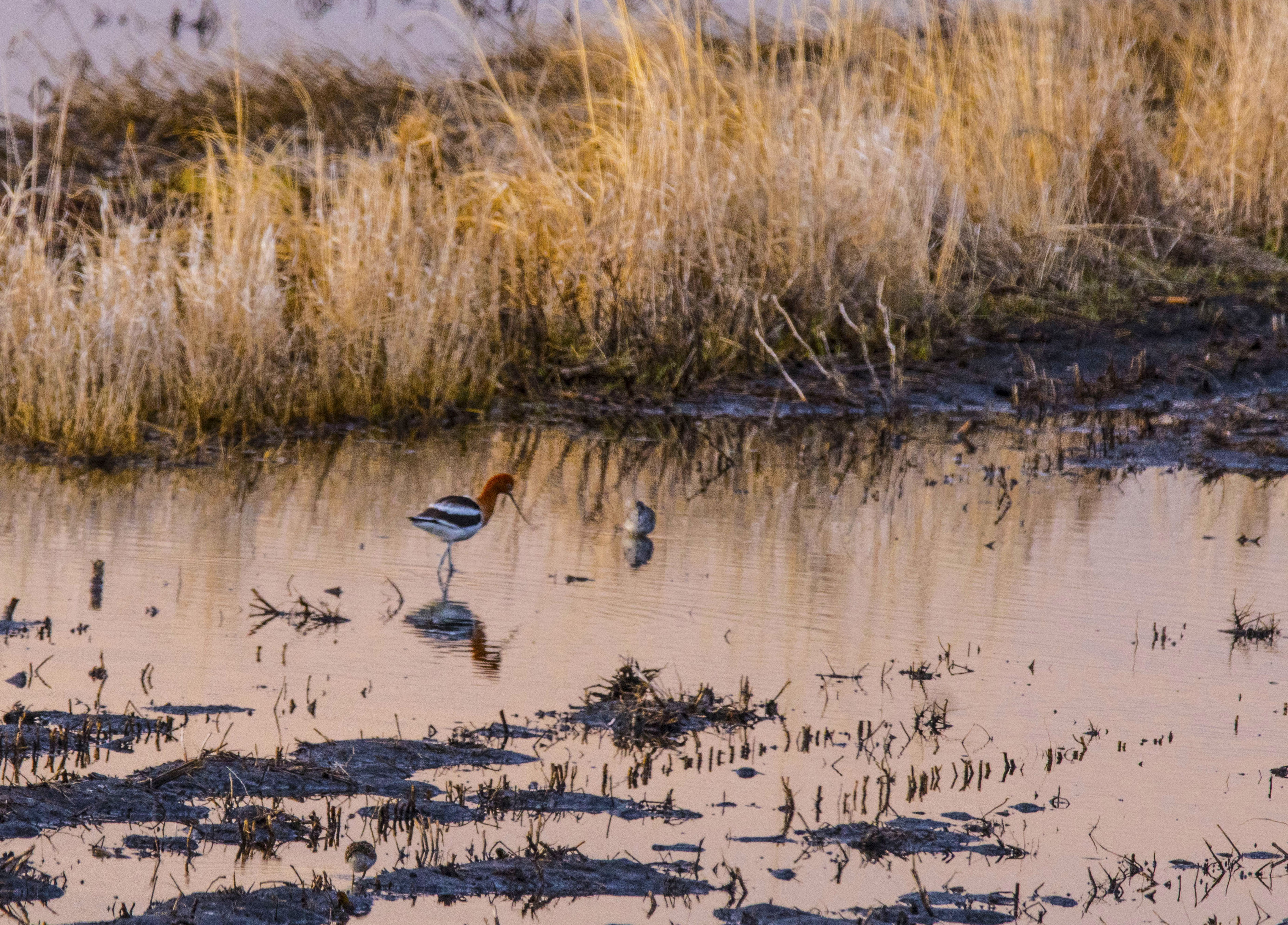
Thanks to Rhyan Schicker I was able to find and photograph my first American Avocet just east of Marietta on the “annual” Salt Lake Birders Weekend.

Then, a few weeks ago, a flock found a flooded piece of shallow flood water within the Ortonville golf course, a spot they would alternate after rapid escapes to a slip of shallow muddy water maybe a football field away. 

Obviously the Ibis were on the woman’s personal birding bucket list. That caused me to wonder about my own bucket list of birds. One I’ve chased with no luck for years, even though my writer friend, Tom Watson, has sent me notifications of his sightings between here and his hometown of Appleton numerous times, is the American Avocet. Unlike the Ibis, a wader with a down-turned bill, the Avocet has a beautiful orangish head boosting an slightly upturned bill. It’s just a beautiful species, and often a favorite of wood carvers who favor waders over duck decoys. 

Another on my short list is the Western Grebe, a long-necked beauty of a bird known for its courting “rushing” ceremony where twin birds skim across the water surface on their feet in perfect synchrony. Although videos have captured the rush so many times, it’s something I’ve dreamed of seeing and hopefully photographing sometime.

A closer view of one of my bucket list birds. We saw the other, the Western Grebe, although it was too distant and dove underwater before I could capture an image.

So there you have it. Two birds. My bucket list. Over the years there have been other birds of interest including some real surprises. Take the Puffin. I never expected to see one before I encountered several on the western seaside cliffs of Ireland years ago. I even asked a guide if it was indeed a Puffin for I expected a much larger bird, and they were much smaller in stature than a Crow … perhaps the size of a Brown Thrasher. 

Many such sightings are unexpected. Take the time when an old and now departed friend, Greg Gosar, then an organic farmer in Colorado’s San Luis Valley, asked if I’d like to see a large grouping of Sandhill Cranes that had landed in one of his wheat fields. We snuck up on them via a sandy, dry gulch before easing onto our bellies to crawl up the bank to see about a hundred Sandhills on a feeding frenzy. Although this was my first sighting of the birds that have captured my interest ever since, the highlight of the moment was actually seeing a single, tall and majestic Whooping Crane. Back then, in the late 1970s, Whoopers were nearly extinct with perhaps 60 total in the entire country. Greg was just as shocked and excited as I was. We talked about that moment for years afterwards, and always with awe.

For those who had never seen a White-faced Ibis, there were ample opportunities on the caravan.

Cedar Waxwings eventually came off the list while looking through a “boardroom” window on the second floor of Java River Coffee Shop in Montevideo. An Indigo Bunting appeared a few years ago at a friend’s bird feeder in a Driftless forest near Cannon Falls, and the striking Scarlet Tanager was spotted while canoeing with friends on the Concord River near the historic town a bit west of Boston. How appropriate this sighting so near the shadow of Thoreau, and for a member of a family of birds that seemingly completely miss our prairie biome! 

And, so on it goes. From the high mountains through my years in Colorado to living along the Mississippi Flyway to now having my home in the depths of the former Prairie Pothole region of SW Minnesota, where a chain of river lakes annually brings birds I had rarely seen before, and sometimes, like the Snow Geese migrations and the immense murmurations, are absolutely stunning. While I don’t maintain a physical checkoff list, mentally the list is alive and growing.

The “annual” Salt Lake Birding Weekend has been on my radar for years and is anchored around the small alkaline, 20-acre lake just a few miles southwest of Marietta. Although the Covid years interrupted the string of consecutive years of these birder caravans, this was labeled as the 45th year. Otherwise it would have been the 48th, and apparently there are only a few of the original organizers still alive. One was Fred Eckhardt, of nearby Boyd, MN, who now uses a cane, and has a vivid memory and legacy in this area of Minnesota. A birder, through and through.

A chance sighting of a short-eared owl captured interest, for most had migrated north.

My hope was of perhaps capturing my two bucket list birds. At the Madison potluck gathering the night before I had mentioned my quests to the Lac qui Parle County SWCD director, Rhyan Schicker, who said she had actually seen a few Avocets at a temporary flooded wetland just east of Marietta. I made note and drove down early before the 7 a.m. meeting at the Marietta Legion Hall to see if my quest had come true. And, it had! There, stalking through the shallow, muddy waters was this beauty of a bird. The striking orangish head, black and white striped body feathers, long spindly legs easing through the muck and with that characteristic upturned bill. I was so delighted, so much so I could have skipped the next several hours! I’m glad I didn’t.

After capturing several images I sped over to the Marietta Legion Hall just as the caravans were organized and leaving, and was able to join with a birder buddy and organizer, Jason Frank, who started his group’s trek along the western shore of Salt Lake. This is the only alkaline lake in Minnesota and was created by runoff from surrounding alkaline soils in this unique and solitary watershed. There are no outlets, and this a briny body of water annually attracts all sorts of birds, especially waders like the Avocets, who are not native to the area, and has become a birdwatching mecca. It’s said that brine shrimp in Salt Lake can reach a couple of inches in length!

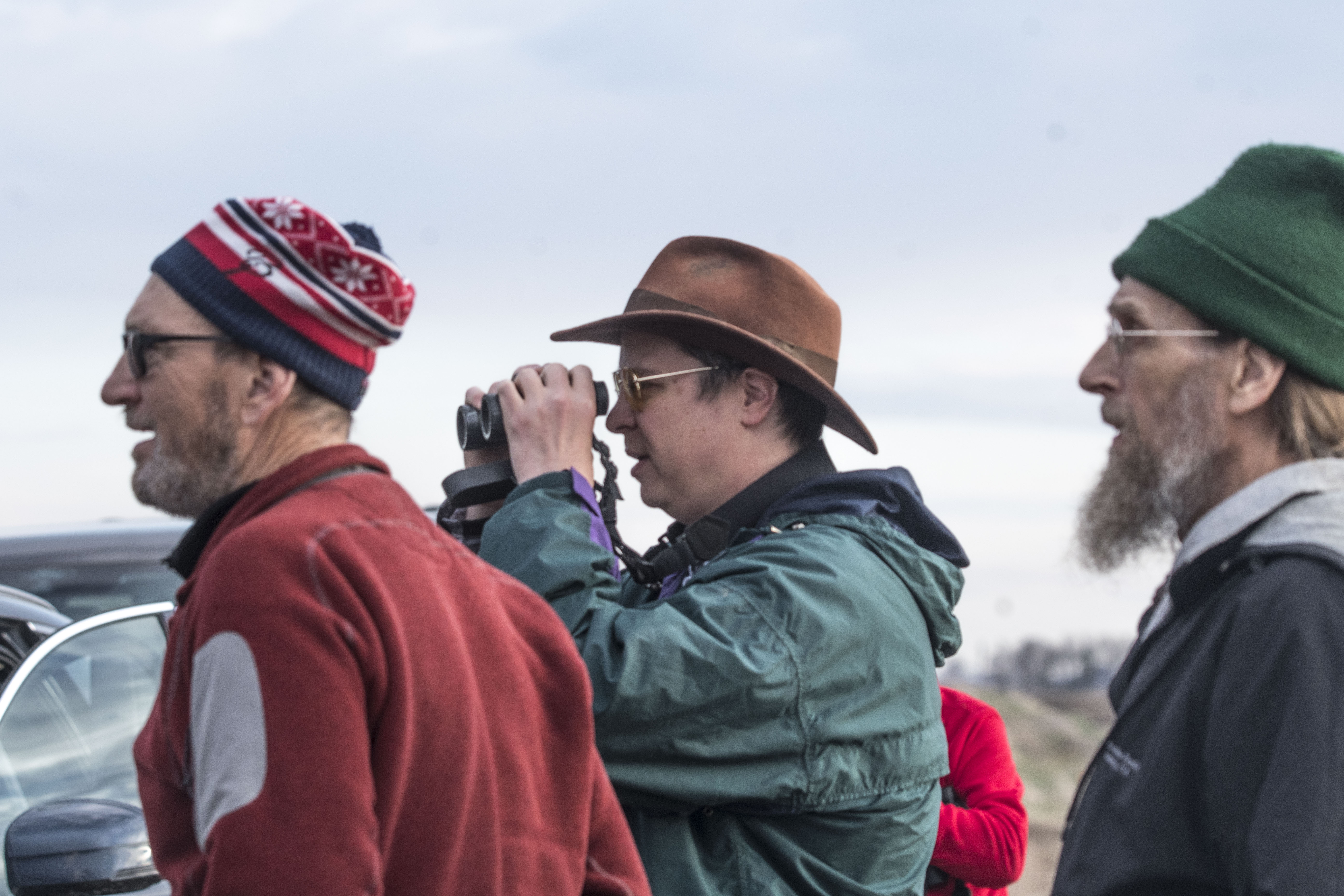
Birder leader, Jason Frank, center, knew the area like the back of his hand, and was amazing in his quick and accurate identifications.

Jason grew up on his family’s prairie farm just a few miles southeast of Salt Lake where many acres of prairie grassland, in cooperation with nearby neighbors, are now in permanent easements of prairie grasses and undrained wetlands. It’s an excellent resource where you can almost visualize how this part of the prairie looked before Euro-American migration. Jason knows the surrounding area like the back of his hand, and we traversed the country roads going past dozens of huge wetlands and abandoned woodlots in search of birds. 

And at one large wetland of what appeared to be about the size of Salt Lake, surrounded by prairie grasses, Jason pointed across to the far side of the windblown waters to my second bucket list bird. Raising the camera with the 600 mm lens, I momentarily caught sight of a pair of Western Grebes just moments before they dove underwater. Although I searched the surface for several minutes I never saw them resurface. Those long white necks with the silhouetted black head and neck gave their identity away. It made for an incredibly successful and fun day!

One of the original organizers nearly 50 years ago was Fred Eckhardt, who once again made his presence.

Later that evening, at the Sons of Norway Lodge in nearby Madison, the birders gathered for a fried chicken dinner with fixing that concluded with Jason and fellow leader, Steve Weston, conducting the official tallies for the day. One by one, all the way through the two-pages of five column lists, they worked to check off the sighted birds from the capacity crowd of birders, including Eckhardt who occasionally murmured, “Really!” with the name of the bird.

One woman had not only kept a detailed list of every single species she’d seen, but also a count of how many. When tally was complete, the birders climbed into their cars to head to their respective motels stretching across the Minnesota River valley, realizing that 139 total bird species had been sighted. Perhaps an all-time record, according to Jason — a list that included the two I had most wanted to see!

Willie’s Inspirations Continue

An ambitious sausage making party down in Iowa made me think of my long ago friend, Willie Rosin. It seems he was intent on converting 100 pounds of ground pork into a variety of sausages. Willie is like that, sort of a back to an earlier era of mankind, taking on a back-to-the-basics approach to life. Old world is Willile’s world.

It’s odd that we became buddies. He’s a Lutheran minister and I’m, well, sort of a spiritual man, compelled to commune more with a seat in the woods than a church pew. Yet, we had a connection. Catfishing. When he was ministering to a couple of country churches down in Chippewa County where I was running a country weekly, we met in some fashion of which I can’t remember and learned we shared a passion for whiskered fish. So we started going to a stretch of the Minnesota River in his aluminum boat to angle for catfish, meaning there was indeed ample time to explore and share both spiritual and real life thoughts.

We even went ramp hunting one rainy morning somewhere along the Chippewa River. A member of the wild onion grouping of edible plants, ramps are rather delicious, so convincingly so that we carefully took a hand trowel to judiciously harvest a few whole plants that I would transfer here to my woodland close to a little pond we had devoted to hopefully slow the runoff through the woods. A couple of them “took” though not enough to eventually harvest.

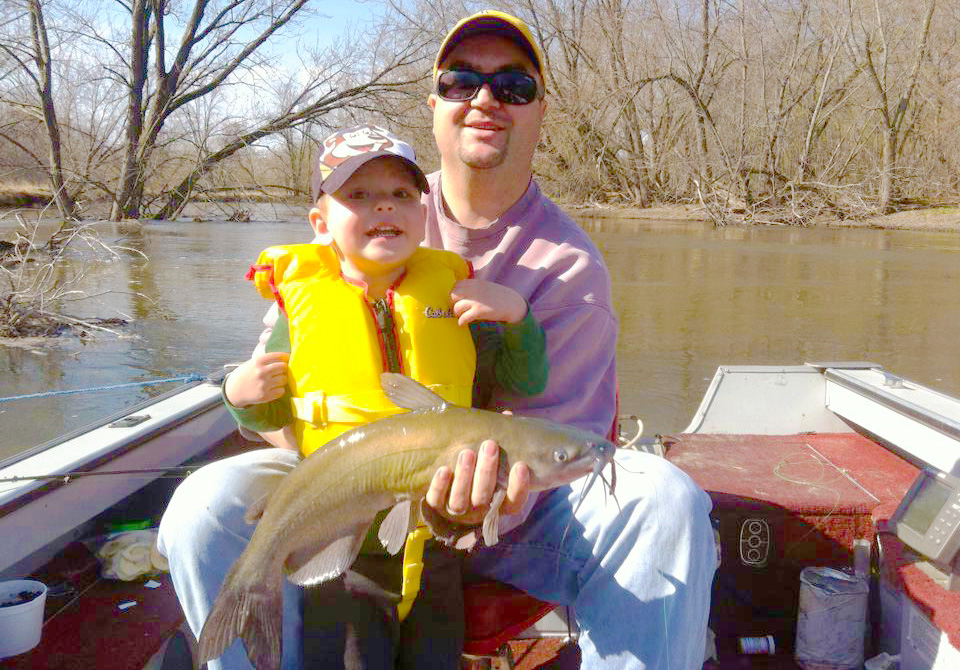
My old friend, Willie Rosen, holds his daughter and a channel catfish!

Willie is married to Jennifer, an inspirational band teacher. When they lived downriver in Montevideo she was suddenly having students making trips to “state” and qualifying for the MSHSL orchestra. Then suddenly, out of nowhere it seemed he took a call to Northwest Iowa which brought an end of our fishing trips. Thankfully, though, not our friendship. Nearly overnight he busied himself in converting a large yard into one of his traditionally incredible bountiful gardens and plying local rivers and ponds for catfish and other Ichthyological wonders. Oh, and Willie has never shied from having his two daughters in the boat as soon as they could hold a pole, and come autumn, they would don orange hunting fashions and head to the hills in search of whitetail deer.

While Willie had them involved in his outdoor activities and venues, Jennifer firmly placed them onto chairs in the music room. You might say their girls, and now three adopted children, are well rounded and grounded. And, once again, children in Jennifer’s charge are qualifying for prestigious honors in the Iowa state musical classifications. Then Willie became one of those rare men who packs up and follows his wife’s career. Jennifer was hired as a band instructor in Muscatine, so they packed up the clan, the boats, the sausage stuffer, rods, guns, gardening gear and kids to move across state to the “east coast” of Iowa. To me, that makes Willie a bigger man than most.

Within weeks, it seemed, Willie had accepted a new call in town and the Rosins settled in rather nicely. The kids are growing in all manners and possibilities just like Willie’s gigantic and bountiful gardens, which he is already tending to. His recent Monday, though, was filled with all that pork and a handfuls of various spices as he set out to stuff casings with kielbasa, kielbasa with cheddar, classic fresh bratwurst, bulk hot Italian and a few hot Italian links, caseless breakfast links, summer sausage along with his first attempt at Nduja, a chili-based spicy, spreadable pork sausage from the region of Calabria in Southern Italy.

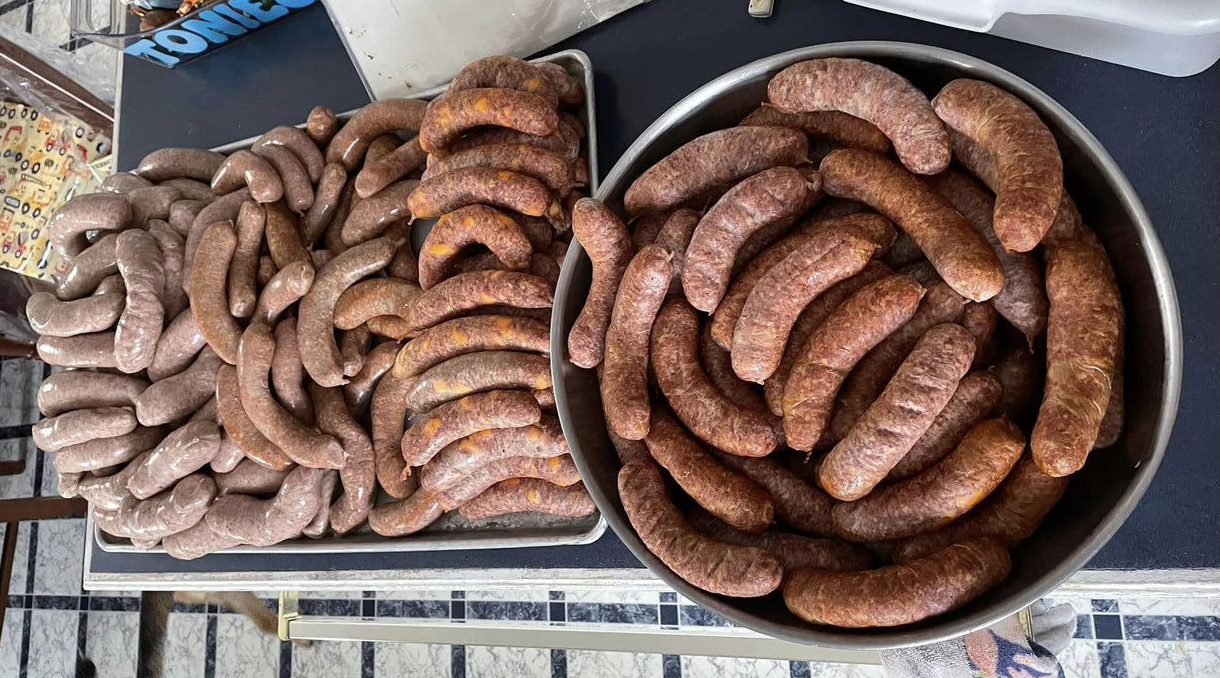
Willie’s sausages, except for the Nduja and summer sausage.

One of the main ingredients of Nduja is a Korean red chili powder, and for those who haven’t ventured into Korean cuisine, it is tongue-seething hot. My first college roommate was Korean, and he wouldn’t eat in the cafeteria with us. Rather, he’d cook on a hotplate in our room and the scents from his fare were tantalizing even on a full stomach. I asked to have a taste and at first he refused. “Sorry, Man,” he’d say. “What I cook will kill you.” After much pleading through the semester he finally spread a few bites of a Korean concoction on a paper plate and handed it over. One bite had my eyes watering and quickly kidnapped my ability to taste for about a week. I’m a bit more cultivated now, I suppose, for spiciness now dominates my cooking.

Says Willie of his Nduja, “These will be stuffed into 55mm Umai casings, fermented at room temp for 48 hours, then cold smoked for a total of 24 hours. Then into the fridge to dry a bit. Nduja is a very spicy, spreadable salami I just had to try.” 

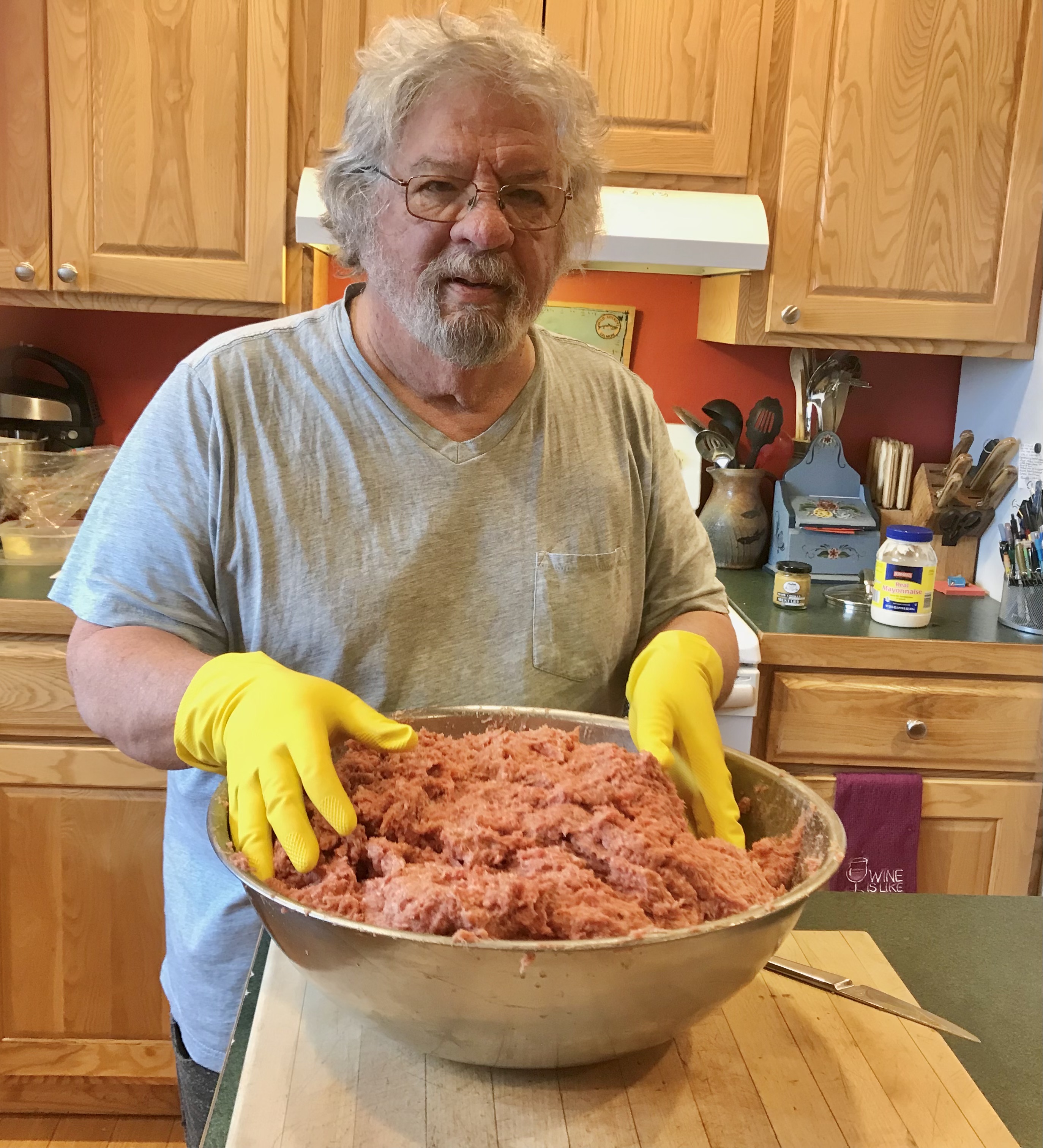
Your’s truly working my 20 pounds of ground pork into Italian sausage.

To suggest that Willie Rosen is a “Renaissance man” is putting it mildly. Whether he plants his feet behind the pulpit or in front of a transom makes little difference for he is seemingly always seeking a means to mingle the joys of Mother Earth with heavenly mirth, and to spread all that joy with both his family and his parishioners just as he did so with me many years ago. I’d suggest we were an odd couple, yet I cherished the time back then and thoroughly miss it nowadays.

So on an afternoon after watching Kurt Arner attack the huge pile of storm damaged wood and my piddling around between new photography software and seeking a burning permit before the two of us ended up in court, I pulled one of Willie Rosen’s recipes from my printed pile of unorganized recipes. When I went for the burning permit to save Kurt’s and my collective souls, I picked up three healthy looking cucumbers and went to work slicing and combining a boil of sugar and vinegar along with a variety of spices for Willie’s Bread and Butter Pickles that are now curing in the refrigerator for a week. These are about the best pickles ever. As an old journalist I’m not sure there’s that heaven Willie preaches about, but if there is I’m sure his pickles are there for all those godly sandwiches.

Here’s his recipe:

3 cups of Vinegar

3 cups of sugar

1/4 cup of pickly salt

1 teaspoon of celery salt

1 teaspoon of turmeric

1 teaspoon of mustard seed

Slice and stuff the cucumbers and onions into quart jars while you bring the brine to a boil, then pour it over the cukes and onions. Refrigerate for a week. It makes two quarts or four pints.

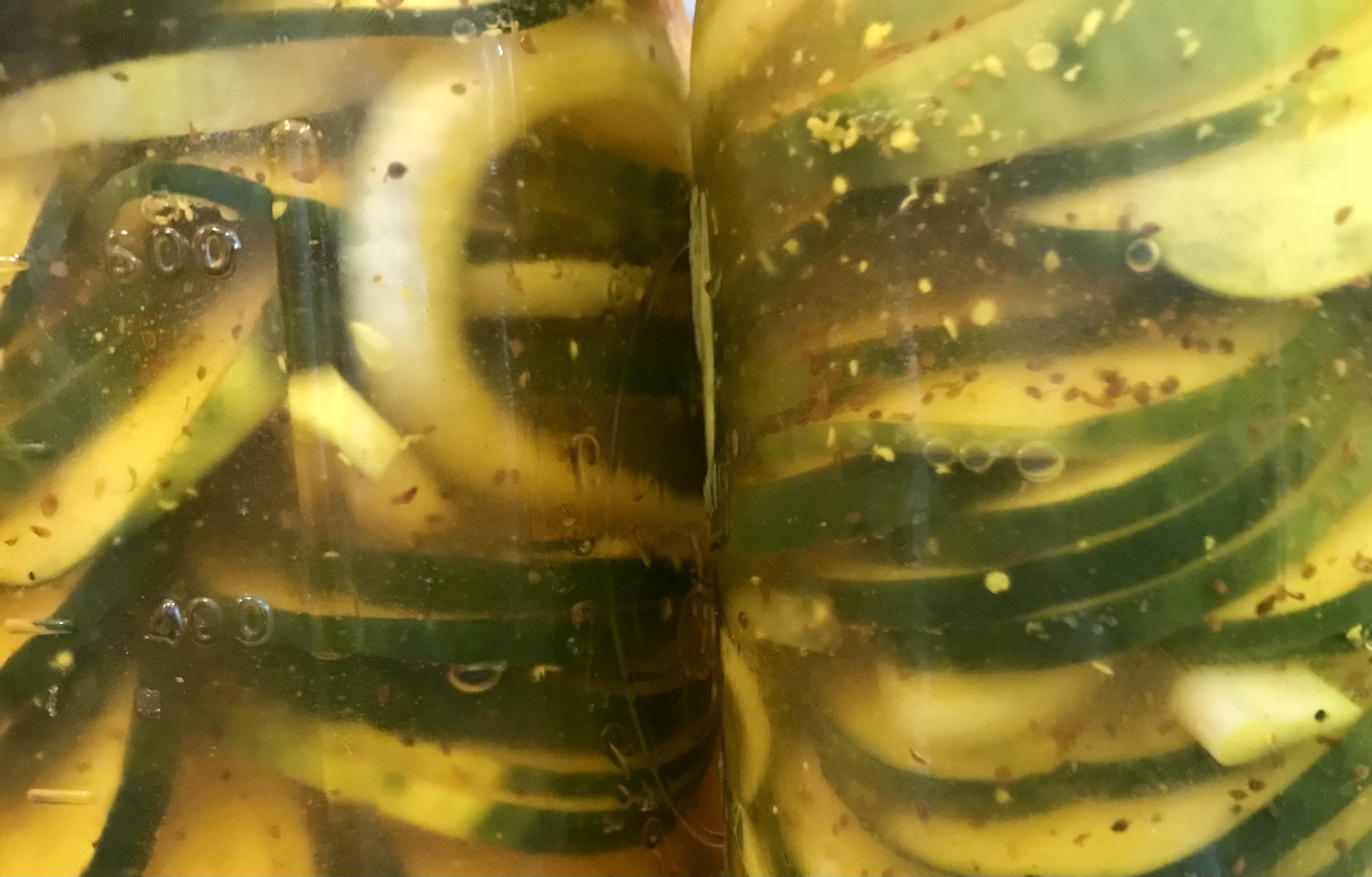
My efforts with Willie’s Bread and Butter pickles fermenting in refrigerated jars.

Seems so simple, yet the taste is top shelf. And to top it off, we then tracked down 20 pounds of ground pork from Pastures A Plenty and proceeded to try our hand at making our very own hot Italian sausage. Although it was a challenge to mix the various spices with the ground meat, we taste tested two patties which passed the test! Only thing left is getting our own garden shaped up and to get in some catfishing along the Minnesota River.

Oh, and just for the record, here’s a complete update on the Rosin family from Willie: “I’m the pastor at Zion Lutheran Church (ELCA) in Muscatine and Jennifer is the band director at Susan Clark Junior High. Grace, our oldest, turns 20 in May and is completing her second year of college at University of Northern Iowa, early Childhood education with special needs endorsement. Isabelle, 18, graduates from Muscatine High School in May. She will attend Jacobs School of Music at Indiana University to pursue a dual degree in horn performance and music education. Lydia is in second grade and keeps us on her toes. Loves reading, writing letters and making crafts. Ezra is growing into his autistic and amazing self. Tons of personality and wit. Abner is a master of chaos who loves Hot Wheels, big trucks, playing in the dirt and all things hunting and fishing with dad.”

Life is good both here and there. Willie has his tongue sizzling Nduja and we have those pickles along with some hot Italian now in the freezer! 

Spiderweb Skies

Finally, after many long months of winter, we are welcoming spiderweb skies. Next to the Sandhill Crane migration in central Nebraska, finding the migrating Snow Geese heading into the prairie wetlands is most compelling. Thanks to the scattered and perhaps uncoordinated skeins of the Arctic-bound black wing-tipped white and blue geese, they seem to spread across the skies as elongated and exaggerated spiderwebs. What a lovely sight!  

Unlike the Sandhill Crane migrations that annually congregates in a 60 mile stretch of the Platte River, Snow Geese seem prone to finding secluded and thawed wetlands or sloughs … which in a few weeks will be long out of sight and gone thanks to underground tiling until they might be seen once again at the end of another winter … to catch a break near over-wintered stalk fields to feed up for their next jump up the globe. In early March of 2021 they chose the wetland just over the rise from my prairie where they stayed for nearly a week before moving on. They rarely seem to choose the same wetland year after year. 

On a recent early morning walk we encountered a huge flock just down the road from Listening Stones Farm scattered across a quarter section of my neighbor’s conservation-tilled grain field. As we walked down the road with leashed Joe Pye, they almost in unison, over perhaps a quarter mile of field, rose at once and took to the sky. Whites mixed in with what is termed their “blue” phase, circled the abandoned grove at the end of the road to fly off to the east. As we continued our walk another group on the far western edge of the field rose before making a slight circle before re-landing. About the same time about a mile to the east another large grouping of the geese appeared just above the distant treetops. Were those the ones we had scared? Who knows. The morning air was full of their unique sound giving us a sense of “surround sound.” One of those magic moments of nature.

One off my joys of spring is the spiderweb skies created by migrating Snow Geese.

Two days before, after talking with outdoor writer Tom Watson, he alerted us to large flock just outside of nearby Appleton. Grabbing the camera and lenses, we left for Appleton only to find a large flock just a few miles southeast of our farm. We never made it to Appleton. We considered ourselves fortunate for it’s the time of year where we often spend hours driving through the prairie watching the skies in search of the flocks. A day or two later we did so again with no success although we saw distant flocks flying or hovering over land in the huge loop we drove. We were very lucky to find the earlier flock just southeast of the farm? 

It is always more fun when they choose our local wetland, which is deep enough and still untiled so it has water standing in it year-round. On March 11, 2021, a large flock landed and adopted the wetland. That was a special event, and one I’ve hoped for each spring since — a hope that remains ever stronger as winter and snows continue deeper into the year.

I can’t seem to get enough of this mysterious beauty of spring.This was from a few days ago when the flocks seemed intent on heading toward the tundra.

When in Nebraska about a month ago there were reports circling around the birders of a huge Snow Geese flock centered on a lake outside of Alda, just north of Crane Trust headquarters. They were in the fields feeding when I ventured up. At the time large flocks were apparently in a standby mode as far south as northern Missouri, Iowa and Nebraska according to reports on internet birding sites. How did they know we were still snow and ice bound here in the Minnesota prairie? An entire month later than when that flock chose us in 2021? Such a mystery. Then this year, just as we began to thaw, our skies began to fill with those spiderweb-like skeins. Once again hopes rose that they would once again find our nearest wetland, and once again they passed us by.

On the year they chose our nearby wetland I was up long before dawn and was busy off and on throughout the day as the birds took off for distant fields, moving from day break to sunset. For most of a week the haphazard skeins rose, returned, and rose again throughout the waking hours when suddenly the silence turned heavy one midmorning and didn’t return. It was a photographic dream.

A flock in a field near us after a call from nature writer Tom Watson.

Those loose spiderweb skeins stretched across the prairie skies like they are right now on our early morning walks and as we scanned the skies near dusk this week. Some days in the past several of the skeins could be seen at once, stretching across the entire sky. They weren’t as dramatic this season. 

Yesterday morning as we neared the return to our driveway, skein after skein seemed to pass over high above us, stretching out in long lines as well as having that classic seemingly disorganization of dozens in various positions outside of, above or behind the main grouping. Unlike earlier in the week when such a skein would appear to be heading one direction until suddenly a group would veer off in a different direction, only to be followed by the rest of the flock. Not on this morning. Yesterday, though skein after skein seemed intent on heading northward perhaps drawn by an inner clock. “Tomorrow morning,” I suggested, “we’ll hear the heavy sound of silence.”

Exactly a month earlier, in 2021, a flock of Snow Geese chose a wetland just over the rise from our prairie to hole in for about a week. Such a joy, encouraging my leaving the windows open at night to hear their sound.

My guess is that their internal clock was suggesting that this spring has been rather shortened by a winter that wouldn’t end, and that it was time to get to their breeding and nesting areas in the tundra. Much like the message that seemed to have the birds “hole up” in the lower Midwest for weeks on end, we were experiencing yet another blizzard.

This has been a gracious week of extremely uncharacteristic warm weather, mostly in the 70s and 80s, and the large drift across our walkway and patio that was above our heads has melted to a little more than knee-height, all in a few days. We pulled out lawn chairs to take in the sun-drenched afternoons, and as we did we could hear and see the skeins overhead. In the grove various murmurations started by the migration of Redwing Blackbirds flitted about. Huge numbers of birds swung from the very tall cottonwoods on the northern edge of our woodland to the what we call our “south prairie.” They, like the Snow Geese, seemed to have moved along. Yesterday the Redwings were replaced by the larger Starlings, and their numbers made the Redwing murmurations seem small. All part of the skies of spring!

And off they go … until next spring!

And, yes, our walk this morning was deafly quiet. In the distance there were perhaps two smaller skeins of Snow Geese in the distant skies. Those lovely and mysteriously shaped spiderweb skies would be no more, at least until next spring. Much like the Sandhill Crane migrations, this is both a compelling and awesome adventure of spring … an avian welcoming for a new and warmer season.

Finding Magic in the Madness

What is it about the month of March, seemingly an annual body blow to the gut after a long snowy and windblown winter? And why does it have to continue into April? To borrow a term from the sports world, this is another form of  “March Madness.” We have rarely had a break between blizzards. Snow on top of snow with more snow on the way. Squirrels worked to destroy yet another bird feeder, and many migrations were still holed up south of us. Pasque flowers, one of our first spring wildflowers to appear, were still dormant beneath acres and inches of snow.

I was more than ready for a break from the madness by mid-March, so with my appropriately named Rogue packed with photography gear, it was off to the Platte River in the midst of Nebraska for the Sandhill Crane migration.

Once I crossed from South Dakota into Nebraska in midtown Yankton, my curiosity was focused on where and when would we run out of snow. It would be 60 miles due south at Norfolk, NE, meaning there was no white stuff hiding beneath bushes and prairie crevices. Reading my car thermometer caused me to lower the windows to feel the blessed beauty of fresh, warm air. The temperature continued to rise until rolling into Grand Island, my first night lodging, with an afternoon temperature of 70 degrees. My driver’s side window was open and a CD was playing some prairie soul by my buddy Charlie Roth. I was suddenly thinking I’d finally escaped from all of the madness when my cell phone suddenly erupted with a warning: A winter storm warning.

A foursome of Sandhill Cranes in a colorful Nebraska sunset.

Awaking to a drop of some 50 degrees overnight, a glance outside my motel window showed my windshield covered with a layer of sleet. Outside, a wind was blasting in from the northwest with flakes of both ice and snow. Fortunately the predicted snow didn’t last, and by the check-in time to Cheryl Opperman’s Sandhill Crane Photographic Workshop at Crane Trust, it had warmed to the mid-40s. Sun was peeking through a cloudy sky. We were just a few hours away from heading to the blinds on the bank of the Platte for a different kind of madness! 

If you’ve never experienced the crane migration, this is a healthy kind of madness. Opperman has worked with Crane Trust for several years in establishing a series of photography workshops, and apparently my invitation came thanks to a cancellation. My original intent was to secure a plywood blind where I had experienced my best crane photography to date. This is what led me to Opperman, an incredible freelance nature photographer from the Denver area. Besides the crane migration, she offers excursions to the Kansas prairie for Prairie Chickens as well as trips to Iceland, Africa and the Antarctic among others. (www.cherylopperman.com/) 

Estimates placed the number of cranes in the valley at the time close to a half million birds, so the skies were full of sound and fury.

Actually, the old blinds are no longer, for in her agreement with Crane Trust those were replaced by a couple of larger blinds surrounded by a hay-bale fortress to prevent the cranes from seeing humans despite our steely subterfuge of arriving an hour or so before their flights in from the fields in the afternoons, and we would traverse the grassy trail in total darkness when entering in the mornings, reversing those strategies on the way out. 

The workshop was a whole new world for me. I had nearly left my tripod at home, yet here I was among folks with lenses as long as my leg and tripods with strange heads. Once in the blind that first afternoon, Opperman helped set up my tripod properly for my 600 mm, and we then settled in to await the show. It wasn’t long before the familiar and heavenly sounds of the cranes began coursing in from overhead. At first they seemed headed for the shallow waters upriver. Meanwhile, I was in dire straits working my rather inflexible tripod, and finally in frustration pulled the camera to record the flyover with my smaller zoom. “Just do what you’d normally do,” she finally said. A certain comfort settled in, although one that would soon be challenged.

As interesting as the evening fly in is the departing of the river come morning, especially if eagles and other threats seem nearby.

After the shoot the following morning, Opperman challenged me to change. One, pre-set to auto focus. Two, change the head of the tripod to a devise called a gimbal. Three, use the fastest shutter mechanism you have (which sounded like an AK-whatever). And, four, before we return to the blinds, go outside and practice. Which in itself was a bit of a challenge for my practice was on a stagnant, browsing bison herd. This was when fellow work-shopper Tom Dietrich, of Laramie, WY, looked across the table and said, “This isn’t photojournalism. It’s a whole different discipline.” Opperman was pushing me completely out of my comfort zone. Putting this new “madness aside,” when we returned to the blinds for the night shoot I was adamant to do it her way.

The gimbal is an interesting and incredible tool. Complete maneuverability with the lens, and she had also given me hints on how to better track or pan with auto focus. No, this was not what I was used to, although it was fun and different. Unfortunately, thanks to this madness of March, for I must place blame somewhere, the cards containing my images from both the afternoon and morning shoots weren’t initially recognized by my reader. West Photo in Minneapolis came to the rescue, and when I finally saw the results of stepping out of my comfort I was rather pleased. 

A presistant eagle above the Platte early in the morning seemingly surrounded by flying cranes.

High among the reasons was that overnight the temperatures had dropped into the single digits, and one of my blind mates, Vicki Von Loh, informed us in a near whisper that the wind chill was a -7 degrees. I recalled photojournalist Dec Haun explaining why one of his prize winning images from the Detroit riots in 1967 was blurry. “I was shooting at 500th of a second but I was shaking at 1000th!” With northwesterly winds blowing straight into the blind my shiver was way more than my shutter speed, yet, about 95 percent of my images were free of shivering shake! Like Tom had said, “This isn’t photojournalism.” Ice plates were floating on the surface of the Platte, and by the time we headed to the vans for the last time, the river was basically a cocktail of hypothermia. 

Back home the madness of March had remained in full beast. More snow. More blizzards. Drifts had become long and picturesque dunes crossing our lawn from the woodland to the prairie. One that formed over our walkway was higher than we are tall, and would blow shut overnight. Every night! 

Cranes feeding in the nearby fields are always interesting and add to the experience and draw motorists who stop along the rural byways with camera and long lenses.

Yet, there were some beautiful moments within the madness. Besides chasing the cranes in Opperman’s workshop, there was my “artist’s opening” for my exhibit at the Kouba Gallery at the Isaac Walton League in Bloomington where many friends, old and new, ventured through the tail end of yet another blizzard to help celebrate. One was a former colleague at the Wisconsin State Journal where I spent a brief time working in 1967-8. 

Now, as we head into April the weather madness continues. That snow dune on the walkway had shrunk quite a bit until this latest blizzard, and with the drifting it was nearly as tall as before. The wind sounds like a freight train, and a trio of Juncos leaving tracks in the overnight snow on my deck convinced me to refill a feeder salvaged from the latest squirrel attack. As we headed to bed a look outside found a beautiful full moon peeking through the ice covered branches of the trees. So, yes, there is magic even in this most trying of times of a forever winter, yet as long as we can find magic and beauty we can see through the madness.