Choking the Dance

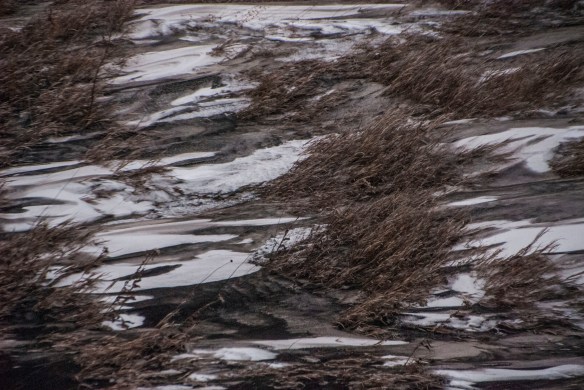
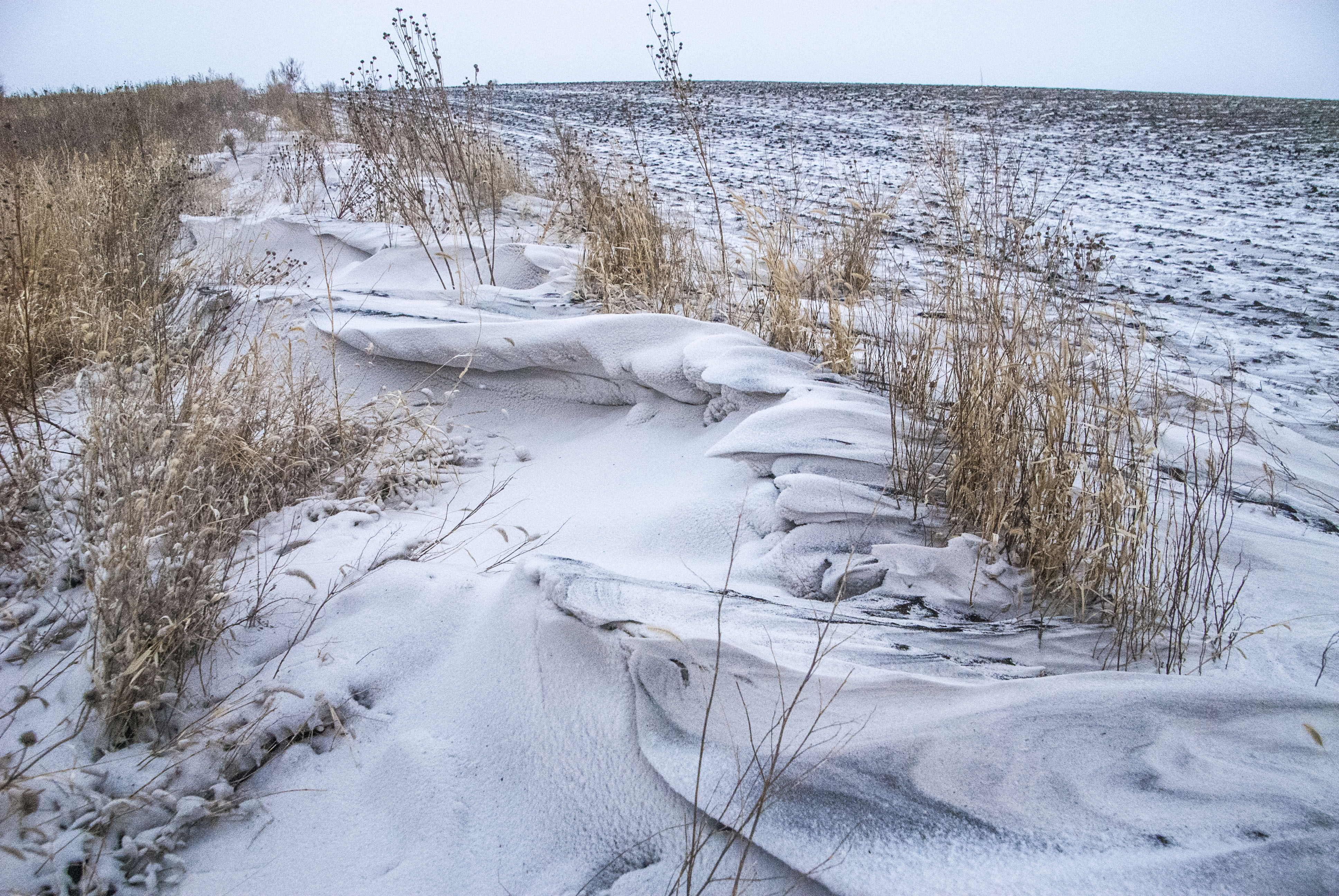
Overnight our prairie changed. Apparently while we were snuggled warmly beneath a pile of quilts, a cold, blustery wind rolling like a freight train across land left a ridge of snow dunes and snirt along the fringe of our prairie from our neighbor’s bare-plowed field. Deep, two to three foot drifts were caught by the prairie grasses.

Our snirt dune, and the adjacent field that was so generous.

Our snirt dune, and the adjacent field that was so generous.

Wind is a significant part of living here, and accounts of wind seem to harass prairie writers as fog does in the novels of London. You don’t have to read too many accounts from the early settlers of the prairie to read of how they gained such a hatred of the wind. Some wrote accounts of losing their minds from the constant wail of the wind. While it is difficult to say how many of us “modern” prairie inhabitants are so afflicted, there will likely (or should) be some farmers concerned enough about the dirt being blown from their fields to do something about it. While we’ll happily take what they’re offering, for it’s free to us, the legacy they’re allowing to blow away puts their finances at peril on the short term, and humanity’s ability to survive at greater risk in the long term.

Yes, the wind is part of the prairie. With each windbreak cut, dozed and burned, and with every spare inch of sod turned into commodity cropland, we lose rather than commune with the wind. Little has changed in the natural forces over those years except for the treatment of the prairie soils we were so blessed with after the last glacier. We have ripped it open, ditched it to drain the water from the wetlands before we laid tile to empty soil moisture for earlier planting. Ninety-nine percent of it. Now a more recent generation of farmers, heaped under high production and equipment costs and land prices, are working to convert more land into crops, and to re-tile with more “efficient” pattern tiling. Yet, the wind still blows, and with it, the product of their decisions … the soil on which they farm.
2.15.15 wind7
We can almost guarantee these constants will not change: The wind is going to blow, winds that are often harsh and constant; and with it, soils that become roadside and ditch borne dirt.

Learning of the harshness of prairie winds has been a revelation. My first 20 some years of living in the Minnesota prairie was on the edge of a small prairie town. We joked that if we wanted to feel urban we could simply look through the front windows where a picturesque postcard scene of tranquility came from an overhanging canopy of mature trees and older, comfortable looking houses. Across the room, though, the view was of the federal version of Hawk Creek and the prairie beyond. It was, in our minds at the time, a perfect collision of town and country. We did notice a wind, especially just before a blizzard when it seemed to reside above the roof tops in a distant roar. You could hear it, and watch as the tops of the trees waved their naked branches, but you couldn’t feel it. With non-blizzard winds, there were just too many houses and, yes, urbanity, to feel the full force of a prairie wind.

Joe Pye found the snirt dune to his liking!

Joe Pye found the snirt dune to his liking!

Now, having since moved to our Listening Stones Farm, we can hear it, feel it, and if you watch the prairie grasses nearby, you can see it. William Least Heat Moon wrote of how the wind gives prairie grasses the freedom to dance while those same grasses give face to the wind. If you lived here, lived within an actual planting of prairie grasses, you would identify with his description.

In our first year here my goal was to walk to the end of the section and back, a two mile hike on a gravel road. On one of those first hikes the trip down to the corner was brisk and easy, and I was feeling pretty chipper for my age. When I turned to return, and once past the abandoned and protective grove at that end of the section, it was a struggle make progress against what was actually a staunch breeze. By the time I made it to the protection of our grove I was worn out and working to breathe. Against a full blowing northwest  wind you are simply pleased to make progress. After a year of this, a membership was purchased at a nearby gym with a couple of wind-free treadmills.

Using the wind in a blue stem prairie.

Using the wind in a photograph of a blue stem prairie.

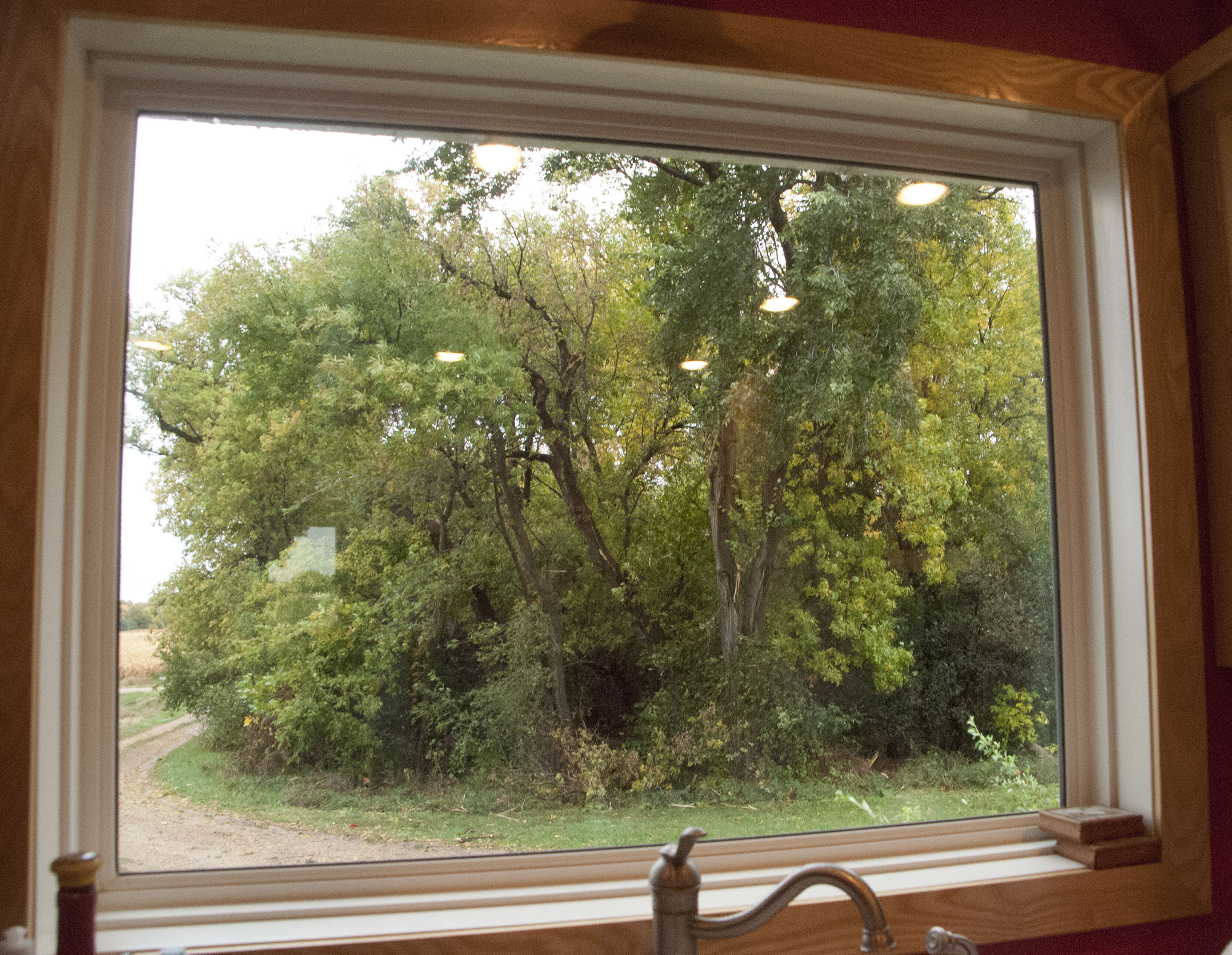
Like most of the farm homes on the prairie, our house is surrounded by a dense grove. That first year the buckthorn was too thick to  get through. Those walks on the gravel road in the open prairie was enough to gain a deep appreciation of the trees. Even the buckthorn. Our biggest concern of clearing the buckthorn the following year was how the new “openness” would translate with a cold wind. Our sawyer, Kurt Arner, suggested we not worry, that the windrows of downed buckthorn would still provide enough protection. He was right. Our mailbox, set just past the protection of the grove, serves as a sobering reminder of the worth of the woodland.

Last year after a cleansing of the vast buckthorn along with many of the damaged and diseased trees, including some with the telltale burnt brown “zipper” stripe caused by lightning, we planted 70 bareroot trees and countless shrubs. Some were fruit trees in our new orchard, but the rest were planted inside the canopy of the standing grove where Kurt had left “holes.” Recently Rebecca has been stewing over our next order of trees. Kurt has also returned to take down some offensive elms, buckthorn and other weed trees on the south and east portions of the yard.

Cone flower pods accented by prairie grasses moved by the wind.

Cone flower pods accented by prairie grasses moved by the wind.

In a short time we’ve learned to commune with the wind. Fighting it is futile. We raise chimes to create wind music, and I’ve learned how to use the wind in my photography. Our prairie grasses on our eight acres of tillable land protects the soil. An east wind will cause our water lines to freeze upstairs, so yes, we’re conscious of it. We’re equally conscious of the effects of the wind on the fields of our neighbors. Those who have left stubble in their corn fields have clean ditches. Those who plowed, even minimally, do not.

Although we have eight acres of replanted prairie, the two of us … migrants from tree-blessed states of Vermont and Missouri … love our few acres of trees, and actually bless them on nights when you can hear the steady “lullaby” of the prairie wind. Last night, as that gusty lullaby of prairie music played and partied, a horrible hangover of particles of blown snow along with minute molecules of our neighbor’s dirt were left in drifts along the fringe of our prairie, choking the dance.

Just down the road apiece is a prime example of the horrendous issues with wind-blown dirt ... all of which will wash into Big Stone Lake in the melt and spring rains.

Just down the road apiece is a prime example of the horrendous issues with wind-blown dirt … all of which will wash into Big Stone Lake in the melt and spring rains.

Pepper Gumbo!

Seemingly we can hold our own in the kitchen, and we sometimes find ourselves gushing with such glee that we’re eager to share our excitement over a meal one of us has placed on the table. After one such dinner last year, which happened to be one of our “pepper gumbo” shrimp delights, an enthusiastic gush was posted a social media site.

Moments later a Cajun fly fishing friend offered an online rebuttal: “I don’t know what you’ve got there, my friend, but I can assure you that it is isn’t a gumbo.”

Rebecca tends to one of her pepper plants in her huge garden.

Rebecca tends to one of her pepper plants in her huge garden.

Say what? I was momentarily taken back, and since have rarely spoken of this tangy, peppery dish outside of our home. Of course, this didn’t bother us here on the farm and when the peppers started coming in out of the garden again this fall, we eagerly began preparing them again for the freezer. Recently, though, that conversation resurfaced with a suggestion that “gumbo” is merely a Cajun word for okra, and that gumbos may consist of any ingredients “including the kitchen sink!”  as long as it contains okra.

All of which is enough to cause a smile. Which is how I got involved in this gumbo mess to begin with. It all started several years ago with a transplanted Minnesota “returnee” who had a penchant for cowgirl boots, ankle-length flowing “hippie” skirts and gorgeous “chrome” hair that hung to her waist. Kim mixed a voice softer than a down pillow with the staunch will of steel plow blade. Her little white pickup often had a beer keg strapped securely in the back bed. She let it be known that it was her keg. How someone so small and skinny could love beer that much was both daunting and surprising. “I’m the beer drinker, not my husband,” she revealed on the day I chose to tease her about the keg.

Peppers! Peppers! And, more peppers!

Peppers! Peppers! And, more peppers!

One day she popped her plastic food container in the microwave we kept at the country weekly and a most delicious aroma soon filled the office. “Wow, what is that?” I had to ask.

“Pepper gumbo,” she answered, and moments after retrieving the nuked container, she offered a spoonful. It was peppery and flavorful, and full of shrimp, pieces of crab and other seafood, and carried that rich gravy ladened flavor and look about it.

She was kind enough to share a recipe that was quite detailed and involved a specific count of peppers. Being neither a chef nor scientist, specific recipes are of little use to me. Yet, I loved the idea, and that fall I made up my first batch that was reliably close to Kim’s directions. Since then I’ve strayed, as one might expect. After a set of life events that completely changed the course of my life, Rebecca and I began our relationship just about the time her immense bounty of garden produce was entering the kitchen … including bushels of various peppers.

“Can I play with those?” I asked as she walked in with a tub full one afternoon.

“Please!” Rebecca said before breaking into a bit of a smile. “Are you thinking of your pepper gumbo?”

Prepping the peppers to start the gumbo. Note the okra?

Prepping the peppers to start the gumbo. Note the okra?

With apologies to dear Kim, and to those hunkered down below the I-10 umbrella, here is what we do: Melt a tall yogurt container of frozen chicken stock in the crockpot, then add a couple of okra, some chopped celery and onion, and stuff all the peppers you can muster (minus the stems and seeds) beneath the lid. Jalapenos. Hot Thais. Hot Portugals. Fish (yes, there is a pepper called that). Martin’s Carrot. Napoleon. Three-sided Syrian. Aconcagua. Tolli’s Sweet. Hungarian Hot Wax. All of these and more. Simmer this on low for eight to ten hours. If you’re not overcome with the pepper fumes and tantalizing aroma, you allow the mushy concoction to cool before hitting it with an emulsifier to puree. A couple of tablespoons of squeezed lime are added before the thick, peppery puree is divided into four cup measurements into individual freezer bags for “saving summer.”

A ladle of a recently made pepper gumbo with shrimp and sausage.

A ladle of a recently made pepper gumbo with shrimp and sausage.

Come winter we pull a bag from the freezer and the actual gumbo comes together. It begins, as most do, by making a roux. Equal amounts of melted butter and flour are whisked around a cast iron skillet until it turns a deep amberish hue. Brown rice is started on another burner as the frozen pepper mix is added to the roux. Various vegetables are then added, including chopped onions and garlic.  As the rice nears readiness, raw peeled shrimp and slices of Andouille sausage are added. If that hint of lime is missing, add another squeeze. Remember, the original mix already had the Cajun trilogy included … celery, onion and pepper … as well as the okra.

You might be surprised in that the gumbo isn’t terribly hot in the spicy sense. Peppery, yes. Yet, not so hot, which might be a function of the added rice. To serve, you ladle the gumbo over a mound of rice in a bowl. Rebecca will sometimes add a little plain yogurt to her bowl, although we mostly take the gumbo straight.

In the bowl! Bon appetit!

In the bowl! Bon appetit!

Although there are rumors of perhaps having a drop or two of French blood in my soul, and that I’m a fan of both Cajun food and music, there is little about that heritage I can honestly claim. So, there you have it. A recipe from a sweet hippie chick. Peppers of various variety and Scoville heat indexing, grown by my lovely wife right on our farm. And a “gumbo” that cuts through the cold of a cruel winter’s night. Joie de Vivre!

Holistic Transformations

A few weeks ago in a fit of hopefulness, and in what many of the “river valley liberals” seemingly call “holistic” planning, a suggestion was made that we create a list of goals, dreams and forward thinking for our Listening Stones Farm. That suggestion was met with a bright and eager neon smile, one of the many rewards of being married to community organizer. Instantly materializing was a Magic Marker and her huge stand-alone flip chart with a tablet full of road map-sized blank sheets.

Looking out toward the south prairie over Rebecca's boots when we first moved here.

Looking out toward the south prairie over Rebecca’s boots when we first moved here.

So began our exercise of holistic thought. All we could possibly conceive became a Magic Marker reality. Chickens. Turkeys. Lambs. Lawn reduction. Wood chipper. Orchard expansion. A sauna. Rain garden. Two whole flip chart sheets of dreamy plans in startling black and white reality were soon taped to the office wall. Many of those points came to life in conversation, each one discussed, expanded, dashed with a hint of spicy realism, then stored for further thought and expansion as we made our twice daily jaunts through our prairie pathways.

Kurt hit the "island" of buckthorn in the south yard yesterday ... reference how it looked over Rebecca's boots.

Kurt hit the “island” of buckthorn in the south yard yesterday … reference how it looked over Rebecca’s boots.

Though we have not actually taken the time to settle in for a formal discussion, some of items on the list are already in the works. Take the orchard expansion, or if you wish, a continuation of the grove cleanup, or if you look at our holistic list, improving the tree and shrub mix here on the farm. Trees for a Vermonter, and perhaps for a transplanted Missourian as well, are key points of our collective lives even on our prairie land farm, which might seem odd since “prairie” is technically comprised of grassland and wide open skies.

A glimpse of the grove before we began the clearning.

A glimpse of the grove before we began the clearning.

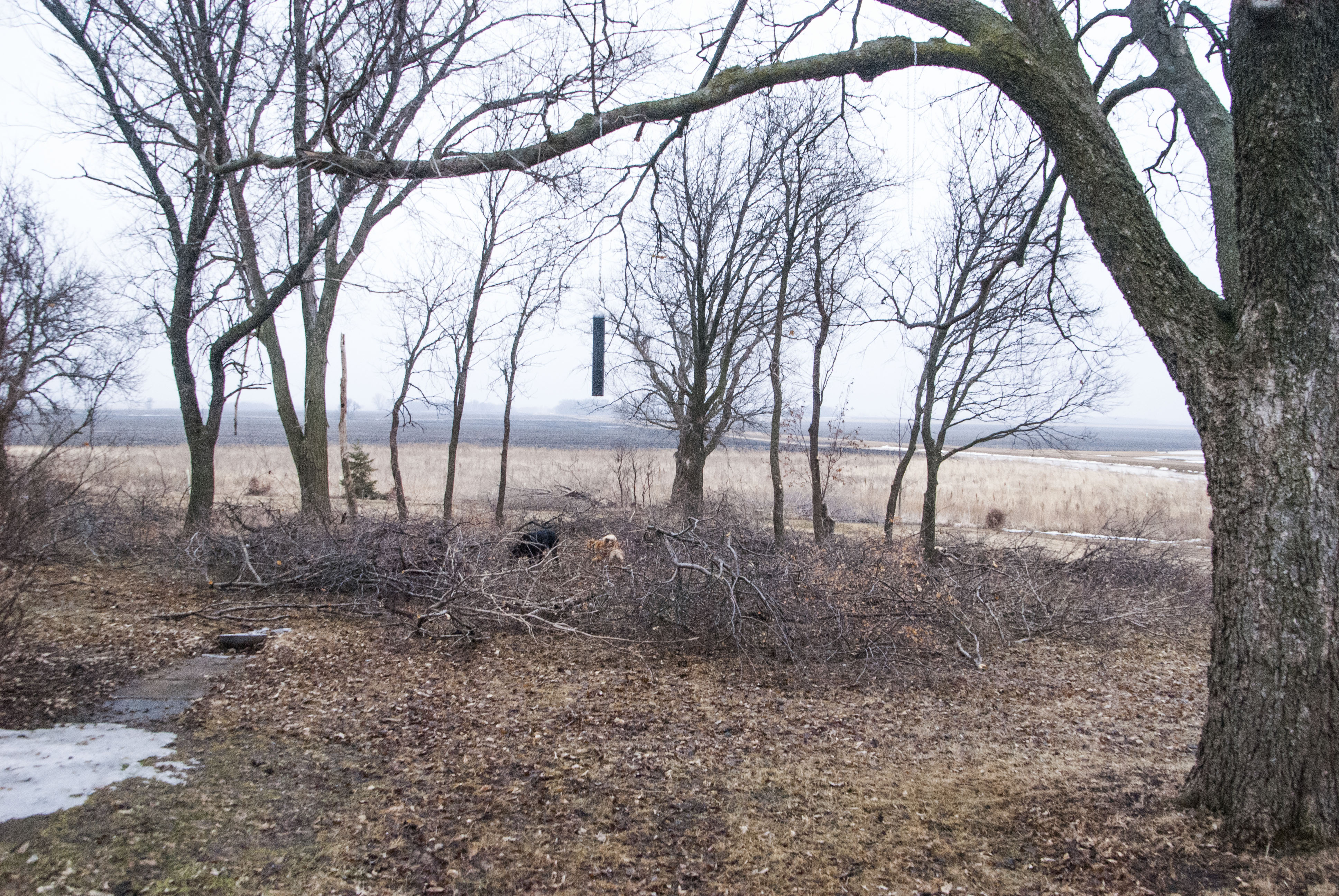
In our second summer here we began the cleanup of the buckthorn jungle in the grove. It was a huge task and was “part two” of the stretch of laborious razing of two decrepit and dangerous outbuildings. Both were burned and buried in a hole that inexplicably came with the farm, over which we planted our orchard. Our sawyer, Kurt Arner, did the honors of slashing the jungle. On the lower end he windrowed piles of the ever present invasive buckthorn, while in the upper grove he slashed and dropped the 20 footers while creating a beautiful path complete with a listening bench in the center of the loop. Which brings me back to our holistic list … along with our ongoing conversations from our walks with the dogs over the farm. Kurt’s slash and drop left a huge pile of downed buckthorn and scraggly trees — besides the buckthorn, the grove was marred with downed and rotted trees, and many more misshapen and severely damaged ones — between that path and the orchard. What he left behind was minor mirror of the big BWCA blowdown a few years ago. It wasn’t meant to be walked through.

Looking at some of the fruit trees we planted in the orchard last spring.

Looking at some of the fruit trees we planted in the orchard last spring.

Rebecca was hoping to expand the orchard while planting wildlife-friendly bushes alongside replacement trees that will eventually maintain the integrity of the wooded loop. The area she wanted to clean was perhaps 50 ft. by 200 ft., and one of our bullet points in the holistic planning was to clean that mess little by little … hopefully to have the area clean enough to plant when the bare root fruit and hawthorn trees, along with a row a nannyberry bush for the birds, arrived later this spring.

Just to the left of the orchard is where we'll plant this year.

Just to the left of the orchard is where we’ll plant this year.

Last week, in a mild surprise, Kurt returned to the farm to finish the saw work. We described our thoughts as we walked through the grove, and he said it wouldn’t be a big deal for him to prep the cleanup. Initially we considered pulling the slash out for stacking and burning, although what Rebecca really wanted was wood chips. Remember, a wood chipper was on our list! This past weekend we started pulling the larger chunks of trunks he had pruned from the branches to pile while stacking the branches and smaller limbs for the shredder. A neighbor, Rick Schneck, brought over both a chipper and a willingness to help. A long afternoon later two of the piles were reduced to feathery chips. We might have another long half day to fully clear that space for our spring planting. Thanks to Kurt and Rick, we are almost ready to mark one of the holistic dreams off the list.

Another view of the area we're clearing for the new fruit trees, hardwoods and bird-friendly shrubs.

Another view of the area we’re clearing for the new fruit trees, hardwoods and bird-friendly shrubs.

In our short time together, nothing about Rebecca surprises me when it comes to her will, drive and work ethic. Since Kurt first arrived with his battery of chainsaws, we’ve unleashed the “Vermonter” in her. My guess is that within the next decade our grove will have an entirely different feel and look about it. Indeed, our whole farmstead will hopefully have been ridded of “junk” trees and be surrounded by good hardwoods, fruit trees and bird-y bushes. In the grove we’ll likely have some healthy looking trees rising in the many holes that has been created, and hopefully, if the bushes produce the berries she anticipates, we’ll have a new menagerie of songbirds residing with us here on the farm. Her orchard will be bearing bountiful fruit as well, all of an incredible transformation of our old farm into perhaps a “permaculture” paradise. As I write, I gaze at the list and smile. Our goals stare at us in our office, and we wonder if and when we will get through all those many items of need, for each seems important. We’ve yet to prioritize our holistic list. There is so much, and some of things we didn’t bother to list might have an even higher priority. Finishing the “Taj Magarage” comes to mind, and that includes the painting of the exterior.

Some of Kurt's slash against a few of the trees we'll leave standing because of their unique shape.

Some of Kurt’s slash against a few of the trees we’ll leave standing because of their unique shape.

Many years ago my father said the beauty of a farm is that one never runs out of things to do, and we might add that transformations don’t happen overnight. While we must continue to remind ourselves of that, being able to draw a Magic Marker slash through the first of those many line items on our list will feel mighty fine.

Lazy Folks Work the Hardest

Can you think of a way to express this sentiment without coming off as a self-righteous jerk? I’m not sure there is one.

Unless, that is, you are saying it to yourself, which is what I was doing at about seven o’ clock this morning, after a half an hour of turning straw bedding in my chicken coop, and the realization that I was going to be at it quite a while longer if I expected to do a thorough job.

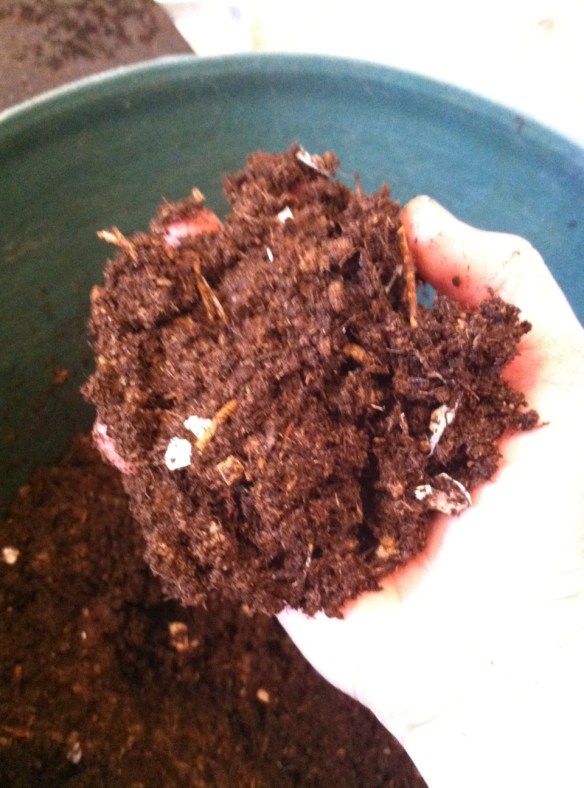
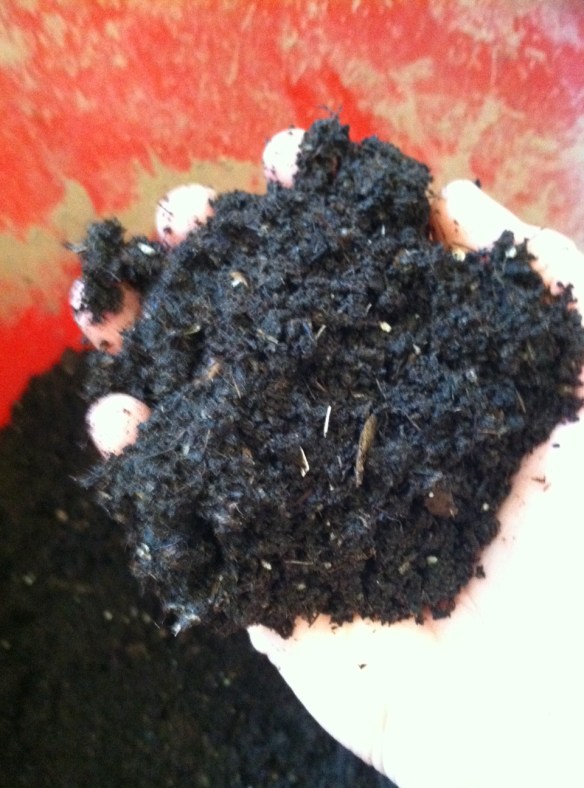
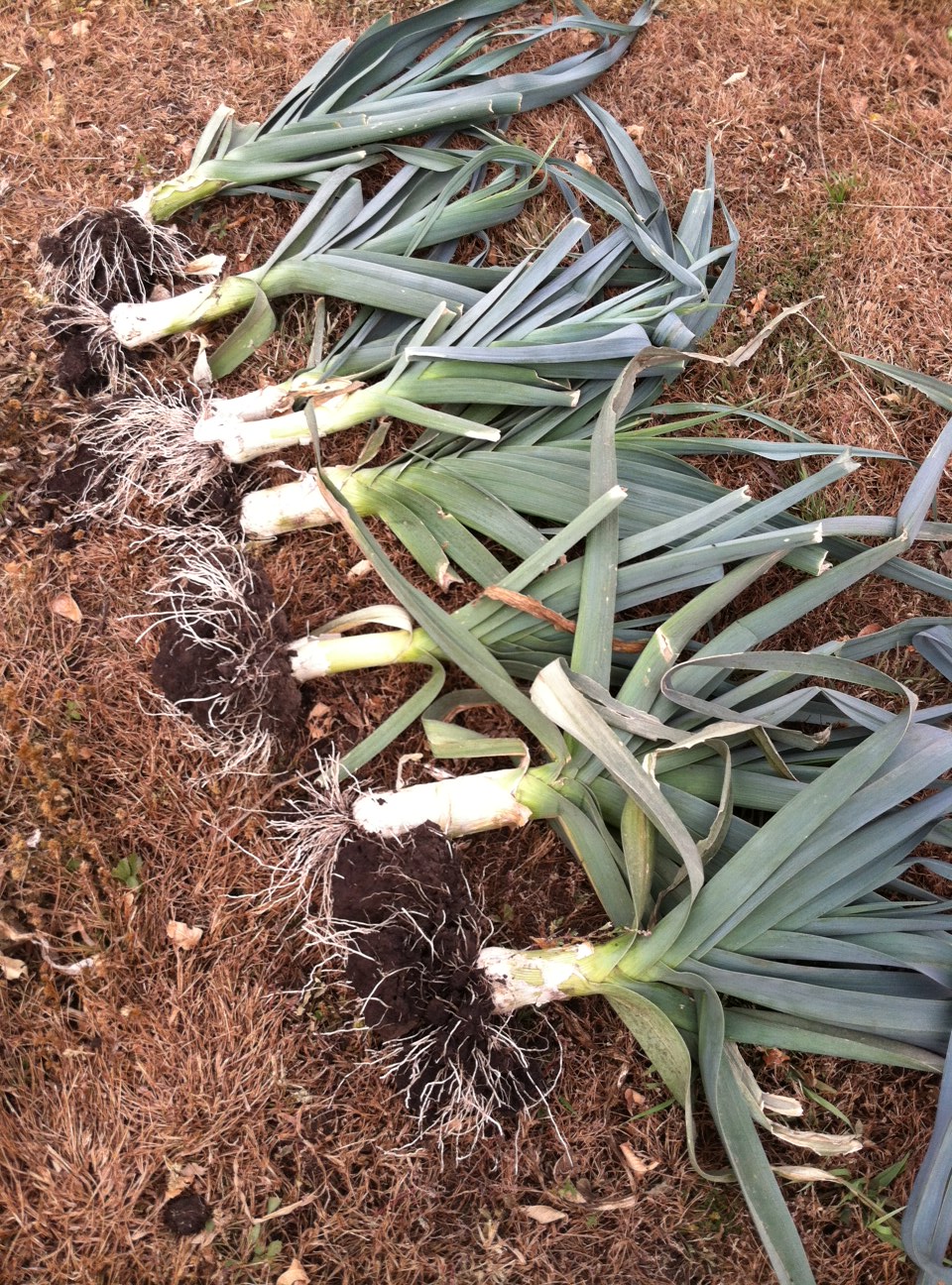
You see, I began a system of “deep litter” bedding in the coop this fall, tossing down layers of locally-grown wheat straw with the understanding that as I added more layers, the chickens would scratch and blend it all together and magically it would turn into the most gorgeous compost ever created. What could be easier? Let the birds do all the work!

Turns out, it’s not as easy as that. Turns out, if you keep adding more layers of straw and you don’t help the turning process along, you get something quite different–a fact I discovered when, after a glorious thaw this past weekend, I walked in the coop and was knocked back by the sharp odor of ammonia.

If the smell was bad for me, it was much worse for the chickens who, although granted plenty of access to the outdoors, still expect to spend the long winter nights inside their cozy, 100-year-old abode. Not only that, but the smell of ammonia equals the loss of nitrogen–nitrogen I’d prefer to lock up with the straw’s carbon and spread in the garden come spring. There wasn’t much I could do about it last night other than crack the window, but when I woke at 5:30 this morning, I figured I could get in a couple of hours of work before…well, before work.

After coffee and letting the dogs out and feeding the dogs, the cats, and then the chickens, I started to dig. If it hadn’t been such a ridiculous monster of a project to dig down through all those layers of compacted straw, I might’ve been laughing about going overboard off the extremely deep end of the deep litter system. Just keep adding straw! The chickens will do all the work! By the time I dug down to the floor of the coop and flipped and fluffed the first 3′ x 18′ strip along the back wall, the rejuvenated litter was waist-high to where I stood in my hole. We’re talking deep litter.

I’m glad I didn’t take the advice of the folks on a certain Facebook group I asked for help. The mantra about ammonia smell in a deep litter system is that either the litter is too damp, or there’s not enough of it. In fact, if the litter is too damp, it also probably means you don’t have enough of it.

I enjoy Facebook, and I follow a few different groups there. I like the West Central MN Birders, and I shadow the posts on the mushroom ID one, too. I hope to get better at identifying edible ones, and I hope the other posters do, too because I don’t know how many more Lion’s Mane mushroom pictures I can see without making a snide comment about participants either never having looked at any of the other posts, or simply showing off to those less fortunate.

I do feel absolutely confident about morels, a fact I like to advertise in case my services are needed for identification (and eating) purposes. That happened a couple of years ago, when I got a call from a friend in the southern part of the county one balmy late spring evening. I was working in the garden when he called, and he asked if it wouldn’t be too much trouble for me to come down there (about a twenty minute drive) and inspect these fungi popping up in a food plot he’d mowed the previous fall. I was about halfway there by the time we ended our five minute call.

And yes, they were.

Anyhow, I’ve been a member of this regenerative agriculture group on Facebook for a couple of weeks. There are members from all over the world, and it seemed like the kind of place where a gal could get some systems-thinking, down-to-earth advice and trouble-shooting. And indeed, I got advice.

I got advice from across the planet about magical products I might buy or prepare (from plants that are dormant under snow at the moment), the mantra about ammonia smell meaning my litter wasn’t deep enough, and also instructions to change my whole system to a different carbonaceous material that I don’t have ready access to without spending a bunch of money. I don’t mean to be ungrateful, and certainly the comments were offered in a helpful spirit, but I do understand the basic tenets of the deep litter system, and it shouldn’t require rare and expensive inputs to work correctly.

The best advice I got through the group turned out to be from a friend and former colleague who lives about an hour down the river valley from here. Julia told me my litter was compacted and anaerobic, and what I needed to do was turn and mix it to incorporate oxygen and trigger aerobic composition.

In other words, Get your fork out honey, ’cause you’ve got a big job ahead of you.

She was right. After about two hours of digging and turning (and sweating and grunting) this morning and another hour this evening, I’ve got that litter thoroughly mixed, and it smells just lovely and earthy in there. There was a nice pancake of beautiful moist humus at the floor level beneath the roost, and the rest was just dry, compacted straw. It wasn’t too wet, and there’s sure as heck enough litter.

In fact, there’s so much poofy litter that it’s seriously awkward to walk on, and it’ll be impossible (OK–an insane amount of maintenance) to keep aerated. I know now that I can’t just lazily throw more and more straw on top and let the birds do all the work (though they sure loved getting access to all those buried “treasures” today, and I found my pie plate that went missing a couple of months ago). By spring, my current system would’ve required a stepladder to climb into the coop, the hens would’ve been laying in the rafters, and I’d need about fifty more straw bales than I have stockpiled.

I decided this evening that the “easiest” thing to do would be to go out again early tomorrow morning and fork out at least a third and maybe half of the litter that’s in the coop now–moving it to the run outside where there’s only a patchy veneer of ground cover left under the snow. Aerating what’s left will be a lot easier if there isn’t three feet of it to dig through.

Even removing half of what’s there, it might be a couple of weeks before I need to break open any more bales and leisurely strew fresh straw over the top–allowing my chickens to “do all the work” of mixing it in.

In the meantime, I’ll be working a little harder on my “lazy folks” method of winter bedding in the coop!


No Words …

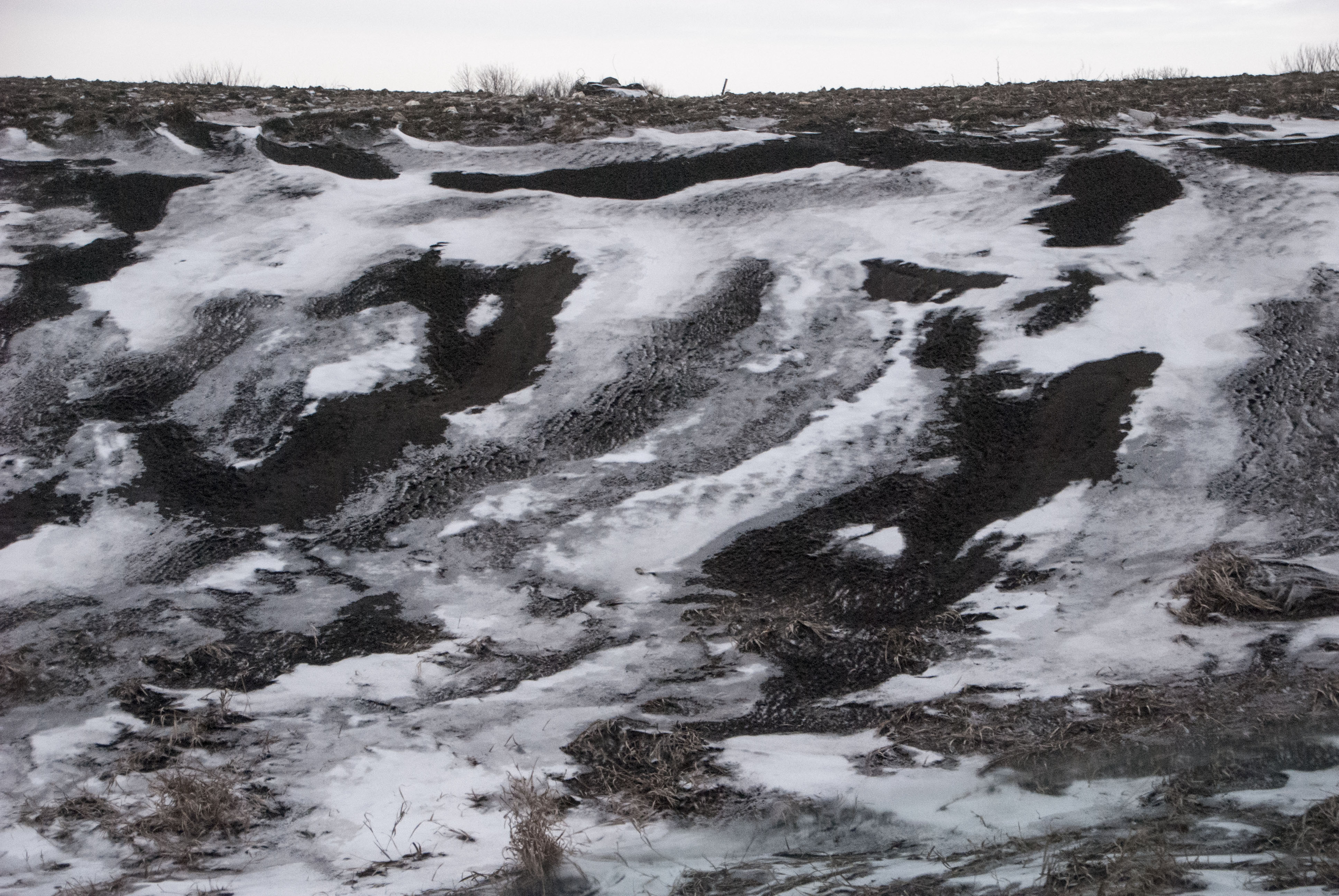
Sometimes, no words are necessary …. •snirt1 snirt2 snirt3 snirt4 snirt5 snirt6 snirt7 snirt9 snirt12 snirt13 snirt15 snirt16 snirt17 snirt18 snirt19 snirt20 snirt21 snirt22 snirt23 snirt24 snirt25 snirt26 snirt27 snirt28 snirt29 snirt30 snirt31 snirt32 snirt33 snirt35 snirt36 snirt37 snirt38 snirt39 snirt40 snirt41 snirt42 snirt43 snirt44 snirt46 snirt47 snirt48 snirt49 snirt50 snirt51 snirt52 snirt53

* Brought to you by a failed Federal Farm Policy and a lack of due diligence on area croplands. Images were made on the morning of January 11, 2015, in Big Stone, Chippewa and Lac qui Parle Counties.

Winter Journal

Up early and at it hard. John’s down south all day in a Southwest Arts & Humanities Council meeting, and while that cat’s away, this mouse is playing catch-up. The sun is shining, and NOAA says we might hit 12 degrees above zero this afternoon with a less than 10mph wind, which seems like a certifiable heatwave given the past week’s brutal chill.

The chickens are finally outside after several days of being shut in. At one point earlier in the week I opened their coop door because the real temp was above zero, but not one of them took advantage, and then the wind came up, and down I went to shut them in again. The two Americanas are finally laying their pretty green eggs (both of them started on the same day!) after a six week hiatus–they are not dependable winter layers like the “Buffies” (Buff Orpingtons) and “The Coven” (Black Australorps), but I know my customers like to see those “Easter Eggs” in the cartons.

photo 3(6)

Overall, laying is down even with supplemental light, but the few more minutes of day length we’ve gained since the solstice are giving us a couple more eggs than we got back in December. So far, everyone is doing fine in the unheated coop–last year’s hens proved themselves during the Polar Vortex (and Polar Vortex II), and this year’s batch are even heavier, hardier breeds.

John and I are planning our late winter travel. For me, it’s important to get out (if I’m going to get out) before seed-starting season commences in early March. I haven’t been to Seattle in five or six years now, and my dear friends out there should not have to wait any longer! That, and it’s always rejuvenating to visit the west coast in winter and to dream of what it might be like to live in a place where rosemary and lavender grow as luxurious full hedges rather than having to be potted up and brought inside or buried under bales for the winter.

Yes, it’s possible it might be cold there when I go…if by cold you mean, like, 35 or 40 degrees (it’s 46 there right now!). Maybe I’m nuts, but it seems a little safer, if I only have a week or so to travel, to go to someplace that’s only marginally warmer so that the contrast of returning to the northern prairie doesn’t send me into a deep-freeze-induced depression. The shock of returning to the cold climate should not be a problem for John, as his travel plans include a foray up above the Arctic Circle to visit a former exchange student and hopefully capture some aurora borealis images.

Seed and tree ordering has commenced, with our St. Lawrence Nursery order going in first of all since Bill MacKentley is retiring and there seems to be no clear succession plan at present. The first iteration of that order was pared back quite a bit, but I still got in a few things I’d been keen to try, but had cut from orders in the past: some hardy shagbark hickories, sweet sap silver maples, and blight-resistant American chestnut, as well as a couple of apples, a pear, a plum, and a few grapes.

The only thing I am having second thoughts about is leaving off a Northrup Mulberry, but I guess if I really want a mulberry tree (or fifty, or five hundred), I could get Harry’s permission to head down to the old farmplace in Vermillion and dig along the fencelines and then see what makes it through the winter up here.

I’ve also begun my regular winter session of being a pain-in-the-ass to my local SWCD guy by e-mailing him every other day to ask if he can get this or that native tree or shrub that’s not on their (really, kind of disappointingly short to a native planting fanatic like myself) list. So far he’s located bundles of Homestead Hawthorn and Nannyberry Viburnum for me, and we’ll add to that a few more oaks, hackberries, cottonwoods, cherries, hazelnuts, and maybe a few evergreens. My poor husband will think I am trying to kill him (again). I swear I will help more with planting this year, even if it means taking a couple of days off.

Seed orders are also taking shape–Pinetree is already done and submitted–I like their smaller size packets of herbs and flowers, plus squash and other things I just don’t need a ton of seed for. Their Summer Dance cucumber is the best, most productive and perfect-looking bitter-free cuke I’ve grown. I’m almost afraid to say that publicly, since a couple of other great F1 varieties I’ve raved about over the years (like Lavender Touch eggplant and Papaya Pear summer squash) have reportedly been bought up by Seminis (a subsidiary of Monsanto), and now I won’t grow them anymore. I grow very few hybrid varieties–if I grow one it has to be better (in my estimation) than anything else I’ve seen. When Summer Dance gets bought up, well, I’ll start trialing open pollinated cukes like I did O.P. eggplant and yellow summer squash. Not the end of the world.

Territorial Seed Company will be a small one–a few things I can’t get elsewhere (LOVE the Talon onion and wild garden mustards!), and Johnny’s is the biggie–though most of the volume is several kinds of organic cover crops–buckwheat, oats, field peas, winter radish. I’ll pick up a few other things from Prairie Road, High Mowing, and Seed Savers Exchange too, but I have quite a bit of seed that’s still good from the last couple of years. Everything from 2012 I’ll try to use up this season, and there’s no seed older than that because of the house fire in 2011.

In my fever of catch-up and planning ahead today, there’s still plenty of time for strolling the prairie and running the dogs. Vega will always be my “saint” dog–the one who’s stuck with me through some incredibly trying times in my life–but I am getting immense pleasure from Joe Pye’s company these last few weeks. I’ve nicknamed him “my shadow” because as soon as I get up from my chair, he’s right on my heels (sometimes literally!)–and especially if I head toward the outside door. No matter how brutal the day, he’s game to keep me company during chores and check-ins, and although I’m still working on training him not to rush the chicken pen fence just to see the “girls” scatter and squawk, I thoroughly appreciate his playful (and occasionally peaceful) presence.

photo 2(8)

John and I have been taking the two of them for “prairie galavanting” twice a day almost every day since Joe Pye came to live with us, and the exercise has made a huge difference in Vega’s (and our) energy levels. Still, sometimes the “old lady” (Vega, not me!) needs to retreat and spend the afternoon stretched out napping on her upstairs bed in the sunshine, away from the attentions of her too-eager little brother.

I brought my camera on today’s morning walk to document some of what everyone in the region has been talking about since Thursday’s “big blow.” We took the least-used path that runs through the lower prairie along the west side of our property. It goes unused because it’s the most open to the prevailing winds, and snow drifts deep in those paths, making the way difficult for Vega with her small paws, long legs, and aging hips.

A plume of light brown road dust forms as a truck passes by.

A plume of light brown road dust forms as a truck passes by.

We live on a graveled county road, so we get a fair amount of dust rolling off from traffic. Our own vehicles are constantly coated in it, and this time of year it’s hard to get rid of because the car wash isn’t open and gas station squeegees are frozen solid from the intense cold. But road dust is an easily recognizable grayish-tan. What’s accumulating in our prairie is our neighbors’ good black dirt–topsoil, that is, pulverized, ridged, and bared by fall tillage, and eroding by the truck-full.

This ain't road dust, folks.

This ain’t road dust, folks.

photo 1(12)

There does seem to be a little more stubble on the fields this winter–a few more roots left intact to hold the soil in place. I don’t know if that’s because farmers and landowners saw how bad the erosion was last winter and nixed fall tillage, or because the cold and snow came on too fast this year for the ground to get turned. I hope it’s the former.

A couple of fields down the road from us during a brief thaw a couple of weeks ago.

A couple of fields down the road from us during a brief thaw a couple of weeks ago. The corn stubble holds the soil and snow cover.

Absent a federal farm policy that actively and forcefully discourages practices that seriously damage the land, we are, all of us, counting on individual farmers and landowners to do the right things. By “right things,” I mean those practices that are proven to preserve and protect the soil & water–cover crops, no-till (or at the least, no fall tillage), grass waterways, buffer strips, and keeping marginal lands under perennial cover.

There are more, of course, and many of these practices are eligible for cost share and technical assistance. But they don’t work unless farmers and landowners use them, and it sometimes amazes me how hard Soil & Water Conservation District staff has to work to get farmers and landowners to sign up. I’ve heard conservationists say that farmers who are good stewards of the land will do the right thing regardless of programs and payments, but farmers who are only in it for the bushels (or dollars) per acre won’t do the right thing even if you offer to pay them (but they might if you fine them for not doing it).

photo 1(13) photo 2(11)

I don’t know if it’s that simple, but I sense there’s a grain of truth in it. Still, farmers, like everyone, need to make a living, and because we have a federal farm policy that encourages and even rewards practices that cause environmental degradation, we can’t only point our finger at farmers if what we get what we paid, and voted, for. We all have a stake in a better food and farming system, and unless we all push for policies and practices that encourage what we say we want (soil and water conservation, protecting pollinator and wildlife habitat, limiting the amount of toxic chemicals in the environment and in our food, and…you fill in the blank) and discourage what we say we don’t want, it’s just not going to get better.

photo 2(12) photo 1(14)

One more thought before I leave this depressing track: did you ever think there would come a day when we’d have to consider listing the Monarch butterfly as a threatened species? That day is sadly here.

Aside from documenting the collection of our neighbors’ topsoil, we’re doing a significant amount of farm planning for the coming year. With tree and seed orders going in, we’re also having to figure out where all this stuff will get planted, and how we’ll clear out more of the windrows of cut-and-dropped buckthorn in the grove to make room for things we’d prefer to have growing. If you’re feeling sorry for that invasive species we love to hate, don’t worry–we’ve also got a generation’s worth of buckthorn seeds just waiting to sprout that are causing us to consider (gasp!) getting a couple of goats. The final decision has yet to be made on that thorny subject.

We’re also hoping to remove a bunch of old fence from various parts of the grove–layers of fence in woven and barbed wire–fence that has become part of the living wood of the trees that have grown up through it. It will not be pretty (it’s not pretty now), and I’m guessing it will take many an afternoon with fencing pliers, wire cutters, colorful language, and probably a come-along to heave those old metal posts out of the ground.

photo(6)

Doesn't this look like fun?

Doesn’t this look like fun?

And did I mention the chickens? An expansion of the laying flock and another round (maybe two?) of “Drummies” for the freezer are on the to-do list. A couple of rain gardens, maybe some rain barrels, too, and, oh, I think I want to take out the entire front lawn to build for a terraced rock garden for perennial herbs, flowers, and maybe a few vegetables, too.

I know that all this might not seem like enough to keep us busy, but I’m pretty sure I’m forgetting a few of the major projects on the list.

It’s going to be a busy year.