The Magic of Winter

It was one of those chillingly cold windy days in February, and I hadn’t been in Minnesota for much more than a month. A group of us from Webb Publishing had migrated after work to a St. Paul watering hole where some of us joined a table where one of the writers was sitting with a young man, who she introduced by adding that he had recently moved from Russia.

“Oh, where in Russia?” I asked.

“Actually Siberia,” he said.

“Siberia?” Having had recently read a couple of Alexander Solzhenitsyn books, where he so painstakingly described the cold, nearly unbearably harsh Siberian climate, led me to ask: “So how does our weather compare to Solzhenitsyn’s descriptions of Siberia?” It was meant as a joke.

November

If you free you imagination, those starkly darkened oak limbs covered with fresh snow might remind you of a royal sword salute at Buckingham Palace.

“Man, it’s the same thing,” he said. “The same climate. This is Siberia …  in America.”

Once again winter is upon us, and a recent road trip through the South made me realize just how interesting it can be here in the former prairie pothole region ­- here in our very own Siberian outback, if you will. Deep in snow and, for the past few days, fog. Our soils are not bare like in the southern states where we traveled. We’re not surrounded by grayness, brownness or whatever color portrays their winter.

Ours is white. Snow came around Thanksgiving and is still here. We made it home from our road trip by sliding between storm fronts, and we’ve seemingly been in some sort of white winter since. This morning I awoke to a fog. Again. The fourth or fifth day running. Fog in winter translates to hoarfrost, which gives our trees and countryside a magical beauty.

Winter is the one season some folks seemingly despise. Even those who live here. Sometimes I’m one of the crowd. Most other times I’m not. If asked between Christmas and New Years a year ago, when the bird feeder tree not 40 feet from my office window was the extent of visible earth for all but one day of the seven, or six days of blizzard conditions, I most certainly was one of the crowd. Admittedly that was a rather rare circumstance.
2.3.2019 wind1

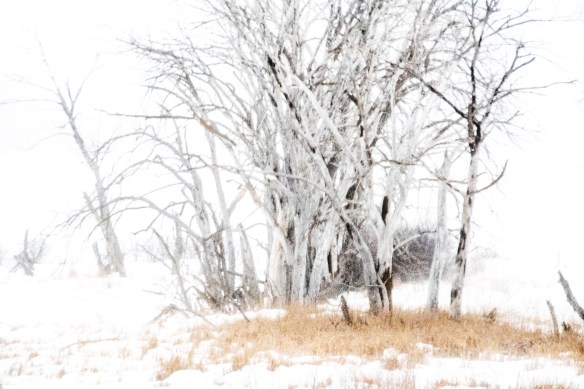
Some winter scenes, like these dead cottonwoods on a nearby wetland, now whitened and grayed with aged weathering, come to life in the winter.

Which brings me to what the Norwegians call “koselig,” translated as a sense of winter coziness. Years ago I visited a dear friend in Tromso, a small city located in the fjord country above the Arctic Circle. My goal was to photograph the Northern Lights, which by the end of the week had appeared for all of 15 minutes just after midnight in the middle of my stay! There were some sleepless nights waiting for a clearing. Yet, much of what I witnessed in that week of February was between being amused and amazed. At that point there were just a few hours of “sunlight.” During the “day” the sky was in a lightened, pre-dusk aura, with the sun occasionally peeking on the horizon far to the south. Peeking as our sun does here in a sunrise or sunset. Yet, people were out on the sidewalks, talking and sharing animated smiles and laughter. Few were seen huddled over to ward away the chill or supposed depression. It was not what you see in many northern U.S. cities, if you see anyone at all!

1.28.2020 stuff9

Winter winds bent the stems of big bluestem, pinning them to the ground during a recent blizzard, only to have them coated with a hoarfrost later on.

One morning we rode a cable car up a mountainside to Sherpatrappa, a beautiful park on top of the mountain overlooking the Tromso bay. The wind was howling, blowing snow to a near whiteout at times, yet the park was crowded by those who were exploring and being playfully active. Yet, as my friend, Hawre, told me recently, “You make Tromso seem like a Disney something. It sure is beautiful here but we do complain. Some of us even get depressed during the Polar Night.”
Norway16

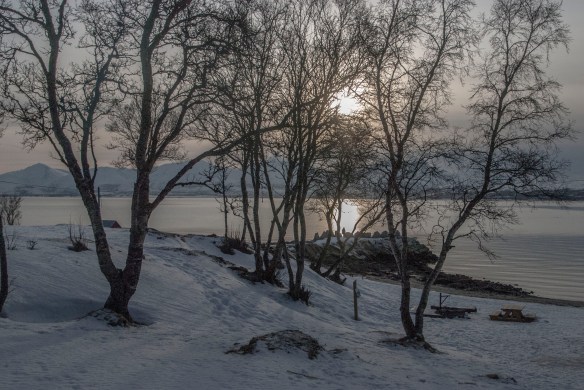
The low sun angle in Tromso, Norway, is similar to our sunrises and sunsets, giving off a beautiful light.

Beyond the occasional reindeer and soccer-crazed “Laps” Hawre introduced me to, there was still a sense of winter comfort in Tromso. Life was going along completely normal which led to my amusement. This is a somewhat  uncommon feeling here on our little piece of prairie.

For me, horizontal, windblown snow, icy roads and the long, whiteout days are the hard times of winter. Snow that drifts down quietly from the heavens, though, seems rather magical and peaceful. One night back in 1969 on a bluff-edge sidewalk overlooking downtown Dubuque, IA, a friend and I watched the snow drift silently over the streets and harbor, glistening like minature Christmas lights in the street light cones below, a moment so spectacular and peaceful that we stopped for several moments to take it all in.

I can feel the same magic here in a forest or prairie. Like when starkly darkened oak limbs are covered with fresh snow, which if you’ll free your imagination might remind you of a royal sword salute at Buckingham Palace. Now in a hoarfrost everything appears as sweet as if sprinkled with powdered sugar. In my upper prairie the tall stems of big bluestem that was well over my head a few months ago are now pinned gracefully to the ground, glistening from the hoarfrost.

So, yes, there is some magic in our version of Siberia … once you free your imagination.
1.23.2019 fog4a

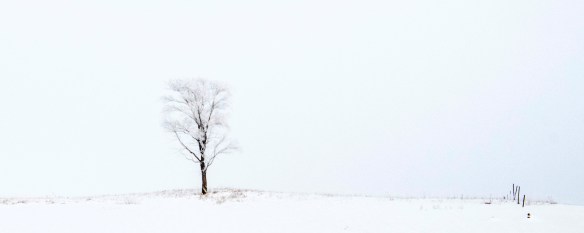
Does this qualify as our koselig? Stark beauty following a hoarfrost.

We each have our sense of wintertime cosiness, our koselig. Or, perhaps what the Danish call their hygge. There was much to amuse us on our road trip beyond visits with friends and family. Some beautiful nature, and the continued witness to climates so foreign to us in a north country winter. Now back home we can appreciate and find comfort in what is ours, a prairie and nearby woodlands alive with the magical beauty of winter!

A Rockport Rookery

You realize just how fortunate you are when you can consider Great Blue Herons as a bonus. And, yes, this is what happened on a recent trip to Rockport, TX, with fiancée, Mary Gafkjen. Our goal was to be up close and personal with Whooping Cranes, which came together better than even the captain and guide of our birder launch could have anticipated. The Herons happened next, and totally by chance.

After our launch and lunch we stopped at an artist’s studio where we both became intrigued by a painting class that was in session. On the wall, though, was an halting painting of Great Blues rising above an interesting mass of treetops. I couldn’t escape the beauty.

1.4.2020 heron13

The Herons seemingly flew into and out of the rookery at will.

“That,” said the artist, “was my interpretation of the rookery down by the bay.”

“Near here?” I asked excitedly.

“Yep, and the Herons are here now,” she said, and promptly gave us directions to the rookery.

6-great-blue-heron-john-james-audubon

Audubon’s iconic Great Blue painting.

That’s where we headed next, our first of several visits over the course of a couple of days, including sunsets and sunrises. Great Blues lend themselves to the muse and imagination of artists in nearly every culture. Interestingly, about a week later we would be in my brother’s family room/porch in Richmond, VA, where he had a large framed print of the iconic John James Audubon painting of a Great Blue. Yes, the classic, the same one engraved on the wooden greeting sign at his Oakley House outside of St. Francisville, LA. It was there years ago that we learned that Audubon’s painting were typically portraits of dead birds, and yes, this one appears to have a flattened wingspan common to one laid out upon a table.

1.4.2020 heron10

The afternoon light was nearly perfect.


One of my favorite paintings was by local artist Deb Bates Larson that she displayed at a Meander years ago. She eventually had a clothe bag made for me bearing the painting. There are so many, including the one by the Rockport artist. Although I have photographed Great Blues in the past, I have yearned to join the crowd. To have images kissed by moody light. The Rockport Rookery would give me an opportunity.

So it began, starting along the beach of the bay using a long lens and simply sitting there watching. We returned a few hours later in the late afternoon light, when the bay had calmed. First I focused on the apex of the canopy, then on a solitary bird wading in the brackish backwater with pairs of fly fishers in waders. We had interesting cloud cover, although the sun was setting much further south of the rookery. Oh, but that light!1.4.2020 heron26 copy

Herons were flying in from different directions, and flying off the dense canopy seemingly at will. There were no desperate measures. Simply walking around looking for different angles and imagery, watching for incoming birds and watching the light. This as unlike the rookies dotting the Minnesota River where the birds are shy and jittery. Here they paid no attention to nearby human activity. It was wholly different ecology.1.4.2020 heron30

At these times your mind plays on memories. Of the Great Blues I’ve photographed rising from the cattails of  our nearby Big Stone National Wildlife Refuge, or one of my favorite of a Great Blue about to land on an old bridging peer in the flooded backwaters outside the boundary. Or the one that steadfastly refused to leave a wooden dock on Camp Lake as I paddled by in my canoe while fly fishing for bass one early morning.

I thought, too, of my late wife, who ignored the typical greetings of spring, that of the bouncing Robins in the lawn. For Sharon Yedo White’s spring began with her first sightings of a Great Blue rising from a prairie wetland, or one she had seen gracefully crossing the sky. In a way, I agreed. Spring or not, I am soothed by their grace and spindly stature, of their colors. That little black hood feather that wavers poetically in the wind.1.4.2020 heron22

Now in the depths of winter, I guess I too wish a first sighting of a Great Blue rising from the wetland over the rise of my Listening Stones Farm, with warm memories of a recent Texas afternoon and sunrise morning.

Oh, Heavenly Rain

It’s not like we haven’t had our fair share of rain. And here we were once again, though this recent rain was hardly a downpour. More of a steady rain a little beyond a drizzle. It was of long duration, though, and if it had been a blizzard, since an inch of rain calculates to 13 or so inches of snow, we would still be digging out from about 20 inches of the white stuff. Since this was midsummer, there were no worries.

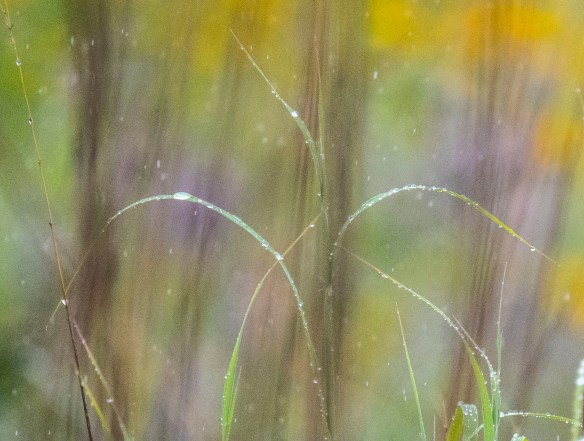
About halfway through my reading of the online morning newspaper I noticed the rain clouding the window screens. Outside, diamond-like sparkles of drops were calling … clinging to the leaves of the prairie grasses. Not far away is the Big Stone National Wildlife Refuge, and within the huge prairie meadow of an “island” in the middle of the three-mile motor loop is an impressive bloom of countless native flowers including a recent full bloom of Purple Coneflowers. My thought of finding one adorned with rainy jewels was enough to get me up, out and through the door.

7.286.2019 rainyrefuge4

The spiky yellow Mulleim was in full bloom, spikes rising from the outcrops like hands raised in an attentive classroom.

Having such anticipation is often a curse, for you visualize an image and in many instances set yourself up for disappointment. As a photojournalist you learn to go with the flow, looking closely for images and react accordingly to the circumstances. These thoughts actually crossed my mind as I drove toward the Refuge dressed as if I were going kayaking … since I thoroughly dislike actual rain gear. So, yes, a splash shirt, swimming shorts and sandals.

There was enough beauty in the meadow to cause me to pause several times along the way. The spiky yellow Mullein was in full bloom. The tall plants rose from the outcrops like hands raised in an attentive classroom. Rainwater clung to the blossoms defying gravity, adding a diamond-like luster to the beautiful blossoms. The plant is not native, brought across the ocean in the 1700s. Yet the Native Americans found early medicinal uses for the plant, making a tea that helped suppress coughing, reduced the affects of diarrhea, and when smoked, was a stimulant for the lungs. The soft leaves were used as lamp wicks, toilet paper and even placed inside shoes for warmth and softness. It’s said Romans dipped the dried stalks into tallow to use them for torches, giving light to the night. Legend has it that similar torches were also used to ward away witches in olden times. Me? Fodder for a rainy day photo subject.

7.286.2019 rainyrefuge26

No matter which way I looked there was something to catch the eyes, glistening with sparkling wetness.


Further along the trail the bloom in the island meadow was both wide and deep with a richnesses of colors. Yellows. Purples. Blues. No matter which way I looked there was something to catch the eye, glistening with sparkling wetness. Rain droplets trickled off prairie grasses and flowery petals. It seemed that every few feet I would stop, hop from the car and seek a new image. As an added bonus, towering above the flowers were the first “turkey-foot” shoots of Big Bluestem. August was near!

So much visual poetry is hidden deep in the grasses, sparkling as if a jeweler had slung a tray of diamonds over the prairiescape. I enjoy most using a long focal length lens and using it to nose around and through the most delicate nooks of nature. This was a day when sauntering through the prairie offered so much to the eye. Thankfully there was no need to lay in the soaking wetness to find imagery, although I did kneel numerous times for different angles. Regardless, I was soaked to the skin, and happily so.

7.286.2019 rainyrefuge35 copy

In every direction the tips of the silken, spindly blossoms had browned …


All of this and I was still a mile or so away from my intended subject. This was one of those numerous times I praised the invent of digital photography, for if I were shooting and developing film I would have gone broke long before reaching the Coneflowers. And, for the record, they were a disappointment … well past the bloom.

In every direction the tips of the silken, spindly blossoms had browned, and many appeared completely dried and shriveled. So you make do, and in the dampness there was still beauty. The natural grayness from the rain seemed to add a solemness to the meadow, perhaps even suggesting a requiem to the end of a season … as another awaited. As the Coneflower season edged stage right toward the curtain, perhaps the stage was open for the Big Bluestem, where even the slightest breeze gives rise to a grassy ocean of waves, of fork-shaped dancers etching the skies like weightless ballerinas. Whatever season is entering makes so little difference, for the prairie is ever evolving and in constant change. Actors come, and actors go, from Pasque Flowers to the last of a milkweed fluff, clinging tenuously to a browning pod as in the yield of an autumn wind.

7.286.2019 rainyrefuge36

The natural grayness from the rain seemed to add a solemness to the meadow, perhaps even suggesting a requiem to the end of a season … as another awaited.

For this one morning, in this soft and gentle rain, the prairie was rich in greenness and vivid colors. Even if we’ve had our share of moisture, capturing all the senses of this particular rain made one feel prosperous and sated, from that classic smell of rain to the muted sounds of the droplets hitting the leaves all around you, and of course, the colors … all those colors in the spectrum of pastel softness.

Paying Homage

Morris area naturalist Dave Ernst delivered a dire warning as we were visiting in the meadow of the Lake Johanna Esker … there would be no Showy Ladyslippers to be seen. Not here.

“The county mower came through and cut a swath along the roadside,” he said, describing the reason why.

While this wasn’t our intended designation, we were still saddened. Actually those official State Flowers are not on the Esker itself, but along the swampy “grader ditch” just outside the fence and along the road. Ditch banks traditionally hold some native forbs you won’t see elsewhere due to the plowing, ditching and tiling of native prairies. Some of us, including Ernst, go to great lengths to pay homage to what’s missing. In some instances, forever.

6.26.2019 trip14 copy

Hidden deep inside the woods was a small clump, which I shared with an ant! 

Was there a necessity on running a mower along the roadside? Here, where the swath reached for only a few feet? I’m not on the County Board so I haven’t an answer. In Iowa there is this: According to Iowa Code 314.17, mowing roadside ditches is restricted until July 15, to protect young pheasants and other ground-nesting birds until they are ready to fledge. The law, which applies to county secondary roads as well as state primary and interstate highways, also protects habitat for pollinators and other beneficial insects, including crop-pest predators. Exceptions for visibility and weed control are built into the law, but non-essential mowing – including cutting for hay – is prohibited.

There was no hay to be cut on this swath. Just some poorly spaced patches of grass and a few solitary Showy’s. So we moved along.

6.26.2019 trip19 copy

While we were there for the Showy Ladyslippers, there were other joys to the eye including this Goatsbeard, silhouetted against the sunny background.

My partner for the adventure was dear friend, Mary Gafkjen, who had researched another possible site for the Showy’s … the Lake Wobegon Trail between Avon and Albany. This was her alternative to my suggestion of driving up to Highway 34 between Detroit Lakes and Park Rapids where the damp, unmown roadside is often a mecca for ladyslipper lovers. Because of a prior commitment she had, we needed to be back to her place by late afternoon and the Lake Wobegon Trail was much closer … and her research had evidence of the Showy’s being there.

There was even a mile marker for reference although finding it offered another challenge. We parked on a gravel roadway between the two towns and started our hike up the paved bicycle and walking path toward Albany. Neither of us are young, so the sun and humidity beating off the blacktopped path offered a challenge of a different kind. While the trail actually extends all the way to Fergus Falls, my hope was that we would be able to spot them long before then. It was thrilling when I spotted a couple of Showy’s hidden in the woods just off the trail, then we found a pair and another small clump. We were pleased with our respective discoveries and were about to hike back when we met fine-art nature photographer and author, Barb Kellogg, who suggested there was another grouping of Showy’s further ahead and encouraged us to follow along.

There was obviously more here along the bike path than the Showy Ladyslippers. As we ambled along there were numerous joys to the eye. I truly wasn’t expecting much imagery-wise because of the cloudless skies and sheer sunlight. You learn to make do regardless of light conditions. Those are challenges I enjoy, and the more I learn about the mechanical aspects of my camera, thanks to a recent class at the Gathering Partners “convention” in Willmar, the more options I can use for my art.

6.26.2019 trip22

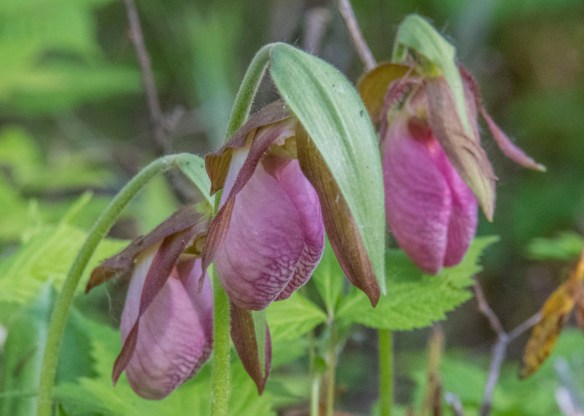
Named as Minnesota’s State Flower in 1902, the Showy is one of 49 native orchids in the state, and one of six ladyslipper species.

Among our other finds were Wild Rose, Rue Anemone, American Vetch, the fluffy balls of Goatsbeard, along with other options … so much so I spent a long while downloading my cache of the day. We left the trail with some nice images and a thirst for some icy water, along with two blisters on the sole of Mary’s foot!

There wasn’t much mystery involved in finding the Showy’s. My first find was one of luck, for they were properly hidden deep in the marshy underbrush. The others? Locals know the trail well, and each year a Ladyslipper Nature Ride is held on the third weekend of June, so the “hints” were well marked. Yet there they were in their pink and white glory, standing tall for ladyslippers. It is one of 49 native orchids in Minnesota, and the tallest of the six native ladyslippers. Blooms will not appear until the plant is 15 years of age, and they grow in a strict micro-climate … usually in a woody fen with subterranean rhizomes branching through the bog-like ecosystem to form the clusters.

Minnesota named the Showy as its state flower in 1902, and made it illegal to pick or transplant in 1925. Whether that legality extends to county roadside mowing operations is beyond my knowledge of the statutes.

6.26.2019 trip24

Our extended hike, thanks to photographer and author, Barb Kellogg, yielded a nice cluster.

So for another season I can rest comfortably, for once again I’ve had the pleasure of finding and photographing the Showy Ladyslipper. They are truly a class into themselves, standing boldly and beautifully. It’s still a pure treat when you find them, and a joy that extends beyond their short season of fame.

Still Looking …

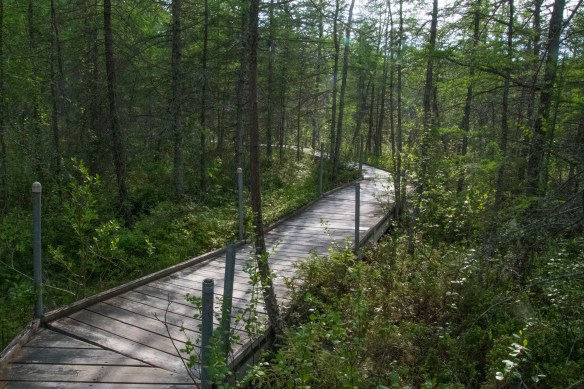
My anticipation in those first steps taken toward the “bog walk” was somewhat reminiscent of those Christmases as a child, back when my dream was of seeing a bright red bow on the handlebars of my first bicycle. In this case my anticipation was if we would find a native Dragon’s Mouth orchid in the spongy, muddy ecosystem.

I wish I could adequately describe a Dragon’s Mouth. I cannot for I’ve never seen one. Thanks to the guidebooks I can say the stem is about six to eight inches tall, and at the bent apex is a pinkish, delicate flower with yellow tendrils.

6.3.2019 tripwmary33

The boardwalk through the bog at Lake Bemidji State Park brings many unexpected treasures to the eye.

My quest has not gone unrewarded, and that begins with the bogs themselves.

Bogs are rather special places and so unlike the prairie. If the “yang” is of a prairie, the “yen” is of a bog, for they are nearly complete opposites of one another. Each is as fascinating as they are different. Equally as fascinatingly different are the flora that live in each. Images of Prairie Smoke bring as much wonder to some as does a bog’s Pitcher Plant to others, and of course, neither could exist as a neighbor to the other.

6.3.2019 tripwmary24

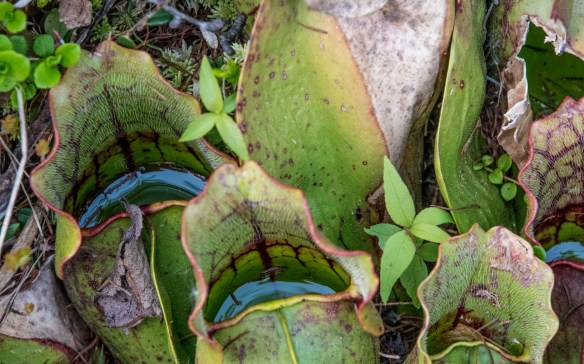
Bog plants are interesting in so many ways, such as the “water traps” to capture insects by the Pitcher Plant.

Both ecosystems are home to numerous orchids. As rare as the Dragon’s Mouth is for me, White Ladyslippers may be for others. Even some prairie people are surprised and fascinated by the “whites,” often asking if they’re real, of where they’re found, and even if they aren’t paled versions of Minnesota’s state flower, the Showy. Actually, Whites are to blame for my late “blooming” fascination with native orchids. I began photographing Whites about a dozen years ago and was later surprised to learn of the vast number of other orchid species native to Minnesota, all with wildly diverging colors.

Perhaps the rarest orchid found in virgin native prairies is the White Fringed Prairie Orchid. So rare it’s on the federally protected endangered list. Then there is the Nodding Ladies’ Tresses, rare in our part of the state as an early fall spiraling white flowered orchid. Equally as rare as the White Fringed is the prairie is the Calypso of the bogs. Global warming issues, actually, are threats to orchids no matter their biome.

6.3.2019 tripwmary9

Marsh Marigolds are so colorful and inviting to guests of the bogs.

So, yes, back to the “yen.” My introduction to bogs came through a long friendship with retired State Trooper Harold Marty, who was an investigator with the patrol. He and his wife, Kimberly, took us to the Lake Bemidji State Park where there is a lovely boarded bog walk. Then, years later, I happened upon a bog near Grand Rapids during a Gathering Partners photography presentation I gave to a group of Master Naturalists where we encountered the true jewels of the bog, Marsh Marigolds. Rich, yellow blooms seemed to serenade us from all directions, both boldly in the open and secretively peeking from obscure, uneven bog structures. A few years ago en route to a fly fishing expedition in Ontario, I detoured off Highway 71 into the Lake Bemidji State Park to revisit the bog … and yes, to see if the Dragon’s Mouth was blooming. Recently, my friend, Mary Gafkjen, and I made the trip back.

The Dragon’s Mouth is one of two bog-based native orchids I really want to photograph: it and the Calypso. Although late May is apparently bad timing for either, though not too late for the Marsh Marigolds and a host of other incredible bog plants. False Trout Lilies. Those bowl-shaped Pitcher Plants. Bog Rosemary, a delicate little plant you can’t help but love. And, many others. All truly unique to bogs.

6.3.2019 tripwmary17

I feel in love with the delicate beauty of the Bog Rosemary, among other plants, so the rewards have been many despite not seeing a Dragon’s Mouth orchid.

On my first walk I discovered a new orchid .. the Stemless Ladyslipper. I mistakenly thought I had found the Dragon’s Mouth until the park naturalist corrected me, and apparently there is not much similarity between the two. I’ll have to take her word for it since I’m still in search of the Dragon’s Mouth.

Who’s to fuss over technicalities? The Stemless is a beauty. And have been rising in their magnificent glory for my past three trips to the bog. If you can imagine that moment when a ballerina rises from a bent position, her hands near her ankles, to rise to the “fifth” position with arms and hands extended skyward in a classic ballet  pose, then you can imagine the beauty in the opening of a Stemless. Poetic grace and classic movement, all in a blend of colors to make a dancer proud if not envious.

6.3.2019 tripwmary27

The Stemless Ladyslipper offers poetic grace and classic movement, all in a blend of colors to make a dancer proud if not envious.

So my anticipation and quest continues. From here at Listening Stones Farm the drive to the Bemidji bog is a long four hours one way. And, as a friend asks, “For a flower?” Yet, it’s more than that. Indeed, for that quest, as Aldo Leopold suggested in his Sand County Almanac, is when “the opportunity to see geese is more important than television, and the chance to see a pasque-flower is a right an inalienable as free speech.” So my quest, and anticipation, continues.