Being Blessed

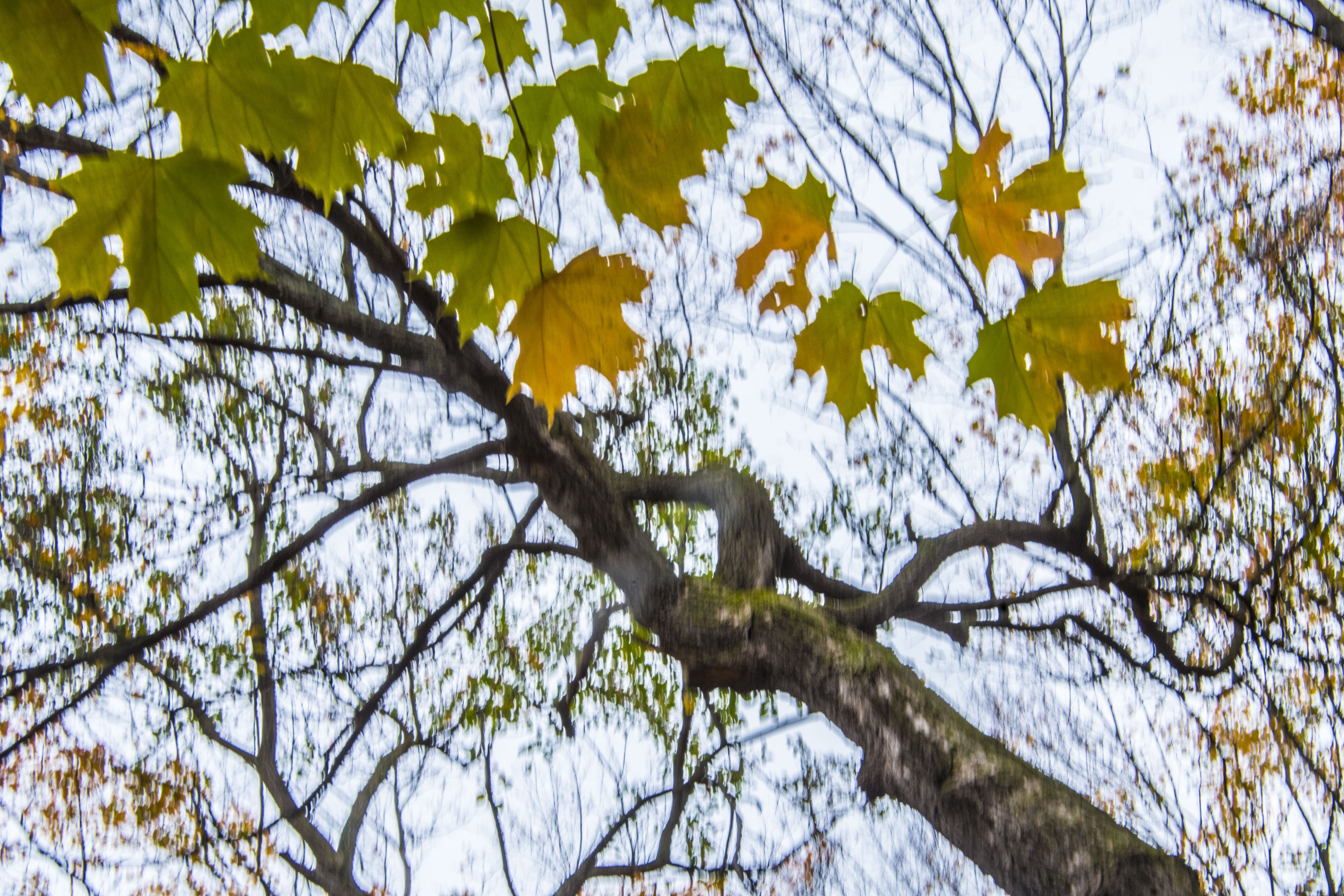
A lone leaf, a last leaf of a summer past, broke free from its tree in an oak savanna choked with a jungle of strong and darkened naked limbs. Halloween trees, as called by my partner, Roberta. Rather than drifting downward, gravity seemed to be drawn from the heavens. The leaf twirled ever higher, a flight not unlike a butterfly, somehow missing the nearby limbs, drifting both higher and laterally. Freely. As the drift crossed a plain created by the forest of oaken limbs, the leaf rose one last time before drifting slowly toward an anonymity of a leaf-strewn forest carpet.

A forestall moment on a late, November afternoon as light softened toward a sleepy haze — a haziness emerging to ever slowly capture the otherwise starkness of the savanna. This was a rare afternoon with barely a breeze in a month that had come in so cold and blustery, blowing, as Aldo Leopold observed in his rather poetic observations, as a wind that describes November. “The stalks hum, the loose husks whisk skyward in half-playing swirls, and the wind hurries on …  a tree tries to argue, bare limbs waving, but there is no detaining the wind.”

Leopold’s wind came early in our November, a somewhat schizophrenic month with afternoons of soul-warming, glorious sunlight mixed with dreary days of gray gloominess. Then the wind. Emily Dickinson wrote that “November always seems to me the Norway of the year.” Dickinson, a introverted loner who rarely left her room, let alone her house outside of Boston, penned the phrase in a letter to her friend, Elizabeth Holland, with this description of November: “The noons are more laconic and the sunsets sterner, and Gibraltar lights make the village foreign.”

Early in November a staunch and chilly wind caused waves at the foot of Big Stone Lake that reflected the ambient colors of the sunset.

Yes, November can be a laconic time following those glorious days of October’s warmth of vivid colors that are suddenly long gone, perhaps signified by a lone wayward leaf joining a dulled leafy carpet. There were days, too, when the trees fought to argue. Days when there was no detaining the wind. Yet, there was color even on the darkest of those days, and enough light to warm the soul just when it seemed the dour gloom of grayness would smother over you like a blanket. Who am I to complain? 

We made a few forays into nature, as is our custom, including a delightful sunny afternoon drive through Sherburne National Wildlife Refuge, where we found two large pockets of sandhill cranes and enough swans to make magical moments seem like a living poem. Such moments feed the soul. November moments, a splinter of time between the colors of autumn and the blessing of light we celebrate come the Solstice.

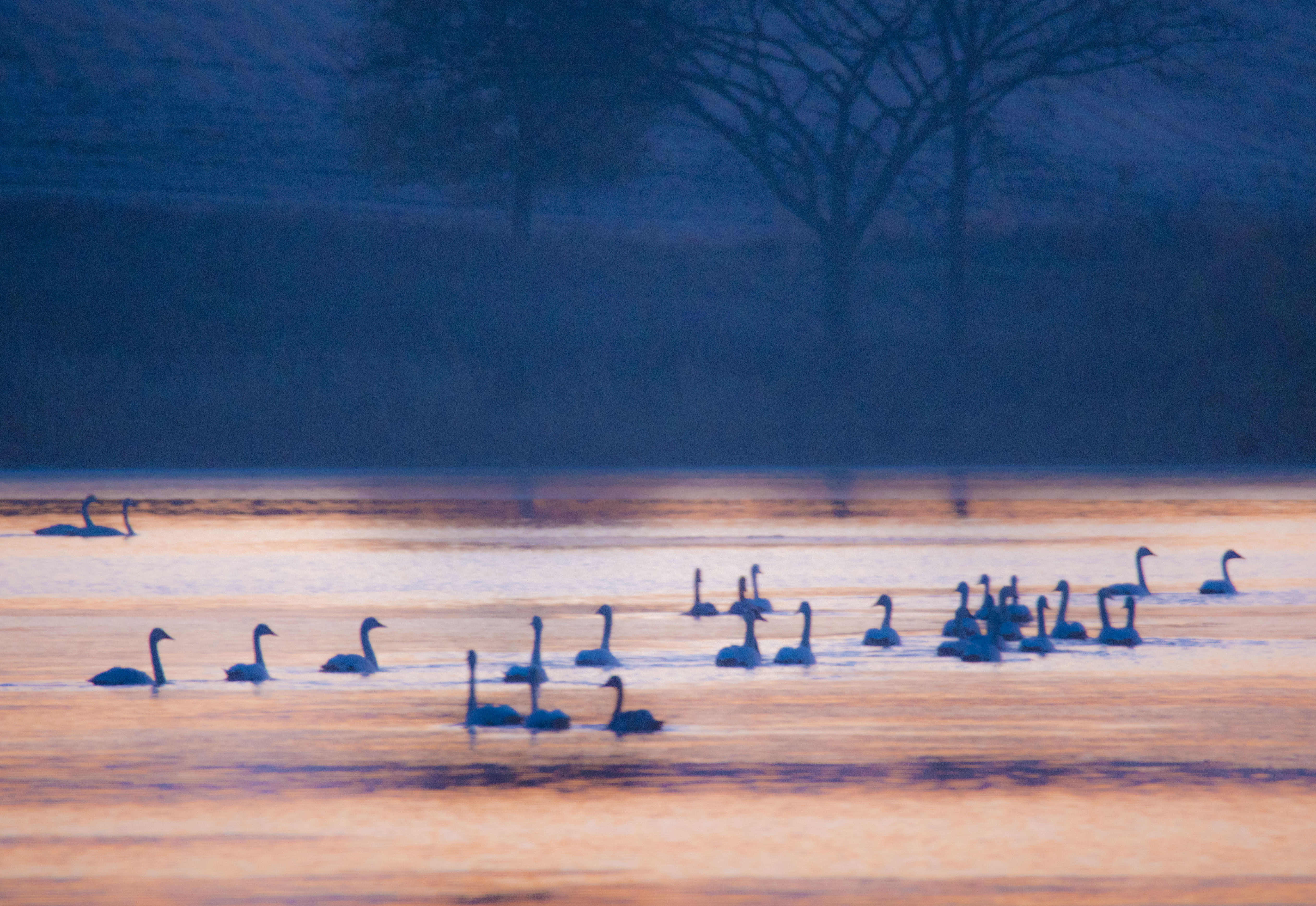
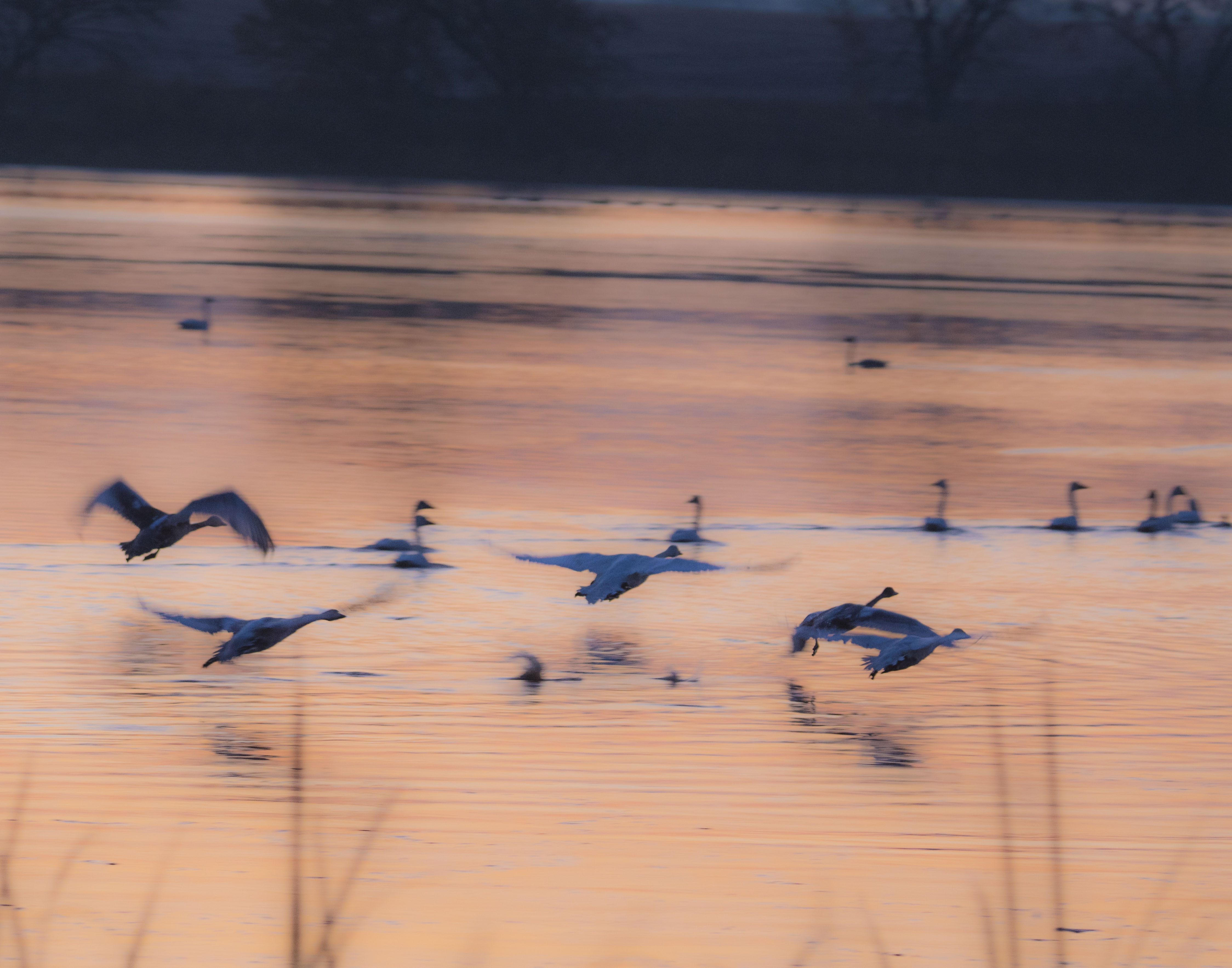
Swans lifting from Eli Lake outside of Clinton in the dawn on a new month.

Yes, November serves as a transition, a prelude to winter that seems equivalent of a spring March as seasons seem to wrestle one another before autumn recedes on one hand, and winter relinquishes on the other. And we are simply on the sideline, observers of a grand plan of which we have little say. 

On those rare years when the joy of October is crushed by a sudden unseasonable snow, the lack of transition seems to hit like a heavyweight’s punch to the gut. Gut punches aside, the transitions ease forever onward. Our grasp for the warmth and color in November is not unlike our wish for warmth and color come March following  a long cold and snowy winter. In my mind these are the reasons for these annual transitions, a slow sliding into winter on one hand, and a quick exit from winter come spring on the other. 

Reeds reflected in the lake waters on an early November morning.

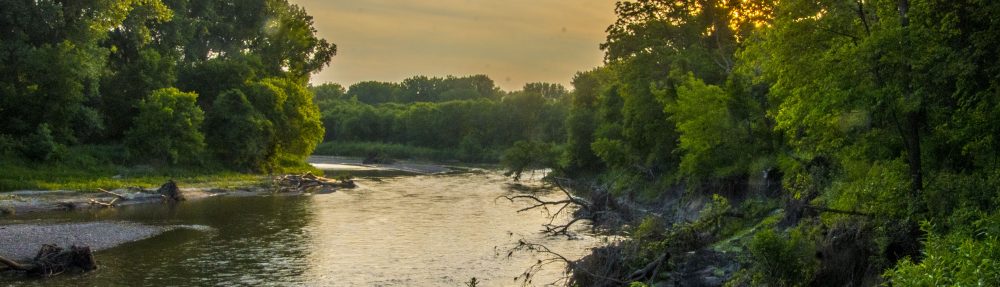
I’m somewhat surprised by the strength of color and light here in the western reaches of Minnesota, although after all these years I perhaps shouldn’t be. Both seem to argue against those otherwise drab and somewhat dreary days by offering a poetic charm to the prairie. An unexpected warmth has mostly kept the waters from freezing, reflecting color and light like prized jewelry or a queenly shawl. Finding such joys helps make this somewhat “foreign” ecosystem seem like home.

Home? On these days of November? This prairie wasn’t part of my grand scheme. I barely realized it existed in my youth, or even as I aged into the “autumn” of my life. Using this as a metaphor, one might suggest I’m entering into the November of my life. In my “September” years we moved to what we learned was the “black desert” of prairie to run a small country weekly. Our initial plan was to give it a few years, yet some 20 years later we were  settled in. We had discovered a vibrant artist community that seemed to dwarf the flatness and lack of trees we were so used to while living along the Little Vermillion and Mississippi Rivers at our former home. Through our new found friendships we discovered the prairie rivers, the riverine environments along with an appreciation of what the late essayist Bill Holm referred to as the “horizontal grandeur.” 

A moment of photographic poetry as a lone swan eases across a prairie wetland.

We would plant a native flora garden in our backyard, and I began photographing the blossoms. Yes, it was planted on a cold November day, a planting session that was averted by a bone chilling rain mixed with snow. Years later, after my wife died, I remarried and settled here in this last semblance of the prairie pothole biome in the “Minnesota Bump.” We bought this little patch of land and named it Listening Stones Farm both in honor of its glacial history and our love of Sigrid Olson’s writing. We converted the tillable land to prairie grasses and flora and made paths through both the prairie and woodland for both observation and photography. 

Then the deeper discoveries began; of small pockets of both native and restored prairies along with the few remaining wetlands. With that came the observations of color and light, especially the nuances of ambient light that often paints this horizontal grandeur with pastels that would have made Monet jealous. Before long a place I had no idea even existed either in my youth and early adulthood had become home. 

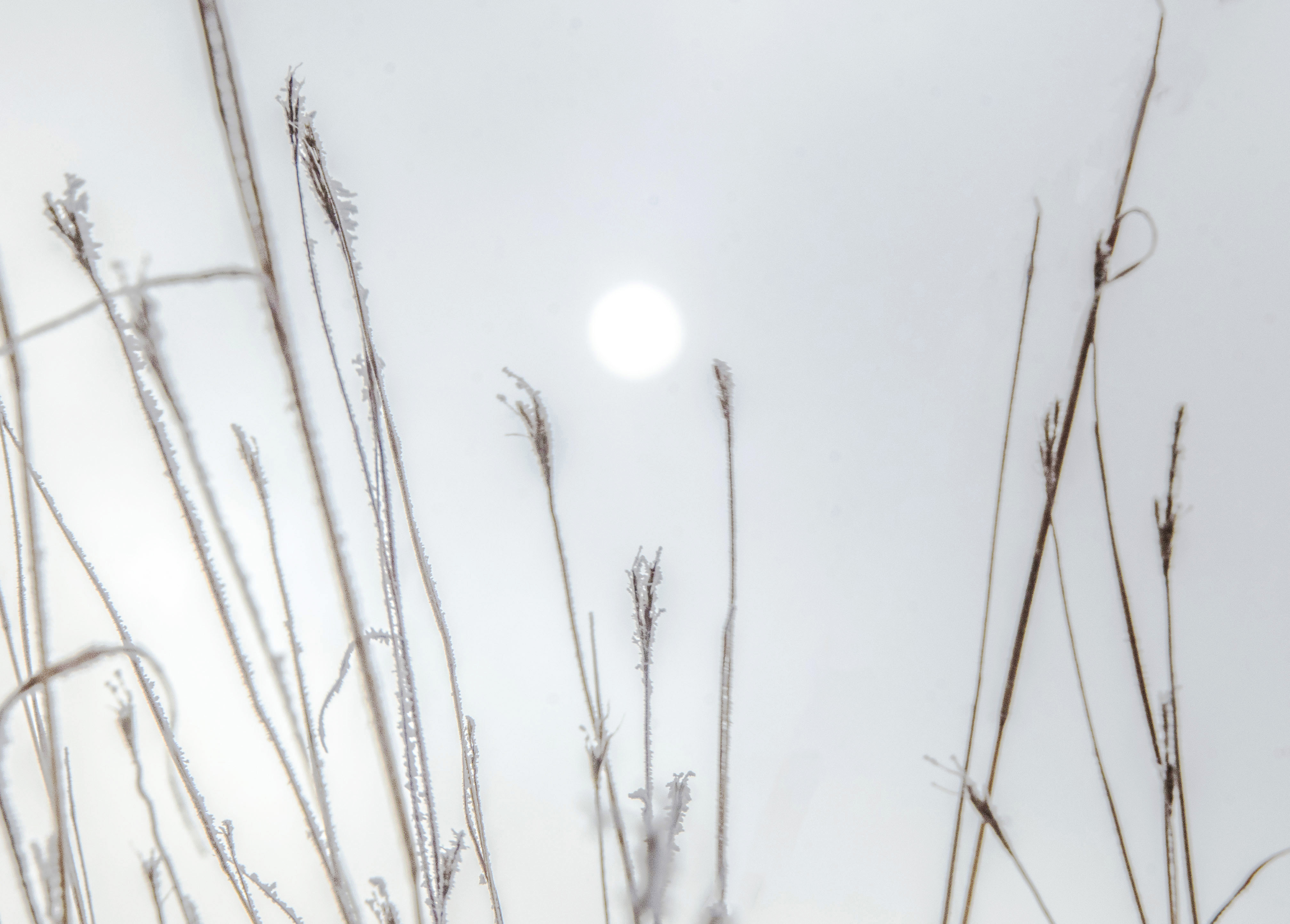
Solar flairs tower above Big Stone Lake State Park, visible through the deep November clouds.

It is said to appreciate the prairie you must look beyond and within the grasses to discover the inner beauty along with the appreciation of color and light; in the noticing of the magical moments such as a last leaf drifting aimlessly through an oak savanna. November sometimes forces you to see beyond those waving grasses, to be encouraged by both color and light and to develop an appreciation of the natural world around you, in bringing joy to the soul. I’d call that being blessed.

Friluftsliv

Long before he became a toddler, we took our son, Aaron, on a short hike through a small riverine woodland just south of Prescott, WI, on an October afternoon. He was in my arms, small yet eager, looking over my shoulder before uttering what my late wife, Sharon, and I claimed was his first ever word: “Preee” he said. It was, indeed, for the afternoon was chummy and sunny, the leaves colorful and the currents of the Mississippi River easing by slowly.

Now, entering his fourth decade, Aaron balances his writing and theatre training into stand-up comedy routines in both English and Norwegian in his adopted home of Bergen, Norway, while studying to become a nurse. In the process he holds fast to his love of nature on long hikes with his wife, Michelle, and their dog, Storm. When I offered him my newest word of his adopted language, he knew precisely what “friluftsliv” meant, a discipline he practices whenever possible.

Pronounced “free-loofts-liv”, this translates into one’s thorough enjoyment of nature. Friluftslive was popularized in the 1850s by the Norwegian playwright and poet, Henrik Ibsen, who used the term to describe the value of spending time in remote locations for spiritual and physical well being. If you’ve spent time in Norway, and especially in the breadth of Telemark County, which includes Ibsen’s home in Skien, the county extends from seaside villas into the heights of the mountains to provide ample opportunities to soak in as much friluftsliv as humanly possible.

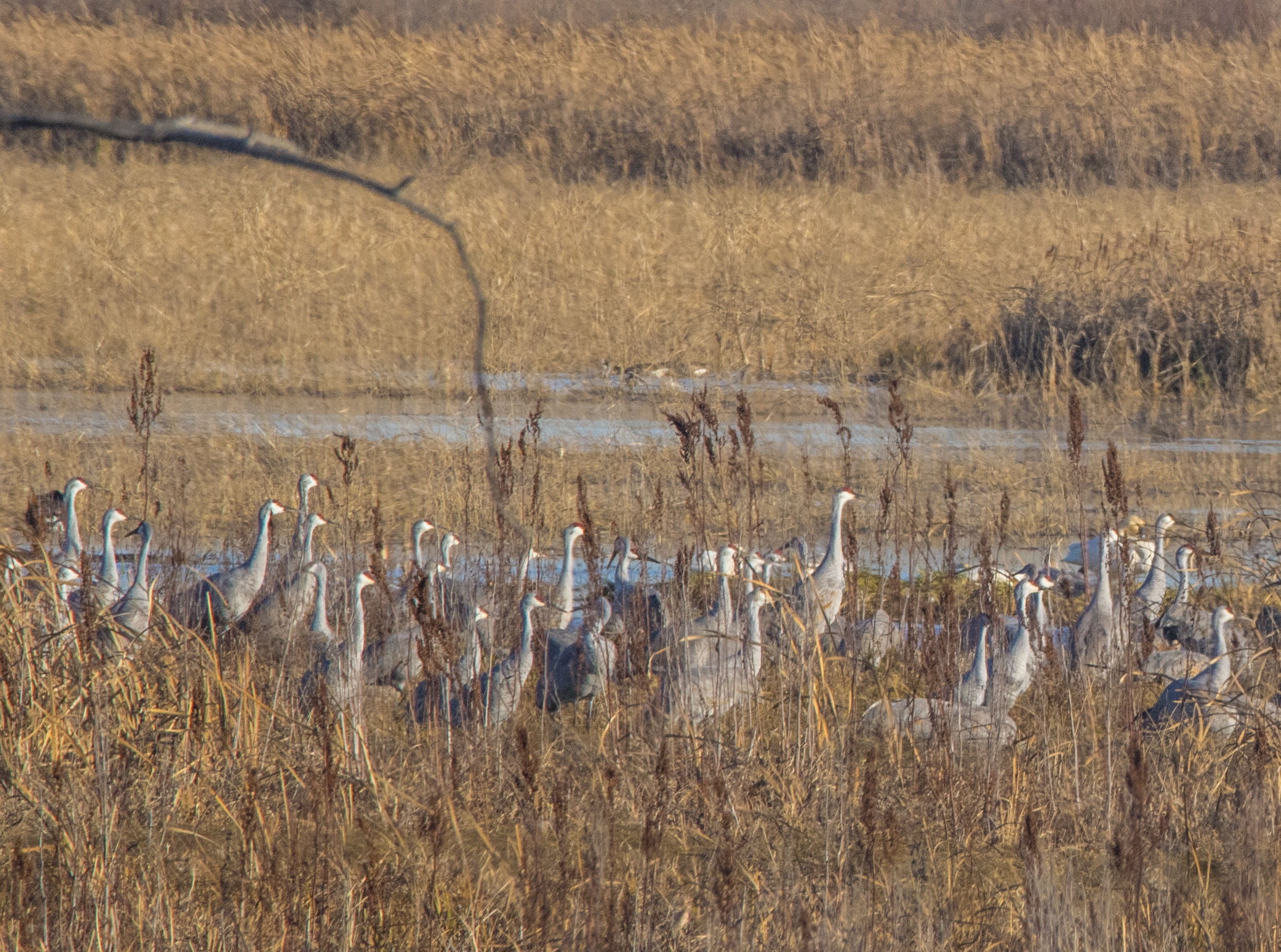
A curious grouping of sandhill cranes caught our attention, and appreciation, at Shurberne NWR.

I can now add “friluftslive” to the Japanese term, “shinrin-yoku,” which translates to forest bathing, into my limited vocabulary. Color me guilty of loving and practicing both disciplines. Forest bathing encompasses meditative disciplines while friluftsliv seems to simply embrace the enjoyment of being in and enjoying nature. Friluftsliv was a word that came from an American-Norwegian friend, Judy Beckman, during a recent house concert here at Listening Stones Farm featuring author-song writer-musician Douglas Wood and his accompanist, Steve Borgstrom. One of their songs, she said, brought the term to life, which I can thoroughly understand since Douglas’ music is ripe with references to nature and, well, friluftsliv. 

Enjoying the beauty and peacefulness of nature comes naturally for us here in Big Stone County on the Western “coast” of Minnesota. While we lack stave churches, mountains and fjords of Norway, we do have the last gasp of the mostly extinct prairie pothole biome, meaning we retain some patches of prairie along with having several potholes or wetlands dotting a somewhat rolling landscape. Nature settings in a natural environment.

Flights of silver … ring-billed gulls near our farm. Colorful joy on a drab afternoon.

How natural? It was here that the massive glacial Lake Agassiz, a large pro-glacial lake that spread across the upper regions of the northern tier states into much of the Canadian prairielands during late Pleistocene Era, and was fed by melt water from the retreating Laurentide Ice Sheet at the end of the last glacial period. When the ice dam broke at modern day Browns Valley, it cut a huge river channel deep into the width of what became a natural prairie extending across SW Minnesota and NW Iowa. At its peak, Agassiz was larger than all of the modern Great Lakes combined, and one could suggest that Lake Winnipeg, which is longer than our current Minnesota River, is a remnant of Agassiz. If one uses his or her imagination, the remnants of that glacial activity surrounds us here both in real time and as “ghosts” of the Pleistocene.

That break at the top of what is now Big Stone Lake created the Glacial River Warren, which came rushing through at speeds scientists estimate at more than a million cubic feet per second (CFS). Warren carved out a wide and deep gorge down to the bedrock that extended from the headwaters to Mankato where an ancient mountain range forced the water northward to what is now the confluence of the Minnesota and Mississippi Rivers. The Minnesota resides in the bed of the ancient glacial river. Some of that exposed bedrock looms today on the landscape within the Big Stone National Wildlife Refuge just south of Ortonville, as well as hidden pockets along the Minnesota River. Friluftsliv, anyone? 

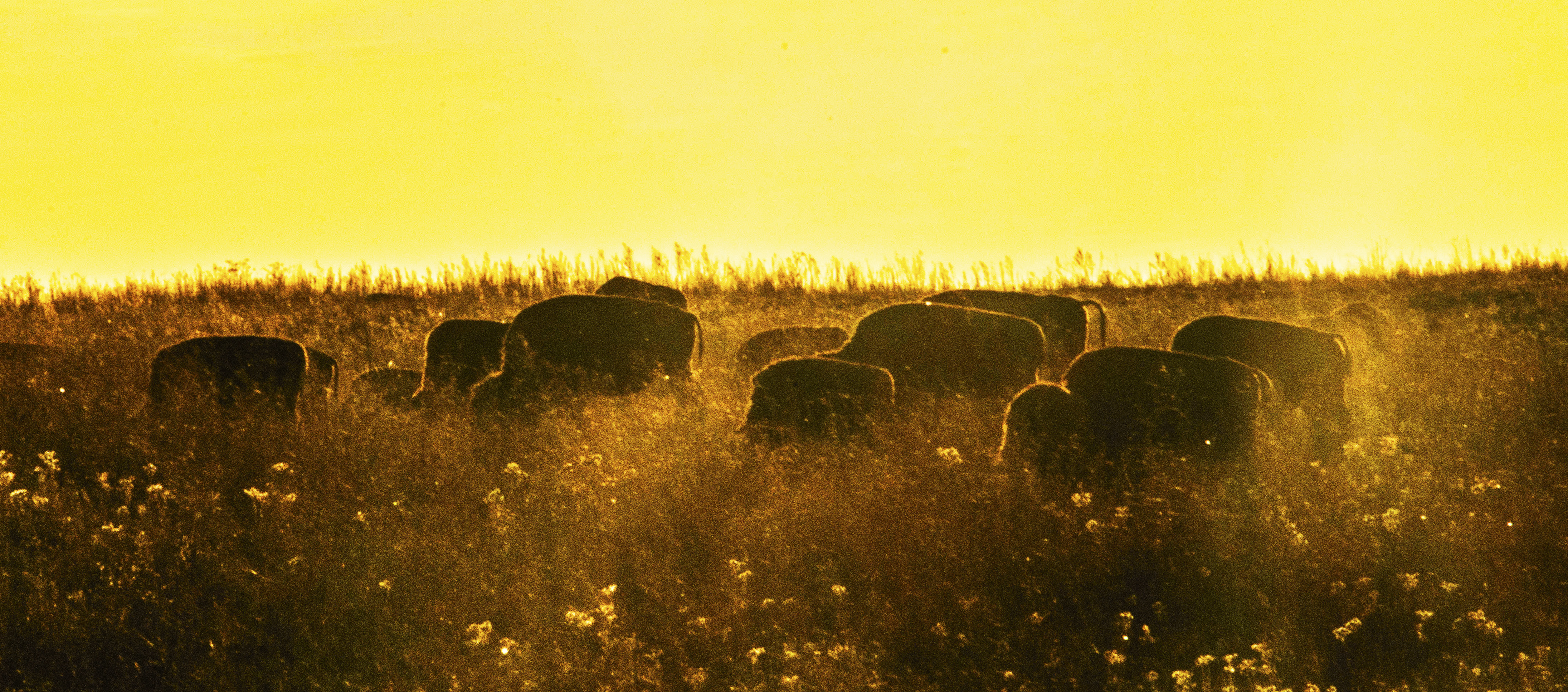
Grazing bison on some South Dakota Native grazing land caused a pause of beauty.

Those “ghosts?” It doesn’t take much of an imagination to recognize where and how many of the huge potholes or lakes existed before ditching and tile draining. Some of that land, like our farm, has been converted back into some restored prairie, perfect for easing into a bit of friluftsliv-friendly sanctuaries.

Also resting in carved bed of the River Warren are two separate areas of Big Stone Lake State Park. The lower Meadowbrook portion is mainly a wide swath of prairieland hosting a healthy stand of prairie grasses and other native flora. Further north is the Bonanza area with both a hillside prairie and a beautiful oak savanna — places you can take a deep breath and find calmness. I frequently practice my forest bathing in the savanna.

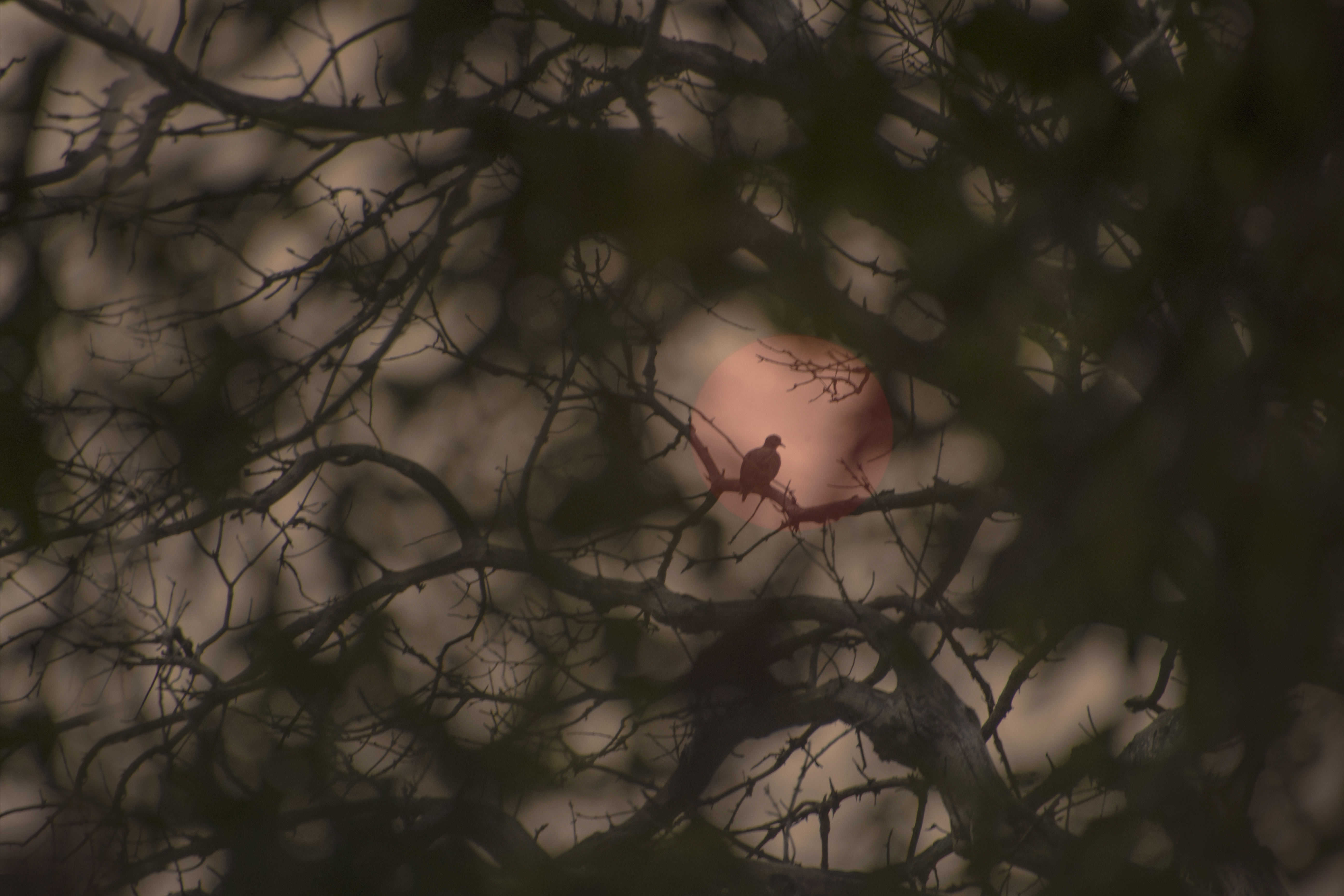
A lone dove in a setting sun here at Listening Stones brought a moment of peace.

We will also make several nature friendly trips over the year to various state parks and NWRs, especially Sherburne and Tamarac. Earlier this week we drove to Sherburne for a last-of-the-year viewing of sandhill cranes. Visually beautiful, and adding to our pleasure was the “music” provided by both countless swans and cranes, accompanied by shrill “sallow flute” piped in by numerous bluejays along the way. Friluftsliv, anyone? 

Friluftsliv may be practiced here at Listening Stones as well, for we make several walks a week with Joe Pye through our own restored prairie. Now, in November, golden stems of six foot tall barren Big Bluestem offer us saber-like arches to meander through. In summer numerous species of native flora add color and a haven for pollinators and various bird species. Stopping ever so often, we may watch the frensied flight of a flushed pheasant, or spy goldfinches munching on thistle seeds. Even now, as November lingers, ring-billed gulls glide over the prairie, their feathers gleaming like sparkling silver. 

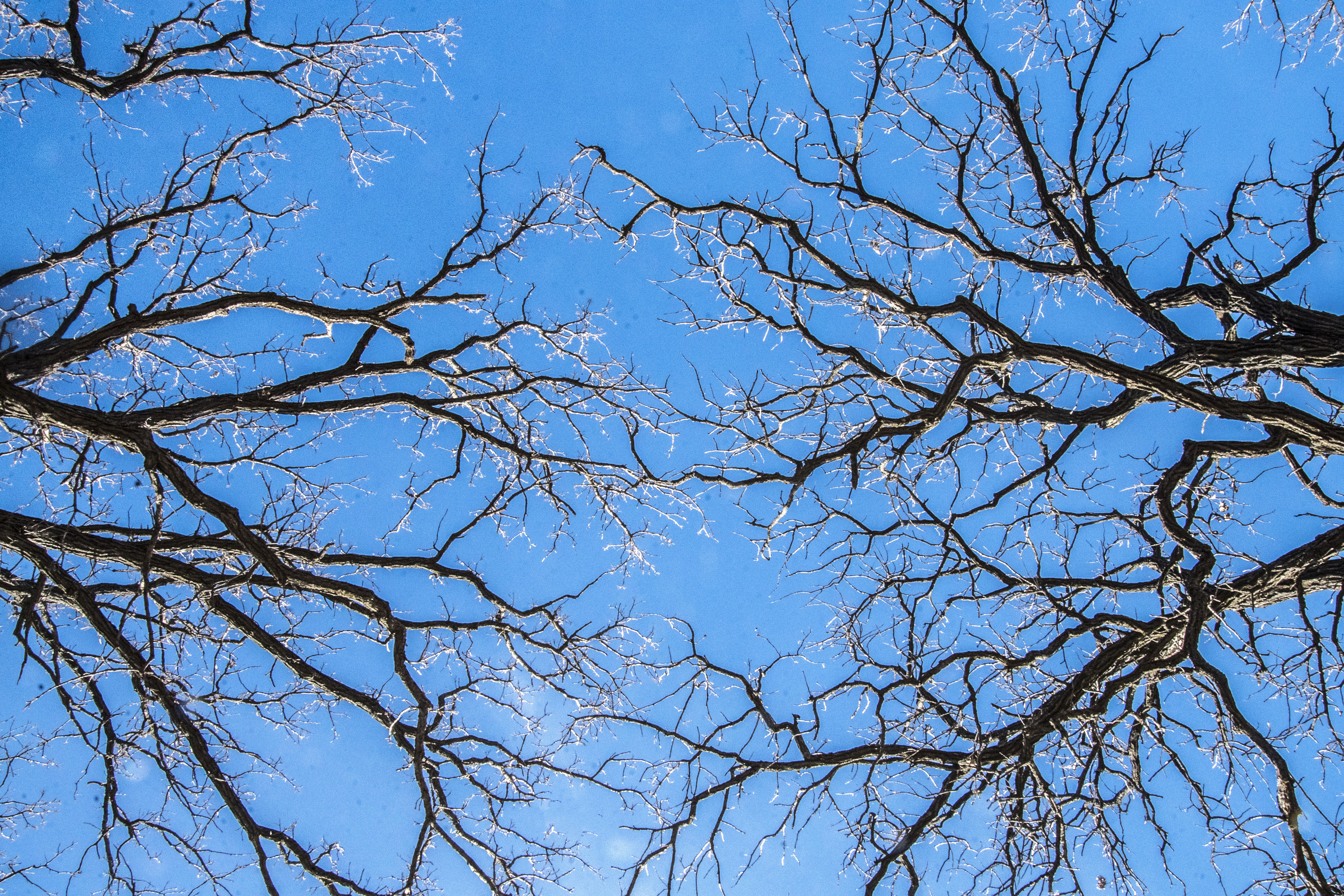
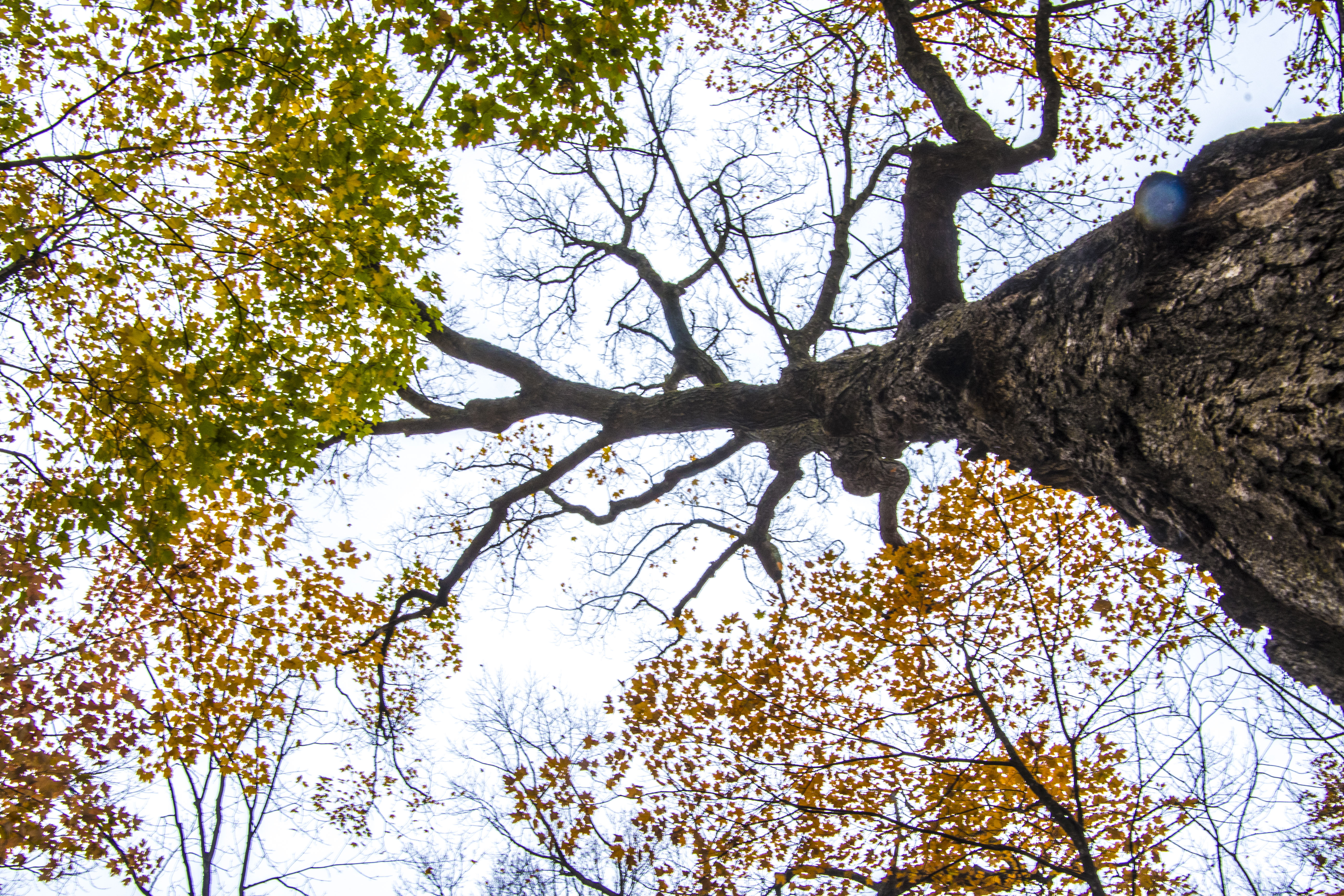
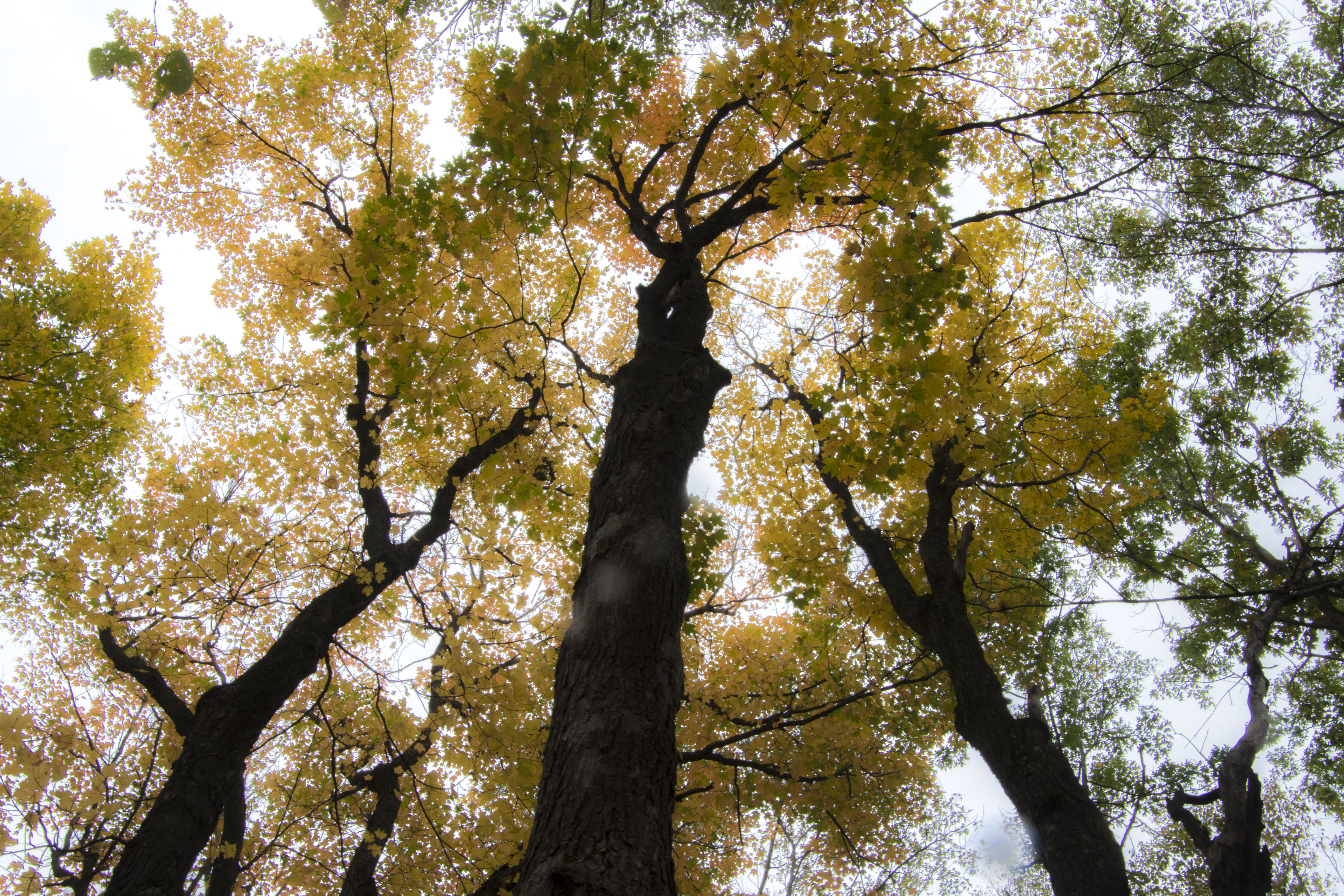
These touching fingers of oak trees, all shining brightly. Sometimes one merely needs to look to the heavens to find a moment of peace and beauty … frilustsliv!.

In these trying times, with wars raging in Ukraine, Gaza, Afghanistan, the Central African Republic, Ethiopia, Libya, Mali, Somalia, South Sudan, and Syria (have I forgot any?), along with an extended attempt of a Nazi rising within our own nation, I find a heightened need to seek whatever peace nature seems to offer. A sweet sanctuary for soothing a weary soul. Maybe my baby boy described nature best so many year ago: “Preee …” Indeed. “Friluftsliv” couldn’t have come into my consciousness any sooner. 

Armfuls of White Blossoms

Ah, November. Come on, surprise us. Give us some glimmer of hope heading into the depths of winter.

Your staunch wind had settled in causing the blueish smoke from my smoker to tangle within the breeze rather than dancing wistfully above the port holes, yet inside the small salmon slabs seemed to be taking it well. This followed an evening attempt to catch a Northern Lights display which we ditched within moments at the top of our prairie, for the clouds even curtained off the moonlight. After tending the smoker this came from a friend from Ely who wrote, “What’s up with this month? Sun never shines. November is dull. But like the ‘moose turd pie joke’, I love November.”

I don’t know the joke, and I grasp to find much love for this dullness, lack of sunlight and the ever present wind, for as Edwin Way Teale pinned, “How sad would be November if we had no knowledge of the spring.” 

Yes, November is our prelude of winter. Medical folks claim January is the toughest month for us mentally here in the North Country, although I could offer a strong argument for November after such a colorful October. At best November could be considered a subtle month, a time when you seek even the tiniest glimmer of color and hope. Our colorful leaves have long blown away into the prairie grasses by those sturdy and seemingly relentless winds, and those gray skies seem empty now that most of the bird migrations have sped through our neck of the prairie. Yes, we still have some ring-billed gulls adding a glitter-like whiteness and beautiful glides through this otherwise muted grayness. 

Then, this happened. Like an unexpected peak of the sun and an umbrella of blue overhead, we were overjoyed when notified by friend, Lisa Thorson, that a 100 or so swans had descended one gray and chilly evening onto nearby Lake Eli. Swans? On Lake Eli? Was this our surprise?

Lake Eli, located on eastern defining edge of nearby Clinton, seems rather unencumbered by canoes or kayaks, so yes, the swans came as an exciting and welcomed surprise, for not much seems to happen around here outside of the annual county fair and hosting what townsfolk call the “world’s longest lasting ice golf tournament” on the shallow lake, one that has been held annually ongoing for 30 some years and draws a few times more than the town’s population each January. For their Arctic Open, holes are drilled via ice auger, then marked by recycled Christmas trees instead of poled golf green flags. 

Yet, there they were. A hundred or so swans offering us both grace and beauty by dropping from the migratory sky to cheer us on a chilly November weekend. We jumped from bed early Sunday morning to hopefully catch the swans in a prairie “sunrise” — for if our sun had broken through between two dense banks of clouds that would have been considered quite a blessing in itself.

As it was, the sun was held captive for at least another hour while the swans held forth in the misty morning. Their collective squawking filled an otherwise quiet morning sky, swan music accented by a few sudden departures that came across as brushed cymbals on a soft jazz piece as long white wings slapped the cold surface of the 160 acre lake when a few select family units lifted from the frigid waters. 

While such a migratory moment wouldn’t garner much attention on the other side of Minnesota, here in the prairie this was wonderfully unexpected, for Lake Eli is not Weaver Bottoms in the Mississippi River. There thousands of swans migrate to the open water each autumn thanks to the bountiful feeding areas in the backwater shallows. Lake Eli, with an average depth of five feet, can offer similar meals for the migratory waterfowl before freeze up. Around here many of the smaller wetlands are already coated with a layer of ice, and both Eli and Big Stone Lake will soon follow suit. By then the last of the swans and other waterfowl will be headed elsewhere leaving behind a stilled silence as we head deeper into winter.

We arrived as dawn settled in to find a large flank of the flock floating across and along the distant bank, much too far for my lens even in decent photographic-friendly light. Not in this low light, dawn-ish haze. Further up the highway we found a good number clustered against the edged water next to the highway. As we neared, though, they began easing away, meandering into the heart of Eli in clusters, some in small select family units or as a larger grouping, their long necks gracefully rising and turning to watch as they sought safety from a rogue photographer. A few took to the air to fly down the length of the lake or overhead. 

As the early morning light grew ever brighter the birds with their beauty and sounds were fine fuel for the soul. Ambient colors began to tint the mostly stilled surface waters. All those thoughts of a gloomy, cold gray November morning seemed to ease away as deep breaths came naturally. How can such a moment seem both calming and exhilarating? Especially as a cold November morning?

I couldn’t help but wonder, though, where the swans will go from here once the lake freezes over? If they even stay around that long? Perhaps to my home state of Missouri, where a couple of Novembers ago en route to our family Thanksgiving we detoured off the Interstate into the Loess Bluffs National Wildlife Refuge in northwestern corner of the state where we were pleasantly surprised to see swans by the thousands supposedly overwintering in the backwaters of the Missouri River. Swans and snow geese, both, and it was a breathtaking sight. 

For now, though, they’re floating on small Lake Eli, where on a cold January morning volunteers will trudge onto the iced-over surface to drill holes for the Arctic Open before motoring down Zero Street and the other streets and avenues in town to retrieve discarded Christmas trees. Although the swans will be long gone we’ll remember how they so unexpectedly came to give us, as poet Mary Oliver wrote, “an armful of white blossoms” —  reminders of the beauty of life on an otherwise cold and blustery November morning. 

Good for the Soul

His email was to invite me to visit his “forest”, adding a tantalizing suggestion of how it would be good for the soul. It was mid-September, back when the days were warmer and the sun seemed to paint most everything with a hint of a golden autumn hue. “It’s in the middle of a section just off the road,” wrote my friend and fellow writer, Brent Olson. While not knowing quite what to expect, it wasn’t going to be Thoreau’s Walden Pond!  Different writers, eras and environments, yet a similar need and desire. 

Some may know Brent beyond our neck of the prairie. He writes a weekly column called “Independently Speaking” he posts online and to an incredibly large number of subscribers near and far, and he has a growing shelf of books he has written. Seven at last count. Mostly essays with a novel or two wedged within. 

When we first met a few decades ago he was giving a reading from his first book at an evening chow feed in the old school in Milan as part of the annual Upper Minnesota River Arts Meander. At the time he was still proudly growing pigs which made him the second hog farmer I knew of at the time to have published a book. I thought briefly that perhaps that was a missing link in my own writing career, that I should be raising pigs. I might add that this was a fleeting thought.

The trees were many, though many were so small you could wrap your two bare hands around the trunks. Your imagination was called upon to visualize trees towering into the prairie sky.

Since I’ve moved into his neighborhood and we’ve become friends, I didn’t take his invitation to his 35-acre cottonwood forest lightly, for I was more than slightly intrigued by both his offer of a walk in the cottonwoods and of soothing the soul. Perhaps I shouldn’t have been surprised Brent had a “forest,” for a few years ago he took issue with the U.S. Fish and Wildlife Service for busily removing trees from their restored prairies in an effort to reduce perching possibilities to hawks and other predatory birds of waterfowl and to restore the land to their long removed heritage.

“I happen to like trees,” came the comment from the avowed prairieman. 

While that may sound like a contradiction, it makes Brent sort of a rascal within the premises of the prairie where for many, trees are viewed with about the same reverence as pimples on a teenager’s cheek. His reputation is that of a principled man with a streak of stubbornness, for he seemingly has no fear of paddling against the flow. Making a mark as he’s done for years with both his writing and his community service in committees, organizations and as a Big Stone County commissioner, as a politician he understands the need for a graceful compromise.  

Brent Olson stops to talk about his 35 acre cottonwood forest.

His independent nature often forsakes previously agreed upon tracks of “suitable” timing for moving things along. He’s more likely to write a grant to jump differing timetables than convention might suggest, or to take a Bobcat afield to inadvertently build a picnic table from a huge slab of polished quartz he had lifted from a slag pile of a local tombstone manufacturer with grunts and hernia fodder into the bed of his pickup. Once home he headed off into his prairie with the slab and eight angle iron pillars he pilfered from an old grain bin to create a rather sturdy picnic table. That table now anchors what is basically a grassy triangular pheasant haven on the peninsula within a beautiful undrained and shallow 150-acre wetland he calls Olson Lake. “For the pheasant hunters,” he claimed. 

Ah, the lake and now a forest? As a third generation owner of the home farm, Brent has followed his family tradition of keeping the shallow wetland intact. On the shores of that “lake” he recently completed the construction of his “writer’s shack” from piecemeal and family relics. It’s a cozy little enclave and wood heated in the winter. Like Thoreau’s cabin, the shack is decidedly basic. By now, perhaps, you’re getting the gist, for his forest, like Olson Lake, stands as a rather defiant metaphor to common acceptance of his prairie peers.

His little forest is located a few miles to the west of the Olson home place. “My forest is the middle of the section,” he explained as we drove toward the dense cottonwood plantation. “Back then when the trees were pretty small I asked Fish and Wildlife if I could keep the trees. They didn’t seem to care back then. Now I’m being told to cut them all down. I won’t. My spirits are always lifted when spending time in here.”

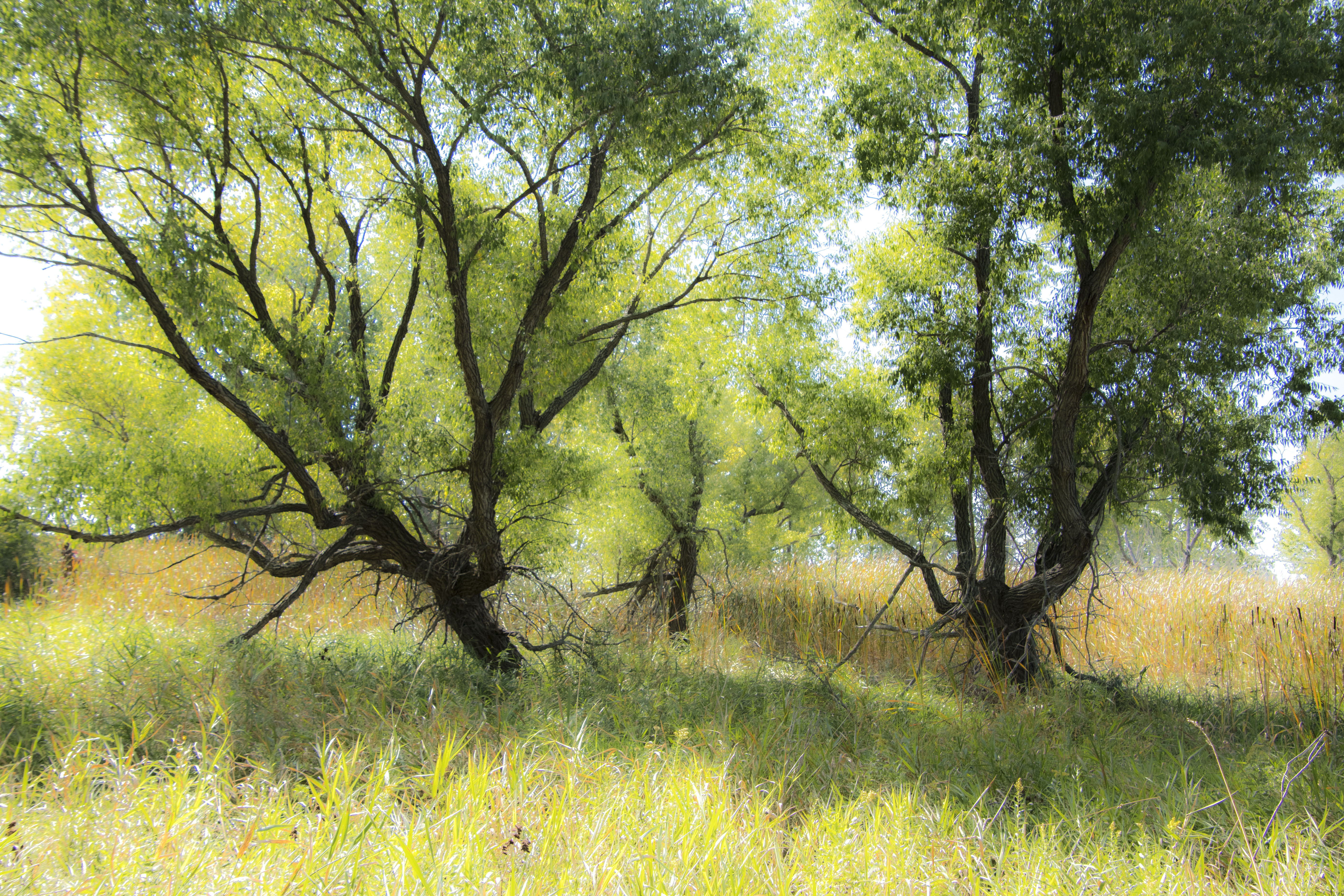
Willows from an earlier time still stand in Brent’s forest, this near a dormant wetland in the middle of the acreage.

The worn tracks through the cropland surrounding the trees give evidence that his spirits are often lifted.

Many of the cottonwoods are immature, small enough you can encircle the trunks with your two bare hands. Yet, you can almost imagine how his forest will look in 20 to 30 years as competition for light and soil nutrients begin to take charge, crowding out the weaker, smaller trees. Natural succession and selection. Century old cottonwoods around here stretch high into the sky with gnarly limbs towering over competitive species in the dozens of farm groves. Which of the hundreds of cottonwoods that surrounded us within his forest will reach such character and status? All part of time, natural history and mystery. Brent seems content to allow nature to take charge.

Many of the trees on this beautiful sunny afternoon bore golden leaves, while others held onto a summer greenness making for interesting color contrasts. Intermingled among the cottonwoods were a few picturesque mature willow trees near a small and “dormant” wetland. A bed of cattails gave it away. Despite an ongoing drought, the cattails, willows and cottonwoods left stranded seemed healthy. 

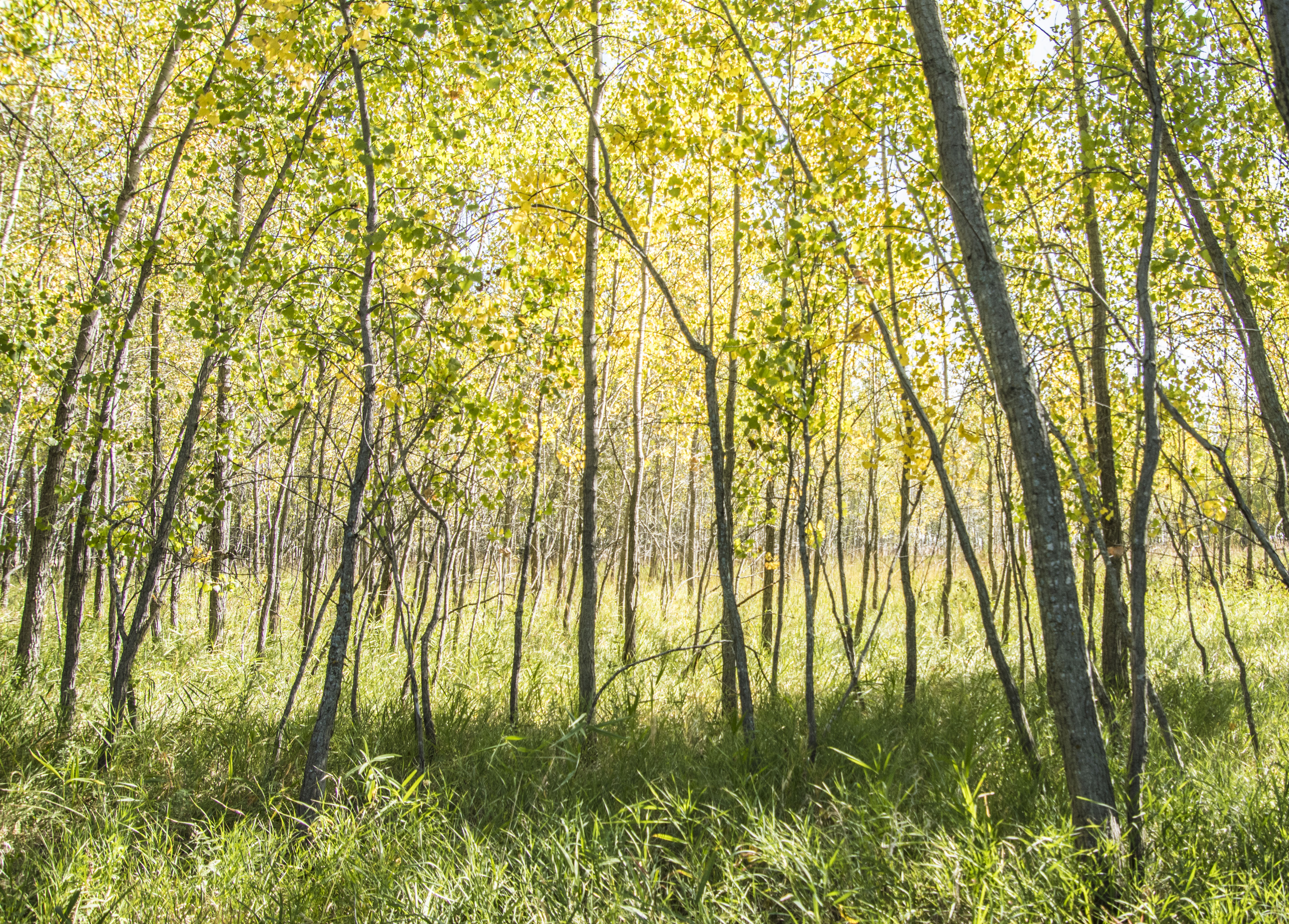
Not all the cottonwood leaves had moved into their autumn gold, giving the forest an interesting contrast.

His forest, seemingly obstinate in its prairie setting, has a lively and lovely denseness despite the drought, and when in the midst of the timber you are surrounded by such a density of trees the adjacent prairie and cropland cannot be seen. Though we were less than a quarter mile from a county highway, and over a ridge from a major U.S. highway, the trees seem to buffer the outside noise. Thoreau’s wooded enclave? While it’s beautiful with a hillside of oaks and maples alongside a tranquil lake, those triangular woods are surrounded on two sides by multiple lane highways with the third hosting a major bed of commuter and freighter railroad tracks. Outside of his “sleepy” Concord, an incredible imagination is necessary to sense Walden Pond being peaceful and quiet, a haven for the soul.

Here in Brent’s woods you feel a need of taking in a deep, natural breath to allow the surrounding nature to settle into higher sensory levels. Sound, for one, soothed the soul as bird songs joined the soft background music of the shimmering cottonwood leaves. Adding another layer of sensory appreciation was a soft woody scent from the nearby cottonwoods. Not quite apple buttery. A hint, perhaps. As we weaved our way back through the trees toward the pickup, Brent’s “forest” was holding its own here in the midst of an otherwise rather flat and nondescript prairie. He was correct. One’s spirits could be lifted here.

Touching the Dream

Ah, the beauty of nature, of how when you least expect a gift of the natural world something magically appears  … even on a stretch of state highway alongside a freighter track. We were returning from a shopping trip miles from home, rolling alongside the BNSF tracks west of Appleton, MN, when we were suddenly engulfed by a murmuration of thousands of red-winged blackbirds, and an old dream, a visualization of a lifetime, suddenly came to life. 

Few remain alive to recall such moments nowadays, although some of the old guys of the prairie will talk about how their fathers and grandfathers spoke of red-winged murmurations so thick the collective birds would block out the sky. One of those guys, in his sixties at the time, was in our Master Naturalist’s class back in 2012, and as our small group worked together on a capstone project the conversation drifted toward murmurations, for it was spring and we were starting to see some come through our region of the prairie. “When I was a kid,” he said, “old timers around Redwood would talk about seeing clouds of redwings so thick they would blacken the sky.”

Was this a moment from prairie’s past? Perhaps, though we have no way of knowing.

Such times were back when there was more than one percent of the wetlands remaining in the now extinct “prairie pothole biome.” Another old timer, back about 30 years ago when he was an aged county commissioner, spoke of similar times when he chastised me for my writing positive commentary about the “sloughs”, by saying, “You don’t have any idea of what it was like before ditching and draining. No way to farm. Nothing but damned mud and mosquitoes. You couldn’t get away from either.”

There were also birds. Millions of birds, from waders to grassland species like bob-o-links and meadowlarks, all adding color and song to the then wide open prairie. Red-winged blackbirds were there, too. Millions of them. That was then … back then before the numbers of all of the prairie birds began shrinking due to the destruction of the grass-blessed prairie and wetlands, red-winged included. Back then, come migration, murmurations formed with hundreds of thousands of birds, and when rising from the wetlands and prairie. they would block out the sun, the sky and the clouds. I’ve dreamed of having that visualization come to life ever since that conversation at the meeting and figured there would never be such an opportunity. Then this happened. On a state highway. Alongside a railroad track. A magical moment of nature.

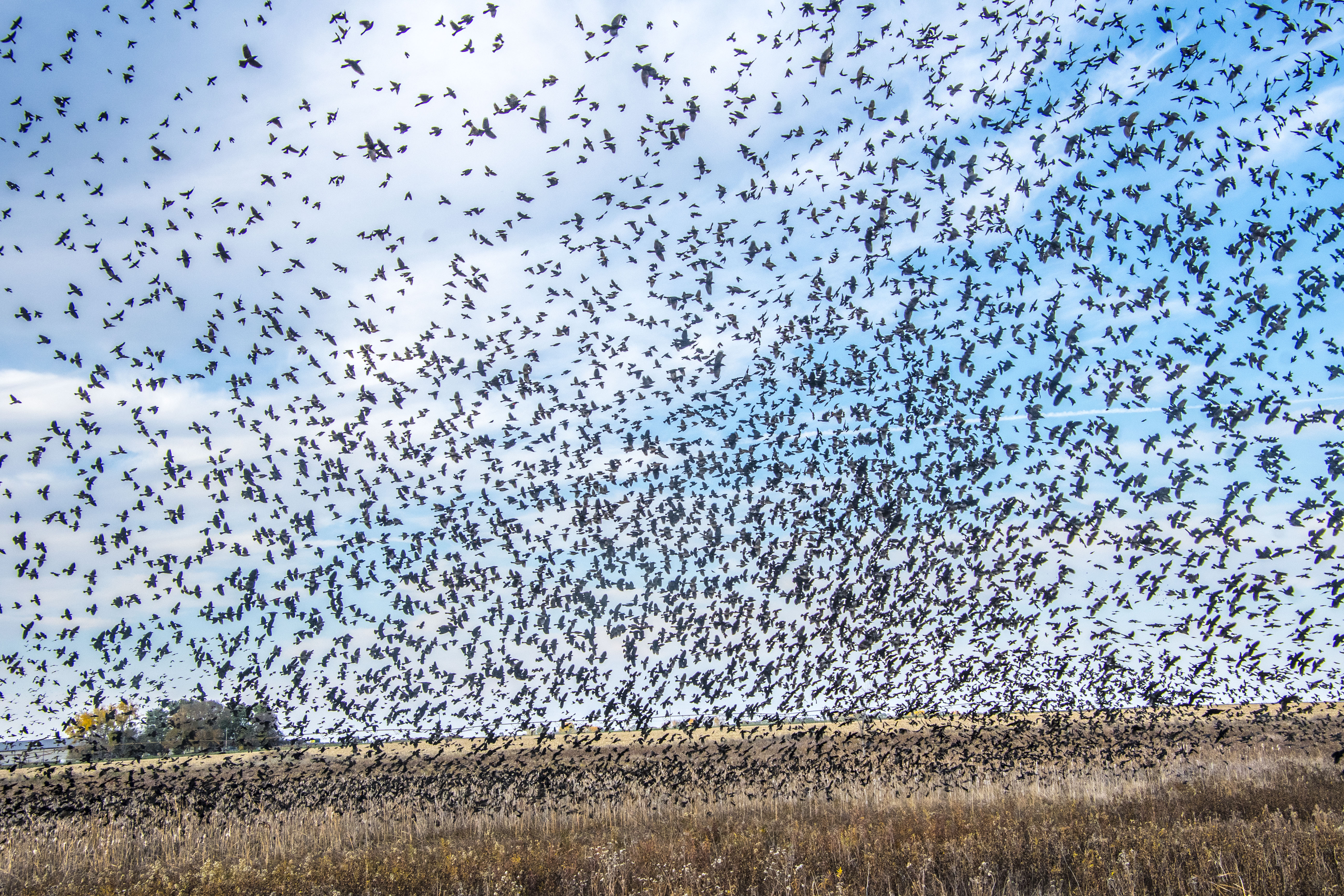
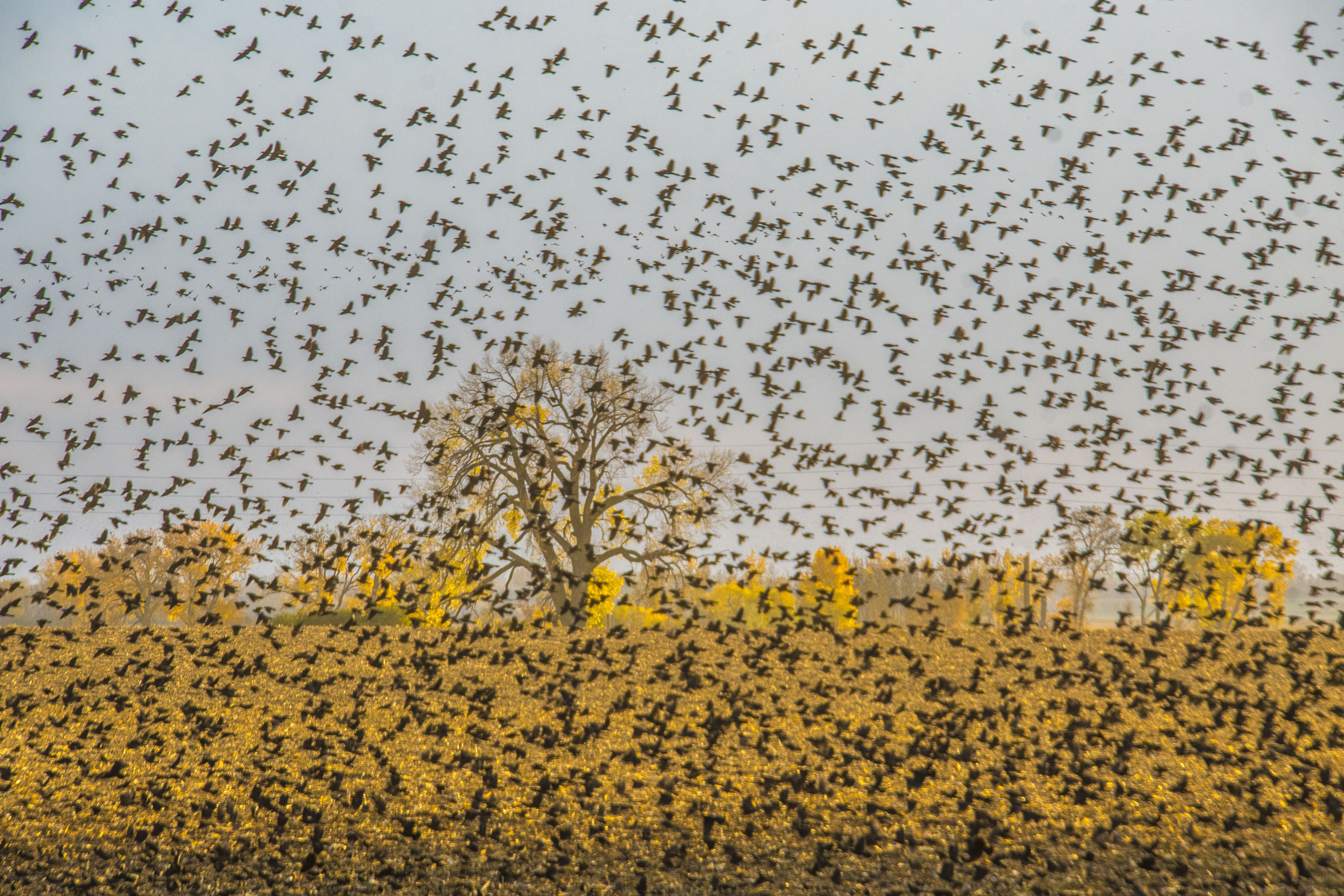
Often the landscape and even the sky was obliterated.

Did they block out the sun, sky and clouds? At times, perhaps. Enough that the visualization held promise.

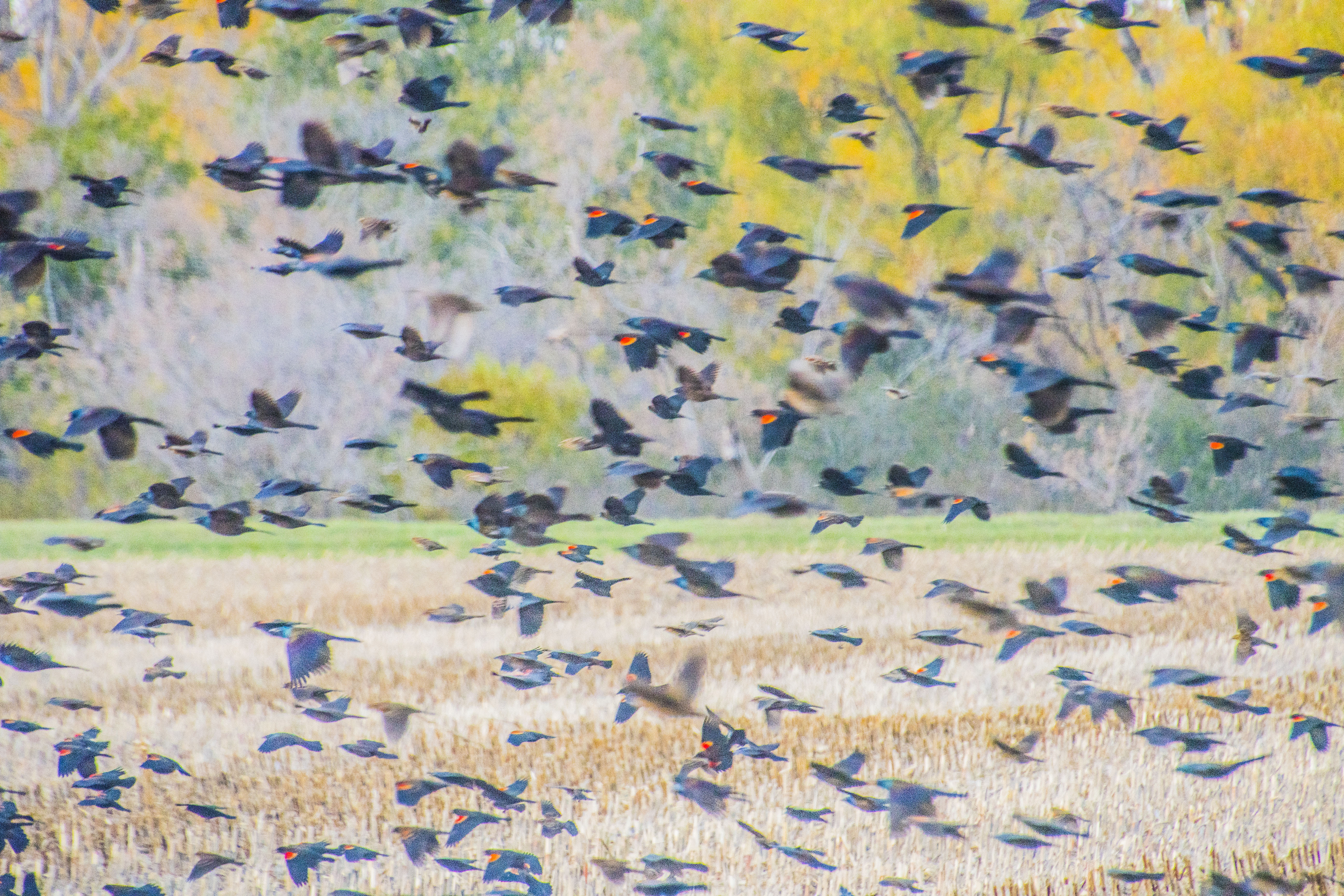
I’ve witnessed some huge murmurations around Listening Stones and due south about an hour or so, though hardly a flock as close and huge as this one — until this surprise nature offered us the other day, a gathering of the colorful epaulet-patched blackbirds so thick they seemingly blackened the sky.

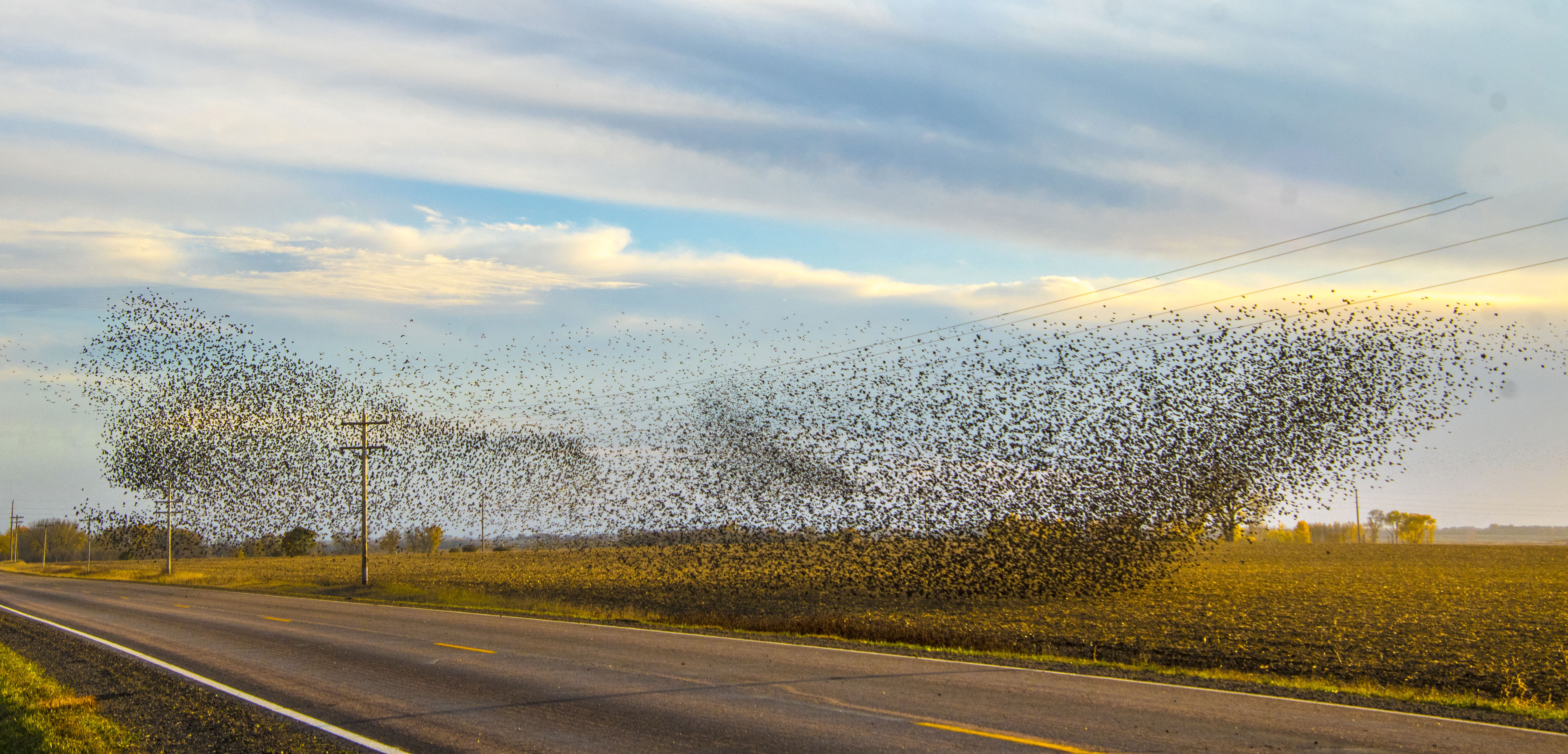
How do you even count so many birds? If we guessed a half million we might have been close, or perhaps, even short by a few hundred thousand. Here, just west of Appleton, along a stretch of State Highway 7, balanced between some shallow wetlands with numerous cattails, a recently harvested grain field, numerous and spacious trees and a semblance of the old prairie. Yes, perhaps even a glance back to those undrained and unditched patches of prairies of old. If this hadn’t been real it would have been a mirage. A dream. Yet, I have photographic and witnessed proof.

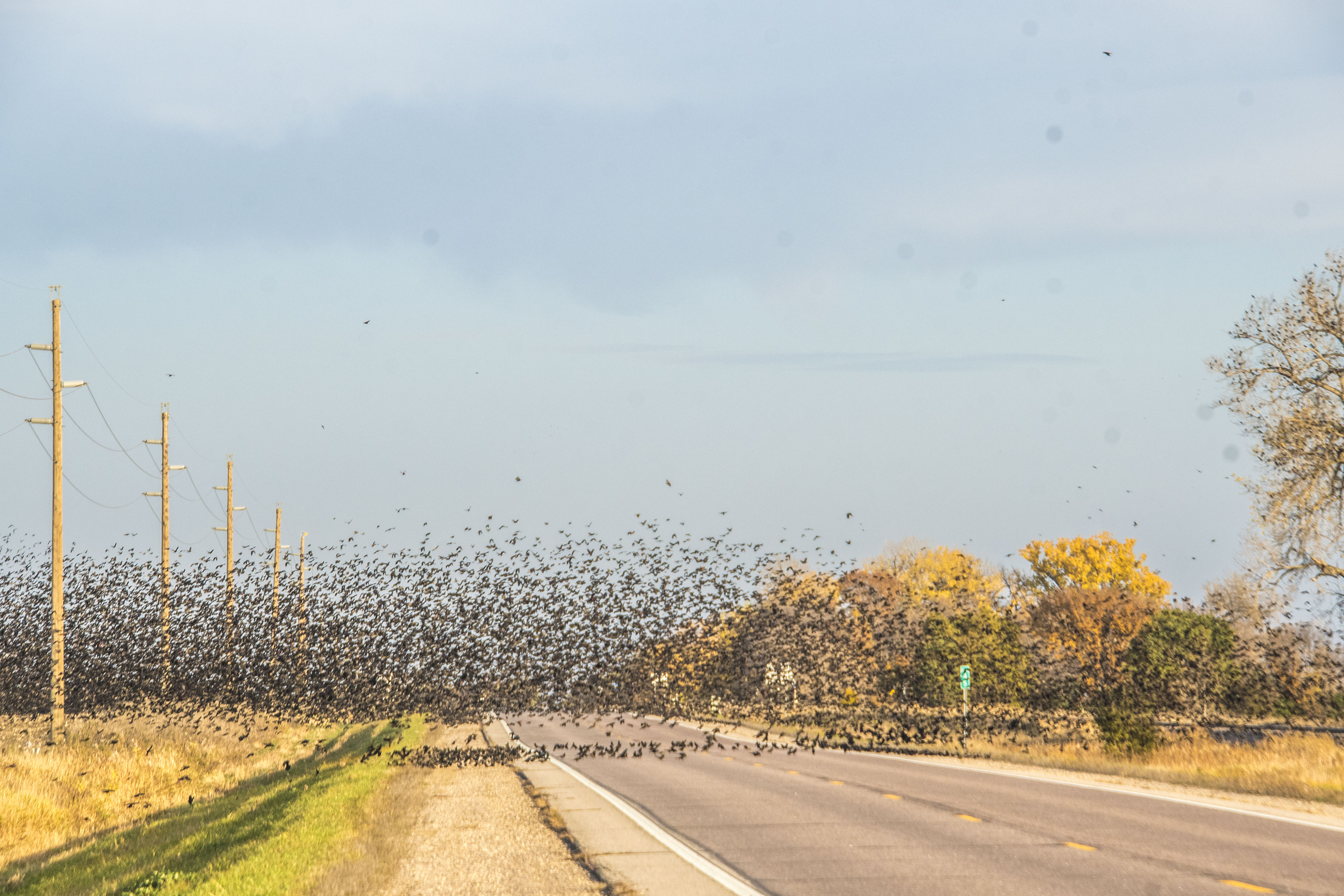
Can you see the car? Yes, it’s in there slowly moving through the curtain of red-winged blackbirds.

We stopped to both watch and take pictures for nearly an hour before deciding to head on home. Then, about ten miles down the road, I pulled over and suggested to Roberta that we return just to hopefully catch the birds in the sunset about an hour or so distant. “We don’t have anything else going,” she said, “so let’s do it.” A u-turn later we were back on the other side of Correll on the way toward Appleton. The murmuration hadn’t left, seemingly nervously rising and settling, then rising as an uncountable curtain of birds. Depths of blackness, with some quite close, and through them in the distances, thousands upon thousands more. It was like a dream come true, and I thought of those who through the years have shared this odd dream of mine.

At one point several hundred landed on the highway surface, temporarily halting traffic until one brave motorist decided enough was enough and slowly crept through the birds causing them to rise once again. This caused them to then turn north along the graveled Ct. Rd 51, and we followed as closely as we could. At times it felt as if we could simply reach through the window and touch one or more of the birds since the flights were so close. Over the years I’ve seen many pictures of distant choreographic-like flight patterns of murmurations, and was hoping that might happen in a colorful sky. We wouldn’t be so fortunate. While we captured images of the distant murmuration dances, none were captured as it might have been with video. 

At first it was difficult to identify the birds, then this happened. Along the county road they seemed so close you felt you could reach out and touch them.

“Imagine what you are seeing are sandhill cranes rather than redwings,” I suggested to Roberta. “Huge birds, coming in around sunset over the Platte. This is like the crane migrations in miniature.”

Twice through those few hours highway patrol officers passed by our car as we sat with our hazard lights blinking along the highway, and one even slowed before offering a knowledgeable wave and continuing along toward Appleton. Yes, I’ve been warned before about the illegality of stopping along a highway to take pictures, so perhaps he was aware of the magic in the sky. Maybe he wished he could stop and watch, too. Yet, he waved and moved on eastward.

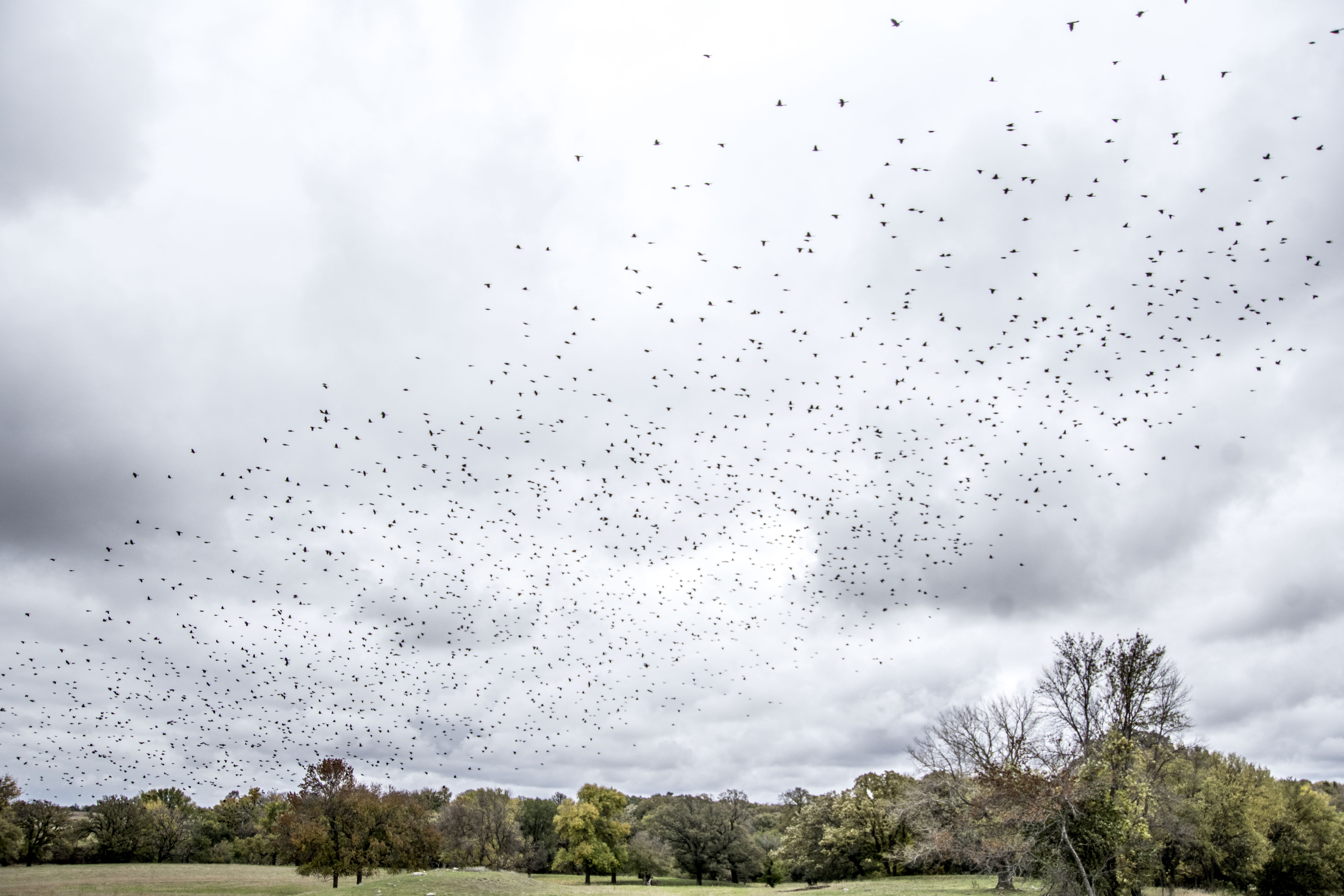
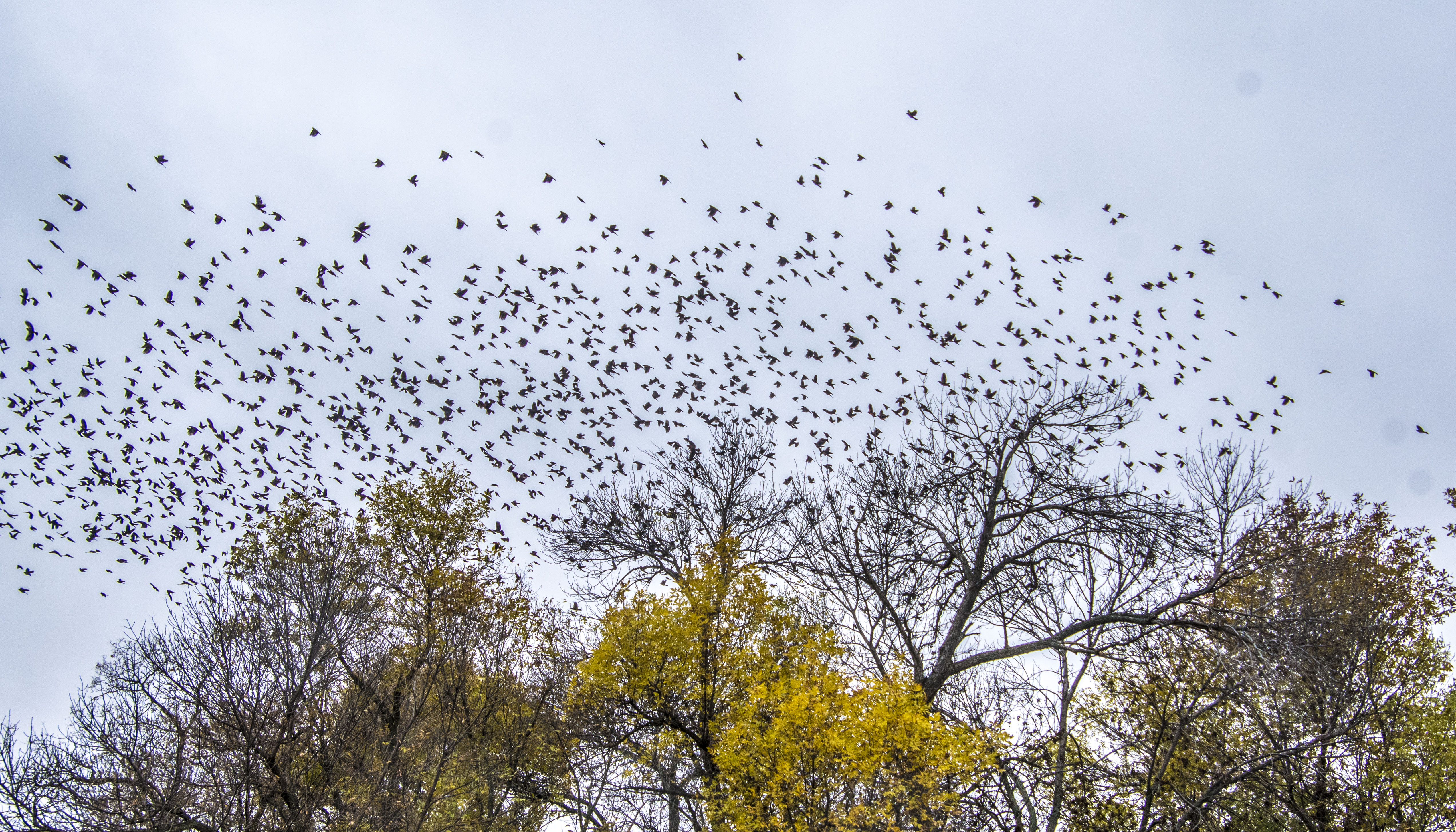
Not only had we parked along the highway, we were often outside standing either in front of or behind the car gazing at the sky, watching as the birds lifted in gigantic clouds from the prairie and trees, seemingly exploding up into the sky as a unit though there were umpteen thousands rising at once. Dancing in movement as though they might touch the clouds, before swooping low to kiss the spine of the prairie, or laterally as if they alone owned the heavens. Clusters thick with points of blackness, each a bird. Yes, it was magical.

Only a portion of the choreographic flights around us.

Eventually the sun began to slide behind the evening clouds as the sky dance continued above us, and around us, blackened dots of red-winged blackbirds dancing in choreographic feathery clouds as nightfall claimed the prairie. Sometimes we are blessed with the pleasures nature offers us, and perhaps the secret is that we notice.

Waves Goodbye

An old fly fishing friend, Rick Nelson, penned this “original Haiku” earlier this week:

Migrating birds

Autumn’s sad farewell

Spring’s cheerful hello 

While Rick acknowledged it might not ring true to purists of the Haiku world, it sums up both of our thoughts of late as we watch and listen to yet another winged species speed south through the flyway.

Another murmuration had settled in earlier yesterday morning, ever briefly, in the woods surrounding our home and studio. Leaning against the studio door to listen, the sound is much like what you might hear in a large stadium before a game as voices intermingle into a tangled and indiscernible murmur. This was at least our fourth murmuration of autumn, yet none were as large a massive one with thousands of birds we passed over the weekend nearly 90 minutes south on the King of Highways along the Yellow Medicine River outside of Ivanhoe, MN.

This shows only a fraction of a huge murmuration along the Yellow Medicine River south of Ivanhoe.

Our’s was large enough, so on the way in for lunch I came with the camera, stopping to watch for several moments has they rustled in the treetops of the grove. Suddenly, for some inexplicit reason, they seemed to rise as one, lifting from the depth of trees into the air to fly high over the house before making a wide ranging loop before returning directly overhead to once again fill the same treetops. It was a loud and anxious sounding murmur … until an hour later it was suddenly gone. The silence they left behind was deafening. 

A few days before it was a huge group of ring-bill gulls. I had stepped out of the studio for a brief break and saw several hundred high above the house, seemingly circling as if undecided on which way to fly. Then, suddenly, they veered toward the east and the large wetland just over the rise of our prairie. Wave after wave. By mid-afternoon they were gone. Not a gull in sight.

Part of the murmuration in our Listening Stones Farm grove earlier this week.

A few weeks before there was an uncountable number of white pelicans in the west pool of the Big Stone National Wildlife Refuge grouped together for what seemed like a quarter mile in length. Stacked up against one another so thickly they created what seemed like a feathery bridge some 50 feet across and stretching for a good 400 yards along the tall, marshy grasses. We’re fortunate to have the pelicans here through the summer, and I suspected as I photographed their collective long trough of a feeding frenzy that I was witnessing a pre-migratory feeding. By the next morning there wasn’t a single white pelican, save a straggler or two, to be seen. They were gone.

About the same time we observed a migratory grouping of great egrets at the Refuge, many standing tall on branches of a canopy of trees. Others lined the shallows stalking for a meal. By nightfall they had left the refuge, shallow waters and all.

This represents about a fourth of the long line of white pelicans holed up in the west pool at the Big Stone National Wildlife Refuge.

Swallows and other species have lined the high wires next to harvested grain fields, sometimes bunched in a line that stretches for several hundred feet. We had left for some business downriver and found dozens of such gatherings on power lines from here to Montevideo. They were gone by the time we returned a couple of hours later. 

It seems like those wings of flight were waves goodbye. One species after another, taking to the skies en masse. There seems to still be much mystery concerning migrations. Those swallows, for example, will cover much of North America throughout the summer “breeding” period before suddenly leaving to cover most of South America during the summer of the southern hemisphere. Is the clue of mass migration dependent on the hours of dwindling daylight? Rarely is it available food, according the writing of Donald R. Griffin in his book, “Bird Migrations.” Often, due in part to climate change, there often remains plentiful food around when the migration occurs.

Great egrets grasp a canopy in the Big Stone National Wildlife Refuge for a migratory rest.

We have learned to track migrations with radar and other observatory and tracking tools of science, although there is no instance of delving into the brains of birds. How can you? Among my wonders is how birds of a certain species suddenly begin to congregate? Where? How is the collective decision to suddenly leave communicated? How much has global climate change affected both the summer and winter site selections? Some suggest migration routes are several thousands of years in the making, yet in many instances those routes have changed. How do they find a helpful, high atmospheric wind current to boost a migration across a vast majority of the Midwest basically overnight? With so many birds that the migration is tracked by radar? It’s all a great wonder. A tantalizing mystery that dates back to Aristotle who correctly recognized some aspects of bird migration in his Historia Animalium in the 4th century, BC.

Ring-billed gulls fill the sky above Listening Stones Farm earlier in the week.

As amazing as it is to watch those skyward skeins and poetic dances of murmurations, those symbolic “goodbye waves” of the collective wingtips, there is this vast silence these migrating birds leave behind … voices full of energy, and perhaps even wonder. My woods seem incredibly empty once the last of the stragglers have flown away to join an orchestrated movement toward often a quite distant wintering home. I then wonder if another will happen through here yet this autumn, or will this be the silence that takes us into winter. 

About Rick’s Haiku, the naturalist and thoughtful fly fisherman says, “I know it doesn’t follow strict Haiku rules. But I was reading an article on Haiku this spring and the premise was, “Write a three line poem about something that touches you.” Rick was touched deeply by the migrations through his Bismarck homeland as I am here home on my Listening Stones prairie as we await “spring’s cheerful hello.”

A Haunting

(Writer’s Note: This piece was written as an exercise this past weekend at Douglas Wood’s “Writers in the Woods” workshop held at Osprey Wilds Environmental Learning Center near Sandstone, MN.)

I am haunted by old trees; trees that reach skyward with form and grace. Darkened, aged arms like that of a classical ballerina; poetic, and for some, reaching through thick canopies in search of their last leafy breaths of life.

Around their gnarly, roughened old trunks, or around broken branches easing biologically into the forest duff, an under story has already come to life. Perhaps seedling offspring from years of dropping acorns or other seeds.

Yet there they stand, defying the supple youth surrounding them, with a grace and form that attracts me, especially now as I am about to enter my eighth decade.

Perhaps my haunting is in hoping I can finish my own life with as much grace and form, with such strength.

These thoughts began a few weeks ago in Norway when I slipped on a slick slope above a rolling river, banging the back of my head on a rock with such force that my glasses flew off along with both hearing aids. My camera lens was shattered along with any sense of youthful verve. My diagnosis was a Class One concussion. Where I almost always felt agile with some semblance of youth, I’ve since found my being in the wild now filled with fear and awkwardness. I have a vulnerability I’ve rarely felt.

Recently as I walked an uneven and somewhat rugged and hilly trail along the lively and rushing waters of the Kettle River in Banning State Park, I found myself constantly struggling in search of safe passage, of reaching for rocks and nearby trees to keep myself upright and safe. Even with slow and deliberate effort to climb down an incline for a photograph, I felt so alone and found fear I had seldom felt before that fall in Norway. I was aware of my aloneness and continued to search the nearby trails for others in the event of another fall.

Along with this vulnerability, I’ve felt as if I had lost my sense of adventure and wonder, and despite the multiple comments of “you don’t move like someone your age” and similar shared thoughts of loved ones and friends, there it was. Where my mobility had rarely been a concern, I was now frightful and even scared in the uneven terrain. I was feeling old, an age showing itself in my gait. 

Then this morning I awoke more rested, and en route to breakfast we ambled along another rocky, uneven path. Although the path didn’t offer many of the same adventurous and challenging features of the Banning trail, I slowly began to feel perhaps righted in a way, less frightened. Perhaps it helped being near others.

Then came our assignment: to head into the nearby nature and return with perhaps something to write about. While many headed toward a trail meandering through a big woods, instead I found myself ambling alone through the remnants of an old forest nearby, one with old trees. Aged trees. Gnarly trees. Trees with character and graceful form. Trees still with shimmering leaves, golden in the morning sunlight. Trees that had grown old and stood brazenly strong among both seedlings and younger brothern, with sturdy trunks and long, well defined poetic limbs still reaching ever skyward toward the heavens with both beauty and grace. They were holding course and standing their ground despite their obvious age.

There came a smile, and a deep breath or two. I was among friends.

A Sweet Remberance

Ah, but the voice sounded vaguely familiar. Something from the past, and for so long so silent, yet, there it was. We were in the Big Stone National Wildlife Refuge near dusk with an old friend who I was showing off Minnesota’s two native cacti on one of the flatter outcrops, the brittle prickly pear and the ball cactus, when the sounds of the nearly forgotten voice seemed both clear and so close. Those clear “tsweeeeets” invited me to first look around, then above us where three common nighthawks were casually circling high in the prairie sky.

It had been years, really, since I’ve heard or seen them; so long ago that I could barely remember our last meeting. Yet, here they were, mere miles from my Listening Stones Farm. “Hey, guys. Look up,” I said, pointing upwards toward the birds circling above the prairie grasses. “Nighthawks. Watch them. Pretty soon one will dive so fast and deep you may lose sight of them. They’re one of my favorite moments in nature.”

This I knew from experience due to our last moments of sharing time together, for it was during my years on my second newspaper job in Dubuque, IA., back in the late 1960s. My apartment was on the top floor of an old Federalist building right on the main thoroughfare through the beautiful Mississippi river town, kitty-corner from the public library and just half a block from a funky little jazz piano bar. A deck ran a half block in length, from my back door to the alley, and come spring through the first days of autumn, the deck became sort of a sanctuary where I could lay back with a frosty beer to watch nighthawks circling high above on the river side of the towering limestone bluffs before making one of their characteristic, breath-taking dives. Some claim they can hear a “pop” in the midst of a dive although I can’t substantiate that, not with my hearing.

Those dives were fascinating in beauty, and mesmurizing at the same time. In those days the numerous nighthawks plying the sky would hold my interest for many long evenings as I lay on my back to await those blinding dives of hundreds of feet, only to sweep upwards at the last possible second near the rooftops. Yet, there they were, once again gliding seemingly effortlessly high above the outcrops in the evening sky, wings spread wide with those characteristic white wing patches under each wing and the white band across the throat. 

Then, as promised, in an instant, one suddenly dove with lightning-like speed toward the ground, sweeping upwards at the last second before it seemed it might bury itself deep into the rock-strewn prairie. According to the guide books, “Chordeliles minor” is called a “common nighthawk,” although thanks to those incredible dives they seem anything but common. Besides being “uncommon,” the birds are neither nocturnal nor hawks. Their closest relatives are actually whip-poorwills and nightjars. Most members of the nightjar family are actual night fliers, yet perhaps the these dusky fliers were muse for Edward Hopper naming his famous lonely nighttime cityscape diner painting, “Nighthawks.” 

Once again I found them just as fascinating and mesmurizing on this odd summer night as before. Experience told me there was no possible way to record the beauty of their breath-taking dives with my camera. Not back then. Not now. If not for showing off the seemingly ever present cacti on these flattened outcrops we would have missed them, and those spiney little plants discouraged me from laying on my back once again, hands clasped behind my head, legs crossed, to witness such acrobatic, or perhaps poetic, beauty in flight after some 50 years.

Despite their supposed range that covers most of North American, from the Yukon to the Gulf of Mexico, according to my Edward Brinkley “Field Guide to Birds of North America”, life hasn’t been kind to nighthawks. Studies indicate that their population has decreased some 60 percent since my years in Dubuque. Apparently there are various reasons for their decline, ranging from a move toward a chemical happy mono-cropping of agriculture that has effectively reduced their once abundant insect diet, along with a move from the former tar and gravel rooftops of the old factory and downtown rivertown buildings they used for nesting to the more efficient whitened, reflective roofing. In Dubuque many of those old buildings have since been demolished. Nighthawks used the gravel for nesting and privacy.

According to Gretchen Newberry, who wrote her doctorial thesis on nighthawks while at the University of South Dakota in Vermillion, nighthawks are now seemingly only abundant in patchworks of grasslands that have not been farmed, and the Big Stone National Wildlife Refuge, with 11,500 acres of outcrops and prairieland, fits that description. 

Indeed, there are seemingly a higher acreage of prairielands along the upper Minnesota River than you’ll find just a heartbeat away from the river as it meanders from Big Stone Lake to the bend northward at Mankato. Newberry wonders if urban nighthawks stumbled into an ecological trap, as roofing materials changed and became unsuitable for nesting. She doesn’t assume that they will find their way back to their natural nesting areas, or even if there are enough of those areas remaining to sustain a sizable population. Gravel patches placed on roofs by kindly naturalists hasn’t worked, either.

So, is our prairies the sustaining answer? With less than a percent of native prairie remaining in Minnesota, and a continued move in neighboring South Dakota to convert grasslands and prairie to cropping land, nighthawks along with numerous other grassland bird species are most likely facing a continued downward trend. 

In her study of rooftops, Newberry found that only 10 percert of her studied nests survived from egg to fledgling. Most died as eggs, but many died in the first one to two days of life before they could awkwardly walk to shade. Even adult nighthawks are challenged to walk. Nighthawks are also considered semi-precocial — they’re not as naked at hatching as songbirds are, with those legs are not ready to run like a crane. They’re somewhere in between. 

Newberry includes the nighthawks with swallows, swifts and bats as aerial insectivores — animals that fly around most notably at dawn and dusk to forage for insects. “That’s their guild,” she explained in a TED talk, “a group of animals that make their living in a similar way.”

So as we stood next to those rugged flatter outcrops in the refuge, we were perhaps standing in their last sustaining habitat in our prairie region, for the granite and gniess outcrops provide both both camouflage and a flattened areas for nesting — similar, perhaps, to the graveled rooftops along those Mississippi River towns like Dubuque and La Crosse back in the 1960s. And the stagnant old Minnesota River that winds through un-canoeable, log-strewn stretches of water in the refuge seem perfect for those mosquito populations that sustains Newberry’s guild.

Will future generations find the same joy and beauty I have in watching nighthawks lazily soaring in a colorful dusky sky before suddenly making a breath-taking dive for mosquitoes and other available insects? On this evening I found I was just as spellbound in my 70s as I was back in my 20s. I find many reasonable attractions to this beautiful sprawling refuge, and thanks to an unexpected stop to show off a couple of native Minnesota cacti, for one brief evening I reconnected an equally challenged “old friend” so unexpectedly. I couldn’t have been happier! It was, above all, such a sweet remembrance.