A Backstory of Momentary Prairie Luck

Here is what I remember from that late afternoon in August a few years back. We were heading toward one of those moments I believe seems most common in the prairie for I don’t recall experiencing what Sophia, the grown daughter of friends in the Cities who had ventured out to the prairie to work on an organic farm, called a   “rainbow sky.” This is that fleeting post-sundown moment when the prairie horizon gathers in a magical grandeur of pastel colors, graduating from orange to pinkish to violet to blue and eventually into a heavenly darkness. Such a poetic term for a fleeting moment.

A rainbow sky won’t happen every evening, and it seems no two are exactly alike. I’m not alone by being drawn to them when they occur, and on this particular afternoon, one among hundreds of such afternoons, nature called me to a wonderful patch of big bluestem to capture the rapidly maturing “turkey foot” seed heads silhouetted against such pleasing pastel colors.

While big bluestem grows abundantly in my home prairie here at Listening Stones Farm, another great patch can be found about a mile or so from here at the hilly Steen Wildlife Management Area  …  if those who oversee it haven’t taken mower and baler to the grasses. The prairie at Big Stone Lake State Park, at the lower end of our gravel road, also beckons, as it did on this particular afternoon. 

Here is the 2024 State Park windshield sticker made from a prairie saunter a few years ago in Big Stone Lake State Park.

My simple goal was to somehow capture one or several of those turkey foot seed heads silhouetted against Sophia’s rainbow sky. Not knowing what nature might offer, I was ambling through the grasses with a smaller zoom lens, one that offers unlimited and minute degrees of focal length options ranging from 28mm to 300 mm. This is rather common practice for me, for as a photojournalist I’m typically looking and reacting rather than planning and orchestrating an image. My goal was to simply find pleasing compositions that work well with the light and the ambient color being offered, featuring this iconic prairie grass. 

Surely there were numerous raw images made, although I remember selecting but two for my permanent files: One was a ghostly multi-dimensional image of numerous seed heads; and a second of a lone dragonfly perched on a strand of big bluestem. Prints were made, matted and framed for the annual Upper Minnesota River Arts Meander. That ghostly image has been made into canvases to grace a few walls. 

Life went merrily along after those few moments on a prairie photographic foray. Years, in fact. Then came an interesting email last summer involving Big Stone Lake State Park Manager, Terri Denisen, and Veronica Jaralambides, a marketing consultant with the Minnesota Parks and Trails. Apparently Parks and Trails was planning to feature the local, Big Stone Lake State Park, on its 2024 State Park windshield sticker. Locally, Terri knew I had numerous images taken at both the Meadowbrook and Bonanza portions of the park. With the park so close I’m in either one section or the other numerous times a week throughout the year. For years.

This “ghostly” image of bluestem “turkey track” seedheads was made moments after the dragonfly image, both blessed by a pastel “rainbow sky.”

The initial request was for an image that blended the beautiful and haunting oak savannas and the mature prairie of the Bonanza area, so a handful of those images were chosen and sent via email to Veronica. Then, having second thoughts, I sent another grouping that included a handful of more individually focused nature subjects including my two bluestem images. Almost immediately Veronica emailed me back to say she absolutely loved the image of the dragonfly, and that she wished to take it to her committee. She would get back to me. A week or so later came the word, that the dragonfly would grace the sticker. There was one major request … I had to be sworn to secrecy. 

So for six months I had to “bite my tongue” all while remembering my thoughts through the years of other nature artists who had a trout, pheasant or waterfowl image chosen for fishing and hunting stamps. Then, finally, late last year the 2024 sticker was introduced, and yes, they hadn’t changed their mind. The dragonfly on the bluestem against the rainbow sky was no longer a secret. 

Parks and Trails had these beautiful cups commissioned featuring the image.

Since the secret was out I’ve been blessed with wonderful press. My long time friend, canoeing and fishing buddy, Tom Cherveny, did the initial honors for the West Central Tribune and Forum Publications, then a call came from WCCO-TV for what turned out to be a fabulous multi-minute piece on an afternoon news program called The Four that used several of my images along with an interview. Other interviews followed and stories published. 

Among the questions asked, of course, was when and what circumstances were involved with capturing the image. What could I say? When your sauntering through a big bluestem prairie and you just happen to see a lone dragonfly silhouetted against a rainbow sky, you simply react by quickly focusing, framing and capturing the image. Not a whole lot of excitement there other than a pleased smile in the moment after checking to see if all those intricate connections worked in the image; nothing like the story of the murderous bear in the Colorado mountains that ended up with an artist’s rendition for a cover and several of my images being published in Outdoor Life Magazine back in the 1970s. Who am I to argue or complain? I’ve had a wonderful journalist career that has been mutated a bit since I’ve been granted entry into the magical world of prairie art.  
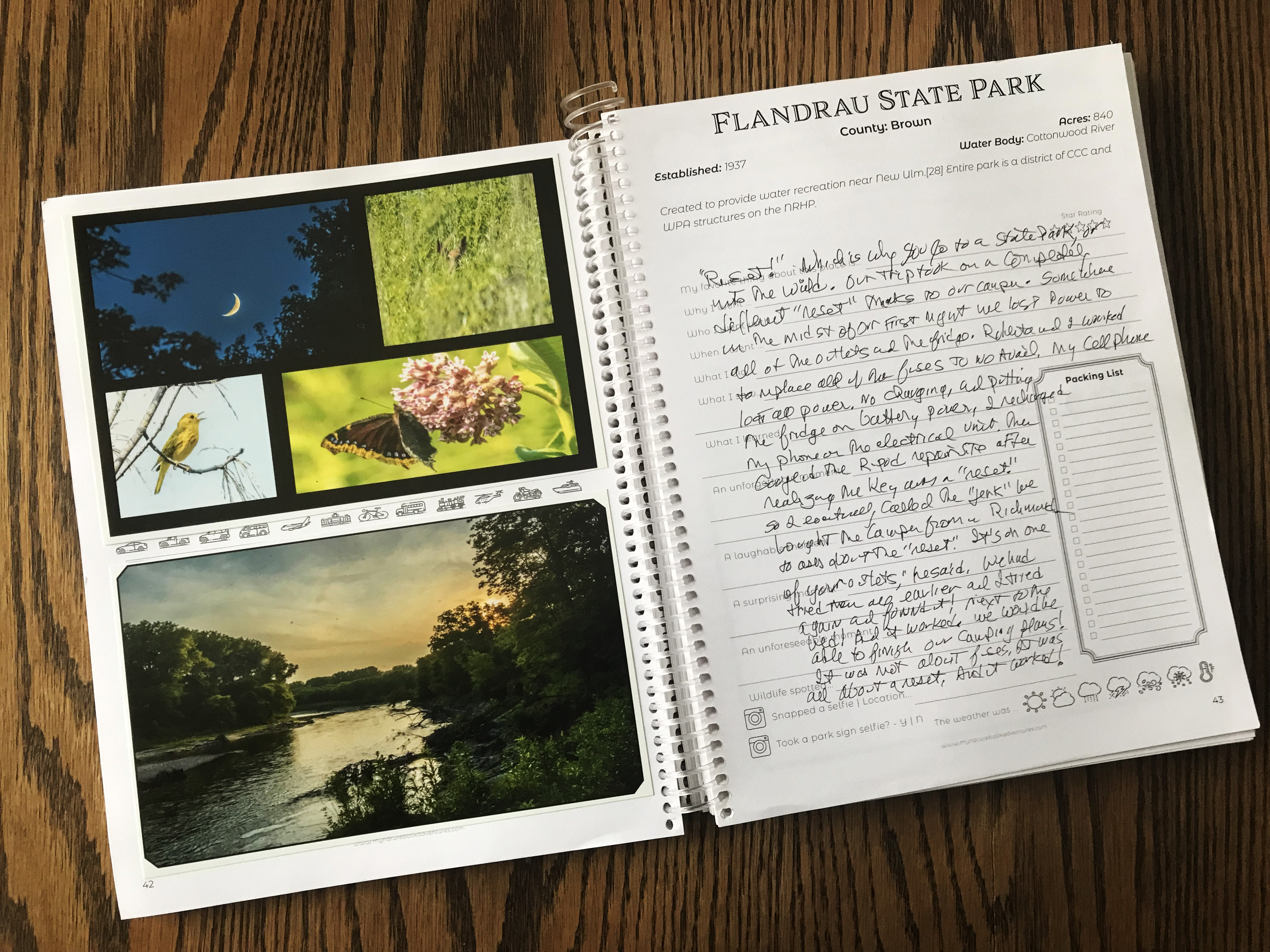
My personal quest is to complete this photographic journal of the 66 state parks in Minnesota, and so far 39 have been added to the journal.

I suppose making up some glorified murderous bear-like story might have been more entertaining and exciting, although I’ve never known of anyone being stalked, chased down and battered to death by dragonfly wings. I was simply doing what a photojournalistic nature photographer would do. I went for an ambient light foray with a camera, captured an image and was simply fortunate enough know the right Park Manager. Adding to that was being so fortunate that my image resonated with Veronica at Parks and Trails. 

This luck came two years after Parks and Trails shocked me by choosing three of my photographs in their annual photographic contest, two of which made their annual calendar.

Minnesota’s beautiful State Parks are quite important to me, and I’m now continuing my work on completing a photographic journal of each of the 66 parks along with my volunteering as a Minnesota Master Naturalist. To date I’ve visited 39 parks, although a few visits were before the photo-journaling began. So the adventures continue, this time with the knowledge that all those vehicles we’ll now pass in the State Parks will have displayed on the passenger-side corner of their windshields a dragon fly silhouetted on a stem of big bluestem in Sophia’s rainbow sky. I couldn’t be more pleased.
Pinfeathers & Needles

I’ve been watching with great concern the outbreak of H5N2 Highly Pathogenic Avian Influenza in Minnesota turkey confinements. As of yesterday, seven facilities in five counties have been affected, including in Lac Qui Parle County, which borders Big Stone, where we live.

I raise what the MN Dept. of Agriculture refers to as a “backyard flock” of free range laying hens, whose eggs I market at our local food co-op. While it’s only a couple dozen hens (and a couple of roosters), twenty-five more hens are in the brooder growing into their role on the farm. The broilers will arrive at the end of the month, and we’re trying a few turkeys this year, too. The demand for my farm-fresh eggs has grown since I started selling them last summer, so I am expanding my flock to accommodate that market. The meatbirds are for our own consumption, but we’re considering exploring that market as well.

However, we also live within three miles of a turkey confinement facility, and since I heard about the H5N2 outbreak and 6-mile “control area” for all poultry flocks (not just turkeys–though they are most susceptible) in Lac Qui Parle County, I’ve been on pins and needles. What if my birds get sick? What if there’s an outbreak down the road?

From what I understand, if a flock gets infected, it gets slaughtered. Being in the control area near an outbreak area means testing of the birds and a quarantine on them and their products for at least a couple of weeks. It wouldn’t be the end of the world if we had to figure out what to do with all our eggs for a few weeks, but the collective effect on producers and markets in affected areas could be a lot bigger.

USDA-APHIS recommendations on biosecurity precautions for cage-free poultry include “Identifying high risk areas that include wetlands along migratory flyways or other areas where wild waterfowl or shorebirds congregate” and “implementing preventive measures for these high-risk areas [including] keeping birds indoors or restricting outside open access by maintaining outdoor enclosures covered with solid roofs and wire mesh or netted sides.”

We live in the Mississippi flyway in the prairie and pothole biome, which is one of the biggest waterfowl migration and production areas in the country. In the past month, thousands of geese and ducks have passed over our farm, and over the region as a whole. According to the recommendations, poultry in our area should simply not be allowed access to the outdoors–or if they are, they should be fully enclosed–basically, confined.

Except the worst outbreaks of this disease in our region have not been in free-range poultry; they’ve been in large scale confined flocks that have implemented the above protective measures. Three large scale turkey barns in Stearns County have tested positive, but so far none of the approximately eighty backyard flocks in the control area around those confinements have shown signs of H5N2. Thirteen backyard flocks in the control area of the affected Lac Qui Parle County turkey operation were tested and found disease free. The thirty backyard flocks tested in Pope County were released from quarantine as well.

In this morning’s Star Tribune, Mike Hughlett closed an article about the latest outbreaks in Kandiyohi and Stearns Counties with this quote:

Curiously, back-yard turkey flocks in Minnesota haven’t been hit hard by the disease so far. “They are at greater risk,” a puzzled [DNR Wildlife Health Supervisor Michelle] Carstensen said. Unlike commercial birds, they don’t spend their whole lives in barns and are more exposed to wild bird droppings.

With my fingers crossed for the health of my, and my neighbors’ flocks, I want to suggest that maybe non-confined birds are in a better position to avoid or overcome illness because unlike commercial birds, they don’t spend their whole lives in barns. They have shelter, but they also get outside, they get fresh air and exercise, and they get exposed to beneficial (and also not-so-beneficial) microbes that help them develop a healthy immune system. They are not crammed into a “disinfected” space with several thousand birds of the same breed, waiting for a pathogen to sneak (or get tracked) through biosecurity and wipe them all out.

We live on a major migratory waterfowl route, and that isn’t going to change. Neither is the problem of human error and breaches in biosecurity.  Avian influenza outbreaks will keep coming with the migrations–are we going to slaughter and quarantine hundreds of thousands of birds every spring? What about the fall migration? What is the cost to taxpayers, affected producers, and markets?

Instead of racing to plug gaps in the existing system, maybe it’s time to question the system itself. Raising thousands of birds (or cows, or hogs) in a confined space may be considered “efficient” in some circles, but it results in a high stress environment that sets out the welcome mat for disease, as well as concentrating waste in a way that pollutes rather than enriches.

Meanwhile, the market for free range and heritage breed turkey and poultry products continues to grow, as more consumers turn away from Broad Breasted Whites produced in a building alongside twenty thousand of their “closest” friends. What if, instead of being the state that produces the most turkeys, we became the state that produced the best?

What if, instead of cramming more turkeys into bigger barns, we tried having more farmers on the land to raise them?


Hope in the Water Wars

Rarely do I come home from an agricultural conference feeling as if much good has come of it since there seems to be so much negativity involved with the overwhelming crush of monoculture intent. Last winter it seemed it was all about pollinators and Bt-flavored GMOs. The year before there was a whole round of climate change fears starting with presentations by Will Steger and continuing on into last spring when a University of Minnesota forestry professor forewarned us about deciduous understory growth that is already supplanting what we know as the great North Woods. So it goes.

This year water has come to the topic table. The corporate buy up of water rights by Nestle in California, or fears that Los Angeles and southern California and even San Paulo in Brazil, two of the world’s largest human residencies, will be out of water by October. Here in Minnesota we fear for what the mining of fracking sand for the oil fields will do to our underground aquifers, and to be truthful, what horrific pollution is being caused when those same sands are pumped into the oil fields to contaminate underground water sources in many parts of the North American continent. Now there is talk of a huge, undeveloped tar sand oil field in northern Mexico … meaning we can expect even more contamination of water resources.

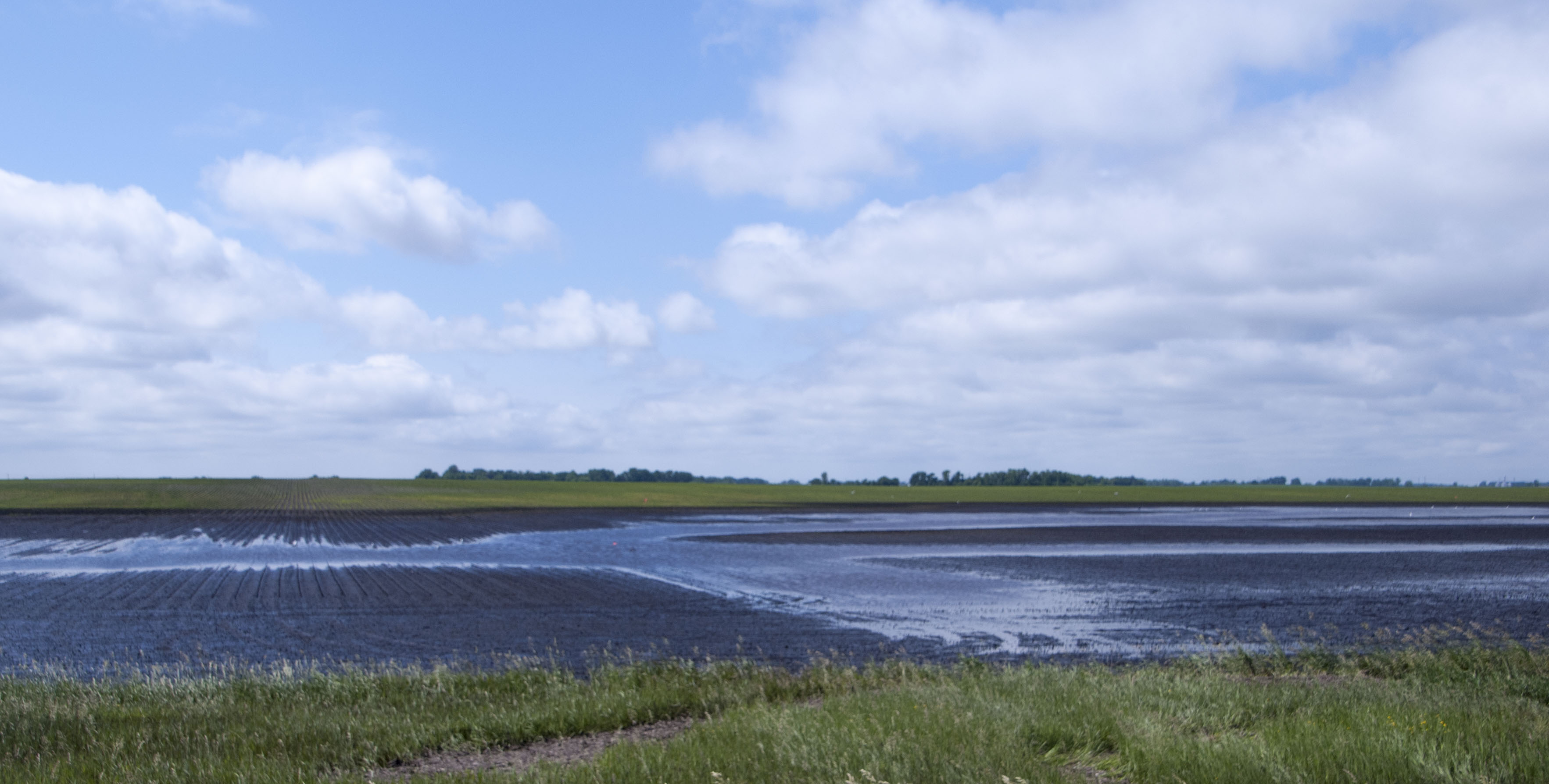
Though temporarily fill, drained wetlands like this one no longer allows for a recharging of the prairie aquifers.

Though temporarily fill, drained wetlands like this one no longer allows for a recharging of the prairie aquifers.

At the conference we were told of how those water friendly tensiometers that measure crop moisture stresses under center pivot systems in the High Plains began beeping like Vegas jackpot machines last summer … for all the wrong reasons. It seems the evapotranspiration rate was so high there that irrigating farmers actually shut off their pumping of water from the diminishing Ogallala Aquifer because the cost of “keeping up” was simply too expensive.

We have our own water issues right outside our windows here on the former prairie. Yes, our farmers continue to add more efficient, pattern-tiled drainage to better flush excess spring melt and early season rainfall from their fields and into the prairie rivers. But wait. Global climate change has also introduced a rather recent trend of choking droughts following the initial spring moisture feed, often around Independence Day. Meaning that in a given year a crop producer can experience both the drowning of a crop due to incredibly high moisture levels and a crop-starving drought in the same field in the same year.

Climatologist Mark Seeley said changing climatic conditions such as high spring moisture coupled with mid-summer through fall droughts will change farming cultural practices.

Climatologist Mark Seeley said changing climatic conditions such as high spring moisture coupled with mid-summer through fall droughts will change farming cultural practices.

So those drainers who can’t wait to flush excess rainwater downriver from their cropland are now tapping into groundwater and adding center pivot irrigation rigs on those same fields to sustain commodity crops like corn, soybeans and potatoes. Groundwater that’s not being recharged at anything close to its historic rate due to wetland removal and tile drainage systems. Remember, it’s a rare instance when any of the drained water is stored, and repeated efforts of attempting to have those who are installing patterned tile upgrades with water table management devices have gone unheeded. While this drainage/irrigation situation is perplexing, it is also becoming ever more common. Indeed, since the conference a friend told of receiving a letter asking permission for the wells on his rural home site to be monitored because an outside investor has purchased a farm within a two mile radius and has sunk an irrigation well onto the property for a center pivot.

“I don’t want my well monitored,” said my friend. “I just want my water.”

Are you wondering about that “feel good” yet? Yes, it has to do with water and farming.

Jerry Hatfield, director of the USDA/ARS National Laboratory for Agriculture and the Environment, discussed the changing seasonality and intensities of precipitation, and suggested the time might be right for new cropping mixtures.

Jerry Hatfield, director of the USDA/ARS National Laboratory for Agriculture and the Environment, discussed the changing seasonality and intensities of precipitation, and suggested the time might be right for new cropping mixtures.

It happened during the recent Farmers Lead the Way conference held at the Southwestern Minnesota Research Station to explore innovative ag practices designed to adapt to the changing climate and weather conditions. I had been invited to hang my Art of Erosion show during the conference, and was invited to participate as well. In the morning speakers like Mark Seeley talked about the effects of climate change on cropping patterns, then after lunch several breakout sessions were held around the large conference room. That is where I heard Grant Breitkreutz, a Redwood, MN, farmer, talk about, of all things, cover crops.

We have both been interested in cover crops for specific reasons, Rebecca with her work with the Land Stewardship Project, and us both with how cover crops might reduce “snirt” problems that are increasingly severe and heightened by a climatic change of reduced snow cover many farmers have failed to address with crop cultural practices. Breitkreutz has, and offered some rather unexpected benefits by doing so. Ironically and by coincidence, he began toying with cover crops about the same time new drainage tiles were installed on his farm … both about a decade ago. He uses a tractor-bourne seeder, or an aerial seeder if it’s too wet, to interseed a mixture of legumes, rye grass and vegetable root crops like radishes and turnips into his row crops of corn and soybeans.

Combining the arts, including my Art of Erosion canvases, with science was an effective and interesting way of handling a touchy subject matter.

Combining the arts, including my Art of Erosion canvases, with science was an effective and interesting way of handling a touchy subject matter.

“Once we figured out what we were doing, our tiles have been dry. Meanwhile, we’re actually rebuilding our soil. Running a no-till planter through our fields is like planting into a garden,” he explained. His soils have come alive and have water holding capacity while reducing crop inputs. All without diminishing yields, and perhaps as importantly, without added machinery costs. Consequently, his soils are not blowing nor is he needing irrigation because of the increased carrying capacity of soil moisture due to the deep rooting action of his cover crop mix.

“My neighbors initially thought we were nuts. Now they’re driving into the yard asking us what we’re doing. I don’t have time to teach them all, which is why I do these meetings. Cover crops have been a total win-win for our farm,” he said.

It is always refreshing to hear a positive story, and especially one coming in the face of so many destructive resource management practices. Cover crops are likely not a panacea for every ill-conceived production practice, yet they certainly should give pause to those who have seen those telltale dirt dunes along the roadways … and perhaps even for those who are thinking of sinking hard earned cash into an irrigation rig and deep well. We can only hope.

Taking Care

We’re enduring another big blow today–temperatures predictably plunging after a brief hiatus in the 20s and 30s, this time an inch or two of snow, and then the wind begins again in earnest and the world beyond the grove-edge disappears.

photo(1)

I was lazy this morning in a way I don’t often allow myself to be. Of course I let the dog out and fed her, made coffee and turned on the light in the chicken coop.  But, the newest issue of The Sun magazine came yesterday, and after fixing the floor lamp above one corner of the couch, I sat down and devoured it until almost noon.

John asked me to make a quiche, and he sautéed the bacon-and-onion filling while I mixed, chilled, and blind-baked crust, then filled it and baked it again. He kept thinking it was ready before it was, and then just as he had given up thinking about it, I brought him a plate with a warm slice.

Quiche isn’t hard. Soufflé isn’t hard, either, but I think we get hung up on anything French as being difficult or fussy or not right if it isn’t perfect. My quiche isn’t perfect, but I like eating it anyway (and thankfully, so does John). There are a series of steps, but they are enjoyable to break up a snow-bound morning at home. The most laborious thing is the crust; but it isn’t difficult when you aren’t trying to be perfect about it. Flour, lard, salt, water. Cutting, chilling, rolling, patching. If I thought my requirement was to make a perfect crust, I wouldn’t bother making it, and if I didn’t make it, I wouldn’t get incrementally closer to a perfect crust each time.

This issue of The Sun was thought-provoking as always, and also disturbing as some issues can be. The disquiet came from one story wherein the narrator describes a character injecting herself with Ritalin. I am incapable of thinking about syringes without a weak-jointed shudder, and I kept looking away from the page as if I were looking away from the actual scene of an injection–then returning as if it were my sole responsibility to follow through on a patient’s care and bring the story to its conclusion.

I admire nurses greatly for their capacity to do this kind of work–and maybe more so for the fact that I would be utterly incapable of it (though with a sterilized sewing needle I can extract almost any sliver).

************************************************************

In the latest Northern Star, our local paper, there is a front page above-the-fold story written by a nurse and community member, Maria Botker, about her family’s quest for treatment for their youngest daughter, Greta. Greta suffers from a severe and difficult-to-manage form of epilepsy, and Maria and Greta have moved to Colorado to seek treatment with a specific form of medical marijuana, which is legal in that state. The story was heart-felt and hopeful–Greta’s seizures have been reduced!–but their family remains separated because the drug laws in Minnesota forbid the use of marijuana as medicine, and Maria’s husband Mark and two eldest daughters remain here on the farm and in their familiar school district.

It’s interesting how relationships can change one’s perspective on an issue, isn’t it? The last thing I expected to see in my tiny, socially conservative western Minnesota community was an article by a well-respected community member asking people to think about legalizing medical marijuana. But, policy becomes personal when it affects a well-known and liked family, and when neighbors are asked to consider, “what would you do?” Of course, you would do everything you could to take care of your child, and no one wants to see families split up.

When the story is personal, it’s hard to think of as a “strategy,” but it is. The policy needs changing, and it’s the personal stories–especially about people you know–that help you relate, and perhaps reconsider your position. It may be a difficult issue, but in the end it often comes down to our values–help for those who suffer, and loving our neighbor. I applaud Maria for sharing it, and the Northern Star for featuring it prominently in their paper.

BTW, there’s also a story in today’s Star Tribune about the issue, and it features the Botker’s story as well. You can read it here.

******************************************************

This lazy Sunday feels like a gift after having threaded the needle in my travels of late–between blizzards and Polar Vortex sequels I managed to attend a media workshop in Minneapolis and travel the opposite direction to the Northern Plains Sustainable Agriculture Society’s winter conference in Aberdeen, South Dakota. I’ll admit I left before the last session (and supper!) yesterday afternoon, after becoming sufficiently spooked by weather forecasts and the anticipated route through Summit and the Coteau des Prairies on U.S. Highway 12. Viewed on a topographical map, it might be barely noticeable to those used to mountain vistas, but conditions are often several shades worse up there than anywhere else. I’ve driven out of a clear blue sky Minnesota River Valley up into sleet, high winds, and dense fogs near Summit that helped it earn its local nickname: The Bermuda Triangle of South Dakota.

However, the idea of an entirely carefree day evaporated early this afternoon, when I discovered Alice, the feral cat-who-thinks-she’s-a-chicken, lying prone between the basement windows. She’d been sheltering there off and on through the bad weather, but she’d disappeared for a close to a week, so I was watching for her return. Alice is usually very alert about anyone approaching–even growling between mouthfuls when I bring her food, so I was alarmed to see her unresponsive.

I ran inside to get her a plate of soft food and chicken broth, and as I got closer, she didn’t budge. I touched, then jiggled her–nothing. I dragged her out by the towel she lay on–the grimace of death was on her face–eyes wide and unseeing, tongue protruding between her teeth. After coming inside and having a good cry, I pulled together a couple of plastic bags to store her body in ’til the ground thaws in spring. Pulling her out of the window well with plastic bag in hand, she let out a small moan, and the very tip of her tail twitched. She was limp, not stiff. And she was alive–though just barely.

I ran inside, laying her on the mudroom’s boot mat, then frantically gathered cat carrier, blanket, and heating pad. She’s now residing temporarily in the downstairs bathroom, where I am checking on her every half hour or so. With a wide syringe (for oral medication, not injections), I tried to give her a little chicken broth, and I think at least some of it went down her throat instead of my sleeve. I’ll try to give her a little more before our supper, and again before bed. She’s still limp, but breathing. Her bowels have evacuated, her eyes stare at death, and her tongue lolls.

Despite our agreed-upon prohibitions against any more inside cats, Alice–on the seemingly unlikely chance she survives–will be granted a reprieve from “outsider” status to regain her strength away from the icy winds and stinging snow.

Meanwhile, we wonder when our reprieve will come–when the white-outs will subside, when we can break through the still-mounting drifts, and step into a warm and spring-heralding sunshine.

[Update 1/27: Alice passed away yesterday evening. She will be buried on our farm in spring.]

Alice, circa 2008, with one of her kittens. Photo credit, Joanne Svendsen.

Alice, circa 2008, with one of her kittens. Photo credit, Joanne Svendsen.