Source: Ah, Autumn!
Ah, Autumn!
Reply
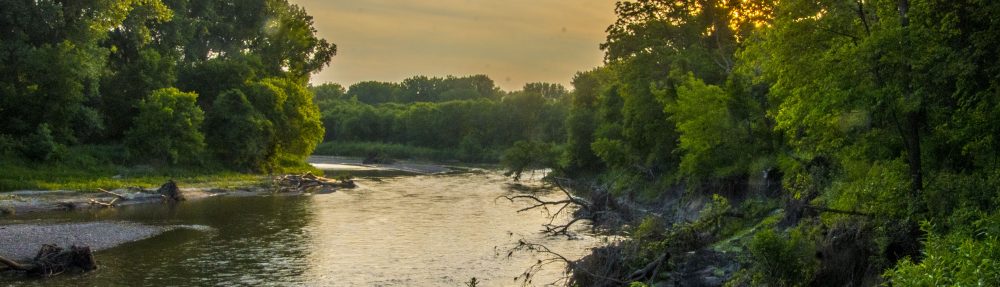
Source: Ah, Autumn!
Walking into the kitchen after a road trip to pick up pork at Pastures of Plenty for our local Granary Food Co-op reminded me of another prime reason for loving this time of year. Rebecca’s roaster of tomatoes and other vegetables were simmering down to make her signature Smoked Eggplant Tomato Sauce. So intoxicating! So autumn!

Sumac shines in the early morning sun just down the road, one of the sure signs of autumn..
Actually, just smoking the eggplant felt autumn-y in itself … although a couple of racks of ribs might have been even more appealing if not satisfying, with that curling scent of bluish apple wood smoke drifting away from the chimney. We are seasonal eaters, with exception of what we don’t can or freeze, so apple wood has become a staple. As have apples, the prime fall fruit along the wooded river hills around here. Cider. Apple sauce. Apple butter. Pork simmering in a curry with tart apple chunks. Ah, the joys of autumn!
Driving up the Lake Road this afternoon offered numerous signs of the changing of the season. Even in our yard, which isn’t all that close to water, the leaves are losing their chlorophyll, meaning of course, their greenness. We are a few weeks from the peak, yet when I sat on our listening bench in the loop of our grove last Saturday a constant sprinkle of crinkly leaves rained down around me. Although we are hundreds of miles from real woods, there was the smell of a fall even in the grove timber. A crispness. A crinkling, dry feeling. With sunlight filtering down through the canopy. Then, unexpectedly, a wren … small, nervously alert, and beautifully brown, like those dried leaves … flitted onto a nearby branch. Ah, autumn.
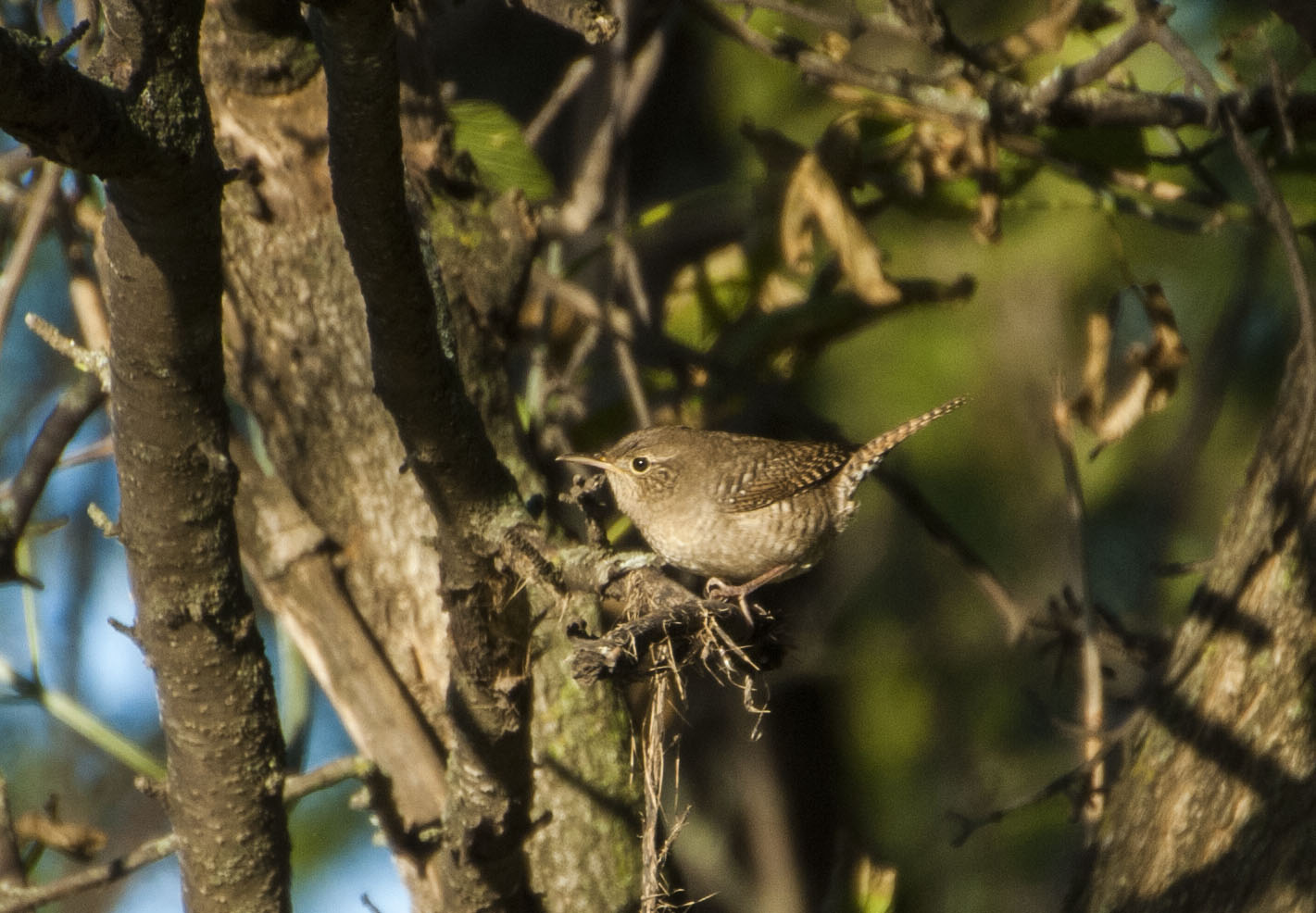
The little wren popped up amidst the sprinkling of leaves in the grove.
On the prairies around us big bluestem and Indian grass are browning, and those clubbish, naked seed heads of cone flowers defy the prairie winds that give the grasses their freedom of beauty. Golden rod is starkly peeking through the brown. You will likely not find a better time to stroll through a grassy prairie, wading through this dance of autumn as a staunch breeze batters you from the side. I wish I could hear better, to perhaps hear the subtle rustle of the blowing grasses.

Cone flower seed heads stand out from the browning prairie grasses.
Just above the grasses you’ll still see a few dragonflies, although those sweeping, acrobatic swallows have departed. Last year their leaving was much more dramatic. I had been working in my wood shop, which is in the former goat barn of the previous owners, and the swallows had been after me all morning. Buzzing in and out, sometimes swooping within inches of me above the saws and the router in their daring-do. That afternoon the barn was abnormally and noticeably quiet before the sudden realization that the swallows were gone. In a heartbeat, perhaps, the signal had passed among them that it was time to go. To migrate, that great innate passage and mystery science is still trying to unlock.

Golden Rod peeking through the big bluestem on a recent pre-dawn morning.
This fall, though, they flew away without so much as a morning of pronouncement! Just disappeared as abruptly and mysteriously as they so suddenly appeared back on that warm, May afternoon. So, no, the swallows are no more, and the few insects out over the prairie grasses are being seized by those dwindling squadrons of dragonflies.
One early morning this week we both stepped onto the deck off our kitchen with our tea and coffee to an almost eerie hum. It was loud enough that we were sort of looking at one another in question when a sudden “swoosh” erupted from the grove as a murmeration of blackbirds rose in unison from the treetops. Hundreds. Perhaps a thousand. You can’t count a murmeration. Last fall I had posted a picture of a nearby rise of the blackbirds from an oak savanna down the road and an old friend wrote, “I’m so glad you now live out here and can see these things.” Of course, she was right. In talking with people my age who grew up before that last great ditching and tiling of the prairie pothole region in the 1960s, back when there were enough prairie potholes of significance, they reminiscence of murmerations so thick of birds that the sky was blocked by a canopy bird blackness. I’m not the only photographer who has recorded a ribbon of murmeration blackness, and certainly not the only one who can wish for experiencing such a moment from the past … one that will likely never be no more, one mankind has erased from the earth forever.
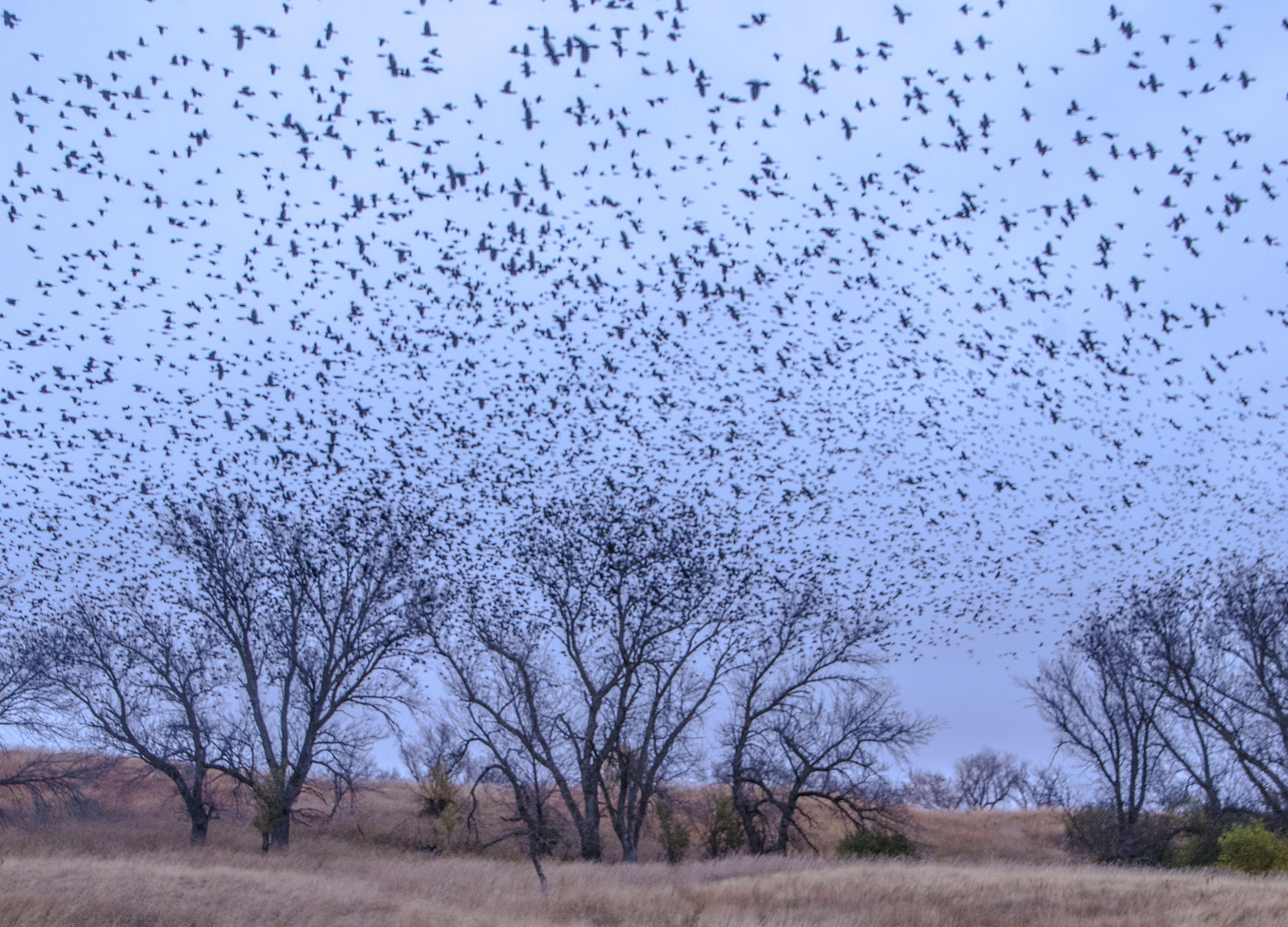
Thousands of blackbirds rise from the trees … a murmeration.
Although our neighboring farmers with the pothole wetlands planted corn this year, which now block our views of those wetlands, we can still hear the geese as they begin to gather. A month from now along with the dust of harvest the skies will be full of the sounds and skeins of geese as they seek recently harvested fields to gorge their gizzards before the last long flight of the year. Ah, autumn!
Moments ago we took our nightly mugs of wine out on the deck, and witnessed a small murmeration, the skittish flight of a few dragonflies, the distant honking of geese, and still another sign of the approaching autumn … a distinct chill in the air. A fall wind. Autumn was all there for the taking, for the filling of the senses. Now is a time you begin the morning with a sweater, then work off the layers as the sun climbs in the sky. Cool mornings, balmy afternoons. We call this an Indian summer for some reason.
Our windows are open at night allowing the breezes to caress us with coolness. While it is still warm enough not to send chills down your arms and legs, you awake in the morning realizing that at sometime during the night you must have unconsciously reached down to pull up a quilt; that you had snuggled deep into the warmth of the bed and up against one another.
Ah, autumn!
Years ago I walked into the office of my little country weekly one morning after a trip to Boston to find laying across my organized chaos a long black tube. Instant curiosity got the best of me and I quickly unscrewed the cap to find a beautiful antique bamboo fishing rod complete with both tips.
“Where did this come from?” was my question for a co-worker.
“Some guy dropped it off. He said you’d know who it was from.”
So began a long mystery, for there wasn’t a clue. No note. “Some guy” isn’t a vivid description, even in Minnesota where vagueness has evolved into a cultural art form. Whoever the mystery man was he would have to know me well enough to know that I was a fly fisher and had an appreciation for such a work of art. Later in the afternoon, I took the fly rod from the case and rigged it up with a five-weight line and laid out some line. While my practiced, piston-like casting doesn’t lend itself well to bamboo, which performs so well with an easy and rhythmic motion, there was quality in the workmanship. This was a fine rod.

The bamboo …
Perhaps it was two years later while cooking hamburgers along the Minnesota River for CURE’s annual River History Weekend with Jerry Tilden, he lifted his spatula from the grill and said, “Say, did you ever find that package I left in your office?”
“Package?”
“Years ago my father-in-law owned a hardware store, and he had hung this old fly rod up over the fishing gear. When the store sold, Dixie and I brought it home and tacked it up in our house. It has been there ever since. When we decided to downsize and move, I brought it over and left it in your office,” he said, smiling.

A gracious and caring man, Jerry Tilden was diagnosed with cancer seven months ago.
Dixie is the missus, who I have known for years. Through her I met Jerry. As I was reading through his obituary this week I realized how little I knew about him, of all the civic groups and community boards he was not just a part of, but in all was cast in a leadership role. No, I didn’t know that side of Jerry Tilden. The side I knew was of his stepping forth as a constant volunteer. The side I knew was of his kindness and care. I also knew of his work as a Master Gardner, and of his basement dedicated to the propagation of his vast gardens along the Minnesota River in the Montevideo flood plain. To me it was ironic that a man who didn’t need a nursery had such a wide assortment of flowery gardens right next to one of the more notable nurseries in the river valley.
Yes, there were the burgers. We cooked them together for several years for the CURE event on a grill he transported himself from Bill’s Supermarket in Montevideo. Me? I mainly manned the grill. Jerry? He was multi-tasking, cooking burgers one second, then the next making sure the potato salad was in the right place, or running to assist his beautiful Dixie with some task. That was the Jerry Tilden I knew.
Then there was that Sunday morning when I received a frantic call from a nearby Chamber of Commerce woman who asked if we could quickly put together a canoe trip on the river, that there were three Hollywood actors in town who had expressed interest in doing a paddle. A call was put through to Dixie, who said the canoe trailers were set up and ready, to just come by for the key. Phone arrangements were then made and my “river truck” was aimed toward Montevideo. Dixie met me at the door with one of her beautiful and encompassing hugs, and handed me the keys. When I got to the garage under their Main Street office, there was a flat tire on the trailer.
“Dixie,” I said over the cell phone, “where can I get a flat tire fixed in Monte on a Sunday morning?”
She didn’t know, but said Jerry was on the way down to help. He drove up before I could ring off. Using a jack from my river truck, we easily removed the tire. “Let’s put it in the car,” he said. “I’ll see what I can do.”
“Should I come along?”
“Just stay here with the kids,” he said, because my two exchange students were along for the adventure. Meeting Hollywood actors obviously offered more excitement than homework. “I’ll be back as soon as I can.”

Pai, Hanna and the actors pose with Nicole Zemple … a trip made possible with Jerry Tilden’s switch job!
Indeed, it didn’t take him long. We positioned the tire and secured the lug nuts and let down the jack. That’s when I noticed the color of the wheel. It didn’t match the trailer, and it was obviously a different tire than we had taken off moments before. “The service station have a spare?” I asked.
Jerry Tilden smiled. “Nah, I just took it off my trailer. I’ll get the flat fixed tomorrow.”
That was the Jerry Tilden I knew. That’s the Jerry Tilden I’ll miss, the man I wish I had known better.
Life didn’t go as planned one morning this week.
Too much running around, along with a neat and new “art fair” in town in the afternoon, made for a rather inefficient day. Plus, Rebecca had a meeting about two hours from here and pulled in near dark, so getting the gear up and ready for our annual butchering the chickens “day” simply didn’t happen. Oh, we were up early and eager, then looked at one another and made an almost unspoken consensus before Rebecca verbalized an obvious truth, “I don’t think we’re ready, or can be ready, in time to get much done.”
A fine reprieve, for from the moment I rolled from bed I had my eye on our prairie, for we awoke to a dense fog. On one of our last beautifully dense fogs I had a meeting in Redwood Falls and cursed myself on the entire drive down. I love fog, although not driving through them. One of my favorite fogs in my lifetime was in the Sand Hills of Nebraska, a day when the rolling dunes of fenced grass became a dreamy landscape. I’ve long lost my boxes of Kodachrome slides, though I can recall many of the images. One in particular was of a white horse by a willow, both in front of a distant red barn just visible in the mist, all dreamily captured in muted and mellow grayness.
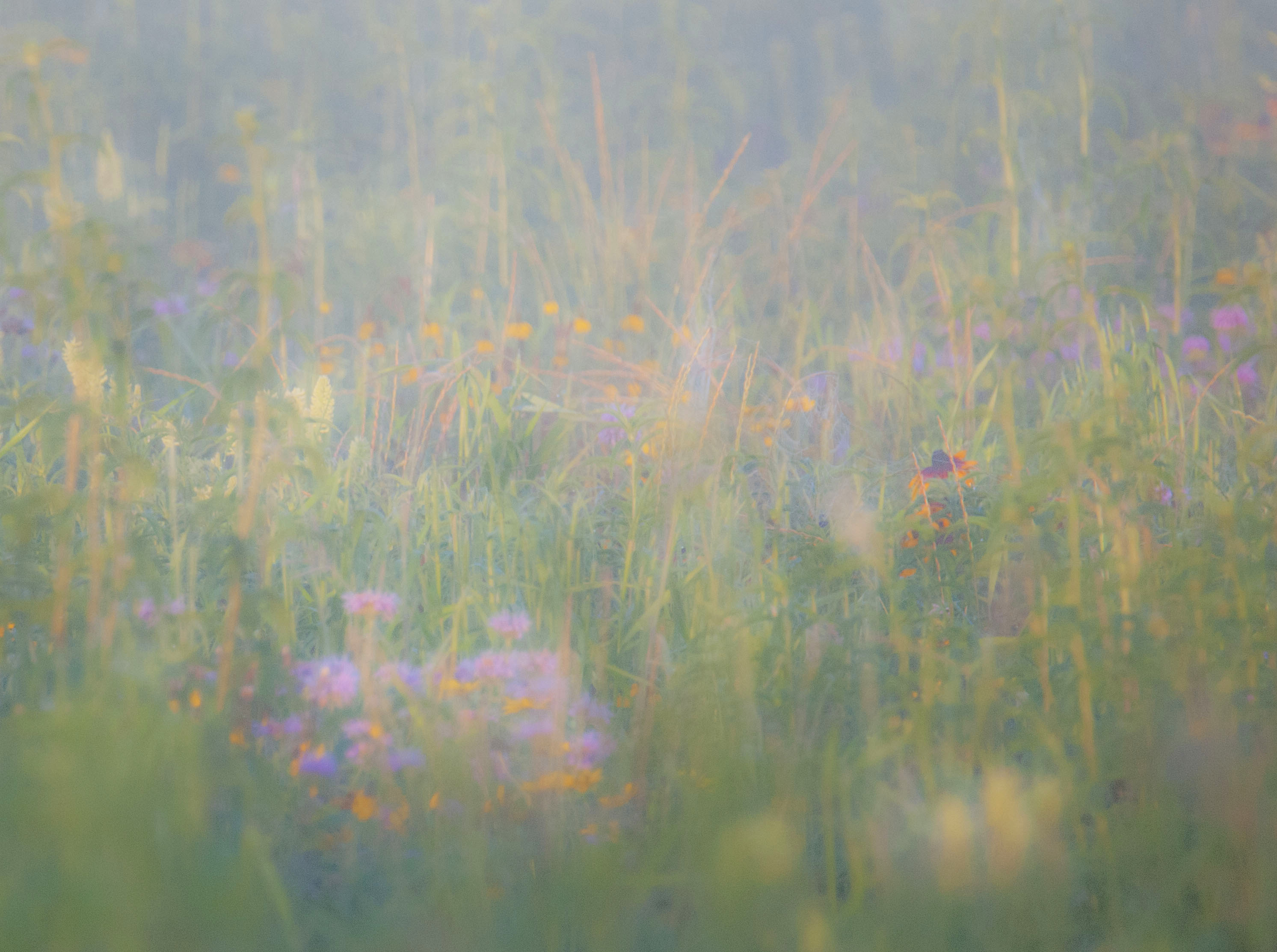
Yes, we have a richness of color in our prairie this time around.
By the time of our decision the sun had risen to give our prairie a glistening sheen. Partly from the remnant moisture from a brief shower from the night before, and party from a dense dew. With the scheduled pressure off, I took my camera to wade into the dampness where the grasses and forbs mostly towered over me. We have an amazing growth in our prairie.
We also have good color in our prairie this year. Last year we grew weary of the constant quilt of yellow. Oh there were occasional peeks of purple, and a persistent white prairie clover here and there, yet the dominant color was yellow.
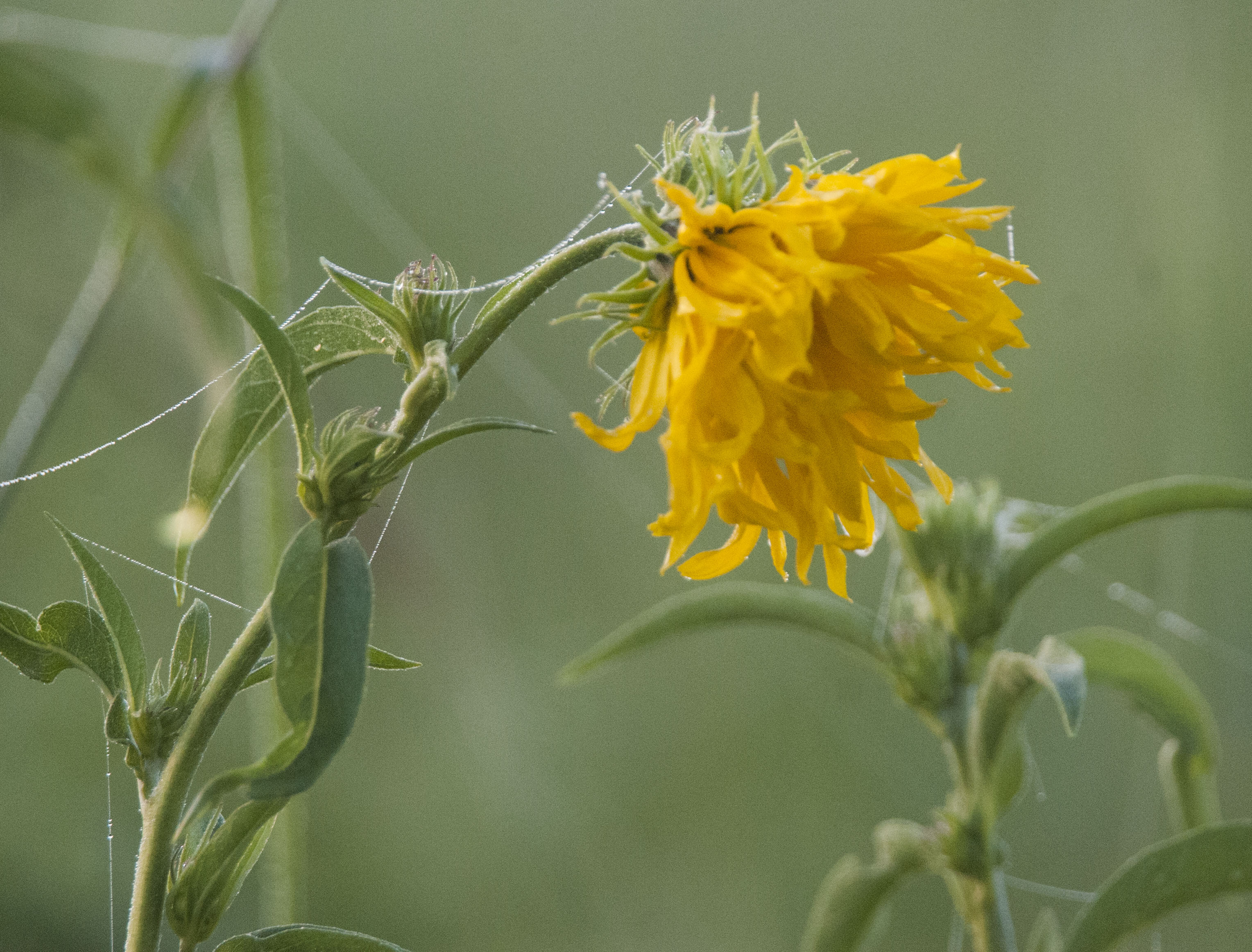
Our shy spiders were deft and creative.
This year, though, we have no complaints. Lavender bee balm pokes throughout, and so do many other colorful blossoms. While my focus has been on finding interesting individual plants, and in particular photogenic composition of parts of those plants, as well as the quality and color of light, these past few days my attention has been drawn to an overall colorful palate of our prairie.

The threading tied the prairie forbs together like a natural quilt.
This was where I was mentally on this morning when I began to notice the threading of our prairie. It all began innocently enough, for as I walked through the partially regrown path Rebecca had mowed through our grassy jungle I found gateway after gateway blocking my progress. I found that these creatively spun spider webs would collapse beautifully, opening just like a gate, if you pulled on a strand off to one side. This was no less amazing than the immense number of webs and threads spun throughout. Single strands were drawn between leaves of one plant to another, and in other places, more ingenious geometric forces were obviously at work. At one point I turned, and with the back light from the sun and the definition provided by the beads of dew, I realized I was literally surrounded by what must be millions of spiders, all hopeful of capturing an unaware gnat or mosquito.
While it is fun to watch the acrobatic flight of the many swallows we have flying over the prairie on any given summer evening, we were equally amazed one day late last summer when Rebecca noticed the thousands of dragonflies buzzing over the canopy of the prairie. Perhaps we should add those amazing spiders … all obviously much too shy to show themselves on this cool, damp summer morning.

Using the web strands in the composition was interesting and fun.
Continuing down the path, I kept making photos here and there of various flowers, and as I did I realized I simply couldn’t take a picture that didn’t include some spiderous threading somewhere in the image. So I began to play with the light and dew, using the threads as parts of the composition. A little further along I came upon two of those iconic full spun webs, which with the dew and the light from the rising sun, sparkled like a jeweled necklace awaiting the adorning of the neck and bosom of a fortunate maiden!
Later I climbed our septic mound for the height and shot a few frames I hoped would more clearly define the immensity of the threading and webbing I had discovered on my foray.
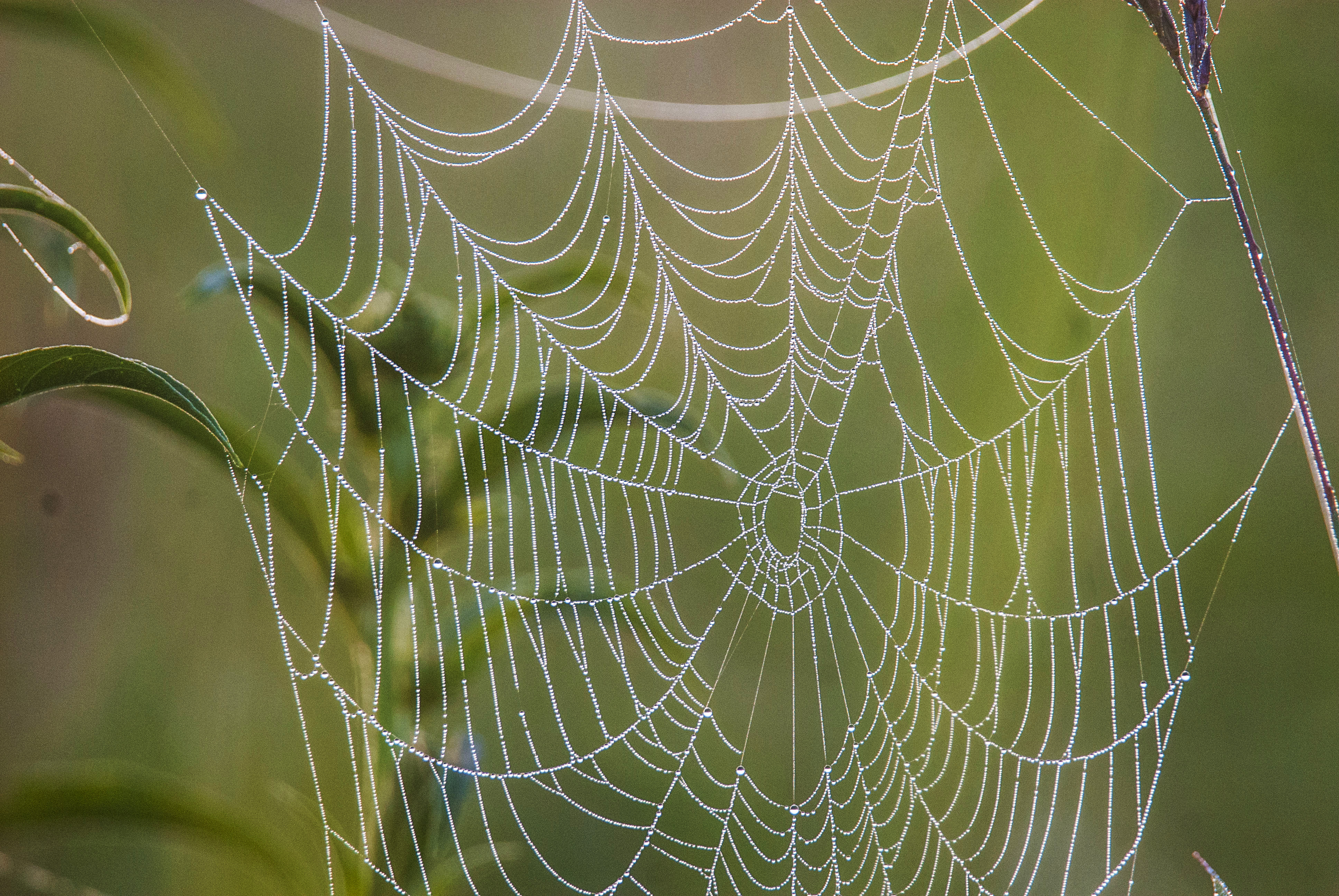
A multi-jeweled necklace awaiting the neck and bosom of a maiden …
When I came into the house, I suggested that I had learned how grassy prairies were held together over the eons. It wasn’t the bison herds, nor the vast jungle of rooting from the prairie grasses and forbs, nor the lightning fires refurbished those matted slopes. No, for it was plainly obvious the entire biome from the High Plains to the towering and forested Appalachian Mountains, from Saskatchewan flats to the piney hills of Texas, had been sewn together by an incredible group of shy Arachnids.
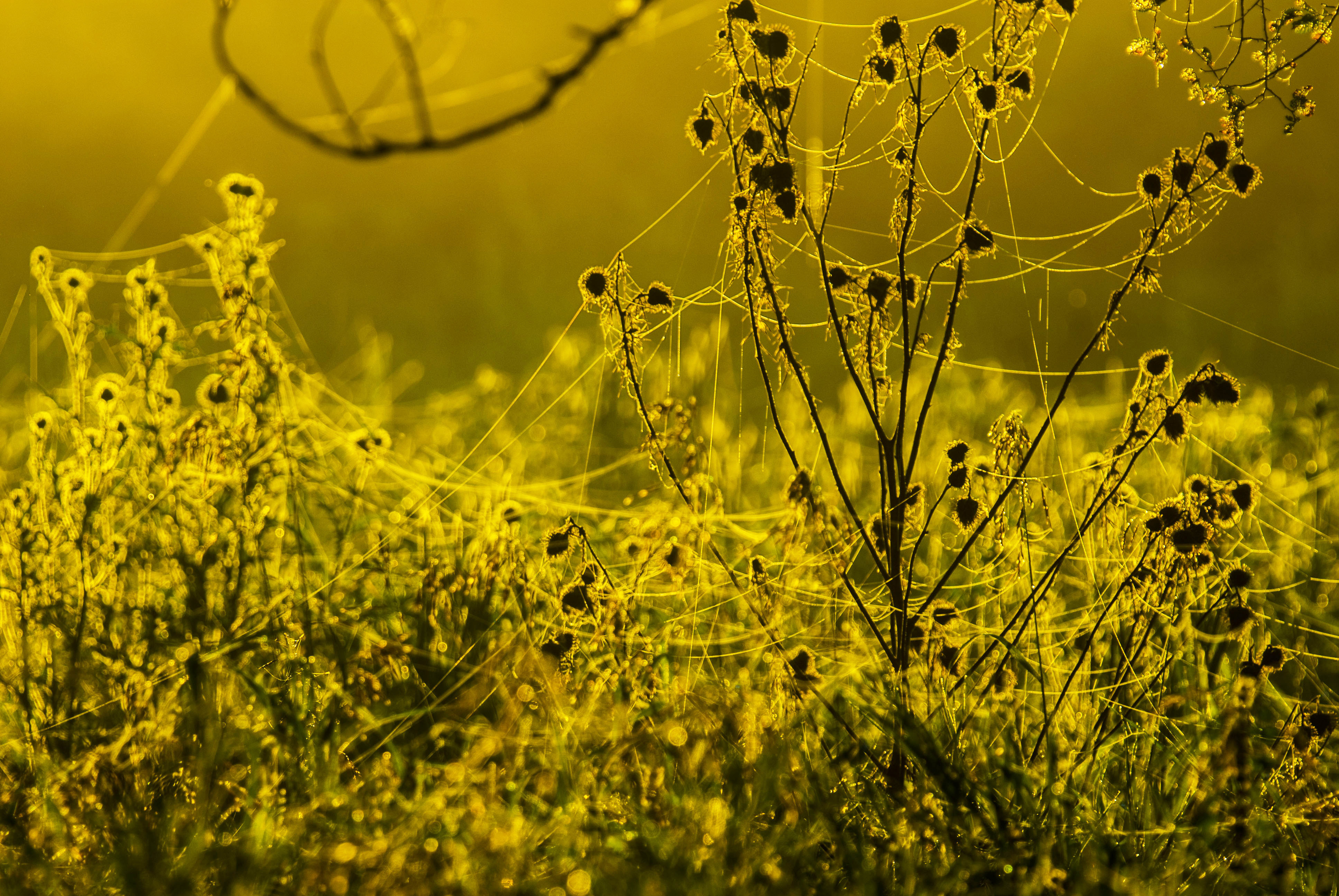
While this captures a small portion of our prairie, on this morning our entire eight acres seemed threaded together by the hard working spiders throughout!
Indeed, it had been my good fortune to have just witnessed the vast threading of the prairie, stitching together that vast quilt of grasses and native flowers beneath the deep, blue skies!
Moments like these give me cause to believe I may be a man of faith. So begins a writing that may see the light of day … since its being published depends on the beaming up of our internet. I’m happy to report that yesterday we were connected most of the day, which was the first time we’ve enjoyed a full day of service in what seems like weeks. “Months” might be more accurate, but I write as a man of forgiving faith.
Despite becoming on a first name basis with our designated service rep, Chad, we awake each morning wondering if life on our farm will reach beyond our small prairie. We are at the mercy apparently of a universe beyond our blue planet, as explained by Chad. Sun spots. And this: “If you can see the Northern Lights, forget the internet.” I haven’t seen them here on the farm, yet we still lack a worldly connection. So sun spots and Northern Lights are among the culprits. So, too, are tree limbs, rain and fog, and the other day, the talkative young man suggested we keep the modem out of the sunlight. We moved it from the top of the printer where we had anxiously monitored the status lights, which blink like a Dallas disco … all except for the little designated light of wonder, which barely and rarely comes to a full summer green.

Among the culprits of our outlandish internet issues is the sun … on the modem, spots out in the universe, and the cosmic rays producing Northern Lights!
Chad and I took a walk through the lawn that morning when he was here, and it was still early enough we collected a drenching dew on the toes of our boots. He studied the angle of the technological arrow protruding from the corner of our solarium and the distant tower, then eyed the tree line that had previously been deemed perfectly fine. “Leaves. Look at those leaves,” he said, pointing toward the tower. “I see interference.”
When the system was installed the sight-line was deemed as perfect. Back in the day he and another tech rep both considered the signal so strong they somehow toned it down, fearing perhaps that my iMac might explode from the overwhelming wealth of beamed, wireless data. A few weeks ago, on a rather frustrating Sunday morning just after returning from the BWCA … where the lack of technology was a blessing, I might add … the crisis line fellow took me through all sorts of technological guts to measure something he called “pings.” Making it simple for such a technological moron, he painted a picture for me of watering my garden when 53 percent of the water had leaked from the hose before reaching the nozzle. “I’ll make a report to the office,” he generously offered.
Apparently his report was lost in the email … provided the company’s crisis center uses its own internet service to communicate between their offices. Since I’m a man of faith, this seems a logical possibility … sans sun spots, the Aurora Borealis, errant tree branches, a non-shaded modem, or that our nearest neighbor a mile and a half to the south baking a cherry pie.
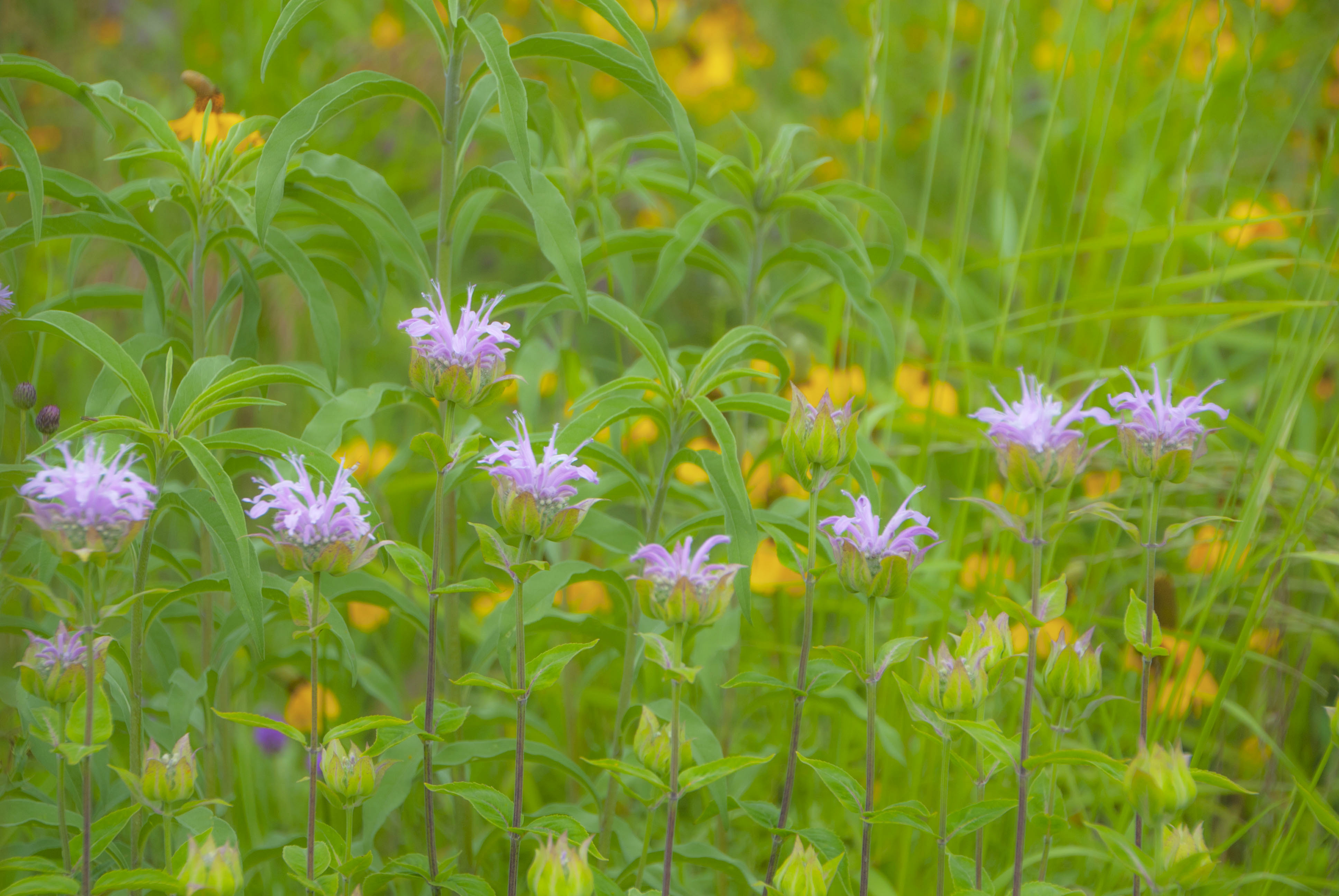
So far, the bee balm in the prairie have escaped scrutiny.
I told Chad I would saw off those wayward limbs from three of the trees. “Don’t do the evergreen,” he interrupted. “I love evergreens.”
Ash, elm and basswood must offer more interference than spruce, which pleases me, for like Chad, I also love evergreens.
Meanwhile we “limp” along with our “smart” phones. We could probably survive our social media addictions and email with the phones, although they’re a bugger when you’re trying to read the morning papers. Yes, I do subscribe to the papers, so when the internet isn’t up, those cyber dollars reek of a bad investment. Rebecca does the majority of her office work here on the farm, and how she can manage her anger so well is beyond my limited faith.
For me it seems I’m always doing some sort of research. For example, yesterday I spent a good portion of my day trying to repair our rider mower by making Google searches for such things as owner manuals, mechanical repair sites and You Tube repair videos. Time was also spent seeking information on making stainless steel table tops for Rebecca’s commercial kitchen, and in looking for greeting card stands and other ideas of photographic marketing. Every day seems to bring new ideas ripe for necessary research, and since I lived in a small Minnesota town with a state-of-the-art fiber optic internet system, perhaps I arrived here on our little spot of prairie hopelessly spoiled. Like most who lived in the drive-past berg, the town’s system was certainly taken for granted.

Yes, fog is suspected!
Indeed, when we bought and moved to our farm here in the Minnesota Bump we didn’t even think to inquire about internet services. While I can’t speak for Rebecca, my assumption was that the entire state was equally blessed with broadband speed. We both were given an abrupt wakeup call, and in our first full year here we tried three services before we found one that was functional. It was owned locally by a middle aged fellow with severe physical limitations due to his many falls from his towers, and who basically relied on his sweet mother for the business side. His last tumble was rather seriously disabling, and more than he could handle pain-wise, and he simply wrote a letter to his customers saying that by the end of whatever month it was, he was shutting the system down.
Who could have guessed that his service was the best of the rest. This time we did a more thorough search. It came down to one area phone co-op with a rock-solid reputation and the Dish Network. Since we could “bundle” with Dish, we went that way. Their system was installed on a Tuesday, with the technician patting the iconic gray disc with pride while telling us our internet issues were certainly a thing of the past. On Thursday, less than two days from his paternal patting, the router began blinking. On Friday the lights went out all together. Calls were made to the company. On Tuesday, exactly one week later, that tech still had not returned to take care of the problem, so we called again and canceled the service.
The next day we contacted the local co-op, which is actually a multi-county co-op, to sign up for their wireless service, since they had not hardwired this portion of the county. We celebrated that night with a fine wine and a delicious dinner. Our internet issues were supposedly behind us. Oh, how my faith has been tested since. We were advised that they were one of the rural internet services being considered for a huge broadband grant within the state, and amazingly, a year later they were chosen. After another delicious dinner with celebratory wine, we began our latest wait for connecting with the world beyond our plat lines.

In the BWCA, technology wasn’t even a thought.
Then a letter arrived from the co-op admitting that their wireless system was severely inadequate. They offered to lower our monthly fee against a blindfold allowance out of the three-year contract we had signed. With great adherence to faith, we stuck with them and have since become ever closer to dear, talkative Chad.
And, come each early morning as the sun rises above the bluestem, I’ll turn on the system to watch the blinking beacons of communication. I’ve still not seen the Northern Lights, so I comfort my soul by watching our modem blink instead. Chad excitedly says the hard wiring in our half of the county has begun, starting in a small town six miles northeast of our farm. Instead of heading this way, however, the crews are spider-webbing across the former prairie toward the northwest — that top half of the Bump.
“You’ll get it,” he promises. “It might be late next summer or fall, and certainly by the following spring of ‘17. Once you have it, it’ll be beautiful.”
So, if you happen to have seen this writing, realize that for one blessed moment that single status light was beaming bright and beautifully green. And, that my friends, is the essence of my faith … a single tiny green light about the circumference of the cross section of a broken-in-half round toothpick.
Later this week I’ll saw off those errant limbs before kneeling on the prayer rug.
A few weeks ago a friend wondered why patches of established prairie were set ablaze each spring. She worried about the birds and animals, and hinted this seemed such a waste of time and energy. Her question came shortly after she had attended an Earth Day Celebration at Prairie Woods Environmental Learning Center where visitors were greeted with an amply charred hillside as they turned into the facility.
Yes, it could have been considered ugly … unless you had an understanding of the process and reasoning.

A controlled burn a few years ago on a Renville area prairie lit the night sky.
Thankfully I have many who have helped me with both, beginning with Audrey Arner and Kylene Olson. Several years ago, just as I was in the early stages of gaining an appreciation for this last one percent of native grassland, Arner hosted a prairie walk on her Moonstone Farm in early July on a small patch of prairie that had been torched just a few months earlier. We rode a hay wagon from the house to this nearby field that was lush with growth. This wasn’t a “tired” prairie. Thick prairie grasses provided ample carpet and support for the prairie forbs popping out all over. A common question among we visitors was, “You really burned this land this spring?” As the group waded through the greenery, Olson, executive director of the Chippewa River Watershed Project and a prairie plant specialist, provided identifications of various grasses and flowers, and she gave us all an education on the beauty of and the aftereffects of the burn. At one point a rare butterfly appeared, fluttering through to land on bright orange blossoms peeking through the greenery.
Few of us recognized the butterfly, or even knew it of its endangerment, which like the formerly ever present prairie chicken, is due to the loss of prairie habitat. Yet the reaction of Olson and Arner in seeing it flutter from flower to flower was just as intriguing as it was exciting. Indeed, the entire experience was enlightening, as if an entirely new world had opened up. Well, in fact, it had.

Reminiscent of the ancient Peruvian Nazca “air strips” are the game trails revealed on this recently burnt prairie.
Among the others who have helped with this journey of education were Tom Kalahar, now retired from the Renville County SWCD; Kurt Arner, Audrey’s brother and a long time fire crew member; and Dennis Pederson, who for years headed burning crews for Pheasants Forever in the Upper Minnesota River watershed. This journey of discovery basically coincided with the beginning of the Conservation Reserve Enhancement Program (CREP) that restored a few thousand acres of prairies and wetlands to the former prairie pothole biome. Kalahar was instrumental in evolving that program in Renville County, and would switch over to “personal time” as a frequent prairie fire crew member. The three kindly called to tell me of a planned fire, and Pederson and Kalahar, in particular, spent much quality time in explaining the cautions taken and the reasoning behind the timing.
Wind speed and direction, location, optimal burning conditions, and nesting seasons were all key in their burning decisions. If conditions were wrong, a burn was called off. As for the animals that make a particular prairie their home, there is ample time for escape to safer pastures and nearby groves.
Burning a prairie is all about the soil and the native prairie plants. A prairie is often described as an upside down forest due to extensive root systems which not only anchor the plants in the soil, but also creates an entire soil-based ecological environment and allows for the storage of often limited water resources. Those same roots allow the plants to withstand the intense heat of a searing prairie fire. Since prescribed burns typically are planned in the spring, the brown duff and leafy matter are dead and useless to the plant. Before Euro-American settlement, when tillage, ditching and later, drainage tile, converted the vast millions of acres of natural grasslands to fields for commodity crop farming, prairie fires were mostly a natural consequence of nature. Lightning set most of the fires, although fires were also set by Native Americans to refurbish a prairie to attract wandering herds of buffalo.
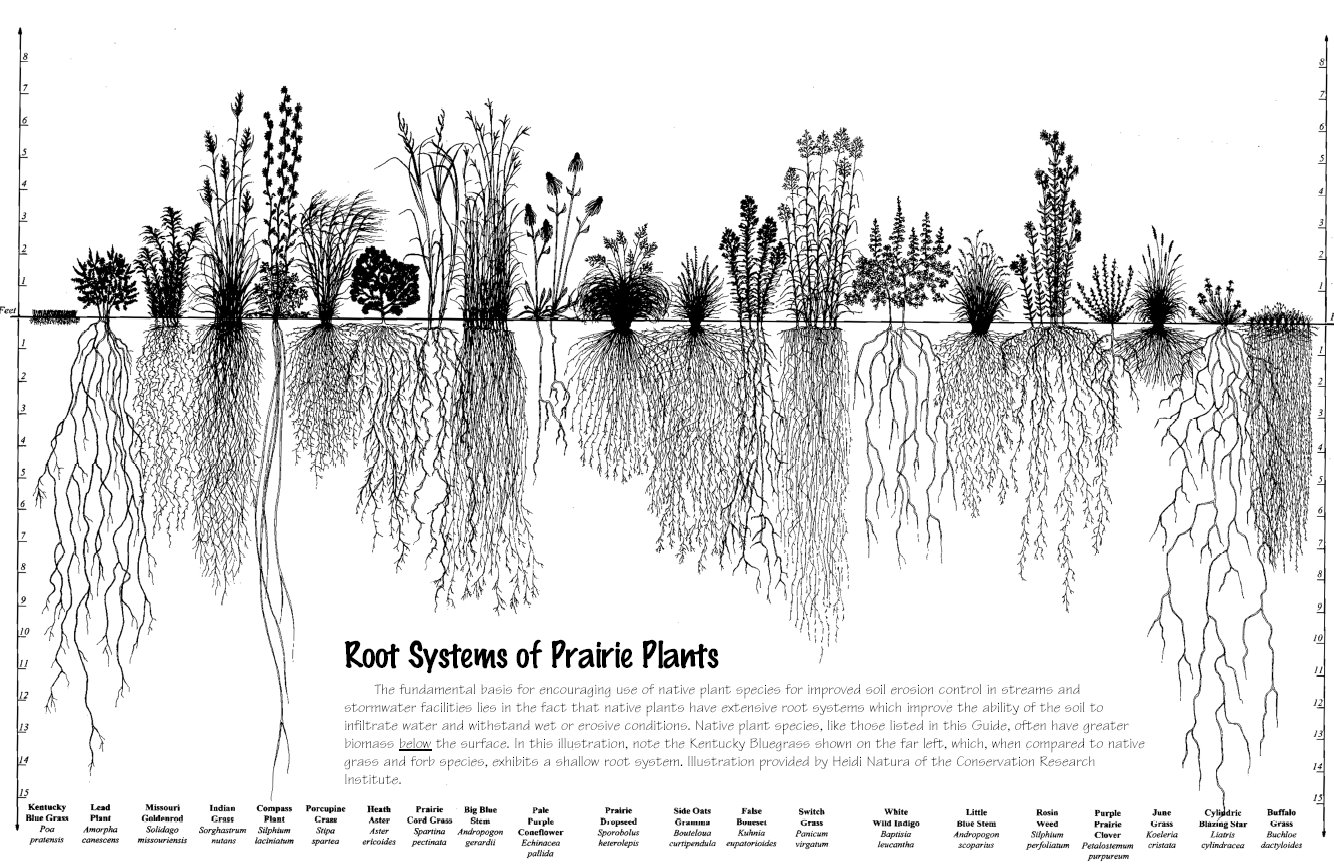
This poster shows how roots from native prairie grasses and forbs run deep … creating an “underground forest” that allows them to survive the surface fires.
“Refurbishing” is the key word. Over time that duff and dead leafy matter cause prairies to become clogged, or bogged down, choking out more and more species, especially perennial forbs and flowers. With the ash adding nutrients, and with choking duff burned away, dormant seeds and freed roots are given new freedom to sprout and flourish. Grass species seem flush with more vigor, too. Besides this regrowth, there is another benefit. Fires also help reduce invasive wood species such as Eastern Red Cedar … which, if you’ve visited the area around and south of Granite Falls, you will notice acres upon acres of the small evergreen trees that have completely overwhelmed the prairie grass hillsides.
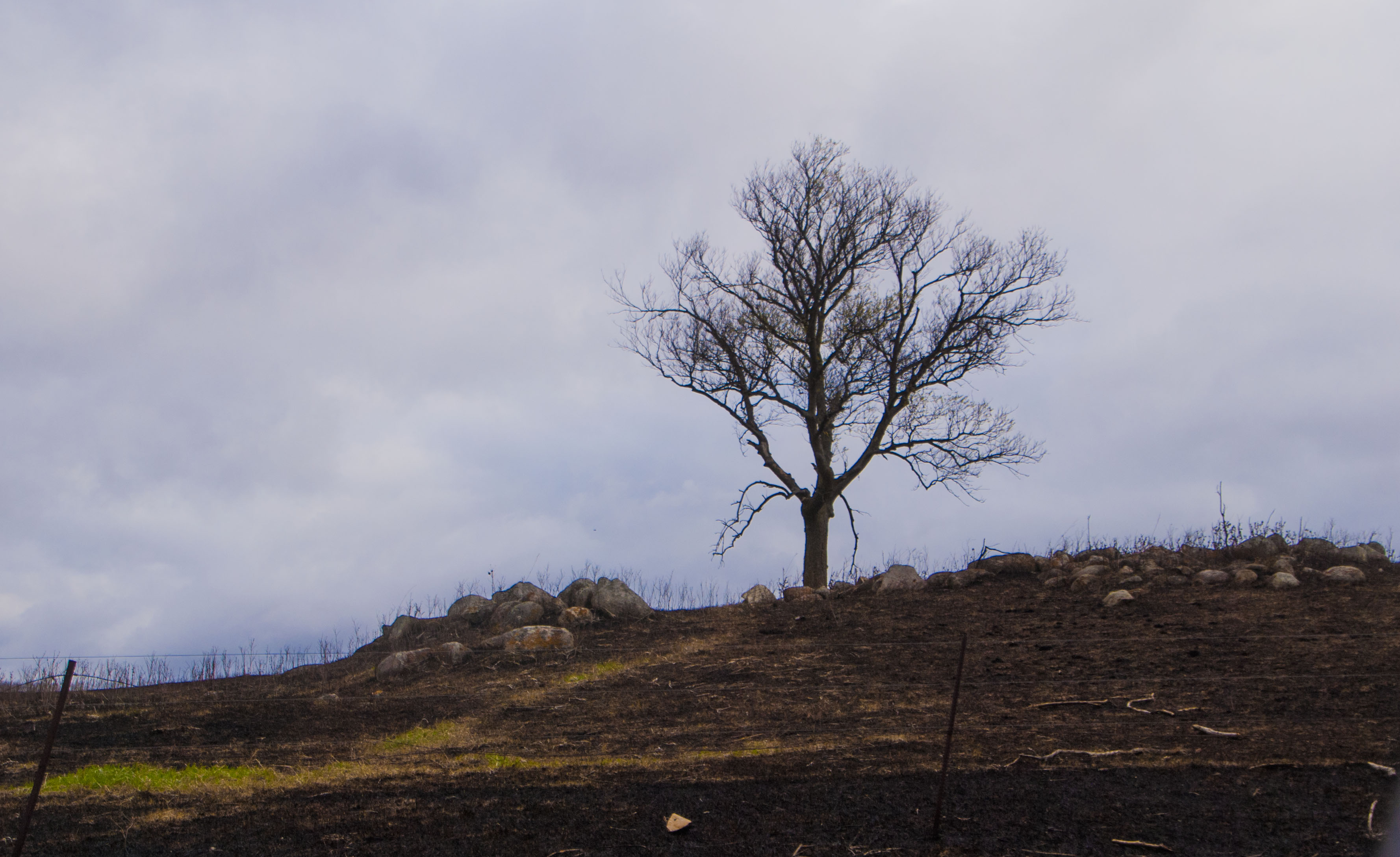
A lone tree after a recent prairie burn …
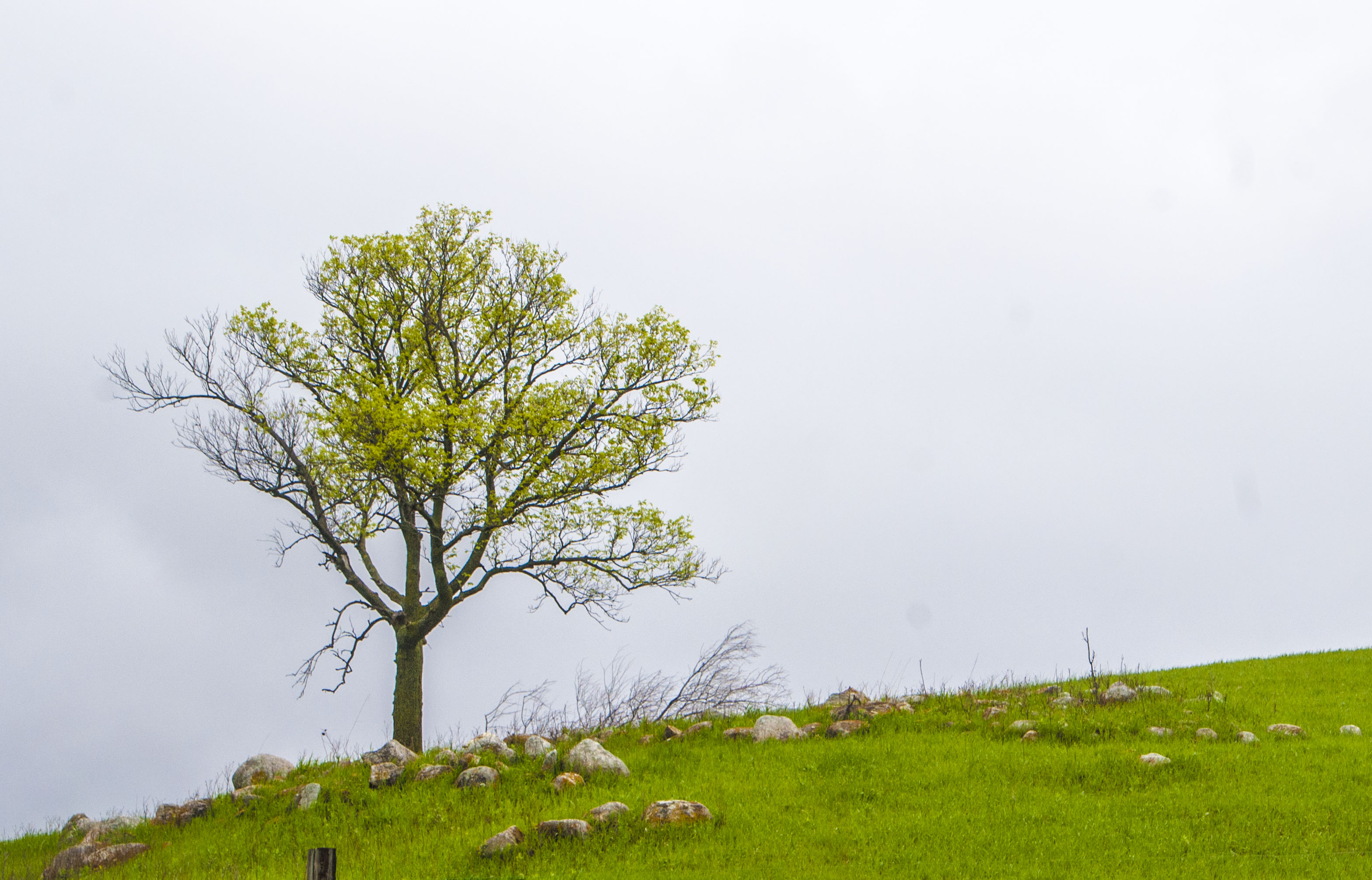
… and later, the greening prairie emerges.
A friend with a beautiful prairie near Montevideo complains, however, that recent fires did little to stop a cottonwood invasion in her grasses, although we are anticipating a fire on our prairie will hopefully put an end to the weedy elms that are thick in patches. Students of prairie ecology know, too, that burr oak, which will cluster in savannas on the shaded northern slopes of native prairies, escape damage due to deep rooting and thick bark growth.
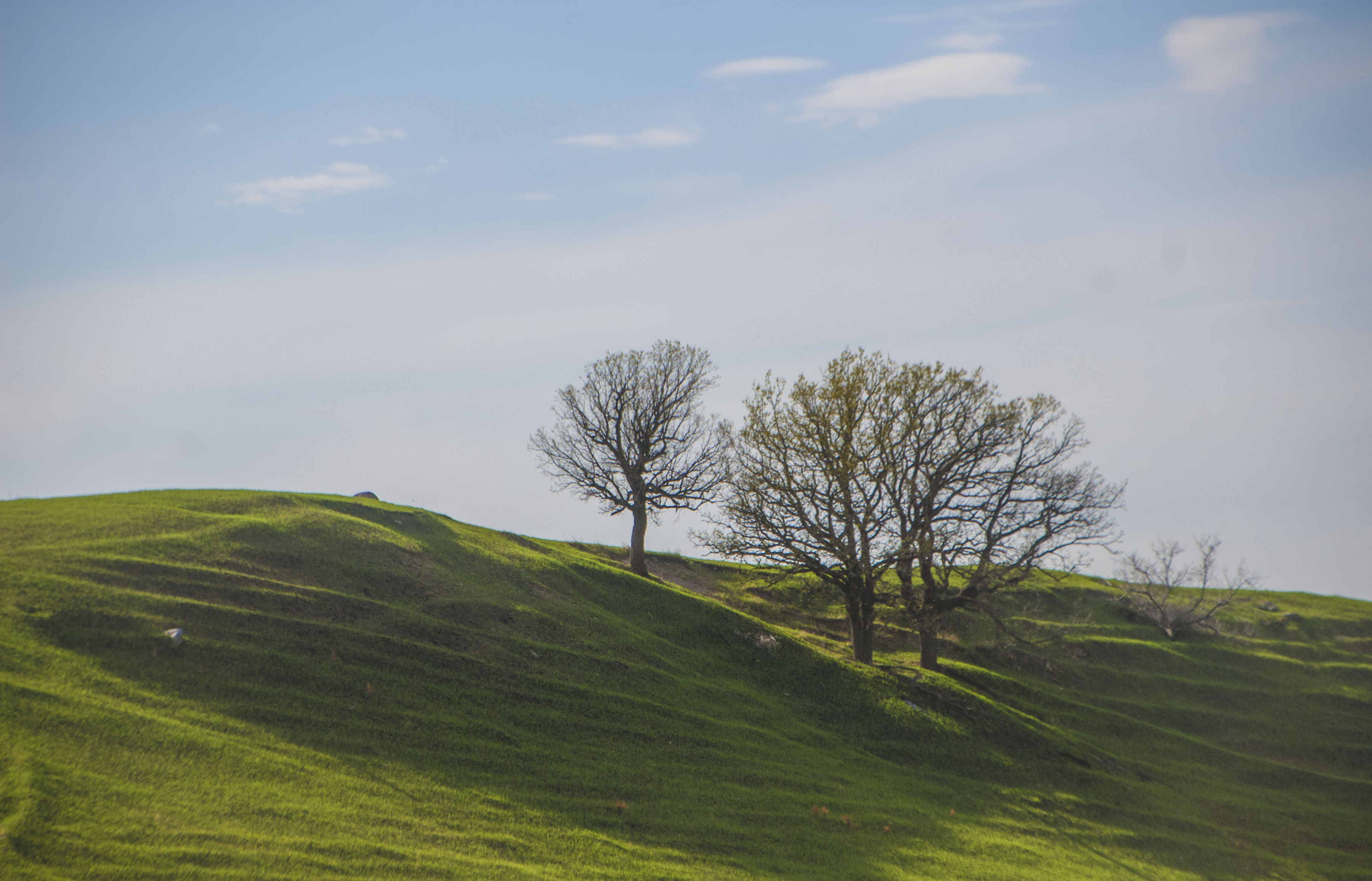
An oak savanna on the lip of a refurbishing prairie that was burned earlier this month.
In reality, we have an eye on a prescribed burn here at Listening Stones Farm. We’re at least two years out from our first burn, yet Rebecca mentioned a “window” for planting specific native flowers she hoped would have ample time to set root before a necessary burn. “Next year will be too late,” she said when returning with her digging trowel. Having a native prairie is a moveable feast of nature, for as yellow as our eight acres of prairie was last summer, we haven’t a clue what to anticipate this summer … or the next, or even in the year following that when we expect to do a burn.
It’s fun and educational to watch a controlled prairie grass burn. Thanks to their kindness, I’ve watched these professionals at their craft, and I’m still amazed at how well they do their work. It is perhaps more of an art than craft, for after a burn you can see how they have completely contained their burn area, working delicately around homesteads and fences right down to the “nth” degree with back burns and fire breaks. We can see evidence of their “art” just down the road from our farm, where odd shaped, long neglected prairies were burned for the first time in many years these past couple of weeks. Driving past the charred hillsides has given me renewed respect for their precision and work. One of those fields is already flush with life in ways we’ve not seen since we’ve lived here.
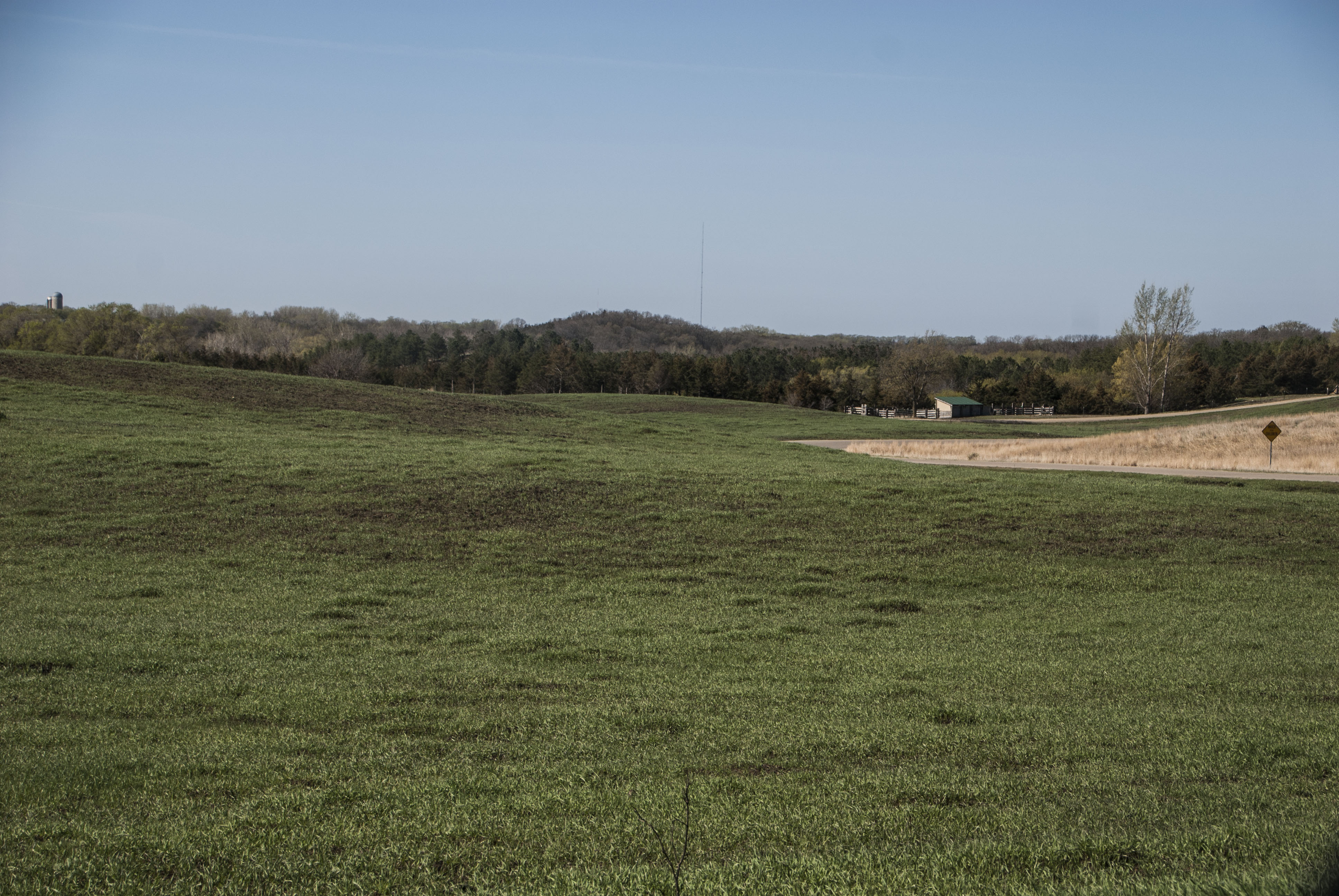
It didn’t take long for this burn to green at Prairie Woods Environmental Learning Center in April. Notice how the burn sweeps around the remaining, unburned prairie to the right.
Oh, and that patch of burnt prairie at Prairie Woods ELC? A few days after her comments I sent her a picture showing the greening on the charred hills that had caused her questions and concern … a greening that came within days of the initial burn.
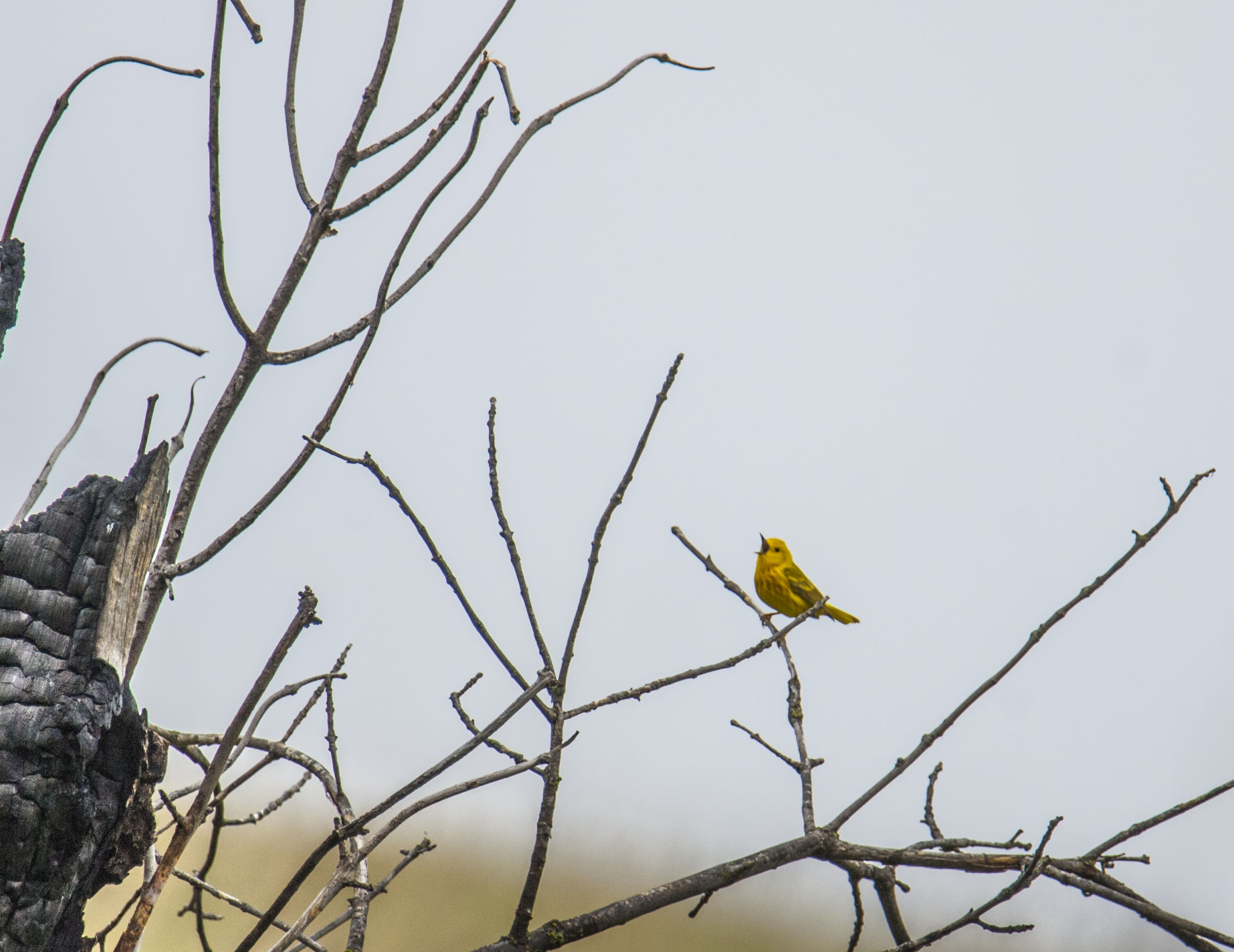
A Yellow Warbler sings on a charred snag from a two year old burn at the Bonanza section of Big Stone State Park … life from the fire.
Her reaction isn’t unique, for like most of us alive today, the millions upon millions acres of native prairie was gone long before she were born. Indeed, less than a percent of the original prairie remains in one of the most thorough conversions of a natural landscape anywhere on earth, all within less than a century of human settlement. While prescribed burns may seem harsh, in reality these fires are breaths of fresh air to the ancestral plants native to our land. From such fire comes life.
 Listening Stones Farm