Hope Within Mourning
This wasn’t an intentional gathering of us “brothers from different mothers,” although we were together to honor the passing of a special woman we considered as one of the “mothers” of our shared advocacy and love of a muddy and polluted Minnesota River. We stood in the commons area of the church, some in our jeans and worn, aged shirts probably scanned an hour beforehand to see if they were stain free.
Several moments into our mutual greetings and acknowledgments of our few fishing stories, Audrey Arner, another long time clean river advocate, walked up to suggest, “Guys, this is like old home week.” Indeed, we were a familiar bunch, had been for years. All around us were so many others who have been part of the advocacy.
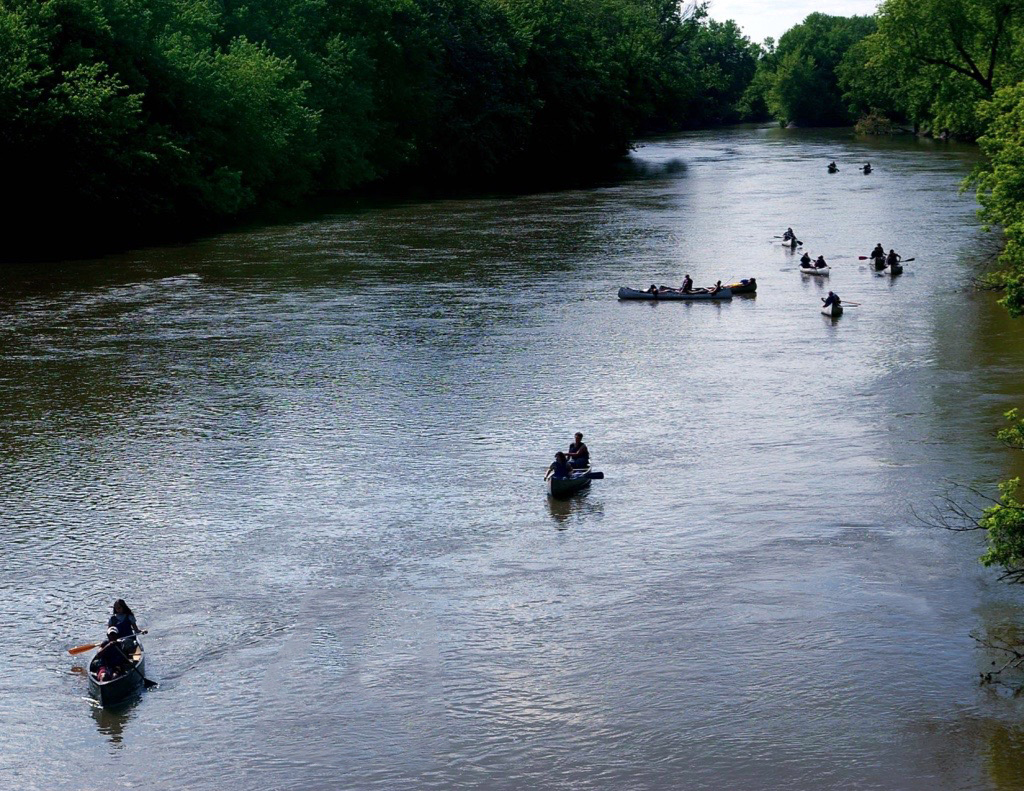
Among them was Butch Halterman, a long time “river rat” who was well respected as a Montevideo senior high science teacher for his unrelenting knowledge, spirit and resolve; a man who for several years escorted groups of high schoolers in canoes from the headwaters all the way to its confluence with the Mississippi.

There was Ron Hanson, who has written a few tough songs he must be persuaded to play, who lives alone in the nearby prairie where he grows some impressive long-thorned cactus plants. A narrow but simple path snakes through the rooms and narrow hallway past the seemingly hundreds of evil looking cacti, and a dire warning that this isn’t a place to bend over emerging from a bath.
Up from New Ulm was Scott Sparlin, who was instrumental in organizing a clean river group called the Coalition for a Clean Minnesota River. Butch, Ron and I had at one point served on the board of a sister river cleanup non-profit called Clean Up the Minnesota River (CURE). Noticeably absent on this day of mourning was its long time CURE leader back in the day, Patrick Moore, who recently had moved to Montana with his wife to be close to the families of their two daughters and grandchildren.

Our church gathering was to honor the late Shirley Werhspann, wife of Del. Collectively they were as responsible and as active with the Minnesota River cleanup efforts as the rest of us. Moore actually credited Del as the muse for creating CURE, initially under the auspices of the Land Stewardship Project. All this organizing came in conjunction with a ten-point action agenda to save a threatened river offered by then Gov. Arne Carlson. It was a heady and strong effort for more than 20 years.
“I no longer feel apart of the river,” Butch admitted, although he still has a cabin of sorts and a landing just downriver from Preen’s Landing. Yes, he still fishes both in the open currents and on the ice. “Used to be a brotherhood, a family of us, and we were all on the river. No more.”
Nowadays, not so much. Perhaps age is part of it, moves another. So has the politics and change in the direction of CURE. “It’s now electric cars,” he laments. “Not so much about the river.”

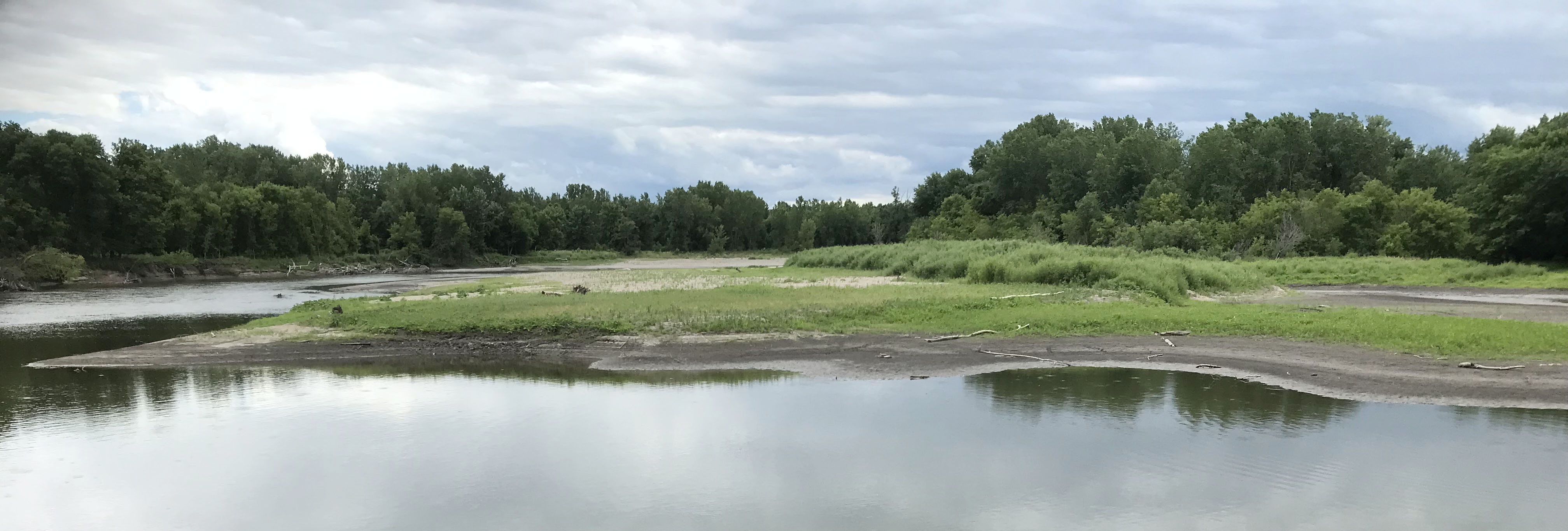
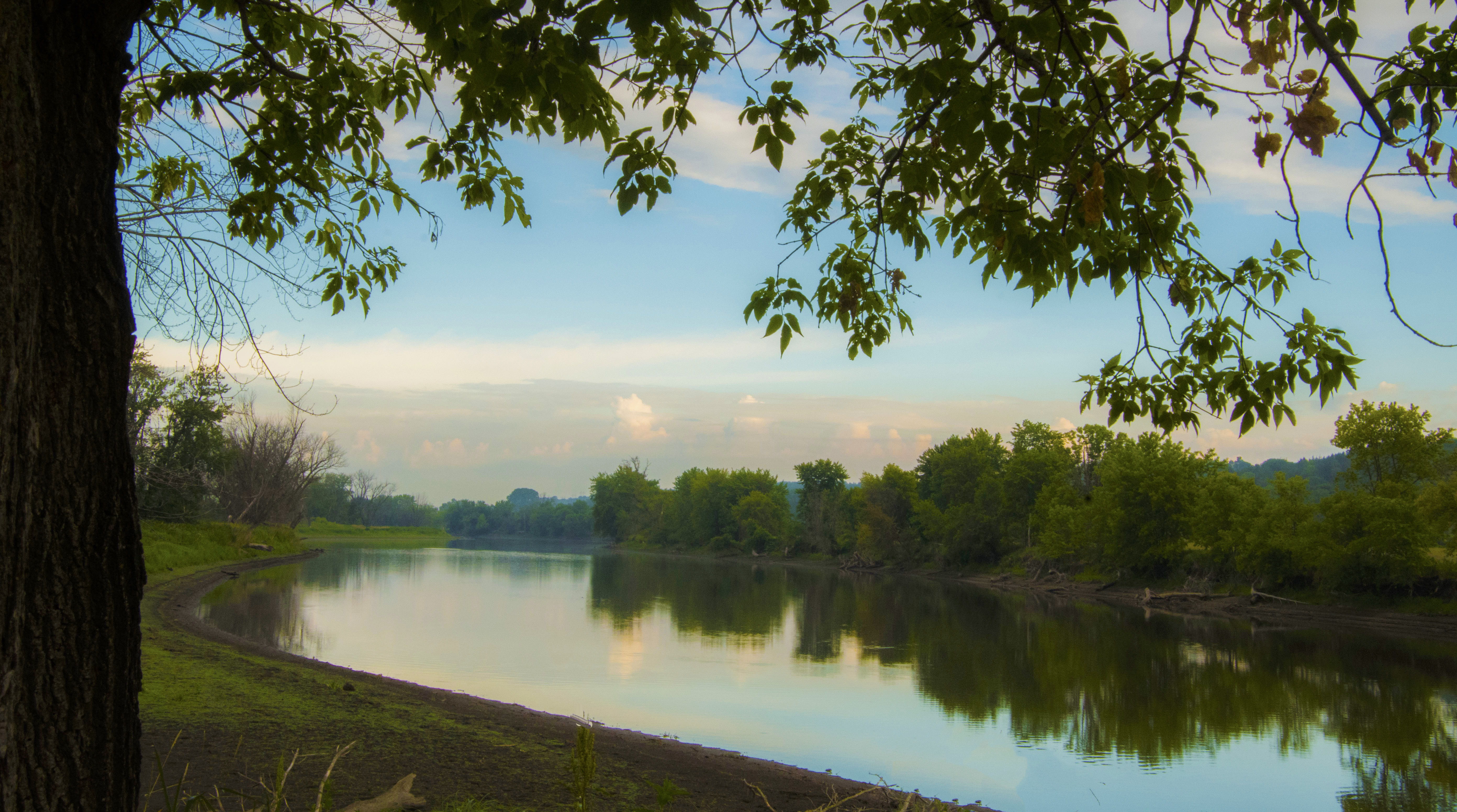
Indeed, not much has improved since all this started back in the early 1990s. Indeed, the river seems to face even greater threats. At Skalbakken County Park, for one example, standing in the picnic shelter back then would have seen the river channel ripe against the tree-lined north bank to the far right of the shelter. Heavy boulder riprap was peppered along the bank beneath the shelter to protect the park from being washed away by the incoming flow. Thanks to some extremely wet years, patterned tiling and an insistence on flushing spring melt from fields of commodity crops, the channel is now to the far left as siltation several feet deep has closed off the original channel. Between the former and present channels, this thick “island” of silt now has emerging willows and prairie weeds sprouting. Further down river the increase of flow has sliced a new channel through the riverine prairie, speeding waters past many of the former serpentine bends to create shallow oxbows.
So much change, so rapidly, that Heraclitus’ statement, “No man ever steps in the same river twice, for it’s not the same river, and he’s not the same man” rings both too close and truthful. Yes, the river has changed and so have we, as we, individually, enter the last one percent of humanity. In a few words, “We’ve grown old.”

There we stood, the group of us along with some other grayed river advocates, awaiting an official mourning of a woman known as an “animal whisperer” and forceful advocate of a cleaner river and environment. Our little group had met numerous times in her kitchen talking river politics over her delicious home baked cookies, of how to better our efforts and how to remain strong while surrounded by a seemingly uncaring and unbending agricultural community. At one point she worked on Congressman David Minge’s statewide staff working as a local organizer and scheduler. Shirley was as strong politically as she was so kind hearted to us, and to her horses and other pets. For years she and Del ran a boarding kennel that was highly praised thanks to her tender and loving care.
Minge, it should be noted, helped craft perhaps the strongest soil conservation program along with Iowa Senator, Tom Harkin, called the Conservation Reserve Enhancement Program that placed nearly a million acres of vulnerable farm land into perpetual retirement. He was also on the original CURE board of directors.

In time we ambled in for her last rites, taking seats, singing hymns and offering prayers. Later, in the church basement over a lunch of a tatter-tot hotdish, our conversations continued. Among them came the offerings of new promise, of a river wide conference scheduled in Mankato, where the muddy and polluted river takes a severe turn northeast toward the confluence with the Mississippi. Like in the past, the “old” Butch, Audrey and Richard Handeen were all encouraging us to once again to join together with Scott and the downriver folks to inspire change and better conservation efforts — some 35 or so years since the first such efforts.
While the effort is hopeful, is there still enough fight and resolve to make a difference? Perhaps Scott Sparlin has a new youthful grouping than we found in the church that morning. In the old days, when we were young, those resolves weren’t even a consideration. We simply made up our minds and took to the river, in canoes, in meetings, gatherings at various county parks, and group paddles on not just the “mother river” but also the five tributaries. We fought with protests and in the courts, and we took our battle to St. Paul. We worked with other down river groups all the way to Lake Pepin on the Mississippi.

Back home on the rivers, my late wife, Sharon Yedo White, one of our exchange students (Luise “Lucy” Hille of Germany) and I all earned our “Prairie Paddlers” patch then granted by CURE — a colorful cloth patch signifying that we had successfully paddled all six of the upper prairie rivers.
Those were the days. On a single weekend in May we would gather in dozens of canoes and kayaks to paddle the rivers, then in September we would close the paddling season with a relaxed fall trip just as the leaves would be coloring, which they seem to do earlier close to the river, when the air would be a bit crisp with the approaching waters reflecting a blueness and sense of clarity we all hoped would someday be normal. Back when the river was a part of each of us. Now, perhaps, a new hope will emerge.
On Thursday, June 12, the 17th Annual Minnesota River Congress will meet at the Kato Ballroom in Mankato starting at 6 p.m. Sparlin continues the batttle as the facilitator of the event, which besides two strong panels will feature Joseph Barisonzi, Minnesota state vice president of the Izaak Walton League, as a speaker. His topic: “The River Can’t Wait.” Barisonzi also is curator of the chapter’s Kouba Gallery in Bloomington, MN, where my current exhibit, “Haunted by Waters” is now on display — a fitting coincidence.
Grasping Joy
Can someone find joy in the South Dakota mudflats? It was Dutch theologian Henri J.M. Nouwen who suggested that joy doesn’t simply happen, rather that is it is something we must choose. Or, find. This thought surfaced recently and caused me to think of what in nature could give me joy. Nature is where I typically turn when that spark of joy is necessary for soothing the soul.
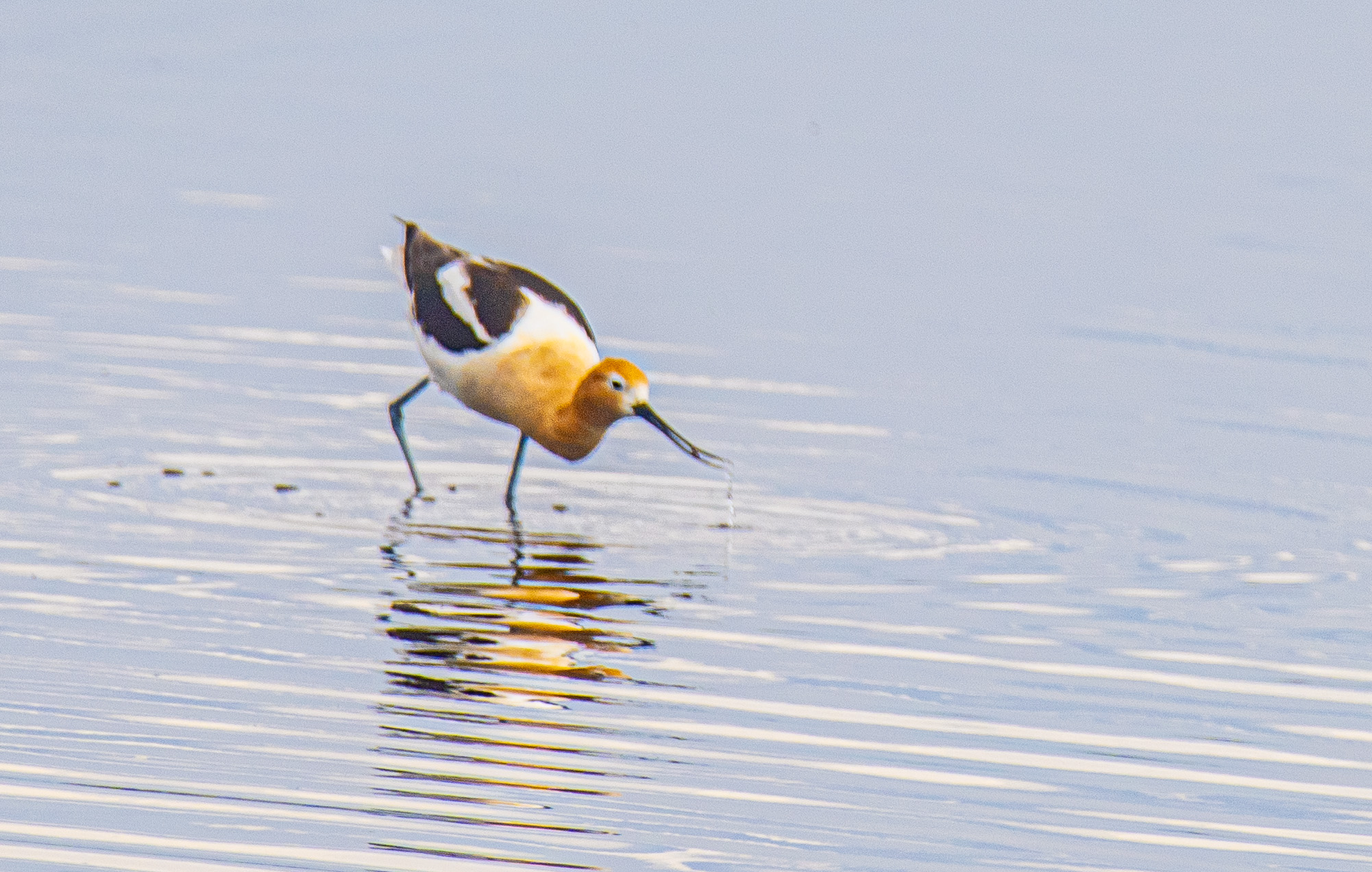
This thought happened to occur in the midst of a conversation about American Avocets I was having with our head librarian, Jason Frank, who is a dedicated birder and naturalist when he’s away from the stacks. We were chatting about my inability to find one of my favorite shorebirds when he suggested the mudflats around Sand Lake NWR about two hours west in NE South Dakota. With an empty afternoon ahead of us, we headed west.
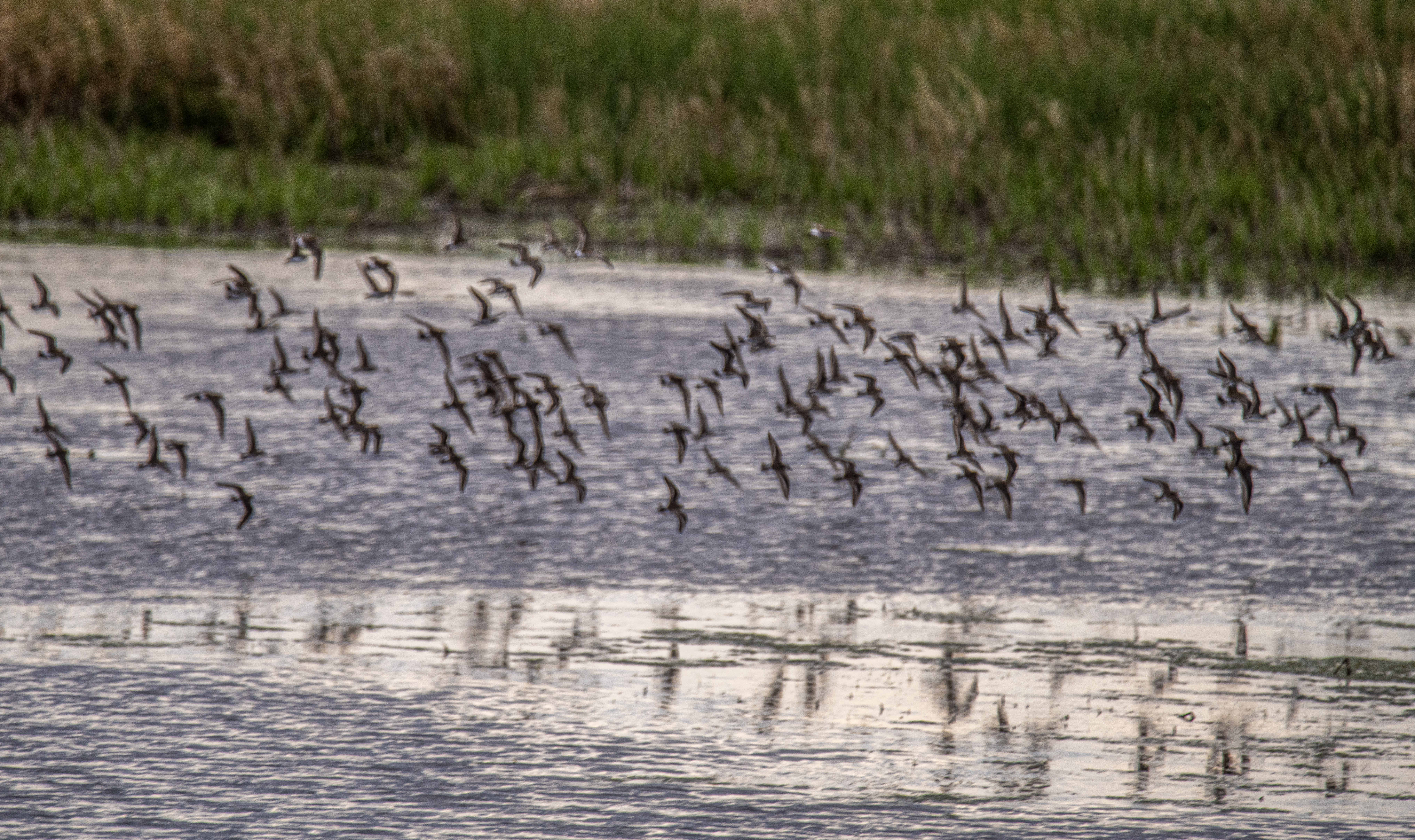
First came the Avocets, which we found in a flooded field depression not far from Houghton just a few miles from the Sand Lake Refuge. That pair would be the first of a beautiful handful of shorebirds that would occupy our afternoon, and yes, all contributed to blissful joy.

Yet, it was the Avocets that drew us across the prairielands. I’d been missing them. Literally. Earlier this spring there was a brief gathering at the Big Stone NWR where Frank had spotted and photographed a flock he found wading alongside the river. Knowing my love, he had alerted me the following afternoon with his photographs and pinpointed where they were wading. I rushed to the Refuge only to find a locked gate and smoke rising from the thousands of acres of prairie grassland. A spring burn was underway, and continued for the next day or two … just enough time for the flock to fly elsewhere.
Refuge biologist Brandon Semel noted a week or so later that we are actually on the very eastern edge of their natural territories. This was after I had spent a few trips searching the area wetlands where I’d photographed them last summer. Which led me to this more recent conversation with Frank. Like, “Where can I find Avocets?”

My attraction to these beautiful waders is a strange love story. Back when I was in a forgettable career stretch with a Minneapolis-based ad agency, I found a piece of cottonwood at the studio of a wood artist friend, procured a few wood carving tools and went to work whittling away both wood and ad agency aggravation — whittling away the late night hours when I should have been sleeping. It was during this hobby moment I came upon photographs of this brown-headed beauty of a shorebird with the thin, upcurved bill. My carving was of a rather non-nondescript assemblage of a shorebird and nowhere close to an Avocet. One slip of the knife would have quickly made their narrowest of bills another shaving.

It wasn’t until a couple of years ago while on the annual Salt Lake Birder’s Tour that I saw my first real life Avocet, thanks to Lac qui Parle SWCD manager Rhyan Schicker. Just before the annual kickoff breakfast she told me there were several wading in a flooded farm field just east of Marietta, home of the annual birding mecca. I rushed out and there they were, even more beautiful in person than in the guide books and magazines. I returned over the next few days for more photographs. Then, the next couple of summers they hovered around here, particularly near some mudflats up by Barry, MN. Not this year, though. We’ve had no rain so the lowlands are bone dry.
Frank suggested the Sand Lake possibility. Over the years this interesting refuge has yielded some nice images, although many hours of stalking the “teapot” flying Woodcocks went sorely unfulfilled. Although our little afternoon foray started with a bit of disappointment when we discovered a formerly quite active Blue Heron rookery abandoned. Finding the Avocets turned the tide. Fortunately no highway patrol came upon us, and that the motorists who whizzed by were so understanding and kind. We had parked as close to the road ditch as possible with my lens sticking out the window, yet half the car was still in the road.

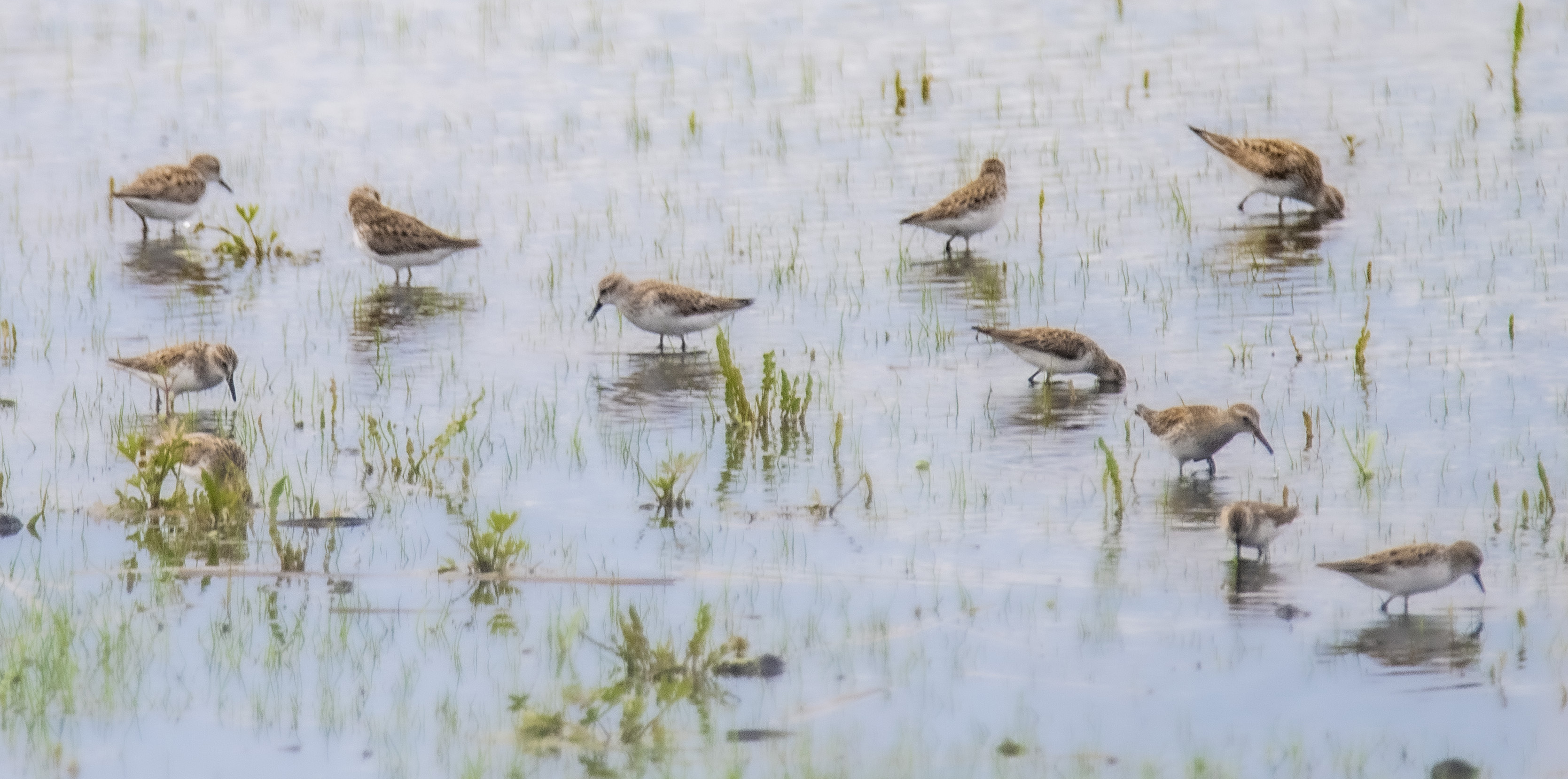
Our luck and joy would continue. As we came upon the eastern edge of the Sand Lake Refuge we found different flocks of Sandpipers, each being skitterish and prone for quick flights and returns. Then we happened upon a solitary Black-necked Stilt. Far more common to the American Southwest, the guidebook offers only a pencil thin width of territory this far east. We were in it. Joy!
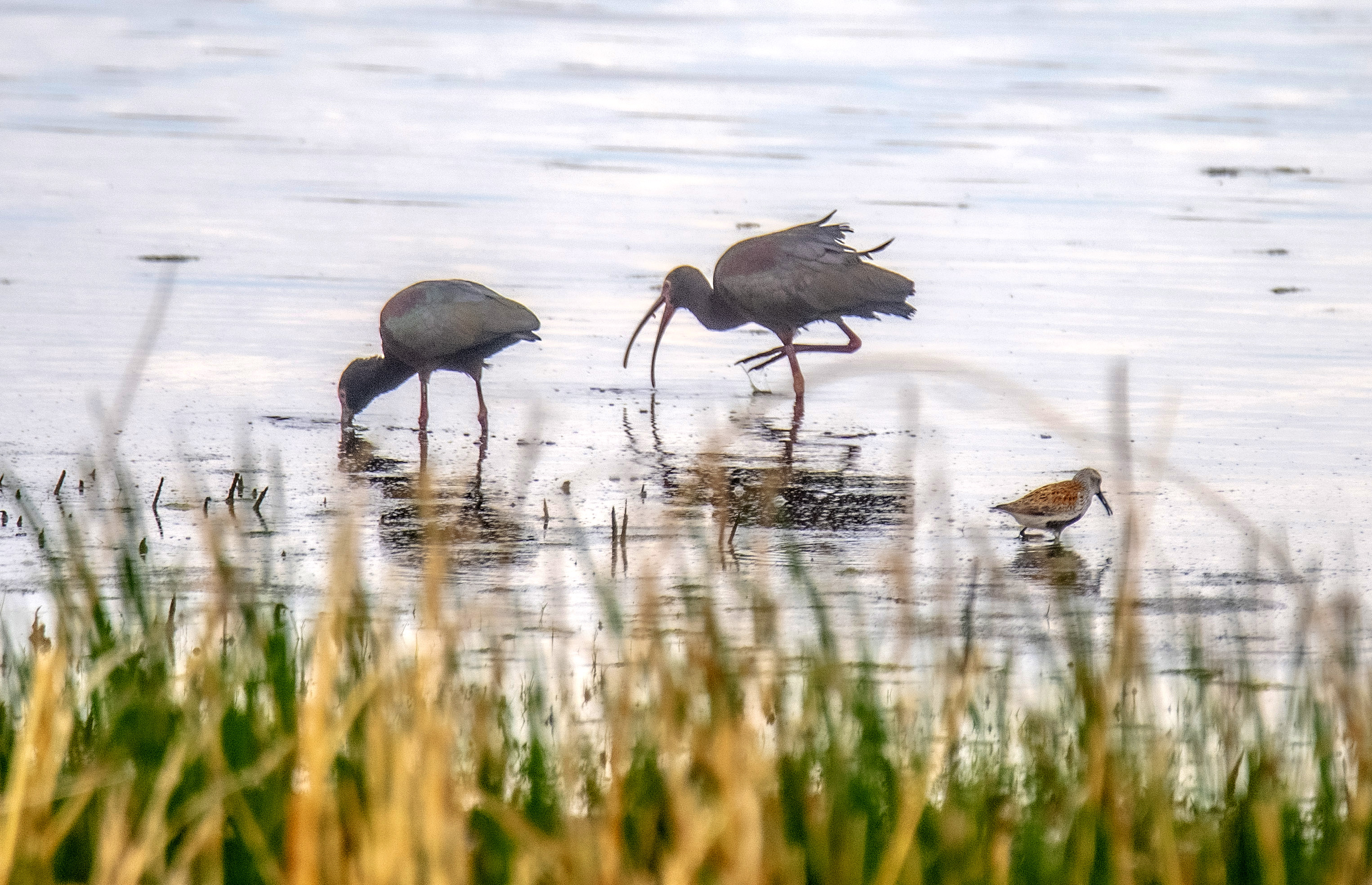
Between the Stilt and the Sandpipers we were enjoying all the offerings as we crept along the shallow waters. When Sandpipers can wade without the water touching their bellies, they’re wading in quite shallow waters. With the taller birds like the Stilt and Avocets it’s difficult to judge the depths. So we merrily wiled away the afternoon before we happened upon pair of White-faced Ibis further down the road.

With our past years of wet spring weather the Ibis seemed fairly comfortable around our area of Minnesota. On that Salt Lake tour a few years ago numerous Ibis were seen at several sites, their bills, unlike the Avocets curved downward. They flew in mini-V formations from one standing water site to another. This year? Not a single sighting until we happened upon them in the Dakota mudflats, where they meandered thoroughly unconcerned with the odd guy with the long bazooka of a lens sticking through the car window. Nor was the solitary Sandpiper keeping them company.
Perhaps it would have made wonderful sense to stick around until sunset. However we decided to move on toward home and leave the birds behind in their shallow mudflats. We had been greeted by an Avocet prelude and given benediction by the Ibis, which might mean very little to many. For us sitting in our car on this roadside nave, there was a thorough sense of joy within the high skies of this prairieland “cathedral.” As Nouwen had suggested in his writing, we had chosen our sense of joy and had gone to find it.
Unbroken Gifts
Poet Mary Oliver penned this on the beauty and joy of Trout Lillies claiming they’re a “gift that can’t be broken.” Often those “gifts” are hidden as if a Mother Nature was intent on hiding something special for Christmas. Such were my thoughts as we sauntered down the boardwalk steps toward Hidden Falls at Nerstrand-Big Woods State Park in search of this rare gift. It was a promise that seemed bleak when we passed two older women who on their way back up the hilly path.
After greetings were shared, along with some good wishes for the one who admitted she was making her first state park adventure since a hip replacement surgery, she asked, “So what are you photographing?”
“Hopefully some Trout Lillies,” I said.
“Oh, my! You’re much too late! They’re long gone,” she said rather adamantly.

What discouraging news, for our heading to the park on this late Sunday afternoon was in search of the delicate and beautiful native wildflowers sequestered within a mere three county area at the iceless lip of the Driftless. Nerstrand-Big Woods is one of the few remaining public locations. Officially, they’re endemic to the Cannon River and North Fork Zumbro River watersheds in Rice, Goodhue and the extreme northern edge of Steele County. We were where we needed to be.
This unexpected photo journey was part of satisfying my need of venturing into nature, a feeling that has been clawing at me for awhile. We were in the Cities for the artist’s reception of my “Haunted by Waters” exhibit at the Kouba Gallery located on the sacred grounds of the Izaak Walton League on the bluff overlooking the Minnesota River. This is about an hour north of the Nerstrand-Big Woods. Yet, even before leaving home my sights were set on the Sherburne NWR for Sandhill Cranes. Sherburne is my “Mall of America”, and if Trout Lillies could be added to our weekend foray, the gifts would be astounding.

We left Listening Stones Farm early Saturday morning for the three plus hour trip to Sherburne and made it just in time for a quick and picturesque picnic lunch beneath the canopy of towering oaks. We were then off into the motor trail, a “timeless” meander that makes one wonder about the limited vision of others as we were seemingly constantly being passed by other cars speeding by. Were they oblivious to the colorful yellowish Hoary Puccoons and early blooms of deep blue Lupines, or the nesting swans and hopeful sightings of the nearly perfectly camouflaged Sandhill Cranes?
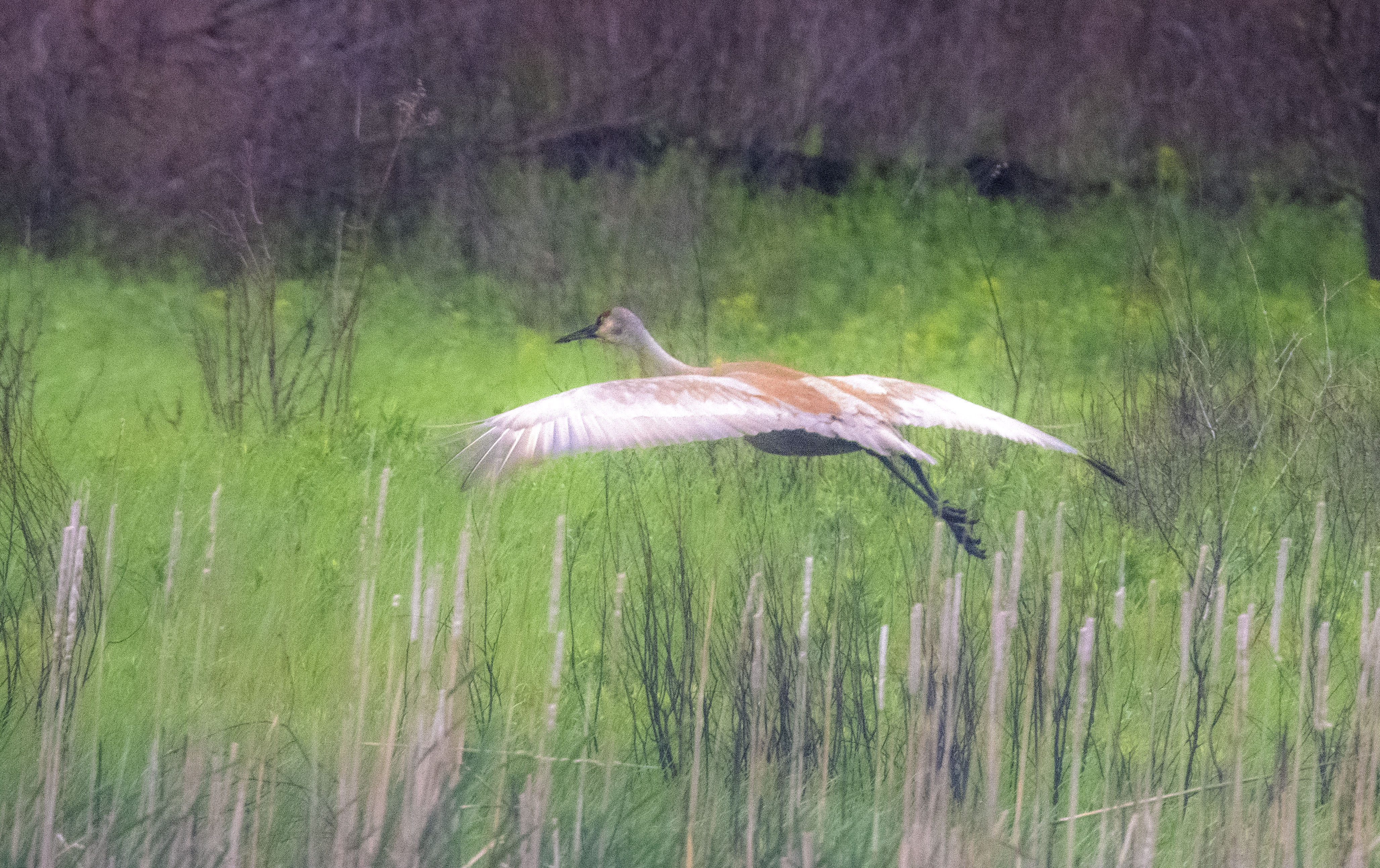
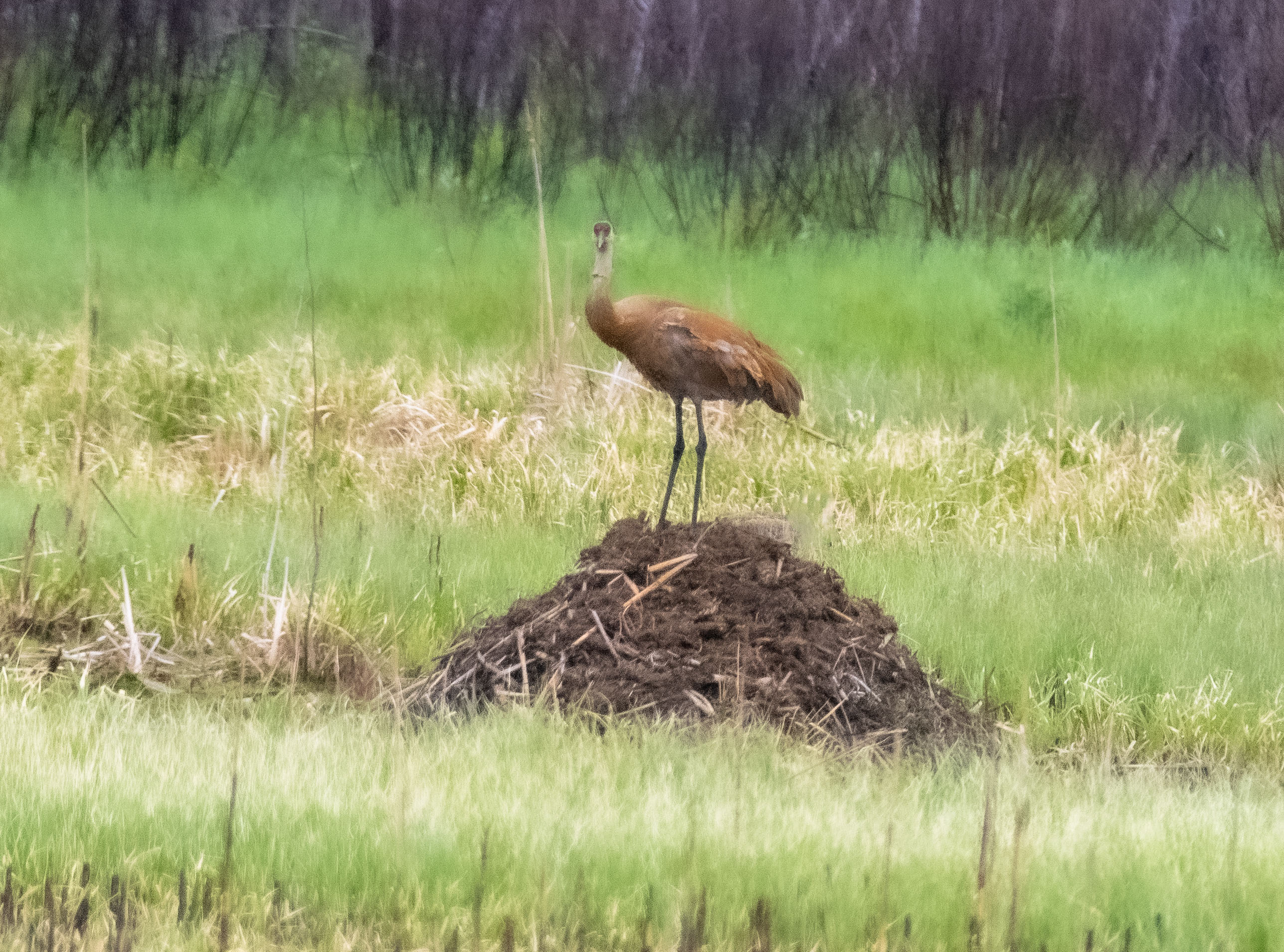
Admittedly, we were moving rather slow, fighting our initial disappointment of being past the halfway point without a single crane sighting. About then we spied a pair feeding near a far distant wetland. Too distant for a workable photograph. Then, suddenly, one flew across the road right in front of us and was caught mid-frame! Rejoice! Seconds later, its mate followed. Another smile. After that the crane sightings increased significantly, particularly on the due south straightaway of the motor trail where dozens were found feeding in a swampy prairie meadow. One even played “king of the hill” by standing erect on a muskrat lodge.

At one point, though, after photographing numerous prairie-based wild flowers, I mentioned it was too bad we hadn’t seen any Trout Lillies. An instant Googling of its natural history indicated we were far from their natural habitat yet within the limited time frame of their blooming. A temptation had been launched. What could be better than capturing Sandhills and rare Trout Lillies along with being honored for an exhibit of my water images?
It wasn’t until a lull in our artist’s reception that I suggested to Roberta that we venture to Nerstrand-Big Woods. The park was only an hour south, although it was in the opposite direction of home. Our’s would be a long and late trip home. She was game especially since she had often camped at the park with her late husband, Harland, whose disabilities prevented them from actually visiting Hidden Falls. Now she could catch the falls, and me hopefully, the Trout Lillies!
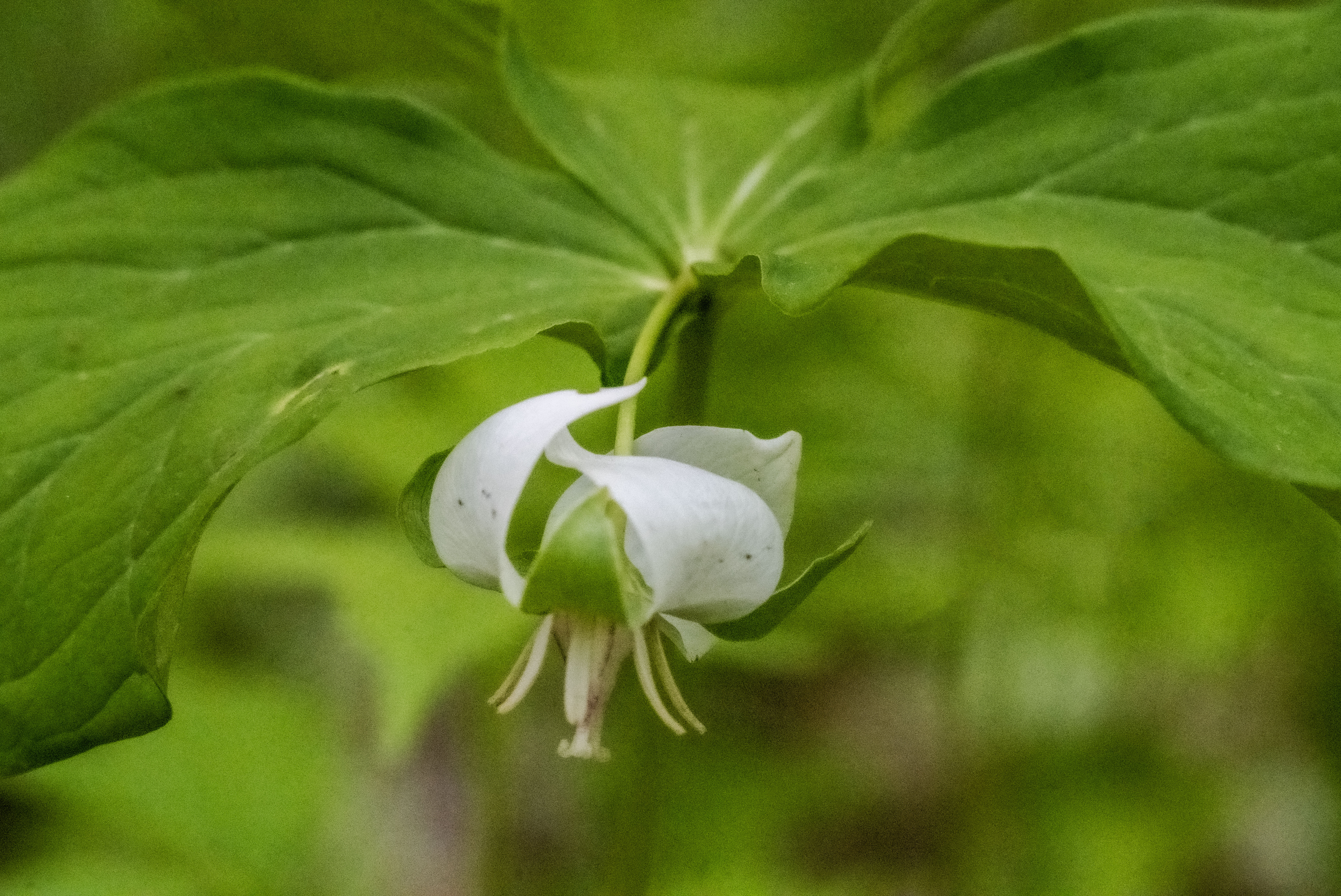
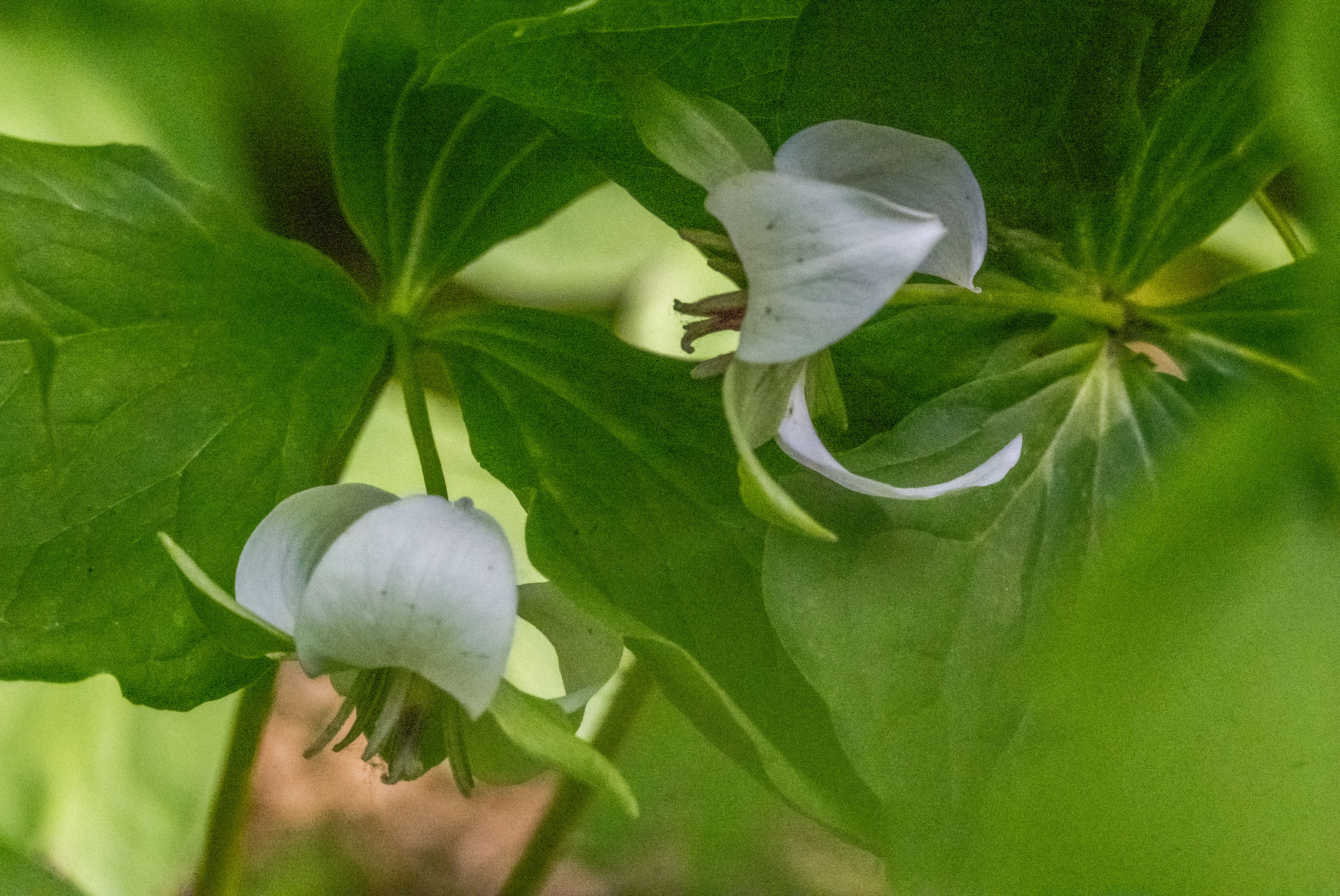
That was where we were when we encountered the two women and their dismal warning. Strangely enough, moments after our passing and further along the trail my eye caught some strange looking elongated white triangles clustered within the plant canopy. As I was focusing my lens Roberta asked, “Are those your Trout Lillies? Look underneath them.” Sure enough, for below those triangles were the characteristic yellowish, white tendrils. Nirvana!

So indeed, we were not too late. A sense of relief eased over me, for despite the woman’s forecast, a friend, Ted Suss, whose farm is nearby, had told us after we’d decided to venture to Nerstrand-Big Woods that there were “Trout Lillies everywhere.” Up to this point, though, we had been “skunked.” No, they were no longer everywhere, so the two women had almost been correct, for the plants were near the end of their blooming cycle. Yet, what joy. What a gift!
And, Hidden Falls was not disappointing despite the small water stream. When we first arrived a young teenage couple sat quietly and lovingly, arms and emotions entangled, watching and listening to the cascading falls in a silent euphoric state of first love — that overwhelming feelings they’ll likely not experience again. As we two couples shared a splendid and reverent moment, another couple, about half our age and twice the age of the teenagers, burst from the trail with their teenage son. They suddenly stripped to their skivvies and leapt into the chilly waters, laughing and splashing as if they were children. Though the quiet was lost, the teenager lovers giggled, as did we. Their’s was a celebration within a moment of life … as was ours and the loving teenagers.

Eventually we turned to head back toward the parking lot, stopping when we reached the small patch of lingering Trout Lillies. Perhaps I broke a park rule by stepping across a rope barrier to kneel into the greenery for a closer, low angled image of Oliver’s delicate gift.
It was an image that sealed a treasured weekend; Roberta finally seeing her long desired view of Hidden Falls, and me with my varied moments of nature. Those images of Sandhill Cranes and Trout Lillies added greatly to my celebration of personal joy with the exhibit; some hopefully expected, another unintentionally gathered — all gifts that will keep on giving!
Searching for Sanity
There was a lull in the middle of the afternoon, moments between a Hands Off Rally and an Easter dinner with my son, on this the Saturday before Earth Day. Easter is a big thing for Jake; Earth Day for me.
First, his story: Years ago when living in a different group home he connected deeply with his primary caregiver who even on her Sunday’s off would come to take him to church. This beautiful Hispanic woman became a cross between a second mother, buddy and caregiver. It wasn’t long after his mother and my wife had died. She also made sure he was registered to attend a summer Christian camp within an hour’s drive of the group home.
Unfortunately, as happens with group homes, she eventually decided to move on. Yet her influence was so deep that years later church holidays and the camp continue to be his heartfelt necessities. He tolerates his father, who is more spiritual than religious. Where he finds peace within the folds of a saintly robe, mine come with nature.

So on this Saturday afternoon with a window of time before our dinner, my thoughts, as spiritual as they were, was to head to nearby Sibley State Park where I might amble through the dense, hilly woodlands in search of some early spring blooms of Hepatica and other woodland fauna. With the ongoing political turmoil we’re facing my traipsing through the prairies and woodlands have suffered greatly of late along with my spirituality. Sometimes I return home with few if any images, and most with little artistic effort. And still with a cluttered mind.
Before realizing it I had lost track of my bearings and was quite a ways north of the Sibley turnoff. Pulling off to the shoulder of US 9 to gather my thoughts, and to gauge a possible time frame, my decision was to head to the Lake Johanna Esker some 20 minutes deeper into the hills and woodlands of the moraine where a fine prairie “wilderness” awaited, if you can describe a grassland as such. This Nature Conservancy is home to perhaps the most prolific Prairie Smoke patches I’ve ever witnessed. Prairie Smoke and Pussytoes, one a brilliant pink, the other offering a gleaming contrast of white.
Although mid-April meant I’d likely miss both, it was worth a look. After arriving I sat for several moments to gaze at the distant esker, a tall narrow glacial stream bed towering over the adjacent prairie and now buried beneath layers of till, dormant grasses and gangly oak trees. That old stream bed is quite visible, unlike in the geological age when it lay buried beneath an ice sheet perhaps a mile straight up from where I was parked.

Eventually I grabbed my camera with a multipurpose zoom lens and ambled through the gate to follow a motorized trail angling toward the top of the nearest rise where typically hundreds Prairie Smoke plants would be blooming. Small leaves barely the size of a fingernail hugged the ground. Then, off to my left and down the rise a bit, my eye caught a hint of pink, and there it was, small and bowing gently toward the earth, a small Prairie Smoke blossom. Instantly I was onto my stomach focusing the lens. Nature now ruled. All of that confusion and nightmarish thought was suddenly gone.
After grabbing a few images, I rolled over to sit in the meadow, looking toward the esker, remembering a moment years ago while sitting here a pair of Sandhill Cranes flew over looking thoroughly prehistoric. Now in a distant wetland, a swan floated on the stilled surface, and high above a small pod of pelicans soared across a single cloud. Nature revived. With each breath my mind eased, little by little. Scents of the meadow and whiffs of spring meshed with the smell of earth. My eyes resettled on the poetry of the lone Prairie Smoke blossom, folded neatly into a perfect poem.

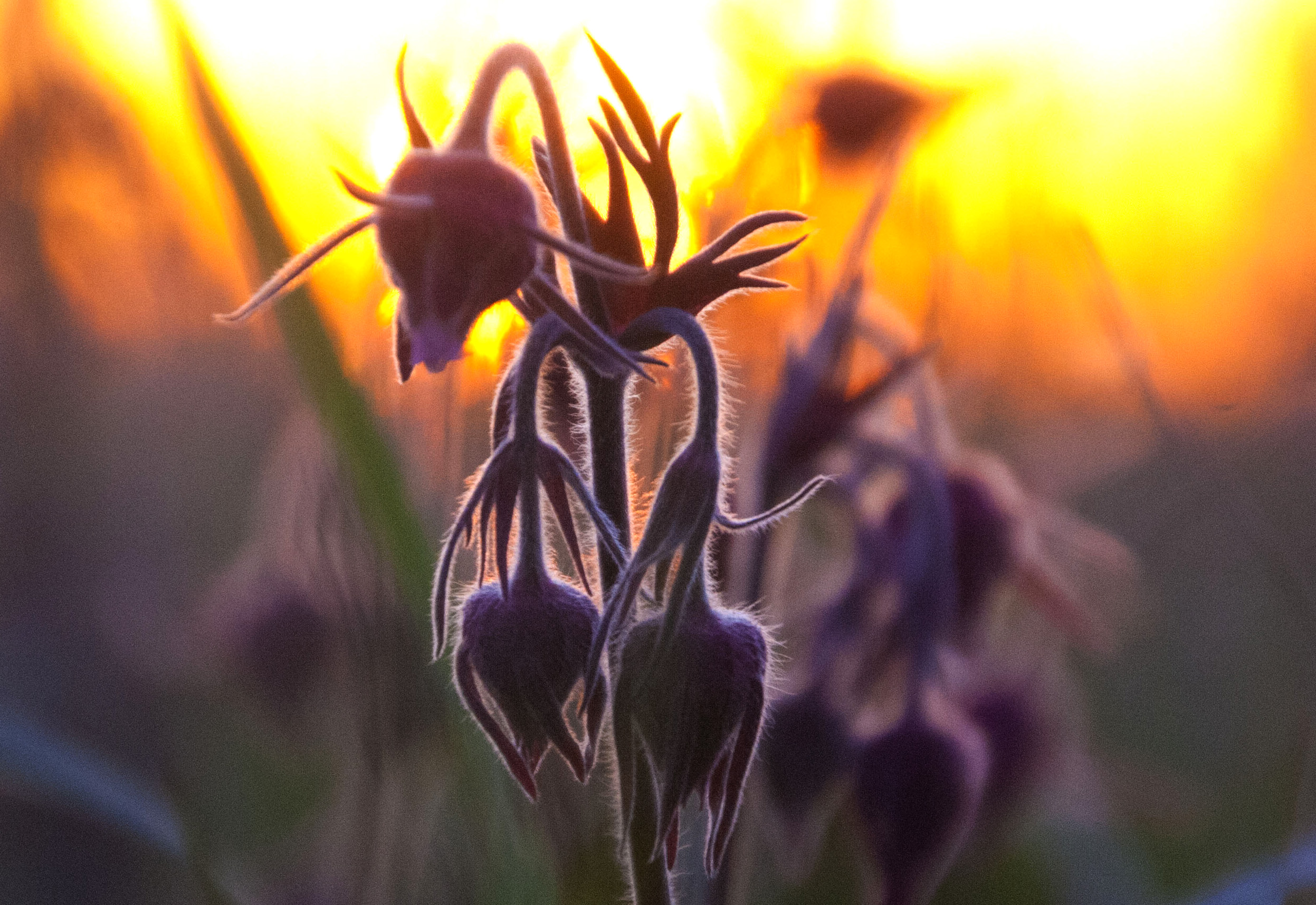
Moments after I stood and regained my balance, it was off through a shallow valley to the distant hill where perhaps I might find some Pasque Flowers, one of our first of the floral seasons. Finding none, I then ambled toward the massive mound of the esker where dormant prairie grasses and oak trees failed to hide the geological relic.
In time, and after a quick turn through Sibley amd dinner with Jake, I made a stop on the way home on a hill overlooking the Big Stone National Wildlife Refuge where I’ve often visited for Pasques, and once again was rewarded. Now fully mature from when I was here just a week before, the blossoms begged for portraits, and I accommodated, once again lying on the ground on the hillside, working the aperture and shutter speeds, playing with the light, doing what one needs to do when making images of nature. Where before the blossoms seem to shrink from sight, they were now open and bold, lifting blueish petals toward the blue sky and drifting clouds.

It was a good day, recharging the soul while celebrating earth … just days before the official Earth Day celebration.
It’s a day offering many memories, from that first one at an auditorium in Denver while working for the Post, sitting with a friend as speakers stood before a nearly empty cavernous room and wondering if the celebration would actually catch on. That people would understand and pay attention to our lonely planet. A couple of years later I met and interviewed Earth Day founder Sen. Gaylord Nelson at a convention in Laramie, WY. Many years and Earth Day celebrations have since past, including when my Art of Erosion exhibit would be part of a Smithsonian water presentation at Prairie Woods Environmental Learning Center just a few miles from Sibley,.
And on this Saturday came the enjoyment of some special moments defying the man and his political henchmen who seems intent on destroying it all. Inspite of that chaos this was what I had been missing, that comforting peace that encourages my spirituality: peace sparked by a lone Prairie Smoke blossom, so colorful, so delicate, bowing poetically as if it in itself was offering a blessing to earth, caressing the prairie with such blissful grace. That was an offered poem I shall never forget.
Wrong Turns
At first glance the coffee-colored pavement we had entered after a late afternoon of driving through Bryce Canyon National Park seemed just what we needed. A straight shot up to I-70 and our hope of entering our third National Park in two days. Then we crossed the first cattle guard, which brought a smile and comment from Roberta. A mile or so later we crossed another, and another. One cattle guard after another and not one sighting of a beef animal. Not one.
We were in a corner of the Great American Desert. If not for the distant mountains, bluish with a hint of reddish hue, we could have as well been in the Australian outback. Reddish soil. Roundish scrub as far as one could see. If a kangaroo had suddenly hopped into view I wouldn’t have been surprised. It’s a lonely stretch of a long, straight highway that has apparently grasped different colloquial names, yet only one appeased me: the Black River Canyon Road.
As dusk began to settle in around us we entered gentle switchbacks into a valley … into the actual Black River Canyon! Two colorful Gambel’s quail crept along the foliage. Long-tailed Magpies did near poetic air sprints across the highway. Mule deer grazed along the roadside, and a pair of antelope barely moved as we sped by.

Indeed, it wasn’t until we returned home that we finally realized that the Black River Canyon Road had been a wrong turn! That would have been our second of a very long travel day that had begun in Las Vegas earlier that morning.
Our first was discovered at the trail’s end of Zion National Park hours earlier. We had stopped at a ranger’s station for a bathroom and sandwich break when I began comparing place names we had passed with a huge map of Zion. My goal had been to follow the Virgin River up to the Narrows, where Roberta had already firmly stated she had no interest in investing in a hike. Me? I was holding onto a final decision.
Imagine my surprise when I realized that after leaving the main park entrance we had veered off toward the eastern entrance of the park and was nowhere near the Virgin River watershed. Not that it wasn’t breathtakingly beautiful, for it was. Not that we would have eventually been on this very road, for this was the route we needed to traverse toward Bryce Canyon National Park.

Apparently our “confusion” happened at Canyon Junction. Had we been more aware we would have immediately realized the challenging switchbacks were on the Zion Mt. Carmel Highway. Perhaps in time we can make it back to Zion, and if so, make the hike up the Virgin River into the Narrows. Yet, two wrong turns in a day?
Back to Bryce, which would have been a photographer’s joy early in the morning. Back when we realized our wrong turn at Zion we also noticed radically worn rear tires. Treadless tires! So our drive from Zion to Bryce was heart thumping, for we had only seen a single tire shop in a small village. Also, the crowds and overflow parking at Zion was nowhere near what we were seeing. The tire guy in a small village was hopeful we could make it to Tropic, Utah, where he said we would find an actual tire shop. We needed both rear tires, which was before the Tropic tire guy pointed to an outward appearing appendage protruding from one of the front tires.
“This one is the bad news,” he said. “This tire is actually more dangerous than your rear tires.” We now have four black rubber souvenirs from our trip.

On that Black River Canyon Road we felt suddenly secure. So off we went on the loop toward Torrey and what would be our third park in two days, with an afternoon date with the Arches National Park. It was in Torrey just before the evening news that we ran into our first of two wonderful curry joints, and this one actually served curry pizzas … basically across the highway from a motel where we awakened the owner to rent a room once we convinced him we weren’t traveling with Joe Pye, our ever hopeful “whatever blood” rescue.
Early the next morning after a thoroughly regrettable breakfast we were off to Capitol Reef with its cool abandoned orchards and petroglyphs, not to mention more red sandstone.
Oh, about that second missed turn? This wasn’t discovered until we were home and scrolling across Facebook when a meme appeared describing one of the ten most beautiful highway trips in the world. Get this: not just in the States, but the world, a highway traversing land between Tropic and Torrey. The “All American Road,” 124 miles of canyonland bliss.

Here is a published poem of explanation: “The way the road connects with the land, feels somehow a part of the landscape, embedded in the slickrock, even though it was once an intrusion into the space. Like the way a lightning strike can ignite a fire in a forest and sweep out gnarly, dense undergrowth competing for sunlight, there is a period of adaptation and recovery. It virtually becomes part of the ecosystem.”
So, within just a few hours our two wrong turns took us away from the Virgin River Valley at Zion and the All American Road between national parks in the Utah desert. Yet, you don’t know what you missed until you realize in the end it made absolutely no difference; that even “wrong turns” can be so exceptionally beautiful.
A Blizzard in March
Being in NOLA for Fat Tuesday hadn’t crossed our minds. Celebrating a small Mardi Gras in a small coffee house with fine musicians and some Cajun fare was on the mind, however … until the blizzard arrived.
For much of the afternoon we held onto hope. For a moment or two earlier in the day we considered going to a protest at the office of U.S. representative before the concert, until the blizzard arrived.
After a morning Zoom meeting much of the rest of the day was spent completing a writing assignment. Another piece I had hoped to have finished still awaits in note form. Between the assignments I decided to take Joe Pye for a hike through the prairie. Then the blizzard hit.

My ever hopeful hound didn’t seem bothered at first, for he’s always gungho about our prairie hikes. It seemed the northern loop might be a bit longer than the south one and just the break necessary to clear the mind. My camera was tucked beneath my arm. Then the blizzard raged. Huge fluffy balls of snow carried by a harsh wind forced snow between my eyes and glasses. Despite being dressed for it, the cold knifed through.
Straight from the north, and we were walking right into the blast. A couple of times I stopped, pulled off the mittens to focus my camera. Not being a “point and shoot” type of photographer, this meant working the aperture and the speed in an attempt to fully capture the moment, the blizzard. Within seconds my fingers felt the wrath of the wind and snow, so the maneuvering was accomplished as rapidly as possible, an image or two captured, and the mittens replaced as rapidly as possible.
The blizzard was more than I had bargained for, so we cut a path through the seedless, wind-bent bluestem toward the woodland. Near the cover of trees we gained the protection we were aiming for. Just inside the canopy was my wood perch. A small bench of cut logs. The afternoon before, in near 50 degree temperatures, I had sat on the perch created by an old friend who back after we had purchased the land had come to clear a path through the grove. Now weathered and cracked, his artwork holds true, and his path is one we still work to keep cleared through the summer, and the one Joe Pye and I would traverse to escape the blizzard.

For several moments I stood looking at Kurt’s little bench, where I had sat a day before with my back against the broken tree to meditate. Nowadays this meditation has a name. Forest bathing, where slow, deep breaths are taken in deeply then released through your arms and legs before being drawn back in, creating a circle of inner peace.
As you breathe, you check your various senses. What do you see? Ah, the trees, many of them quite old and bent if not broken. Some that had been sawn and now have shoots reaching upwards. Not one or two, but a half dozen or more defying death. Basswood, perhaps. To the north, twin trunks of an old and dominate cottonwood stands as a sentinel along the edge between the woody grove and the northern prairie. It and the adjacent basswood and weedy buckthorn are common hosts to warblers and cedar waxwings, blue jays and sparrows of a woodland-based summer. Now, despite the calmness and quiet of this archway between winter and spring, there are no birds. No chatter. Only a stillness beneath the hum of wind.
Beyond the edge and into the prairie grasses, the wind roars through the grasses and tickles the top of the canopy. Outside of the edge of the trees, just past Kurt’s perch, wind-driven snow nearly rolls in waves across the landscape. The fence row trees separating this half section from the neighbor’s field a mile to the east is lost in the whiteout.
So we move along, Joe Pye and I. He continuously lifts his snout to capture scents that escape me. That is one of the senses you attempt to awaken in your forest bathing meditation. No scents of interest came to this inadequate human.

We edged along up the slight rise though the stretched arm width of this long cut and worn path I had last cleared in the late autumn. After reaching the apex of the rise, the path led us down toward the hen house and driveway. An expanse of a park-like opening free of invasive buckthorn and weedy burdock was starting to collect a thin carpet of snow, what little could drift through the canopy. Beyond the grove, to the south and west, distant trees were nearly impossible to see through the rolling haze of snow.
When we reached the end of the wooded path, we then headed to the warmth of the kitchen. Inside, through the beautifully wide window we placed here instead of the twin “double-hungs,” the wind driven snow coursed through the adjacent stalk field, rolling, wind-driven blasts of snow much like the waves on the shores of Lake Superior. Joe Pye lapped his water as warmness filled the hearth, and a calmness settled the soul. Outside the blizzard of March roared mightily, while inside, warmness prevailed.
Callings
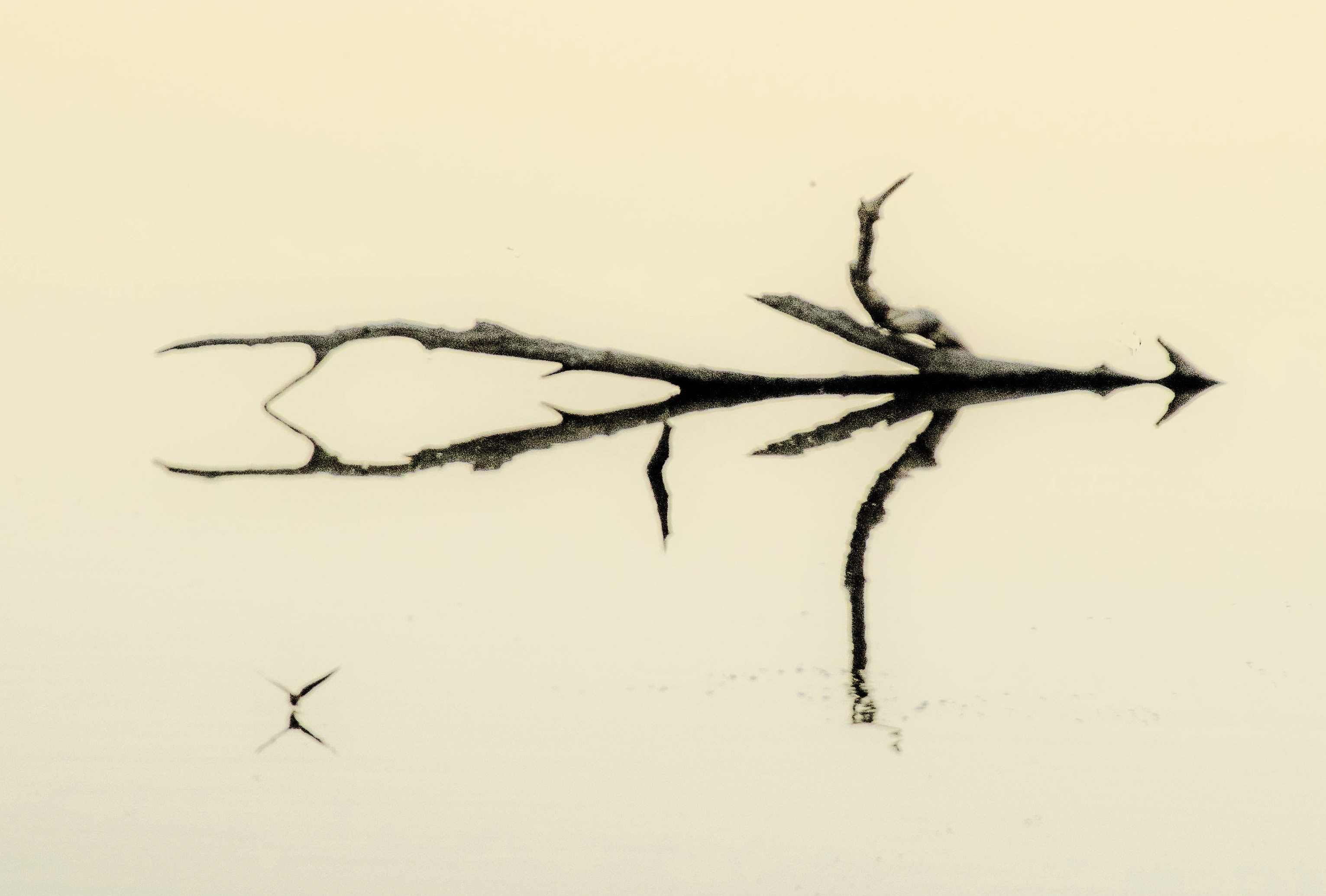
There it lay, weathered and broken, a once sturdy branch of a burr oak that seemed to be reaching out, inviting me back into a world of consciousness and mental peacefulness that seemed to have slipped away … a dreary feeling that has held me captive since early November.
As the oak reached outwardly, I raised my camera to record the moment. Sometimes you have to do these things. When nature calls one must lend an ear. Open an eye. Especially a mind. To paraphrase the late naturalist John Muir, “The oaks are calling and I must listen.”
This singular oak was in the savanna of the Bonanza Education Center some 11 miles due west of Listening Stones Farm, and as my habit, I was once again meandering through this northern portion of Big Stone Lake State Park seeking, well, mental peace.

Back in November I was frequently searching the many wetlands for calm waters. Yes, photographic metaphors. Just like the oak limb. That quest began the day following the results of the election. For about two weeks my files were stuffed with images of just that … calm waters. A stagnant metaphor, it turns out. When frigid airs froze the wetlands, it seemed for awhile I was lost. As temperatures plummeted way below the comfort level, I entered that mental cocoon.
My recent feeling of detachment from nature is solidly evident in my photography files. And with my writing. Oh, I’ve tried. With imagery and words, though little has come of it. This isn’t like me. It isn’t who I am. And I have not been comfortable on who or what it seems I have become. A man shriveling into a darkness of mind; one who for perhaps the first time in his life has chosen to hide from resilience. This is not what I’m comfortable being, at this age, a bent shell of an old man.
Then I found myself driving through Bonanza on a February afternoon. For an unexplainable reason I had stopped the pickup to just sat quietly. My was window lowered as I breathed in the cold air while seeking a certain calmness. Since I was parked on the road between the woods and a woody ravine, perhaps I was seeking that calmness I feel when forest bathing. When I opened my eyes those limbs of the oak were reaching toward me.

Ever since I was introduced to the savanna several years ago, Bonanza has been a harbor for my soul. In decent weather this is where I come to silently meditate and breathe, often easing down to rest my back against the solid trunk of an oak tree, or to even lay beneath an umbrella of staghorn sumac. Countless times I’ve merely sat on a plank bridge crossing over a spring fed rivulet coursing through one of the dozens of ravines found in the park … ravines common to the Big Stone Moraine all along the eastern border of Big Stone Lake.
If my meditation is deep enough even the boats of fishermen on the adjacent lake are duffed into nothingness, often lost in the wind. A scolding wren, though, can break through, as can the peeping chatter of warblers and silken cedar waxwings from high above in the canopy.
Granted, Bonanza isn’t to be confused with a wilderness. While it is fairly uncommon to meet others on the few trails that curve through the undulating savanna, it happens. Cars will slowly cruise down the single gravel road to the Education Center, turn in the wide loop before heading back slowly toward the climb out of the park and valley.
While it seems most convenient to take the lakeside trail, especially with the snow cover, tackling the various loops into the hillside woods beyond the Education Center is almost like entering a different world. A cathedral of tall trees.

A friend, writer and musician Douglas Woods, regularly sends his Sunday morning thoughts from his cabin along the Mississippi River, his “Church of the Pines.” Douglas is seemingly closer to God than I am, although over time we have individually found our respective woods of worship. Mine is here at Bonanza, where when I drive up that hill out of the valley I most often do so with less tension and a sense of mental freedom.
Twice this week that has happened. Somehow I feel stronger. Mentally refreshed. Again I look toward nature. The coming migrations of snow geese and sandhill cranes, of pasque flowers popping up from roughened and sparse hillsides, of wading shorebirds and cottonwoods filled with bald eagles … those passing through rather than the ones now tethered to their nests.
.

Scoring My Annual Buck!
Travis Sandberg surprised me. I had entered his farm office for an interview for a We Are Water panel scheduled for display in March and quickly realized his office was also a studio for his taxidermy work. Although some of his acreage surrounds Listening Stones, his being a taxidermist was surprising.
Skulls with antlers littered the floor before becoming European mounts, all cleaned by mealworms so perfectly they glistened while awaiting a mounting on wooden plaques, already stained and polished, along with a wall lined with several traditional mounts in various stages of completion. In a later tour of his “man cave” inside his rural farmhouse, his own collection of artistic mounts was displayed along with antelope, pheasant and a fine walleye.
Yes, I knew he was a man who farms in a way that protects both his valuable soil and all of our water resources, which was the reason for my visit. But this? And, Travis is as diligent with his art of taxidermy as he is with his precious top soil.

On the other hand I can also say that, yes, I once again got my antlered buck this past autumn. And, no, Travis won’t be mounting my buck for it still lives as far as I know. My buck was shot with my trusty Nikon rather than with a bow or gun, captured within the confines of Big Stone Lake State Park. This is where I go after the Upper Minnesota River Arts Meander and around the hunting season in search of my annual buck. I’ll also readily admit that I do not adhere to the two-week gun hunting season nor the longer, September to December, open season for archery.
This past year I was pleasantly surprised and relieved to even find a photographable buck, and a nice one at that, since there was a special permit granted for area farmers along the Lake Road to kill up to 10 whitetail deer they found munching on their commodity crops of corn and soybeans. Apparently it was a successful program for the deer population along the highway seems significantly reduced.

While that is rather sad, perhaps there is a silver lining for in past years in the depth of winter many area deer appeared to be stressed food wise. Shrunken flanks, and their munching on shrubs right next to the traffic without regard for the danger and in spite of their shy nature. Over population of the deer herd can also lead to such diseases as chronic wasting disease (CWD) and “blue tongue,” officially known as epizootic hemorrhagic disease. This viral disease can spread quickly through a herd. Symptoms include mouth ulcers and a bluish tongue.
Fortunately my antlered bucks have all appeared to be healthy, surrounded by a robust herd of does. They seemed to move freely on the park land and along the hills and ravines that drain into Big Stone Lake within the Bonanza portion of the park. Admittedly, there have been some beautiful racks on some of my bucks that were certainly worthy of Sandberg’s trophy’s art.

Way back in my youth I remember when a photograph appeared in our local Macon Chronicle Herald of the Missouri Conservation Department releasing a buck and three does from a horse trailer into a nearby woodland. The foursome had been captured in the Ozarks before being released into our wooded hillsides. Later, the same would happen with wild turkeys, and now both are so prominent that Outdoor Life and Sports Afield magazines have since placed Macon County within the top ten hunting counties in the nation for both species. That wasn’t my youth.
However, I was briefly a hunter. Years after the release I had a nice hickory recurve bow and arrows with Fred Bear razor-headed arrows and deemed myself rather proficient at archery, Thanks to my adventures with fly fishing in the area around our family farm, I had a rather decent knowledge of the nearby woody wilds. I knew of a stump surrounded by waist-high brush, and figured this would be a great hideout. People were not hiding in trees back then. I sat with my bow, arrow notched, on the stump to await the big kill. I envisioned the rack. A mount like I’d seen in the Herter’s catalogs and now on Sandberg’s walls. In fact, a mount like my friend Sandberg could create. After a few hours of fidgeting I gave up, hopped into the pickup and drove home with the realization that perhaps I wasn’t made for long hours of patient and tedious sitting. Today I might be more patient and in tune with nature. That was my last hunt, however, probably back in 1958 or so.

In my moving between states through my career years I hadn’t given either hunting or deer much thought. I do recall during my one disasterous month as an editor of Country Magazine viewing an excellent portfolio sent to the magazine by a Kentucky photographer with the most beautiful deer images I had ever seen. Leaping fences. Facing off, antler to antler. Picturesque portrayals in the hilly woodlands like back home. His images were definitely in the wild, and much different from what I had remembered by the legendary Leonard Lerue in the 1960s on whitetail deer.
Then I moved here to Big Stone County to plant a prairie and begin a second career as a prairie photographic artist and learned I was surrounded by incredible numbers of deer. I recalled the Kentuckian’s portfolio, and have since spent hours chasing the whitetails. Does and fawns. Winter, spring, winter and fall. And I began my autumn ritual of searching for a nice buck with a beautiful rack of antlers.

To date I’ve been rather fortunate. And the deer have been somewhat cooperative. My one wall “trophy” was discovered on a canoe trip along the Minnesota river years ago, the weathered skull of a nice buck that we believed had found a very secluded place to die after being fatally wounded. It hangs here in my office where I could probably hoist a collection of my big buck images. I’ll have to think about that.
Journaling New Horizons
Here we are fresh into a new year, and I am already having old thoughts, those that bring me back to where I was exactly one year ago. All of which began a few years before that with an ad on Facebook featuring a journal of Minnesota’s then 65 state parks. Although many had been visited over the years, there was neither a file of photographs nor a journal consisting of my thoughts of the individual parks.
Once the book arrived a look at the journaling aspects showed a facing page offering basically an itinerary and planning guide followed by a log of the who, what and whens of the visit on the second page. Not being a list maker, this was way too detailed for my tastes, so, I created my own little manner of journaling that now includes an opening page of photographs followed by my actual journaling. Black ink to the rescue! “Fill your paper with the breathings of your heart,” cautioned William Wordsworth. I can’t do that with a list.
Shortly after receiving the book I pasted my first image … one of my late wife, Sharon Yedo White, sitting on a log at the then new Afton State Park with our two sons along with our then exchange student, Fredrik Croona from Sweden. My own image was reflected in a mirror she was holding. It was taken around 1985 or so. Our first home in Minnesota was about a mile south of the southern border of the park, on a bluff overlooking the confluence of the St. Croix and Kinnickinnic Rivers. That was perhaps our most blissful summer together before the stresses of life snagged us … starting a family along with a corporate business life in magazines and an ad agency.
Ah, yes, the makings of a journal. A photograph plus a facing page containing my written thoughts. I promised to fill the rest of the photographic page with images from the park, which was accomplished this past October.
By November of 2024 some 38 state parks had been visited and journaled, although one of my favorites where we spent so much time camping and fishing both as a couple and later with many foreign exchange students, the Upper Sioux Agency State Park, was decommissioned and the land returned to the Dakota Nation. While that was likely an overdue move by the State, it’s a place that holds many fine memories as well as beautiful camping nooks for escaping the ills of society. Yes, it’s journaled.


Just inside the journal is a state map noting the location of each state park, and by now, some three years after receiving the journal most of the state parks in the southern half of the state, from the tip of the Driftless along the Mississippi River and Iowa Border up to the Canadian Border, have been visited, photographed and journaled. Indeed, last September after our aborted effort to do the Lake Superior Circle Tour, we decided to start at Grand Portage State Park at the Canadian border and visit all of the State Parks along the Superior “coast.” A redemption, if you will. Something to sooth our raw souls (yes, thoughts that were journaled!).
Our first day went well, and the second started wonderfully with a short hike into the falls at Cascade River SP that was breathtakingly beautifully. The park was a “water baby’s” dream offering waves of photographic poetry. Next was Temperance River SP where I choose to take a rock stairwell rather than a paved path and lost my balance on a deeper than expected step. Down I went, crushing my camera and lens beneath my body in a hard fall. Both were ruined, which has since led to quite a technological adventure, and one that is quite challenging for a man my age.


After much thought and concern, the decision was made to continue with my art. I wasn’t ready to quit even as I turned 81. Since my crushed Nikon had been discontinued I have since “graduated” into a whole new realm of technology. My old photo processing software wouldn’t handle the new imagery, and then came the reality that the printer I’d used for the past several years was obsolete. Epson had discontinued producing the specified ink cartridges …. meaning a new printer. More technology, and one I’m still dealing with. My two main software programs still operating on my old iMac desktop were long obsolete although still usable with the older equipment. New camera. New software. New printer. More new technology. New tricks for an old mind.
Yet, there’s the state park journal along with my quest to continue my form of “Impressionistic Prairie Art.” No, I wasn’t ready to quit — not my art nor my journal, not when I only 26 state parks short of completing my goal!


This past year we actually visited 17 parks. This came after a count when I sort of felt like I’d short changed myself. This doesn’t include our home park, Big Stone Lake SP with its distant Bonanza Educational Center. Both that and the Meadowbrook section are visited numerous times each month.
So now I’m where I was a year ago in looking over my journaling and the parks previously visited and scheming forthcoming trips. Minnesota is blessed with some of the most beautiful and interesting state parks in the nation, and hopefully if my health and energy continues we’ll make a dent in the 26. Typically we’ll park the camper at one state park and visit any that are close by, Roberta holds Joe Pye on a leash while I search for imagery, sauntering down a narrow wooded trail or seeking an angle of a beautiful river, all while seeking some photographic “poetry.”