Source: Earth Day
Earth Day
Reply
Source: Earth Day
As flames danced exotically against the blue sky, Earth Day 2017 became one we’ll not long forget thanks to a favorable wind and the Clinton Fire Department.
Ah, yes. My very first prairie restoration burn. And one I didn’t quite expect so soon. Initially we had plans to attend the important March for Science at the University of Minnesota-Morris. Age perhaps had a hand on my being home after two straight days of driving to Fargo and back with computer issues. Surprisingly the call came mid-morning from the fire chief. Yes, I had the burning permit, and yes, I would be home. All I had to do was activate the permit with a phone call.
About an hour later the trucks began arriving, along with the wind. “This won’t take us long,” said the chief, eying tree activity in the grove. Yes, even the larger branches were swaying. “We’ll start here in this corner and work around your farmstead.” Which I found interesting since I had envisioned starting on the northwest corner of the prairie and working down this way. Luckily I wasn’t in charge.

Taking the canisters of mixed fuel, he and another fireman walked the edges of the prairie next to the garden and along the county road and my first, on-farm prairie burn was underway. All eight acres! Within moments the wind fueled the blaze, fanning flames high into the air. Smoke bellowed above the prairie sending the signal aloft for all to see miles away. Their burning plan created a natural fire break and kept the burn both within caution and reason. The burn was going extremely well despite my fear of being a bit late, for the undergrowth of grasses had already begun to green. That green was no match for the intense heat. Initially we had aimed for the first of May so the weed trees would have a bit of greening. An unseasonable, early spring had taken care of that.
My burn plan actually began a few weeks ago when the same Clinton fire crew suddenly pulled up in front of the farm and made preparations to burn a patch of prairie across the road. As they monitored the burn I approached to ask a few questions. “We really don’t have time to talk now, but will once we’re done here,” said the harried fire chief.

About an hour later they drove up the driveway. And new plans were crafted. With the proximity of my studio to the prairie, the fire department would have been called despite the original plan made with a dear friend, with ample restorative prairie burning experience thanks to his work with Pheasants Forever, over a pizza weeks ago. He is also deep into wild turkey season, and frankly, the distant two-hour drive and unpredictable wind directions made it more sensible to do the burn with a local crew.
So on this sunny and windy Earth Day all forces joined together to renew our prairie. We were due a burn for both prairie age and to thwart the encroachment of the weed trees, mainly Chinese Elm. Now the wait begins to witness an amazing transformation. It might not look like much now, for the only green is in the walking paths we had cut through the prairie … for there were no matted prairie grasses there for kindling. Otherwise the prairie is charred black. It won’t take long for the prairie to recharge. Typically a beautiful flush of forbs and flowers will explode from that blackness, and hopefully the big bluestem will finally take hold to become the dominate grass.
We still have some important steps to take. First will be the arrival of Blayne Johnson with his brushhog to whack down the weed tree forest that has taken root over three primary portions of the prairie. Within an hour of his tasking, the small exposed trunks of the seedlings must be sprayed with a strong brush herbicide to kill them. Although the tops were likely “killed” by the heat of the fire, the roots … like those of the matured prairie grasses and forbs … are very much alive and have stored enough reserve energy to quickly send up new shoots.

We have a serious an issue with weed trees. When the grasses went into dormancy last fall the true extent of the weed tree takeover was vividly evident. Those elm shoots remained green in contrast with the brown prairie grasses, showing a dominance of volunteer seedlings.
This will likely be a life-long fight on this little Big Stone County prairie regardless of our success with this initial burn. The real solution is to take out all of the “mother” elms, a decision I have yet to accept because I hate losing mature trees that add both physical beauty and shade for the farmsite. Especially the tree next to the studio, one of stature, character and beauty.
Certainly the elm issue is of topical concern, although we are beginning to see an influx of Eastern Red Cedar on the nearby hills and bluffs that aren’t farmed. Cedar can throughly dominate prairie lands as evidenced by the wild, unfarmed areas around Granite Falls, just little over an hour southeast of here. More and more of the cedars are dotting the hillsides up here which isn’t a positive sign.

Fortunately, we’ve seen no cedars here on the farm.
Our Earth Day burn didn’t take long. About as much time as the march in Morris, I suspect. We’re quite fortunate to have a small town fire department in Clinton with the knowledge and tools to do a good burn. Soon after they motored off to do three more burns Saturday afternoon we sat on the deck sharing glasses of wine and marveling at the blackness of the charred prairie and talking about the resurgence of the native flowers and grasses.
Within a few weeks, perhaps, the greening will begin, and the entire eight acres will soon be in full flush of new growth. Lush with color and vigor. That is one of the beauties of growing an underground jungle. And, certainly, a reason for our sense of excitement. While we missed participating in a wholly necessary political march less than an hour from our doorstep, our Earth Day was hopefully spent in an equally important manner.
Source: A Gift
For the past few weeks I’ve gone from website to website studying various features of different fly reels. Which was what I was doing about this time a year ago. Eventually I chose a fairly nice looking, mid-priced reel for my virgin fly-in trip into Ontario for a fly fishing-only adventure.
That reel, unfortunately, was a mess. Or, at least the amount of line that involuntarily escaped by my feet while casting created a mess.
Over my many years of fly fishing I’ve basically used Pflueger reels, and was on the verge of ordering another one last year when I mistakenly decided to try something “sexier.” So this past Tuesday morning I bit the bullet and sent in my order for new one. Later that afternoon a surprise package arrived from Apple Valley and it sat unopened on my desk for hours as I combed my mind for any reference of someone I might know there. Finally I opened the small, heavily taped box.
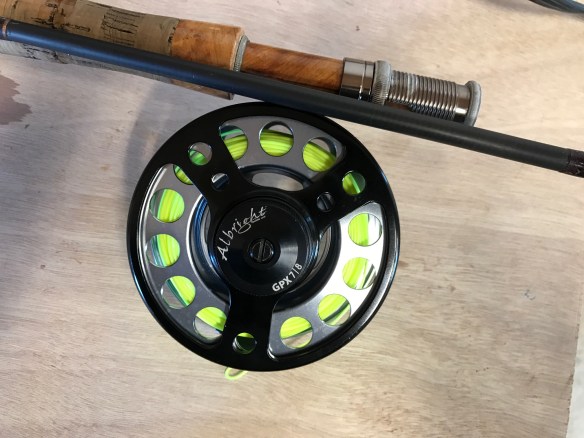
My homemade rod and my new reel, a gift from Edward Hoffman.
Inside was a fly reel, one already lined with 10 wt. forward-weighted floating fly line, and a note from Edward Hoffman, a retired classical musician from the Baltimore Symphony who has since moved to Minnesota. Ed and I fished together last May in Ontario. Ed was the first person on the trip to ask if I would spend the day in a boat with him, and in fact, he was one of two fishermen two days later who basically saved my life after the boat I was motoring flipped over into the frigid waters.

One that came to hand ….
Once we were back I mailed him a framed print in appreciation, and in October he surprised me by coming out for the Meander, a juried art crawl I’ve been a member of now for four years.
After placing the new reel on my 8 wt. rod, which was “overlining” the rod as he and others have suggested, I walked into the windy prairie to give the system a try. Interestingly, the rod was perfectly lined, and I wrote Ed an email to tell him so, and to thank him for the incredible gift. Moments later he responded by writing, “Bob Clouser gave me that reel many years ago, and his only caveat was that I give it to someone some day. You are that someone. If you don’t need it, just give it away to a deserving person.”

This old VCR is still in my collection!
With that, I had to sit down. Clouser is one of masters in the sport of fly fishing, and his Clouser Minnow is a must for any fly box. A gift like this would be like getting a football from Brett Favre. Clouser’s minnow is my primary fly for river walleyes. A different choice of bucktail and hook size has caught pike and both largemouth and smallmouth bass, and a much smaller version tied with yellow and white bucktail has been a great choice for crappies and silver bass through the years.
Which brings me to this. Years ago I purchased a VCR tape featuring Clouser and Lefty Kreh (think Temple Creek fly rods and his own iconic fly, the Deceiver). The box says “1996.” Between then and now, Kreh was the featured fly fishing expert at the Great Waters Show in Bloomington, and was certainly approachable. He loves to talk and share stories. He also lays out a beautiful line, as he demonstrated at the hotel pool later in the afternoon. With incredible deftness and economy of motion, he double-hauled the tip of the fly line some 90 feet through an open door on the second floor where tables were set up for fly tying demonstrations. He was in his late 70s, or early 80s, and this one moment provided confidence that I could continue this passion for as long as I’m able walk.

Dan Johnson and Edward Hoffman
I’ve not met Clouser. Kreh and the other “super stars” of fly fishing have totally destroyed a myth that this is primarily a sport for elite, self-important, perfectly-dressed jerks. Through the years I’ve been fortunate to hook up and chat with Kelly Galloup (his Zoo Cougar is a smallmouth must), Skip Morris (tyer of the SMP, a very effective bluegill fly), Tim Holschlag (perhaps the premier smallmouth fishing guru and author of books on the sport, and the host of the Ontario trips) and Dave Whitlock (who gave voice for years to warmwater fly fishing). Whitlock and I have talked at fly tying gatherings three or four times, and each subsequent time he has remembered our conversations. At an Eden Prairie fly shop one night he even said, “You trout boys, let me get with you momentarily. After John and I quit talking about bass and catfish fishing.” Talk about privilege!

Whitlock’s signing of his book for me.
Holschlag is one of those people who you can ask about the weather, then a half hour later you’re still listening and wondering about the intent of the question. We first met at Bob Mitchell’s fly shop when it was still located in Lake Elmo back in the 1980s. He was giving a seminar that morning on smallmouth bass fishing, an event posted on a small blackboard in the shop. My late wife, Sharon, and I, along with the boys, were on an agenda-free Saturday morning outing, and she was kind enough to allow me to stay for the presentation. I hadn’t fly fished for smallies since leaving Dubuque years before, and it was a sport I simply loved. And, we four were his entire audience that morning. My how times have changed!

Tim Holschlag and Dan Johnson with the camp dog!
So, here we are, years later, doing Holschlag’s trips to Ontario where the smallies are huge and plentiful, and the largemouth prevalent. Pike prowl the shallows, and if you’re patient and lucky, and know the proper technique, muskies can be brought to a fly. And you can meet and fish with some very fine people, like Dan Johnson (a boyhood chum of Holschlag’s and his right-hand man still today) and Edward Hoffman.
In about six weeks Hoffman, Johnson, Holschlag and another eight or so of us fly fishers will gather again in Fort Francis to fly into a small, deep woods resort surrounded by water teeming with hopefully hungry fish. Once again I’ll go with my own hand-made 8 wt. fly rod but with a reel handed down from Bob Clouser through Ed Hoffman. One of the flies I’ll no doubt tie on will be Kelly Galloup’s Zoo Cougar, and when that happens I’ll think of Garrison’s Keillor’s closing line in his last monologue on Prairie Home Companion … “What goes around, comes around.”

Before an evening outing at Slippery Winds in Ontario.
(Written in appreciation for the vast appreciation I have for all the fine acquaintances and friendships that have resulted from fly fishing and tying. Besides the previously mentioned, to Rick Nelson, Roger Emile Stouff, Doug Peterson, Norway’s Erlend Langbach, Joe Norton, Dennis Ulrich, my nephews, Matt and Scott White, and so many I cannot remember and should probably list. Pretty good stuff for a guy who was given a fly rod for doing chores as a ten year old for a neighbor dying of lung cancer, and a sport I learned on my own thanks to Sports Afield, Outdoor Life and the old Herter’s catalogs. I may not be very good at it, but little does that matter. For I’ve always had fun.)
Source: Good Timing
Source: Bliss in a Blind
Source: March Madness
Yes, there are taxes to do. I could be bent over the jig building a spin fishing rod I had promised a friend for an upcoming fund raiser. Instead I’m looking out over the prairie where winds are pushing snows to a near whiteout and thinking of birds. In this wind-blown snow black shapes clamor for sunflower seeds or their turn at the pork fat, and none seem worse for wear in this intermittent blizzard.
Wild birds are a long time passion of mine, even if I’ve not been adept at keeping a running Audubon log of those I’ve seen over the years. Yet, until old age takes a grasp of my memory, I can still remember specific first sightings. My first curlew up in a wetland near Clinton three springs ago, slowly striding the edge of the water with its long, turned-down beak. Or the scarlet tanager at a park along the Concord River west of Boston. Perhaps my first cedar waxwings in the tree branches outside of an upstairs window of Java River Coffee House before a board meeting of an environmental group; of being surprised at how small they were. There was the excitement, too, of the brilliance my first red-breasted grosbeak perched on a branch, and unfortunately just passing through. I could go on. Maybe I’ve made my point.
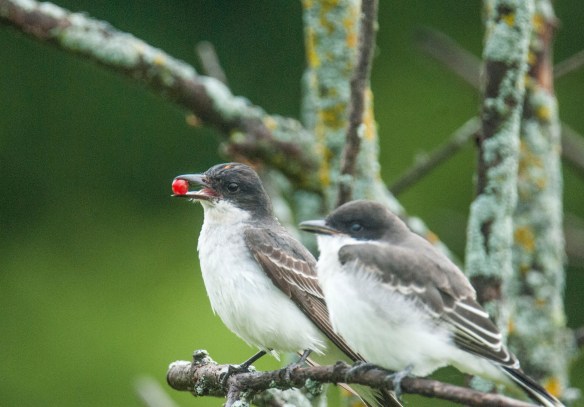
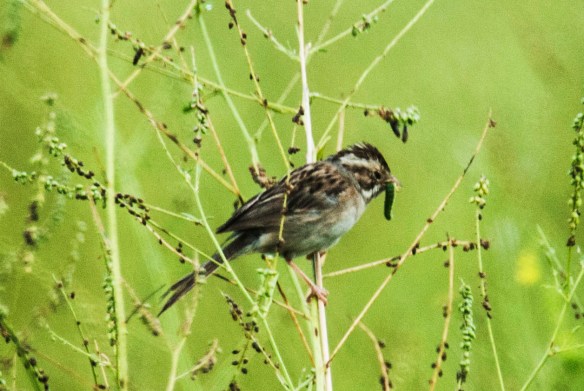
For the second time in my life my home is along a recognized flyway. The first was at our home across the highway from the Little Vermillion River east of Hastings. An area called Prairie Island, this land mass stretches from lower-town Hastings between the Little Vermillion and the Mississippi down to Redwing, and it’s a backwater, wooded paradise. A bird feeder just outside our dining room allowed us to sit for hours at the table watching the comings and goings of a vast number of bird species. Many new sightings along with obvious renewals of song birds I had seemingly forgotten on my 12 year Midwestern hiatus while living in Denver.
Those backwaters were tremendous gathering spots for waders like the egrets and herons. Seemingly every year a “Louisiana” heron hung around two large backwater “ponds” we visited across from the house. High spring waters left behind fish trapped in the pools.
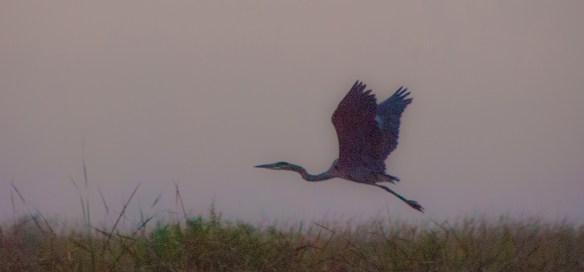
After Hastings we settled into a small prairie town about two hours southeast of here where I ran a country weekly, an area lacking of much avian variety beyond red finches and house sparrows.
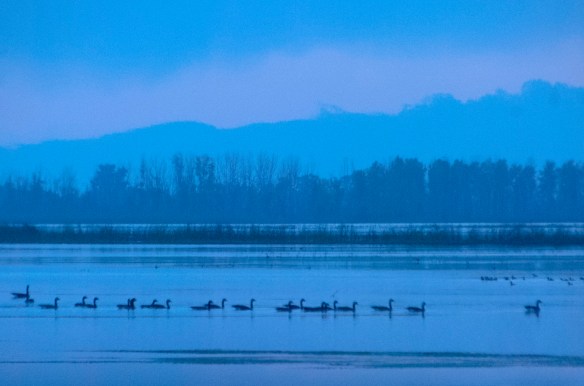
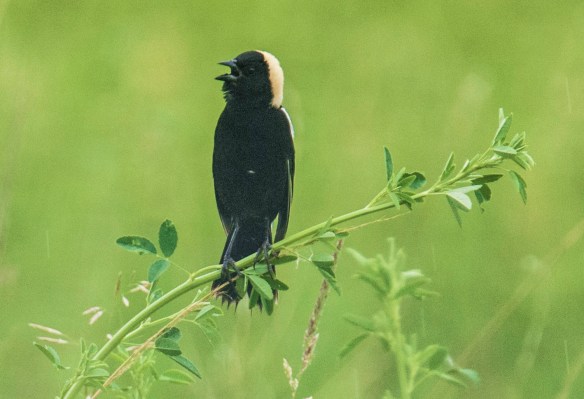
Then my now ex-wife and I bought this small prairie farm just up the hill from Big Stone Lake, on a “branch” of the Mississippi flyway, and once again there is an abundance of bird life. More varieties and numbers of geese than I could have ever imagined, and thanks to the last remnants of the pothole prairie, murmurations of red wing blackbirds, starlings and other “black” birds that are as frequent as they are mesmerizing each spring and fall. Terns drift in the wind currents on summer afternoons, and we’re serenaded by songs from the wetlands over the hill each spring. Swallows dart around over the prairie all summer, and gold finches mingle with grosbeaks, jays, brown thrashers and the many woodpecker species, and pheasants “bark” from the native prairie surrounding our house.


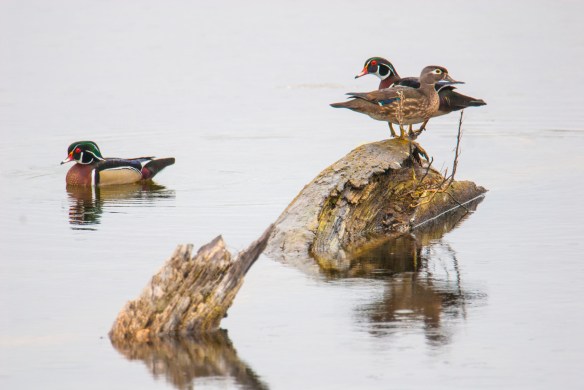
One of the real treasures, and interestingly one that isn’t mentioned much to either newcomer or tourist, is the motor trail winding through the nearby Big Stone National Wildlife Refuge. What a birder’s paradise, and one that seems to offer a constantly changing population of winged characters depending on the season. Damming of the Minnesota River has created a swampy shallow stopover for hundreds of thousands of geese, swans, species of ducks, shore birds and waders in the spring and fall, and acres of prairie grasses create food and nesting homes for bobolinks, meadowlarks and other prairie grass loving birds that have been forced out of our lives (and their’s) by modern agricultural practices. Oh, there is also ample woody terrain for kingbirds, orchard orioles, warblers and others.

Beyond the driving loop, owls, eagles and huge hawks perch and glide through the exterior of the nearly 12,000 acres of the Refuge. To break it down, nearly 1,700 acres of the refuge is in prairie grasses and other native plants. Some 4,250 acres of water are there for the birds thanks to the Highway 75 Minnesota River dam. Perhaps one of the most beautiful aspects of the park are the natural outcrops … nearly 100 acres in all of granite mounds bared by the Glacial River Warren, washed out of the prairie earth by the aftermath of the breaking of the huge ice dam of the glacial Lake Agassiz. While naturalists are attracted to the rare and native ball cactus and the other narrow window of native plants specific to this rare and interesting ecology, the outcrops attract nighthawks and other birds.
A drive on the loop most times of the year will provide nature lovers and birders ample sightings, and it seems no two drives ever offer a diet of the same winged species. No one should be shocked at the chance surprises, such as a bald eagle crashing into the water before departing with a fish secured in its talons, or the sudden appearance and flight of the quite rare “upside down” bobolink. American avocets drop in temporarily, as do the yellow legs. I could go on and on.
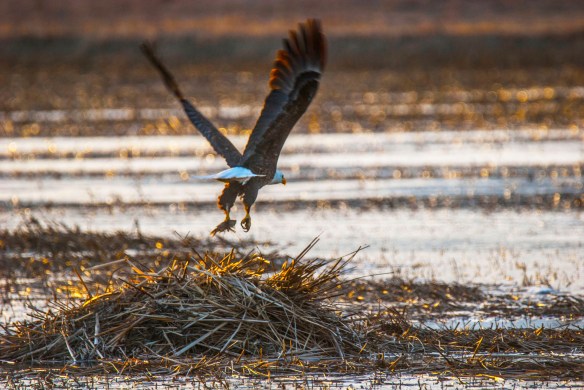
So the blizzard offers a partial white out, and the taxes and rod awaits. I can smell the pork chops and sauerkraut simmering in the crock pot, and despite it all I almost pine for a quick trip through the Refuge just to see what is there to see. My feeder, though, offers a warm refuge for the likes of this old guy, so most likely I’ll simply stay put.
Ah, yes, the wind. Gales. Gusts. Lulls. Then, more of the same. All we’re missing is the popping of the sails. Rather, on this remote Minnesota farm, chimes dance beneath anchoring limbs, adding tingling percussion to the seemingly constant low roar.
This is the prairie, after all, where grasses once grew. And the winds continue to blow. In the near distance nowadays, a softness of color hangs along the low horizon just above farm fields. Especially in areas where the grasses are long gone and the fields were tilled bare months ago. Some fields were worked last July and August following wheat harvest, meaning they will have been exposed to the prairie winds for 10 or 11 months before a new crop emerges enough to protect what is left of the soil. Most of the ground was worked after corn, soybean and sugar beat harvests in November. And that softness along the horizon? Dirt, aloft in the winds, misplaced, adrift and gone. Forever.

At a showing of my “Art of Erosion” images at the traveling Smithsonian “Water Ways” exhibit last summer, a man asked why he doesn’t see dirt along the ditch banks beyond the winter months. “It’s there,” I explained. “It’s the snow that provides contrast, making it easier to see.”
That contrast is an integral part of a showing of the “Art of Erosion” now displayed on the brick walls of Java River Coffee House in Montevideo, which will hang through March. An artist’s reception is scheduled for this Friday, March 10, with the wonderful women’s musical group, Homemade Jam, providing entertainment. We’re calling the event “Prayers for the Prairie.” This will be the first public display of the “Art of Erosion,” which has made the rounds at many sustainable and organic farming conferences, plus the Smithsonian exhibit at the Prairie Woods Environmental Learning Center, over the past three years. Common comments fall into the “beautiful but sickening” genre.

Choosing to hang the 19 canvases and call-out boards came about with much thought and discussion, especially considering the political climates in both St. Paul and Washington, D.C., where a political party seems intent on loosening regulations without much concern for the health of the planet. Consider this a protest display, if you wish, for it is certainly meant as a statement. The “Art of Erosion” was made possible by a manifestation of failed farm policy and a neglect by individual farmers of healthy soil stewardship practices. The images were made on a Sunday, January morning after returning from a trip to Marshall the previous day and seeing the miles upon miles of “snirt” — a colloquialism describing the combination of snow and dirt — along the entire trip. All were made in an area of Lac qui Parle, Chippewa, Swift and Big Stone Counties, and beyond minimal cropping, were not enhanced in any way with computerized post production software.
Interestingly, this idea came on top of a longer drive home from Missouri the previous Thanksgiving when we witnessed snirt along the highways from Missouri through Iowa and into the former prairie region of Minnesota. Hundreds of million tons of dirt, all blown away. Online research showed that Land Grant universities in much of the Midwest, and even into Canada, were concerned enough to post instructions on how to protect our valuable croplands from being misplaced by the winds. Simplest and least expensive was simply holding off tillage until spring. Indeed, that is evident along our roadsides, where ditches along stalk fields remain quite clean.
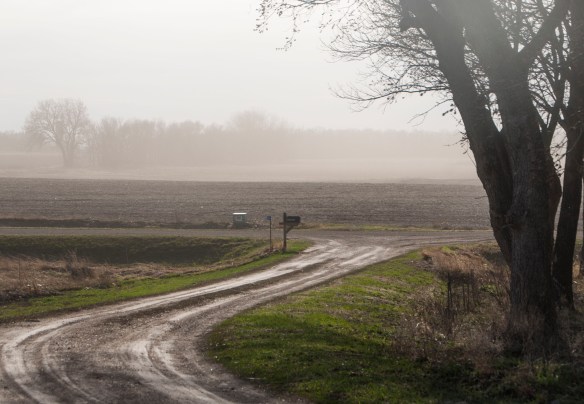
Thankfully there has been a lot of conferences and efforts since to convince farmers to plant cover crops, explaining multiple benefits such as a softening of the hard pan, better moisture retention and the addition of crop nutrition elements. All on top of preserving a key component of life … our soil.
Numerous soil experts such as Rick Cruise, professor at Iowa State University and the director of the Iowa Water Center, points that besides cover crops, no-till, terraces, grassed waterways and any number of practices can contribute to saving soil in row-cropping enterprises. He emphasizes that some landscapes are sustainable only under an agronomic system that includes perennial crops – trees, prairie and pasture.

David Montgomery, author of “Dirt—The Erosion of Civilizations”, points out that the earth’s “last frontier” of farmable lands are now being cultivated, and once that thin layer of life sustaining food production is eroded away, then what? Erosion has brought an end to man-made civilizations throughout history. Will snirt be end of ours? Does anyone care? Aren’t farmers and others aware of what is being allowed to happen to this soil?
After a recent Water Quality Conference, a Minnesota State Representative who has since introduced legislation to eliminate a soil saving buffer strip initiative, was quoted as saying that farmers in his district were “great stewards of the land.” A quick trip down Minnesota Hwy. 28, which was the likeliest route for his way home from the gathering in Morris, showed miles upon miles of blown dirt in the ditches and road banks, and several places where windbreaks had been dozed from the ground, eliminating even more protection for this “last frontier” of farmable soil.
Which led to a friend to ask, “What? I wonder which route he took on his drive back home?”
Spring in the western prairie region of Minnesota comes alive in some special venues, though none more lively and boisterous than in the wetlands.
Ah, but what a term. Some who grew up here look askance at you when you say, “wetlands.” More common to them is the term, “slough.” Technically they’re the “potholes” of what ecologists call the “prairie pothole” biome. These are the remains of the last glacialization some 12,000 years ago, and if you happen to see one, or if you are more fortunate than most by living near one, you are near a rare moment of earth time.
Here is why: since John Deere’s plows came to the prairie with the encroachment of European settlers, 99 percent of the potholes have been drained to make way for what we call commodity crops. Corn and soybeans, mainly, but also sugar beets, potatoes, edible beans and sweet corn. A “prairie” is a really a misnomer since all but one percent of these former grasslands that stretched from mid-Canada into Texas remain, sectioned off into mile-wide squares. In the early to mid-1900s, there were typically four quarter-section farms. No more.
Before the plow and eventual underground tile drainage and ditching, there were thousands upon thousands of potholes dotting the former prairie. Several in each quarter section. Ghosts of those wetlands typically appear each spring when the frozen subsoils prevent the spiderwebs of drainage tiles to move off the surface waters. In time, perhaps, the ghosts will return, for as a dear friend and naturalist, Tom Kalahar, preaches, “Nature always wins!” We can only hope, though none of will likely see this in our life times.

After living in the industrialized “black desert” of farming for the first twenty-some years of my prairie life, moving into Minnesota’s “Bump” has been a revelation. For all around our Listening Stones Farm are many natural potholes. A large one can be seen from the upstairs rooms of this old farmhouse just over the rise to the east, and a smaller one is up and across the road from our upper prairie. Thanks to a recent hint we have discovered a jewel box of potholes just north of the “Clinton Road” just three miles from the mailbox. Big Stone County is perhaps the closest county in all of the former Minnesota prairie pothole region of resembling the original, post glacial landscape. Indeed, many federal and state sponsored restored native plantings surround some of the wetlands, allowing you to almost visualize how the natives saw the land pre-plowed back in the 1800s.

Best of all, living nature seems to agree. For those of us fortunate enough to reside here, spring is truly a special season. A recent trip north toward Barry found about 20 bald eagles resting on the ice of a frozen pothole. A month after moving here I saw my first Curlew on a nearby wetland. We’ve already seen several pairs of geese on the smaller wetlands, presumably scouting for nesting possibilities. Within a few weeks male Redwing Blackbirds will arrive to stake out territories on cattails now frozen along the edges.
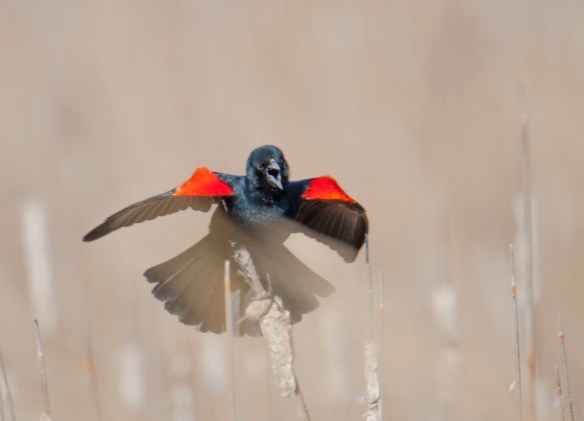
Back in my country weekly days I was often amused by phone calls from readers excitedly describing their first viewing of spring Robins. Sorry, folks, I’d suggest, but the true sign of spring already happened two months ago in a nearby slough when the Redwings appeared as suddenly as they had disappeared last July, their feet securing balance on a browned and bouncing stalk of wind-blown cattail, nervously alert while staking territory.
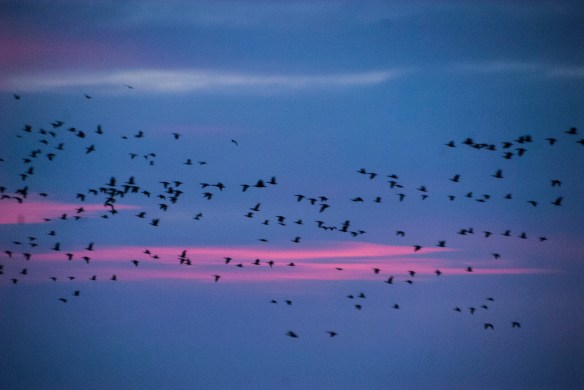
Just being outside right now gives witness to skein upon skein of Canadian and Snow Geese flying over, announcing their flights in seemingly joyful chorus. And friends sitting around a late afternoon bonfire will look skyward following the sound, searching for “vees,” faces fixed in smiles. Early mornings as the sun rises, you can hear geese either over the hill or feeding in one of the unplowed corn fields nearby. As the potholes thaw, more and more will alight in rest and the sounds will dominate spring air. Literally thousands of geese at a time will hole up in the wetland to the east. It is a sight and sound I’ve thoroughly welcomed in my life and anticipate with glee.

Spring in the potholes is just as alive and vibrant as any I’ve found while canoeing the nearby prairie rivers. Be they Swans, geese and the many species of ducks, when the potholes come alive, spring has finally arrived.
 Listening Stones Farm