Chasing Cats
Reply
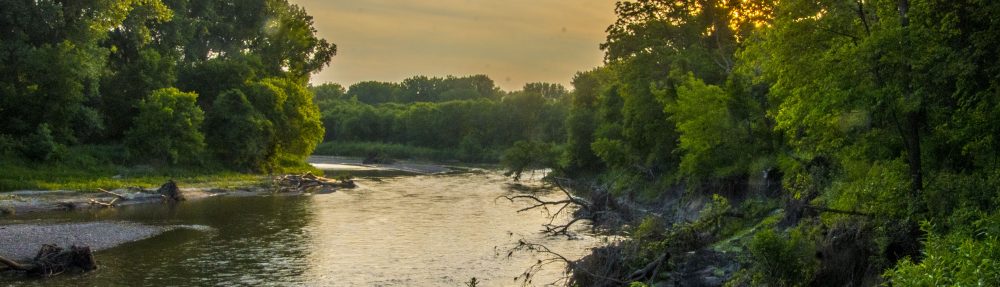
Along with the ease of my paddle slipping into the murky waters came a comforting sense of once again being one with the Minnesota River. An intermittent facing breeze riffled the waters as we pushed off from the Wegdahl landing between Granite Falls and Montevideo heading upriver. This was my first paddling of the year and my shoulder weakness, particularly on the left side, was apparent.
“Tom,” I said to my longtime friend, paddling and fishing partner, outdoor writer Tom Cherveny. “Give me a little time to find my rhythm. It’s been a long winter.”

“No problem,” came his response. This wouldn’t be the first time he has “pushed me through.” We’ve paddled canoes for many years of our friendship. On the Minnesota as well as the other upper Minnesota River tributaries, on several area “motor-less” lakes and in the BWCA. Cherveny is an experienced and excellent paddling partner, and on this lazy Saturday afternoon our quest was to bring home a stringer of channel catfish.
For years we would slip into a canoe in his hometown of Granite Falls and paddle downstream to the then Minnesota Falls dam, which we would portage around before having a picnic lunch while angling in the waters below the dam. Fortunately the dam is now only a memory as the river has been returned to a natural state of interesting rapids. Typically that trip would happen in April or early May, which meant it was usually the second or third of our annual springtime paddles.

For many years we would tackle the stretch between Wegdahl and Granite as soon as the river was freed from ice, and sometimes that meant putting in as early as the first weekend of March. Death water, and only once did it cause heart palpitations. That was a spring of extremely high water, and the current from above was colliding with the water being backed up by the dam to cause our canoe to rollick and roll in the frigid waters. No one would have survived a capsize in that combination of unrestrained currents and the near freezing water temperature. Otherwise it was a wonderful trip for observing geese, ducks and eagles, which seemed plentiful on every bend of the river.
Eagles were scarce Saturday afternoon, and we saw only a couple of pair of Canada Geese. Wood ducks were plentiful, though, and broke often from the wooded banks and from the trees on the entire paddle upriver to the first major turn after the straightaway … probably a couple of river miles upstream.

The water wasn’t extremely high on this jaunt, yet it was high enough that we canoed easily over the rapid field as if it didn’t exist. Tom’s idea was to paddle upriver against the current to the bend heading due east. This bend heads into the long lower leg of the wide “u” that then takes two 45 degree turns before the river cruises beneath the Highway 212 bridge toward Prein’s Landing just outside of the city limits of Montevideo.
It wasn’t long before my shoulder muscles warmed up enough to ease into the routine so I could take some of the paddling pressure off Tom in the stern. Our route was accented by dimpled reddish hues of springtime buds on trees along the banks of the river, adding to the beautiful fleeting color of the wood ducks … perhaps the most beautiful of the duck species if not the entire avian universe.
And certainly, after all of the rain these past few weeks, seeing a cloudy yet sunny sky was a blessing. If there was a “down” on the afternoon paddle it was the drone of traffic on the parallel highway. When I’m driving on the highway, though, passing this stretch of the river brings back many memories of paddling through here over the many years; along, of course, with the many fishing memories. Our afternoon would add to those, no doubt.
In high water a temporary island appears on the first turn after the Wegdahl bridge, and just past the island along the bank is a deadfall that seems to always produce some nice catfish. This would be our last stop on the way home a few hours later.
When we eventually reached our intended destination at the top bend of the straightaway, where a small stream eases through the woods to empty into the river, I pulled my cellphone from the Ziplock to take a picture of the stream. A split second later as I was slipping it back into the bag, a deer suddenly bolted from the woods and leapt across the stream. “Shit!” I shouted. “That missed picture will haunt me for the rest of my life!”
“It probably isn’t your only missed picture,” came the response from the stern. How true.
Once tethered to a branch of a deadfall, our lines went into the waters and the wait began. Fishing is another term for the wait, and conversations between old friends and writers ensued. These are some of my favorite moments. Tom has paddled probably every lake in the BWCA at some point, and has hundreds of stories. I’ve begged him for years to put those memories into a book.
Here’s one: Years ago a Scout Troop leader, Dan Stephens, inexplicably left his canoe and group in search of a portage, and lost his balance hopping over a rock in the deep woods and was knocked unconscious, resulting in confusion and a concussion. His was one of the two stories in the book “Lost in the Wild” (by Cary J. Griffith, Borealis Books). Griffith writes of a paddler’s group that was stopped by rescuers and asked to break down Stephens’ camp and drop off his tent and other items at the headquarter’s office in Ely. That “group” was Cherveny and his sons.
On Saturday he had another interesting tale involving a bear hunting companion with serious health issues who joined him on a hunt in the BWCA this past September. When Tom returned from his post his friend was nowhere to be found, and due to his friend’s heart condition and bad knees, the time of day and temperature, Tom called for help from the search and rescue squad. This resulted in a massive manhunt that included manpower on the ground plus a helicopter and float plane. Around dusk he was found two lakes and a muddy marshland away, and hopelessly lost when the helicopter pilot spied the man’s campfire.
I mean, what better way to spend a springtime afternoon than catfishing and listening to another Cherveny tale? Not all of the stories, though, are as dramatic as these.

As the afternoon passed, we began bringing catches to the gunwales. We normally do rather well with the rods, and this was no different. Tom was in the stern last summer and netted my 8 lb. walleye, and years before he witnessed a great hour of wilderness walleye fishing below a falls in a BWCA lake when I used a deer hair jig I had made. On this afternoon I personally landed three different species of fish, including a nice channel, and Tom did even better on the catfish as we worked our way back down river toward the landing. Wood ducks, and a huge turkey tom, made their appearances on our way back before we stopped at the deadfall just upriver of the island.
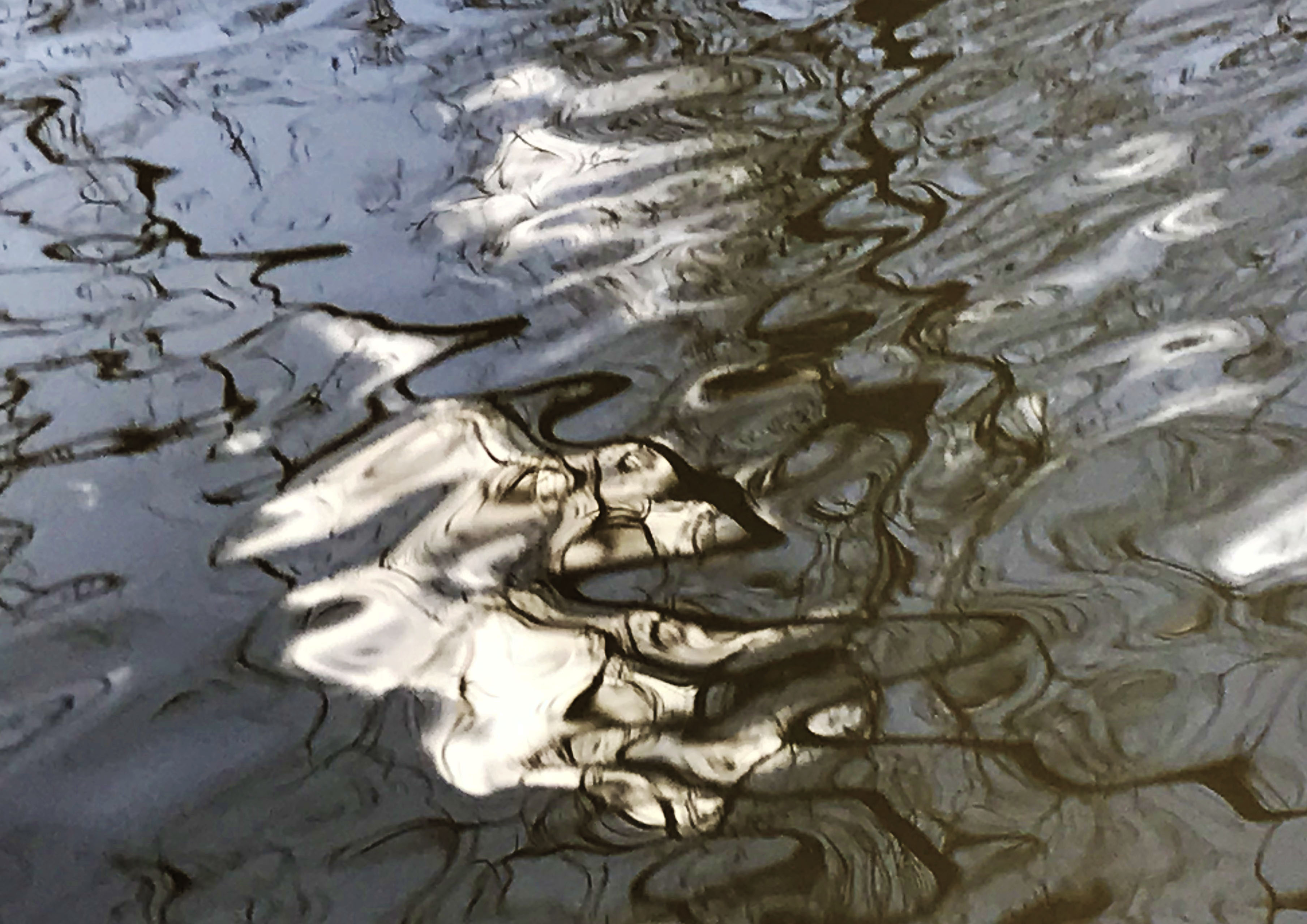
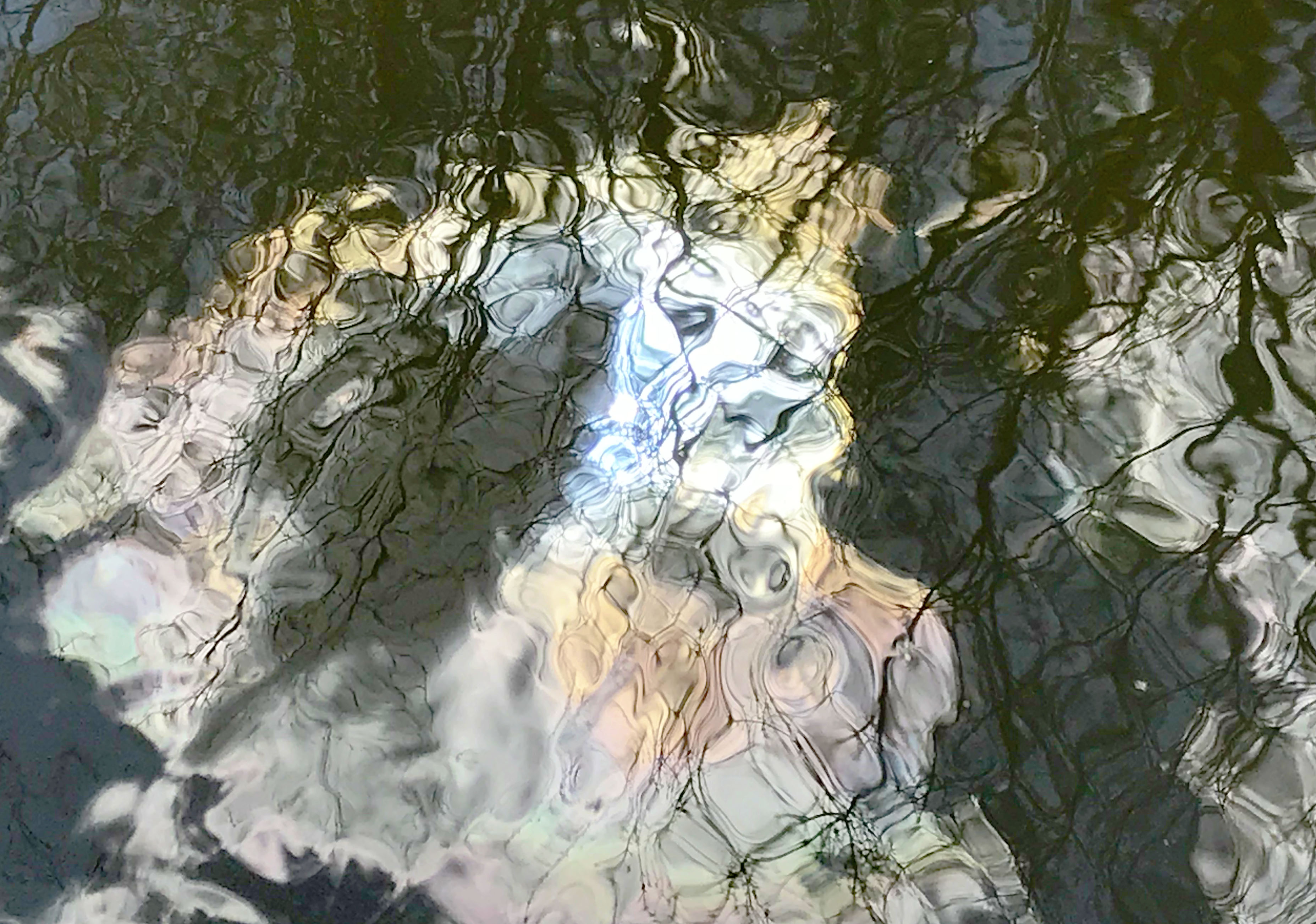
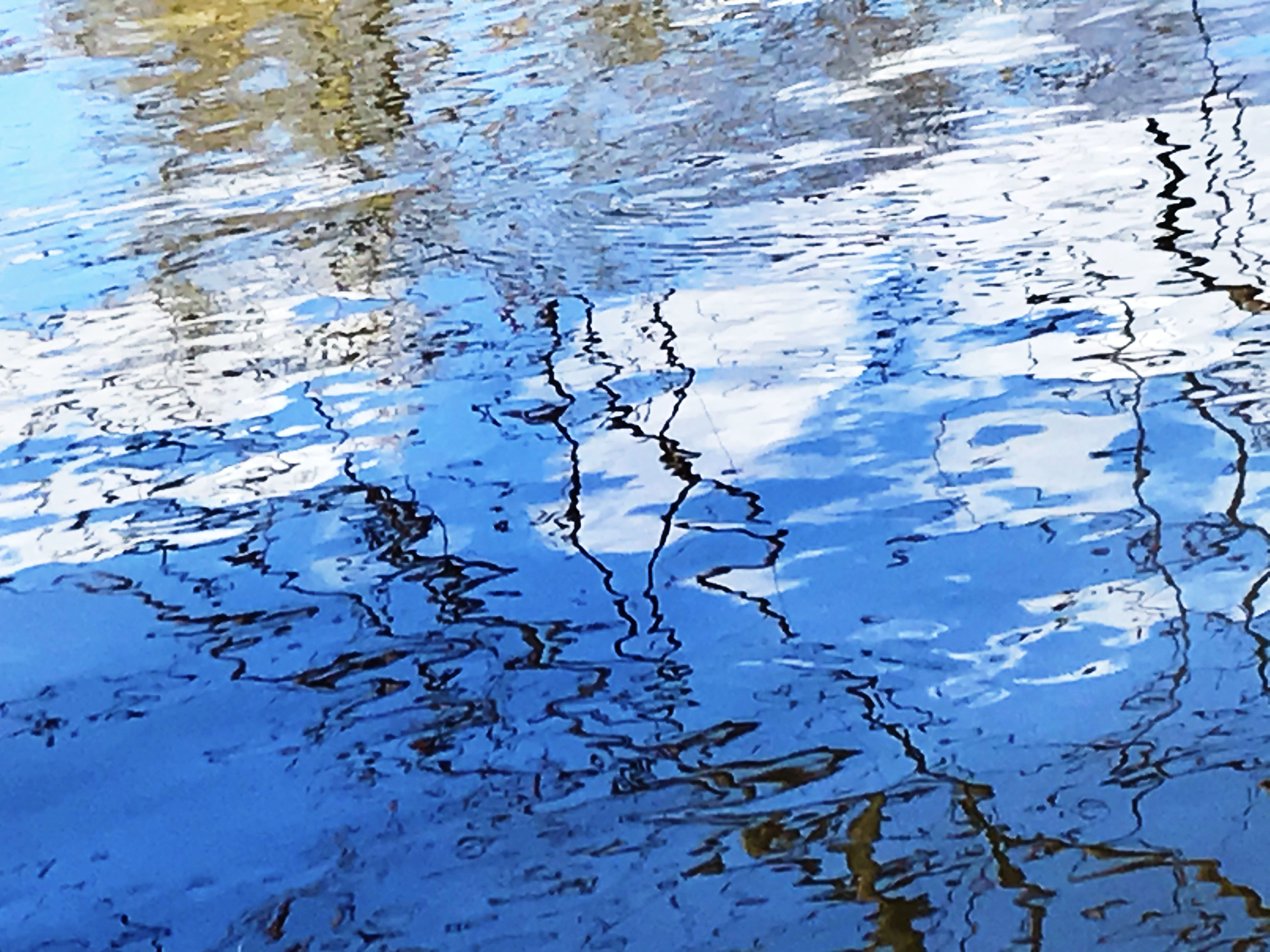
Besides the fish, a few reflection photos found their way onto my cell phone to help ease the pain of my missed photograph of the leaping deer. Little did any of it matter as much as simply being out on the Minnesota sharing a commune of nature with an old friend. As a late prairie wordsmith and colleague, Whoopy Warrings, was prompt to say, “A great time was had by all!”
From the photography blind on the North Platte River last week while awaiting poet William Stafford’s “far wanderers,” my view was of a nearby horizon of cottonwoods extending across the wide, shallow and flat waters. Huge limbs reaching skyward from the tall trees, strong and stately, were silhouetted black against the dull gray rain-drenched sky. Cottonwoods, like the sandhill cranes, have a way with me, and on that afternoon in central Nebraska was no different as I sat and awaited the magical arrival of the birds.
Staring at the trees, awaiting, briefly took me back to my childhood home in Missouri where we had a beautiful and stately cottonwood near a farm pond, one I could see while laying on my bed in the upstairs sleeping porch. Much like when he was a young boy growing up about 30 miles west of my Missouri home, Walt Disney spent hours laying beneath the canopy of a huge cottonwood he called his “dreaming tree.” So here we were seeing dozens of them.
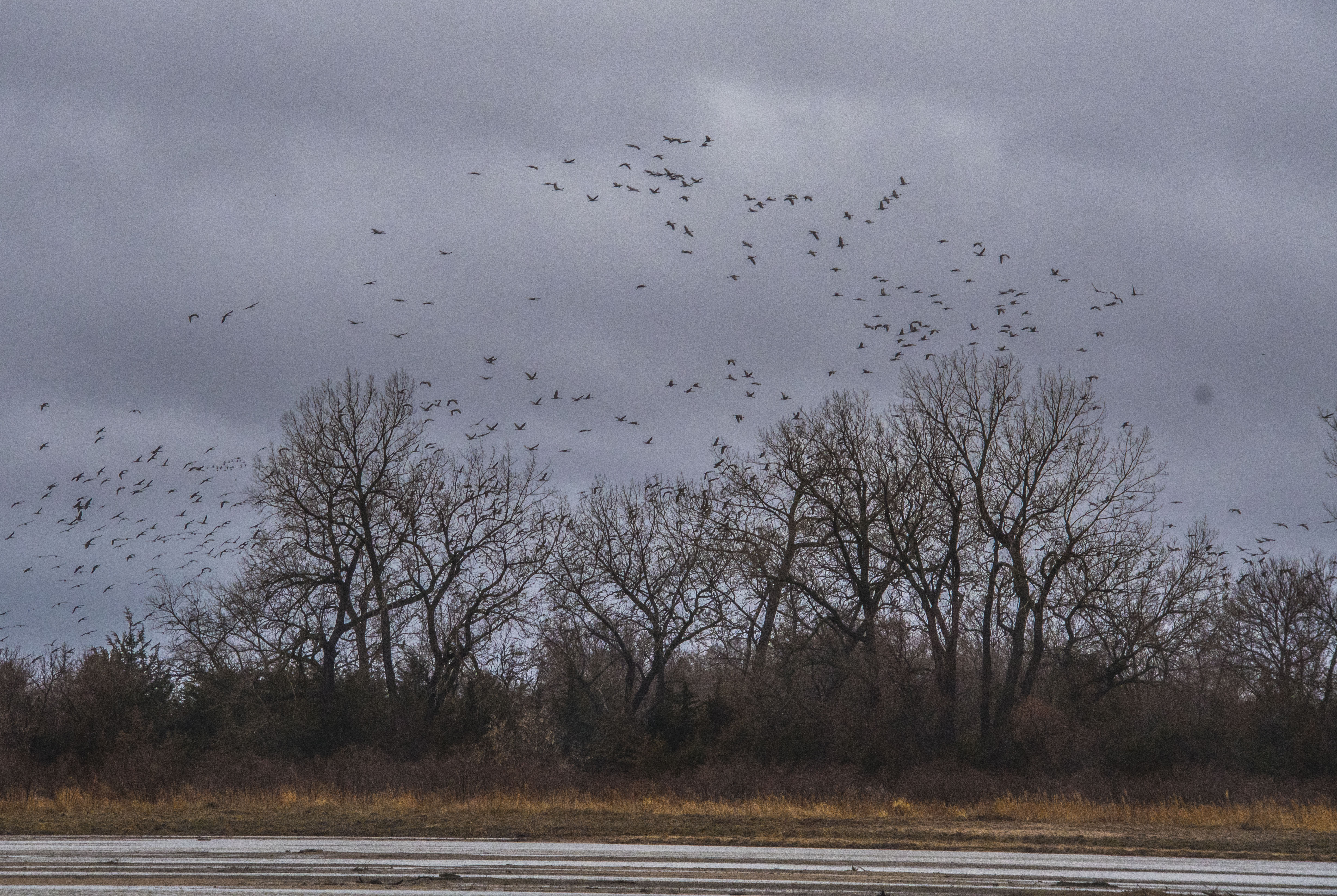
These “dreaming trees” across the shallow river would be stage-front of my next 16 hours of sandhill crane viewing and photography. Later, as that unmistakable melodic chorus of the sandhill music filled the prairie air across the North Platte in the chilly, rainy wind, I was eagerly prompted to open the side window of the blind and peer through the hazy moistness at the cottonwoods hoping the cranes would begin landing on my side of the trees. My section of the river was shallow, too, with sandy islands just like on the opposite branch of the river. A half dozen bald eagles attested to that.

Hope and patience are typically virtues you need when entering a photography blind, especially with sandhill cranes as your subject. Both would be necessary virtues claimed the volunteer driver who escorted me through the scrubby browned prairie grasses toward the photography blind at the Iain Nicolson Audubon Center at Rowe Sanctuary earlier in the afternoon. We were drenched by a rain that wouldn’t abate until the following morning, with winds rocking the front of the blind at speeds alternating between 20 and 30 mph. The temperatures were in the high 40s.
This was my second sandhill crane migration within this funneled stretch of the North Platte where ancestral birds have passed through on migrations northward for hundreds, if not thousands of years. Eons. After arriving around 4 p.m. and setting up the cot and organizing the layout, I eased into the camping chair with little to do but wait for when the birds might appear. “Might” is the key word, for once again the warning was issued that the birds had thoughts of their own on where they might overnight. Meaning, that they might decide to eloquently drop from the sky right in front of the blind, or somewhere different. Like across the river and behind the curtain of dreaming trees.

“We have no way of knowing,” offered the volunteer. “We can’t make promises other than that you will see birds. At last count we had more than 645,000 in the valley.”
Our driving around the area earlier gave his comment credence. Thousands of them filled the stalk fields, wading in puddles and performing their dancing preludes of courtship. That wasn’t a promise of having them overnight right in front of the blind, though. Three years earlier we learned the importance of patience. We were in a Crane Trust blind downriver some 40 miles near Wood Lake, NE, and had received a similar forecast and warning before watching helplessly as sedge after sedge drifted down from the heavens around a bend a half mile to the west. Mary preached patience, and on that night her calming reassurance was that the birds would come. Then, with the sun truly sinking below the western horizon, a huge sedge suddenly drifted down directly in front of our blind not 30 meters away. This sedge was followed by seemingly thousands of other sandhills. Would I be so rewarded this time?
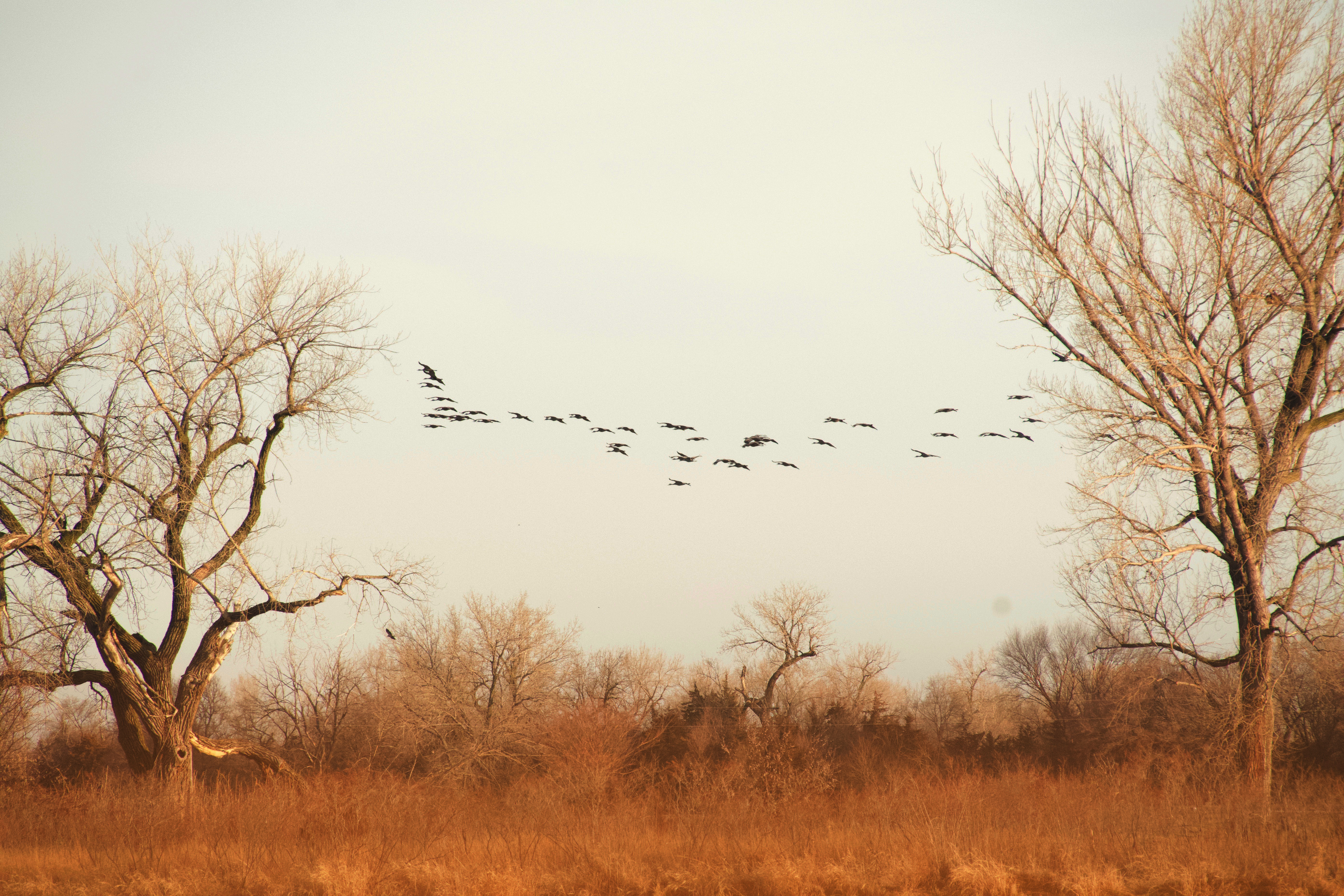
As the wind and rain battered the small, 6 ft. by 8 ft. blind at Rowe, I was holding onto both hope and patience as I glanced out a covert slide-down window on the side of the blind protected from the pelting rain. Above the stately skeletons of the bared cottonwoods on a slip of land just across the Platte, hundreds of sandhills were coming to roost. Sedge after sedge. Occasionally there would be an “explosion” when literally thousands of the cranes would suddenly erupt to rise above the cottonwoods before returning behind the separating spit of land.
My patience was not rewarded, although sitting comfortably in snow pants and a parka staring across the river at the distant cottonwoods and cranes was still relaxing in a Zen-like way for I was sharing a moment repeated in geological natural history spread over eons, and I was a witness. Just being in the blind observing and hearing the cranes, a chorus accented by the blustery wind, was sweet music. After all, I was dry and warm, and would remain so despite a fitful night of sleep.
Sometime early in the morning, with the skies still in complete darkness, I was jerked sleepily from the warmth of the sleeping bag when a sudden crescendo of sandhill wings and calls filled the sky. Outside the blind window, deep into the dark pre-dawn mazarine sky, barely visible black crane silhouettes filled the air as if I were inside of a sky-wide umbrella. Oh to have had any semblance of light! It seemed the entire universe, all 645,000 of cranes by the volunteer’s count, had taken to the sky as one.

With the coming of dawn, though, there were still numerous sandhills around as sedge after sedge rose from the river through the framing of the cottonwoods. My volunteer said someone would come once the cranes had departed for the nearby grain fields, and that it could be anytime between 8 a.m. and 10 a.m. As at Crane Trust, the birds continued to fly in small sedges up and down the length of the river. With the sun finally peeking through the clouds and a wind now eased into a slight prairie breeze, I opened all the blind windows to watch, going from one to the other with my camera, capturing what I could while watching with wonder and admiration.
No, they wouldn’t ease down to overnight right in front of me despite my hopes and patience. There are worse fates, and our trip was delightful regardless. We met with friends from near here for one of the few times since the pandemic to share a lunch and a trip to a delightful art museum before meeting later on a state park bridge with other birders with more hope and patience as we once again waited for the sedges of sandhills to land on the nearby shallow sand islands of the North Platte. A grouping of a half dozen white-tailed deer played in the river as the sun graced us with a most colorful and beautiful sunset. There was no need to question the definition of magic.
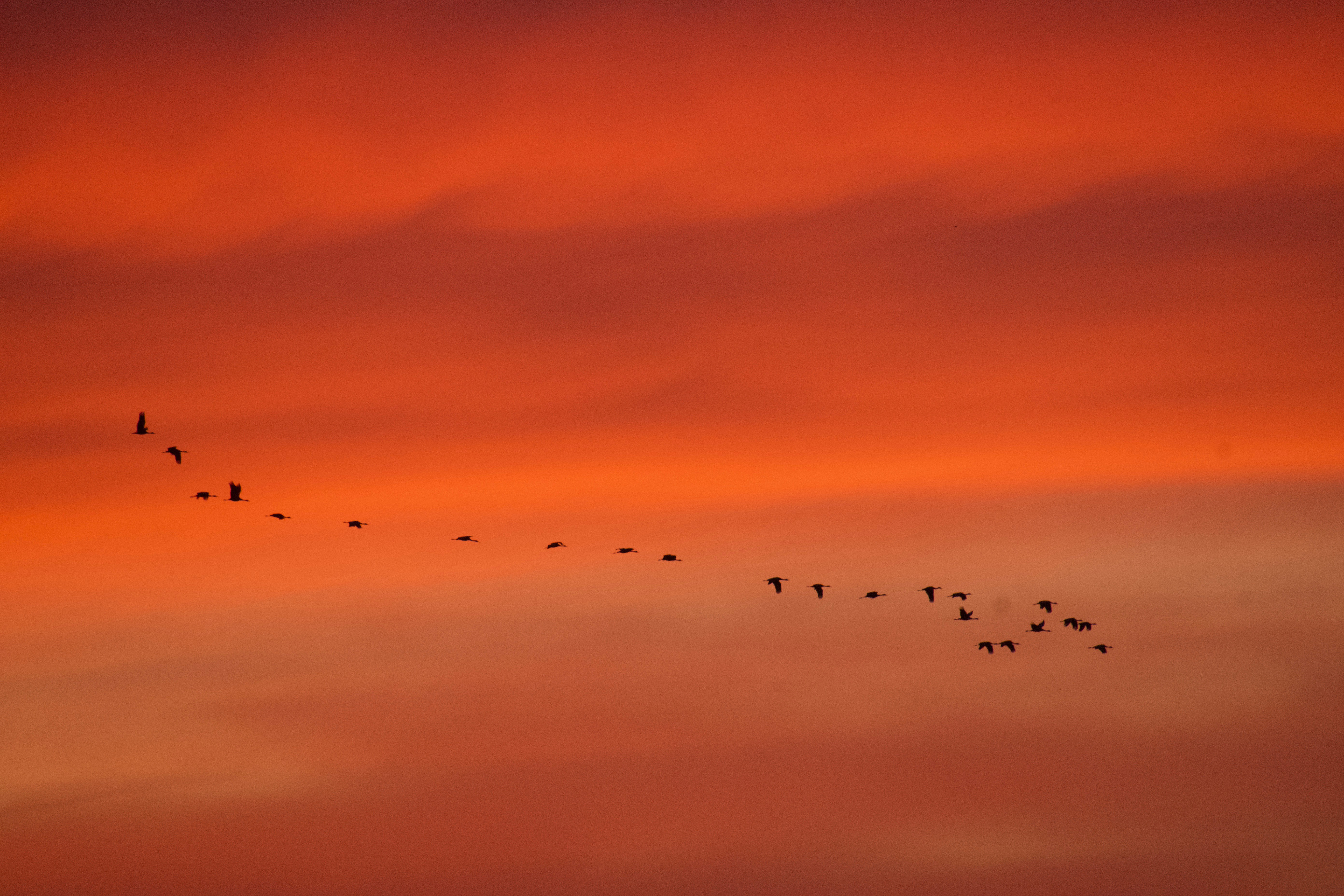
Yet, there we were, witnesses of the entrancing wonder of a spring crane migration, of which Stafford writes in his poem, “Watching Sandhill Cranes:
Spirits among us have departed — friends, relatives, neighbors: we can’t find them. If we search and call, the sky merely waits. Then some day here come the cranes planing in from cloud or mist — sharp, lonely spears, awkwardly graceful. They reach for the land; they stalk the ploughed fields, not letting us near, not quite our own, not quite the world’s. People go by and pull over to watch. They peer and point and wonder. It is because these travelers, these far wanderers, plane down and yearn in a reaching flight. They extend our life, piercing through space to reappear quietly, undeniably, where we are.
Isn’t this where we came in last year? Back in March? With the Snow Geese and White Fronteds flying through? With murmurations of black birds poetically gracing the skies? With something called a coronavirus threatening worldwide mankind, a pandemic creating fear not seen in our lifetimes?
Now, a year later, with similar plans to head to Nebraska for the Sandhill Crane migration, a trip that was canceled last March because of Covid-19, we move hopefully forward with less fear and a sense of confidence for the future. Thankfully a year ago our human consternation didn’t halt the Sandhills nor did it stop the murmurations or those stretching skeins of geese gliding noisily overhead. It stopped only us.
Finally, thanks to vaccinations and covid consciousness, we seem to be closer to our former normality. A couple of weeks ago it seemed warm enough to invite friends home from Texas for a steak fry. Not warm enough to break a sweat, yet with enough warmth to carry the deck table and chairs from the studio and the bag of charcoal out to grill the first steaks of spring. All of us were vaccinated and we still practiced social distancing. It was a glorious and welcomed night. Then, a couple of days later the deck was once again covered with snow.
Yet, what a week! The warmth. The “political calm” that has seemed to settle in since the inauguration. Beautiful arrays of sunrises and sunsets that have been both joyous and spectacular. Plus we have watched nature awaken around us. On a recent morning a male pheasant, with those red eye patches in contrast to those startling green facials, was striding through the path where half-melted cross country ski tracks were cast in twin shadows. His stride was as if he owned the prairie, which I suppose he has as much right to ownership as I.
Then suddenly came a second rooster, and a third. I called for Mary, and we watched a parade of male pheasants, perhaps ten, as they followed one another in near military formation up the path cut through the tall bluestem. It’s not that we don’t see pheasants in our restored prairie. Usually a sighting comes on a startled flight after being flushed by Joe Pye.
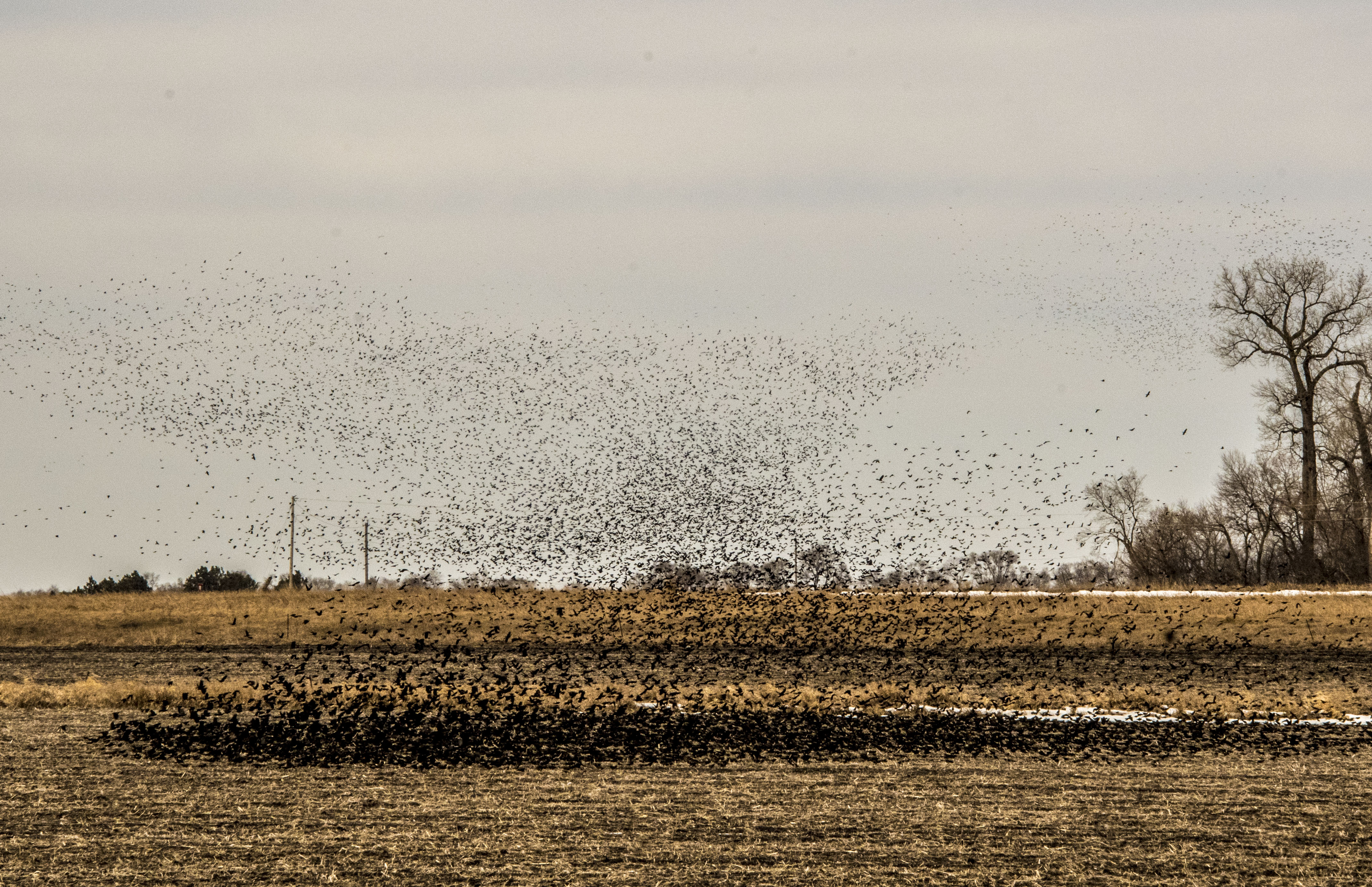
Thus the curtain was drawn on the breaking of Spring, of our highly anticipated anniversary when the sight of normality seems within our collective grasp. In the intermittent warming, with quilts flapping on the clothes line, our first small murmuration of redwing blackbirds circled the grove, scurrying from tree cluster to tree cluster, then into the bluestem for nutrition. Later, on the way home from picking up a borrowed cot for our trip next week to central Nebraska for the Sandhill Crane migration, we passed a murmuration stretching as far as we could see. It was a blackbird vortex rising from a field into the sky. One of those had we been distant would have been pure feathered choreography.
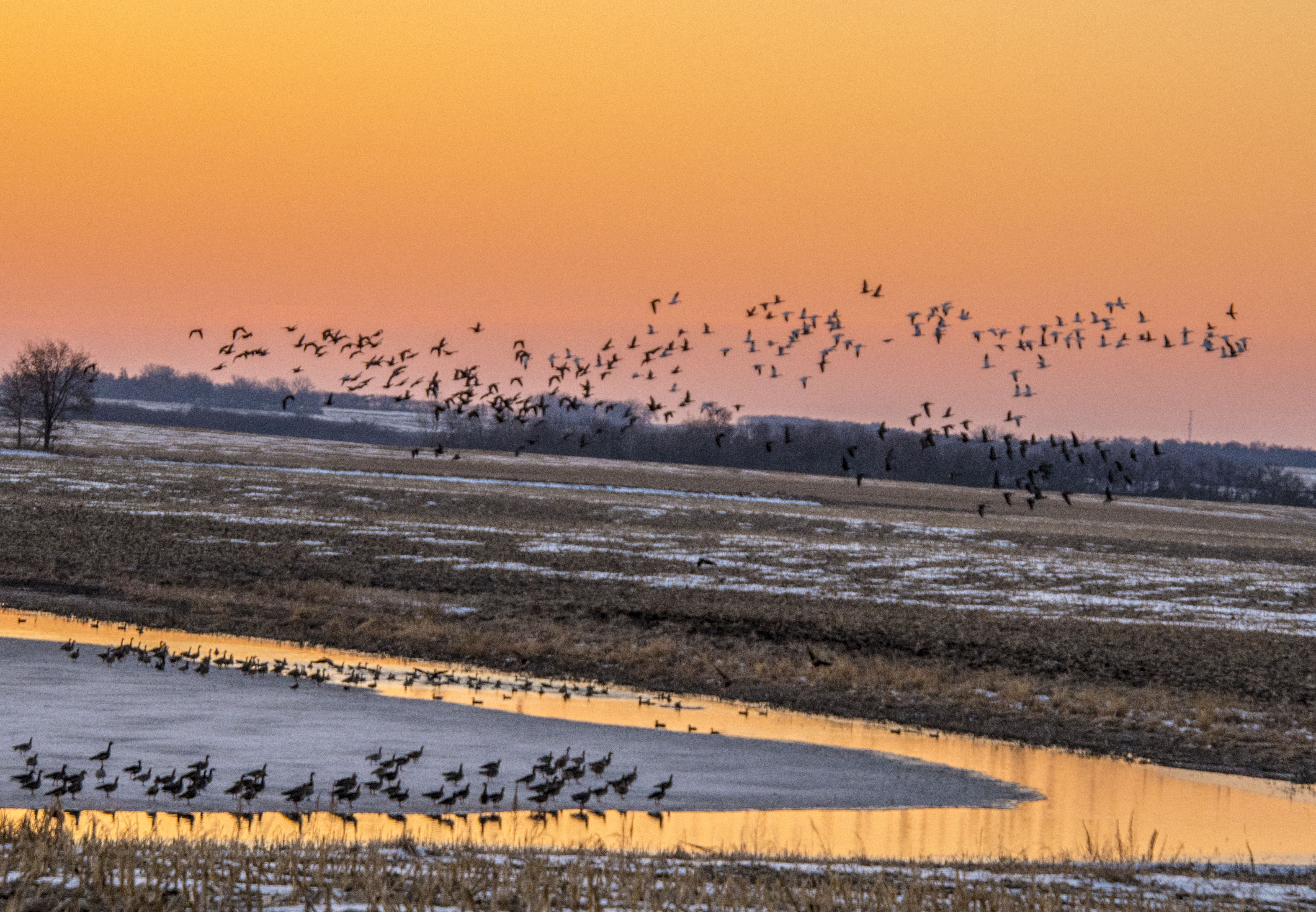
What has been so rewarding and entertaining for us, though, has been the unexpected arrival of a massive flock of Snow and White-fronted Geese that chose the wetland over the rise from our prairie to recoup and recharge on their way to their Subarctic and Arctic homes. They began arriving on a Sunday afternoon while I was on a call from nature at Maplewood State Park. Just two hours after having a solo picnic in a parking lot overlooking a frozen lake that was surrounded with hillsides of snow, I walked out of the garage to see a skyful of skeins overhead. As with the pheasants, this is just something that causes you to pause in appreciation.
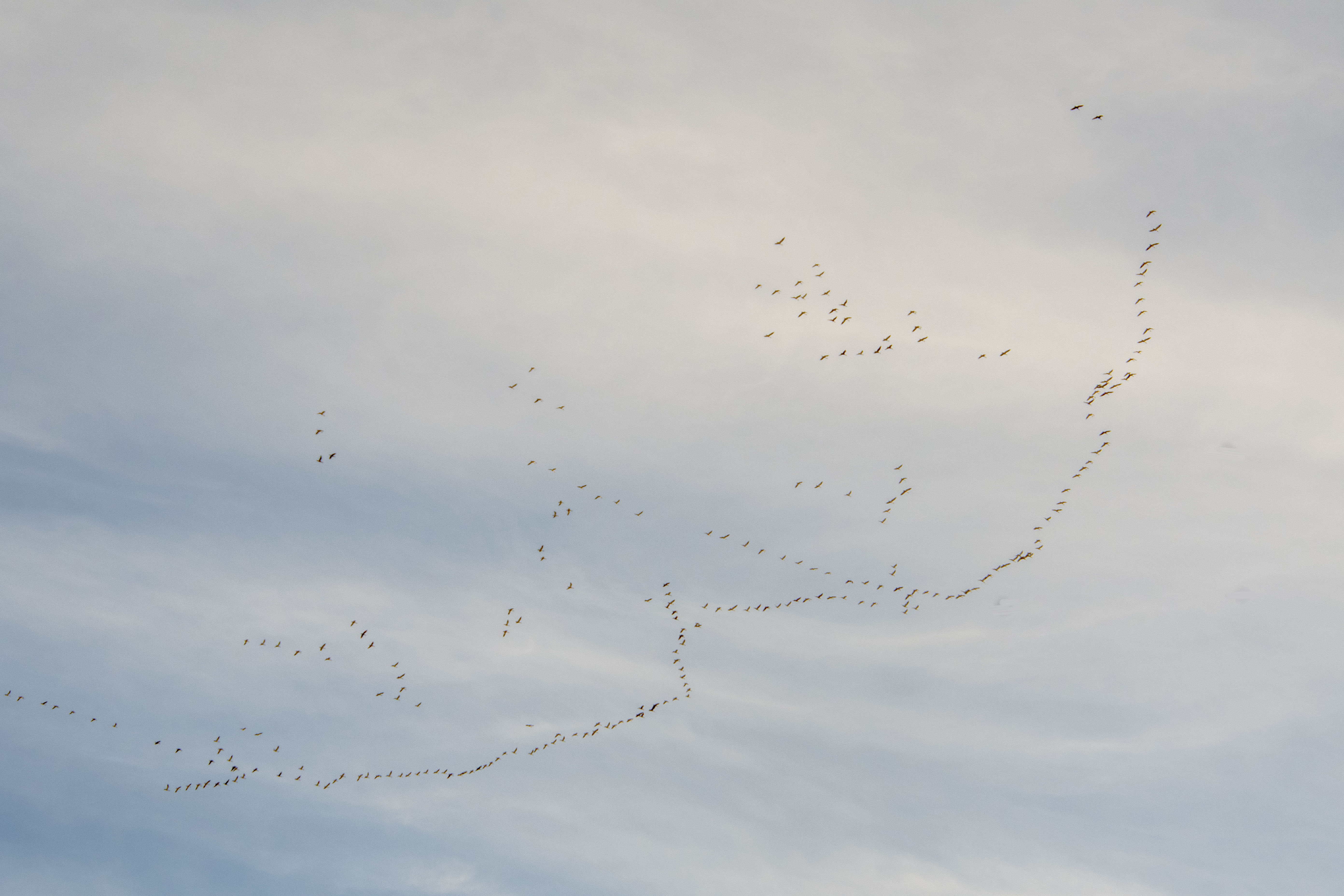
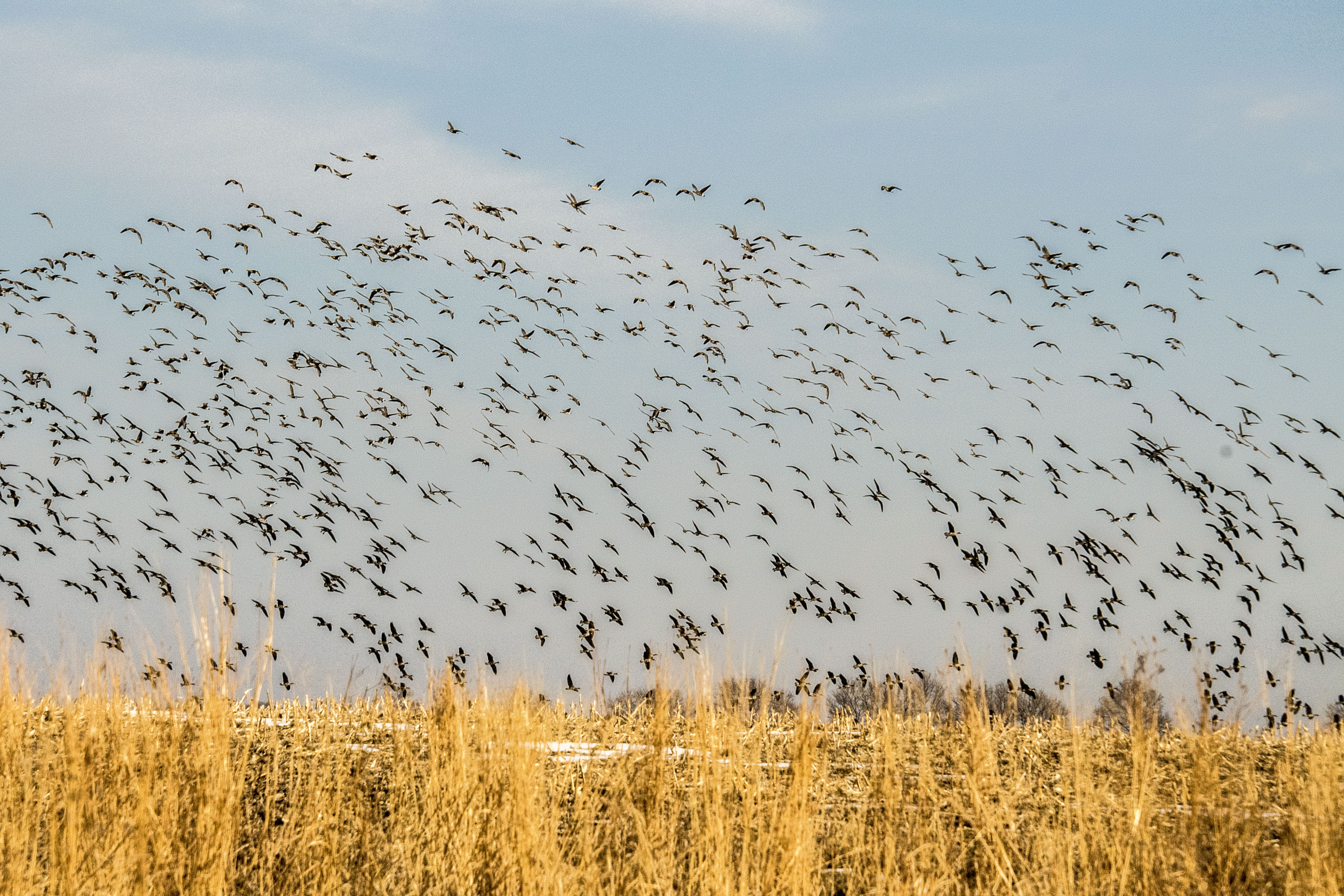
The skeins continued to fill the sky for a couple of hours. Thousands upon thousands of geese, high in the sky, all heading northeasterly. After sitting on the deck with a nice white wine (a prelude to summer, right?) while watching them for quite some time I finally broke down and headed to my studio to fetch my camera. There was both ample time and opportunity in the skies above. We have no way of even guessing how many flew over, though they were in the thousands.
Then the surprising magic occurred as they began filling the melting wetland just over the rise. We could hear them at night, and in the morning as the sun rose. They seem to be feasting, noisily, in adjacent fields, with as many arrivals as there are those leaving. It’s a constant movement that has now lasted for at least a week and a half. In time silence will announce their departure.
Having such closeness to the natural world reminds us of life unencumbered by a human pandemic and the ills of our human existence as reported in the news. We can now offer a sweet sigh of relief as this anniversary, marked by the timeless migrations of our feathered nature, that a blip of our human history, one churned by ugly politics and those that questioned the reasoning of science which might have saved countless lives, is seemingly evaporating in front of us.
We should rejoice in this odd anniversary of mankind that we’ve survived to hear the geese as we lay for sleep, that we can watch with wonder with their coming and going from the nearby wetland, that the winged poetry of the murmurations are still in the skies and that within a week we’ll be seated in an overnight blind witnessing once again the magnificent Sandhill Crane migration in central Nebraska. All is most welcomed.
March is said to be the month of winds, which perhaps means the originators of the saying didn’t live in a prairie for we seem to have winds all year long. Especially in the wintery months. When you subject that constant with farming practices that perhaps began with the first of the early settlers you can only imagine the result. Well, you really don’t need to imagine, for a drive along most any rural road will illustrate the sad results.
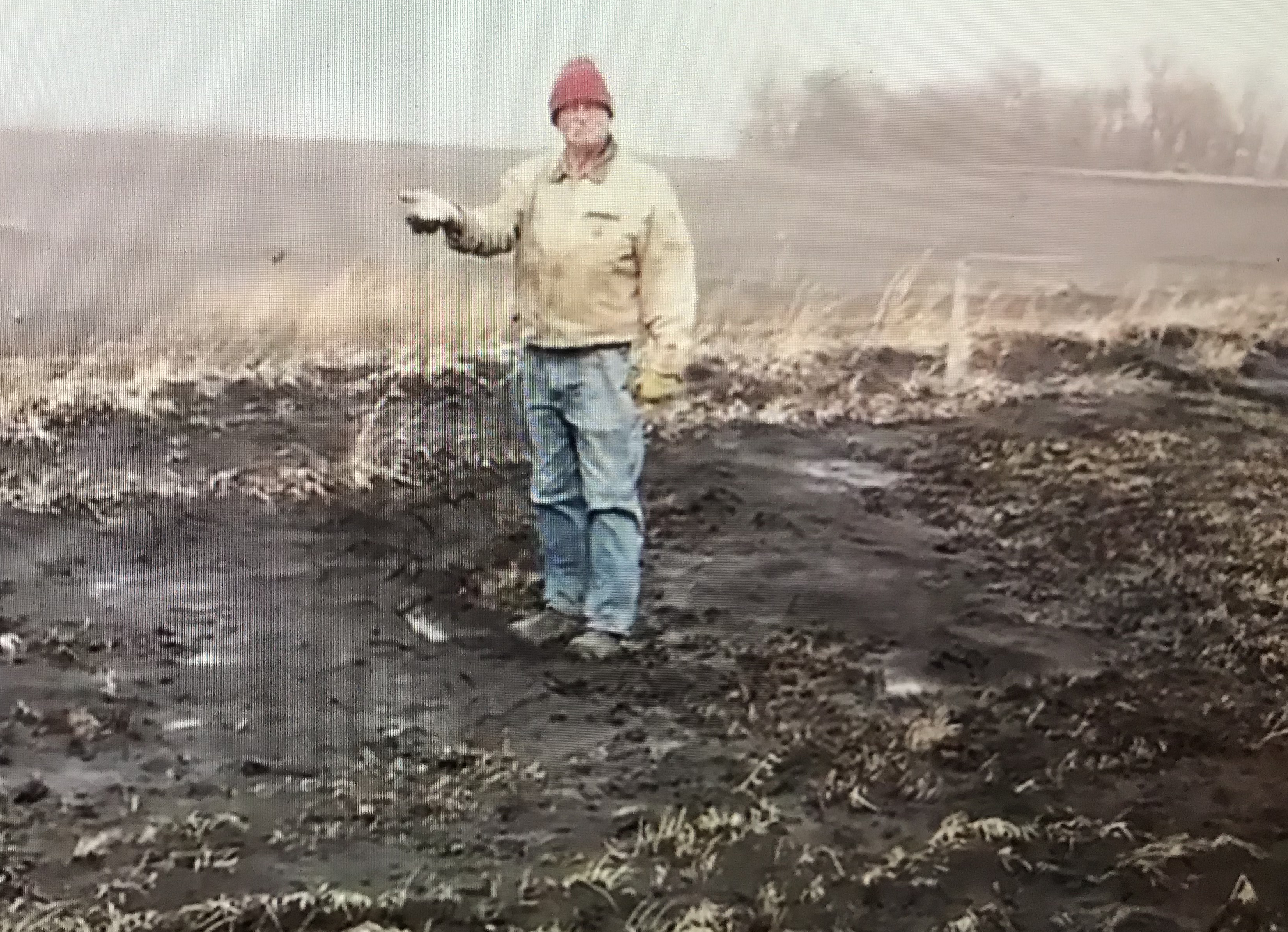
If it were not for the contrast given by the snow perhaps the unaware would likely miss seeing all the fine particles of dirt blown into the roadside ditches and across the windswept prairie. A few days ago my friend and fellow blogger, Jim VanderPol, and his wife, LeeAnn, drove to the edge of their mostly grassed farm where they raise hogs and cattle on perennial grasses to catch a glimpse of a late February wind and the results of a winter’s worth of windblown soils from a neighbor’s tilled and bared field.
LeeAnn filmed a short video of Jim walking into the muck covering his grasses where he bent down, grabbed a handful chilly mud before disgustedly wiping it off his hand. Behind him the near horizon was a hazy brown, which for Chippewa County is far too common. The mud blanketed his grass for nearly 40 feet fron inside the fence (catch the video on his blog at http://www.pasturesaplenty.com).
Several miles north of the VanderPol’s, on a hillside overlooking the Pomme de Terre River, so much dirt has blown off a field that the complete hillside, which is a grassed meadow, is entirely blackened with the dirt blown from an adjoining crop field. This is a valley hillside of the Pomme de Terra River, meaning that some of that dirt will eventually seep into the river. If not the soil, then the washable nutrients placed on the crops and embedded in the dirt are certain to drain into the river.
Roadside ditching are thick with wind-eroded dirt. Some on both sides, and on one stretch of a county road near here there is more than a mile long where drainage ditches on both sides are blackened with wind-eroded dirt. So thick you cannot tell where the field edge exists. Not on the same road is a farm home where an entire yard was encrusted in black through the winter. Dirt that had blown across the highway to become clogged in the drifts of snow duned by the trees in the adjacent grove before lapping around the northwest corner of the house and into the front lawn. Besides the house, the only object not covered in blackness was the propane tank! All from a field across the highway.
These on-site observations comes on the heels of a report published in late February by three geoscientists from the University of Massachusetts … Evan Thaler, Isaac Larsen and Quin Yu … called “The Extent of Soil Loss Across the U.S. Corn Belt.” Their use of high definition satellite imagery across an eight-state Corn Belt swath, including Minnesota, showed that A-horizon (nutrient-rich topsoil) was essentially no longer present on convex slopes. If you’re crossing the former prairie and current commodity crop complex this evidence are all those tan or light brownish spots you see on the rises in the fields where the topsoil has eroded – what VanderPol was holding in the palm of his hand in the video. “The A-horizon was almost always gone on hilltops,” says Thaler.
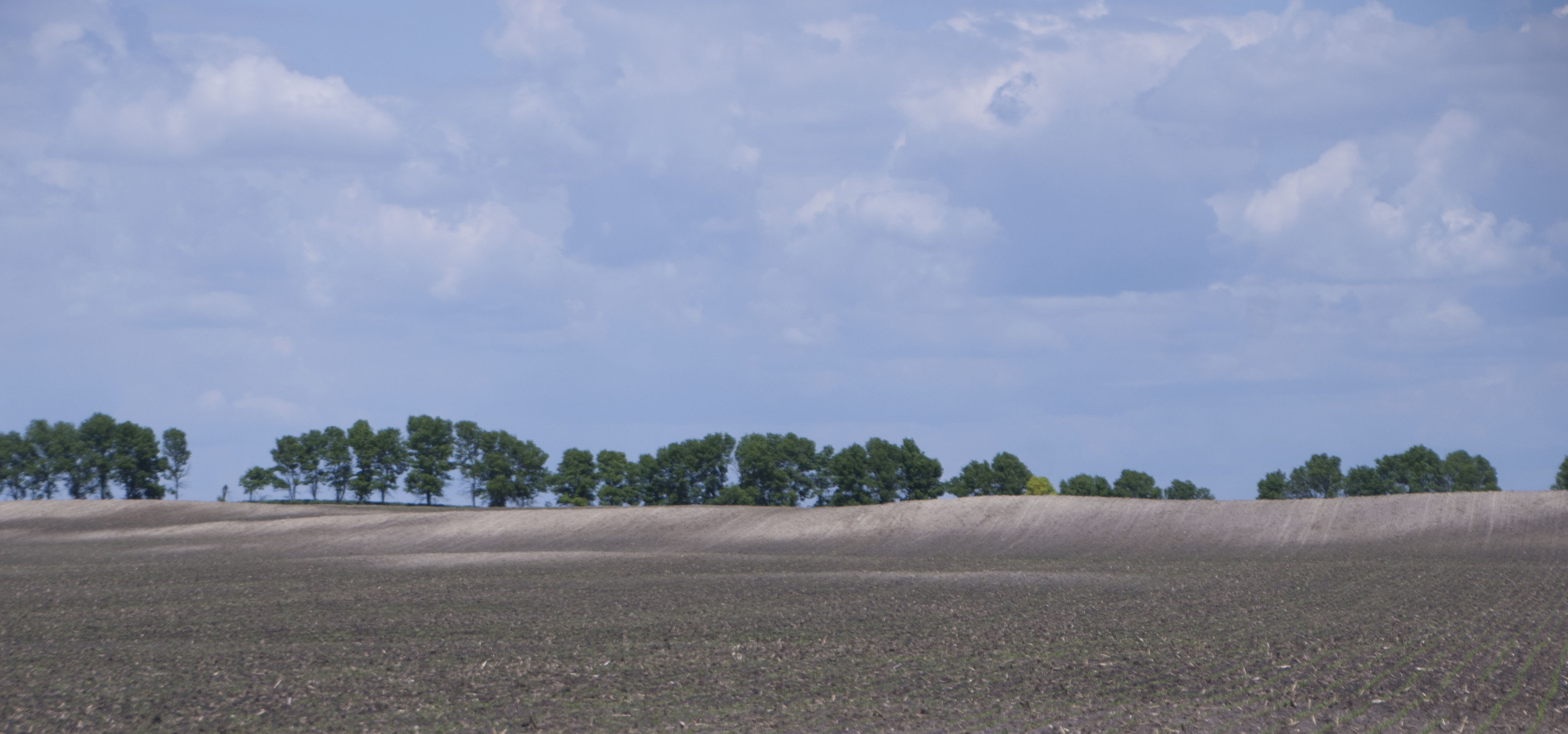
The low areas are medium to dark brown on the satellite imagery, which is where some of the A-horizon soil has eroded to. When the prairie was first broken a century and a half ago, those soils, including what you now see as tan B-Horizon sub-soils, was covered with about a foot and a half of fertility rich topsoil. By the mid-1970s nearly half that topsoil had already been lost to both wind and runoff erosion. Despite such conservation efforts as contour plowing and various set-aside strategies that paid farmers to keep marginal land out of production, the soil losses continued. This was more than 50 years ago and the erosion continues on soils that are left bare from fall plow-down in October and November until there is some sort of plant protection by the following June. In other words, soils are left unprotected for nearly nine months.
The geoscientists calculated that about a third of the crops are being grown on erosion-prone soils. That estimate is far higher than those published by the U.S. Department of Agriculture. “I think the USDA is dramatically underestimating the amount of loss,” Thaler adds.
This isn’t a pretty sight, and it’s also a dangerous one. In his sobering book, “Dirt: The Erosion of Civilizations,” David R. Montgomery wrote, “Projecting past practices into the future offers a recipe for failure. We need a new agricultural model, a new farming philosophy. We need another agricultural revolution. Unlike the first farmer-hunter gatherers who could move around when their soil was used up, a global civilization cannot.”

In other words, this is it: we are growing crops on the earth’s very last productive soils. “The estimated rate of world soil erosion now exceeds new soil production by as much as 23 billion tons per year, an annual loss of not quite one percent of the world’s agricultural soil inventory. At this pace, the world will literally run out of topsoil in little more than a century,” adds Montgomery. “It’s like a bank account from which one spends and spends, but never deposits.”
Once again there are farming techniques that might preserve these last few inches of productive topsoil including using cover crops. Those farmers who have bitten the bullet to integrate cover crops into their cropping repertoire have reported some significant benefits even beyond protecting their soils from erosion. Better water retention, a disruption of weed issues and less compaction, among them. Perhaps what is known as “conservation tillage” has helped in some degree, although driving past those fields indicates “not much.” Perhaps the least expensive alternative is to simply leave the corn stalks untilled until just before planting … when the soil is worked once again regardless. On soybean and sugarbeat fields, there is little to no protection whatsoever.
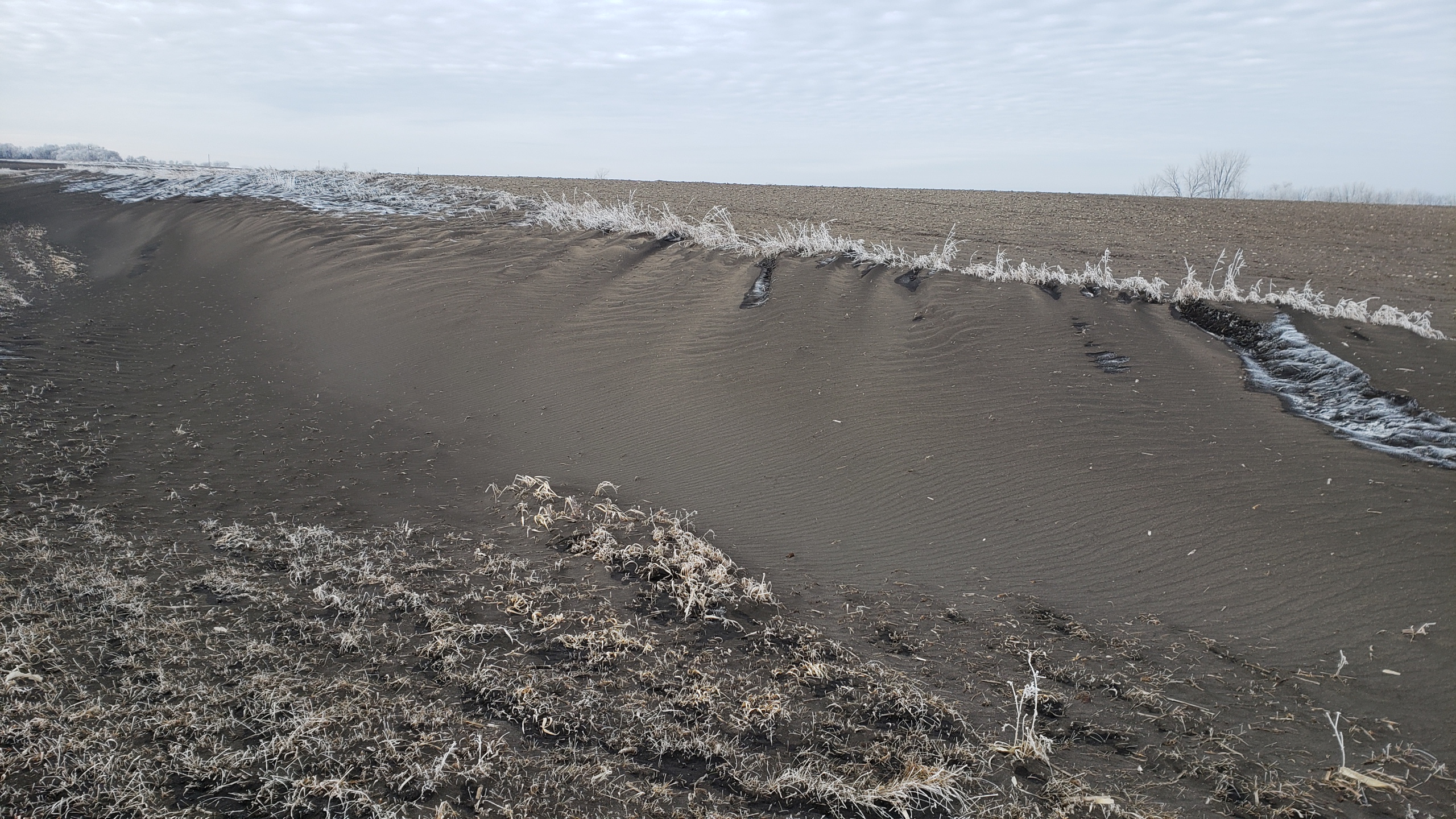
Someone even suggested that perhaps a solution to change would be to forbid those guilty of such erosion should lose their crop subsidy benefits. Regardless, too much of the remaining topsoil is subject to both wind and runoff erosion, and there appears to be quite a lackadaisical attitude among those who tend to the land. How many times have we asked one another as we drove past those miles upon miles of dirt covered roadside ditches, “Don’t these guys even notice the erosion?”
Apparently not.
Lonyearbyen, a small Arctic village in Norway’s Svalbard archipelago, was said to be 33 degrees warmer than we were this weekend. In other words, we are enjoying their typical weather while they’ve doused their seaside saunas!
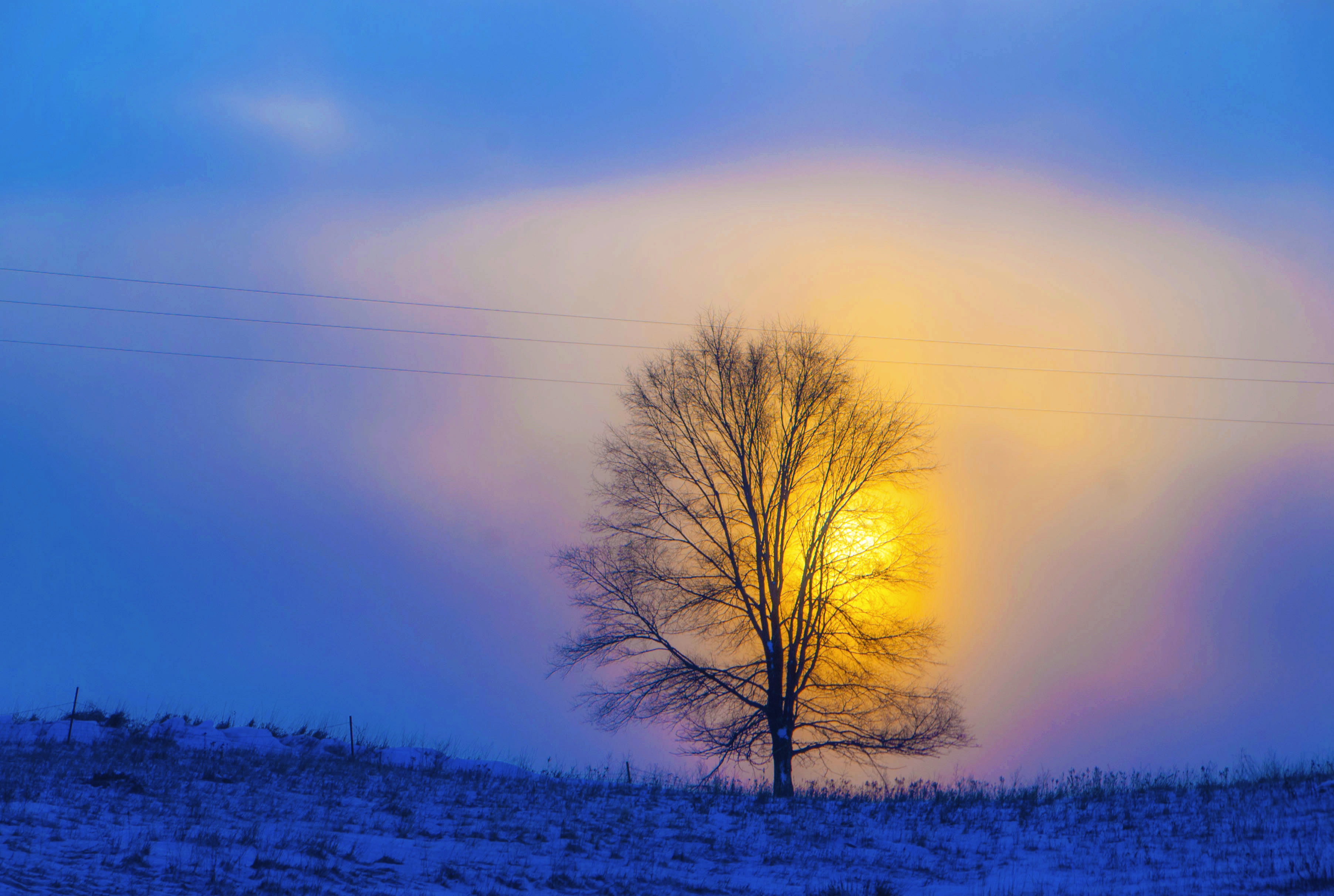
Artist musician friend, Lee Kanten, sends a photograph of ice frozen in a lawn chair from South Padre Island. Another friend writes that they may as well head home from their winter hideaway since the temperatures are about the same as at home. Someone else posted a picture of the Riverwalk in San Antonio covered with snow. Every single county in the state of Texas is below freezing! Actually the entire central part of the nation, from mountain range to mountain range is below 32 degrees, which seems warm for us right now in the heart of this polar vortex.
Our little dog, Cocoa, steps through the door onto the deck and instantly raises her paws signaling that our weather here isn’t fit for neither man nor beast. These outside temperatures range from between -24 to -18 degrees, and this isn’t with factoring in the wind chills. We’re also warmer at these temperatures than much of the country is to the north and east of us. This morning Mary lamented, “This is the longest stretch of sub-zero weather we’ve here had in years.” In retort I suggested that we usually have a week or so of such temperatures, to which she responded, “But this is now more than two weeks. This isn’t normal.”
I’ve given up trying to make wooden frames for my show in March, for it’s too cold to run my saws in my unheated wood shop, and even if they did it’s too chilly to attempt to do the sanding. Indeed, the garage with in-floor heating is struggling to keep enough heat to even paint the frames. Adding to that, I have a spinning rod I’ve made that I can’t spread the epoxy on due to the low temperatures out there.
Mary is keeping our hearts warm, however, hunched over her computer. I’ve never known anyone more immersed in doing computer research, for between her quilting she is finding her warmth in planning our summer camping trip to the coasts of Oregon and Washington. This began as a caravan outing that germinated last September among her “tribe” of “Murdock girls” who all grew up together in her small railroad town here in the prairie and have remained extremely close even now as they near their 70s.
Last September her tribe met in a state park in western Montana and remained socially distanced and masked in close proximity throughout the trip out and among ourselves in the campground around the campfires. We sat as twos, as couples, distanced from one another into the nights. Since there were three RNs among the women, Covid consciousness was at the extreme as it surely will be again come this July.

She is mixing in a couple of cabin nights she’s found in her research to interstice with our road time. So far the longest time we’ll be on the road is a stretch between Pendleton and Corvallis, Oregon. This appears to be about ten hours in the pickup. Most of the other days are in the six to eight hour range. Within the plans are visiting with some old friends of mine in Oregon and southern Washington en route to Larrabee State Park outside of Bellingham. Mary’s college roommate, who now lives in the Bellingham area, arranged the Larrabee portion that anchors the venture there and back.
Initially we had considered returning through the Tetons on the way out since Mary figured I missed the late afternoon shots with my favored light when we were there on the way home from Montana. It was either the Tetons or traversing the Columbia River valley, and like many of my desires of late, doing the Columbia again in my lifetime seems almost a dream. We’ll add a couple of more states to our history, for in our fourth year as a couple we have now been through 30! Had the pandemic not happened it would have surely been more for we had our sights set on a trip to the Southwest over this winter and spring. Like her sisters and the Murdock girls, just give her time.
So it’s a fine reprieve for her from the temperatures outside. So is planning for the exhibit, which took a turn since we’ve now placed an order for pre-made frames rather than fight the elements. Now I can work on the fly rod I’ve been intending to make for the past several months. Like the spinning rod, it will be a gift. It will have a burl reel seat for soul and beauty, and offer some fine 5 wt. action for bluegill and bass around here, and for trout out west. I guess these are things you do when it’s too cold to do much else. Mary alternates between our trip planning by creating some incredible beautiful quilts while I make prints for the upcoming show and wrap line guides to fishing rod blanks. All while keeping the bird feeders stocked with black sunflower seeds!
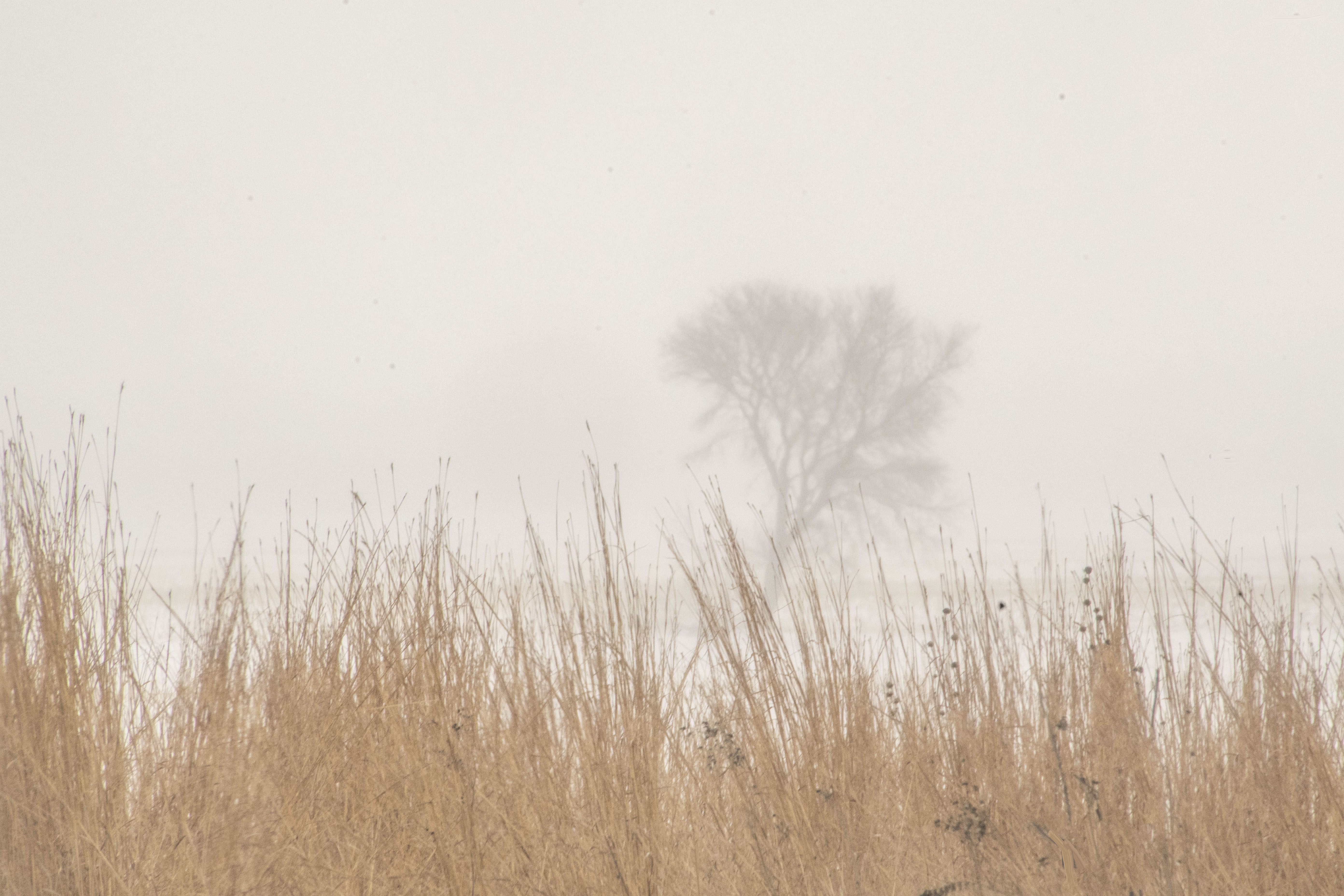
Seems the most I can do outside is fill those bird feeders, for I find it too cold to ski. Warnings are to not spend more than a few minutes outside because of frostbite, and little Cocoa’s paws offer a fine reminder of such dangers. This provides a few breaths of fresh air while we busy ourselves indoors with creativity and dreams of a warmer and hopefully safer summer. Sometimes the cold of winter is like that, so you feed those feelings with hope and dreams of different times. Or as Alfred Lord Tennyson said, “Hope smiles from the threshold of the year to come, whispering, ‘It will be happier’.”

