Bygone Ethics

Recent rains have given us a rare opportunity to revisit the long-gone prairie potholes that were part of the original, post-glacial landscape.

Recent rains have given us a rare opportunity to revisit the long-gone prairie potholes that were part of the original, post-glacial landscape.

Recently a friend who happens to be a farmer asked, “When did you become so anti-farmer?”

After my initial surprise and denial, and later, after subsequently rolling through the countryside, I began to realize how my comments and rants could be taken in that manner. My growing up as a child and teenager was in a different era, when having a thick thatch of grass growing where water could create rills of erosion in a field was not only expected, but common. Also common was leaving a swath of anchoring vegetation along riverine embankments. I can also remember my father’s concern when Earl Butz, as Secretary of Agriculture, began preaching his “fence row to fence row” philosophy.

“That will ruin farming,” my father said. He meant the land, although it has also altered farming into a Catch 22 cash chase.

A recently "refurbishes" grassland where the rocks were removed and the trees cut and piled.

A recently “refurbishes” grassland where the rocks were removed and the trees cut and piled.

Realize, please, that my father and I had many rifts and disagreements, politically and otherwise. Despite that, I grew to firmly respect his attention to real conservation farming practices as well as his trepidation on the Butz preamble.

My father lived long enough to watch as neighboring farms grew quite large over the hills of northeast Missouri where grass and grazing was a better ecological fit. He watched as abandoned farmsteads were leveled, burned and the ashes buried, and he watched as hedge rows were dozed along with tree lines and windbreaks. Fences were pulled, wires rolled, and posts, mainly hedge, burned. Forty acre fields became 80’s, and 80’s 160’s, causing him to sadly shake his head. Folks back in my home country now call this “Minnesota farming.”
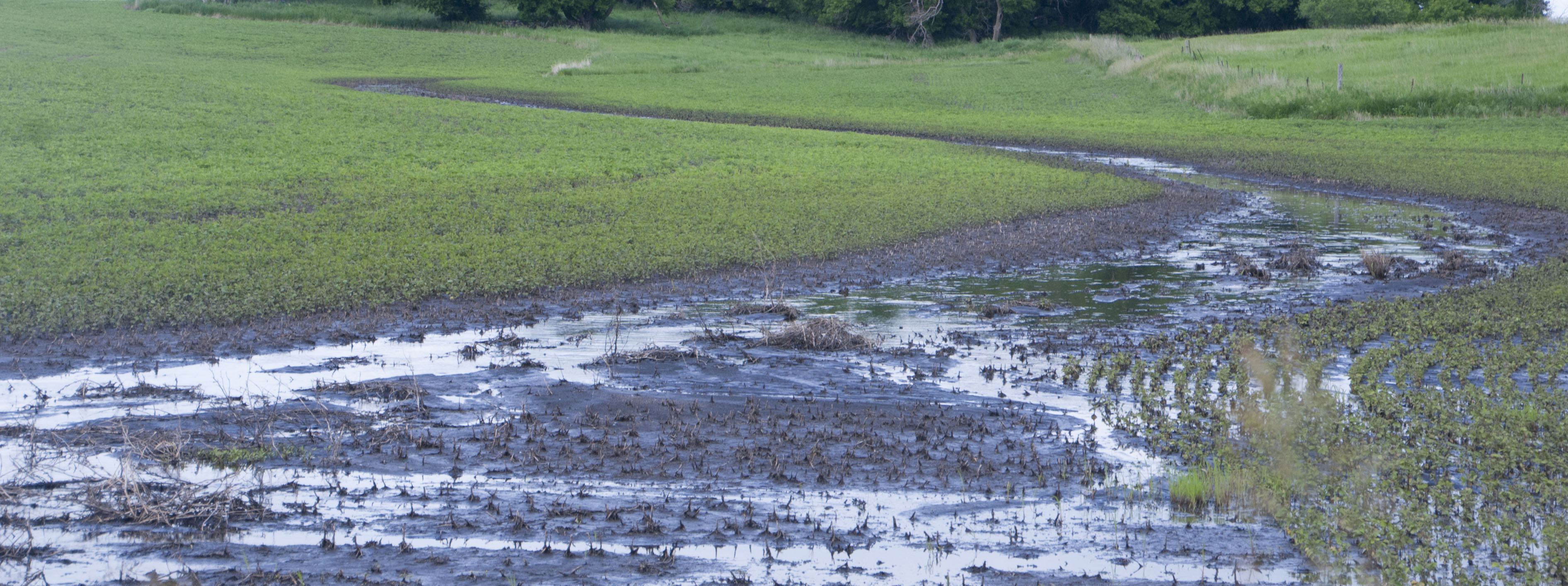
Where's the grass? Tons of soils have washed off fields where rills and gullies were created by heavy rains and moisture.

Where’s the grass? Tons of soils have washed off fields where rills and gullies were created by heavy rains and moisture.

Yes, this is precisely the treatment of the land we see all around us. Industrial road grading equipment is used to extract glacial rocks from fields (which are then stored for sale in faraway cities to landscapers), and groves and farmsteads dozed and burned. Sod and prairie grasses, CRP land … all being plowed. Painstaking efforts are made with a blade to cut just enough of a two-foot deep furrow through fields to aid in the rapid flush of water. In many cases these furrows are too shallow to qualify as a legal ditch, meaning a mandate for buffer strips, and once cut, are carefully skirted by tillage equipment and planters. Cattails are allowed to grow … until hit by contact killing Roundup.

In fields already tiled, new and more efficient patterned tile systems are being installed. Although the technology is readily available that would allow farmers better water table management, the devices have been a tough sell despite years of positive presentations at many winter meetings. At least one watershed project had staffers basically begging farmers and landowners for a single demonstration installation … to no avail. Flush is seemingly the norm for managing water tables, not the holding back or storage of melt nor rain.

Shallow water "escape routes" are cut in fields that won't technically qualify as a drainage ditch, therefore not mandated for buffer strips.

Shallow water “escape routes” are cut in fields that won’t technically qualify as a drainage ditch, therefore not mandated for buffer strips.

Hilly lands that should never have been tilled stretch for miles with no regard for erosion. In wet springs and early summers, like we’re having again this year, runoff water carries tons upon tons of soil off the higher land. We passed a field with corn nearly two feet tall in the valleys with spindly, four-to-six inch stalks poking up on the rest of the acres. “That’s where all the good soil has washed off to,” said Rebecca. Typically, 20 percent of a field has the healthy stalks. The rest? Will it qualify for USDA emergency subsidies?

Indeed, an observer can easily see the change in soil color and tilth … light tans compared to a rich darkness … in field after field, mile after mile. A keen observer can also tell that many are ignoring either the advice or statutes that call for grassed buffer strips along artificial drainage ditches, and any thought of a grass “waterway” would be considered absurd! Most of us know by now that 99 percent of the wetlands are drained, with a like percentage of native prairie tilled. Where is the rage you see with the distant Brazilian rain forest?

The banks have held and the buffer strips on either side have kept both the field and the drainage ditch in good condition.

The banks have held and the buffer strips on either side have kept both the field and the drainage ditch in good condition.

Driving through the rural byways in the winter months can just be sickening with mile upon mile of “snirt” — that dirty combination of snow and dirt. Overwinter cover crops are rarely planted, and any thought of leaving stalks to hold soils in place is basically unheard of. Our food supply is threatened in that one day fields will be barren of healthy prairie dirt. Realtor’s will be challenged to barker farms with no soil left to sell.

One wonders where the crops will be grown, of how subsequent landowners and farmers will continue to “feed the world.” Have we become so selfish as farmers that we can only think of today, of mining the soil for the most cash possible with crops with little direct food value and staunch government policy support? If we’re blaming policy for the woes and goals of the tractor jockeys, then perhaps some teeth should be placed into the policy smile … a net zero erosion factor as a qualification for any USDA commodity benefits ­— mandated buffer strips on all riparian waters, including drainage ditches; grassed waterways; winter cover crops, especially following soybeans and sugar beets; an actual crop rotation that includes nitrogen fixing legumes; banning practices that threaten pollinators; and so forth.

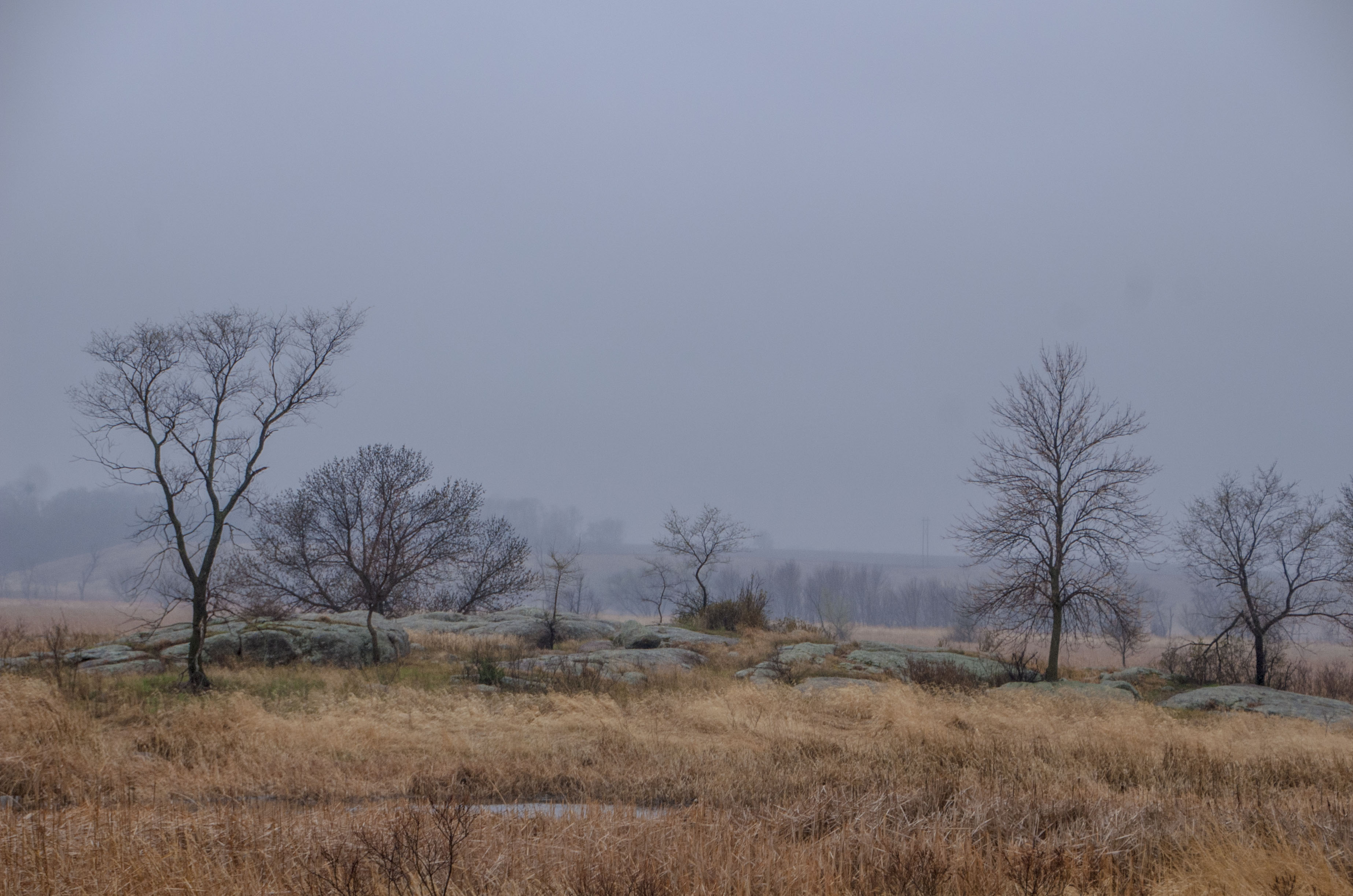
Common to many ares around the prairie are "ghosts" of the old prairie potholes — wetlands — that perhaps should not have been drained.

Common to many ares around the prairie are “ghosts” of the old prairie potholes — wetlands — that perhaps should not have been drained.

Am I anti-farming? Or, am I simply someone concerned about a future that appears ever more ominous for a climate challenged earth that will be incredibly feeble environmentally for our children and grandchildren — indeed, for all future generations.

Am I anti-farming, or am I someone who simply wishes for the bygone ethics of conservation farming practices that promotes soil health and keep earth’s dirt in place?

Am I anti-farming, or someone who wishes to keep our people, our land and our rivers healthy, and in place for future generations. Surely this answers your question.

A beautiful buffer found in Chippewa County.
A beautiful buffer found in Chippewa County.


Seeking Self Forgiveness

We were to flip a coin. Heads we drive around the lake to a favored restaurant on the South Dakota side, or tails for the Italian place in Morris? When the quarter landed in my palm, I hid it from Rebecca.

“So, when it was in the air, how did you want it to land?”

She smiled. “Bello Cucina.”

As we piled into the car after changing clothes, I considered running back for my camera. Nope, we were just going for dinner and would likely be home before the good light descends on the countryside. Take a deep breath and leave with thoughts of “no regrets.”

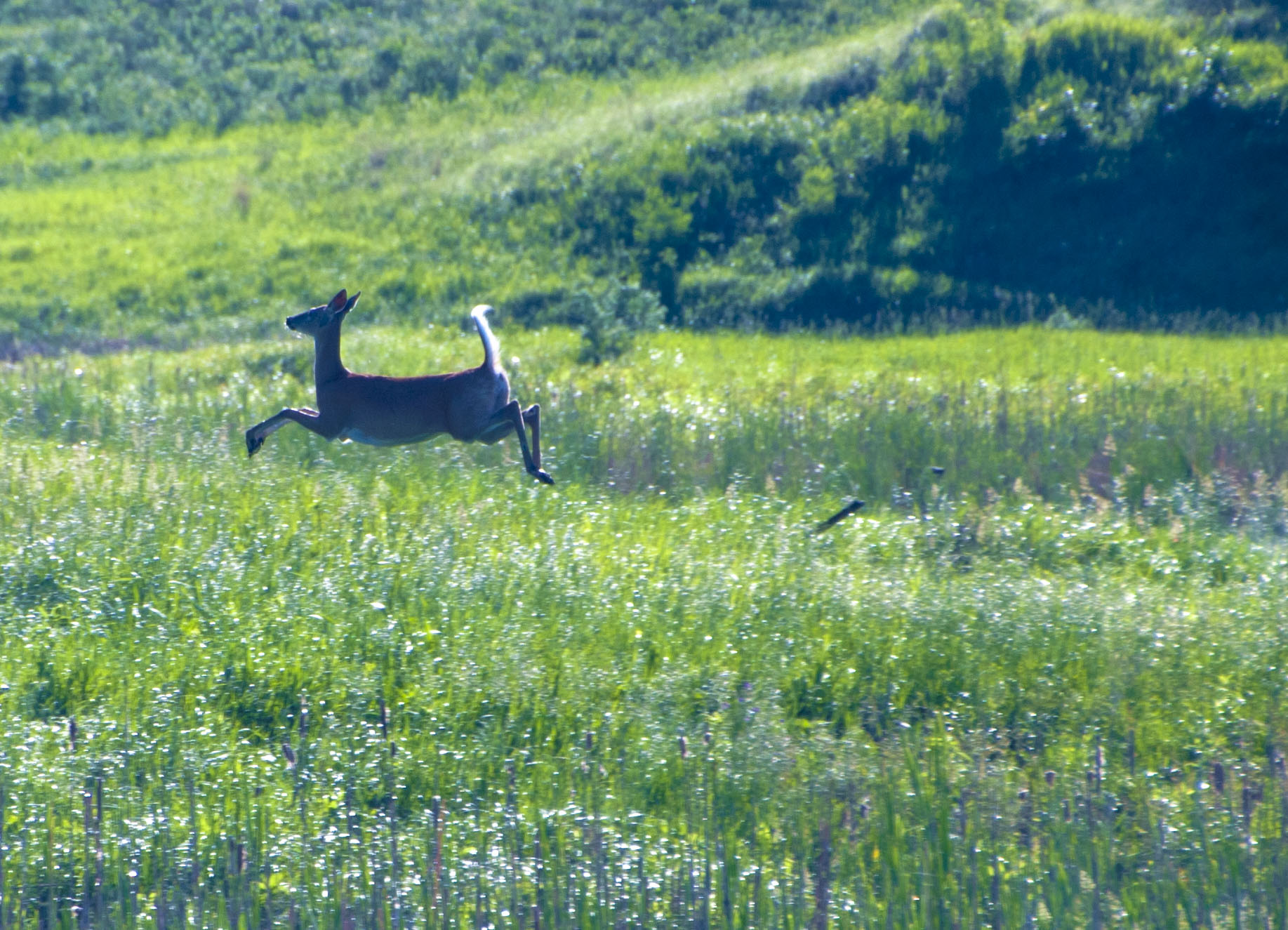
A doe in dewy grass.

A doe in dewy grass.

After a great dinner of some excellent pasta dishes — mine a wild mushroom and shrimp affair — we took a stroll around the block before starting home. A stop was also made to fill the tank. All of which pushed us into several miles of squinting into the lowering sun. What a relief it was when we turned south toward the “Clinton Road” just before reaching Chokio. When we turned back toward the west, an intense and colorful light graced the prairie. This is a favored beautiful and interesting stretch of highway hosting several restored patches of prairie, WMAs, a two-section wide federal waterfowl management area, and perhaps even some remnants of native prairie. When we passed a grassy wetland with a perfectly calm, mirror-like surface, my groan was audible. “Wow!” came the grouse. “That would have made a great picture.”

“Cell phone?”

“It fell under the seat and I can’t reach it.”

Just a few more miles further down the highway it happened again. There in a “ghost of prairie” wetland in a flooded corn field, a doe and her fawn waded in knee deep water lit by a perfectly intense glow of soft reddish purple light. Not a single ripple disturbed the surface as the doe nuzzled her fawn, and my moan was no doubt sickening.

“Hey,” Rebecca said, instantly recognizing my angst and trying to soothe my obvious disappointment, “we got to see it. It was a beautiful moment  and we got to see it with our own eyes. We and no one else.”

A startled doe, and a twin fawn I hadn't seen.

A startled doe, and a twin fawn I hadn’t seen.

Yes, but as a photographer, and especially as a recent nature photographing junkie, it was a missed image that will haunt me for several months if not years. Photographers who have missed such moments can identify with Hall of Fame pitchers like Bert Blyleven and the late Warren Spahn, the latter who told me (minus his frequent f-bombs) during an after-game interview when he was managing a Triple A team in the 1970s, “You remember the losses. The homers the jerks hit off you. Straight curves. That’s what you remember.” Blyleven has admitted as much during broadcasts of Minnesota Twins’ baseball games.

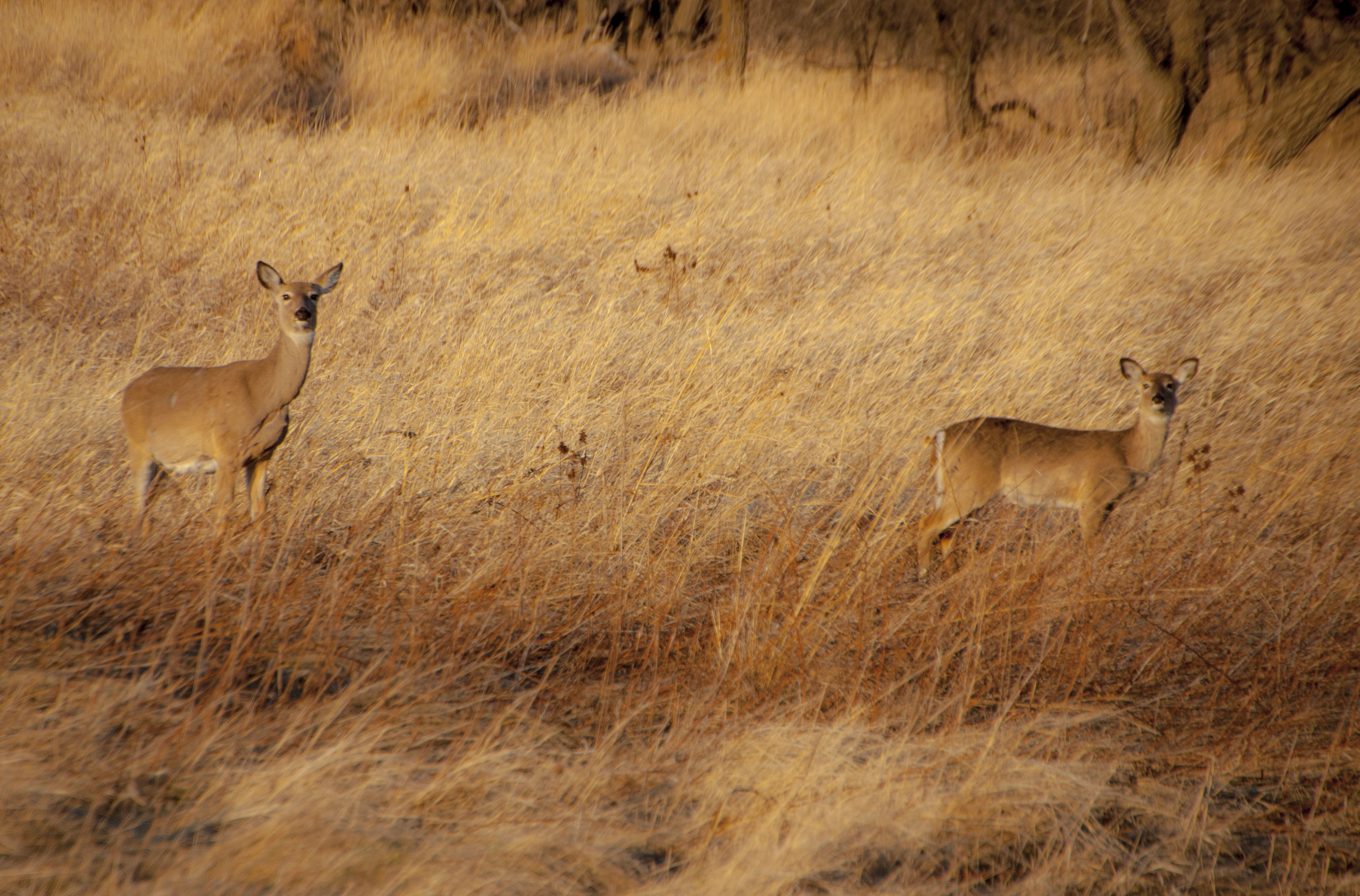
I'm pleased with my image of two deer at dusk, although this isn't the picture in the wetland I missed.

I’m pleased with my image of two deer at dusk, although this isn’t the picture in the wetland I missed.

Ah, the losses … those missed opportunities. Wild turkey toms facing off right after dawn just down the road. The trio of white-tails who were in ballet-like sync rounding the edge of a hill in the late afternoon light … also just down the road. And, now, the doe and fawn. All while “driving naked.” Each time my camera was back at the house. In fact, I still remember cresting a hill somewhere northwest of Dubuque in 1968 just as a farmer driving his tractor was silhouetted in a huge, bright red “sun ball” that was perfect for a 300 mm lens. I was speeding to a grass fire and didn’t stop. The next day I told my managing editor, Jim Galedis, about the near miss. “And you didn’t stop? Always shoot the picture. Always. Fires either get better or they’re nothing but ash. Always shoot the picture.”

Key to his advice, of course, is to never leave home without your camera.

After all these years I should know better.

And, there is this: A photographer never forgets, nor is there self forgiveness. You live, and will most likely die, remembering the misses, all of those “perfect” latent images.


After Thoughts

Martin Anderson was all smiles on the boat ride up the Minnesota River.

Martin seemed to enjoy his boat ride up the Minnesota River.

After an evening of interesting hill hugging lightning to the west of Glacial Lakes State Park, and a downpour that broke while in the depths of sleep, we were packing out a day earlier than we expected. More rain was forecast, and all of our gear was soaked after leaving open the largest “window” of the tent for some cross ventilation. So, yes, we can sleep through a storm in the grand outdoors.

Across the site Wes Konzin talked in a low murmur to his grandkids as another downpour drenched the campsite, meaning our breakfast would wait a little longer. It was my turn to cook breakfast, a treat of thick pepper bacon from Pastures of Plenty and a dozen eggs from our Listening Stones Farm that I would break into the peppery bacon grease.

Once breakfast was served and the soaked gear packed, stepson Martin and I left for home. As we weaved our way through the curvy road of the state park, he looked up and smiled. “I had fun, but I think when I look back on it I’ll have had more fun than I actually had.”

Martin is an indoorsy boy, so our camping out was definitely outside of his comfort zone. His “zone” would be challenged again a few days later when another river rat, Willie Rosin, boated us upriver from Waterman’s on a catfishing outing. What’s a boy to do when he has a stepfather river rat who viewed being indoors at Martin’s ripe young age of 11 as comparable to being stranded in a prison cell? I disliked inside as much as Martin does the outdoors.

The late afternoon sun kisses the grasses of an oak savanna ... the only sun we saw on the camping trip.

The late afternoon sun kisses the grasses of an oak savanna … the only sun we saw on the camping trip.

To his credit, Martin is adjusting — although he was rather quick and vocal when asked if he would like to join me on another fishing trip this past weekend. Martin reminds me of a cousin on my father’s side back when I was growing up who preferred reading to anything outside … until the day he somehow discovered fly fishing. Joe’s mother, perhaps my mother’s best friend, knew of how I had become completely immersed in the sport at about Martin’s age, and asked if I would help him get started. By then I was of driving age, so heading to farm ponds all around the area with my cousin was welcomed.

Since I was self-taught through the pages of Outdoor Life, Field & Stream, Sports Afield along with the iconic Herter’s, Inc., catalogs, Joe didn’t exactly have legendary fly caster Joan Wulff as his tutor. Those lessons went fine until an errant, wind influenced fly, snagged my poor cousin in the ear. Fortunately that didn’t deter his passion, for as an adult he became a hydrologic engineer with the Corps of Engineers when he wasn’t casting the long rod.

Fly fishing has a way of attracting the intelligent kids like the Joe’s and Martin’s of the world for it’s cerebral nature. Interestingly, people will ask about “fly fishing lessons” with an eye toward the casting rather than the line control and various retrieves necessary for successful fishing. This isn’t unlike learning the mechanical features of a camera and thinking this alone will make you a good photographer. Both the casting and the mechanical camera lessons are essential for reaching positive end results, though neither will be mistaken for the art of either.

Martin’s few weeks with us have been an adventure. He has really tried, and for that he deserves credit. He was mystified when his mother eagerly agreed to come on a one hour, one way jaunt to a swampy woodland savanna to see white prairie lady slippers. “All this way just for wild flowers?” He had balked, though gave in, to going on a few earlier trips to the nearby Clinton Prairie as I took pictures of prairie smoke.

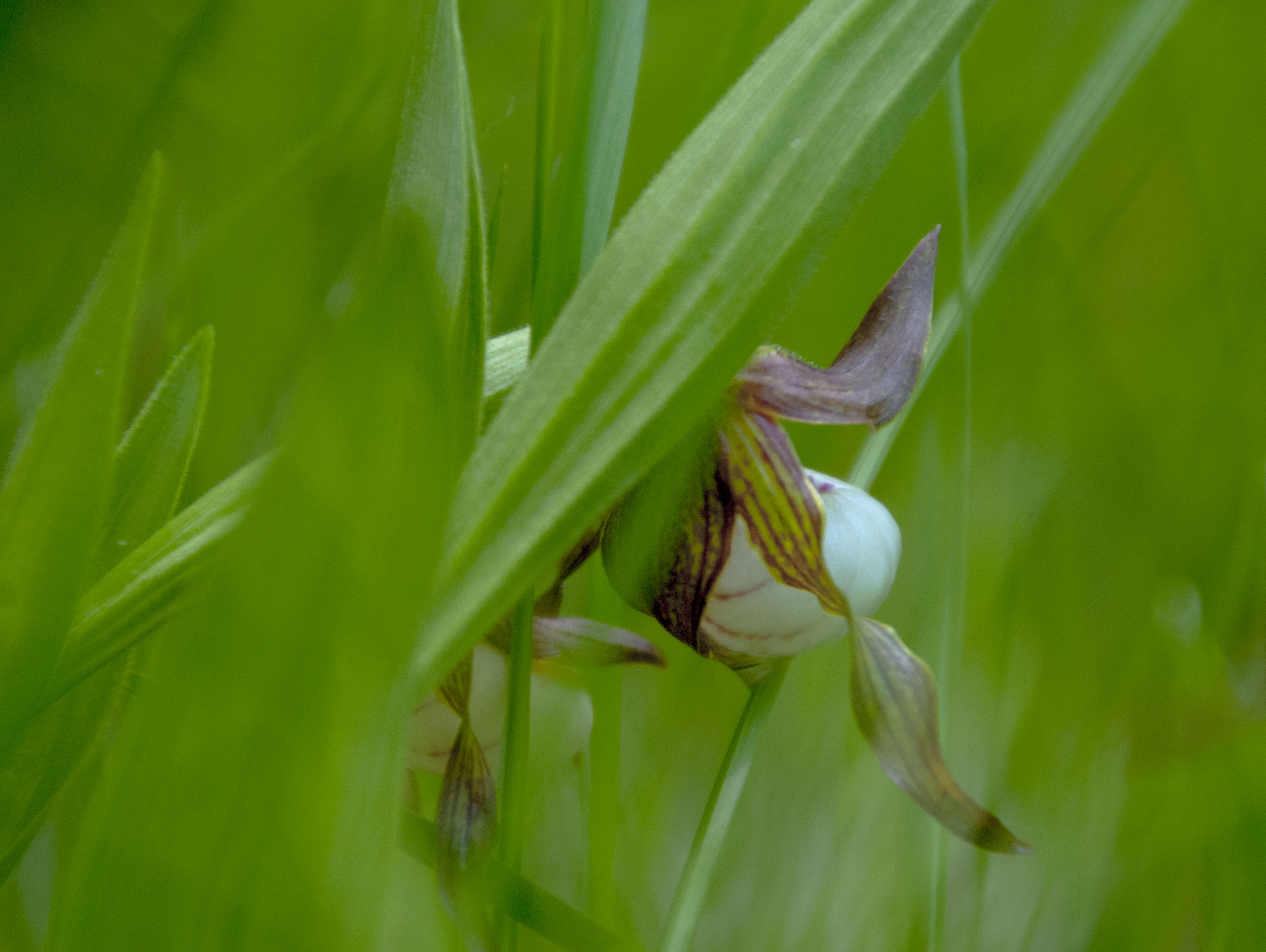
One of the Prairie White Lady Slippers we found on our foray.

One of the Prairie White Lady Slippers we found on our foray.

Yet, when I’m looking at my results at my computer after an outing Martin will often look over my shoulder to offer comments and compliments on the images. Yes, he had a good time on our camping trip and willingly took his seat along with Wes’ grandkids on their story telling stump. On one of our photography forays he asked if he could use my camera to make a picture. And, after the trip with Willie, Martin asked for a fillet knife to help clean the catfish we had caught. I hesitate to mention how proud he was for catching more fish than his stepfather.

His becoming a passionate outdoorsman may be way too much to expect, although we have taken a few baby steps into that odd universe we call a “comfort zone.” Like Kermit the Frog said, “It isn’t easy being green.” Martin was also right in his comment: “I had fun, but I think when I look back on it I’ll have had more fun than I actually had.”

What outdoorsman hasn’t said that at least a dozen times? Yes, the journey has begun.

A wetland, as we were leaving.

A wetland, as we were leaving.

Joelie’s Dandelion Cookies

Have you ever had one of those Euwell Gibbons’ moments? Moments where you find yourself searching roadside ditches for wild asparagus or turning cattail “hotdogs” into a pancake mix, or even collecting and cooking dandelions?

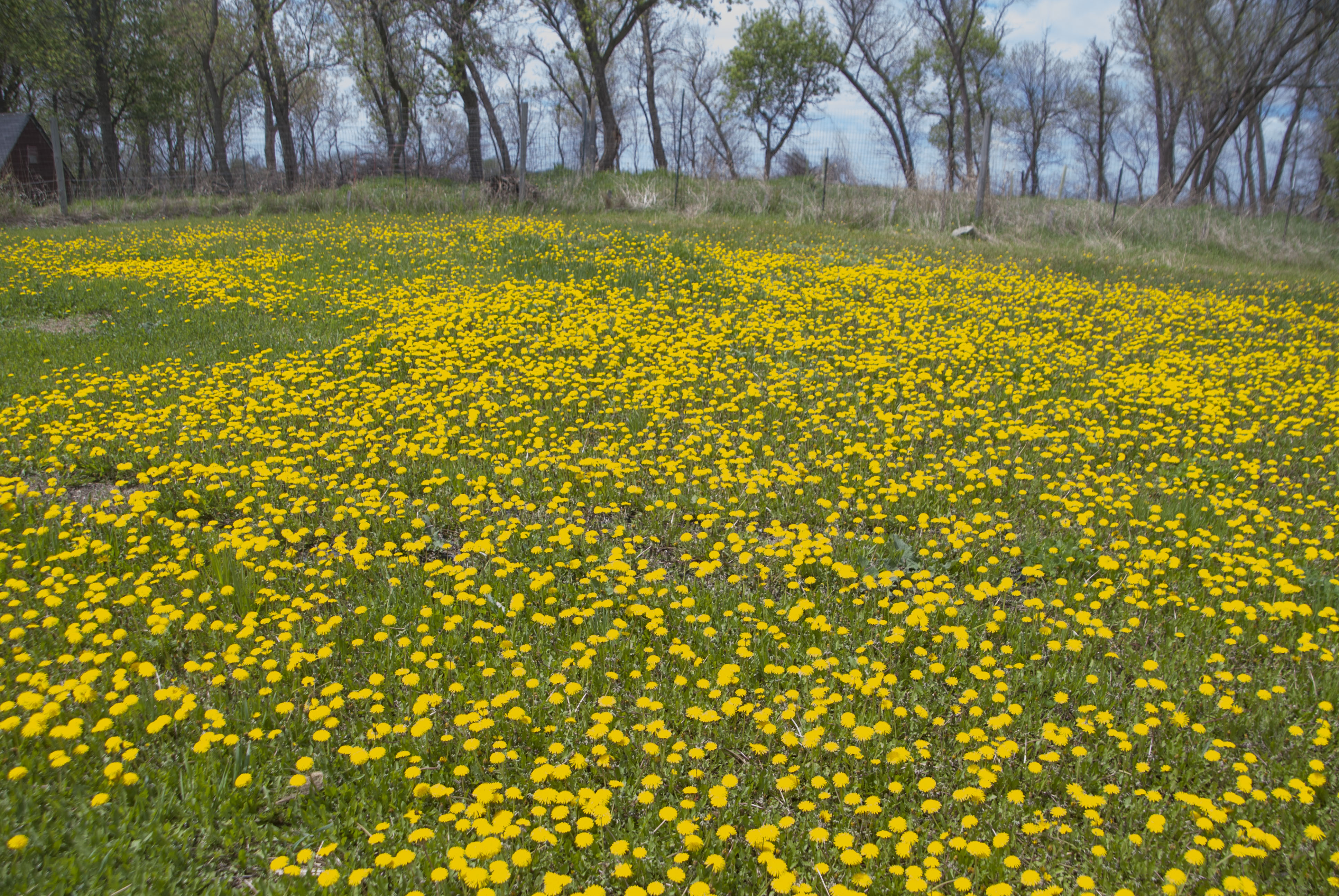
Our bountiful field of yellow!

Our bountiful field of yellow!

Earlier this week a friend of ours, Joelie Hicks, posted a recipe for dandelion cookies. Hmmmm?

Back in my Dubuque days with the exciting daily Telegraph-Herald, I wrote a story on a junk yard guy in his 70s who was married and, according to all involved, fathered a child with his 29-year-old wife. There was little doubt of her deep feelings for the old codger, for you could see love in her eyes as she talked of how he respected and treated her as a person. He was one of those tough exterior guys with a soft heart who acted and worked like a man half his age. After recording the interview and doing the pictures, he asked, “Say, Boy, how about I pour you a little glass of my homemade dandy-line wine?”

Those yellow petals are intense with color.

Those yellow petals are intense with color.

At that age I was far from being one to turn down an offered drink, so he pushed a paint-chipped chair past the prone German Shepard in his little office and reached for a label-free wine bottle, pulled the cork and filled my glass about a third full. Before jumping to conclusions, this was a little fruit juice glass. “Pour you any more, Boy, and you ain’t drivin’ back to no Dubuque.”

The old man was honest as a summer day is long, for I was challenged to make the drive even with what he poured.

Fortunately I have once again settled down with a dear woman who holds dandelions close to her heart. Actually, I find it a bit disheartening that couples aren’t asked in premarital counseling, “Which is more important to you, John and Rebecca, a field of golden dandelion goodness or to have a dandelion-clean and perfectly green lawn?”

Years ago when my brother, Mark, lived in Omaha, his next door neighbor woman became rather riled over his suspected failure to spray his backyard of the pretty yellow spring flowers. “Mam,” I said, aiming for a spot somewhere on the soft side of her heart, “have you ever heard of this new lawn technique they’re calling ‘naturalizing?’”

This was just enough to stop her rant for a precious moment.
dandelion4
“That’s where you plant native flowers so they will bloom to add interesting color and beauty to an otherwise boring green lawn. That was my dear brother’s intent here with his lawn. Look. You can’t call this a boring lawn.”

She stared at me for a good 45 seconds in what could be generously described as a rage of silence before turning on her heels and stomping off to her house.

Back in the present, a few days ago Rebecca asked, “Have you seen the incredible yellow in the goat pen? The bees are just loving those dandelions.” We have a rich carpet of them.

Between the two of us I’m sure we attended at least three or four meetings this past winter over the crisis facing bees and other pollinators, so we see dandelions as a bridge to our recently planted clover and hopefully the prairie flowers sure to rise in our tillable acres. And, of course, our garden. We hope to have enough blossoms around our little island of pollinator friendliness to withstand the expected GMO corn and soybeans that reportedly carry genes that are causing bee colonies to collapse. In the spirit of marital cohesiveness, I asked her permission before I took my half-cup measuring tin outside to fulfill Joelie’s recipe requirement.

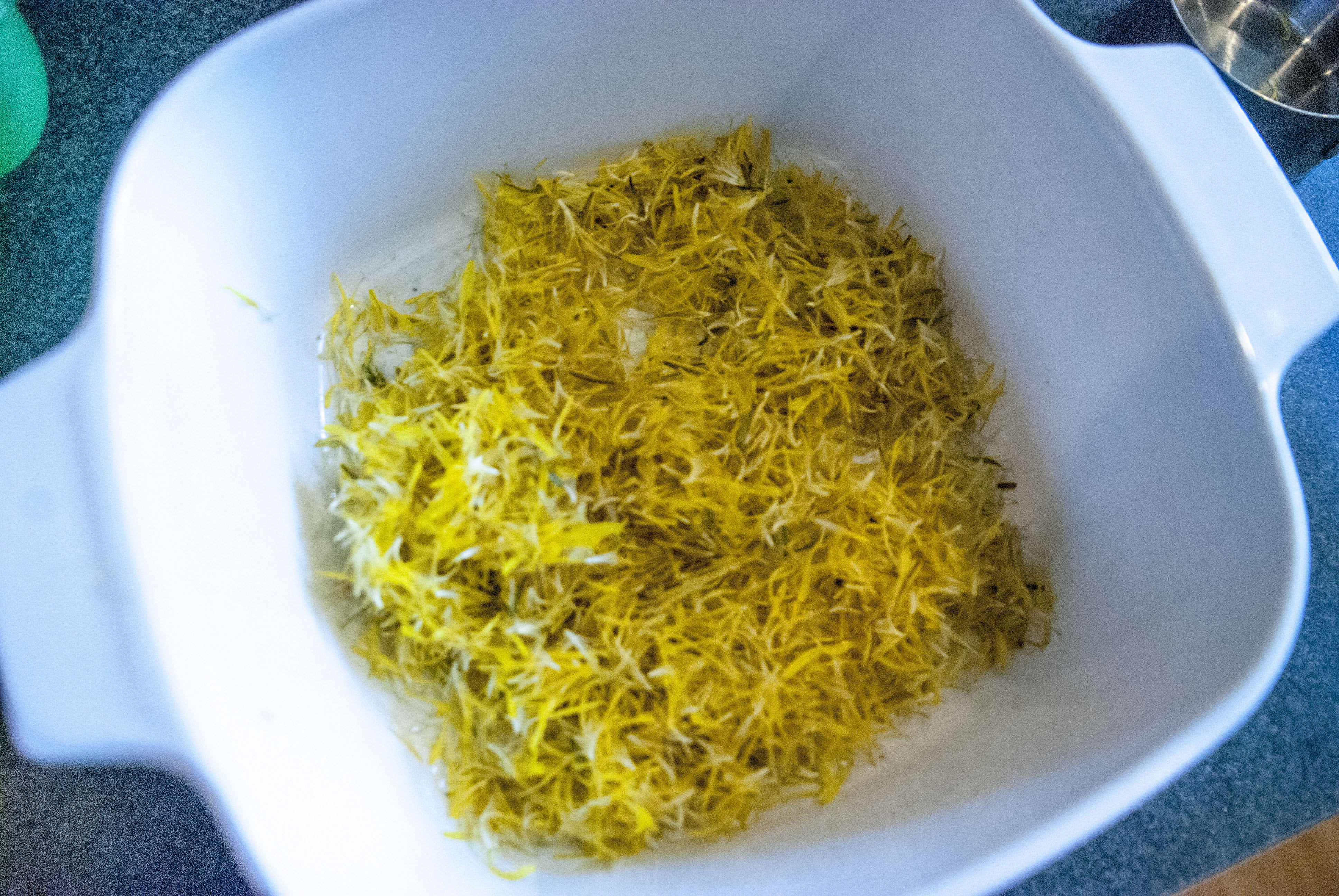
Just a half cup is all you need ... without the green "crowns."

Just a half cup is all you need … without the green “crowns.”

As the cookies were baking Rebecca came inside to say it was hard to see where I’d even picked the blossoms. Our son, Martin, who is here for the month, also came inside to say, “John, I don’t think you even made a dent in the dandelions out there.” Hey, I’m good!

For those just dying for the recipe, here it is: Blend together 1/2 c. butter, 1/2 c. honey, 2 eggs and 1 teaspoon of vanilla, then stir in 1 c. flour, 1 c. dry oatmeal, 1/2 c. dandelion florets pulled or cut from the base of the flower.

Just before adding the flour and oatmeal.

Just before adding the flour and oatmeal.

All ready to drop on the pizza stone!

All ready to drop on the pizza stone!

Bake at 375 on a lightly oiled cookie sheet or pizza stone for 10-15 minutes. I added a cup of chocolate chips just because I could, so I suppose that should read as “optional.”

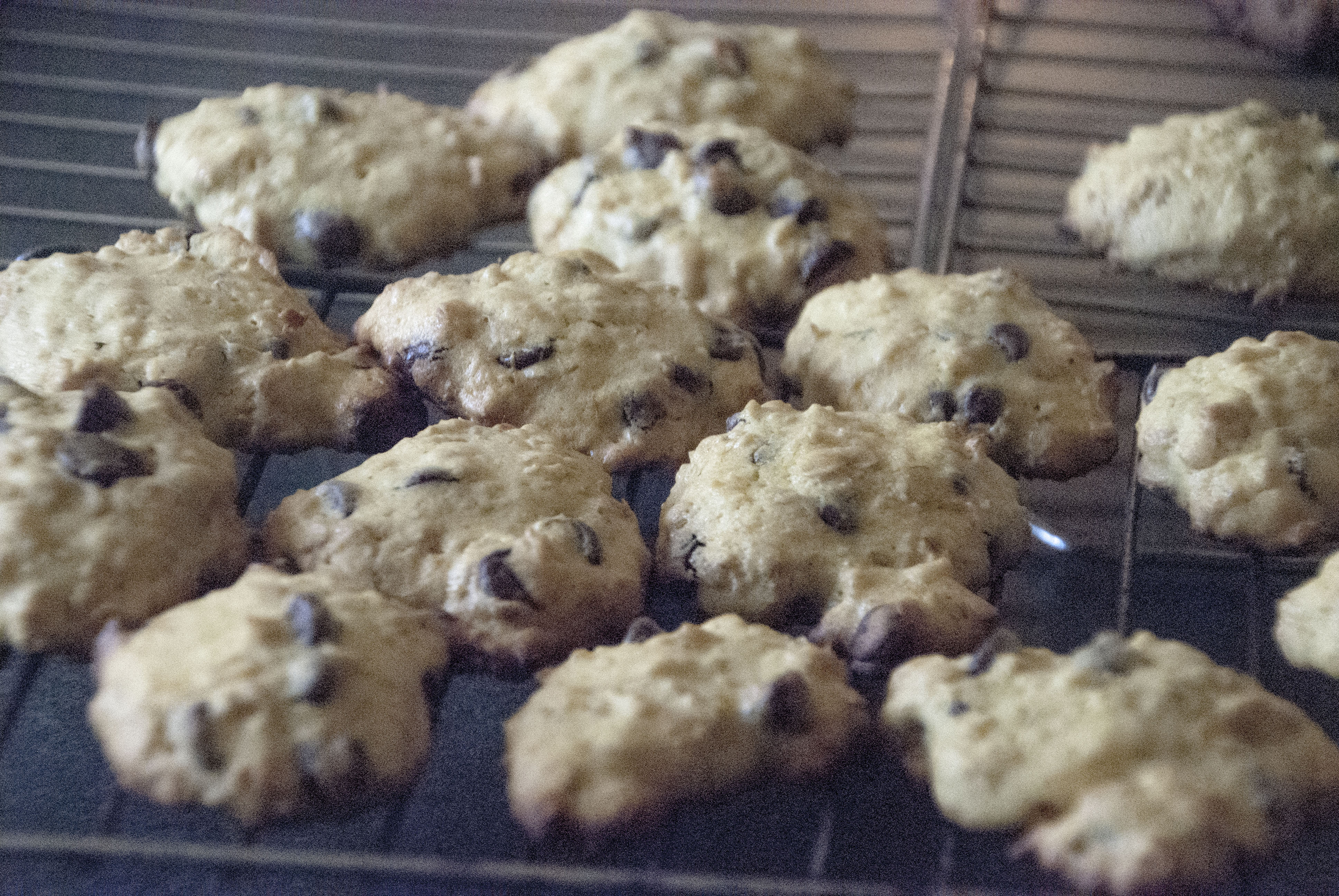
All baked and ready to eat ... and they were a big hit, even to Martin!

All baked and ready to eat … and they were a big hit, even to Martin!

Yes, they’re rather delicious, though they don’t seem to have the same kick as the old junk dealer’s dandy-line wine. In fact, I think I could eat the whole batch and still drive all the way to Dubuque.

On the Drive Home

Not long after pausing to capture a few images of a Bald Eagle perched in a tree along the shore of Lake Minnewaska, then the painstaking process of following a farmer with a grain drill who insisted on driving down the middle of Highway 28 going through North Morris and forcing oncomers to take the shoulder and the followers to bide time, it was back on the open road once again. Back in the country on the backstretch home, and off to the west, a plume of smoke rose from the prairie.

The Bald Eagle takes off.

The Bald Eagle takes off.

Fire in the prairie this time of year is considered a good thing, a time of renewal. By burning off the thick duff left behind by several seasons of prairie grass thatch, a prairie fire brings potential death to invasive shrubs and trees as well as a lush new birth to the deep rooted native forbs and grasses. A prairie, say many, is forest turned upside down. The vast vegetative portion of the plants are all underground, anchoring ever deeper into the soil profile. The smoke plume reaching into the distant sky brought a smile.

After a weekend conference of Minnesota Master Naturalists at Camp Friendship just outside of Annandale, my thoughts were generally positive from meeting with like-minded, environmentally-friendly peers. This was a nice reprieve from new reports of global warming incidents around the globe. Landslides and flooding in the Balkans. Reports and charts portraying perhaps the warmest December on record worldwide. Wildfires once again ravishing the U.S.’s Southwest, which involved a cousin who was forced to evacuate her home going into the weekend.

To the west, the plume was getting ever closer and was exhibiting that familiar profile of width. Immediately I had hopes of capturing the crew working a prairie fire photographically.

On a long drive home, the mind wanders … and mine was. Wondering about my cousin and the fate of her home; of a fire of destruction as well as one of renewal. Then other thoughts drifted in … of how our own sons will fare in an ever changing and warming world.

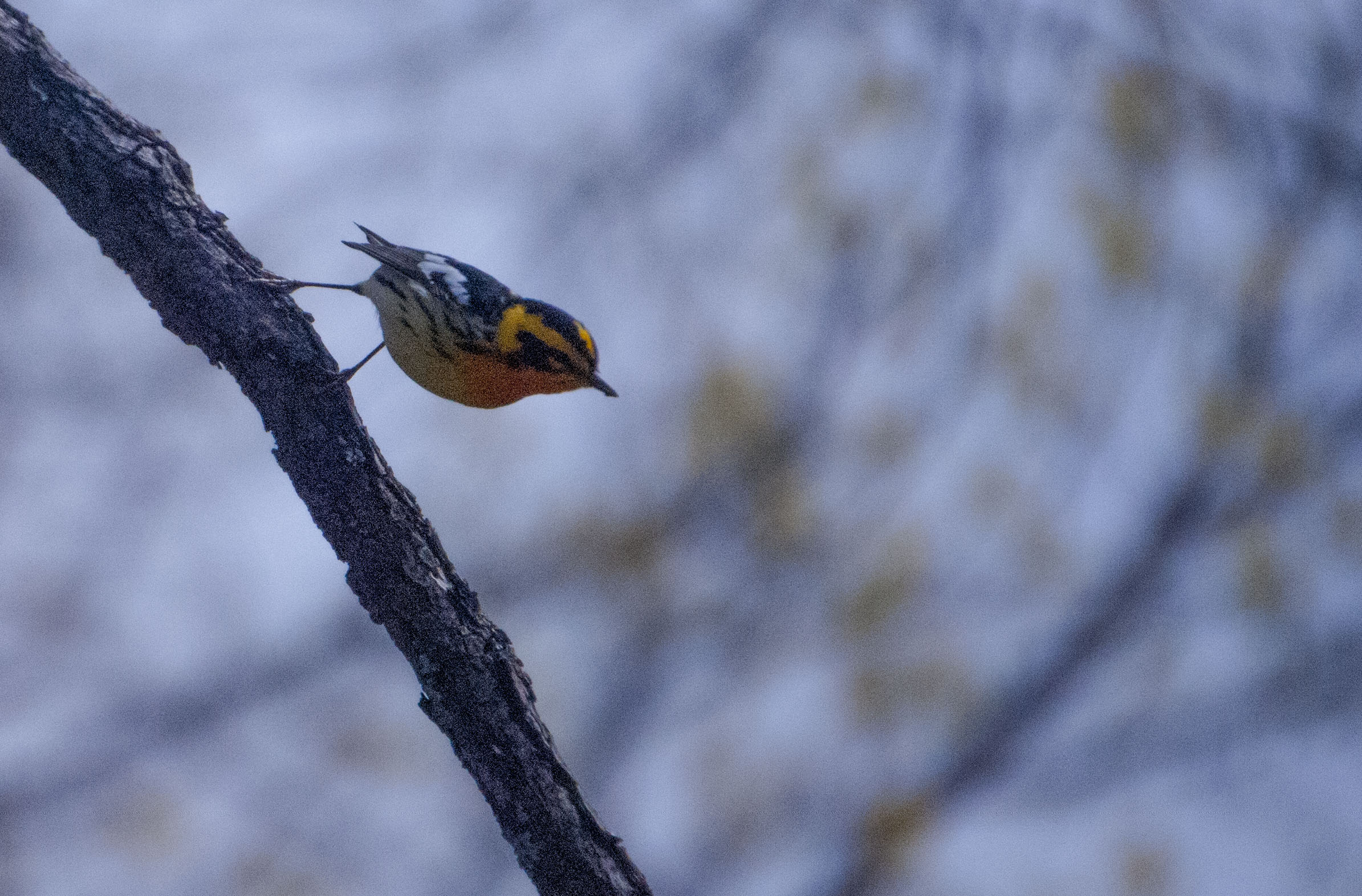
Will the Black Burnerian Warbler still find a home with the change in the biome species?

Will the Black Burnerian Warbler still find a home with the change in the biome species?

Global warming has been a nearly constant conference and meeting agenda item this winter. Seminars and conferences have included the threatened bees and pollinators, and we attended two different presentations by icecap explorer Will Steger. At both he showed the incredible footage from the documentary, “Chasing Ice,” showing a massive ice field suddenly and unexpectedly collapsing that was captured on film by a crew. Indeed, while wildfires threatened my cousin’s California home, news broke that a collapse of massive portions of the Antarctic ice sheet now appears inevitable and could trigger a far higher sea-level rise than once projected — up to 12 feet, or four meters — according to major new studies by University of Washington and NASA researchers.

Those who have read Jon Bowermaster and Steger’s page-turner, “Crossing Antarctica,” will realize that more than half of the book and the issues his team faced on the trip were on the West Antarctic ice sheet — which is about the size of New Mexico and Arizona combined. This won’t happen in my lifetime, since it is estimated to occur over 200 years …  a time span that, interestingly, sparked more thought from the weekend conference, again concerning global climate change.

It was during a keynote address by Dr. Lee Frelich, research associate and director of the University of Minnesota’s Center for Forest Ecology, that he described the expected changes in the boreal forest biome in Northern Minnesota. At one point he agreed that, yes, the boreal had migrated over time as far south as Tennessee and as deep as the northern wilds of upper Ontario. “Those changes, though,” he explained, “occurred over thousands of years, which geologically are snapshots in time. What we’re seeing now, within a century or two, has not happened so fast in the history of earth.”

Core samples taken from a Siberian lake that offer a portrait of earth over nearly three million years gave proof, he said. Frelich added the forest profile around the Boundary Waters will take on significant change over the next 30 to 50 years and maybe even sooner. “If you want a preview of what the Boundary Waters will look like by 2050, go to Granite Falls along the Minnesota River in the Western Prairie. All along the river you have the same rock formations as you find in the BWCA, and you’ll see a plant profile there now that is very similar to what we’ll see there. Scrub cedar. Burr oak. A dominance of the maple species. Prickly pear in the rock formations.” You could sense an audible murmur as that reality settled around the room.

As I turned south onto a county blacktop off Highway 28, the remembrance of the murmur was lost as the plume of smoke grew ever closer.

“For a scientist,” I remembered him saying, “these are exciting times, for we’re seeing events in our lifetimes that have historically taken thousands if not millions of years to happen. Another drought. Increased instances and severities of windstorms, and the resulting fires will complete the transition. Already the understories of the new forests have taken hold. Drought, wind and fire will bring this succession to life in our lifetimes.” In some areas of Minnesota and Ontario, he predicted, the succession might be only a summer or two in the making … depending on those three climate-driven conditions.

Outcrops and species profile of the Minnesota River valley might be the future BWCA area species profile.

Outcrops and species profile of the Minnesota River valley might be the future BWCA area species profile.

Finally, on the Clinton road, as I drew mental images of Lake One with a Minnesota River plant profile, the prairie fire grew closer and closer, and finally the field appeared. There, south of the highway, a farmer was burning off the last of a wide CRP buffer strip, and was following behind the fire with a huge tiller pulled by a tracked behemoth tractor, turning the newly blackened prairie sod upside down to plant his next crop right to the lip of the drainage ditch.

As the professor said, “In our lifetimes …”


Freeze Warnings

Over the past few hours we have frantically put ourselves on the front lines in the battle against a red alert freeze warning. Our main concern is the new batch of broilers we just had moved outside into the goat barn. Only a week old, the 51 chicks had already become crowded in the horse trough we use as a brooder.

Using old sleeping bags, we covered as much of the 6 ft. by 8 ft. dog kennel as possible. As we moved plants inside we discussed our efforts with hopes that the covering along with the lights will be sufficient for the chicks to survive. In all, a snow fence was affixed to the dog kennel, and then she attached galvanized roofing panels to the outside of that, and then the blankets and sleeping bags were draped over the whole thing to try to keep them warmth through the night.

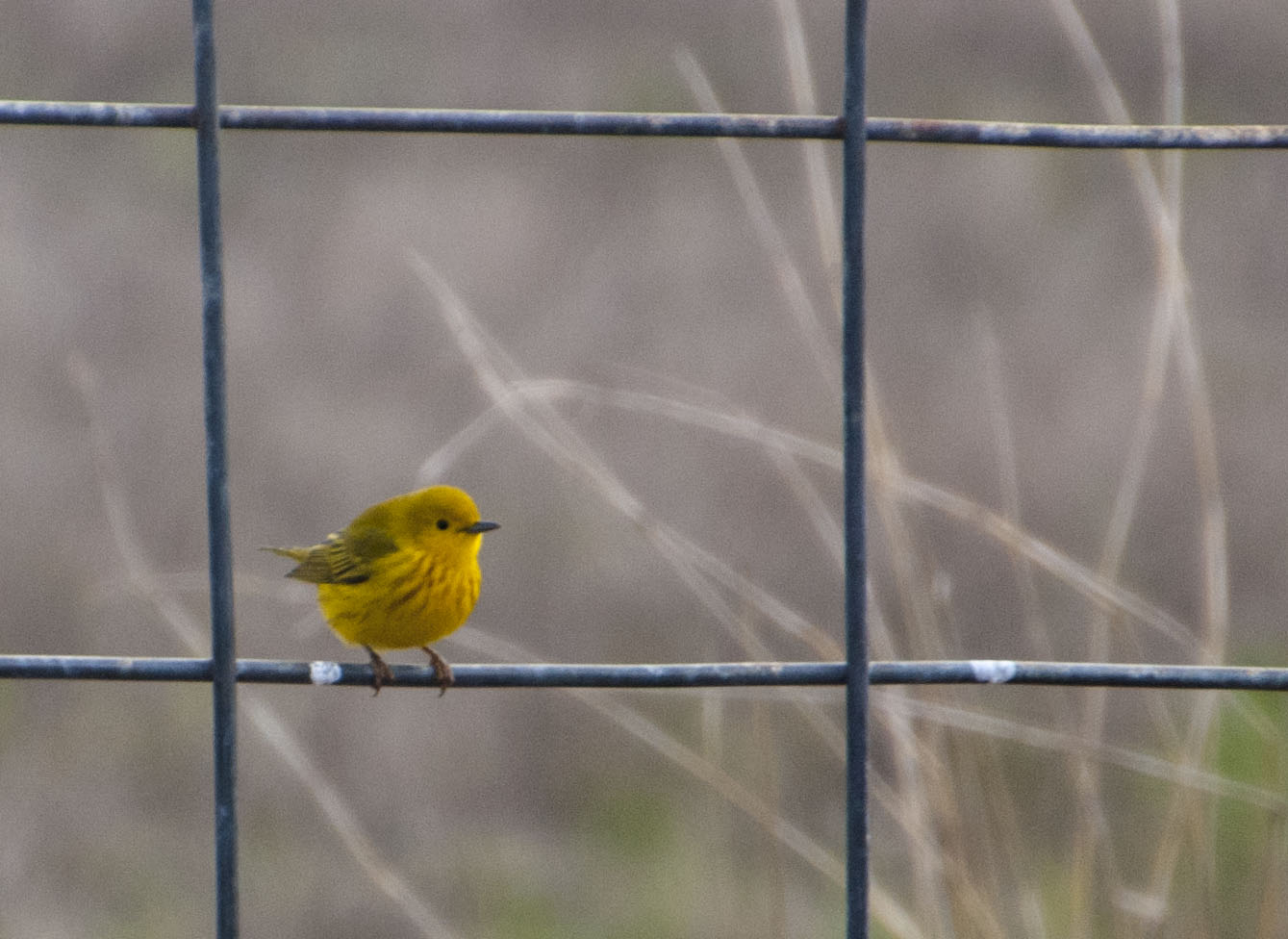
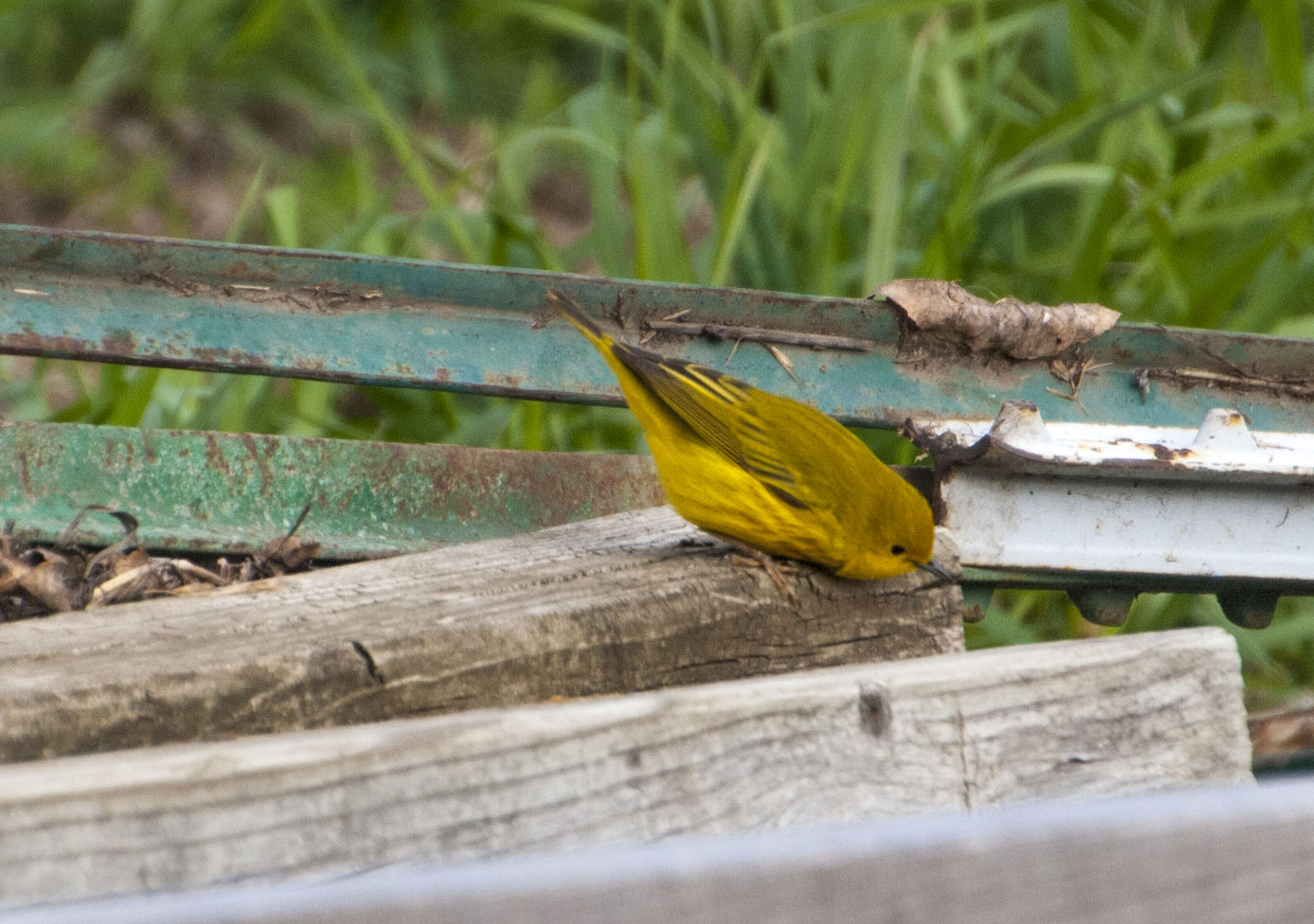
Despite the concern and worry, Rebecca came back to the house from her garden in complete ecstasy. Once again her little jewels, tiny yellow warblers, were there to keep her company. The warblers, with their intense hyper activity, rarely stay put for long, and she said her efforts to capture images of the little birds with her phone were nearly impossible.
yellowwarbler4
Since I am still smarting from not having my camera on the listening bench in the pathway through the grove a couple of weeks ago, I eagerly volunteered to bring my camera to the garden to see if I would have any luck. She was right. The warblers dart here and there, one second on the frame of a raised bed, the next on a cattle panel, then off to the edge of the prairie. We counted three. Perhaps there were more. Their name tags, if they wore them, were much too small to read!

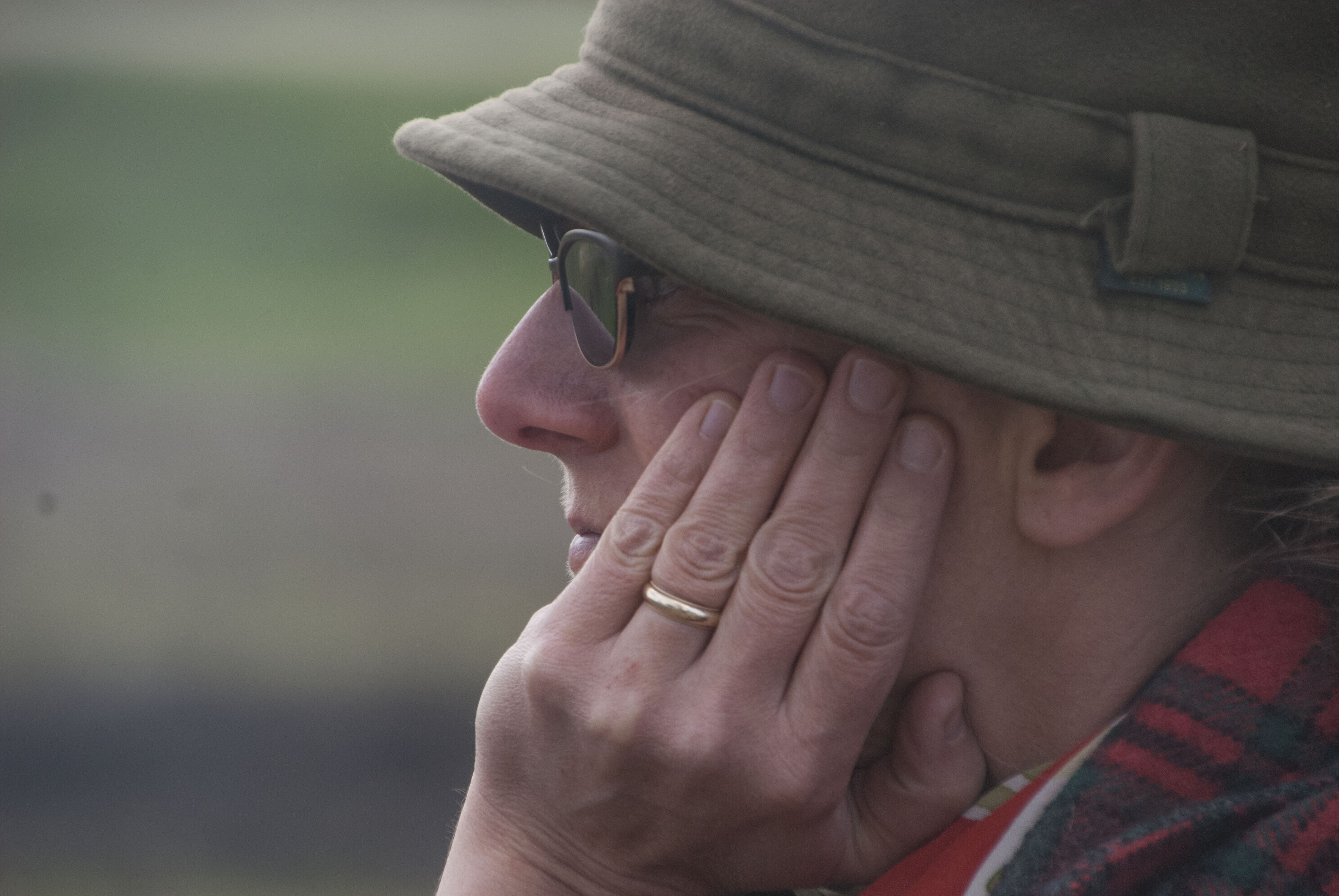
For a half hour we sat in the lowering sun to watch as they flew in and away. Rebecca was nearly mesmerized. As much as I love our life on the farm, my love pales in comparison to hers. Warbler sightings and accompaniment are part of that love she has for the farm. I captured a nice picture of her as she sat watching the warblers.

Rebecca watches the warblers at the foot of her garden.

Rebecca watches the warblers at the foot of her garden.

For me, it was almost as comical as if I were doing a Whack-A-Mole. “Oh, there’s one!” she’d say. “Oops.”

Living jewels are indeed fleeting.

“Oh, look! By the bale!” Bingo.

By the bale.

By the bale.

Fortunately the warbler bounced from in front of the bale to the lower frame of a raised bed, then skirted that more deftly than an acrobat can balance on a thin train rail. It skittered along to hop onto some of her cattle fencing. Another warbler swept in, and a third … which took a perch on the erected fence panel itself — gave us a fine show. Her garden jewels were shining all over the place.

Like all good shows, this one had to come to an end. We headed back to the house excited about our short adventure, although about halfway there thoughts of the impending freeze warning emerged.

Despite the dire possibilities, I had to smile. Are we becoming farmers? People who cannot have a conversation without worry creeping in? Years ago I did a story on a woman farmer near Gluek for the sole purpose of portraying a happy farmer. I hadn’t known her for very long, yet her conversations were constantly filled with wonder, fine accomplishments of simple tasks, descriptions of her growing crops, and usually concluding with a report of riding around her farm on her horse as a sunset approached. Every conversation was somehow positive.
yellowwarbler2
And here we are on our own farm facing a freeze warning. When we go to bed tonight I’m sure we’ll both think of the chicks spending their first night in the “wilds” of the goat barn, huddled beneath lamps inside a large dog kennel covered with old sleeping bags to hopefully retain the heat. Yes, there is that. I’m also guessing we’ll both have smiles, too, as we recapture those precious moments in the garden with Rebecca’s jewels … those beautiful little yellow warblers!

A Welcoming Home

From the corner of the eye I caught the flash of pure bright brown. Off to the right, across from the garden. It came while awaiting for the bucket of smelly fish fertilizer to fill with water; a mixture we were sloshing into the holes we dug for the new trees and shrubs we were planting in the grove and in strategic spots of our prairie. Yes, said Rebecca, she had seen it, too. Brown Thrashers.

We had a pair in the very southwest corner of the grove last summer. We had concerns that with our cleaning of all the buckthorn and brush from the grove over the late fall and early winter that we had fiddled too much with their habitat. So seeing the vivid brown and those long tails, and for her, hearing their song, was wonderful. Over a thousand variations of the song, according to our field guide.

Now, we await the Orioles. Friends have made reports of arrivals further down the river valley, and someone said just this morning that a pair had arrived at her home along the lake. Maybe we’re next.

Living in the flyway has many rewards, and not just in waving at those traveling through. We also rejoice in those who are returning home. Like the Brown Thrashers and colorful Orioles.

A duck in flight in the wetland.

A duck in flight in the wetland.

A huge exciting moment for us came early Saturday morning while we stood in the kitchen sharing a quiet time over coffee and tea. Up in one of the woodpecker trees was a huge dun-colored blob, which sent me running for the binoculars. Meanwhile a second, more colorful mate appeared. Wood Ducks! Oh, what a close and wonderful view through the binoculars! With close proximity to two wetlands, one of our initial hopes was that we would have Wood Ducks in our grove. As we watched, the pair made a very determined and thorough investigation of trees offering possibilities, and yes, we have several.

First one would hop from one canopy to next, soon followed by the mate. As they would stand in the tree we marveled at their dexterity, of how well they stood with webbed feet. Then they would check out another. This continued for about a half hour. Maybe longer. Rebecca and I were anxious and curious. In my limited real estate searches, I doubt if I’ve ever scoured a potential neighborhood more passionately. Our weekend guests soon joined us at our big, kitchen sink window to watch the pair, although I doubt they shared our excitement.

Then, as suddenly as the ducks arrived, they departed. In our search of the grove since it looks as though we won’t be sharing our neighborhood that we now share with Yellow and Golden Winged Warblers, Red Bellied Woodpeckers and any number of other song birds. Apparently we lack enough oak trees and their favored diet of acorns. Fortunately bur oaks were among the trees we planted.

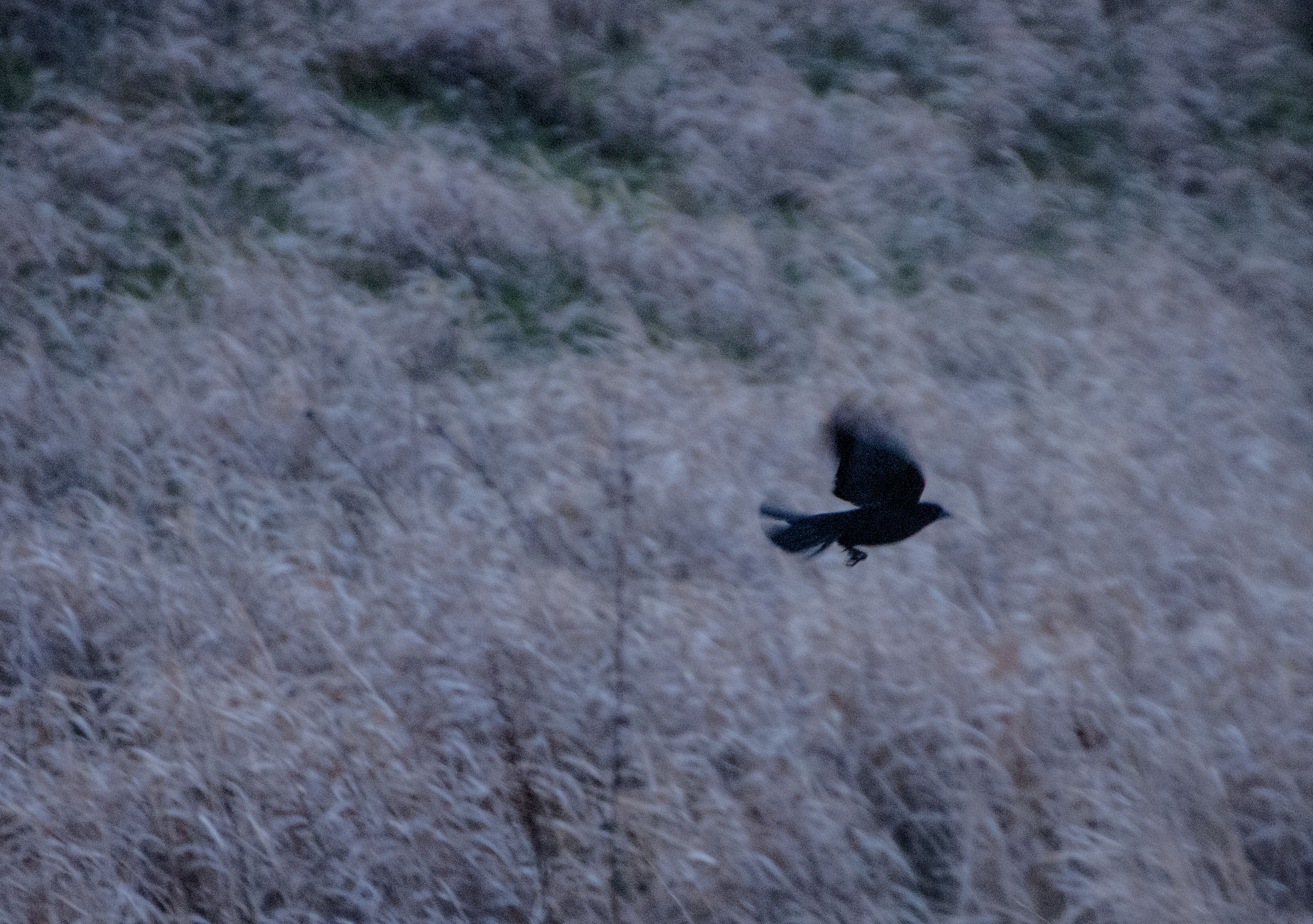
A flushed Red-Winged Blackbird in the Clinton Prairie.

A flushed Red-Winged Blackbird in the Clinton Prairie.

Up in the wetlands we flushed a murder of Yellow Headed Blackbirds that burst from the cattails almost as a feathered bouquet of glorious yellow. Around them the Red-winged males were staunch in defense of their individual territories. Nesting will be happening soon. Same with the paired Canada Geese, who have staked their select corners of wetlands and cozy river bends, and are surely tending nests by now.

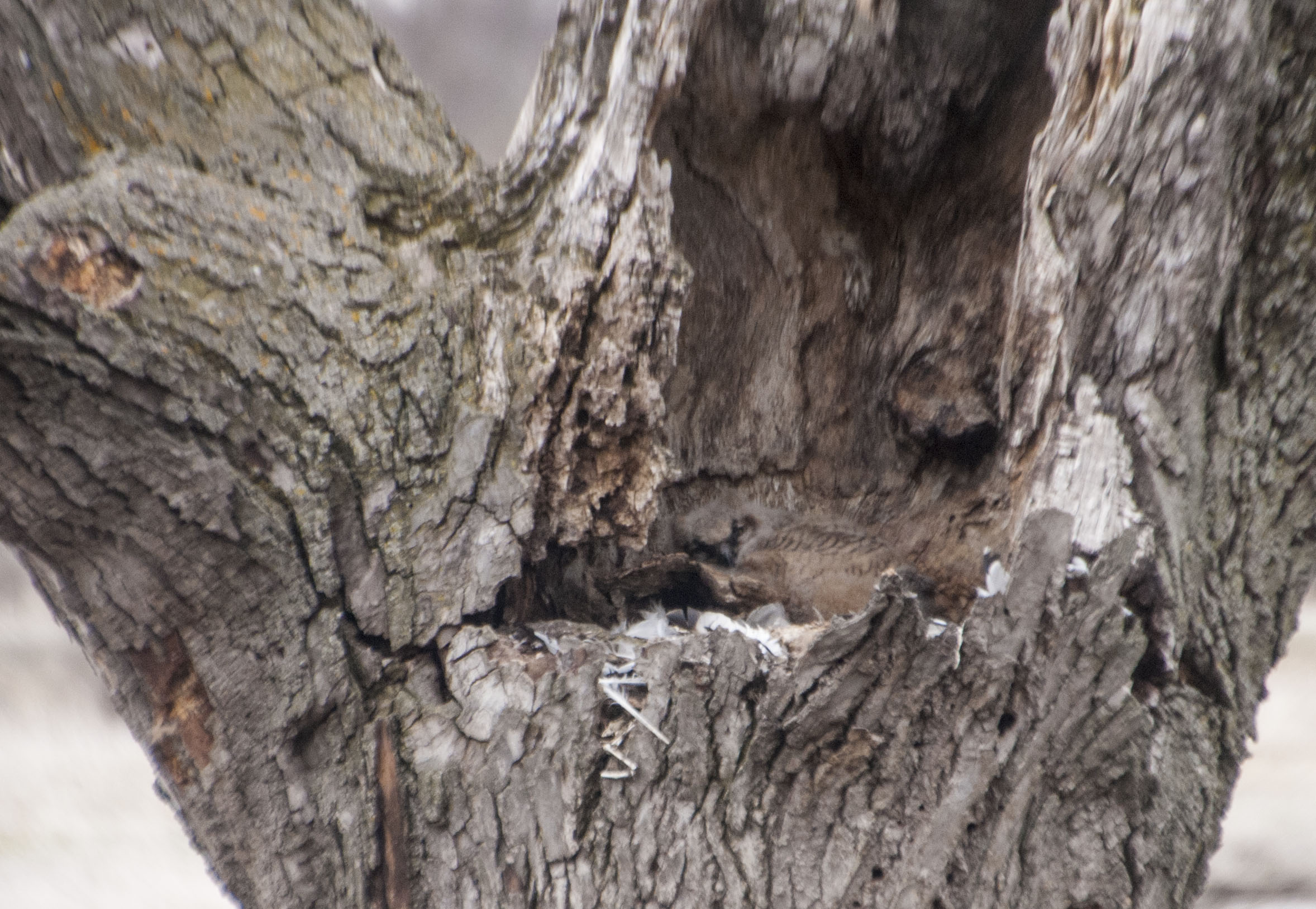
Look closely and you can see the owlet.

Look closely and you can see the owlet.

In the river valley we’ve noted heads bobbing in the nests of Bald Eagles, and was fortunate to have been guided to the nest of a Great Horned Owl. If one looks very closely at my photograph, you can see the well camouflaged owlet nestled inside the nest.

Our sky still has flocks of ducks flying between the wetlands, but the huge vees of geese have moved on up the flyway. Those vees have been replaced by the ballet beauty of flocks of White Pelicans. We often share our first glass of evening wine on our small deck hopeful of witnessing those magical moments of flight when the pelicans become nearly invisible before turning as a group in a contrasting flash of white against a deep blue sky.

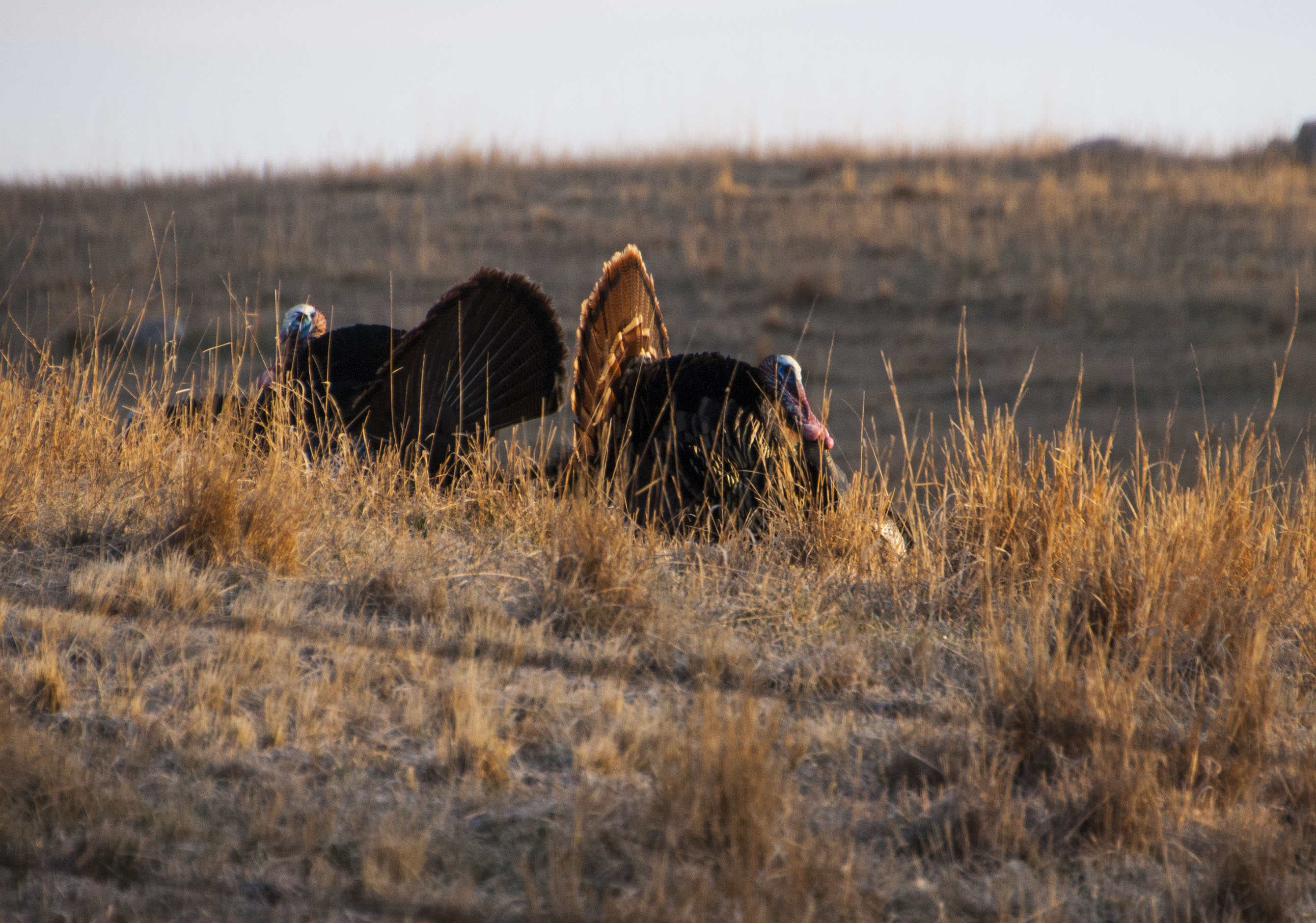
In the nearby prairies we hear the “barks” of Pheasants, and Wild Turkeys are strutting in display. Trying to capture a display has been almost cartoonish. On two different early mornings I passed strutting turkeys in full display just down the road, and both times I was without a camera. On Earth Day morning, though, when a fog hovered over the wetlands and in the river valley, I was finally able to capture an image of two toms just over a ridge as they tried to woo nearby hens.

Two toms in a strut-off on a nearby rise.

Two toms in a strut-off on a nearby rise.

All of which signals that, yes, spring has finally arrived. Even our acrobatic Barn Swallows have returned, which are more of a joy in flight than in how they leave the inside of our barn! We all have faults, which are mostly disregarded when you’re welcoming home members of nature’s family.

Livin’ Easy

Rain driven by a staunch prairie wind battered us as Willie Rosin guided what he calls his “perfect river boat” down the Minnesota from Waterman’s Landing toward spots known though rarely spoken of publicly. We were after our favorite fish, the sweet-fleshed channel catfish, which despite it’s fine taste is also an excellent fighting fish. We didn’t know if they would be out and about in the 45 degree water, although he had broiled up a family dinner from his limit of the day before — which was a perfect warm and sunny, 70 degree day. Our morning outing offered a distinct contrast.

Willie and I were fishing together for the first time since it seemed that every invite we shot at one another last year bounced back, so I was curious of how he went about his business. Several bends down river he eased off the throttle and guided the boat behind a promising deadfall. I smiled. “I see you do it right.”

He backed the boat into the deadfall to attach an anchoring cord. Yep, the Lutheran minister knew his catfishing business on the river. “So,” I asked, “you must have moved from down south?”

Willie laughed an easy laugh. “South Dakota. Actually, I didn’t learn about catfishing until we moved here. Where to find them in the river, and also that you bleed them out before you clean them. Once you do that you have the sweetest and most flavorful and delicate white meat you can find. Just delicious.”

This isn’t news to a southerner who grew up eating catfish (synonymous with channel catfish and not to be confused with distant family members such as flatheads or bullheads), yet to hear this from a child of a tier-state where walleye is considered king was music to the ears. Within moments we each had lines in the water. The wind and rain combined to make it bitterly cold as we hunkered down to await any movement of the line. Moments later my line tightened slightly and I set the hook, and was quickly in battle with a very strong fish.

“That’s what I love about river fishing,” said Willie, reaching for the net. “You never know what’s on the line.”

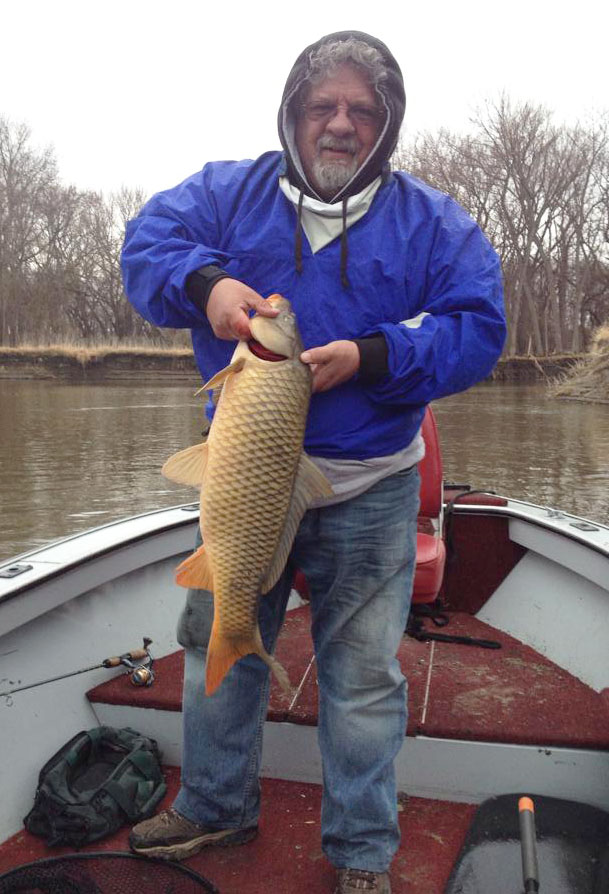
My first river fish of the year was a carp. “A good smoker,” as Willie put it. And, a great battler. It was promptly put into the livewell. Shortly I had another “golden salmon” on the line, which was much heftier than the first. We figured the best smoker was already in the bank so this one was released. Last summer I had caught and smoked one about that size before our trip to the BWCA, which in my mind was just as tasty as expensive, store-bought smoked salmon.

With one of the larger carp that we returned to the water.

With one of the larger carp that we returned to the water.

We chatted about people we know who needlessly kill a “rough” fish like that before returning it to the water. A good fighter, though, should be granted a measure of respect. Years ago I hooked onto an amazing fighter in the tailwater of the Granite Falls dam. It was late afternoon, and some men heading into the Legion across the river for “happy hour” stopped to watch. I didn’t know what was on the line, yet hopeful of a large channel cat or flathead. After a good 10 minutes of playing the fish in the fast water I finally brought it to the net. A large carp, probably in the 12 to 15 pound range. When the men saw it was a carp, I saw them waving it off as a joke, laughing as they entered the darkened bar room. It wasn’t a laughing matter to either the carp or myself, and after I disgorged the hook, I slid it back into the water. Then I sat down for a needed rest. Carp will do that to you.

Just up river at the Wegdahl bridge a few years later I caught about a ten pound carp on a nymph and five weight fly rod. If that doesn’t give you respect for a fish, nothing will. I was fortunate on two counts. My fly rod didn’t break, and I didn’t have a heart attack.

Willie netted a very nice catfish in the three pound range out of the snaggy deadfall, and I hooked another large carp. As we chatted about the similarities of our youths, we hooked a fish or two before eventually gliding downriver to different snags along the way. When we finally bowed to the harsh, cold wind and rain, Willie had a couple of good cats and a smoker carp in the livewell along with two of my five carp. I had also caught a fiddler. He anointed me as the Carp King, a crown I was pleased to wear.

Smoked carp fillets are a treat, for if done correctly they’re really just as tasty smoked as salmon. There are four significant keys to getting that special flavor — bleeding the fish by snipping the gills while they’re still alive, soaking the fillets in a good brine overnight, slow smoking with a sweet wood, and of course, not overcooking it. In my first effort last summer I used a simple brine consisting largely of salt and brown sugar. After an overnight soaking, the fillets were dusted with a Cajun spice before going into the bullet smoker. Although tasty, they were a little too salty for my taste. I thought perhaps the fillets weren’t rinsed thoroughly enough.

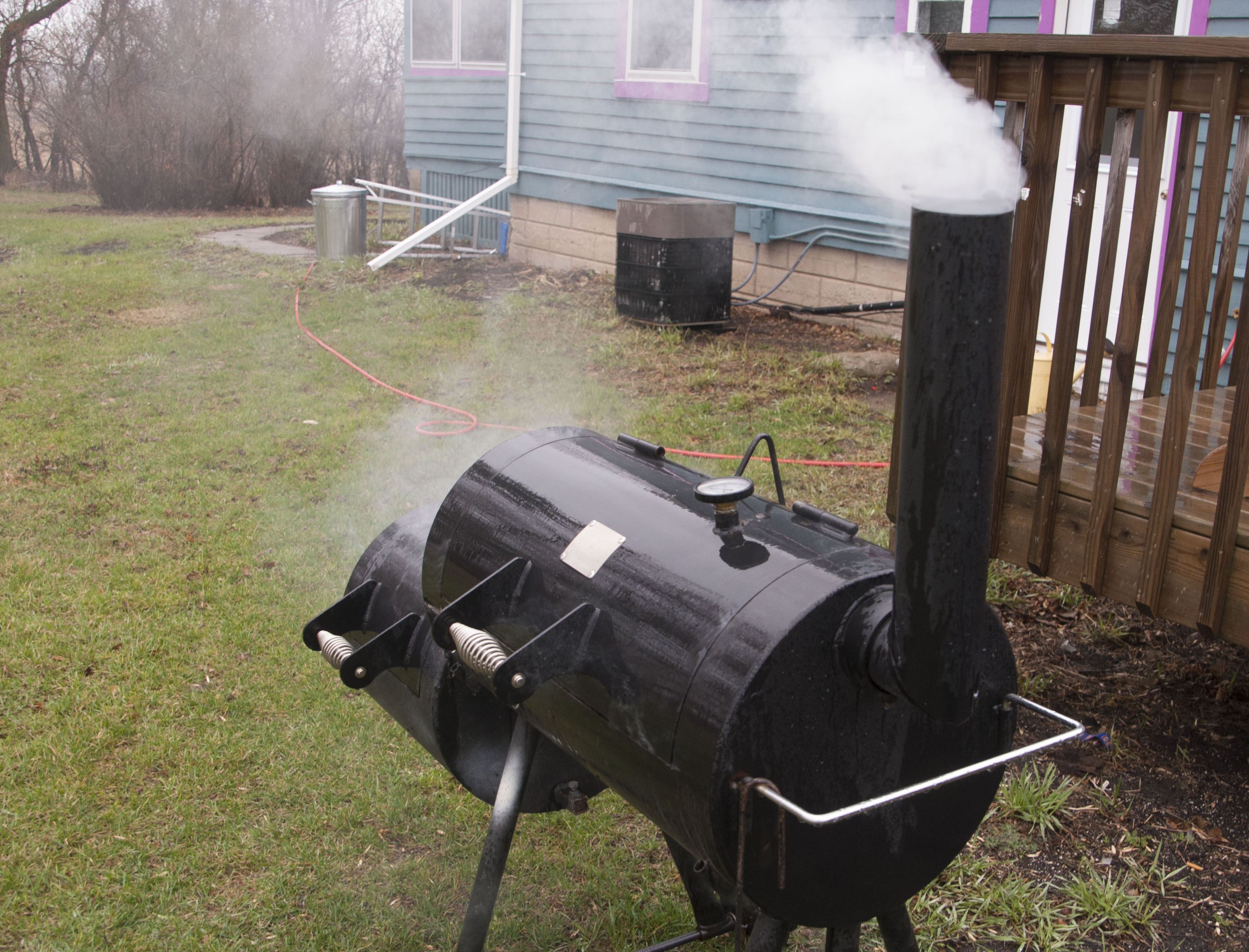
Smoke from the pecan shells escapes through the chimney of our new, secondhand offset smoker.

Smoke from the pecan shells escapes through the chimney of our new, secondhand offset smoker.

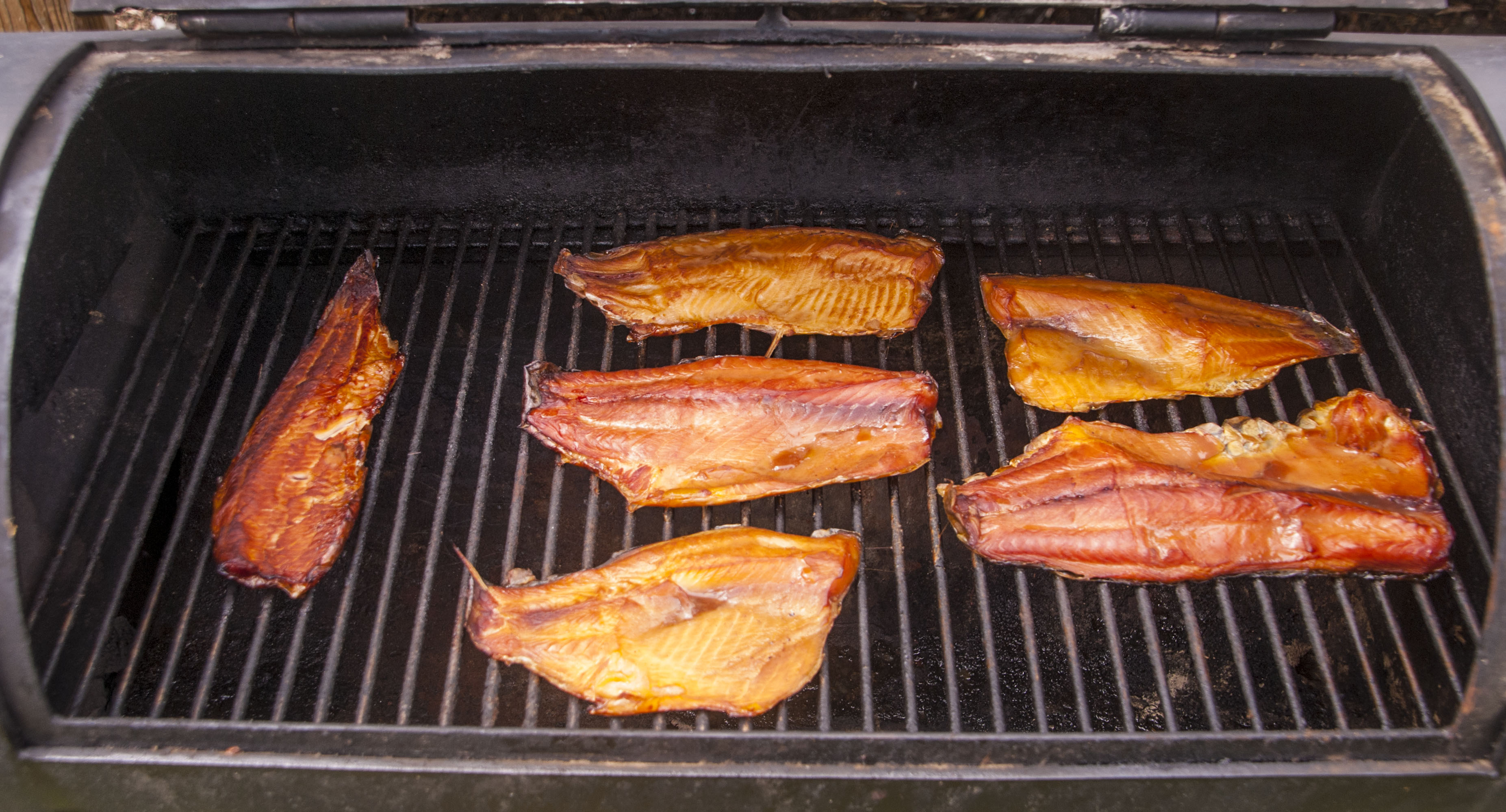
Online I found a recipe that was both more interesting and less salty. Recipes, of course, are like road maps … guides for an eventual adventure. In two quarts of water went a cup each of brown sugar and soy sauce, a half cup of salt, a liberal dose of fresh ground pepper, teaspoons of onion salt, garlic powder and seasoned salt (I used Tony’s Cajun spice), plus a tablespoon or so of Tabasco. The recipe also called for a cup of apple juice, which we didn’t have and I wasn’t driving an extra 20 miles to buy. After an overnight soaking in the brine, I shook off the excess as I placed the fillets onto my new, second-hand offset smoker. Soaked pecan shells were used for the smoke, with the fillets reaching glazed perfection after about two hours at 180 to 200 degrees.

Just about perfect!

Just about perfect!

Between our two “stringers,” six fillets went into the smoker, five of which are now in the freezer. The sixth didn’t last too long when company came Saturday night. Featured as the center piece on a cheese plate, we enjoyed the smoked delicacy with chilled glasses of Hinterland Vineyard’s LaCrescent. Ah, yes, the livin’ was easy for the Carp King!

Magic Moments

In my youth a group called The Drifters rocked our Teen Town with a catchy tune called “This Magic Moment.”  A song of love, of meeting someone special, it was sang with beautiful, old Soul Town harmony.

Several times over the weekend I found myself mentally humming the chorus and music, moments of small special things. Ours was a hard working weekend of planting our recently received bare root shrubs and trees in our new orchard along with some roses along the garden we hope will detour the deer, Luise Hille’s wedding gift spruce and a colorful crab apple in the yard. Both our hard work and breaks offered magical moments.

A bit of history … when we bought our Listening Stones Farm, a classic antique hog barn was nestled in the grove. We debated about restoring it. Close to the barn, though, was a deep pit, which might have been dug to bury the barn before us. No one seems to know, yet that is where the hog barn ended, along with an imploding granary that was in the yard. The excavator set fire to the pile before covering the whole mess with tons of soil. This was where we had dragged and piled the downed buckthorn from our grove we had planned to burn.

That was a problem. That was where Rebecca planned our orchard, so after planting a cherry tree where the yurt was planned, and two pear trees further down the slope, she looked at the pile of buckthorn and said, “We don’t have enough time to burn it, and besides, we’re in a burning advisory. We’ll have to move it.”

Remember the old Pick Up Sticks game where you tried to deftly remove a long toothpick-like stick without disturbing the pile? Buckthorn isn’t toothpicks, with the branches entwined inside and out, over and under, and we three — Rebecca, our son, Martin, and I — worked for a couple of hours pulling, pleading and dragging one tree after another from the pile. In the midst of our work she pleaded with me to take a break. Perhaps she was afraid of working me to death!

So I headed into the grove for the listening bench, found on our circular path that winds through the remaining trees. After removing my hat, I leaned against the downed box elder that serves as the back rest, and was suddenly joined by a tiny and wholly colorful warbler that began flitting from branch to branch and across the path to the box elder, landing on a spike branch not five feet away. As bird watchers will attest, this is a rare happening.

That was when I first heard the musical strains of “This Magic Moment.”

Then came the cooing sounds of nearby mourning doves. Had they been singing all afternoon? Had I not heard them? As the mental music played on, I tried counting them. That’s when I noticed the sap dripping off the box elder. Sunlight slicing through the canopy caused the sap droplets to glisten like pearls.

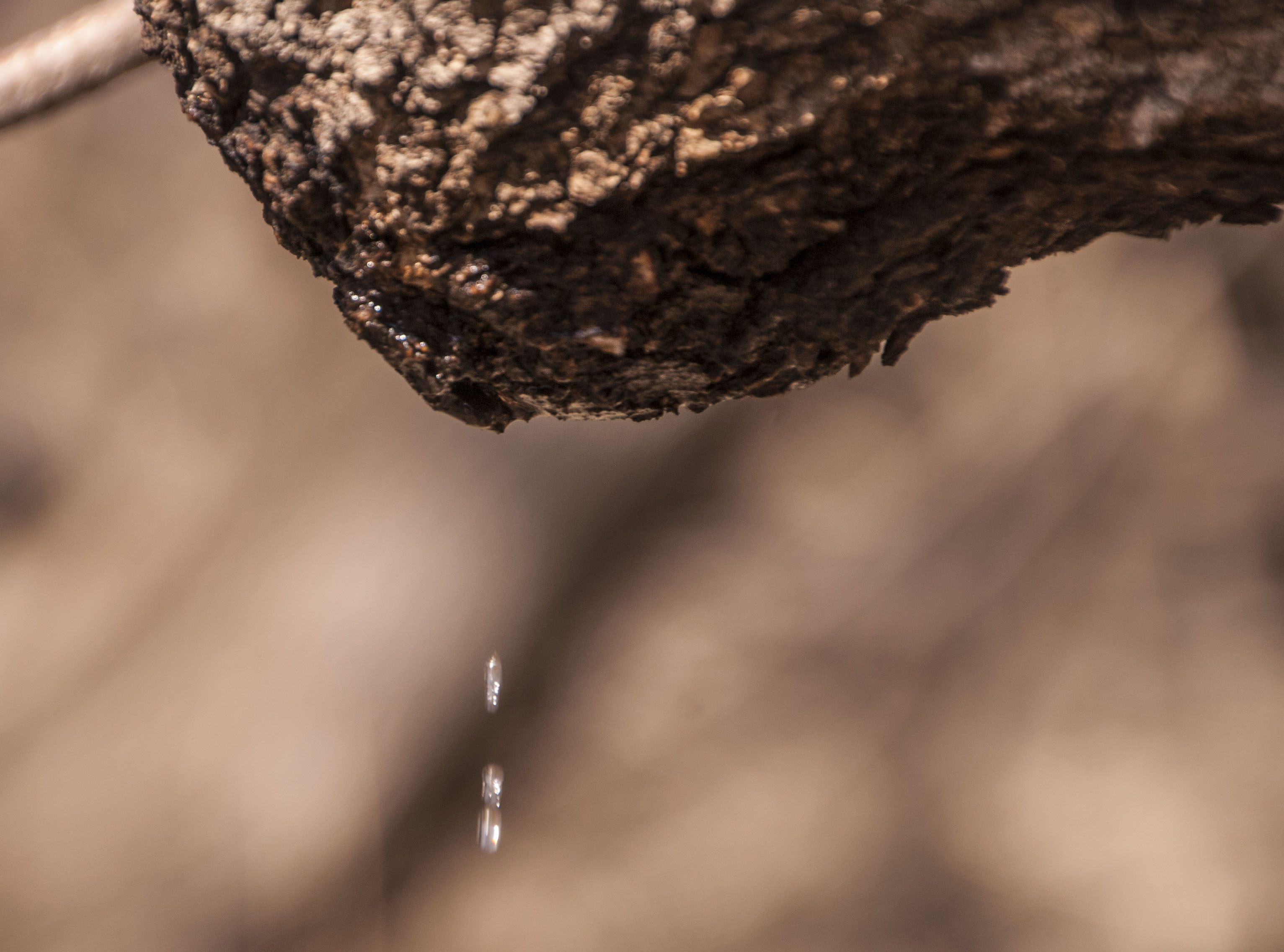
Like pearls, sap drips from the old and bent box elder.

Like pearls, sap drips from the old and bent box elder.

And so it went, little windows of nature there for the revealing.

Later, as the sun lowered in the sky, we drove into town for dinner and passed wild turkeys silhouetted in prairie grasses down the road, and deer grazing in many of the meadows. Dusk was settling in when we returned home, yet we watched was three deer crossed the road from our grove. All quite magical.

Whitetails in a nearby meadow.

Whitetails in a nearby meadow.

We were back at it on Sunday, working to complete the plantings in the new orchard. Besides the cherry and pears, in went two plum trees, three apples and a crab apple. We each took a shovel to dig a hole perhaps 24 inches deep, with Rebecca using her special tining spade to loosen the dirt around each hole. She poured about a half bucket of water into the hole as I held the spike. Once the loose dirt had been packed around the tree, mulch was added along with more water. We bent wire cages around each tree to complete the task.

It was perhaps mid-afternoon when we threaded the last deer proof cage through a stake to keep it in place, then made our way to the house for chilled glasses of sun tea. We eased our sweaty backs onto our Adirondack chairs to rest while taking in the cobalt sky above us. We watched as ducks  and geese flew over, and even saw a redwing blackbird on one of the feeders.

“Oh, wow!” said Rebecca suddenly as she looked out over the newly planted orchard and grove to the north. “The pelicans.”

At first I didn’t see them, then suddenly, as one, an entire pod of about 20 pelicans turned with their white contrasting the deep blue of the sky. They were drifting in a one of those invisible columns of draft, alternately becoming almost completely invisible when their “black side” was turned toward us, then exploding in glaring white as they turned. If there was ever a magical moment, this was it, one that was replayed again and again.

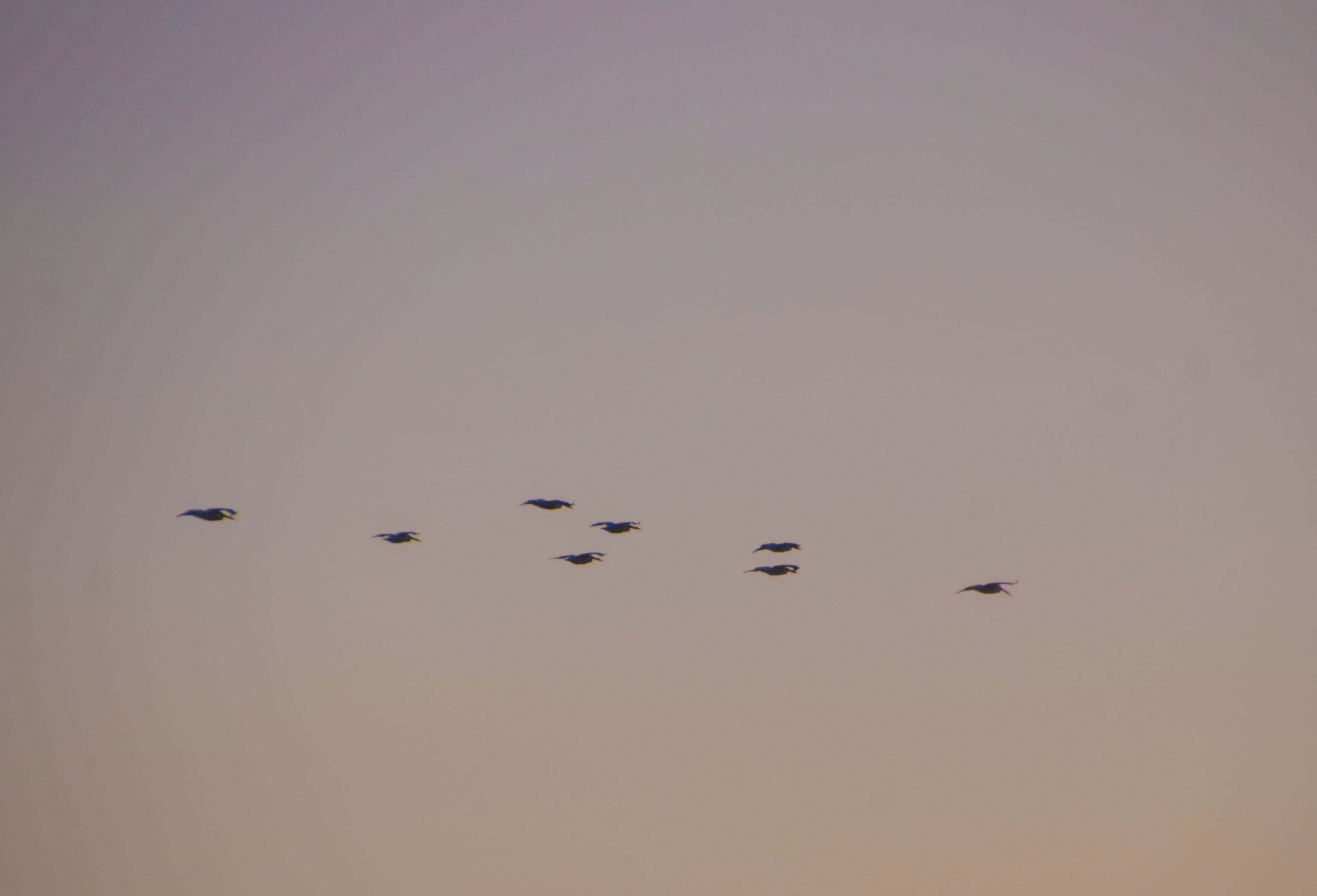
An image of pelicans taken the following day in the setting sun. One day I'll capture the white against the blue.

An image of pelicans taken the following day in the setting sun. One day I’ll capture the white against the blue.

Sometimes I think of all the places where I’ve lived, each with good friends and nearby quiet places. Now, in the autumn of my life, I find our small acreage offering so much solitude and so many special moments. Someone recently suggested that this appreciation comes with my age. Perhaps. Yet, I can also remember growing up on our Missouri farm, and of the hundreds of nights I ventured off alone with my fly rod to one of the ponds, and of how easily I breathed in a love of solitude and nature, of noticing the little things and magical moments. I don’t know if this has to do with age, but I know magic. A sudden visit of a warbler. Silent, glistening pearl drops of sap dropping from a bent and bowed box elder as old as our farm. A real life mobile of suspended pelicans appearing, then disappearing, then magically exploding in a vivid white against a deep blue sky.

I’ve learned that if you can appreciate those little things … those special magic moments … you can more fully appreciate life.

Medicinal Miracle

We’re not necessarily blaming our son, the South Dakotan, for this horrid flu that dropped in on us complete with chest congestion, continuous coughing, and just for the fun of it, some belly button-deep sneezing. Rebecca calls the school he attends, and indeed, most schools, “germ factories.”

Then you have my late father, who suffered from a fate you could call “mechanic’s luck.” In other words, if you hear a ping in your car engine, it would be persistent if not increasingly louder until you steered the clunker into the shop. There the engine would purr like a contented kitten and the mechanic would look at you as if you were crazed.

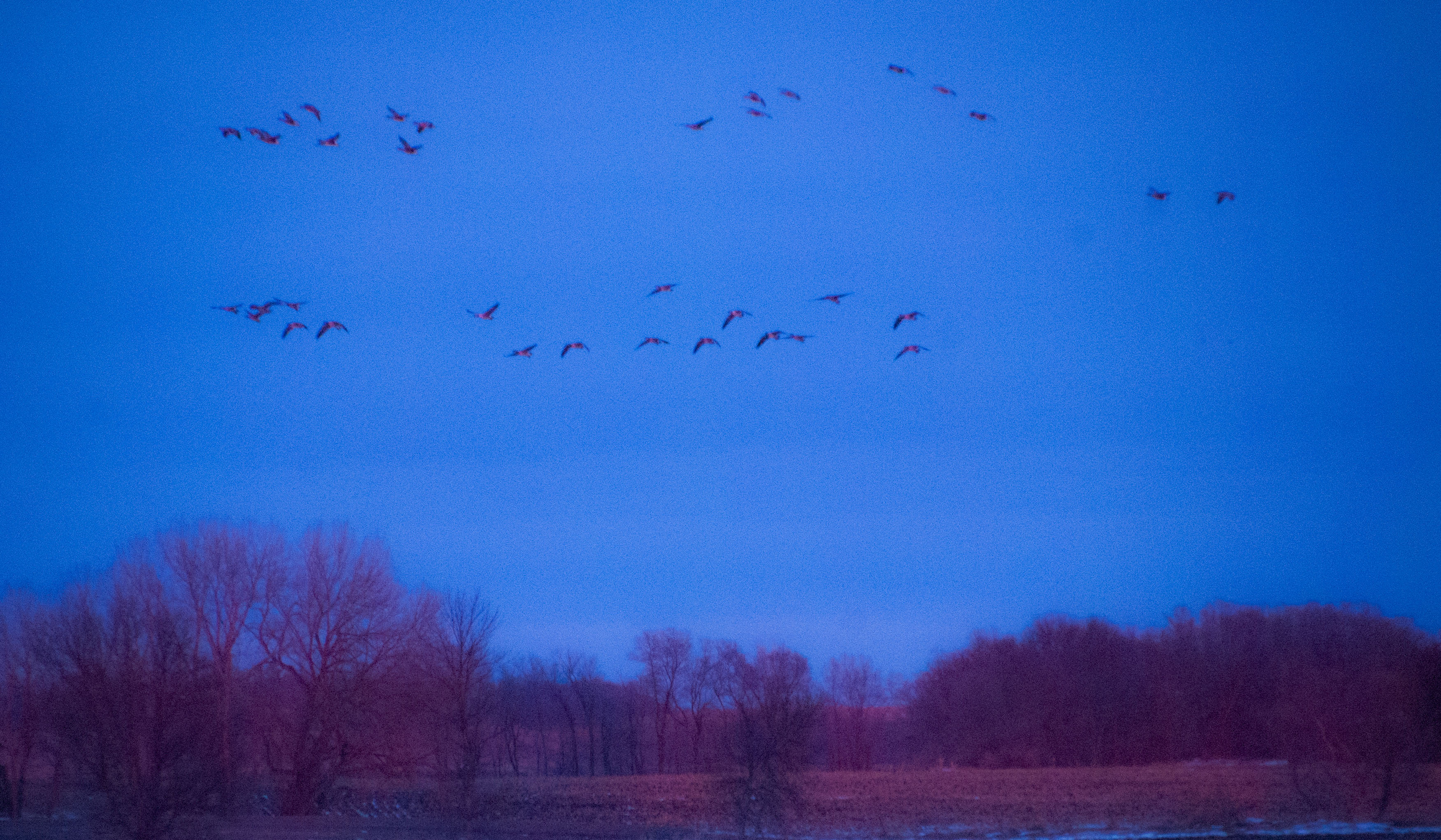
Welcome to the realm of “germ factories” and “mechanic’s luck” — since the day before I came down with Martin’s flu I had visited with my doctor and felt about as well as a person can feel. Four days later the flu was in full swing, knocking both Rebecca and me completely off our feet most of Friday afternoon and all day Saturday. Sunday was a bit of forced reprieve. A few hours were spent hiding in the grasses of the wetland up the hill, across the gravel road from our prairie, to sneak in a few pictures of migrating geese. While off at the wetland, my smoker was up and going putting a little pecan “blue” on a rack of ribs. On the way back I even stopped for a short spell to help  Rebecca pull cut buckthorn from the grove to place into piles to be burned later on.

Shortly thereafter my party came crashing down. Big time. One of my “sons,” Kevin, has been visiting us from Germany, and almost his whole time here after that first weekend I’ve resided either in bed or on the couch. We mustered up just enough energy for him to take us out for a “last” dinner the night before his departure, after which I came home to rub a menthol-salve on my feet and chest before laying down for the night for a most fitful sleep.

Rebecca has been pushing Echinacea tea into my system … even with a little lemon, honey and a jigger of whiskey included. Neither the plain nor doctored has seemed to offer much of a miracle. Other family members have swore by its magic, although it didn’t seem to help them much more than it has me. Medicinal miracles are hard to come by, perhaps. We’ve heard of these before, haven’t we? Hopefully the other herbs of interest are more effective, more productive of miracles than Echinacea.

Then there is the elderberry syrup. She’s been pushing that as well. At least this is more soothing, and seems to work wonders with her. Calming, yet moments later my coughing and sneezing returns. It was so good while it lasted, all three minutes.

over the wetland

What makes this tough is that while I feel compelled to stay inside to rest, I can’t help but see the skeins of geese flying across our windows, flying toward the two wetlands and farm fields so close by. I still like stepping onto the deck just to hear the constant chatter amongst them — through the wheezing and coughs, that is.

Last weekend my social computer network was full of reports from my birder friends who are visiting all those beautiful stops along the river valley, from Skalbakken County Park up to the National Wildlife Refuge just down the road. Many posted incredible images of the thousands of birds they’re finding along the way, from eagles to swans, from mergansers to ducks, from snow geese to wild Canadians, which only added to my discomfort. I wished to have been out there, too.

Then again, I feel I have some time to make up. After leaving the Mississippi Flyway in 1992 I missed so much of the migrations due to my working schedule and living in the middle of the “black desert” surrounding  Clara City. Living in the little stranded prairie town didn’t offer much in terms of bird migrations, with no comparison whatsoever to the river valleys. A year ago, our first here in Big Stone County, we were involved in a sprint more than a marathon to remodel this old house into our new home. Arrivals on the flyways greeted us each morning as we drove the six miles out here from Rebecca’s house in Clinton. There seemed a tease of an awaiting promise. Next year, came the message. Next year we’ll all be together.

Anticipation of the migrating birds really made the winter seem shorter and tolerable, and now the season is here I feel too sick to be outside with my camera and binoculars. Don’t worry, write my friends, for the migration is just starting. There will be plenty to see once you’re well.

Perhaps the downed internet service since Tuesday was part of the grand plan, to help prevent a deeper discomfort from missing the migration. If so, I’m missing the message. Moments ago we had a conversation concerning my sense of isolation, from the illness to the lack of internet. When your bond to the outside world is not just inconsistent, but non existent, your sense of isolation is heightened considerably. It is how I can keep up with the news of the outside world, of trends and what we in the news business called “spot news,” and of course, staying in tune with folks from Australia to Austria, and from Clinton to Clara City, on the social network sites.

My internet was also my dictionary, my spell check, newspapers, my … well … medicinal mental miracle. Just an example, in a couple of weeks we have a bentwood trellis class through the Milan Village Art School with Jo Pederson, and I had a fleeting thought of looking through some patterns. Oh, yes, we have no internet. No link. No nothing.

In front of me is the machine of my methodology, minus the major tool that makes it really shine. Outside the geese are serenading the flyway, crossing the windows, leaving invisible paths of their web of life. Inside my wheeze-enlightened coughing continues, and I sip Echinacea awaiting any medicinal miracle.