Unknown's avatar

About John G. White

Somewhat retired after a long award-winning career in newspapers (Wisconsin State Journal, Dubuque Telegraph-Herald, Denver Post and a country weekly, the Clara City Herald). Free lance photographer and writer with credits in more than 70 magazines. Editor with various Webb Publishing magazines in St. Paul, and a five year stint as editorial director at Miller Meester Advertising.

Skyscapes

Sometimes I wonder why I’ve never left what author and essayist Bill Holm called the “horizontal grandeur.” Our move some 32 years ago to the prairie served two purposes … getting out from the depths of debt caused by briefly owning houses both on the riverine banks of the Mississippi and from where we had moved in Denver, and in continuing a career that had seemed to dead-end after an unhappy stint at an advertising agency. 

To Holm, the prairie was about function more so than form, a place that “requires time and patience to comprehend.” And, a staunch home country if there ever was one.

He had an eagerness to compare this horizontal horizon with both encompassing trees and mountains. “Prairies, like mountains,” he wrote, “stagger the imagination not in detail but size.” He complained about being surprised by storms he couldn’t see coming in a forest, for trees were synonymous with jail bars, and mountains were high rather than offering something wide — a horizontal grandeur. 

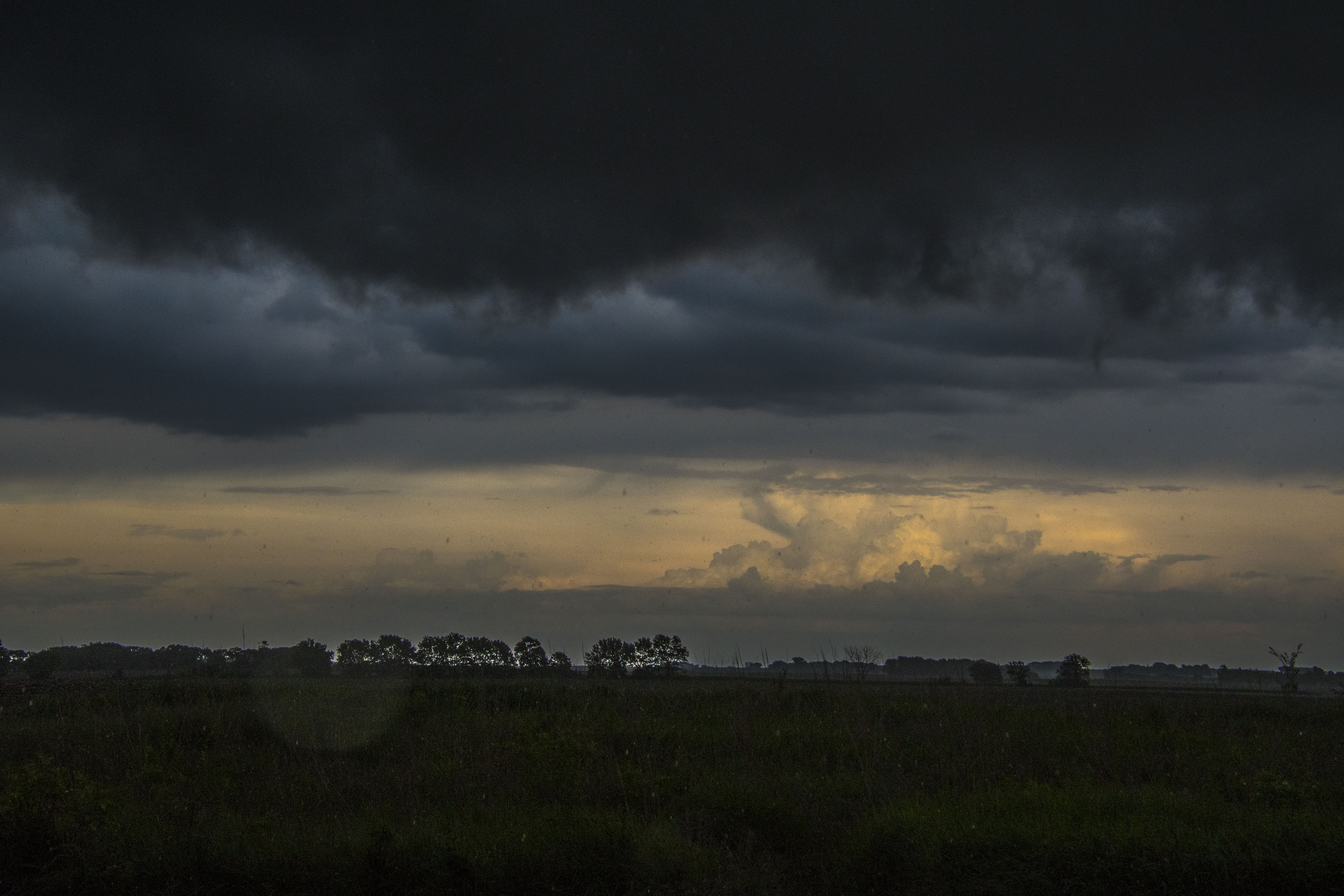
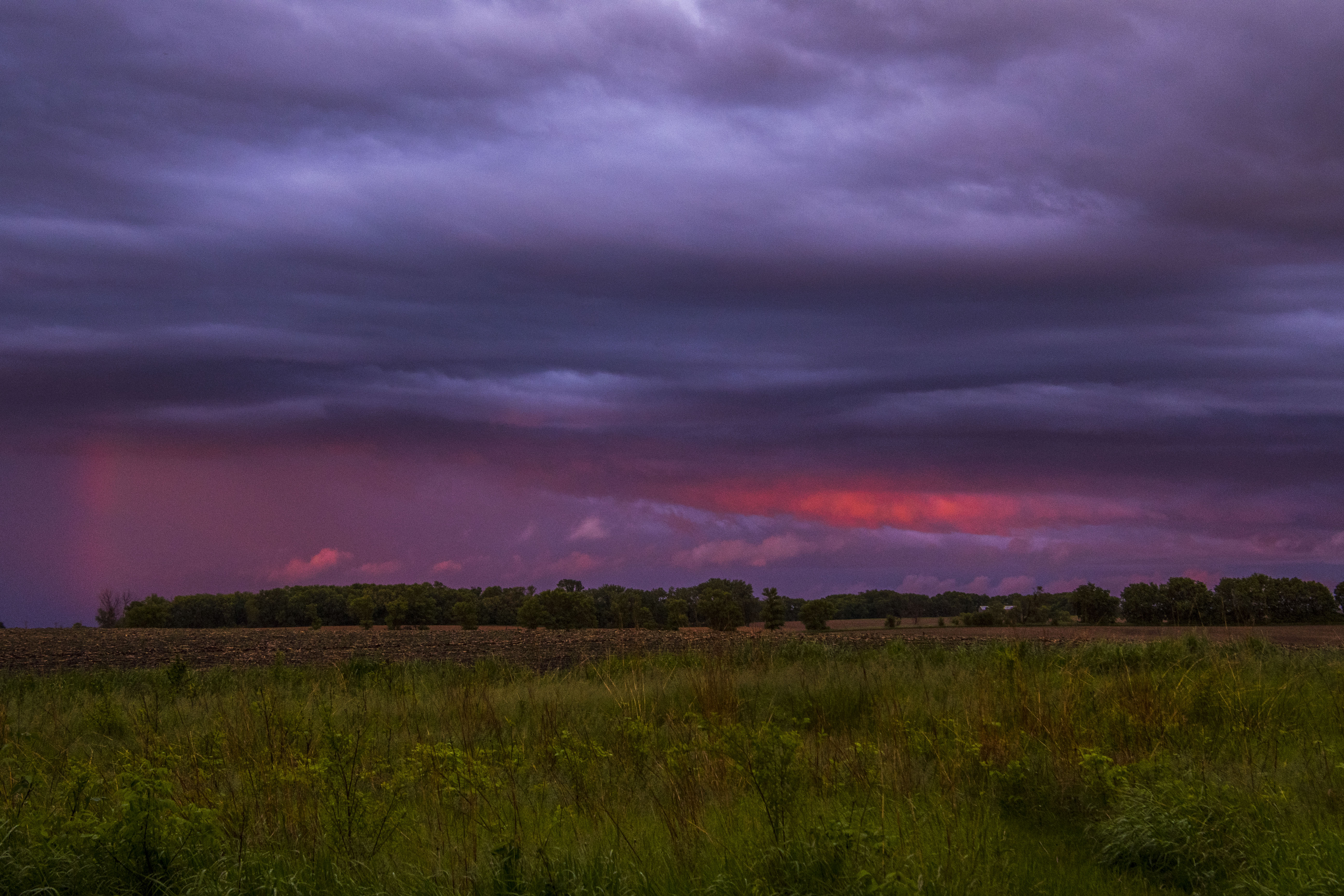
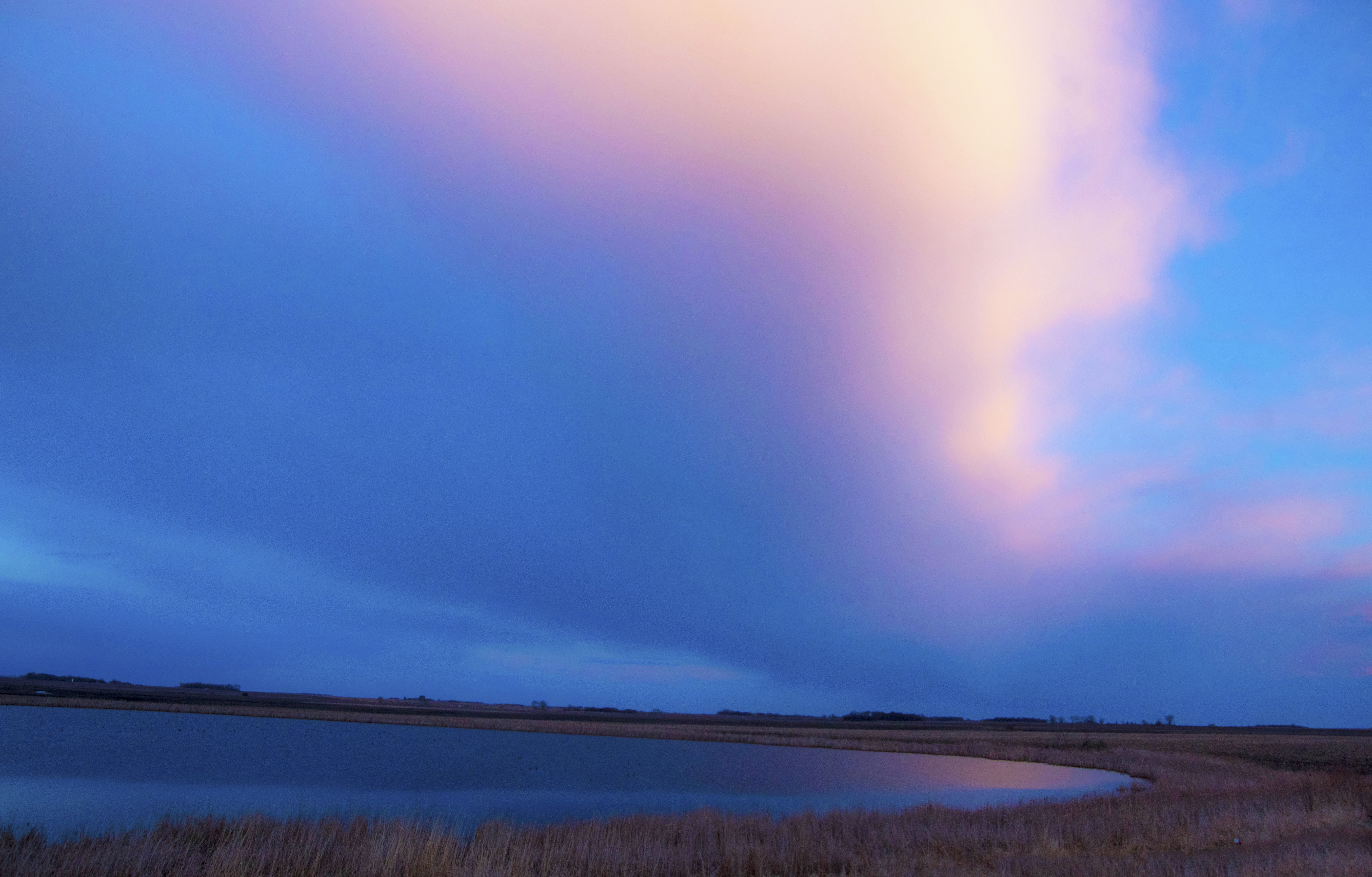
Looking up from planting, here is the storm above the prairie in early afternoon.

Holm wasn’t alone in his thoughts. A writer named Don Young wrote of the prairie, “A single Monarch butterfly dances around the prairie, searching for an elusive bit of pollen; the silent gliding of a Cooper’s Hawk searching for anything that moves; prairie grass roots searching deeper and deeper for moisture; and me, searching for solitude, inspiration and a photo opt or two.” Sounds familiar.

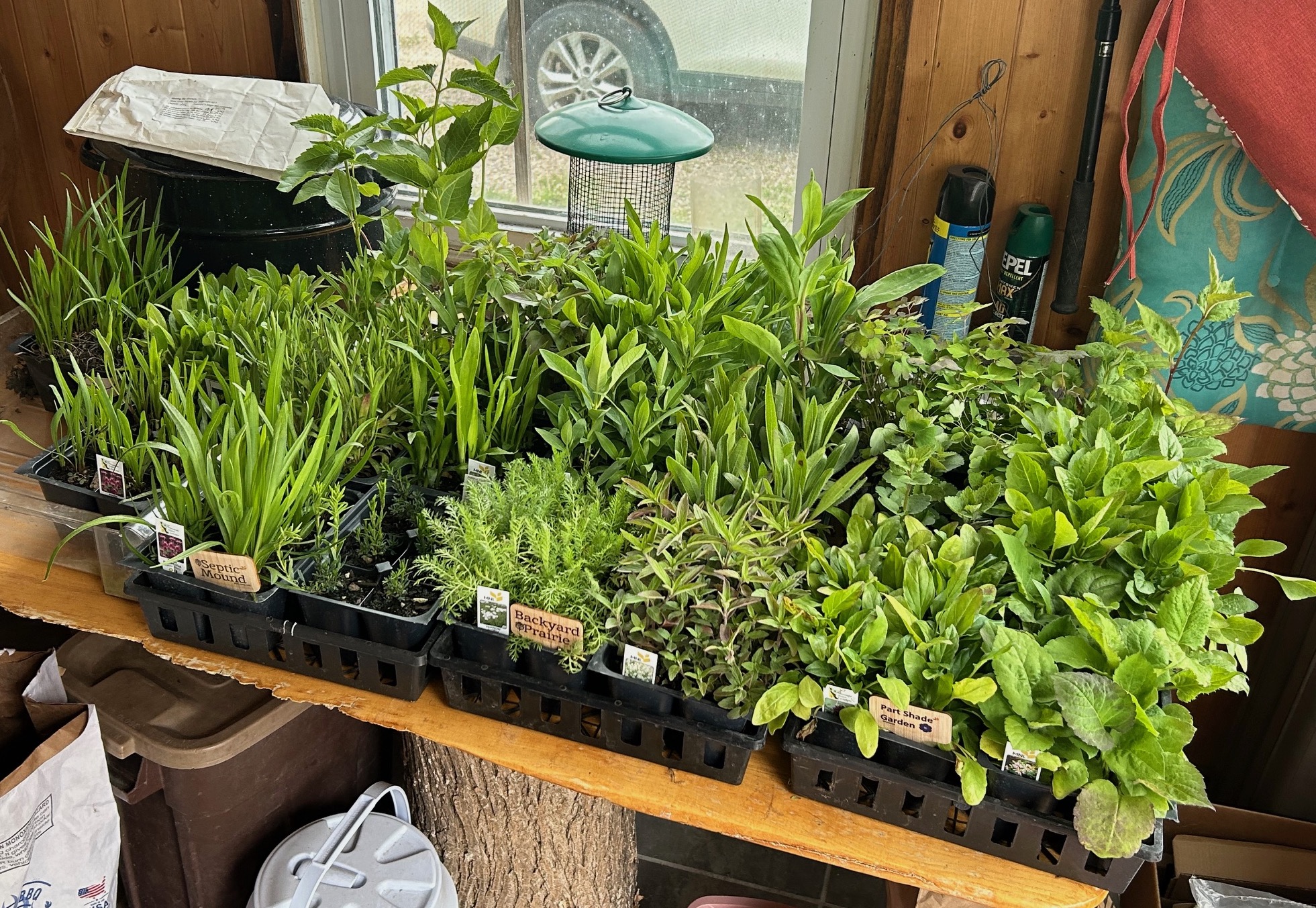
Technically we’re speaking of land form, for actual prairies, those seas of grasslands, are no more. Nor are there many potholes. Commodity agriculture took care of both decades ago. Then this happened a few days ago while working to plant at least a part of our lawn to pollinator-friendly native forbs, an effort interrupted not by Hal Borland’s “homeless winds” that seem forever on the move, but by rain. A fast and furious downpour. When I looked up from the perch of my knees I noticed the sky, and later, while chasing the ever changing skyscape, I realized a bit of what Holm had written about concerning time and patience: a prairie sky as a palette of color, form and mysterious intrigue.

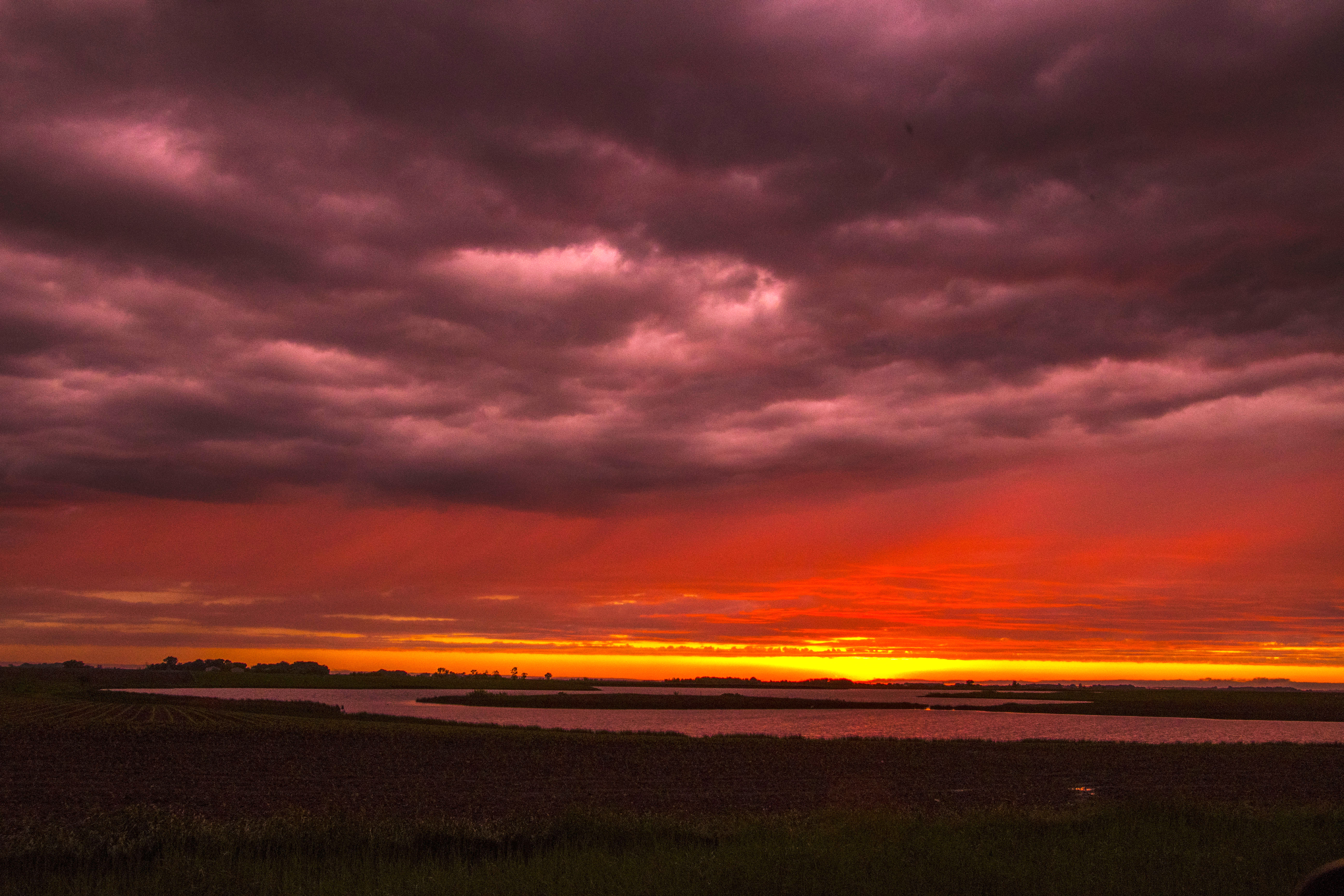
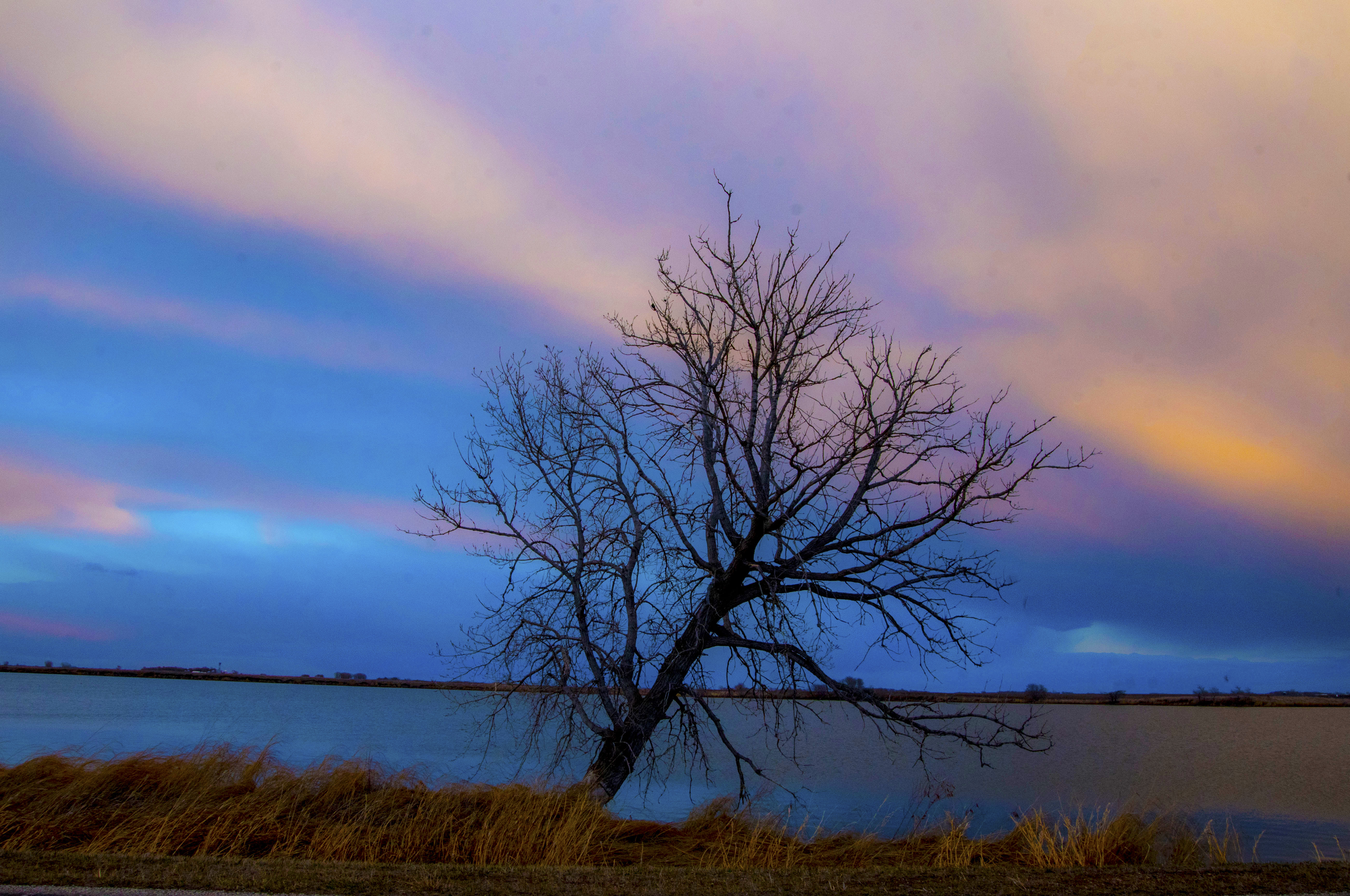
Nearly the same view at sunset, with the ambient colors to the east.

After rising quickly from the planting, I rushed into my studio for my camera. Sandwiched between the rueful blackness of both an overhead storm cloud and the darkened color of our restored prairie, a cumulative white bank of distant clouds fluttered within basically four different levels of threatening storm clouds, all offered as an interesting visual sandwich offering both drama and color.

And it would only become ever more interesting hours later as evening approached. Within a half hour of nightfall that palette offered several different painted skyscapes, and I couldn’t stop attempting to capture them. I suddenly realized what Holm had suggested, and that through time and patience, it was this horizontal skyscape that has allowed me to settle in, to find “home” within an landform and ecosystem so unlike any I had lived in previously. 

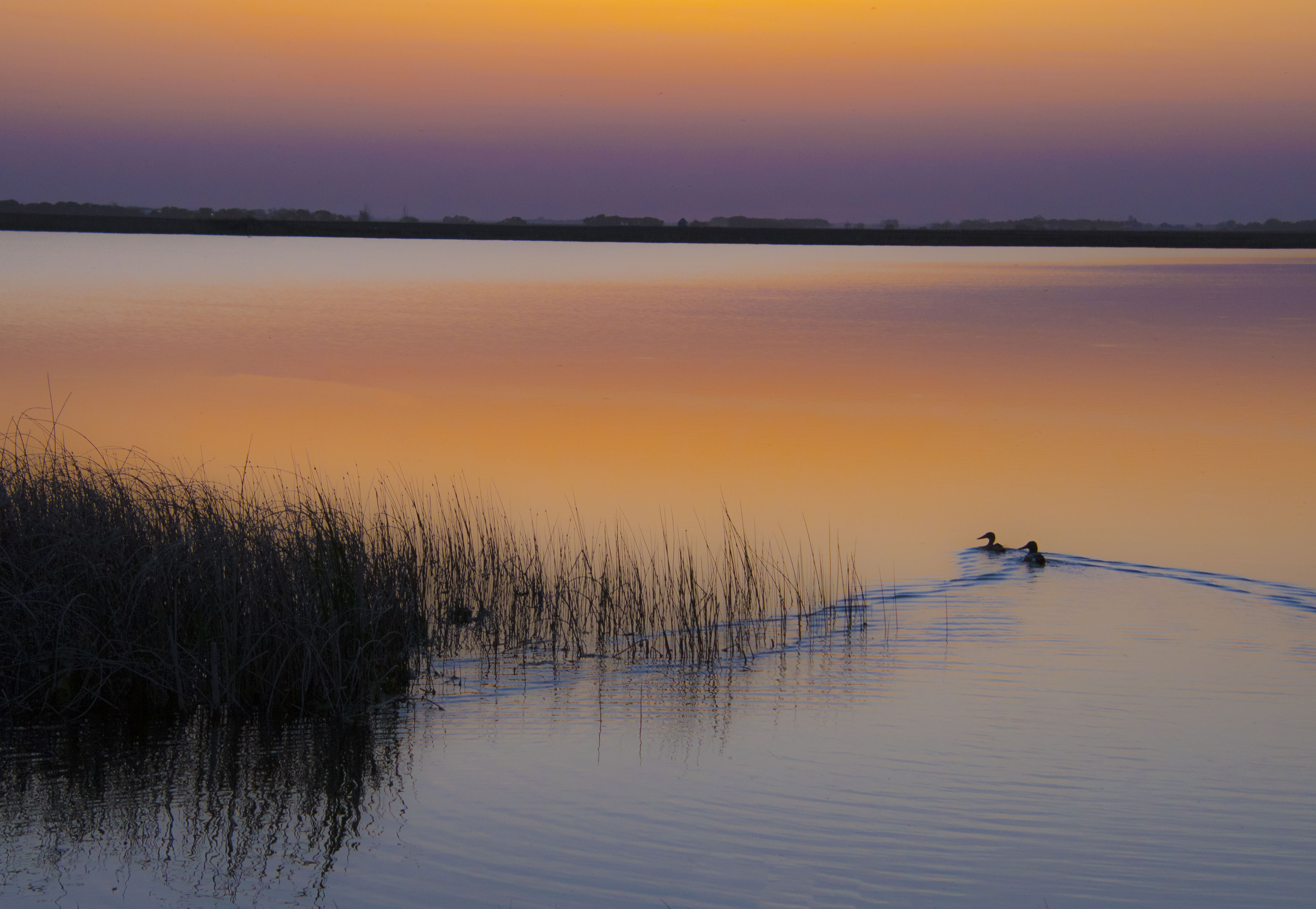
The aftermath of the sunset over a nearby wetland. Still the same afternoon.

Yes, I grew up in the wooded hillsides of northeast Missouri, and spent years living along the Mississippi and even in the hills of the Driftless. More than a dozen years were spent in the Rockies of the west, years when I wrote and photographed happenings throughout the mountain communities for the Denver Post, and later traveled from Colorado to the Pacific Coast as a magazine freelance journalist.

When we left our rural home south of the Twin Cities to move to a small town where I would become a “country editor”, our goal was to give it two years at most. Yet, we raised our sons in the small town, then my wife died, and through it all I’m still here in what remains of the original Prairie Pothole Biome. In some ways I feel the influence of Monet, who featured ever changing palettes of color and intrigue in his paintings be they of haystacks, lily-padded ponds or quaint city streets. It was through my love and study of his work that I learned the beauty not of a sunset itself, but rather of the surrounding ambient colors, the drama and intrigue offered by these prairie skyscapes.

Almost as captivating as the afternoon image, again facing to the east.

Nowadays I wish I could once again visit with Holm. Our first of three conversations came after his speech and ragtime piano performance at Prairie Edge Casino not long after his publication of his horizontal grandeur essay. We had teased one another over our respective loves of prairie and woodlands. Now, as this land or skyscape has evolved to grow on me, I could offer a more aware perspective in the conversation, and perhaps we might have had more of a basis for friendship than simply a friendly bantering. Of which we never evolved.

Regrets aside, no longer is there a quest for moving or living elsewhere. Besides that ever loving and changing palette of a skyscape, I’ve come to thoroughly appreciate the solitude and rhythms of seasonal change, of the surrounding nature that has over time developed into various seasonal expectations thanks to both the interesting feathered drop-ins from the flyway to the poking up of overlooked prairie forbs through prairie grasses. 

A final image, all in an afternoon and evening of the same day, all interesting skyscapes!

Someone recently asked if there was a “fall back” position or plan considering my age along with possible prospects of a decline in health, and I simply couldn’t think of one. I guess this horizontal grandeur and an ever interesting skyscape makes this close to being home, and an interesting one as one can possibly find. We’re not being ravaged by affects of global climate conditions as we might be further south, and going back to the mountains might now be limiting age-wise. 

And, as my dear friend, the artist and musician Lee Kanten has suggested, you simply cannot find a better place for observing both sunrises and sunsets. Come dawn or dusk. Ah, yes, those beautiful ambient colors where the likes of Monet could settle in next door and happily place a blank canvas on his easel; where he, Holm, the Kantens and ourselves could sit around sensing the smoke from the grill over mugs of wine as the skyscapes surrounding us become painted with another intriguing image.

Calls of the Wild

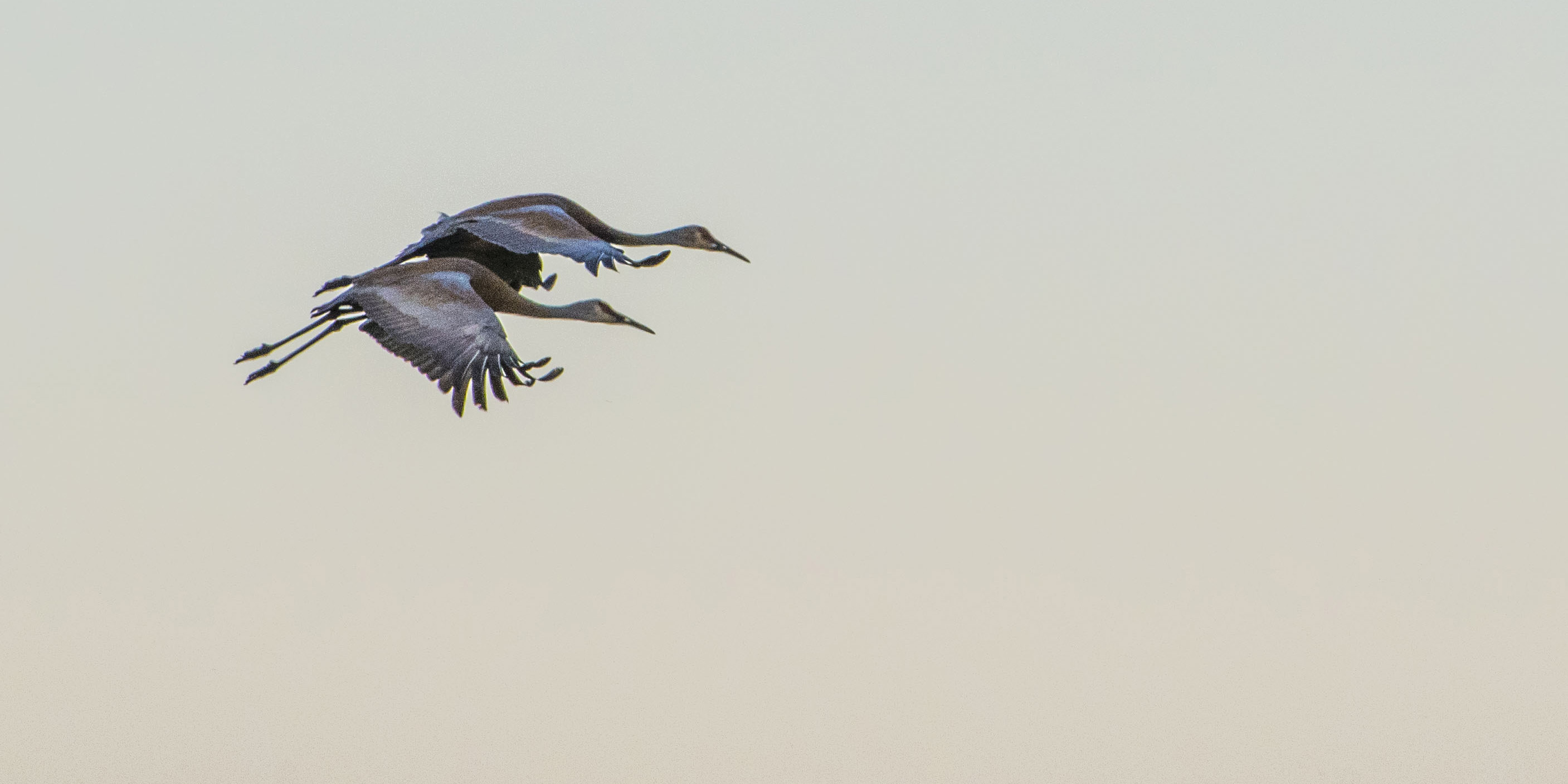
As soon as the distinctive call echoed across the wood-rimmed rolling hills, I rolled to my side and glanced toward the sky my camera ready. So familiar, so beautiful. Vivid, yet hidden. A mystery, yet none at all. They were there. Somewhere. A few years back I was sitting a mere few feet from where I was prone when the same sounds broke over the prairie and I was fortunate to capture one of my favorite images of sandhill cranes in flight, one that so portrayed their Pliocene existence. They seemed so prehistoric in flight.

Would I be so fortunate once again?

We had ventured here to the Lake Johannas Esker to once again mingle with the prairie smoke wildflowers that flourish on this rise come May. Years ago Morris naturalist Dave Jungst introduced me to the esker at a time when the white pussytoes and reddish-pink prairie smoke comprised a sparkling carpet of alternate colors on the rounded prairie rise below the husky shoulders of the prominent esker, and since I’ve made point to revisit annually. While once again impressive, there has not been a view quite so compassing as found on that first May visit so many years ago.

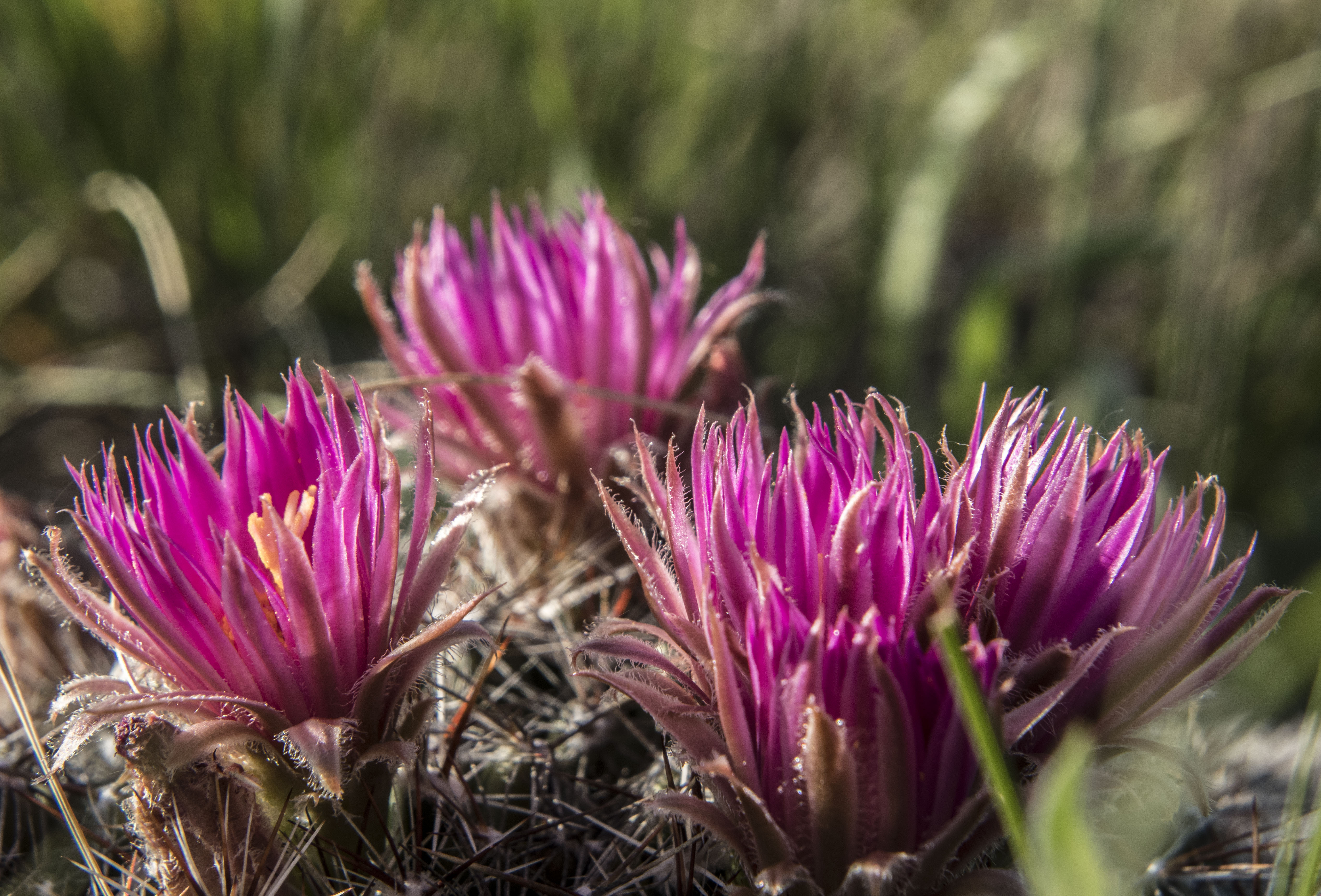
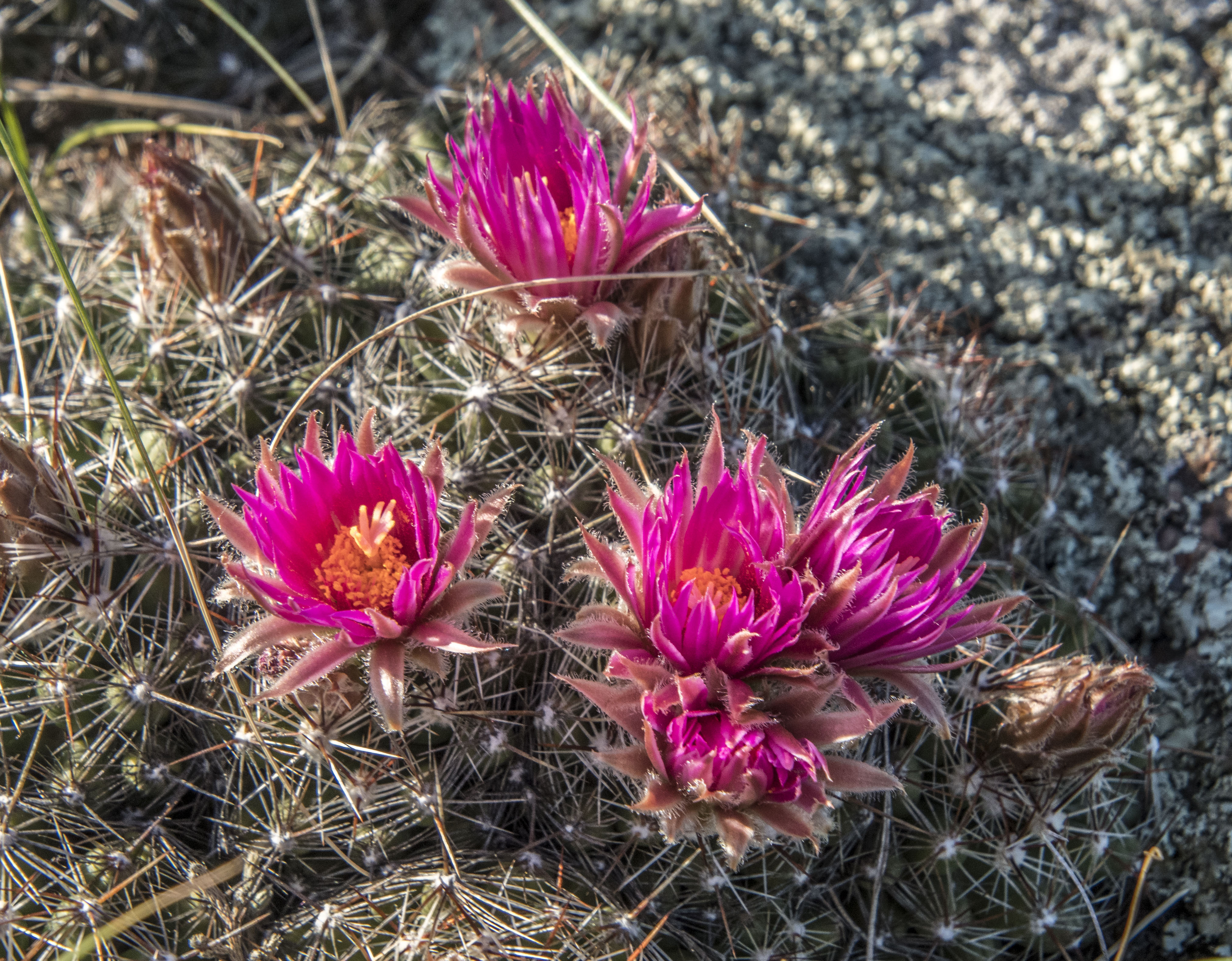
Yes, I’m a prairie smoke addict, and these blooms always captivates me.

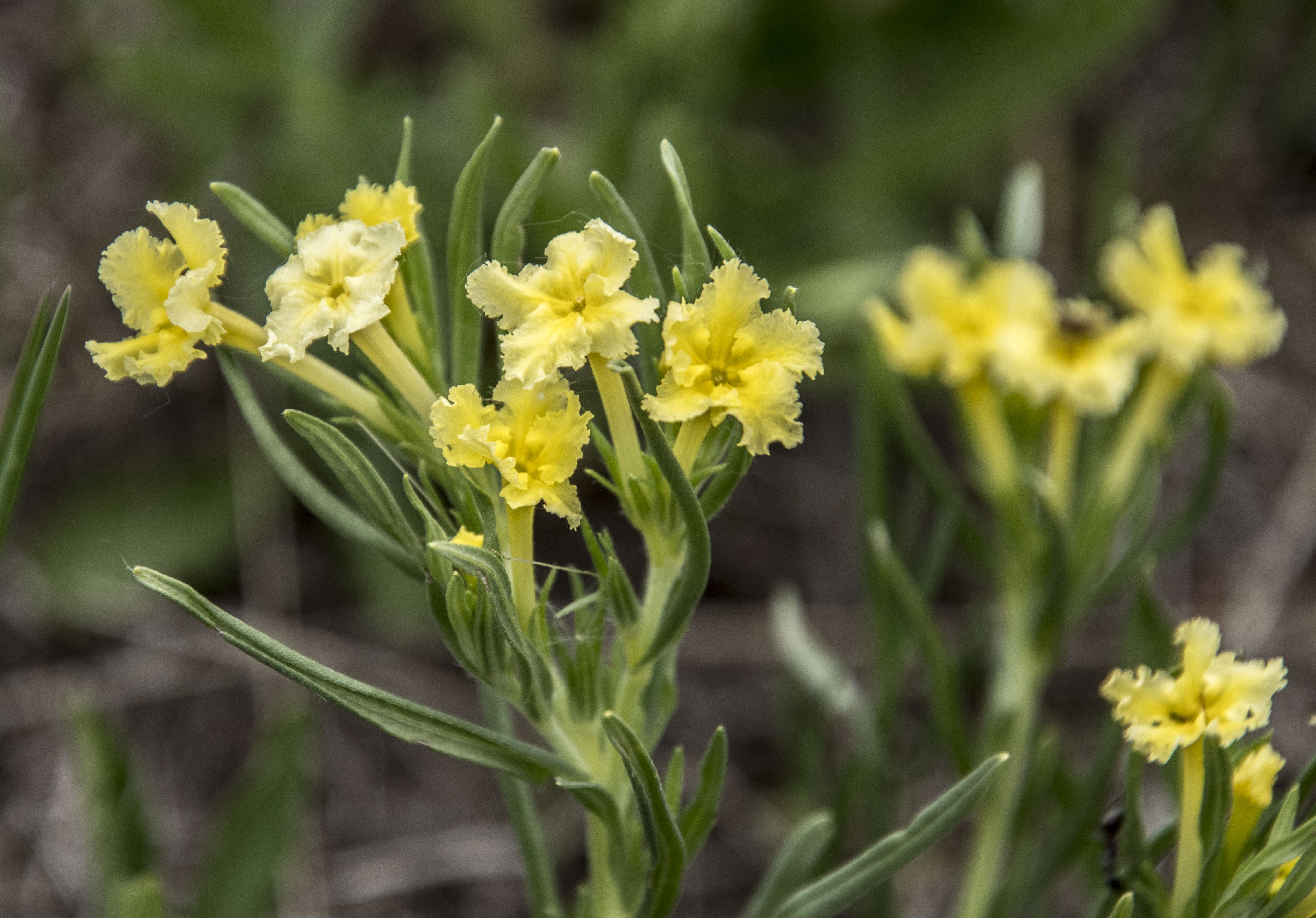
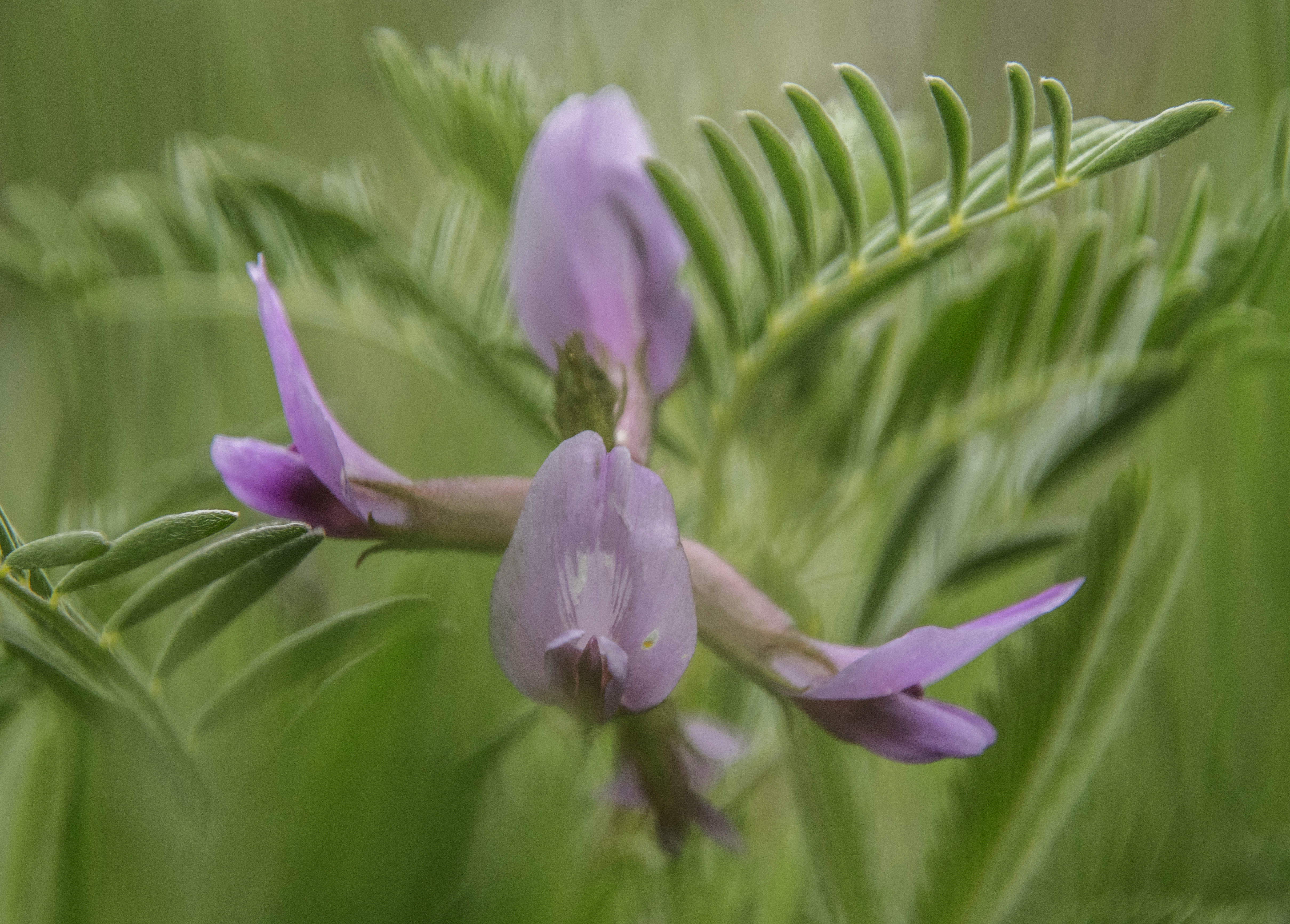
Yet we were once again surrounded by beautiful spring prairie flowers. Those glorious yellow blossoms of fringed puccoon poked a welcomed greeting from the dried sage and dormant grasses, along with brilliant chickweed that seemed so white that it beaconed from the prairie. A whiteness smiling with glee. Tucked away was the purplish ground plum, blossoms not unlike the explosion of a sky high fireworks that peeked through the grasses. All of that plus the prairie smoke offered us a mounded prairie of brilliant color. How could one not be impressed?

Distant to the north of us stood the tall esker, an abandoned glacial stream bed now cloaked by sodded grasses and brush. A snake-like ridge offering a staunch backbone to the lower prairie, rising high in the distance. Here a few years ago as I sat in rest and reflection on the esker itself, a wild turkey popped up from behind a sage bush not five feet away before attempting to secretly sly away. Our brief glances seemed as much a surprise to the turkey as it did to me.

As we ambled up the rise the first patch of prairie smoke appeared, tendrils yielding to the wind. Closer to the esker we came upon a carpet of smoke, a quilt of blossoms in all stages of maturity. Laying low with my lens focusing through the offerings, it could have been mistaken for a forest of reddishness, with the smoky tendrils reaching out from the star-like blooms, many pointing downward while others defied gravity. All stages of the plant’s life cycle seemed evident.

There is little that is more interesting to me than laying on my stomach and focusing a long telephoto through that foot high jungle of pinkish beauty in search for interesting imagery. It was there where years ago I heard the calls from the Pliocene, Aldo Leopold’s “trumpet in the orchestra of evolution.” Hearing the sandhills brought on a whole new level of energy and excitement, a complete jumble of creative focus. From that point forward I would continually peek from the smoky forest to glance over my shoulder in anticipation of a possible flight. Sandhill cranes will do that to me.

Aiming my large telephoto through the “forest” offers a wide gallery of imagery.

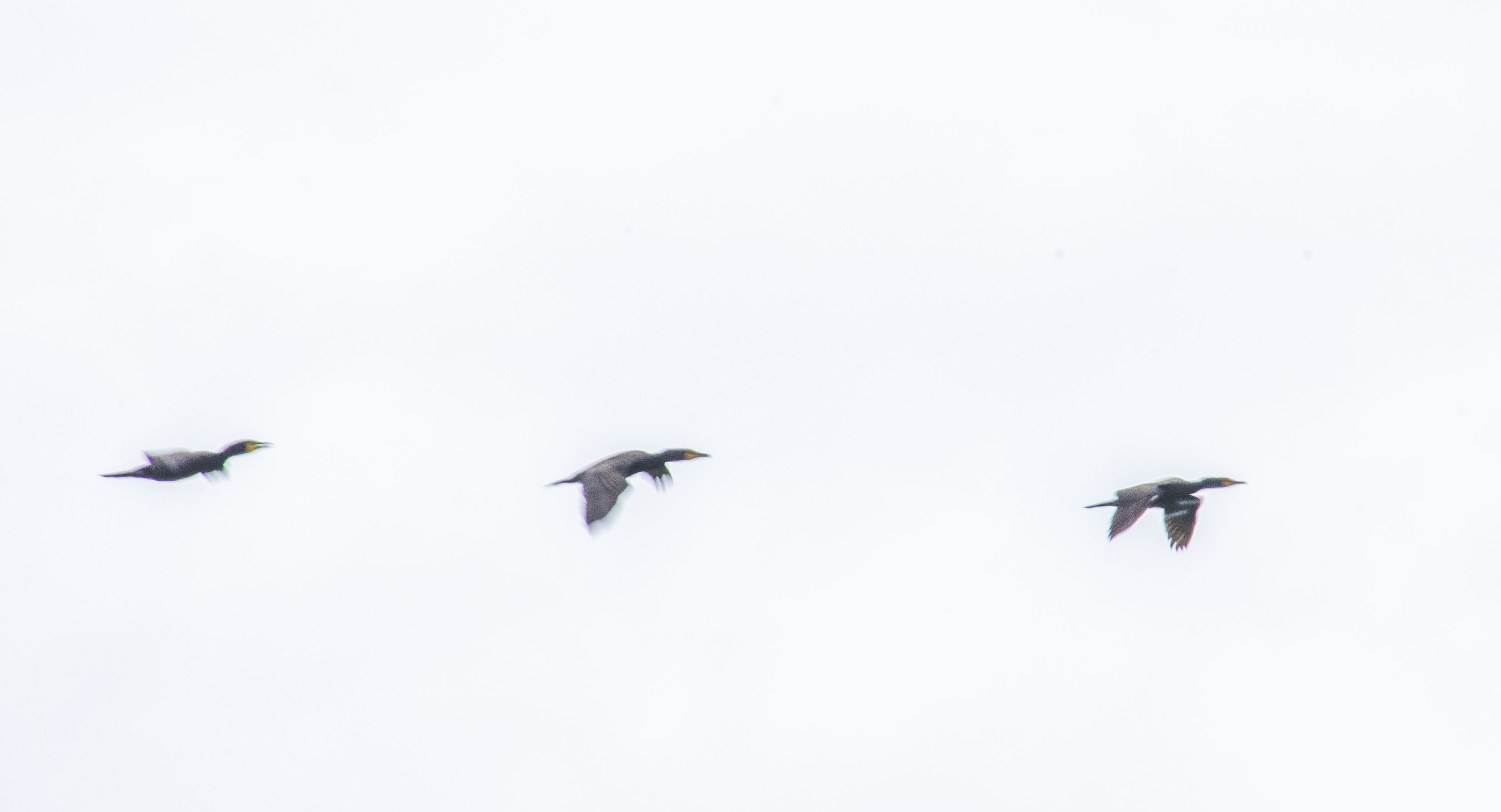
Eventually we would have a brief flyover … of cormorants rather than cranes. They were noticed thanks to my hopeful glances for the sandhills, and I rolled to focus as quickly as possible. Were they from the nearby rookery? Just north of the esker, and beyond the adjacent Ordway Prairie, itself a feature of the Nature Conservancy, cormorants have commandeered a tree studded small island in Lake Johanna as a rookery. From the apex of the esker you can make out the collections of stick nests in the canopies of the denuded trees. With their hooked bills, which is quite a bonus for their fishing capabilities, cormorants look much more prehistoric to me than cranes. If one can make an argument about birds being evolutionary cousins of dinosaurs, cormorants could serve as photographic proof. Their rapid flyover hardly diminished such an argument!

Yes, my eyes were open for the sandhill cranes I heard calling before the cormorants did a flyover.

Still, we had come for the prairie smoke, and despite the welcomed interruptions, I would again be consumed with my intent of gazing through the grasses and the smoke searching for interesting angles and individual flowers. A search that never tires. Prairie smoke is one of my “seasons” of an emerging Spring. They are why I come to the esker much in the same vein as I make a drive to central Nebraska for the annual sandhill crane migration, or drive around Big Stone County’s numerous surviving potholes seeking huge drop-in flocks of snow geese. This is one of my rites of spring, and one I’ll continue until I’m unable.

My image of the sandhill crane flyover in 2019 at the esker.

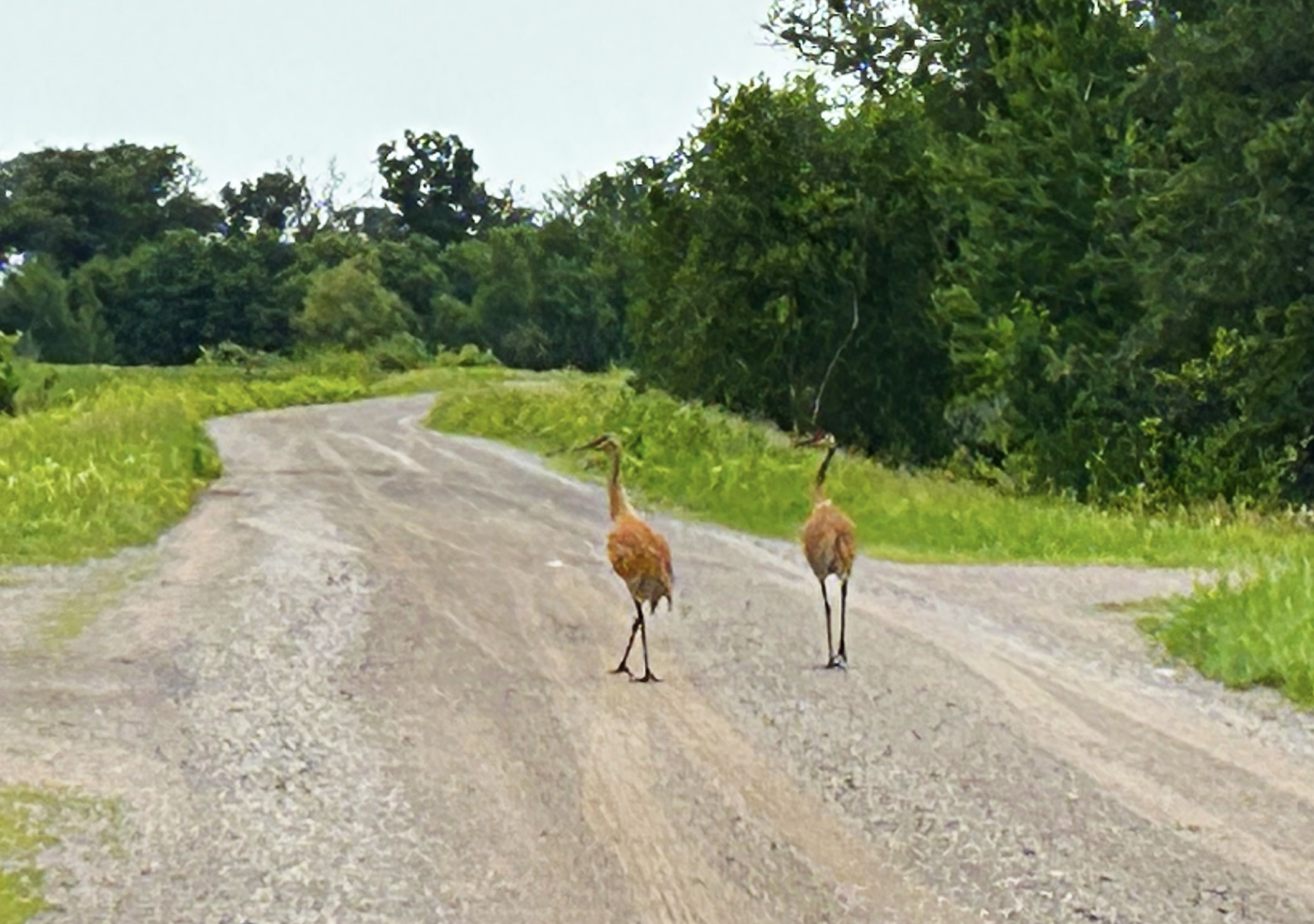
No, the esker has never let me down. This 800-acre floral paradise is nestled some two miles east of the Ordway Prairie and is dominated by the serpentine rocky esker that rises some 70 feet above the prairie where I laid. Well hidden within the surrounding tree-lined hills between Brooten and Sunburg, it is also close to the Little Jo WMA and the Moe Woods. Driving to the esker acreage takes you through a tree-lined, graveled paradise of a road that includes a few hidden potholes and possible swan sightings.

Yet, once you’re at the esker you’ll find an expansive natural floral “garden” that will likely captivate your imagination. Such were among my thoughts as I lay prone with my long lens, focusing through the incredible color while listening and hopefully awaiting more calls and even a flyover from the evolutionary past. I can’t imagine spending a Sunday afternoon in a more delightful environment.

A Man of Many Seasons

Few will mistake me for a phenologist for I fail to track calendar time by the gathering of my oddly celebrated seasons … those numerous seasons consisting mainly of bird arrivals and the breaking blossoms of spring flowers. Each of these countless seasons offer mostly smiles of recognition and joy. One might compare each as a meeting up with old friends at some obscure cocktail party, with each offering a welcoming sigh of recognition. 

Perhaps I fall short in my tasks of phenology in that I fail to chart my observations from day to day, let alone year to year like an avid and true naturalist and phenologist, although I do try to capture as many of the arrivals as possible with my camera. Years ago there was an elderly naturalist named Ed Stone who lived south of Renville on the rise above Vicksburg County Park near the Minnesota River. Ed charted his finds on a day to day basis, keeping immense records of precipitation, temperatures, the breaking of daylight and the setting of the sun right along with his astute observations of nature along his bluffy hillside. If you asked when the skinks were first sighted on the flat outcrops just beyond his quiet home, he’d flip through his recording books to tell you. Such seasons were clearly evident in his detailed collection of works. Ed Stone was a true phenologist and someone I truly admired.

Moments ago, in the rain, a Yellow Warbler was captured outside my studio window, the last of the colorful seasonal birds common to Listening Stones.

Then, there is me. By now many my notable seasons have already occurred, seasons that began back in early March with the skeins of snow and Canada geese along with the murmurations of Redwing blackbirds and starlings. This was about the time Pasque Flowers poked through the dry grasses on a hill above the Big Stone National Wildlife Refuge, typically our first bloomer of the year. 

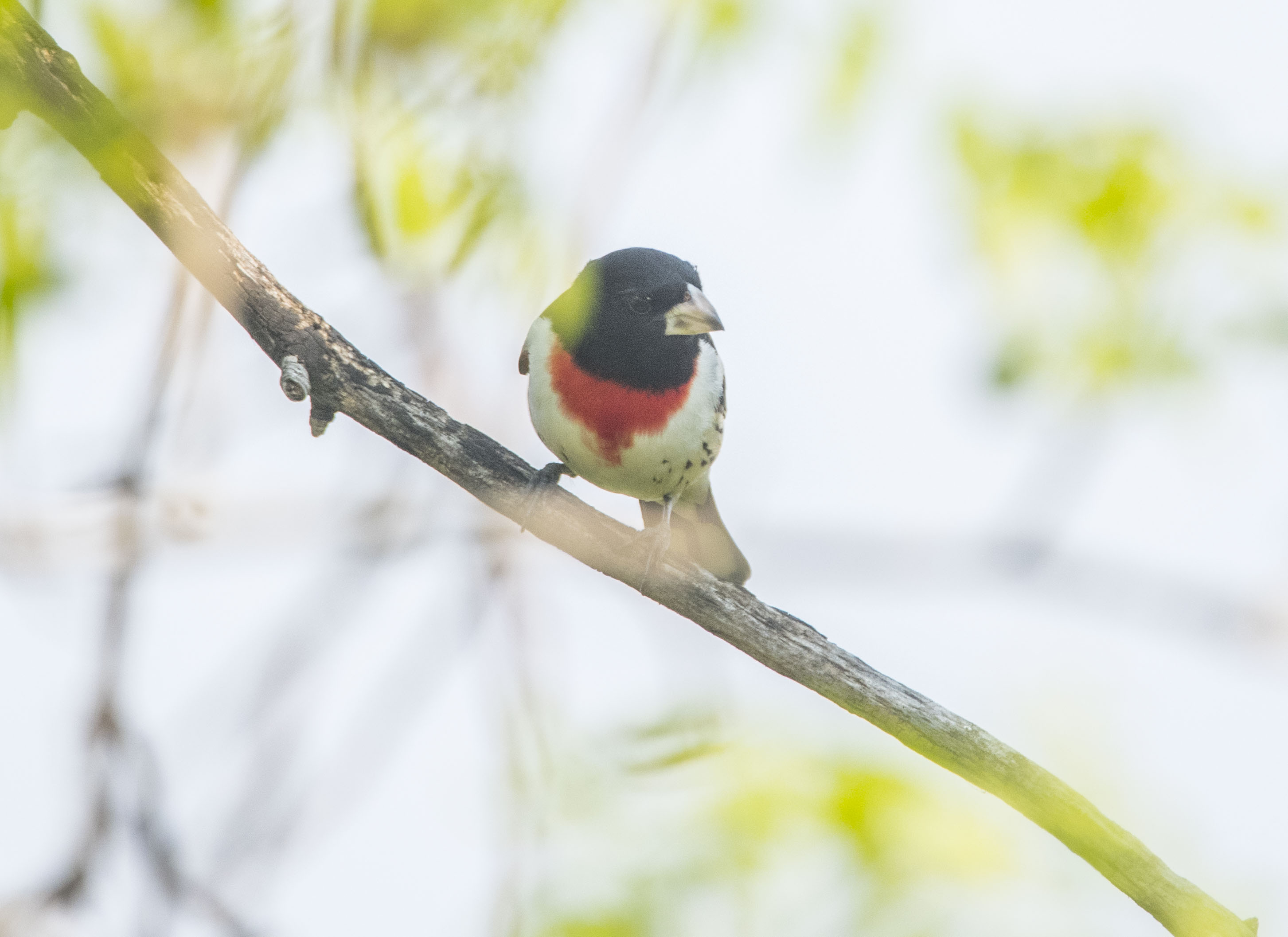
As an amateur in the art of observation it seems that the waterfowl migrations were a bit early this spring, especially when compared to a year ago, and my neighboring birders felt as though the same might have happened with the waders, those wonderfully sleek and graceful shore birds. My spring seasons are never complete until the oriels, Gold Finches and Rose Breasted Grosbeaks champion our feeders. These past few days, though, have not been unlike an anxious child awaiting Christmas. Now they’ve all returned, and moments ago, actually, my Yellow Warbler was spotted. All now accounted for; all adding vivid color to our little farm!

It seems that I must always head to central Nebraska in March for the Sandhill Crane Migration.

It can’t already be two months since we motored off to central Nebraska for the annual Sandhill Crane migration, an event that leaves you in awe for their migrations are of the ages; migrations that began long before mankind appeared in these prairielands, if the crane hype is accurate. On this visit we opted for an early morning blind viewing along with perhaps 40 or so crane chasers. The night before, then through the heart and eve of the day after exiting the blind, we were basically road tripping between the area around Rowe Audubon Center near Kearney and the Crane Trust headquarters below Grand Island. This was my fourth such pilgrimage for the migration and perhaps my most productive image wise. 

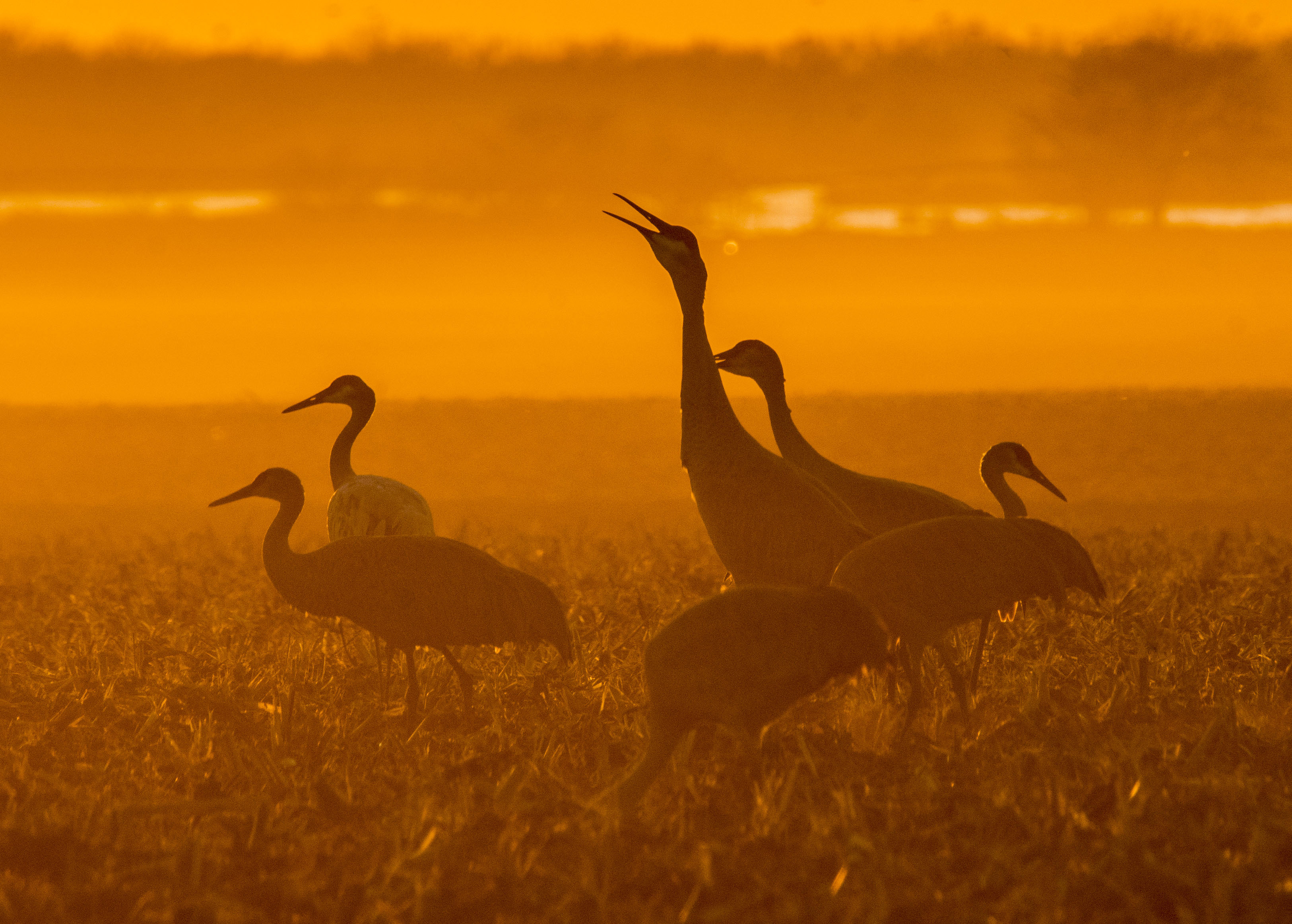
We ended our time on a corner below Crane Trust with cranes feeding in untilled stalk fields on either side of the gravel roads. Above them, up in the skies, hundreds of thousands of cranes, in wave after wave, from all directions, were flying towards the Platte River to settle in as the sun eased below the horizon in the western sky. All around us rapturous melodies from times perhaps more historic than mankind itself drifted from the heavens. 

We celebrated on our first sightings of Red Breasted Grosbeaks, and oriels! Have I mentioned Goldfinches? All add color and beauty to our lives!

Back here at home, spider-webbed skeins of snow geese and the seemingly more organized skeins of Canada Geese plied the skies around the same time. Murmurations of redwings and starlings filled the groves, our own included. A farmer friend alerted us to a grouping of migrating Bald Eagles on a WMA adjacent to his farm. Weeks later came the waders, or the more commonly labeled shorebirds. Yellow Legs and American Avocets were coursing through the shallow depressions in the area grain fields. Our prairielands were coming alive, season upon season, species after species. What a glorious time!

One species that was so common a year ago, the White-Faced Ibis, must have ventured for a different route this year. Last spring they were frolicking in those same flooded depressions in the area fields as their kin. We’ve yet to see one. One of my birder buddies spoke of a lake being drained about two hours southeast of here where reports of a couple thousand shorebirds were busy feeding in the shallow waters. About the same time, though, I was in the midst of preparing for an exhibit and simply ran out of time. He now believes most of the shore birds have now passed through.

An early morning bonus at Glendalough, and look at that beard!

By April’s Earth Day we tried for an image I’ve thought about dozens of time. My aim was to capture a sunrise at Glendalough State Park where in past years hundreds of blooming pasque flowers blanketed a hilltop near the entrance. A park ranger suggested in a message that the tiny beauties should be peaking around the Earth Day Monday, so we set the alarm for 3 a.m. and headed out the next morning for the park. We made it in ample time but was faced with an unexpected heavy and cold-to-the-bone wind, along with a hill with but a handful of pasques poking through the grasses. Tall trees fronted my sight line toward the rising sun. Things happen like that in nature photography.

Yet, all wasn’t lost. Our day was saved when we drove deeper into Glendalough and ventured onto the loop toward the picnic grounds where we spotted three wild turkeys, including an amorous old tom. The sun had just risen, splashing a fantastic yellow hue to the morning. The light was nearly perfect. And, in front of us was the old tom, in his full mating display, strutting about with the longest and bushiest beard I can remember seeing. Perhaps the old guy had never ventured outside of the park boundaries. What a lovely moment! And, yes, capturing a tom in mating display is among the seasons I love to capture.

We watch faithfully for various waterfowl, too, from geese to the many species of ducks!

Another species. Another season. So it goes, on and on. And, even better, more await. Soon we’ll be seeing Prairie Smoke and White Ladyslippers, both common to the prairie. Dozens of woodland species are already making their wondrous debuts, all adding to this glorious mix of personal seasons. 

A few years ago a fellow nature photographer wondered about just how many images of prairie grasses or flowers she would ever need, and I guess the same might be said about any one of my numerous seasons. Is there a limit? Can there be a new light, or perhaps a color enhancement, that seems new and different? There is all of that, yet it perhaps comes down to a simple truth, that of welcoming those old familiar friends from nature back into your life. 

Home

After jerking away the dead compass plant stalks poking in myriad directions from our triangular prairie-plant garden, and a half dozen batches of another dried plant, we had a nice little bonfire going in our pit when Roberta said, “It’s good being home. I enjoy looking around and being surrounded by the beauty of the prairie.”

This coming from a child of Milwaukee, one who had spent much of her married life in the woody hills of the Driftless, was high praise. 

Home.

Not unlike my partner, I grew up in the wooded hilly land of Northeast Missouri, not too distant from Mark Twain’s bluffy Hannibal, so like her, I love trees. Home meant being surrounded by maples, oaks and especially shagbark hickory. And, also like her, I also realize that as we drift into our elder years that living in the prairie was hardly on our individual bucket lists. 

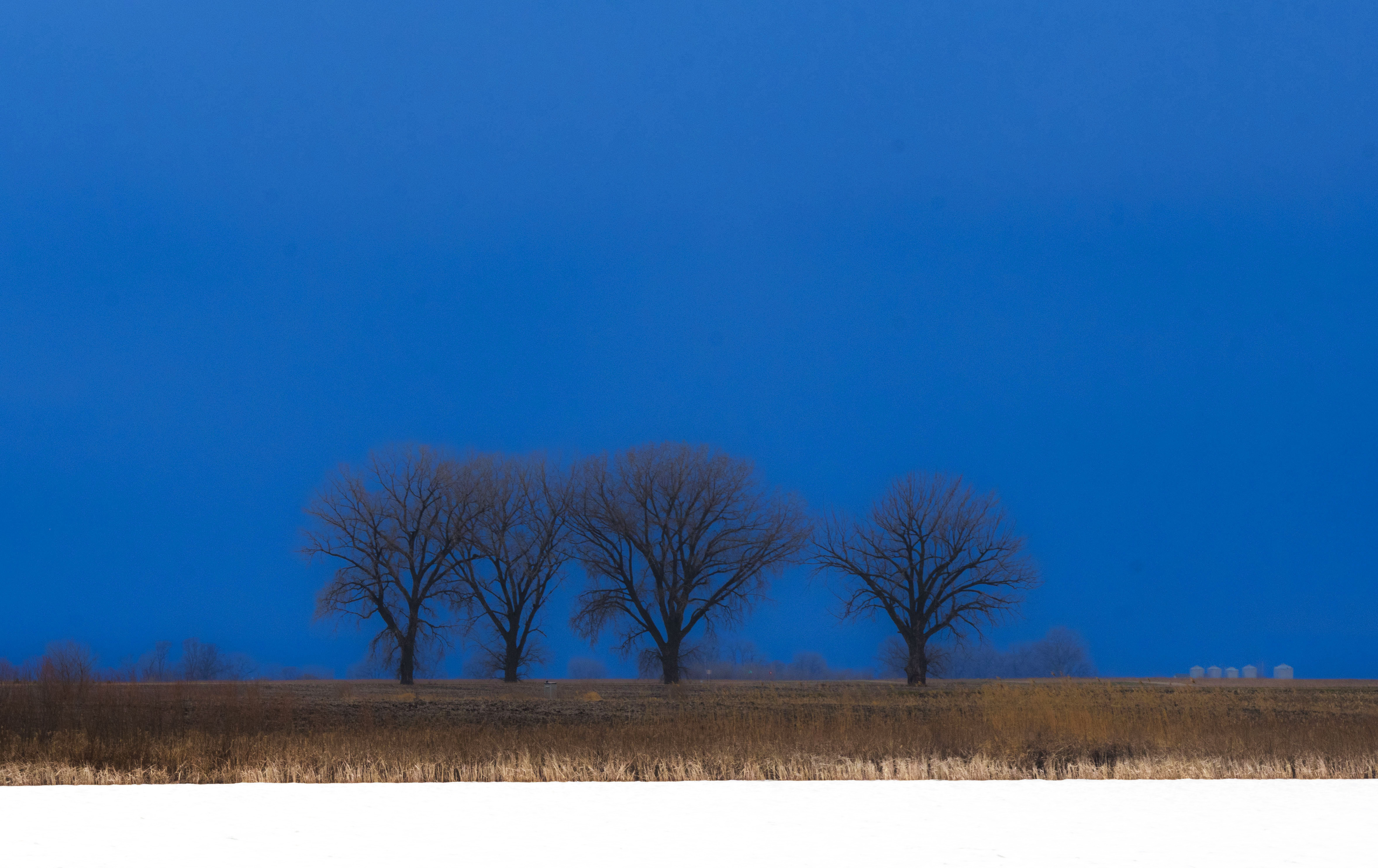
Later in the afternoon we took a drive around the neighborhood. Deep, dark blue stormy-like clouds loomed along the western horizon, and it appeared rain was falling in the distant east. As we left Listening Stones Farm we spied a rainbow off in the eastern sky. So we adventured down a gravel two miles north of us and drove toward the rainbow, stopping intermittently to grab a few images. I had a wetland in mind a few miles away. Unfortunately clouds blanketed the arc.

That rainbow was the first of many nice images offered on our multiple-mile loop through what remains of the prairie pothole ecosystem. We would come across mallards, a lone pair of Northern Pintails, and on the surface of another wetland, a flock of Canvasbacks. At the apex of our loop a pair of Yellow Legs ambled through the shallows of yet another wetland. 

Have I mentioned the clouds? That continually evolving sky-scape rising from the horizon, clouds painted with the ambient colors of an invisible sunset hidden by deep blue curtain of storm clouds. Where was Monet and his easel? 

Home.

We had just returned from a week-long longboat trip up the Danube, from Budapest to Regenburg, Germany, where we had passed numerous picturesque villages, vineyards climbing steep hills, steeples of aged-old churches and even a few castles. Spring was breaking through all along the river, and some of the trees were coming to life with colorful blooms. Cormorants were busy building and guarding rookeries in trees alongside the river. We were in the midst of a grand and picture-worthy adventure, one that included a tour of a private estate for some homemade beer in the Bavarian hills. Peacocks, a pair of guard geese and well tended horses ventured over the greening grounds, all part of a forthcoming promise of spring complete with greening grasses and emerging spring flowers. Through it all, though, despite the peacefulness and beauty, there was never a sense of wondering about having a life there in the Bavarian countryside. We were passing through. 

Later, as our plane left Munich, we flew over much of the same countryside where small villages poked from the hillsides in all directions, all connected by strings of two-lane highways. It was hilly, quaint and beautiful. So  comfortable looking. It wasn’t home.

Having lived along the Mississippi River in various stops in my career, and after a dozen years of living and working in Colorado, thinking this little patch of basically flattened prairie would eventually feel as “home” would have taken a long stretch of imagination. I didn’t even know this landscape existed, and as a traveler passing through there wasn’t much to inspire a life here. That changed some 11 years ago with the start of a short, failed marriage. I knew a few people around the area thanks to my connections to the arts community, but otherwise I was a complete stranger. 

It’s taken awhile. It’s not like we’re in a remote Bavarian village with a language barrier. Yet, we’re somewhat “remote” with our’s being the only year-round residence within a five-mile stretch of gravel road. We are slowly gaining a few more friends; some coming, some going, some just hanging around.

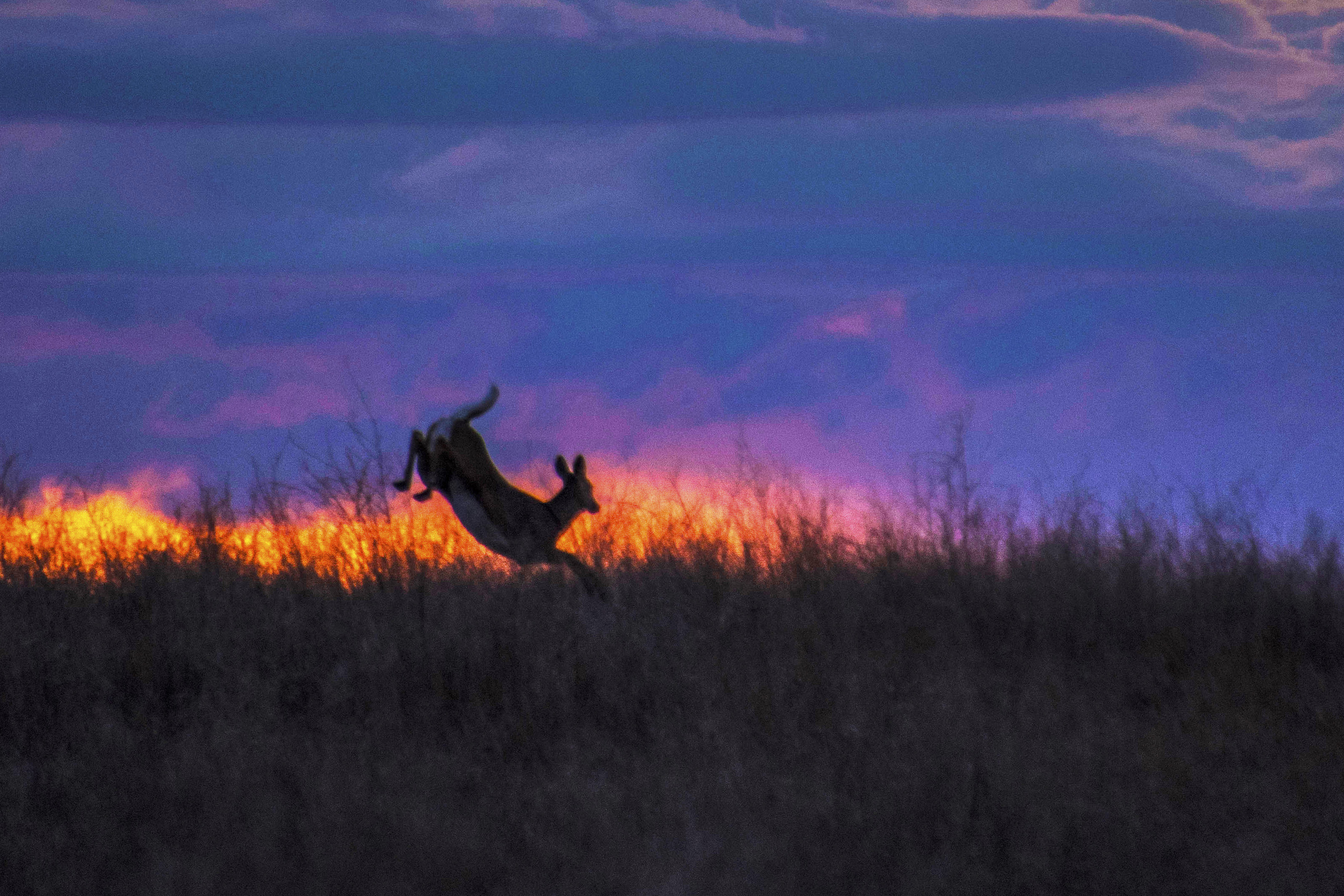
Still, we are offered an almost daily menu of colorful sunrises and sunsets. Where our woods play host to occasional wild turkeys, wood ducks and piliated woodpeckers. Where pheasants “bark” from the staunch depths of our big bluestem prairie. Where deer come and go in their infinite movement between prairie groves. Where our dog, Joe Pye, laid claim to this patch of prairie some ten years ago and seems to rather stubbornly guard it day and night (even if it comes from the foot of our couch!). 

So what makes a place home? How does one measure the comfort in reaching the foot of the driveway after being gone for awhile? Or, in closing your eyes to breathe in a relaxing sigh knowing it is okay to ease into a chair on a sun-drenched deck with a glass of sun tea? Or know there is a nice wooden bench partially hidden in the grove offering an occasional perch to watch leaves flutter in the wind or to spy on summer warblers; to walk through the paths in the prairie in search of new wonders, or to recognize the return of an old one? Our kitchen felt home-like from the moment I walked into the house years ago in the “look through,” although I thoroughly disliked the two double-hung window above the sink. Those were replaced with a single space filling framed “picture” window that brought the outdoors inside, a perfect spot to watch those nightly sunsets while making dinner. 

Home. What more could it be? 

Little Help From My Friends

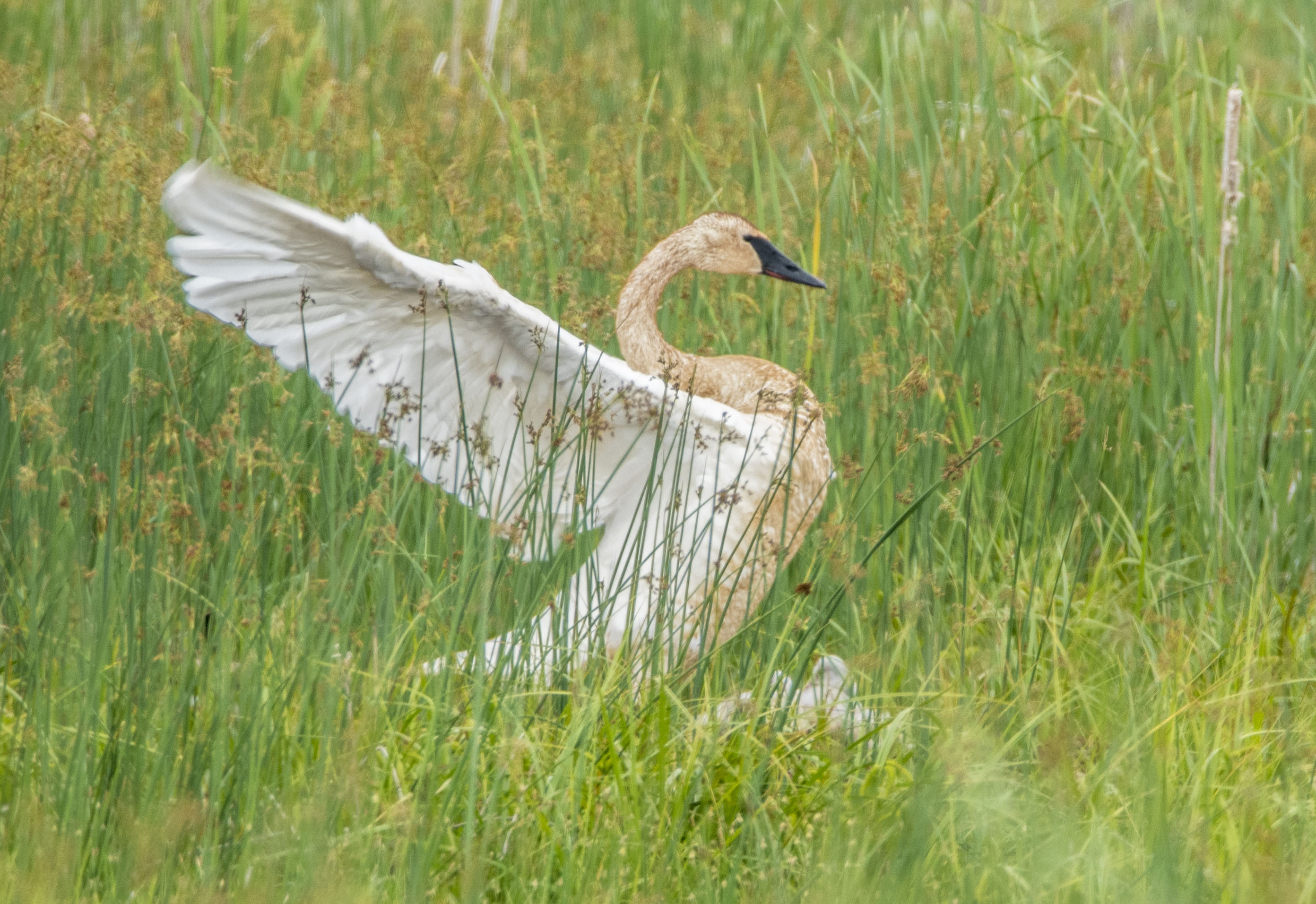
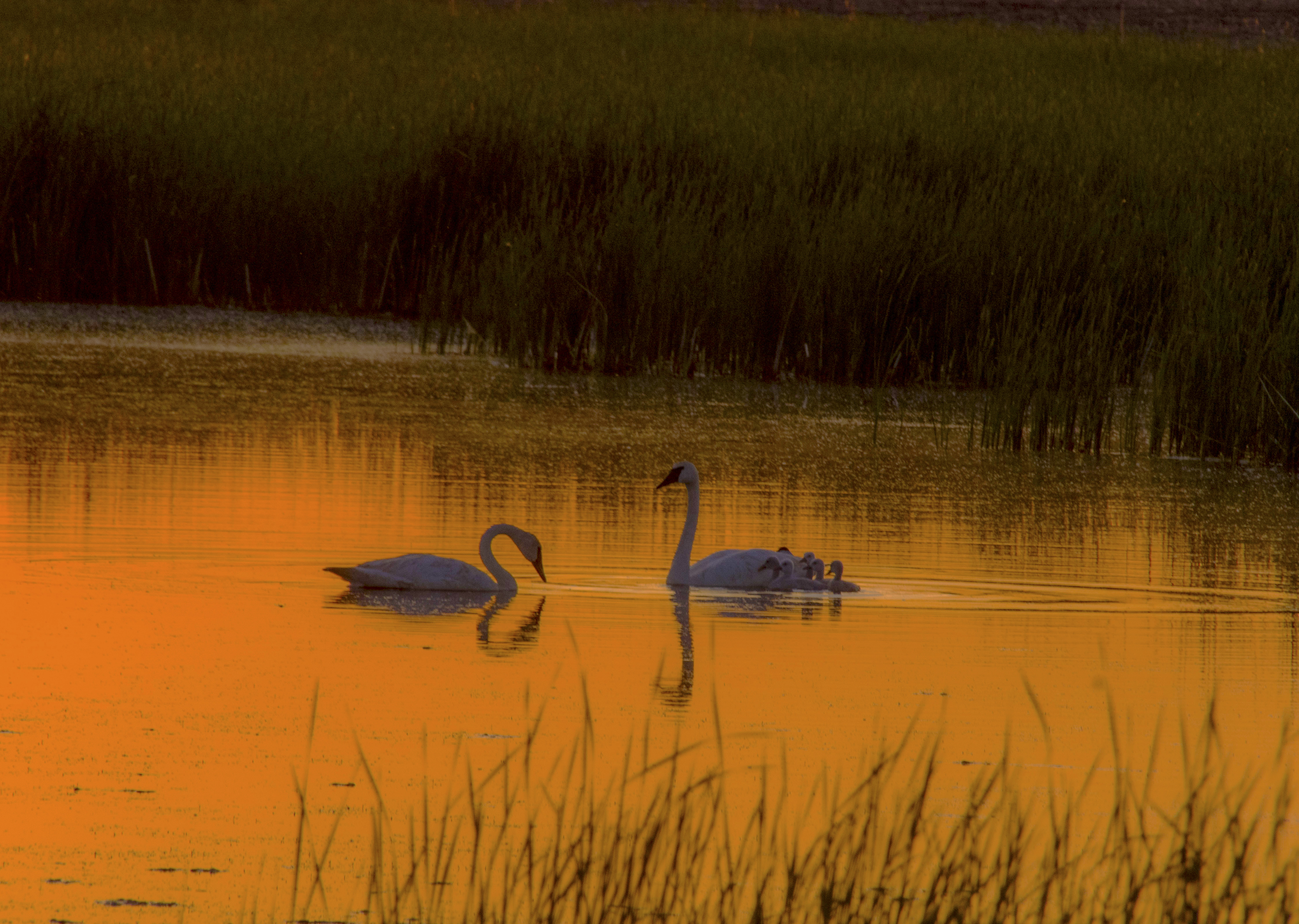
We were about to ladle some red beans and rice into our “porridge” bowls when my cell “pinged” with a message. Jeff Klages. Apparently there was a huge gathering of migrating Bald Eagles hunkered down in a prairie grove on the Klages Wildlife Management Area (WMA) about 20 miles east of my farm. This wasn’t the first time Jeff Klages has messaged me about possible photographic opportunities on his Big Stone County farm. A year or two ago it was a pair of Swans with signets in another of his wetlands. Would this be as wonderful?

Here’s the thing: Klages, who besides being successful beefman, is a county commissioner along with another friend, author Brent Olson, and has set me up with some fine photographic opportunities before. Both have, actually. And, Klages’ message came in just after another friend, Richard Handeen, had stopped over with a chainsaw to open our path through the grove where a huge tree had fallen across in a harsh winter storm a year ago, and for good measure took down a nice black walnut that apparently didn’t survive the past few years of spring flooding. Sometimes you just need a little help from your friends. Believe me, all is thoroughly appreciated.

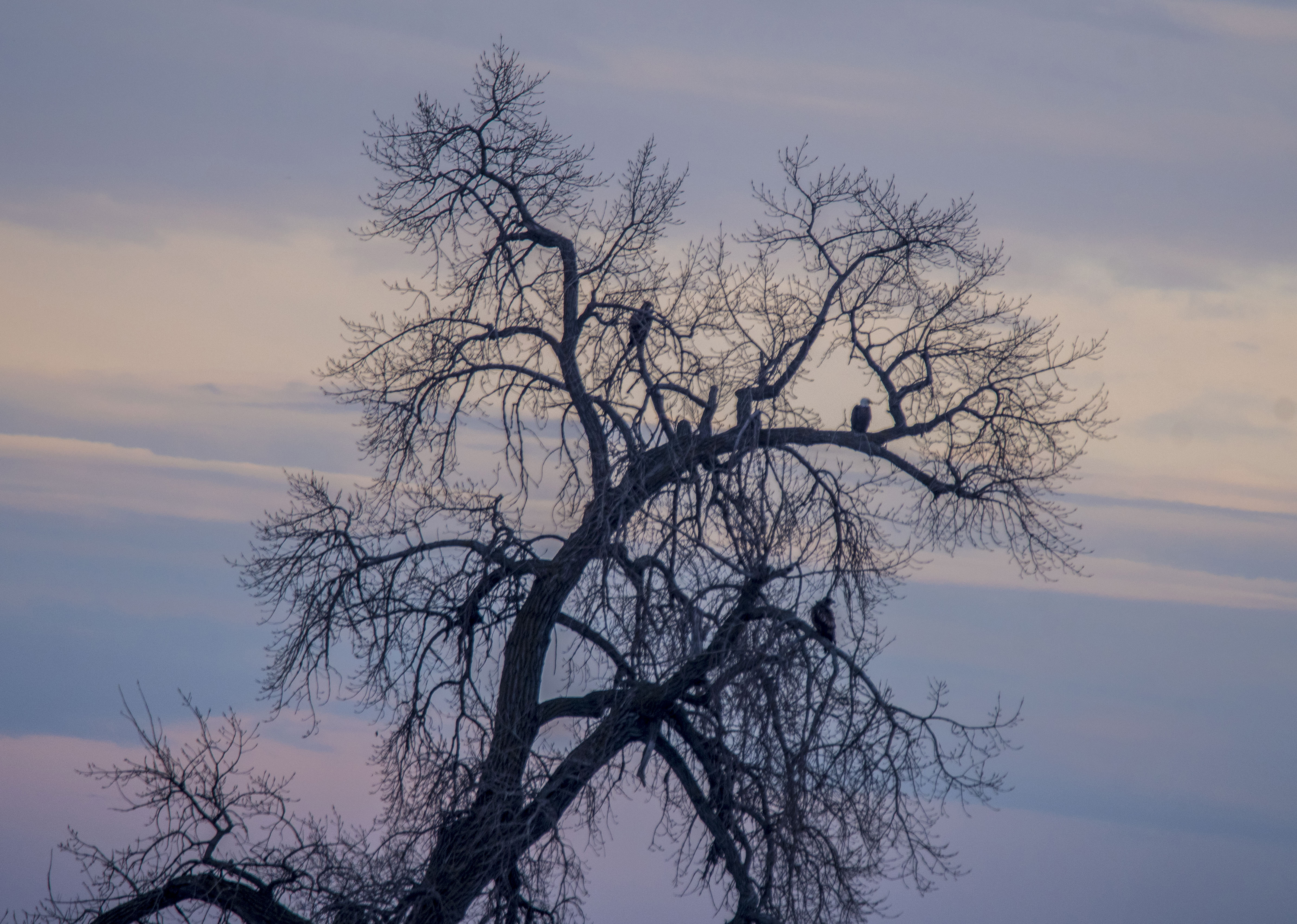
Bald Eagles perched in one of the tree islands on the Kalges WMA earlier this week.

With Klages’ hint in hand we made plans for an early morning rise to get on the road to the WMA and awoke to a brilliant red sunrise blazing through the bathroom window. Experience shows that if you see it coming through the window you might as well simply settle down to appreciate the beauty, for it is already too late to rush into the countryside seeking images. There are the car keys, grabbing the camera gear and so forth, each in its own way necessary, to slow you down as the sun rises ever higher and the ambient colors ebb in an ever growing grayish morning sky. Like this one. Perhaps one should be more aware and prepared. 

As it was, I was pleasantly surprised we were up and off so early, and what a fine little road trip we had. Once we reached the junction on the outskirts of Ortonville we still needed to course through nine miles of somewhat rolling prairie before skirting up a gravel road for a mile, then another half mile or so east. And, there they were, about two dozen Bald Eagles, posed on perch as white crowned royalty in the branches of the patched islands of trees. Occasionally a pair would fly off to make me wish for one of those airborne mating rituals, where the birds face one another in flight, talons holding one another tightly, one rightfully up, the other upside down. Although it seemed close to the courting ritual, their suspected courtship seem to fade in mid-flight.

More eagles on a beautiful tree.

That’s when a thought of the lovely song by the Beetles came to mind, of how love can sometimes be so lonely … without a little help from your friends.

We were parked alongside the wetland in the WMA long before the prairie winds picked up, and we sat with the windows down listening to prairie nature. We are prone to doing this at times like these. Above us azure to grayish skies hosted the remnants of the earlier sunrise as clouds drifted through, holding just enough color to bring an interesting hue to the images. If the eagles were conversing it was beyond my range of hearing, although faint sounds came of some nearby geese. 

When we left the wetland a bit later we would pass several Canada Geese waddling about in a farm lot just to the east of the WMA, which explained the sounds we had heard. Before we left we headed to the Klages’ homestead where we encountered a flock of resting migrating Redwing Blackbirds perched high in the farm grove. We had stopped to offer our thanks and found only the nearby cattle in the adjacent fields. Down the road on our way back toward the WMA we found a solitary Redwing perched on the branch of a blackened log, a result of an attempted burn, next to a pool of water. Another example of an early though approaching Spring.

While I was hoping for a courtship images, the aurora would pass.

Since we weren’t quite ready to leave we stopped briefly at the WMA to once again soak in a little more of the eagles. I was still hopeful of a mating image, but other than the occasional fly off, the eagles were collectively content in their restful perching. Other social media friends have posted similar images in the past few days while we’ve been traversing the nearby prairie in search of geese gatherings. 

Our luck would soon change, for moments later we would find our bonus. Turning back toward the west on the way home on a paved county highway we came across a huge gathering of geese feasting in a stalk field. Initially those closest to the road skirted away and up the rise. As they did so suddenly a huge flock rose from behind the ridge for a very nice portrayal of spring. 

This image from two years ago thanks to another one of Jeff Klages’ friendly messages.

Why should I have been surprised, for when Klages’ messaged me the first time about the swans in his wetland I had passed Stoney Creek about four miles east of the Ortonville junction on the way out where a beautiful snake-like ribbon of fog hung over sweet curves of the creek. Gritting my teeth over a missed opportunity I had continued on down the road for my goal was to capture the Swans in the rising sun.

Like on this trip, though, after securing my initial images, I drove back toward town to surprisingly find the creek still grasping the fog and was blessed when a couple of bank swallows flew through to provide me with an amazing image. Pure fate. It was one of those delightful moments of photography when all the elements suddenly come together. And, now, once again, it did on a morning when we went searching for eagles.

And, we were able to capture this image of the geese on the way home.

Yet, this was more than about swans, creeks, springtime flocks of geese and eagles. This was more about being neighbors, of being neighborly, of reaching out in anticipation with possible gifts provided by nature.

In these post-Covid and politically difficult times, when our connections with neighbors have seemingly become strained, having neighbors and friends like Jeff Klages, Brent Olson and Richard Handeen, reaching out means so much. All of which makes the world so much gentler and breathable. It just gives one a wonderful feeling that perhaps we aren’t as individually stranded as it feels sometimes. Yes, there are certainly times when we thoroughly appreciate a little help from our friends. And, yes, sometimes I even sing out of tune … 

Believing the Birds

So lets talk about our warming planet, for in case we don’t get it, our feathered friends surely do. For example, records from the annual Sandhill Crane migration in Central Nebraska indicates this is one of the earliest overall arrival of the cranes with this being the last week of February and the first two days of March, with nearly a quarter million birds already camping out overnight in the shallow Platte River. This is more like the numbers expected by mid-March.

Local naturalist, Jason Frank, who organizes the annual Salt Lake Birding Weekend, noted, “This will be the earliest waterfowl migration I’ve ever seen; almost all the duck species that pass through here are here right now. The only species I haven’t seen yet are Blue and Green Winged Teal. Waterfowl migration will certainly be past peak by the time of the bird count April 27, but it remains to be seen what happens with shorebirds. If it stays this dry, they may not linger long as they pass through.”

Already observers of the annual Sandhill Crane migration are seeing mid-March numbers with counts of nearly 225,000 birds already in that area.

Then there is this: Last Monday three young men were ice fishing on a small wetland north of us. Ice on nearby Big Stone Lake was considered so unstable and unpredictable that our local bait shop officially closed off their guiding and rental season, as ice was melting and stacking up along the shore. Temperatures were in the high 60s, and perhaps even 70 degrees. On February 26. They, along with many of us, were giddy.

All of which changed the next day when the guys were nowhere to be seen as winds hustled across the prairie at speeds around 20 mph, with gusts a good 10 mph stronger. Clouds, thick and densely gray, choked off any semblance of sunny, blue skies. Thermometers seemed generous at 9 degrees above freezing. Winds were so blustery that on the way home from the countywide caucus that night our car gave us grave concern on the way home. Blasts of snow and dirt coursed through the darkness where the fishers had parked about 30 hours earlier. 

Some folks at the caucus were wondering what might we expect as we move even deeper into the aspects of global warming. “What’s normal anymore?” asked one woman. When it was suggested that the weather swing might be our new normal, she simply stared while seemingly thinking it over. 

Yes, the cranes are special to watch, and seem to be more aware of the planet heat than many of us.

If one goes deep into the daily newspaper they will find buried stories concerning issues with global climate change. Refugees trudging across the jungles and deserts of Mexico in search a more humanly sustainable future course through our southern states seemingly ruffled monthly by hurricanes and tornadoes. Tornadoes ravaged a Chicago suburb and communities through Michigan and Ohio already this week. A huge wildfire burns out of control in the Texas Panhandle into Oklahoma, the largest in Texas state history. Last Sunday a story appeared on the fear surrounding the southern shores of Lake Superior, which for the first time in recorded history was completely ice free. Only 2.7 percent of ice coverage was reported for all the Great Lakes for the entire winter. 

“We’ve crossed a threshold in which we are at a historic low for ice cover for the Great Lakes as a whole,” GLERL’s Bryan Mroczka, a physical scientist, was quoted as saying. “We have never seen ice levels this low in Mid-February on the lakes since our records began in 1973.”

Already Canada Geese are pairing up near the melting waters.

Here is another report from the Sunday newspaper: This winter’s shrinking supply of cold air in the atmosphere has coincided with what is probably going to be one of the warmest winters on record. Many locations in the United States are on track for a record-warm winter as temperatures soar to near and above 30 degrees warmer than normal in the season’s final days. On Monday, Dallas hit a record high of 93 degrees. Minneapolis reached 65 — 32 degrees above average. Chicago touched the 70s on Tuesday. Globally, more than 200 countries have seen record warmth this week, according to weather historian Maximiliano Herrera. January was the eighth consecutive month to register as that month’s warmest on record, while 2023 was Earth’s warmest year on record for both the land and oceans.

All of which brings to mind a moment in a Master Naturalist’s “Gathering Partners” presentation several years ago when someone asked a University of Minnesota climate specialist what we should expect in respect to a warming climate. His offerings: that we in the central part of Minnesota should expect to have summers and winters much like we see in the band across from Omaha to Des Moines; and that a preview of the BWCA area would most likely be witnessed in Granite Falls where outcrops of gneiss and granite along the Minnesota River mirror the rocks on the Canadian Shield. Despite his good intentions, he wasn’t close. No one, apparently, can accurately predict what will happen as our planet continues on its current warming trend, temperatures of which when viewed over the past few centuries resembles a hockey stick — although there has been no edging that would complete the mental profile.

Naturalist Jason Frank reported that all but two of the major duck species are already in the area, along with the two major geese species.

All speculation aside, and with deep respect to him and others concerning the changing climate, we humans haven’t any idea of what a burning planet will resemble in the years ahead … not even for next year, 2025. You may recall back in the “teens” that the worldwide goal from the international climate conferences was that for our planet and its species to survive long term certain perimeters needed to be in place by 2025. So little has been accomplished, and indeed, county-level arguments are being roused around here on allowing for methane digesters along with a pipeline. We have a political party that resists any conclusive attempt at halting the earthly fire. While all this may sound new to us, warnings of global climate warmth began in the 1970s yet most of us act as if nothing needs to change, and to hell with Al Gore! 

We humans have been far too passive, and perhaps that comes with the labeling, that ever evasive “tipping point” seems as a moving target to where it no longer means much. Way back then those warming slopes didn’t look so steep, and the potential impacts were far off into the future. Not next year! Given the scientific knowledge at the time, perhaps what we needed was what a major newspaper like The Guardian did by introducing new terms back in 2019 that “more accurately describe the environmental crises facing the world”. Instead of “climate change” the paper chose the terms “climate emergency, crisis or breakdown” and “global heating” over “global warming”. 

Last spring the arctic-bound snow geese arrive here in late March. They will most likely be long gone before the end of the month.

The editor said, “We want to ensure that we are being scientifically precise, while also communicating clearly with readers on this very important issue. The phrase ‘climate change’ sounds rather passive and gentle when what scientists are talking about is a catastrophe for humanity.” 

Well, there you go. Catastrophic storms and unpredictable weather come on a daily basis across the globe. Perhaps this is our “new normal” even if there is nothing “normal” about the escalating temperatures. However, if you still question the absolute yet unpredictable science perhaps you should simply reach for your binoculars and watch the birds. Our feathered friends seem to have a far better grasp on our changing climate than we humans.

The Evening Linka Exploded

Last week a dear old friend, Mardy Wilson, wrote me from Fort Collins, CO, to say her son-in-law, Neil Kaufman’s first novel, “Upriver Journey”, was published, and asked if I would read and review his book. A few days later it arrived from Amazon, and being between books, Kaufman’s novel was opened to words of new and interesting adventures.

It was hardly surprising that his story was about both his home country along with his love of fly fishing. His tale of two Wall Street investment bankers being sent to Colorado and Wyoming for a week long wilderness and mental retreat was both intriguing and well written. His descriptions of fighting trout in various locations and waters was excellent, for Kaufman put a fly rod squarely into your hands from the cork grip to the pulsating feverish action at the end of the line. Few writers have taken one so deep into the backing.

Then, on page 399, two of his characters, wilderness guide Amanda and protagonist Michael, as they were discovering their mutual interests, found themselves on tubes on a small Wyoming lake when an incredible and magical moment in time occurred, and as his descriptive words unfolded so did a remembrance of a similar experience. It was an evening when Lake Linka exploded, of art mirroring life.

This was well into the frenzied hatch on a May evening on Lake Linka, south of Glenwood on the edge of the Glacial Shield.

But first, here are the excerpts from Neil’s book that brought that memory to mind:

“Whips of moisture create visible currents in the air as they move between Amanda and me. Looking skyward, I see the sun’s orb bleeding through the fog like a cloaked spotlight. Refracted light illuminates the moisture, adding a shimmering quality to our surroundings.

“A set of concentric rings appears a few feet to my left and another directly in front of me, then two more the right. They seem too small to be fish. Perhaps we’re at the dew point as moisture is condensing into minute droplets falling to the water’s surface. I turn my cheeks to the sky, anticipating little flecks of rain that do not come.

“Another half dozen sets of small concentric rings disturb the otherwise still surface before the refracted sunlight catches on a tiny glistening fleck rising straight above the water. Two more appear. Suddenly, dozens of them dot the surface and the still water surrenders into little waves crisscrossing one another. Dozens become hundreds as the water boils with activity … with neither splash of water nor flutter of wing, thousands of tiny translucent mayflies ascend the surface of the lake … ”

This was my first image after grabbing my camera.

His was a description of a wilderness morning while mine came late on a May afternoon on a Glacial Shield lake a few years before; on an warm summer evening much like when we met while visiting my former Denver Post colleague, Mardy. Neil and Mardy’s daughter, Erin, came to visit with us along with my son, Aaron, and his wife, Michelle, from Norway. I remember Mardy and I both so pleased our children seemed to meld so easily in friendship and conversation much as we had nearly 50 years before. Indeed, Neil and I would talk about fly fishing and the nearby rivers. And, now, nearly two years later, his book has arrived.

Indeed, the time of day on Mardy’s patio corresponded with that late May evening back in 2021 when Linka exploded in much the same way as Neil explains that magical, unexpected moment in his novel.  It was late enough on Linka that the sun was perfectly positioned as dusk neared. Linka is a shallow lake, especially along the outward southern bow, and is within the first reaches of the Shield. 

Acres across the surface seemed illuminated during the hatch.

Across from the cabin where I was staying, and almost directly in front of the Griffin Farm toward the west of what is now in Nature Conservative-ship, the hatch began slowly with dozens of tiny pops of light glittering in the approaching dimness of dusk. On the surface, and rising a few feet above the blackened waters came the sparkling pops of light, first with a few, then a few more. It was astonishing to watch, and I quickly rushed into the cabin for the camera as more of the pops came, all highlighted and sparkling in the last remnants of the setting sun.

Dozens became hundreds, and hundreds became thousands all across the western surface of the shallow lake. Oh to have had my kayak in the midst of the mayfly hatch like the fictional Michael and Amanda, yet simply watching it occur was an awesome experience. Sparkles of light illuminated the surface, rising a few feet in the air, covering acres of the water. It was as Lake Linka was exploding with life, and it was. Moments later, almost as suddenly as it began, the hatch ebbed, much as Neil had described in his novel. Then it was over. 

The concentric ring is perhaps an indication that fish in Linka were feasting on the emerging mayflies.

Watching the mayfly hatch the night Linka exploded still makes me wonder if there was an incredible feeding frenzy as Neil writes about in his novel. Trout are rather selective eaters so to fish effectively you must “match the hatch,” which differs somewhat from warm water fly fishing where fly action is often manipulated with the rod or line. Was that hatch that came and ended so quickly beyond the consciousness of most of the Linka fish? Ah, the mysteries of nature. How would one know?

Unlike Neil Kaufman’s Amanda and Michael, my life of love on Linka ended abruptly a few months after the hatch and I’ve not returned. I’ll never know if that moment was truly unique, or if it was one of those being there at the right time moments. Does it happen on other Minnesota lakes? I’ve fished and canoed waters from the Iowa border to the Boundary Waters for years without observing a similar hatch, so I’m ever so thankful for that wonderful memory of the one magical moment of the evening when Linka “exploded.” 

A Delicate Farewell

A portion of my heart was broken last year when news broke that one of my favorite state parks, my one time “home” state park … Upper Sioux Agency … was about to be closed. Immediately plans were made to make one last visit before the actual closing, which occured this past weekend. Somehow a mistake was made on my end for I thought it was in mid-March rather than February. While I will miss the park, there are now no misgivings about the future of that land for it is being returned to the Dakota tribe. For many good reasons.

This, though, doesn’t dismiss what many of my friends felt was long-kept secret in St. Paul, and a decision that was seemingly made minus local input.

Politics aside, I will miss this stretch of public park alongside the Yellow Medicine River, the teepees in a campground along with some beautiful wooded campsites next to the river, as well as the high, tree-lined hill beside the “pull out” on the upper end of the park that stretched along the Minnesota River. I cannot count the number of times fellow writer, Tom Cherveny, and I used that pull out to conclude canoe and fishing trips down the Minnesota. Oh, and of all those catfish and walleye caught in the upriver bends and at the confluence of the two rivers, that triangular strip of earthen prairie sod that came to an ever-narrower point with each spring melt.

One of the two park teepees that attracted campers, an image I made for a friend in Granite Falls.

My first time at the park was to cover what some 30 years ago was the annual opening area-wide high school cross country meet on a late August afternoon, held on the hilltop where the old agency building stood fast. Little did I know of the historical significance of that building and the park at the time, nor did I learn of the angst of the local Natives until years later when a carload burst through the admission gate during a park event held with an intention to recognize that history. “We ain’t paying to come onto our own land!” came the anguished cry. 

That cry served to awaken me to a realization that as we move into the seventh generation since the War of 1862 between the Dakota and the immigrant white settlers, some of which occurred right there on that very hill overlooking the joined river valleys, some nerves were still raw. Yes, this land retained ghosts of a deeply troubled past. 

Not long after that introduction via the cross country meets our family began visiting the park perhaps a half-hour distant from our small town to camp, canoe and enjoy the incredible mix of nature, all accompanied by that grand and rarely quiet singer, the Dickcissel. No matter how many times a trip was made from the campground to the confluence, and mostly by foot with either a fly rod or camera, the loud songster was perched on the adjacent farmer’s barbed wire, fencepost or treetop, chest protruded and head arched back, blaring an operatic prairie song from deep within it’s inches-deep, feathered soul! 

Seemingly an “operatic” Dickcissel always accompanied us down a dirt road to the confluence of the Yellow Medicine and Minnesota River.

Over the years we took carloads of foreign exchange students to camp there, for they were usually quite excited to spend a night or two camping in an iconic teepee. They would generally pair off for long walks, often climbing the hill to the park office at the top, or meandering along that dirt road to the confluence beneath the songs of the Dickcissel. One morning I cooked a breakfast for the group that included a package of peppered bacon, and when Jordan, the first or second grader daughter of dear friends, came through at the front of the line she piled the entire stack of bacon onto her plate. She’s been known as the “bacon thief” in the 20 plus years since!

On one deeply dark moonless night artist Joe Hauger set up his sky-scopes and did his best to point out those invisible (to me) constellations high in the night sky. In the end I could connect the dots but simply couldn’t see the inwardly connective tissue, those mythical shields, robes and arrows. I suppose in a few years it won’t make any difference, although just once … once in my 80 plus years of life … I’d love to identify, see or simply acknowledge Orion or Scorpus, or any damned thing beyond the Big Dipper!

On another day another artist, Ashley Hanson, with the help of a cast of local river rats, created a “river play” that could only be viewed by canoeing along various stopping points of the Minnesota that concluded a final two acts at Upper Sioux. Somehow she convinced an at-the-time fellow country newspaper editor, Scott Tedrick, to star in the play dressed to the “nines” in a beautiful blue prairie dress! 

For most of an afternoon I played “photo tag” with this Yellow Warbler, and this was my only full image of the shy singer!

Yet it was the quiet times with my late wife, Sharon, and our sons, Jacob and Aaron, that I most remember, of walking down that dirt road with our fishing poles to the confluence, then coming back near dark often with a stringer of fish that I would fillet with the headlights of our car; of how we would sit quietly in camping chairs watching fireflies buzz in the dry prairie grasses, sipping cold beer or wine. Once on a very cold and sunny winter day we brought the boys down to enjoy the sled hill at the entrance when one trip of trudging back up that hill dragging both the sleds and a boy each was considered a one and done. Have canoe trips been mentioned?

It was here we witnessed our first of many Wacipis, powwows hosted by the Native Dakota in the horse campground on the other side of the park, complete with hot frybread, beautiful drum songs and jingle dresses. It was our introductions to the Native culture and wasn’t taken lightly. Ever.

As a photographer, the light in the park was always divine.

My last visit came long after Sharon’s untimely death when I came with a new woman friend with our newly purchased camper. We were to meet some of my Missouri family in the midst of their “Laura Ingalls Wilder” trip through the Minnesota and South Dakota prairie with my hopes that they would join us at Upper Sioux. Their’s was a different agenda, although we did meet for dinner in nearby Olivia. We two had ample time to explore the park in our wait, although this was years after a rain-dampened landslide had permanently closed the state highway between the lower campground and the hilltop headquarters. My hope then was to once again visit the canoe takeout but we found the long winding road down the hill chained off. Yet, the prairie was alive, and I would spend most of an uneventful afternoon playing photo “tag” with a yellow warbler. 

Yes, I again went fishing, and we were once again serenaded with an operatic prairie song by a feathered diva, yes, an ever present Dickcissel, and actually saw one of the few Meadowlarks in all my many years here in the “prairie region” of Western Minnesota. And, the Minnesota was sparkling in the late afternoon “Monet light” with beauty and poetic color, and I viewed that upriver bend unknowingly for the last time. The beauty preceded a deep sigh or two one has when meeting an old friend. Then, on our last day, much of an approaching evening was spent trying to create a good image of one of the teepees for a friend who lived in nearby Granite Falls. 

The various views of the bends of the Minnesota were often spectacular.

For many years … numbering close to 20 overall before moving upriver to Listening Stones Farm … the Minnesota River bottom was my home away from home, and Upper Sioux Agency State Park was my anchor. This is where I would come after crossing through the uncountable farm fields on mostly gravel roads to where the waters of confluenced rivers roamed, where old, soulful trees lined the banks and adjacent hillsides, where one could find nature’s beauty and sense the soulful depths of a riverine landscape. 

Now the old state park has been rightly reclaimed by Dakota for all those reasons and more, and it is time the rest of us moved along. I’ve heard the plan is to finally demolish the old Agency Building, a bastion to centuries-old ills of racism and genocide, and to close the former park to those outside of the Tribe. According to news sources, the Department of Natural Resources have discussed plans for a new state park within the area. Although there might one day be a replacement park, perhaps the word “replace” is the wrong word. In, these, my farewell thoughts, I must say thanks for many cherished memories.

Beautiful, Yet so Ugly

Once again the wind is blowing. Gale force? Perhaps not, since that would be in a range between 34 knots (39 mph) to 47 knots (54 mph). At least not consistently. Yet the sound and feel is such that it is surely lifting soil and blowing dirt, and thanks to the recent thaw, not much of this continual erosion will be visible since snow provides a convenient contrast. Rest assured, though, that dirt is shifting and that some of it will blow into the adjacent road ditch and perhaps even the distant ditch across the road.

There are ample examples all across the western prairie region.

Down the road apiece, just past our little eight acre prairie, we have evidence of displaced dirt. Between the field and the edge of the road blown dirt covers what little snow that has yet to melt. Driving through the “black desert” — basically within the Hawk Creek Watershed in Chippewa and Renville Counties — dirt covered ditches on either side are a common sight on both highways 7 and 40. 

A rather symbolic portrayal of past and present … the downed wire of a former pasture and the weathered skull stand against a possible demise of modern agriculture, the loss of valuable topsoil to wind erosion.

Unfortunately wind-blown dirt erosion is far from centralized since friends traveling beyond our state borders  have witnessed “snirt” … a word that combines “sn” of snow with the “irt” of dirt … in Iowa, Nebraska and Kansas. Recently some have taken to calling the eroded dirt “snoil” that combine snow with soil. Whatever the moniker, it is a tragic loss for now and especially for future generations who may be dependent on whatever soil is left to grow food.

One of my long time friends, Kurt Lawton, former editor of Soybean Digest magazine, suggests that every farmer and land owner should be required to read “Dirt: The Erosion of Civilizations” by David R. Montgomery. It’s a telling and fascinating book of non-fiction that describes the many “civilizations” that have been ruined and lost because of the erosion of dirt dating back before the birth of Christ. He also points out and warns that we are now farming (growing food, and yes, ethanol) in the “last frontier” of tillable soils, and adds quite pointedly that we’re still “treating our soils like dirt.”

“Monks” of an erosion, quipped a friend seeing this image.

It was after reading Mongomery’s book in 2014 that I began to collect roadside images of wind blown eroded dirt on snow that led to creating my Art of Erosion exhibit, which has now been in numerous exhibitions around the states of Minnesota and Wisconsin, from the annual MOSES (Midwest Organic and Sustainable Education Service that is now called Marbleseed) gathering in La Crosse, WI, to being included in the Water Works traveling exhibition from the Smithsonian. Add a few gallery walls and conferences to the list. A commonly heard comment in those varied exhibitions is, “ … this is so beautiful yet so ugly.”

Initially my images were centered around erosion in Big Stone, Lac qui Parle, Chippewa and Renville Counties of SW Minnesota. Since, more images have been added from Stevens, Swift and Yellow Medicine Counties. Some of my earlier images have been pulled from the original 24 as newer and perhaps more compelling ones have been gathered. There is seemingly no end to the addition of more imagery. A few year ago it I included a white farm cat clustered with dirt along with dirt-crusted, in-town Christmas decorations and stairways. Last year I framed a multi-image collection from dirt blown from a single field at graduated distances ranging from 100 to 400 meters, along with a second image where “waves” of dirt had cascaded down a hillside from a fall-tilled field from just over the rim. Little imagination was needed to view it as waves of an ocean beach. 

A common sight along too many rural roads …

More images have been added already this winter and it’s only February, with nearly four months to go before seedlings are high enough to provide modest protection. A handful of these images were captured on a recent trip to my credit union in Dawson. Sadly, these poor farming practices continue, and perhaps even sadder is that apparently those farming the soils where I can count on gathering images every winter rarely do much about it. Are they blind to it? Overlooking or ignoring the damage being caused? As if soil is an unlimited resource?

Viewers of the Art of Erosion have asked about changes in the farm program that might mitigate the issues, or question why such tillage practices are continually being used. They worry, as do I and others, including Montgomery, about feeding future generations if the erosion continues. They ask about cover crops, which can be challenging to plant when considering both a compressed harvesting season and a shortened possible growing season for the cover. However, more and more farmers have noticed and are working to find creative solutions to keeping their soils in place including turning to crops like kernza, a commercially available and economically viable perennial grain crop that is a suitable ingredient for bread, cereals, beer, whiskey, and even ice cream. 

Snow provide a convenient contrast, though the erosion continues from nine to six months depending on the previous crop.

Perennials are a favorite of Jim VanDerPol, author of “Conversations with the Land,” who bemoans both the loss of perennials overall and the grazing of farm animals that would better protect our soils. His family farm, now being transitioned to his grandson, is a green isle in the midst of the aforementioned Black Desert. Poor animal prices, however, won’t convince so many who are dependent on the USDA farm program to switch their 24 row planters and combines for a patch of grass and a herd of cattle.

Perhaps the most inexpensive means is to simply leave the residue from the previous harvest standing. Untilled. Farmers, though, seem to balk at this by arguing that come planting season new issues might arise including a late winter or a very wet spring. Yet, what about the soil? “The soil is being eroded 100 times faster than it’s forming. And that kind of situation can burn right through the soil profile,” says UMass Amherst geoscientist Isaac Larsen. Those who have studied the erosion seem to unanimously conclude that this is unsustainable.

I seem to be captivated by the dirt swirls and other impressionist creations by the wind.

There is a cost involved. Jodi DeJong-Hughes, University of Minnesota Extension regional education specialist, sampled the top inch of snirt in ditches along Minnesota Highway 40, yes, the same one mentioned above, that through laboratory analysis and math revealed that this field lost $51.30 in nitrogen, $7.80 worth of phosphorus and $23.50 in potassium per inch of ditch acre. In other words, $82 plus change per ditch acre. These figures do not even include the most valuable soil components of topsoil (clay particles) that blow away before heavier particles settle into the nearby ditch. How do you assign a value to valuable soil organic matter, microbes and minerals that lie in a ditch? Yes, it’s dirt. It is also money. Anna Cates, a University of Minnesota soil scientist, says: “Every farmer who changes (tillage practices) references erosion as a motivator.” 

Snirt, or snoil, is a perplexing and costly issue that likely remains in the hands of individual farmers to recognize and rectify. It seems unlikely that an abrupt change will come from the USDA. Some Farmers have changed practices, yet it seems a majority have either ignored looking at their ditch banks or even considered the costs of erosion both in terms of crop inputs and actual loss of soil. I would hope it isn’t due to a complete lack of care, for this is it; this is our last remaining farmable topsoil on planet earth. 

A Lucky Seven

It began with a blissful and brilliant feathered ember in the desert landscape. Contrary to what one might think, this was not a glamorous show girl on the famous Vegas Strip but rather a rare desert bird we found at the Henderson Bird Viewing Preserve on the outskirts of the city.

Days later we would visit Red Rock Canyon National Park where a more mundane appearing avian wonder would appear in my lens. In between there was lots of magic and wonder, and “seven” would be the magic number!

Let’s start with that “ember”, which the naturalist at the Preserve took a quick look at the image presented in the Nikon viewer and said, “Yep, that’s a Vermillion Flycatcher.” 

The “ember” … a Vermillion Flycatcher was the first of the seven new birds seen on our recent trip to Las Vegas.

When I first saw the brilliantly bright red flash among the brown winter-ish leaves of a tree against the deep blue sky, my first thought was that I’d seen a Scarlet Tanager. Here? In the desert? Yet, the feathering seemed too rough and the body too compact for a Tanager. Actually the Vermillion Flycatcher is considered rare for that area of the desert according to the Field Guide to Birds of North America published by the National Wildlife Federation. Apparently it is much more common further south in Mexico than north of the border, and especially as far north as Las Vegas.

It would be one of seven new birds I’d add to my Audubon list from our week-long visit to Vegas. The naturalist at the Henderson also identified my second one as an American Pipit. Although most of what we viewed at the Preserve were waterfowl, capturing two new birds on our first excursion was rather special. Perhaps our being there mid-day meant the shy waders had left for quieter waters, and the smaller songbirds were clustered within the foliage. There was ample plant growth surrounding the nine pools of water within the compound.

This Rufous-Crowned Sparrow would be my seventh new bird for the list!

Toward the end of our stay, on a drive through Red Rock Canyon, I was able to photograph the seventh, some ground-and-brush hugging Rufous-Crowned Sparrows. The idenity came once we returned home and compared my photos with the birding guidebook. 

The other four? As guests of Roberta’s brother, Craig Schultz, and his partner, Anita Murrell, we saw and photographed Dark-eyed Juncos, Red Breasted Nuthatches and Eurasian-Collared Doves, and briefly saw a Great-Tailed Grackle on their patio where Anita is the chief seed distributer. The first three would fly in almost as soon as she dribbled the grain onto the concrete, and the grackle made a brief landing on an overhead patio beam before immediately pivoting and flying away.

Besides the birds, we did take in some “entertainment” including a fascinating AI show at the Arte Museum, as well as “Mystére” by Cirque du Soleil.

Some of you might be chortling about now about this old man recounting a trip to Vegas is explaining his excitement of viewing seven new birds. Rest assured there were many special and magical moments although none at the tables or machines. Take “Mystére” by Cirque du Soleil, which more than matched their “O” that we saw several years ago. Cirque du Soleil has so much magic going on that it’s difficult to embrace it all, and the artistically athletic beauty just kept on coming from seemingly all directions. Literally. 
We also spent a long morning viewing an AI enhanced art show at the Arte Museum, and I especially loved the rooms called “Forest”, “Waterfall Infinite” and “Garden Light of the Master Pieces”, the latter of which mixed art from the Orient along with some works of the Impressionist artists. What a wonderful way to lose yourself in wonder and music, and yes, the magic of which for me is an unexplainable technology. Honestly, I find technology brutally boring for the most part, yet this AI creativity was nothing short of amazing.

A gnarly, weathered and burnt desert log leading an eye toward the red rock formations.

This was my fourth or fifth trip to Vegas and the first that wasn’t business oriented. This was simply a visit, and not a single dime was dropped into the gambling devises. We had a couple of lunches and dinners out, and a dinner show complete with fine musicians and singers who were friends of Craig and Anita. So it wasn’t completely devoid of entertainment. All that and I still came home with seven new birds for my Audubon list! 

Of all of our stops of interest, though, visiting the Red Rock Canyon National Conservation Area was on visual par with the Arte Museum. Just a bit west of the city, the park is located in the Mojave Desert where towering geological features include red sandstone peaks within the Keystone Thrust Fault, all rising high from the desert floor. A fine 13-mile scenic drive through the park offers pullouts and special viewing areas along with a wonderfully wide shoulder where you can pull over for photography or to simply breathe in the surrounding beauty. Computing the size of the featured geology is almost inexplicable until you notice a human climbing one of the reddish walls, being a mere miniature “stick creature” pressed against a huge slab of mountainous stone. That adds an incredible perspective.

Thanks to the late afternoon light, the redness of the rocks were brilliant.

Besides the contrast in color and the size of the formations, a spiritual sense seemed to resonate within, tugging at the soul like having your toes pulled from below in a deep pool. Native Petroglyphs can be found among the rocks, and had we arrived earlier in the day we could have taken the paths to view them. The lateness was all on me, for I convinced Craig and Anita to go in the late afternoon for my preferred photographic light. And once again, the late afternoon light didn’t disappoint.

At one of the pullouts I noticed a split tree trunk that had appeared to have suffered from an earlier fire. Blackened and mysterious, I visualized using it for contrast and composition in framing the bulbous rock formations. While traipsing through the mesquite, desert marigolds and other plants to the Y-shaped log, a group of the Rufous-Crowned Sparrows played a bit of hide and seek, hiding within the branches and foliage. It was enough to test one’s patience, yet a few images were caught of the teasing avians. They would become the seventh and final new bird in my count. And, I got my visualized image of the log.
The “parting shot” from the plane as we flew home gave a wholly different perspective of how such a huge and dominate landform seemed so small in the overview landscape of the surrounding desert.

On our flight home I was hopeful that our plane would head west from airport as it appeared most of the planes we had seen over the past week had done, and if so, that I might capture a sky-high overview of Red Rock Canyon. Fortunately I was blessed, for we had a beautiful overview that added a wholly different perspective of how such a huge and dominate landform seemed so small in the overview landscape of the surrounding desert.

They say that there is something quite special in rolling a lucky seven in Vegas, so coming home with my own “lucky seven” was heavenly. So much fun, magic and beauty, all in one week! As late newsman Whoopy Warrings used to write in closing each of his short paragraph “locals” for our country weekly, “ … and a great time was had by all.”