Unknown's avatar

About John G. White

Somewhat retired after a long award-winning career in newspapers (Wisconsin State Journal, Dubuque Telegraph-Herald, Denver Post and a country weekly, the Clara City Herald). Free lance photographer and writer with credits in more than 70 magazines. Editor with various Webb Publishing magazines in St. Paul, and a five year stint as editorial director at Miller Meester Advertising.

Tears of a Prairie Goddess

     When I re-entered the gym full of crafters back in December, my neighbor to my right with the scroll saw art was hovered over my table of framed prairie prints and calendars.
    “I’m so sorry,” he said as I walked up. “I just brushed against this and it fell from the table and your frame broke.”
    He was frantically working to re-glue one of the four framed images on which I had not had time to install the corner stabilizers. Fortunately the glass hadn’t shattered. When I turned it over to see which of my images would obviously have to be pulled from the show, there was barely any surprise. My Penstemon grandiflorus, or giant beardstongue.
    This plant and I have an odd history of sorts, one that began a few years ago in my attempt at bringing to life a native prairie garden in back of my home in Clara City. My garden was like a very special Christmas; gifts that were startling visual, were “presented” for almost daily unwrapping, and were usually quite interesting.
    These gifts usually came near dawn as I habitually took my first cup of morning tea by making a slow walk around this garden I’d planted in the disturbed spoils of soil resulting from the installation of a geothermal heating system. My previously beautiful “glacial till” was now mixed with subterranean gravel, probably not perfect for a prairie and less so for many other offerings this side of Phoenix. Yet, my little prairie was setting root in many interesting and surprising ways.
    When Sally Finzel of Morning Sky Greenery provided a list of native prairie plugs of grasses and forbs for the garden it was like looking at a list of words from a foreign language–Latin, to be exact. Over the years I had grown fond of wind-swept prairie grasses, especially Indian grass, and like many I adored coneflowers. All those other plugs we pried into the rocky mixture of clay and till were what offered all those many Christmas-y-like surprises — changing from day to day, and as I would learn later, year to year, as prairies do.
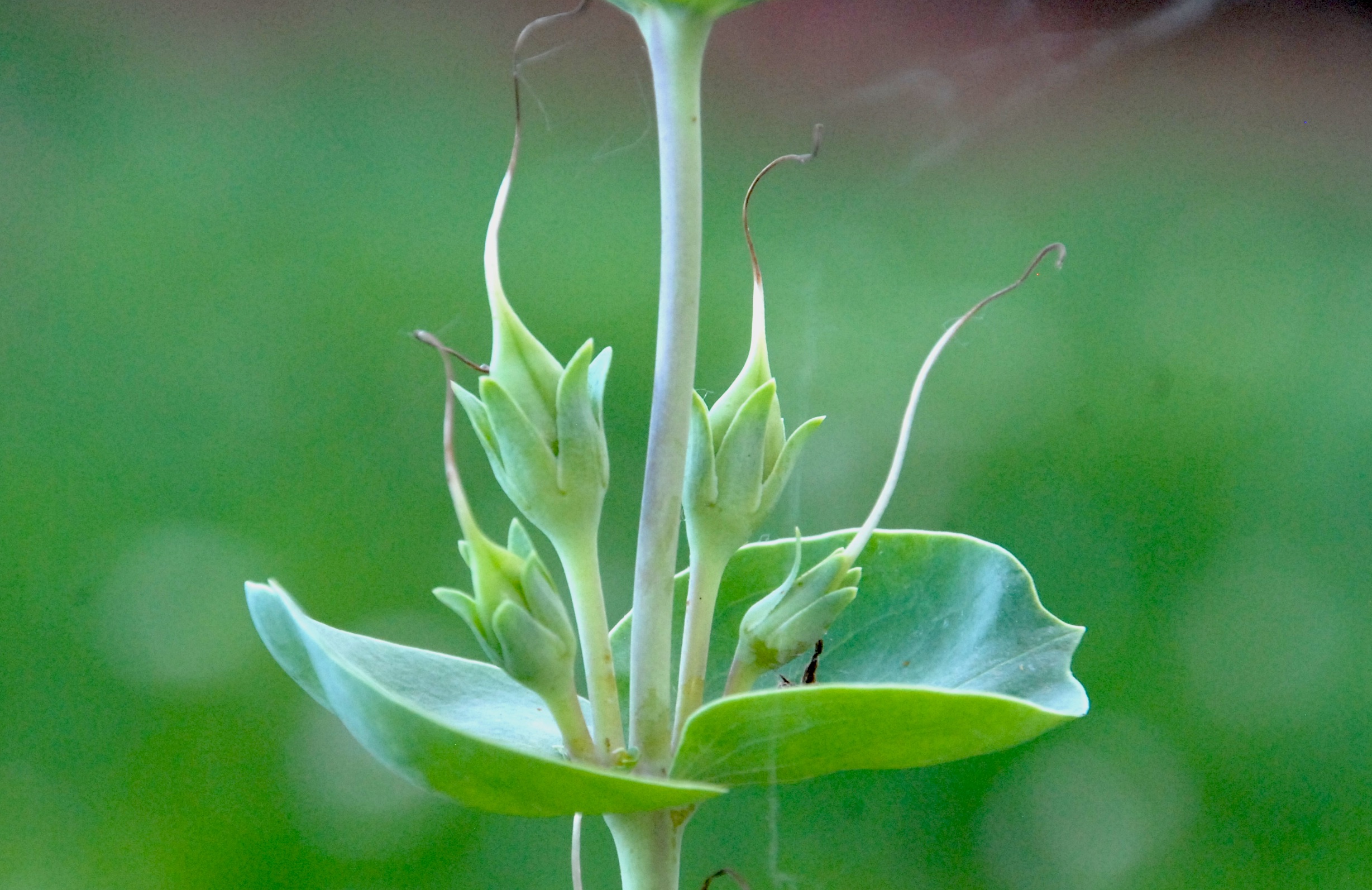
    One sleepy early morning in late May as I slowly made my way around the rock perimeter of the little prairie garden I came to a sudden stop to stare in disbelief of what appeared to be a scene straight from a sci-fi movie. There, between cupped sturdy leaf shelves, were four to five regally crowned stalks, each looking as if they had magically and perfectly captured giant green teardrops from a tall prairie goddess, each trailing a curly tail reaching toward the heavens. These “platforms” of magical teardrops stair-stepped their way up the smooth, green stalks.

Image
    With what had become an almost daily occurrence, down went the teacup as I fetched my camera. My focus was on this unworldly beauty, of these magical characteristics of this unknown plant. This image has intrigued me ever since. My intention was to place the image in my next prairie calendar. My only trepidation was in not actually knowing what plant offered this visual magic.
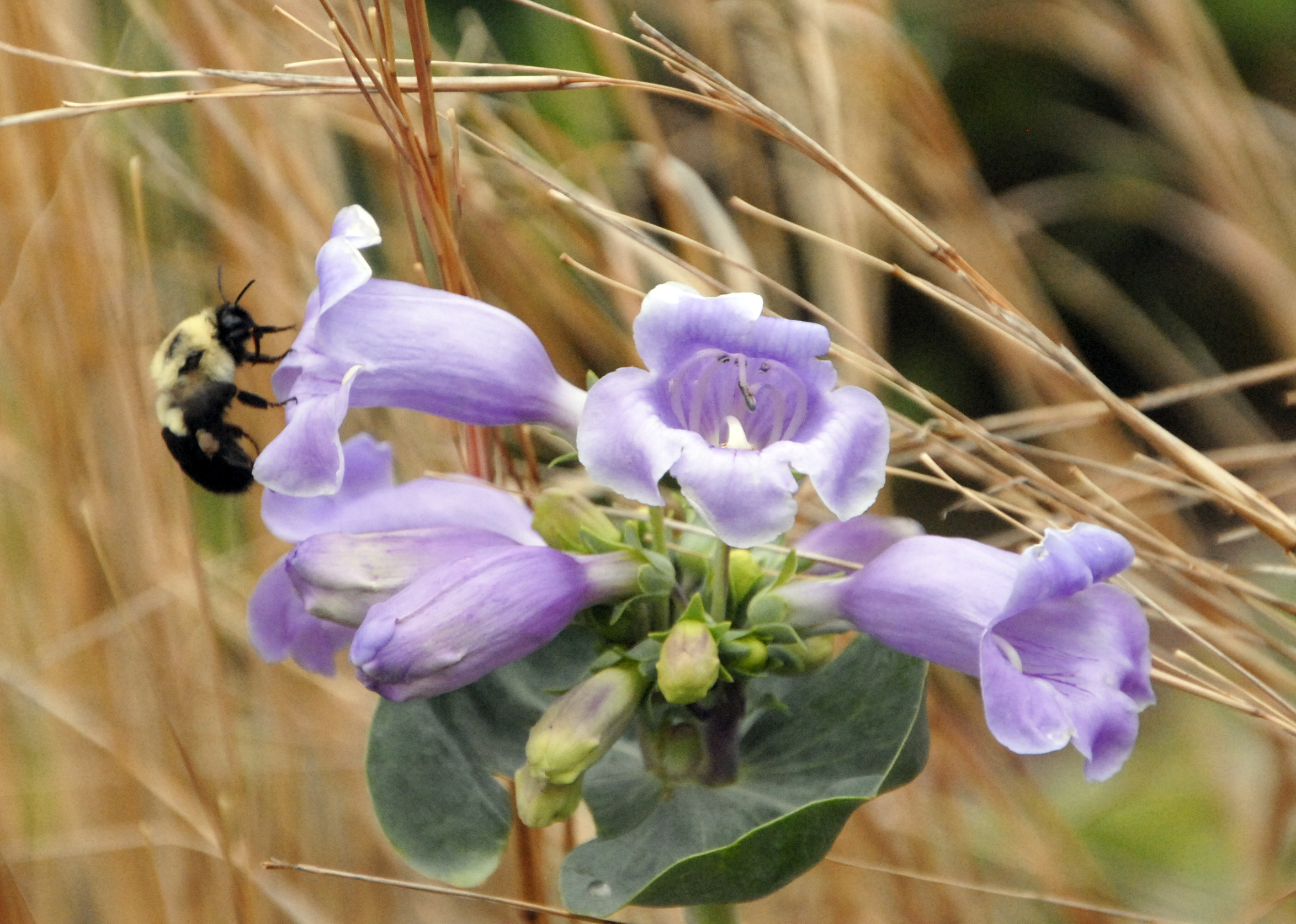
    Later in June of the same summer I photographed bumble bees bullying their way deep into lavender  blossoms that were at least in inch or two in length, much like a child does while crawling into a parent’s sleeping bag. The burly bees would simply disappear inside the blossoms for long moments before budging back out to fly away.
    Images of the bees and the unworldly sci-fi plant were among the possible calendar images I was showing my artist cousin and my wife last August when we noticed that the waxy, egg-shaped leaves in both images were identical. Another friend with immense knowledge of prairie plants immediately identified the plant. “Oh, that’s giant beardstongue,” she said.

Image

    A moment of research indicates that the plant is rather common to native prairies, though it is seemingly more common to the High Plains than the warm grass prairies. It is found in the more rocky areas of Minnesota where the glacial moraine apparently stopped,  and along the Minnesota River valley. As the beardstongue was telling me, I was beginning to discover there was a whole lot about the prairies of the past I either didn’t know, hadn’t realized or even noticed despite so much time spent afield.
    My intentions were seemingly always trumped by more colorful or timely images, so when the possibility came for putting together an exhibition at Java River in Montevideo of my photographic series of Ghosts of the Prairie, the magical beardstongue image was among one of the first I sought to print. The time had arrived to move this image from bridesmaid to bride.
    Less than a month before the show this was among the framed prints I took to the show in Maynard, and it was hardly surprising to find this image as the one to have been nudged from the table. My crafter friend was quite apologetic and was intently using what he called his magical glue to put the frame back together.
    “I’ve tried that glue before,” I told him, “and it just won’t hold. So, really, don’t worry about it.”
    Before the doors opened for the little craft show, I took the broken frame and the photograph of those magical green teardrops of the mysterious prairie goddess back to the car.
    Her time would come. That is how it is with magic.   

What’s in a Name?

She wasn’t real fond of “Kale Yes Acres.” Nor did “Pleasant Pheasant Farm” get the nod.

What’s a man to do?

Frankly, I hadn’t given much thought to the naming of our farm. Didn’t see much need. Yet, my dear Belle of Vermont believed we needed a name for the farm. “What about this?” she would say. Perhaps it was the form of my smile.

My suggestions contained more Teflon than Velcro it seemed.

“Maybe we should just have a naming dinner party,” she suggested as we sipped wine one night, which sent us into an impromptu brainstorming moment on who of our many friends might be of the best help. While we couldn’t agree on a farm name, nor the best gathering of brainstormers, we did agree on who we would want as a facilitator.

This went on for weeks. Often in the kitchen after one of my walks, or when she came in from her work in the garden … after quiet muse time.

The Belle had a farm with a name down in Vermilion, SD. Flying Tomato Farm. She had no desire to move the name north. She held forth that naming our farm was important, and that cute, pun-like names, which happens to be my forte, just wouldn’t work. Naming a farm provides an image, perhaps even a brand. “Farms need names,” she insisted.

Back home in the 1950s my father went through some trepidation himself before settling on Meadowview Farm as its name. Our family farm was split almost equally between crop and grazing land, although the plan was seemingly to have just enough corn to sustain his cattle through the winter months, with the other crops grown for rotational purposes. His love was beef cattle, and his relaxation was saddling up on summer evenings to ride alone through the hilly back country to check on the herd. So the name was equally poetic and appropriate.

We have no hills here on our 14 acre spread. Of those, only eight acres are considered tillable. We made an easy and early decision between us to place those acres into native prairie with help from the local Pheasants Forever chapter and the SWCD. My guess is that about another acre will be devoted to the Belle’s vegetable farming after the spring thaw. Our eye is on a permaculture-like existence, with perhaps a farm stay or artist’s retreat with our out buildings — which might even include a yurt.

scape10
We have many dreams for such a small spot of earth. We find it exciting to see what shakes out. So naming our farm does carry a significance. One recent afternoon the Belle strode into our office with a purpose, grabbed a marker and wrote a name onto her faithful flip chart. “Listening Stones Farm,” it read.

Hmmmm.

There is a history here on the farm. When our friend, Kurt Arner, came to clear our grove of buckthorn and a half century of deadwood, he suggested a trail be cut through the upper half. Since we had discussed doing this beforehand, it was an easy decision. His  traversing trail concluded with a wooded loop at the far end.

I asked if he could cut one of those trees into a bench. He did, and we called it our “listening bench” in honor of Sigurd Olson’s “Listening Point.” Not just a title for a book, but Listening Point was an actual point on 26 acres on the shores of Burnside Lake near Ely. Here “he could look out over the wide-open spaces of the lake, listen to the birds, watch the sunset, and regain some balance in a life that had become more and more hectic at a time when most people begin to think about retirement,” reads a dedicated website.

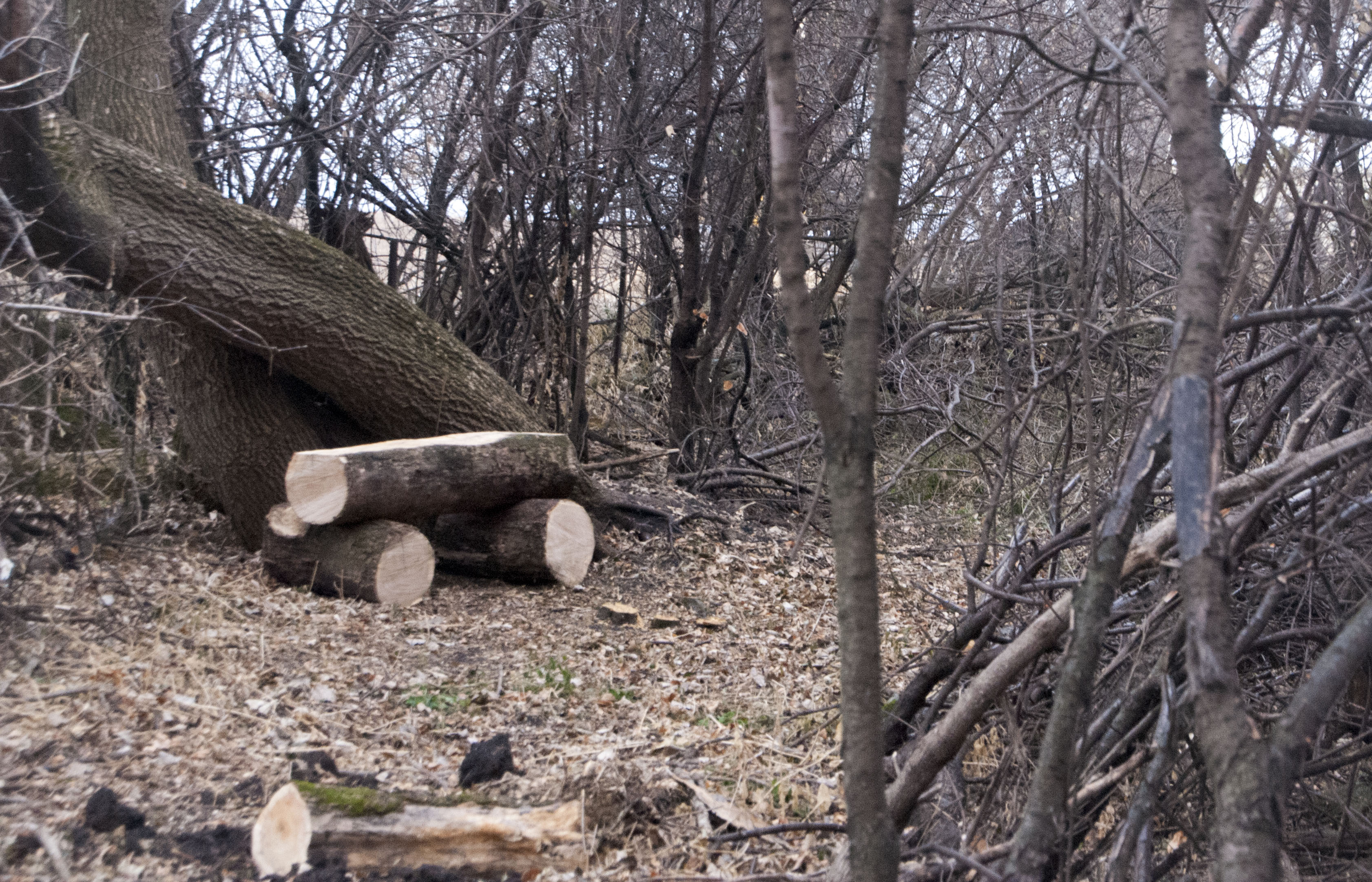
Listening bench_1
Our bench is comprised of two portions of a log Kurt V-ed before centering a portion of the same weathered trunk into the grooves. He then sliced off the top third to create the bench, which abutted another fallen tree for a natural staunch backing. No wide open spaces, nor a view of a lake, yet it is a fine place to escape what life can throw at you at times, surrounded on all sides by trees and a protective canopy.

Also on our farm were two outbuildings long past saving. We found an excavator who brought in a large machine to dig a hole where he could deposit the spoils of the two buildings for burning. Embedded in the foundation beneath the century-old granary — yes, we found hand scrawled messages on the painted red barn wood that read, “Changed oil July 1911” — were several boulder-sized glacial stones he set to the side beneath the canopy of a tree we had saved from the saw.

These stones were, I believe, her inspiration, and a fine inspiration at that. Our farmland lies on the cusp of the moraine of the last glacier, and the rocks likely came from this land. Several similar sized boulders were unearthed in the cleared grove. Rocks, or stones, form the name of this county, and are a prominent physical feature of the river valley.

“Stones are what brought us together,” said the Belle. “People talk about Big Stone Lake, and of the soil. Stones just don’t get a fair shake.”

So, what’s in a name? For us, the eons of heritage of our small, appropriately named farm.