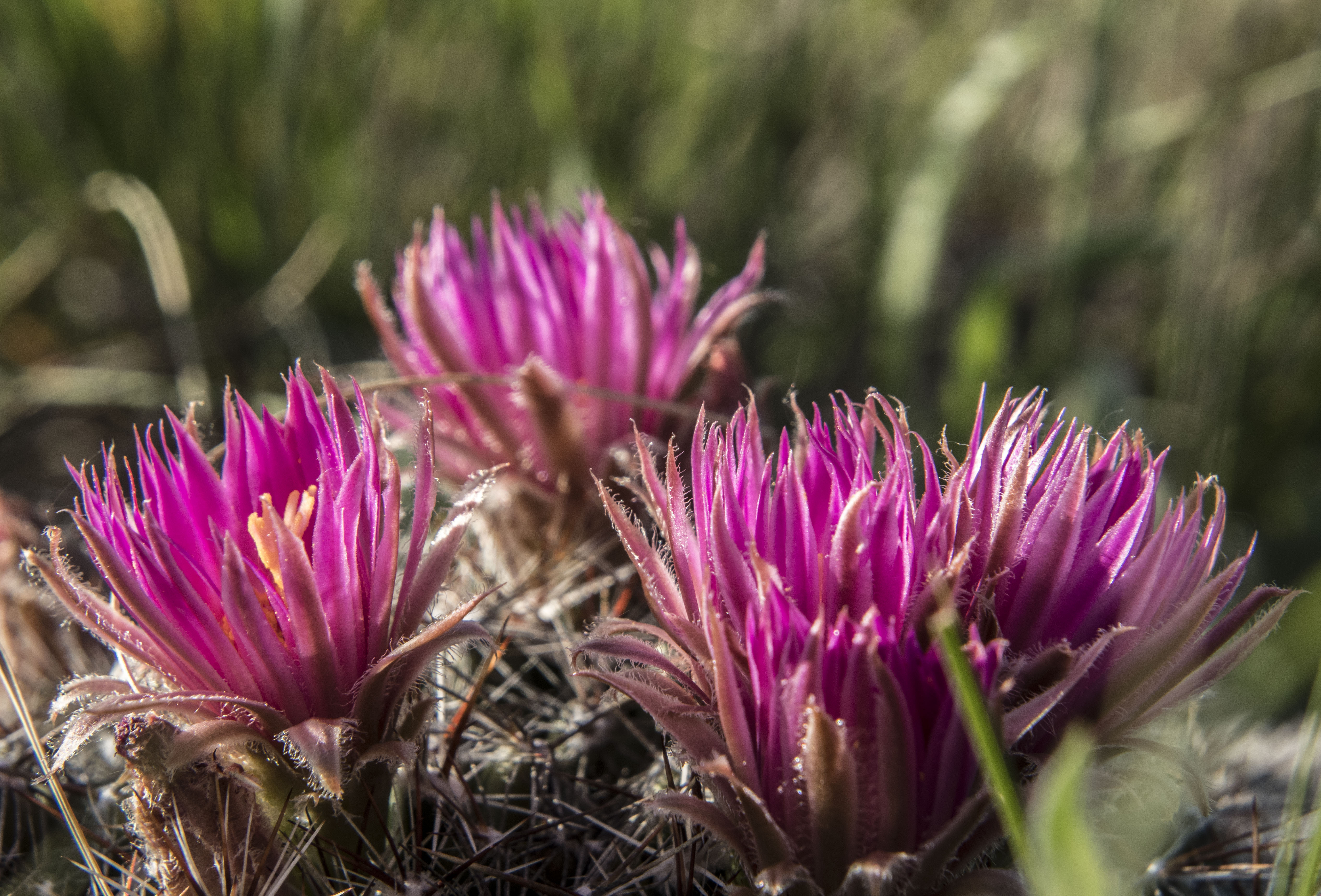
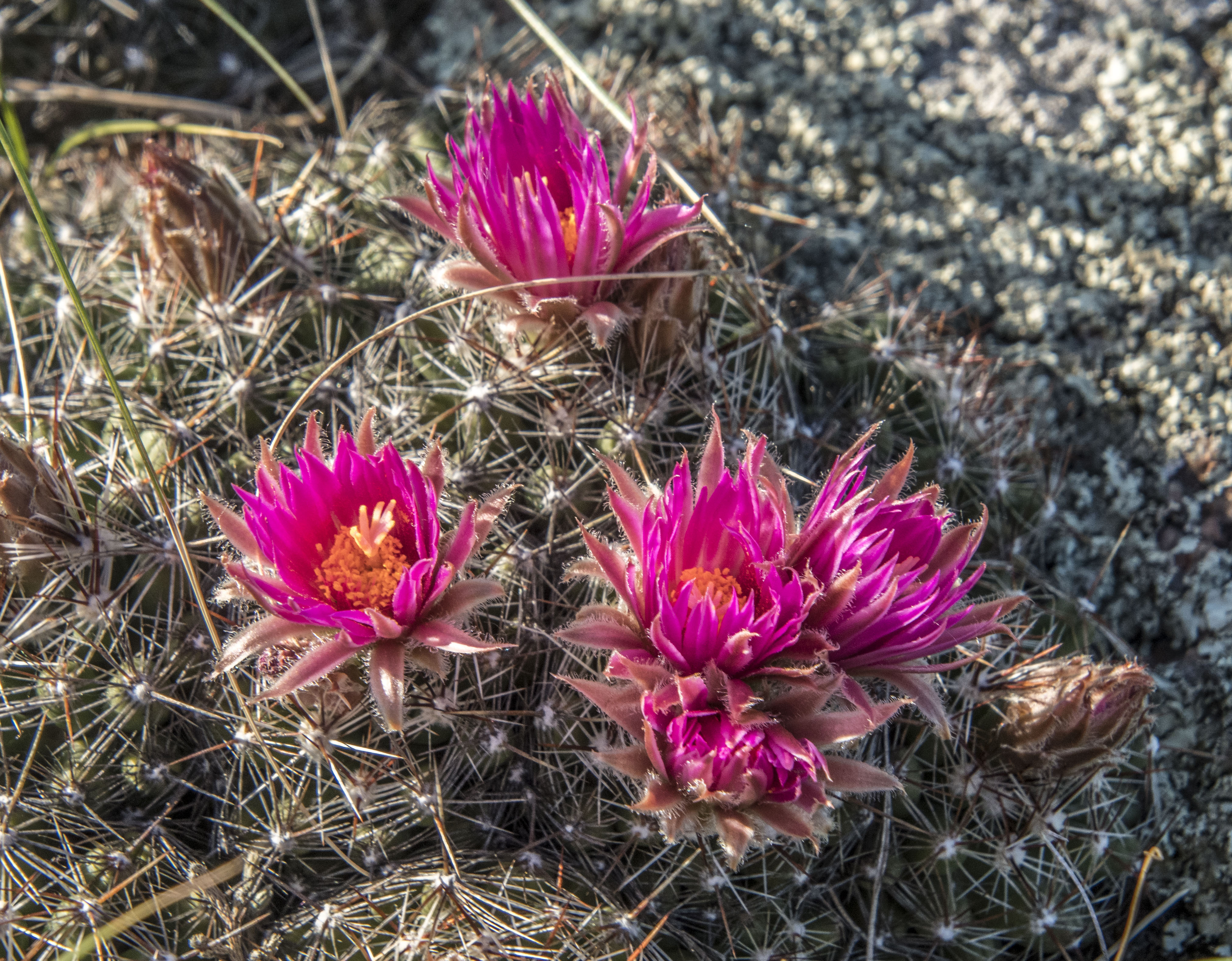
Ball cactus (Escobaria vivipara) are not only extremely rare, they’re also apparently rather shy in showing off their magnificent stark red and yellow blossoms. Catching them in their full glory has been a personal quest come June for several years, so imagine both my surprise and delight the other day when we climbed onto one of the granite outcrop flats at Big Stone National Wildlife Refuge and found not one, but literally dozens in full bloom.
After several moments of looking for different angles and light possibilities, my eye caught a minute bright red spot on a neighboring granite flat about 20 meters away that was perhaps surrounded by some of the other rare plants of this ancient biome to grasp my interest. How fortune seemed to have blessed me in this particular moment, for it was there I found an almost perfect image of the blooms.

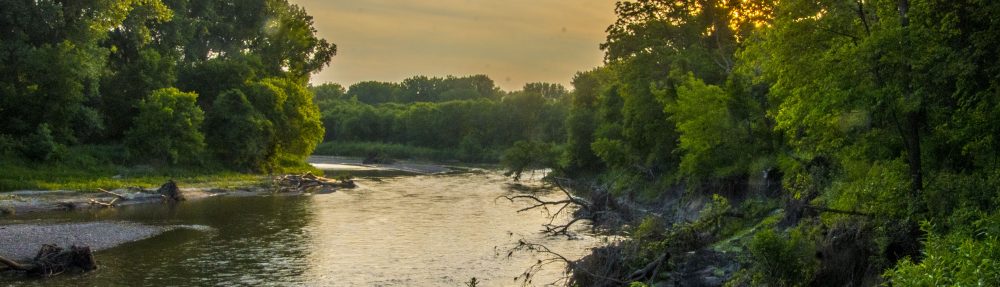
We are actually quite blessed to have such a wonderful and beautiful resource near us, from the outcrops to increasingly rare birds like bob-o-links and nighthawks, and to all the water-friendly species who find this patch of ancient prairie, stocked with bedrock outcrops, such a haven. Almost every trip around the circular drive yields nice imagery for me to photograph, and I seem to be drawn here several times a week and usually come home with what in the old film days would be three or four rolls of film. Finding the balls in bloom, though, just about tops the list.
About the size of half a tennis ball, with long protective spikes, the small cacti seem to cluster in packs in a unique ecosystem that has somehow survived several thousands of years since the dam broke on glacial Lake Agassiz to form the glacial River Warren, which scoured the valley and exposed some of the oldest rock in the world bringing along a small collection of quite rare plants. Those with knowledge say that the ball cacti are found only in a small two to three mile area, and only in the crevices and kinks of the original granite bedrock exposed by the ancient river.
Although small, the cacti might be huge for the security of these sacred and holistic outcrops between the Refuge and the town of Ortonville, for their vulnerability may be the only hope remaining to prevent the gravel mining company that purchased this area from creating a new, deep gravel pit mining operation that will basically destroy a rare and beautiful relic of glacial history. It was while writing stories on what was known as the Strata Conflict about a dozen years ago that a local historian, Babou Don Felton, pointed out my first viewing of a small cluster of ball cactus on a hike across the acreage. At the time I doubt that any of us realized just how powerful that rare little cacti might be.
Nor did I realize back then the beauty of their blooms, and wouldn’t until a few years ago when State Park Manager Terri Dinesen published her photograph of one of the blooms from the refuge on a social media site. Since then I’ve been hooked, so much so that when Madison Eklund, the first kayaker and first solo woman to paddle the Canoeing with the Cree trip to the Hudson Bay, was resting here for a few days, we made trips in hopes of seeing the blossoms. We were “skunked.”

Since several dozen trips have been made to the Refuge in search of the blooms, a quest that started a few days after Terri made her post. Yet, I had northing. After several attempts, sometimes making three trips in a day to the Refuge hoping for the just the right circumstances of light and heat or whatever, I sent her samples of my images in frustration to which she suggested I might have been too late. That the blooms were already gone.
According to the Center for Plant Conservation, ball cactus (one of three native cacti in Minnesota) was probably found more frequently and on a broader basis on drier, thinly vegetated prairie habitat, but it was eventually reduced to only undisturbed granite surfaces like found just south of Ortonville and into the refuge.
According to its website, “Granite and quartzite outcrops in Minnesota are home to ephemeral pool habitats – shallow depressions where water can pool for a few weeks each year. These accumulate biotic matter and host several plants rare to the state, including Bacopa rotundifolia and Heteranthera limosa (both state Threatened). With only one ball cactus population left in Minnesota, it is hard to generalize about its preferred local habitat, but it appears to favor moss shields that occupy some of the same kinds of shallow depressions that form ephemeral pools. The plants also hug cracks in the granite and may even anchor an accumulation of duff and moss material around them as prairie winds blow over the rocks.”
The Center applied for and received a grant to collect seeds from a nearby quarry site and since has received germination rates to over 70%. “As a result, we will eventually be planting roughly 2000 cacti seedlings across the three recipient sites over a several year period,” read the report.
So there may be hope for a future for this rare species.
For me, finding the balls in their full glory was a dream come true. Interestingly, a day or so ago we stopped back and wandered onto the flat to find that the outcrop nearly reminded me of what my apartments looked like a day or so after a party, when the balloons have withered and the festivity’s merely a memory. Those blooms were now but a memory, and had clasped tightly together to appear much like they had in the images I’d sent to Terri Dinesen a few years ago. Yet, we were there for the fun, the glory and the beauty. How can one be disappointed?
 Listening Stones Farm