Several years ago while driving toward Blackbird Trail, that winding sweetheart of a drive through the Tamarac National Wildlife Refuge near Detroit Lakes, my eye caught a lone beauty of an interesting flower that I couldn’t believe was either “native” or “wild.” Yet there stood a beautiful lone blue iris, radiating and standing tall against the greenish nearby native marshy plants … with exception of the adjacent gangly cattails.
Was this some sort of garden remnant? Did someone luckily hoist a bulb into the marsh from the graveled road?
After returning home a little research confirmed the identification, noting that Minnesota actually has two closely related “Blueflags” or native blue irises with territories divided on a loose geographic border drawn horizontally across the state from our largest city. Iris versicolor is the northern and predominant species from the Twin Cities up into Canada while Iris virginica similarly reaches from the Twin Cities south toward the Texas coast.
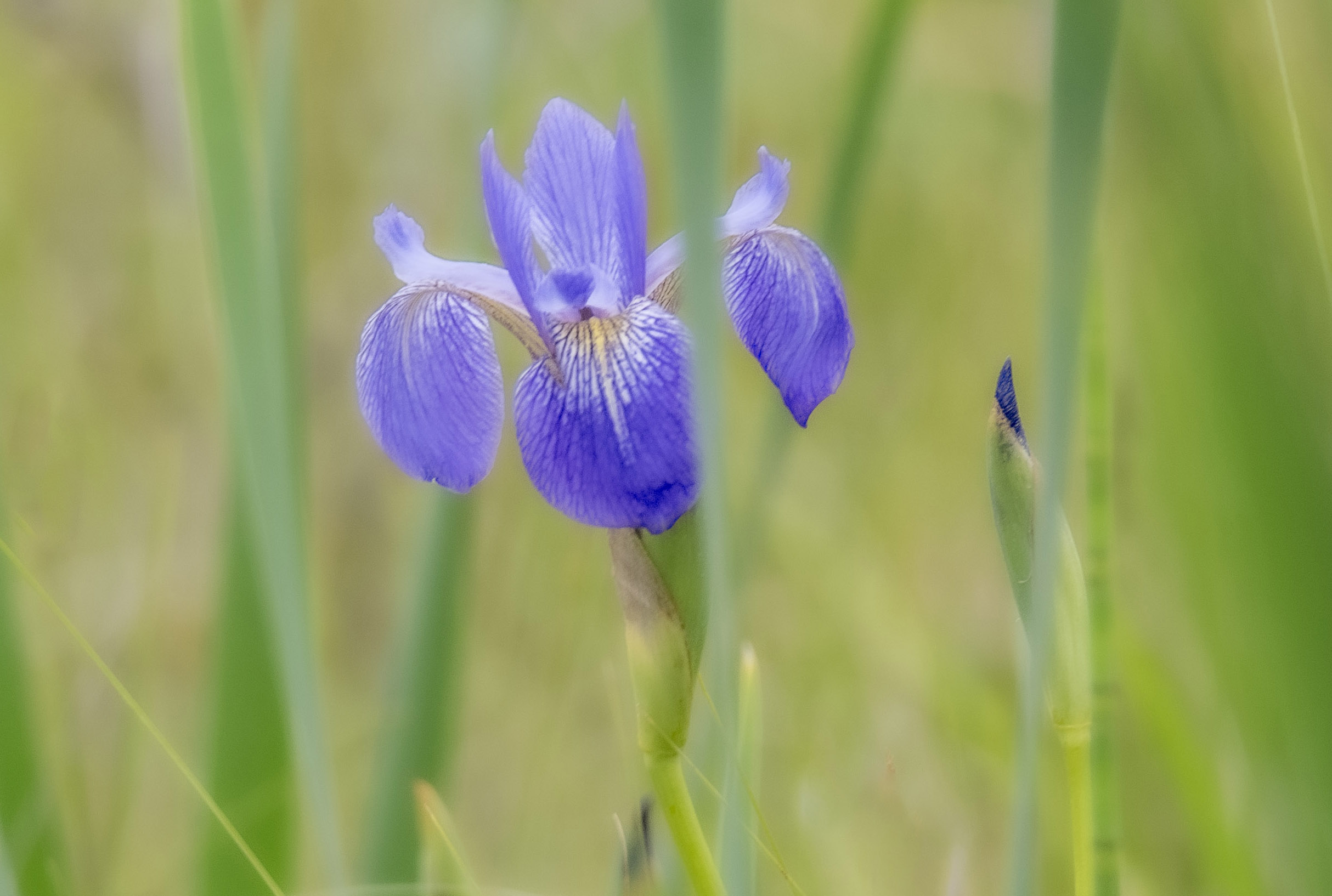
According to the scientific explanation the upstate species is typically more richly pigmented on the outer sepal edges, fading lighter towards the “throat” with veins prominently tinted toward a faded greenish yellow. While microscopic characteristics might cause a botanist to giggle, the northern iris is typically a darker blue than its faded cousin. There! Science has spoken.
Now here is a bit of poetry, thanks to Margaret Atwood’s “The Handmaid’s Tale” — “Then we had the irises, rising beautiful and cool on their tall stalks, like blown glass, like pastel water momentarily frozen in a splash, light blue, light mauve, and the darker ones, velvet and purple, black cat’s ears in the sun, indigo shadow, and the bleeding hearts, so female in shape it was a surprise they’d not long since been rooted out.”
Science, or blown glass like a pastel splash of velvity water, these beauties stand awash in the nearby greenery of Tamerac, catching a wandering eye like a thin metal washer drawn instantly to a demanding magnet.

While we had a free day and a will of once again hopefully capturing blooms of both the yellow and showey ladyslippers that bless this northern refuge, I also held hope that we might catch the wild blue of irises in bloom. All three wild flowers came through splendidly along with a host of other colorful wild flora. We were blessed.
Not so much by the fauna, however. Not one songbird, including the fluttering and shy warblers, allowed me a moment. While the swans were cooperative, we had some near misses along the way: a grouse with three chicks slithered like spies deep into the trail grasses before scooting out to escape my hungry lens into the dense woods. This was just moments before I caught sight of a beaver in my rear-view mirror tugging a six foot willow branch by the clamp of his teeth while charging across the motor trail in a beaverish waddle. Like the spy-like grouse, it dragged the branch through the dense woody underbrush while successfully remaining obscured by the leafy branches. We then came over a rise to find a bald eagle posed perfectly on a branch of a dead tree. I quickly raised the camera although apparently not rapidly enough. My image was of the perfectly weathered grayish branch, a bunch of blue sky and the feet and butt of the rising raptor. Ah, but those wild irises!

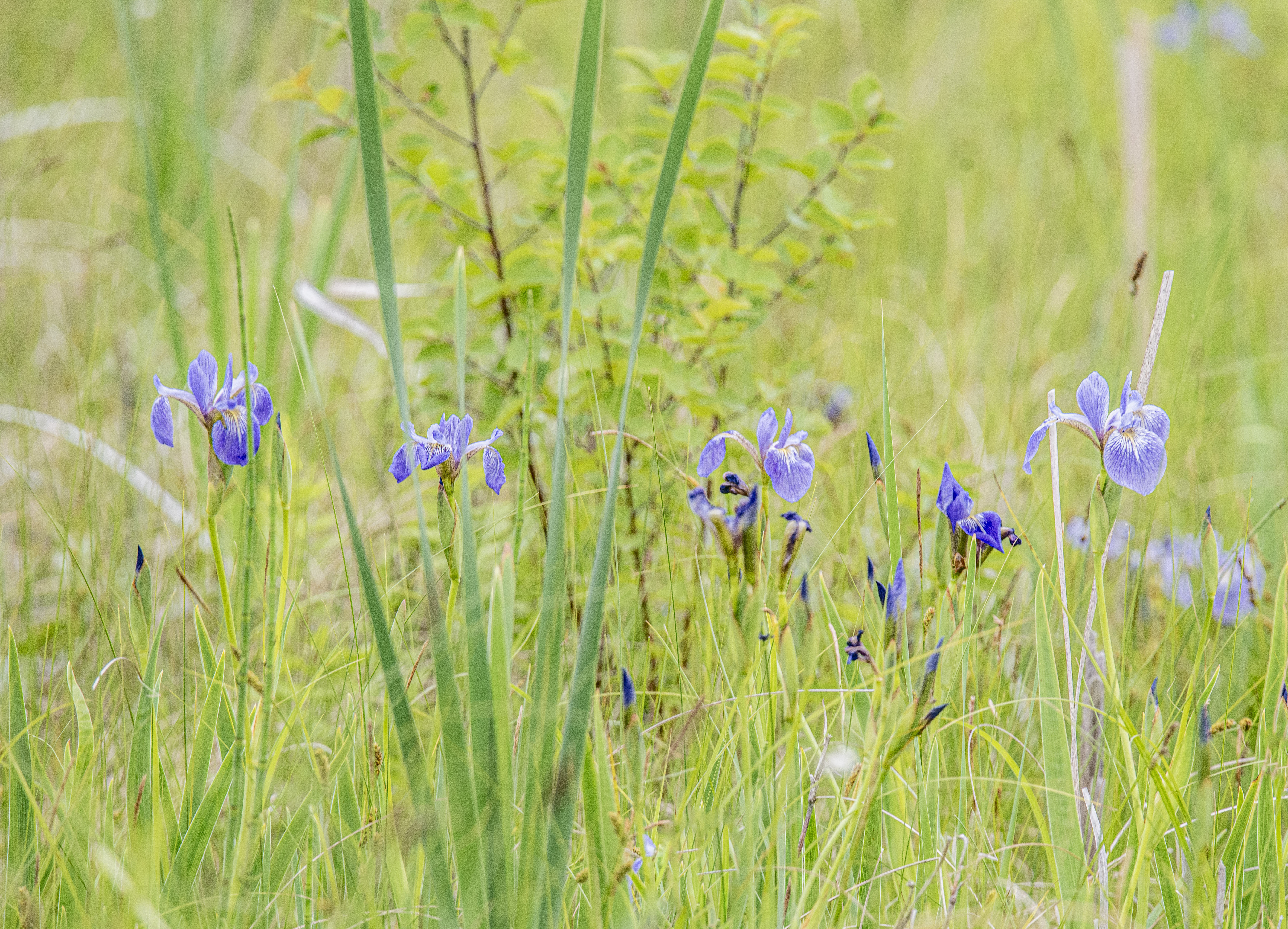
It was in the midst of all that commotion that we finally came across the irises. In three distinct locations, each marshy, each different and distinct from the other. On our last sighting a broad curved broad grassy looking leaf of a plant would have made a nice arc over two near perfect younger blossoms. Without hip boots, though, my idea of making an image with a composition of the plants beneath the arc of leaf simply didn’t work. A thought of wading into the marsh with the hordes of mosquitoes was as much of a deterrent as was the possibility of sinking knee deep into the muck. Even laying onto the gravel didn’t provide the angle I envisioned. It was what it was. Welcome to nature. And those were the last of the dozens of irises we came across.
Our first batch was quite numerous, and I actually let out an exclamation of delight when they initially came into view. Time had played a role in their aging, however, with spent blossoms hanging blackish along with those struggling to grasp their fading beauty. What can one do when faced with these situations in nature? You simply do what you can. Between this incredible array of blossoms and those arching above the arc, we found another set that hadn’t aged so distinctly. Being partially shaded, it seemed, might have helped. This batch allowed me to play with light and depth of field, those tools of our odd trade. Perhaps too much time was spent attempting to create a bit of art from such a wonderful blessing of nature.
Yes, it was delightful to once again see the rich blues of the irises, along with the white and pink of the showeys. Those vivid colors of the yellow ladyslippers and the bright crimson of the columbines added joy as well. My partner, Roberta, suggested on our way home that I was smiling. Internally there was certainly a sense of peace and joy, that those six hours of drive time had been well worth the effort.
Sometimes these seasons I photograph, be they birds, trees, prairie grasses or native flowers, help me check off a mental list. Do I need more images of wild turkeys fluffed in sexual desire, or the first poking of pasque flowers through dormant grasses after another long and dreary winter, or of those lady slippers I chase from the prairie to the northern woods as was the reason for this drive, or even the pastel waters of little black cat’s ears in the sun? As a naturalist and photographer, though, these are seasons of life, of nature, of the knowledge that for one more year all is surviving nicely in the natural world. Myself included. So yes, I was smiling!
 Listening Stones Farm