No ‘Trumpets’ in the Calmness

We were on the way home from visiting our sixth Minnesota State Park in the past two weeks when we saw the sign pointing toward the Sherburne National Wildlife Refuge. Just a short jog off our Google-assisted path home, so why not take a chance for once again photographing some Sandhill Cranes. Yes, I’m an obsessed “crane chaser!”

So we headed a bit south and west toward the seven-mile motor loop that meanders through this haven of “Cranesville” with high hopes and a quest for a picnic lunch. Yes, our anticipation was high, for we had made the earlier decision to postpone the last state park on our planned trip, one that was relatively close to Crex Meadows just across the Wisconsin border where Sandhills are often photographed. Visiting Sherburne was a nice salve for sore feelings.

What we found was a lazy afternoon in the Refuge. Numerous swans at rest and preening in cattail hideaways. Resting cormorants in the skeletons of long dead trees sunning themselves to dryness. Kingfishers posed on woody spikes with watchful eyes. Long-beaked Green Herons poised for murder and mayhem. Beautiful wild flowers painting the adjacent prairies and glowing global teacups of white water lilies floating on the calm surfaces of the wetlands. 

And not a single sighting of a Sandhill Crane. Not one.
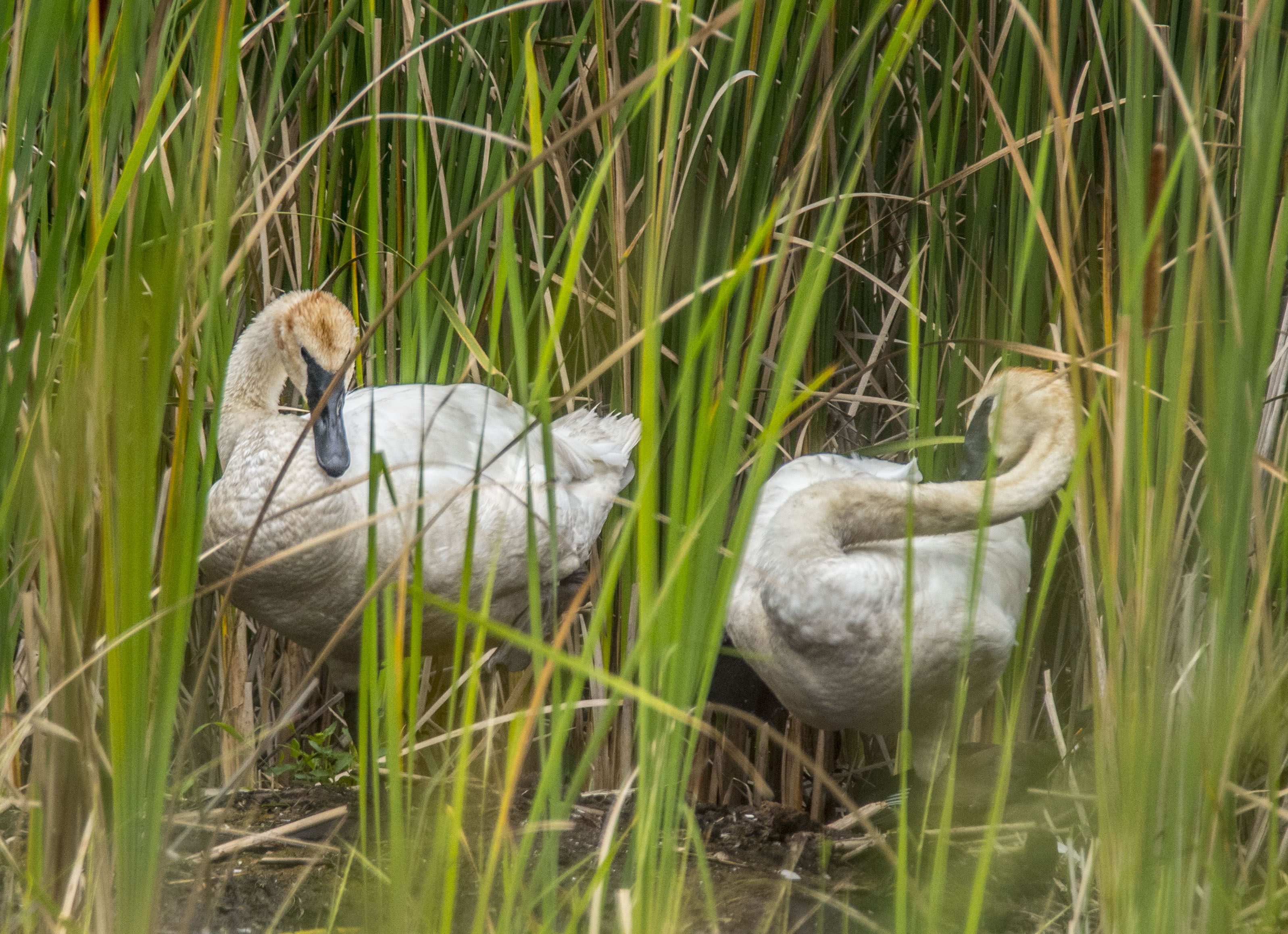
Yes, there were swans preening in cattail hideaways.

“Off to the grain fields and prairies north of here,” was my shared thought, for we had passed three on the trip out not too far north, and actually along the highway we had just driven from. My suspicion was that the trio was a mated couple with their fully grown colt, and they were stoic and beautiful in the small patch of prairie next to an oak grove. Had we not been in a rush we might have pulled off for a picture, so we moved along.

Was this absence another sign of our dwindling summer? The weekend before we left on this excursion to hopefully complete my personal photo journal of the Minnesota State Parks, we had delivered a print to a farmer friend who has been quite kind over the years in suggesting nature sightings on his land. Next to his farm site we photographed power lines filled with seemingly hundreds of Redwing Blackbirds that had congregated as they do before migration. That we’ve seen the small family flocks of Canadian Geese flying around Listening Stones is another sign of a waning summer, but what really caught my attention was the bright blue, starred blooms of asters in the woody fringes of the state parks. It seems so early. Too early.
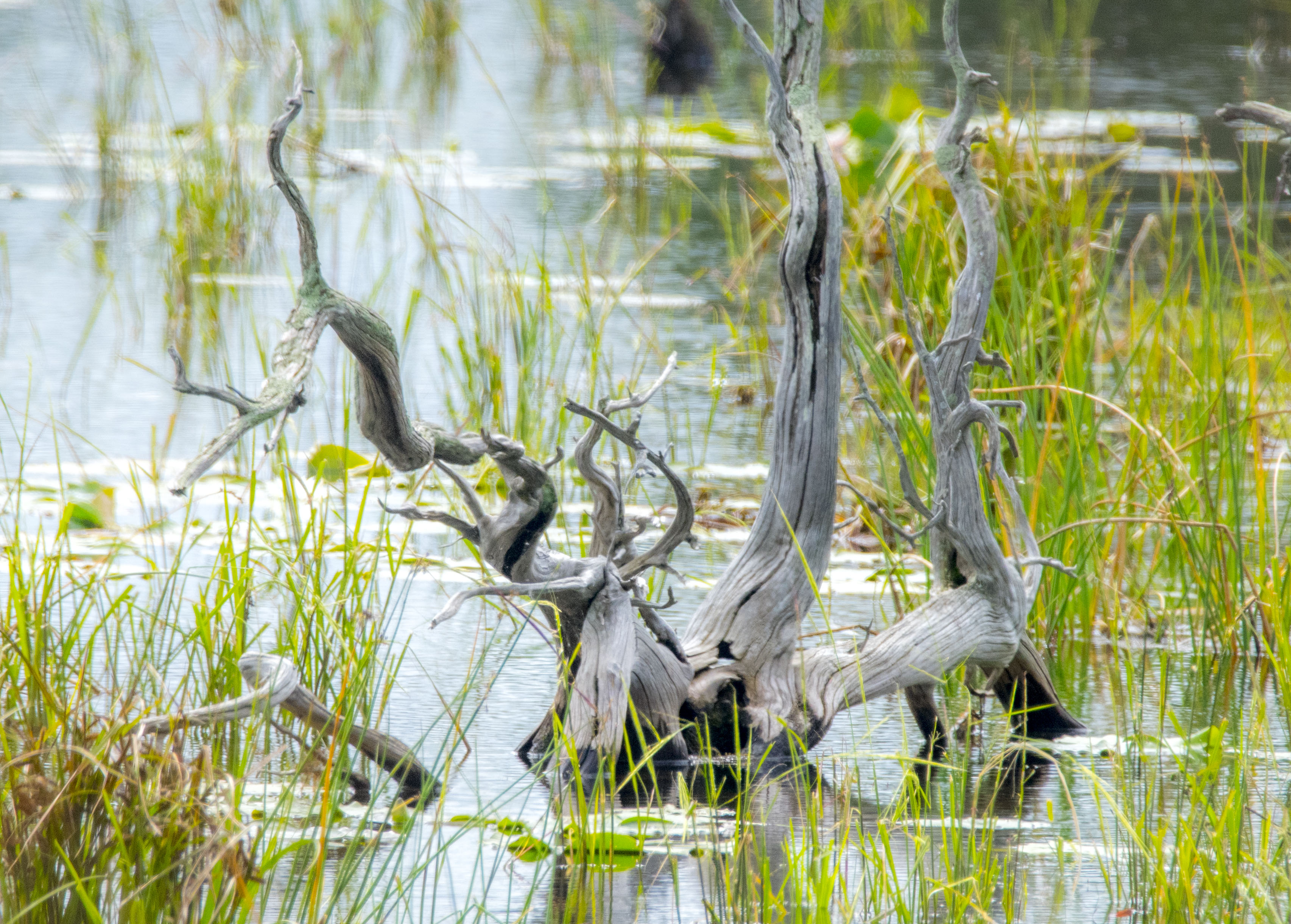
And a calmness where even the wetlands suffered not a ripple.

But yes, we are more than halfway through August so fall is quickly approaching, and nature is opening its annual gallery of these many seasonal changes that await us.

Our wildlife loop through Sherburne was almost shocking for it was my first time in the many loops I’ve made through there over the years without seeing a single Sandhill Crane. Spring, summer or autumn we’ve always been greeted by cranes, and once it was before we even reached the welcoming signs and kiosk less than a mile past the gate. After Thanksgiving last fall we spotted hundreds in two different groups along the edges of distant wetlands. Not this time, and we scanned the distant landscapes thoroughly with the 600 mm lens.

Regardless of species, the spring hatch has now grown mature enough that the parents are offering “flying lessons” to gorge up for the upcoming migrations. We must include the Sandhill Cranes among those offering such important lessons, for before long the prairies will be winter quiet. 
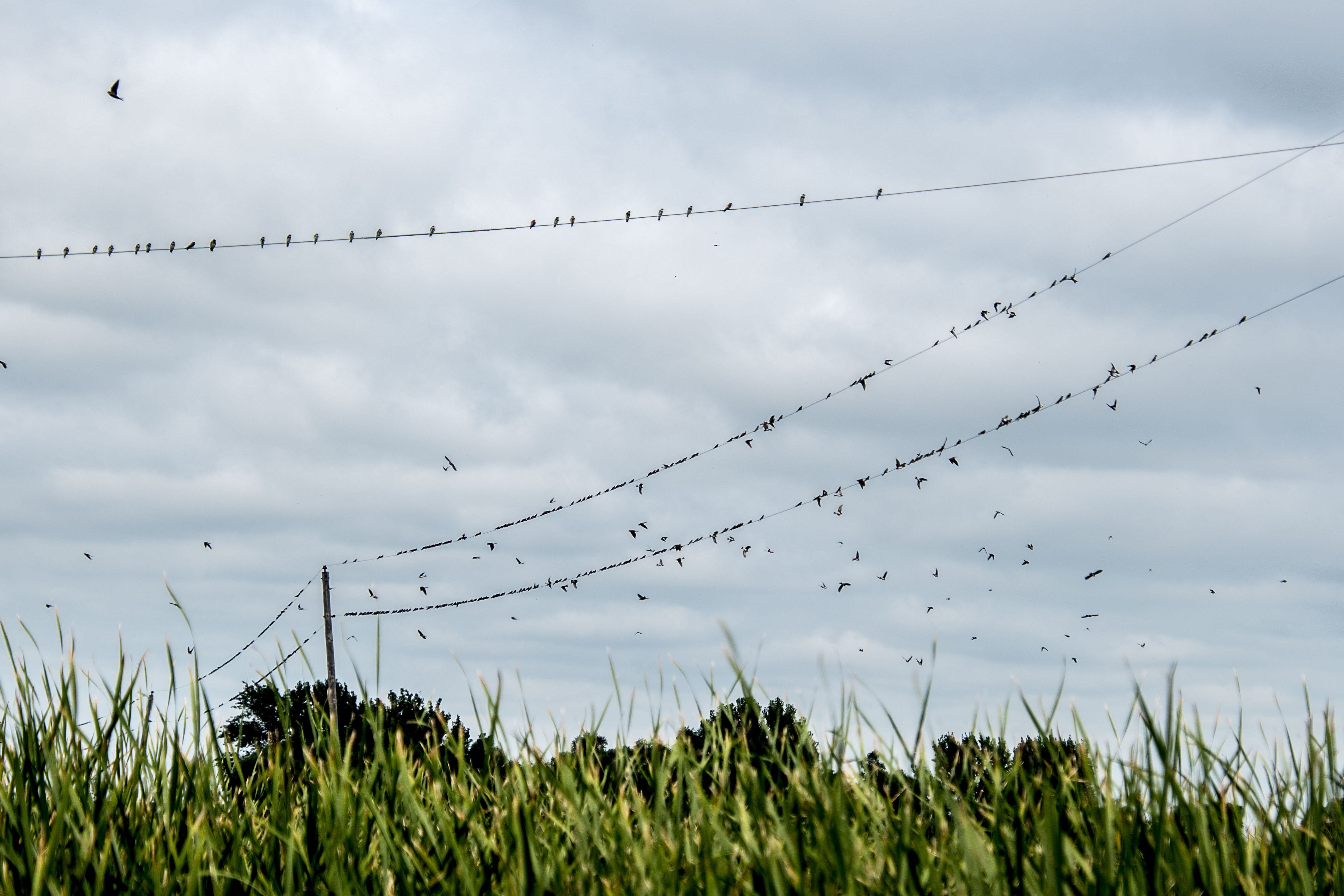
Earlier, next to a farmer’s homesite, hundreds of redwings perched in rest on the power lines.

Around the house the number of barn swallows has nearly tripled in the past couple of weeks, as the young seem just as adept at flying above the prairie for mosquitoes and other insects as their matured parents. A few years ago I recall sitting on the deck with a class of cold tea looking at all of the swallows perched on the clothes lines and the several perchable edges of the outbuildings. Our prairie was noisy with the loud chatter of a late morning. We had gone inside for a quick lunch and when we returned a little later there wasn’t a swallow in sight. All were all gone. And the silence was deafening. In a midday instant the migration had parted.

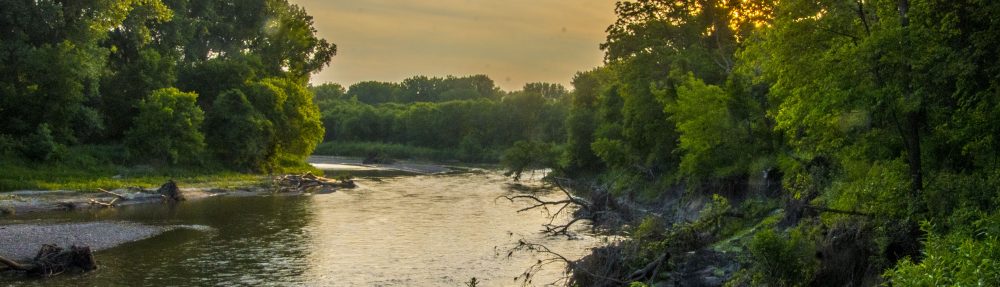
Sherburne was sort of like that on our drive through late last week. Yes, it was a lazy and warm afternoon. There was barely a ripple on the surfaces of the multiple wetlands, so besides the feeling of laziness it was also incredibly calm. Peaceful in a way that makes your breathing easy.

Glowing global teacups of white water lilies were floating on the calm surfaces of the wetlands.

It was almost like we were intruding on sacred natural moments, viewing scenes we weren’t supposed to see. In terms of humans we were almost all alone for we saw only a couple of cars, and only one had eased around our camper and pickup. Perhaps the “regulars” already were aware that the Sandhills were off feeding away from the refuge. My guess is that if we had been there hours earlier around dawn or even later in the evening we would have seen the beautiful skeins flying in, necks and legs straight like an arrow in flight, silhouetted in a sky in the full color of a brilliant sunset. Just not then, not in an early and easy afternoon.

Perhaps the asters had given us the clue all along. I was somewhat shocked to see them already in such a mature bloom, and I suppose the shorter hours of daylight should have been previously noted … and perhaps it was by folks more astute about the constant messages sent by nature. Those blue blossoms have rarely lied. and our summer is nearing an end.

Yet I missed the poetic stalking, that unmistakable purposeful stride through tall prairie grasses; that watchful and protective eye of the tall standing male as the female and colt garner food nearby; that unique call of the wild that Aldo Leopold claimed was not the call of a mere bird, but a “trumpet in the orchestra of evolution.” Yes, that bird.
Skies of Anger

My songwriter friend, Charlie Roth, penned a beauty about this time a year ago that he called “I Don’t Want to Live in an Angry World,” a song with such a catchy chorus that even on the night he introduced it to a live audience most were singing along with his simple but catchy and timely chorus by the end. A room of harmony that maybe even surprised Charlie. The song was about politics and how he thought it was time to do away with the anger on either side of the divide and become friends again.

I found myself mentally humming his chorus as I looked up at the angry heavens the other day, of a planet that is in dire need of human hope and help. After all, we’re the ones causing this climatic turmoil. Our skies are alive with that disgusted anger. It seems the planet is not just angry but pissed, and she is letting us know from the plains of Africa to the mountains of Canada, from the deep South to the Pacific islands. We are living in an angry, climactic world.

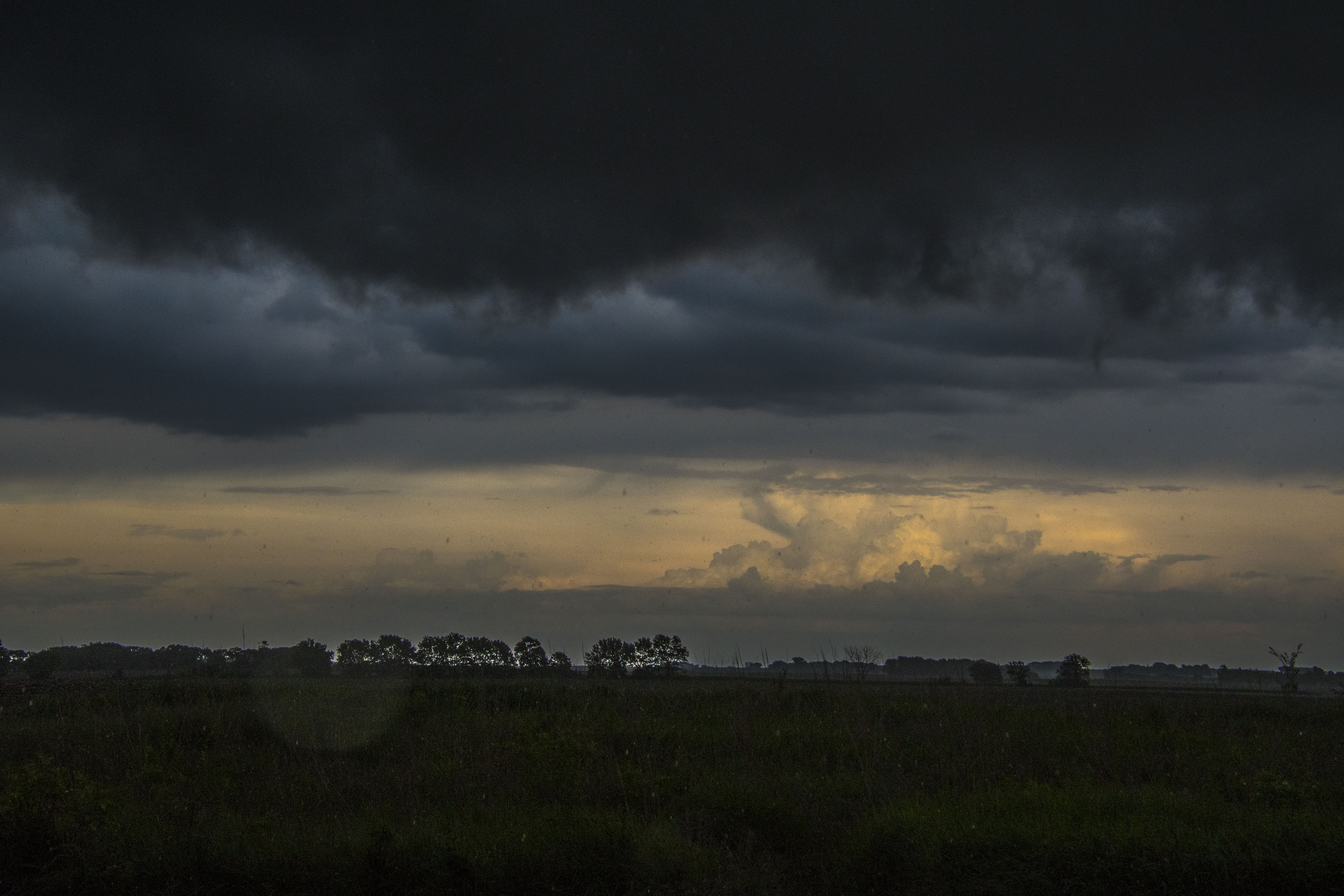
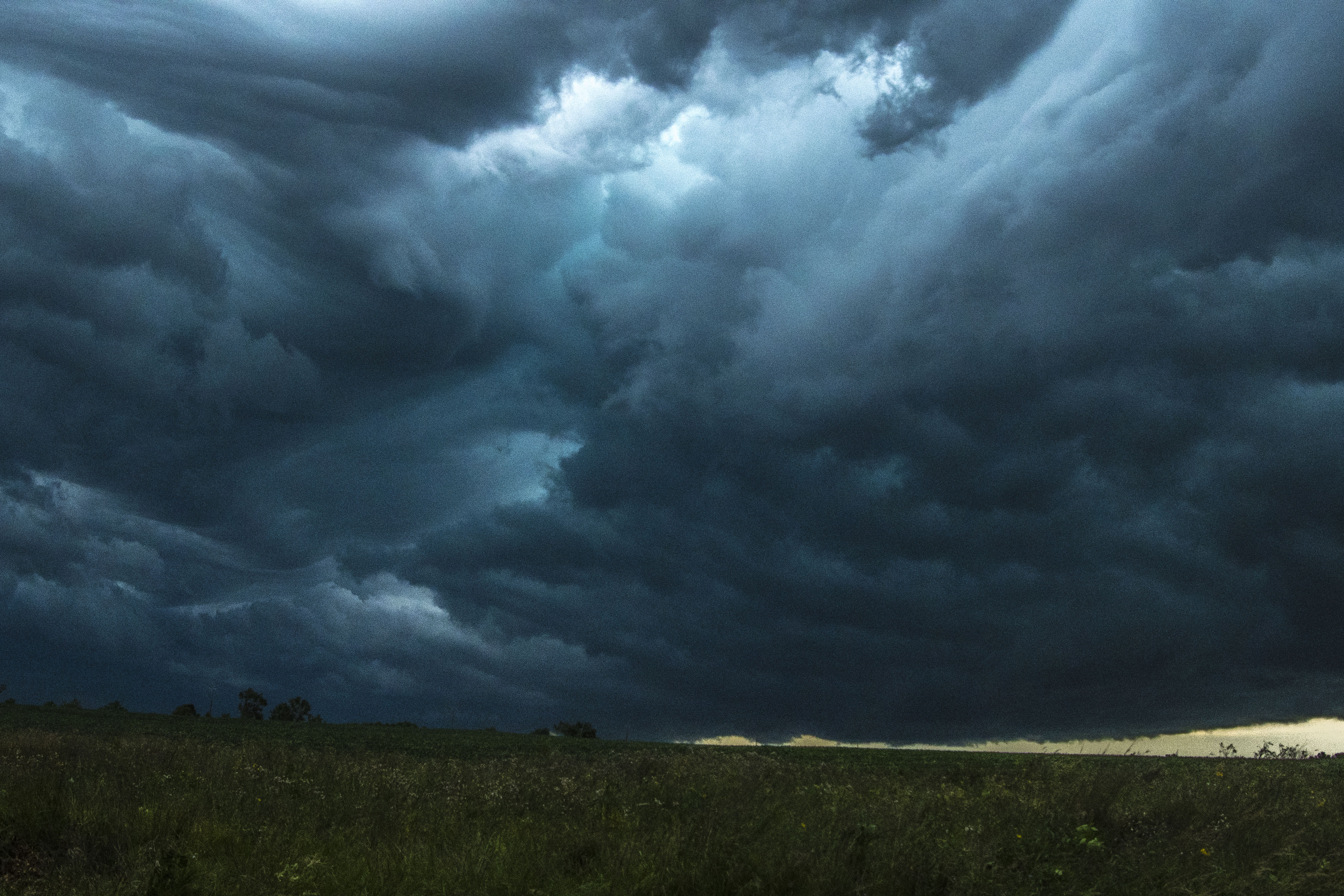
Yes, the sky looks angry as a cumulonimbus bank of clouds darkened the prairie.

Although we have so far escaped the dreaded tornado activity being experienced in the South, and obviously the horrendous hurricanes and typhoons of the heat-bearing oceanic regions, our skies have been burdened with layers of smoke from the uncountable fires from the Yukon to LA, and although our stormy weather has been somewhat wet and traumatic, we’ve been lucky so far. 

Still, that anger is there, above us, and the heavens aren’t shy about showing that rage. This week we’ve suddenly been bombarded with dense dark clouds bearing lightning and deep, bass thunder that has shaken our very foundations. Huge rain storms have ravaged nearby communities, and baseball sized hail pounded the crops and homes less than ten miles north of here. Nearby Granite Falls had about five inches of rain in an hour or so last Sunday. Many of our saturated farm fields have standing water in the rows of their commodity crops, and the wetlands are full. Nearby the rivers were just nearing bank-side when these latest storms cruised through.

This was the mid-morning scene above the prairie and woodland and our first rain of the day.

Let’s pick a single day, say July 31, a day that began here in the western Minnesota prairie with some clinging early morning heat accompanied with crushing humidity. Normally I’ll laugh at my significant other for what she terms as scorching days of heat and humidity. Having grown up with it, and having worked in the hay fields and haylofts during those formative years, most of our summer days have been in the mid to high 80s with mild humidity — in fact, before Wednesday I spent the afternoons kneeling in the garden pulling weeds to make way for a cover crop. Yes, there was a lot of sweat pouring but there was also a nice breeze both afternoons.

Wednesday, though, was different. A humid haze hung like a dense curtain on the fringes of the horizon. Sweat came with minimal activity, like walking from the deck to the studio. Then, around 10 a.m. I stepped out of the studio to notice a huge, deep black cloud hovering just above the woodland and northern prairie. Within moments we were enveloped in darkness, as lightning and rumbling thunder rolled in along with the first rain. It was a hasty affair, lasting mere minutes as the prairie winds quickly moved it right along toward the east. Nearly an iinch fell and you could sense the pressure relaxing.

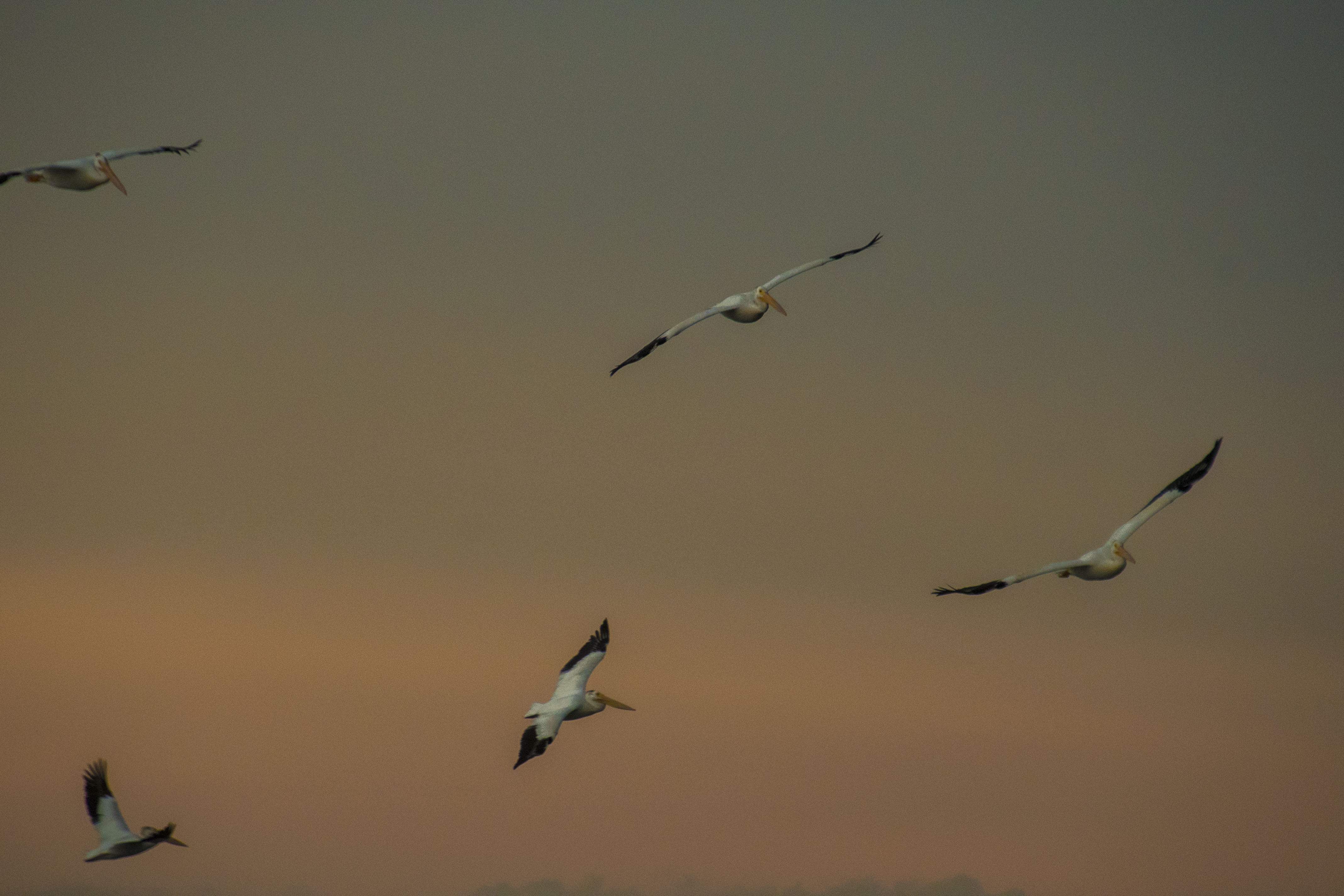
This pod of pelicans offered a brief calmness to the day.

Having a photograph to make in town, I left the farm via the Lake Road, got my photograph and started back home. As I was passing the supermarket along First Avenue I noticed a pod of pelicans just above the lake, and was able to grab a couple of nice images as they turned mid-air to ease to a landing on Big Stone Lake. A moment of peace in the turbulent skies.

This early storm was merely a prelude to what occurred overhead by mid-afternoon. I actually shouted to Roberta to come and look at the overwhelming ominous cloud capturing the sky above us. Our only lightness was a thin strip of a collar between the blanketing cloud and the horizon. This dense, rollicking cloud seemed to blacken the entire prairie. 

Lightning lit deep within the rollicking layers. Lightning seems to be a prelude for all of the stormy events regardless of country or continent. It’s said that lightning is actually a neutralization between our dominate poles, equalizing the natural pressure of the atmosphere. Between the clouds and the lightning, it was both frightening and awesome to behold. But, was there any equalizing going on?

Besides an emerging rainbow, a cosmic unevenness seemed to prevail over the prairie.

This theory was verbalized by a speaker at a Gathering Partners’ annual gathering of the Minnesota Master Naturalists a few years ago. He noted that without thunderstorms and lightning, the earth’s atmosphere electrical balance would likely disappear within minutes, adding that the science community isn’t really sure what would happen on earth if this balance wasn’t maintained. As it is, somewhere on earth this neutralization though lightning is ongoing, 24/7, 365 days a year. On this day it was our turn, happening right above and around us.

Yet, another hypothetical and unanswered question that concerns scientists with the warming of the planet is what happens if the currents in the warming oceans were to suddenly stop. We are entering a time on perhaps the only livable planet in the universe where we have many unanswered questions about our future as a species, and perhaps our neglect is what is feeding these angry skies.

Even at sunset the prairie above Bonanza seemed threatening.

On our travels on this eventful day we followed the continuing storms with my camera, concluding in the nearby Bonanza section of Big Stone Lake State Park as the evening sunset painted nimbus clouds in an array of puffy beauty, like little cotton balls adorned with foundation makeup of a movie beauty. These clouds provided a momentary sense of artistic flair compared to the giant cumulonimbus clouds that we experienced mid-afternoon, the one that completely blanketed the prairie as far as we could see, clouds rolling and rising, churning with a grasp of what I read as anger. Pent up, deep-in-the-gut retching anger in the skies.

I couldn’t help but think of that chorus in Charlie’s song while looking at those deeply dark and churning clouds. As tired as I am of living in a politically angry world, being surrounded by a world reeking of ever worsening patterns and events within a global climate change that threatens all of humanity worldwide, there are those who choose to ignore the threat or dismiss it as some sort of a “liberal ploy” This causes an internal rage within me, a rage that seems awakened by the turbulent skies above us. I don’t want to live in such an angry world. I really don’t.

Homage for the Blues

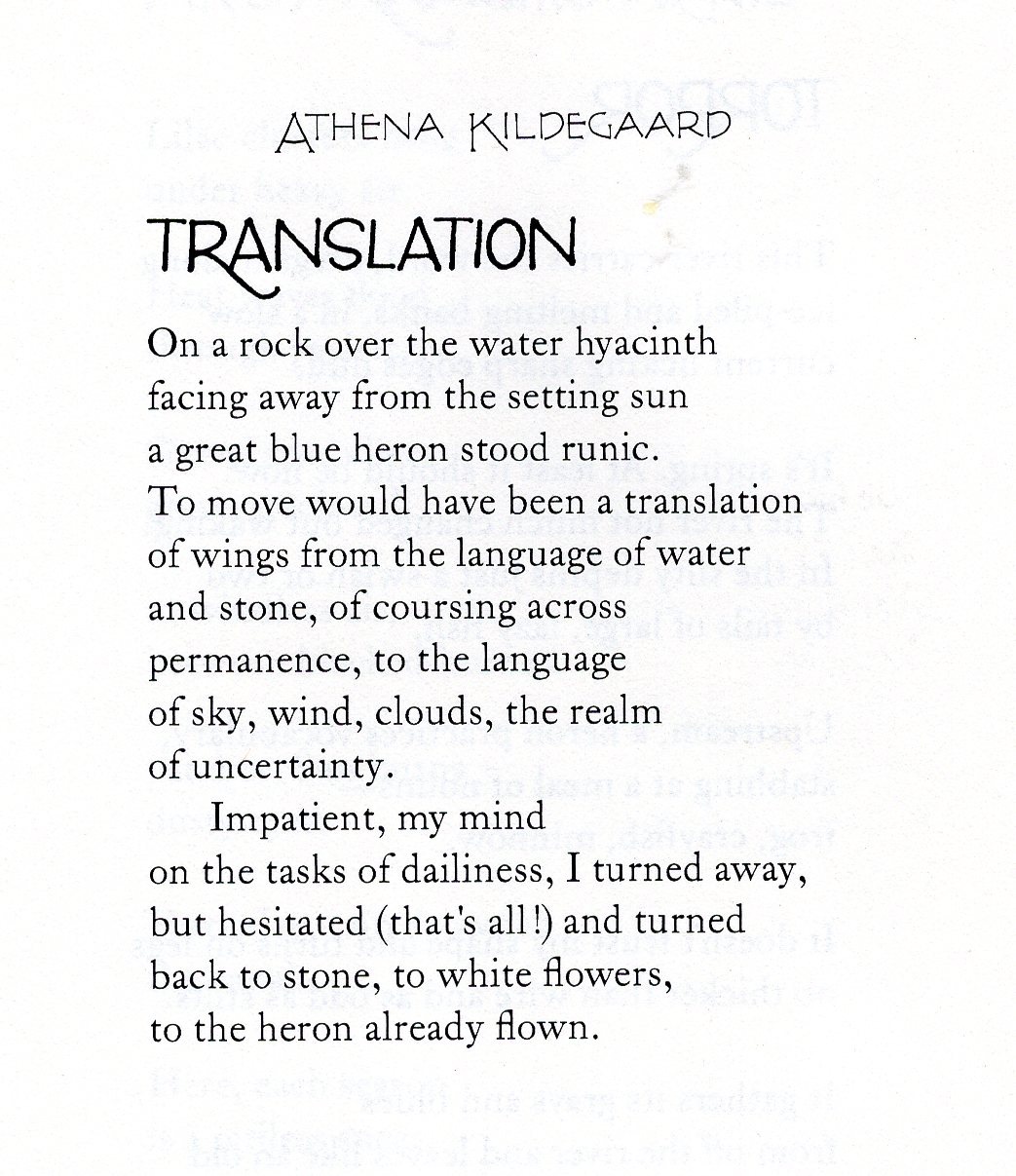
A few weeks ago my poet friend, Athena Kildagaard, excitedly told me one of her poems, “Translation,” was going to be published in an anthology on Great Blue Herons called “Broad Wings, Long Legs … A Rookery of Heron Poems.” Within moments an order was placed through the publisher, North Star Press of St. Cloud, and what a fine collection it has turned out to be, for I’ve long loved these beautiful birds.

Even the cover is artfully donel, And if you’re one of those who read the jacket statements, check this comment by Chuck Dayton, an environmental attorney and activist: “Herons are magical. They draw you into their world without moving …” 

So true. I’m just as guilty of that spiritual seduction as Chuck, the dozens of poets featured in the fascinating anthology along with countless avian and nature lovers.

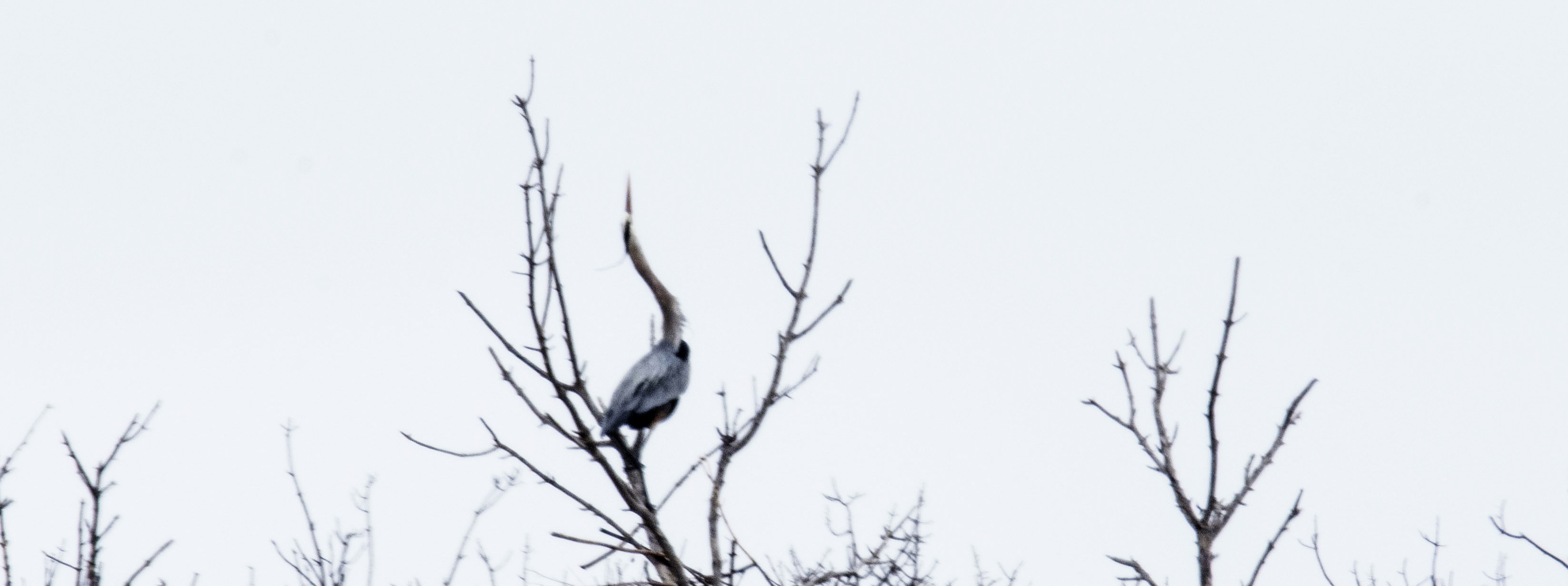
Being drawn into their world with moving.

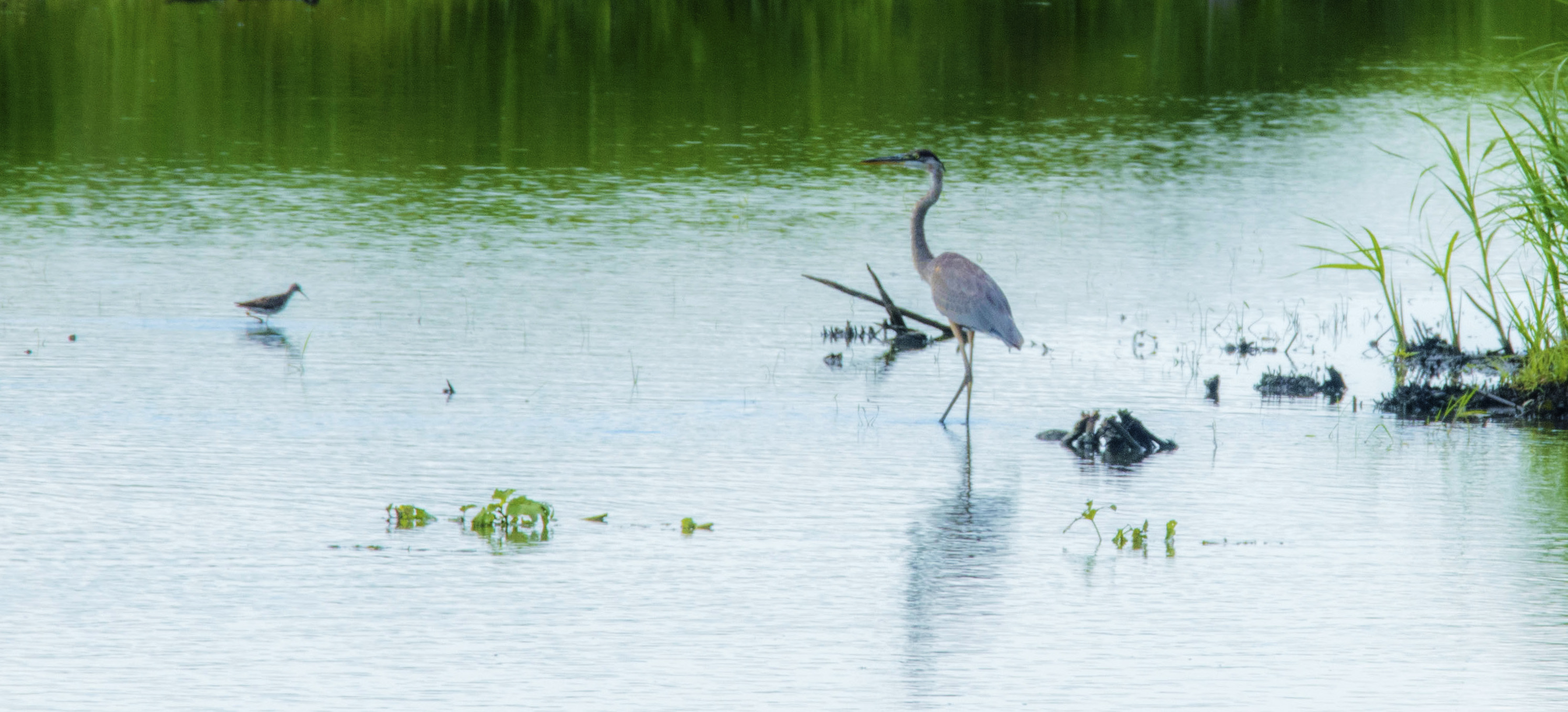
Poets and herons share a lot of same … a strived beauty in form, a sense of seemingly meditative isolation, sudden flights of escape from perceived angst. This can come across in watching a heron at rest in old, worn trees, or quietly stalking an unseen prey, posing quietly in a small prairie stream, and yes, especially in the beauty of flight as they lift away from even the stealthiest canoe, easing lazily in flight downriver past leafy dogwood and cottonwood much as a poet edges from a crowd for solitude and a pad.

Eventually when you hear the beauty of their crafted words, carefully chosen, words stalked much like lone heron eyeing an unsuspecting frog, then finally, with the power of their chosen and spoken words, Athena and her brethren of poets stand poised to provide a mesmerizing reading of their artistic endeavors. 

It’s all poetry, both in form or in word, in feathered flight or presented word. What a wonderful marriage of nature and language.
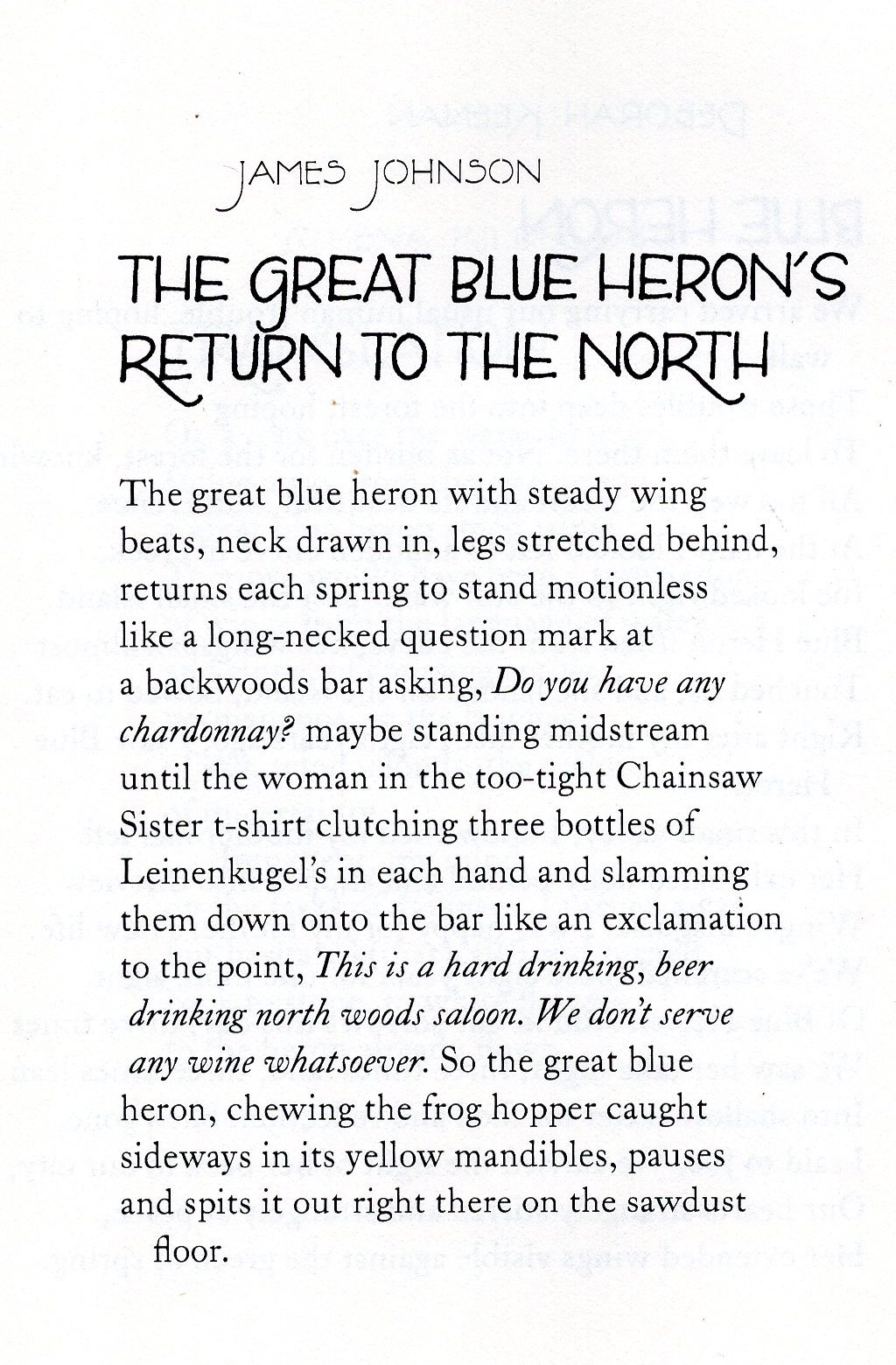
Athena’s poem, Translation, that led to grabbing the anthology.

Yes, this collection of poetry pays tribute to one of nature’s more splendid birds, the Great Blue Heron. Our family has kept a keen eye on these lonesome avian artists for many years. Sighting her first heron of the year meant that my late wife, Sharon Yedo White, had at last witnessed the closure of winter; that spring was soon upon us; that nearby waters were finally free of ice and the prairie meadows would once again bloom. Yes, for her herons were the artfully flying harbingers of a changing season, necks bent in flight with legs stretched behind straight as an arrow, a slow blur of powder blue, gray and white, all crowned with a short hooded cape of blackness.

Sharon loved these curve-necked fliers as much as I love my Sandhill Cranes, and perhaps for many of the same reasons. Grace. Perfect form and beauty, in waterside pose or in flight. along with an independent will. While I’d suggest that herons are much more solitary than cranes, collectively their individual beauty gives both species a select space in our appreciation of avian artistry.

We didn’t see many Great Blue Herons in my youth, although our move to Minnesota brought us closer to herons than ever before. Our first two homes were along, first, the St. Croix and then later, the Little Verillion River near Hastings. I soon discovered the beauty of fly fishing from canoes, and early mornings in a canoe flipping flies for bluegill or bass in the reedy shallows sometimes allowed me to sneak up on stalking, solitary herons. Once in Camp Lake in central Minnesota, a heron eyed me cautiously while strutting on a wooden dock as I quietly stroked my paddle. I expected flight at any moment, yet it defiantly held ground. 

Poetry doesn’t always have to be so serious.

Canoeing the rivers means you can rarely keep up with skittish herons as they keep a respectful distance between themselves and the paddlers. Yet, one late August or early September morning our fishing party of a handful of canoes that had pushed off from Skalbakken County Park below Sacred Heart passed several nearly full grown youngsters perched along the riverine bank. Back then there was live rookery tucked close to a nearby river bend, so we suspected these were the nearly grown from the spring hatch. Perhaps fear or even survival had yet to enter their collective mindset. Who knows, yet it was an unexpected and welcomed surprise.

Their grace and beauty has always attracted my photographic eye. My sister still displays a Christmas gift of one of my first images of a Great Blue, one I photographed in a wetland just west of Willmar one evening on the way home from fishing. That one morning fishing on Camp i would have loved to have had a camera although by then I had learned that cameras and canoes are not necessarily good companions, Yet, I can hardly pass up an opportunity of capturing new and different images. I’m seduced by the magic, drawn into their solitary stealth, captured by those pleasing plumes of color and awed by such graceful flight. 

One of the poems, written by James Silas Rogers, called “On the Cannon River” … which we canoed dozens of times … hit so close to home:

“… Our quiet, passing canoe

untethers their blue-gray forms.

They lift

and in solemn, slow strokes

row the air, move downstream.

Without wanting,

we chase a Great Blue for miles,

in pursuit of solitude.”

Our Marvelous Maples

Heading into our short Fourth of July vacation a year ago, I spent quite some time studying a way to portray a gnarled and rugged looking old maple tree on the farm where I was raised. Despite its age the old maple keeps hanging on, for it was an old tree when I was a kid some 70 years ago.

For a brief period of that time one of the limbs held a rope swing. On hot, humid summer afternoons, hay crews would wander across the lawn to lay in the shade after one of my mother’s incredible meals … fried chicken or braised roast beef, mashed potatoes with thick, rich gravies, and typically one of her delicious fruit pies. Long before air conditioning, this was as cool as we would be from the dews of dawn toward the setting of the evening sun.

While from the distance it appears to be rather healthy, for the limbs are still flush with leaves, a closer look gives evidence of how the years have created deep scars, a hollowed and rotted out trunk, all of which has given the old tree reverence and character. For all practical purposes the tree is ageless, for there is no possible way to determine its actual age.

This old beauty probably dated back to my grandfather’s youth, and the big limb that held our tire swing still reaches outwards. Here’s where we rested in its shade as tired haying crews after one of my mother’s incredible midday meals.

Here’s the skinny on trees, be they old and aged like our marvelous maples, or young sapling searching for space in the heavens. Only the outside layers of a tree are “living.” An incredibly small lifeline begins with the cambium layer located just inside the bark, which producers new wood and layers of bark. Adjacent to the cambium is another near microscopic layer called the phloem, which has the task of transporting the sugars created through photosynthesis from the crown to the roots.

Those layers, combined as less than the width of the tiniest sewing needle, is the lifelines for that old tree and two other very old maples on our adjacent farm place.

Those two less than a quarter miles away at the the old farm house where my nephew’s family now resides, perhaps dates back to the 1860s. That’s when the farm came into the family originally, and It’s where we lived until I was 10. It was there this past Fourth of July that I began nosing around looking at these equally old maples. Between his remodeled old house, incredible landscaping and a strikingly nice machine shed was our first “swing tree.” Yes, another aged maple with amazing character. It stands like the other maple, with grace and beauty, with stoic stubbornness fighting the fate of time.

In my first ten years as a farm boy in Northeast Missouri, this was our shading maple. The sandbox was under one side, and a swing hanged from one of the stately limbs. Now aged and gnarly, this maple truly stands bold and beautiful.

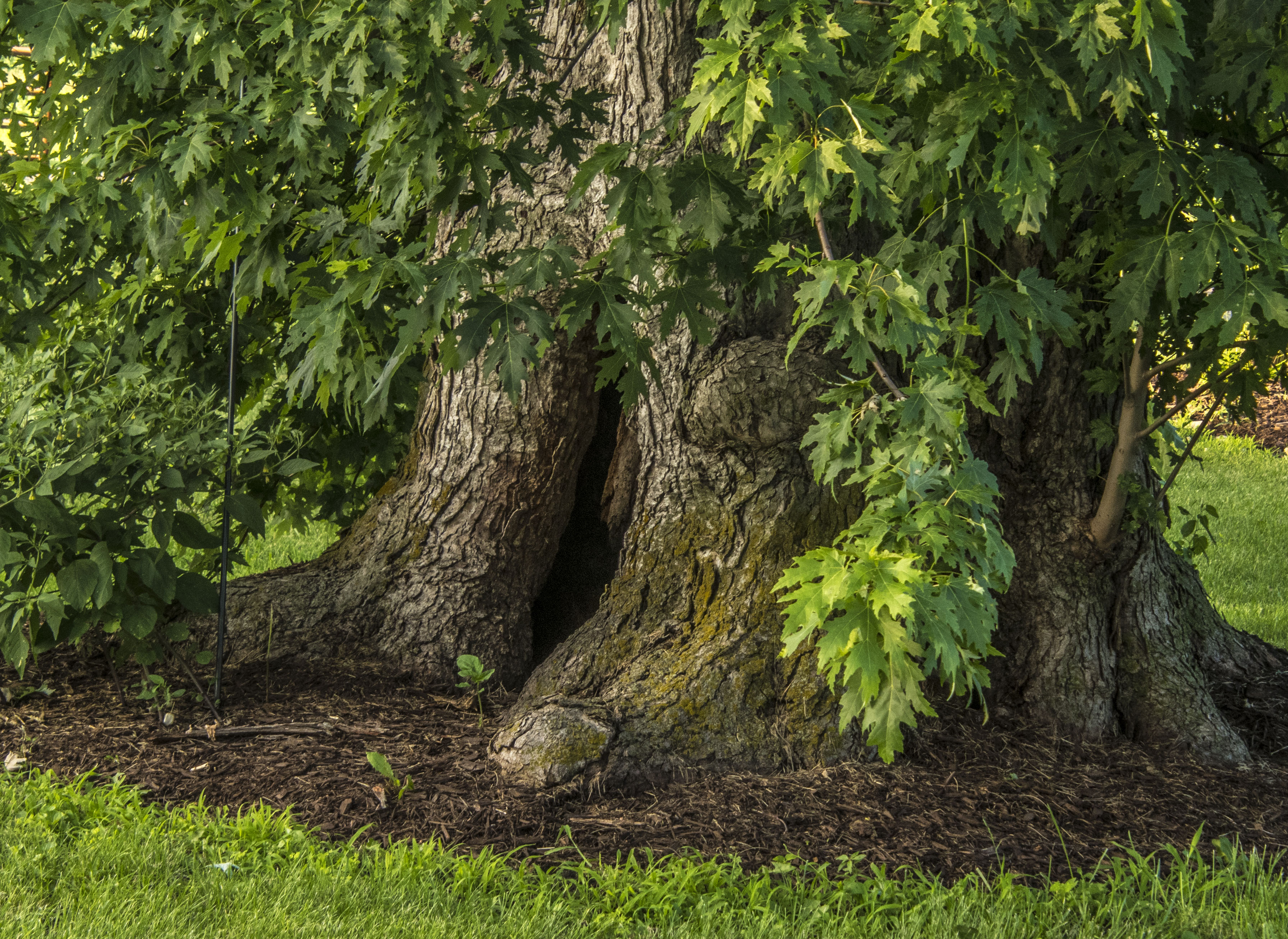
A third old maple stands between the two. Never a swing nor shade tree, because until my nephew removed a fence to add more yard for his family of six, that tree was just that … nestled tightly against the fence. Storms and time haven’t been so kind to this third tree, for many of the stately limbs have broken away. What I found as neat, though, was that the roots at the base seem to have formed dinosaur “toes” over the years.

Yes, I’ve been accused of having a vivid imagination. So be it. That old beast of a maple needs to have some sort of striking feature since it has spent its life sequestered with a neighboring elm that I climbed one extremely hot and humid afternoon to jump up and down on a supple branch within the canopy with such energy that my alarmed mother came running from the house with absolute worry of what her young son was doing.

This was in the late 1940s, back in the polio scare, which caused her to be on pins and needles about her children’s health anyway. And, may I once again add, long before air conditioning. “I knew how hot and uncomfortable you were, Mom, so I’m’ trying to start a breeze!”

Whatever you wish to term the weathered old bark, all three of the old maples speak of character.

With the patience that made her such a great teacher and mother, she explained that despite my efforts it was highly unlikely that I alone could create a calming breeze regardless of how hard I tried or even how necessary it seemed. 

That elm, like the dinosaur-toed neighbor, that tired old maple, still lives. Both show their age.

All three of the old maples are identified as sugar maples, although my guess is that capturing the sap for syrup might be impossible. Even if it was possible, i would hesitate simply because I would be more interested in seeing them continue to live a long and breezy life.

If you suggested that maples are among my favorite tree species you would be correct, for we grew up swinging and having dreams of building tree houses on those stout and staunch limbs. That they’re still alive is both heartening and reassuring; that despite age there is still a good life and beauty. Yes, those three trees were old when I was a child, and I’m now 80. My guess is that one if not all are twice that age, for I’ve never not known them as being small and supple. I would venture to guess they were planted before my father was a boy, and perhaps when his father was one. 

Though this third old maple on our farm was bordered by a fence through most of its life, I love how the tree seems to hang tough with “dinosaur toes.”

Making the long drive from Listening Stones to my childhood home is a long eight to nine hour drive, yet there is little that makes me feel more at home nor welcomed than seeing those old maples. Old friends that they are. The two have shaded men and machine through the ages of that farm, and would today if modern machinery would fit beneath the limbs. Looking at the trees it doesn’t take much imagination to wonder if the trunks will eventually split completely apart, or that one of the usual ice storms coming to northeast Missouri winters will destroy the limbs or even the trees themselves.

Yet, they keep hanging on, those marvelous maples, using that microscopic thread of life to bring forth a new year of large pointy leaves and beauty beyond shade. Weakened, yet strong. Old, yet bold. Gnarled, yet stately. Like old friends, they’re our maples and we share a joy of living a long and wonderful life. And as I bring this to a close, I’ll extend special kudos to my nephew for leaving them be despite their imperfections. 

Guardians

Just before stepping up onto the ledge of a flat outcrop she appeared suddenly from the grasses, nearly flat against the rough and gnarled granite, her beak wide with eyes speaking of the wild. She appeared to hiss at me, although in reality it was more of an anguished squawk. 

Her message was clear, both eloquent and forceful enough to convince us to skirt around the granite outcrop away from her perhaps quite well camouflaged chicks. She was quite adept in her role as a guardian of her small brood.

Yes, her squawk appeared as a hiss by this guardian nighthawk at the Big Stone NWR.

While nighthawks fly with uncommon grace, and dive from great heights with blinding speed, on the ground their short legs and horizontal stance makes them almost immobile. The Cornell Lab of Ornithology notes that nighthawks won’t make a nest and their young are so well camouflaged that they’re nearly impossible to find, and even the adults seem to vanish as soon as they land.

Not this one, for she was a guardian with a goal of protecting her young, and if the experts at Cornell and Audubon are correct, we might not have seen her chicks even if we’d stepped onto the outcrop. In all honestly, this was the first nighthawk I’ve ever seen on the ground. 

Near the nighthawk, an adult eagle rests outside of the next that holds a nearly full grown eaglet.

Researchers have noted that with the overwhelming takeover of grassy lands for commodity crops that much of the former territory of the nighthawks has been destroyed. Nowadays they use areas like the outcrops at Big Stone National Wildlife Refuge (NWR) as nesting sites. So she was an unexpected and welcomed bonus.

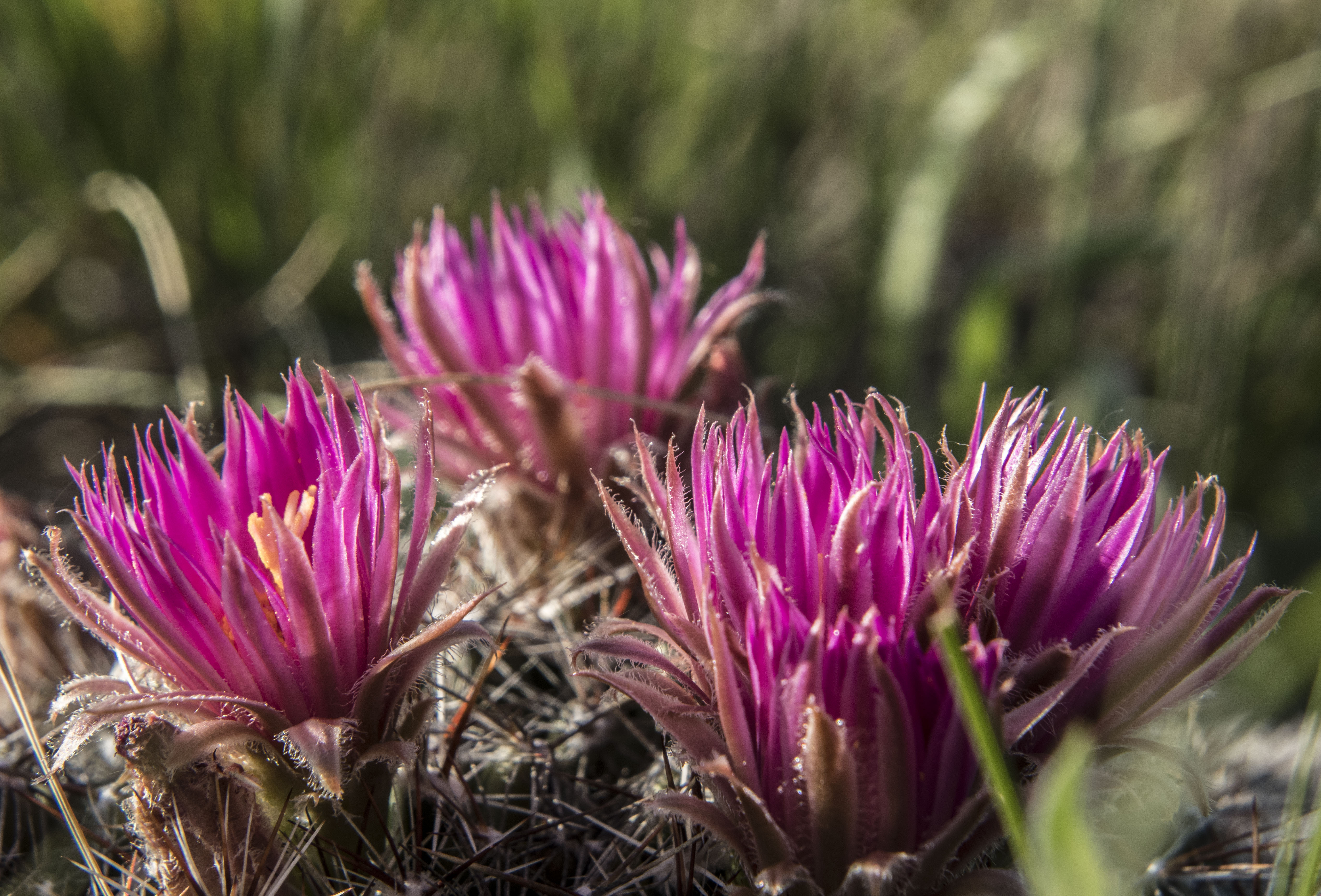
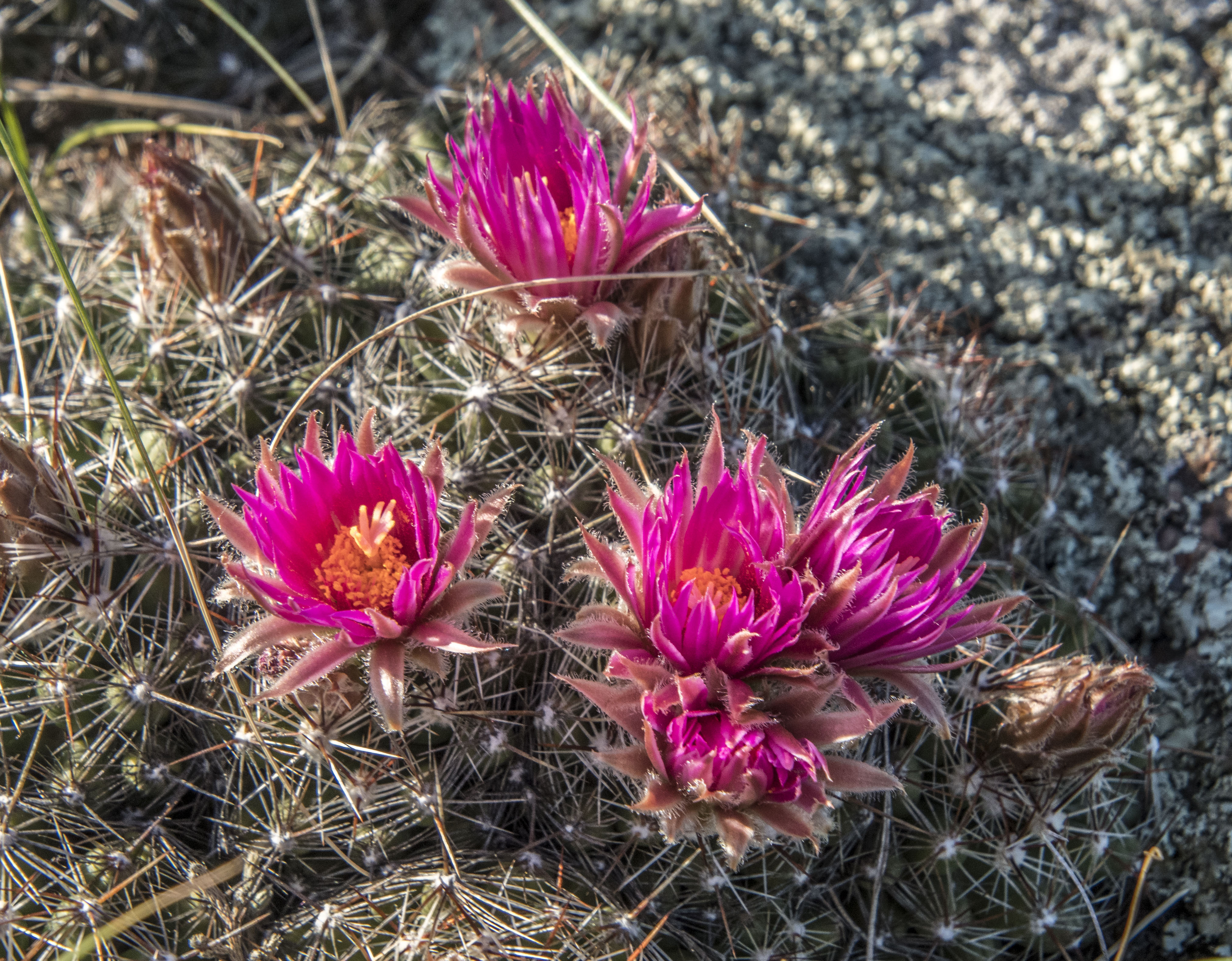
We had come to the outcrops in hopes of photographing blooms of the second of two cacti located in the Refuge … brittle prickly pear. Earlier we were incredibly fortunate to capture the blooms of the extremely rare ball cactus, and now the blooms of the brittle. Thankfully they were blooming on the adjacent flat outcrops so we were able to photograph several clumps of the beautiful pale yellowish flowers without disturbing the protective nighthawk.

One of the three osprey chicks kept rising in the nest at Tamerac NWR.

This female nighthawk wasn’t the only guardian of newly welcomed hatched birds of the early summer. Due to our wandering through three different NRW’s in the past week we’ve noticed many different species doing the same, from raptors like bald eagles and ospreys to swans and ducks, pheasants and even sandhill cranes. What a joy to observe such protective care and parenting in nature. And now is a perfect time to be out and about to observe and capture images of all the different species in parenthood.

Not far from the nighthawk, for example, is a huge eagles nest, and the bulky “baby’ seems nearly as large as its nearby, perched parent. We caught both on the nest tree. We also were fortunate to capture an osprey on her nest at Tamarac NWR a couple of days later with three young ones she was protecting in the nest. Thankfully one continued to poke his head above the contour of the edge of the stick-heavy nest. 

An adult sandhill crane is mimicked by its colt in the Sherburne NWR prairie.

While I haven’t had much luck in catching a brood of pheasants, for they’re quite good at sneaking into the roadside grasses before I can focus, watching the swans with their cygnets both at Tamarac and Sherburne NWR, along with some in a nearby wetland, has been a rewarding experience. Unlike the nighthawks, swans, like the sandhill cranes, have made a resurgence in numbers and are no longer consider rare. Same with bald eagles. 

At Sherburne we witnessed sandhill colts in lockstep with their parents, easing through the prairie grasses near the wetlands pecking for edibles. We weren’t considered a threat, it seemed, as they leisurely meandered along. Two parents and the colt.

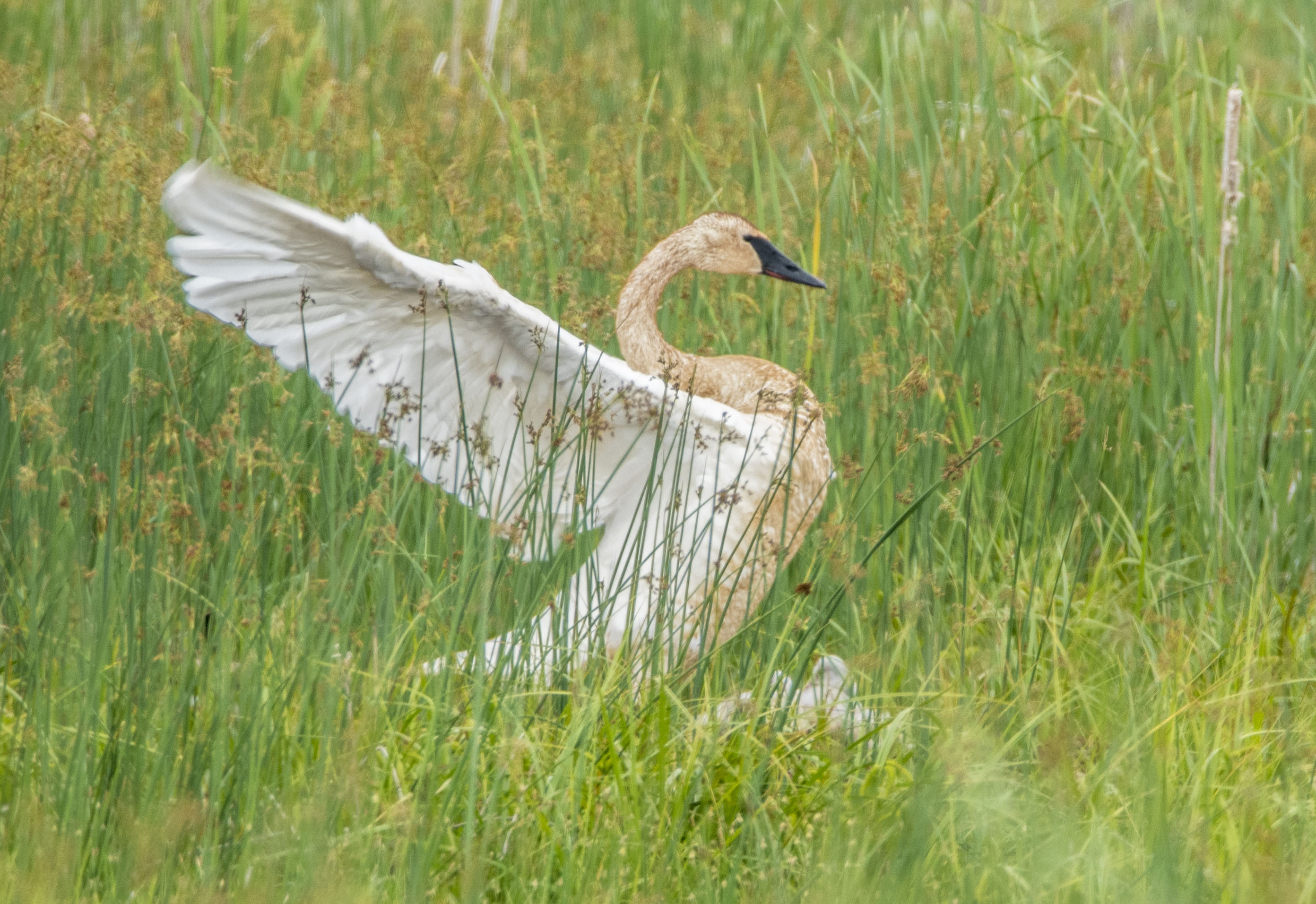
Despite their artistic beauty, guardian swans always seem to keep an eye out for the photographer.

Twice we’ve been stopped on the road by mallard hens as their tiny ducklings waddled slowly behind them across the gravel toward a nearby wetland. And twice I’ve captured wood duck hens with their brood cruising though the shallows of wetlands. So peaceful. So beautiful

Oh, and the swans! There isn’t a way to overlook or ignore the artistic beauty of swans, and when they’re with their cygnets the beauty is in the protective parenting more so  than the arts. Both at Sherburne and Tamarac, male and female couples hung close to their growing brood, easing through the waters with apparent ease, or resting quietly among the cattails and reeds.

Easing through the marshy plants is a female wood duck and her ducklings.

Yes, this has been a wonderful start to the summer watching the recently hatched birds of various species as they move from cracked shells through their quick learning path. Most of these avian guardians are common to us. But the nighthawk? What a wonderful surprise and photographic capture. In a world of devastation due to wars and climate change, watching nature evolve in peace and parental care has been an incredible and welcomed diversion; that the world of nature marches ever onward despite the ills of humanity.

Then JAGs Came Calling

T’was a moment when my memory of JAGs surged forth, and it seemed as if his voice was right there in my ear. James A. Geladis was our Managing Editor at the Dubuque Telegraph-Herald back when I started working at my second daily newspaper in the late 1960s. He had this way of looking down his nose at you, his eyes peering over his half-lens reading glasses in what we in the newsroom called “the stare” as he offered a kindly bit of advice. 

Although you might be subject of a stare from time to time, you never wanted to have JAGs offer the same suggestion a second time. In his defense, JAGs was a fine man and just the type of ME a beginning journalist relished. Creativity was essential, and every once in a while you would see him standing at his big window facing the newsroom before he wiggled a finger in your direction. That meant being summoned, and that perhaps he had an idea. 

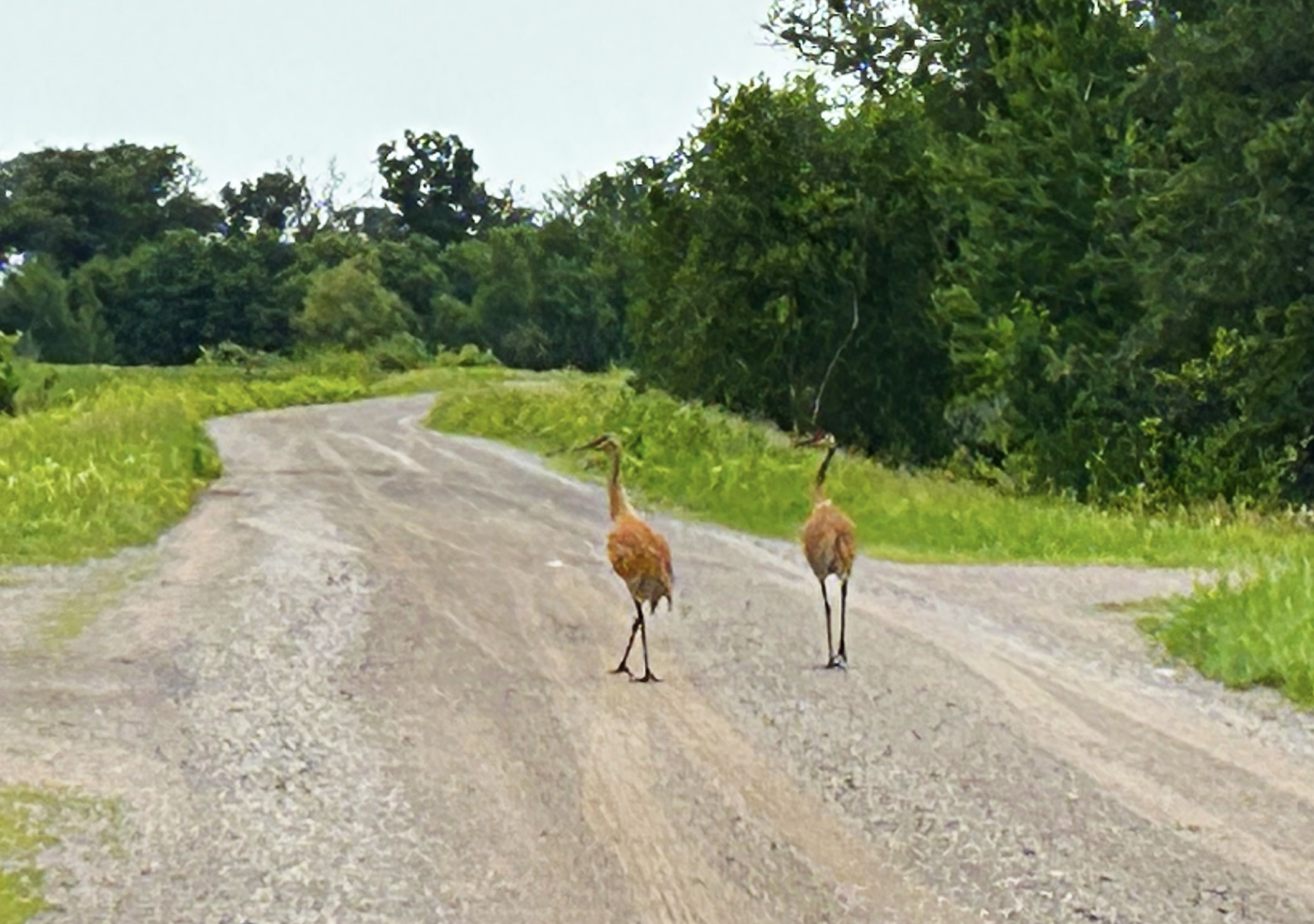
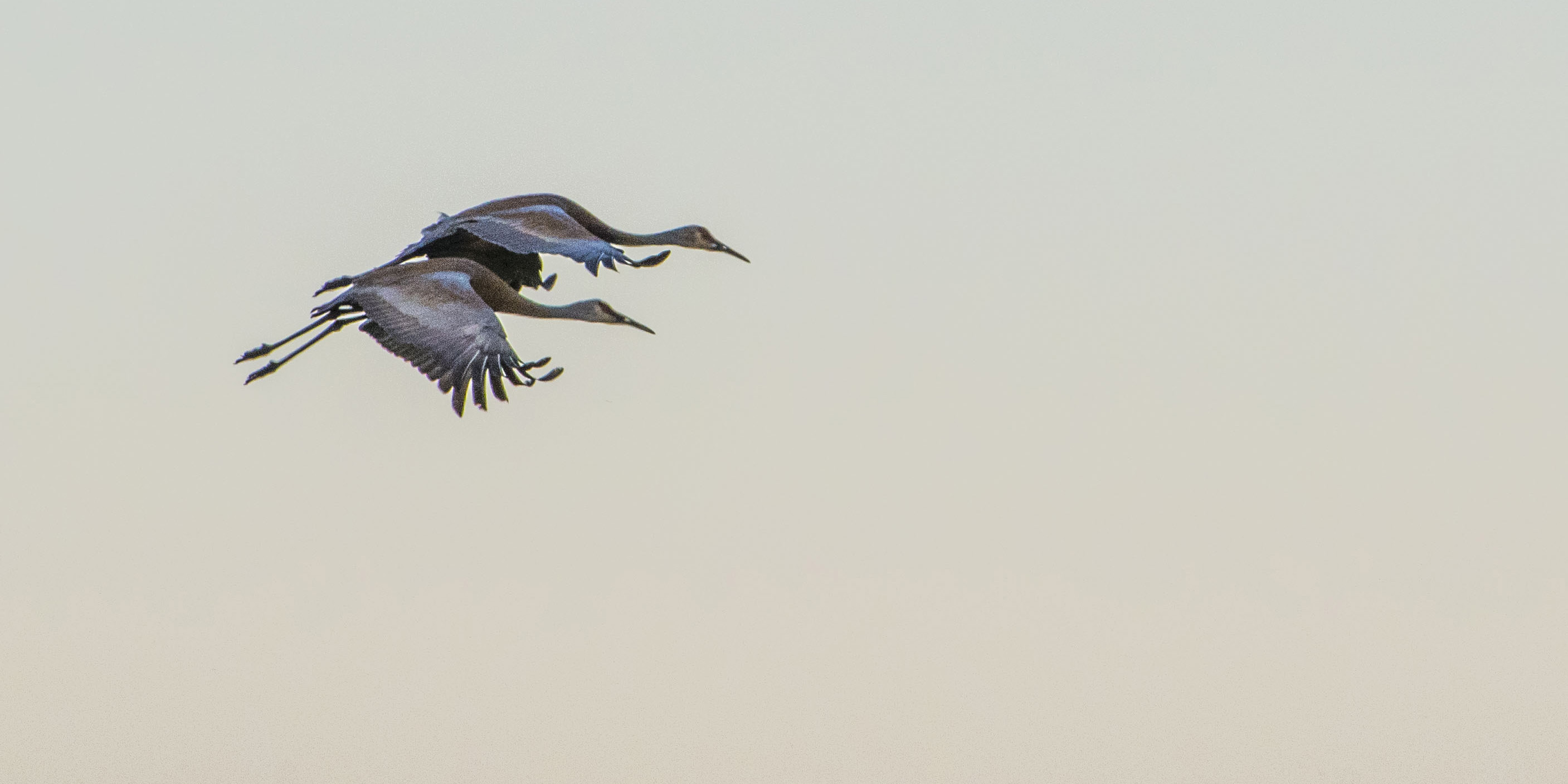
Moments after my battery died, two tall and gangly sandhill cranes emerged from the grasses to amble down the road in front of us.

Over my two years I got more than a few summons. “What do you think of us starting a youth’s page?” he asked. Calls were made to area high school art and English teachers and a full newspaper page featuring young contributors was created. Or, “We have a lot of very lively elderly people in town, and in the hills and valleys around here,” he said another time. Shortly thereafter I was writing a column we called Lively Elders. Fun stuff. Now I’d be considered a candidate! Although I didn’t get many “stares,” I certainly remember the first one.

En route to a fire out in the distant hills of the Driftless northwest of town right around sunset, I crested one of the hills coming up from a valley, which was common in the Driftless, when I passed by a farmer on a tractor silhouetted by a huge red sun ball. I nearly stopped before remembering the assignment and hurried on toward the fire. Yet, I couldn’t get that silhouette out of my mind, and some 50 years later I can still visually see it. Missed images are sometimes like that.

A pair of sandhill cranes and their youngster forage through the Refuge.

By the time I arrived at the scene the fire was already doused, so I did some interviews of fire chiefs and grabbed a few images and headed back to Dubuque in the dark. After developing the film and making the prints, I wrote a short story that would basically be a cutline. The next afternoon I made a mistake of recounting the passing of the farmer and the red ball sunset. JAGs lowered his chin, looked over those half-frame glasses and said, “Never ever pass up a picture!” 

I’ve used his advice ever since, and have had a decent history of giving my photo editors some nice feature images over the years, and twice came in second in the annual regional “clip art” contests of the NPPA while working at the Denver Post. 

Besides the sandhill cranes, picturesque swans offer many photographic opportunities.

Now in the present; we were at the Sherburne National Wildlife Refuge Monday morning where I had just finished capturing an image of a pair of swan pens (the technical name for a female swan) and their cygnets easing through the cattails when my camera battery suddenly expired. My camera was dead. No problem, for I’ve always carried a charged spare in my camera bag. Except this time. I felt inside all the compartments and even turned the bag upside down to give it a good shake. Yes, I had faithfully charged the batteries but somehow failed to place them into the bag! And good ol’ JAGs came calling!

We were only about halfway through the Refuge motor trail when I realized I was done for the day. Then, as I dejectedly started the car, a pair of sandhill cranes suddenly popped out of the grass not 15 feet away to waddle down the graveled loop road in front of us like a pair of tall, gangly drunken chickens. They would not yield the right-of-way, and waddled on for about 60 meters before eventually veering off the road and into the grasses. I was being dissed by sandhill cranes! 

Despite JAG and his imagined nagging and stare, I did what any sane fellow would do in the 2020s … picking up my cell phone and trying to make do. It was a sad “make do” by the way, for I didn’t opt for one of those incredible cell phones destined to make cameras obsolete. 

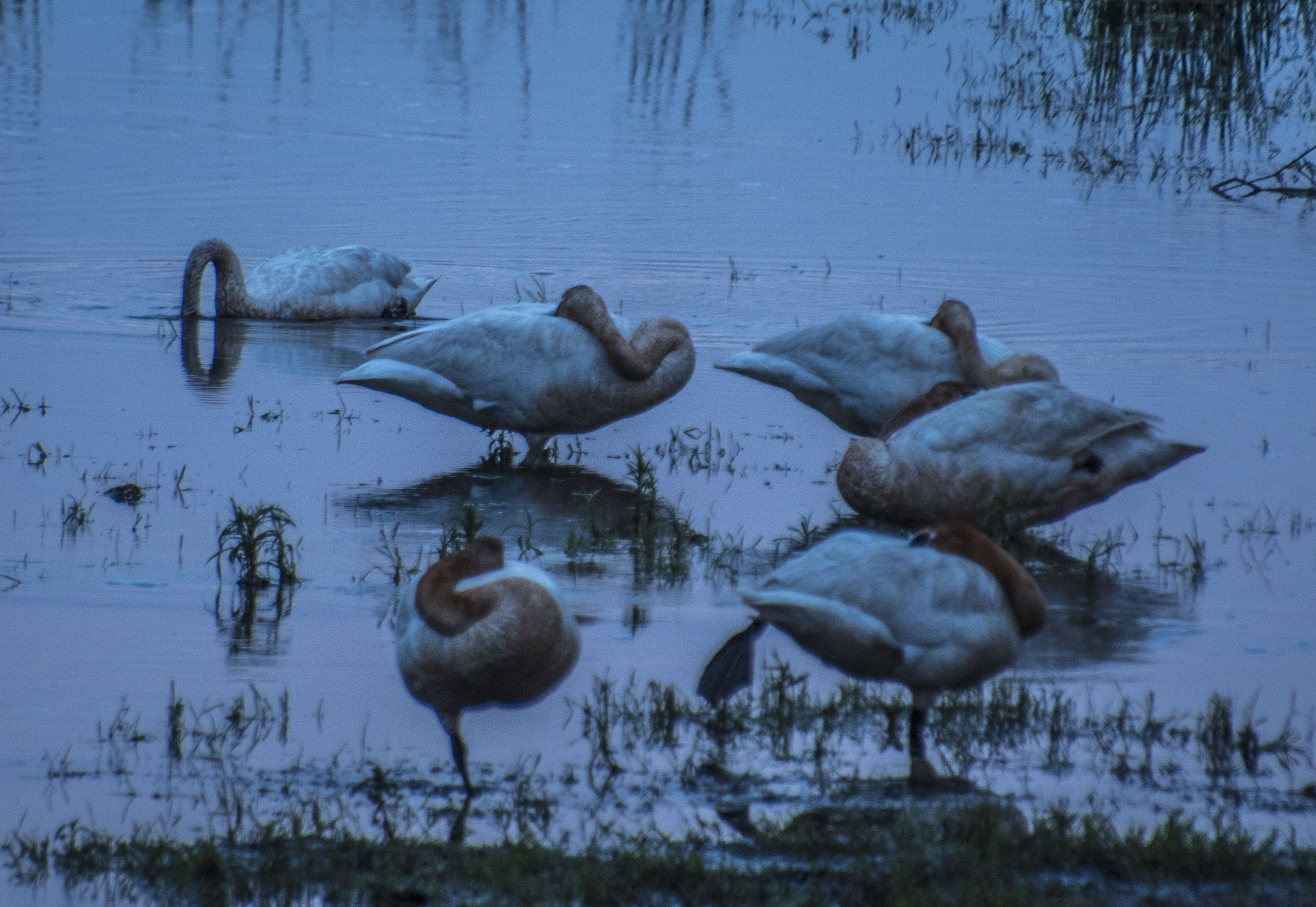
We pulled into the Refuge the evening before where this “blue hour” image was captured. What a beautiful evening to be wandering through the Refuge!

To make matters even more dire, we continued to pass picturesque swans, a pair of bald eagles high in a deadwood moored tree in the swamp (that was reflected in perfectly stilled waters) and even more sandhill cranes on a rise just around a distant bend. Not only did we have a beautiful hue in the stilled waters, Sherburne is known for having both ample swans and sandhill cranes, and both were why we had rented a nearby motel room the night before. 

Indeed, my sunset images from the night before were cool, and so were all the flowers we captured in bloom. A couple of songbirds were caught, too, including a warbler. Our photo foray up to that point had been excellent, even as the sun was setting the night before. We even had a blue light image of a pod of sleeping yearling swans! And, if there was time, we had designs to venture further north to see if we could capture some yellow and showey ladyslippers. 

All of which was for naught. 

A pod of yearling swans asleep in the “blue hour” after the sunset.

Once home I found my two fully charged batteries on the desk of my studio office Guess where they are now? One is in the camera, one is the bag, and my third is on the charger! 

And JAGs had thankfully eased back into his office chair with his half smile, fully confident that this would never happen again. While it was darned good to hear from the old editor after all these years, and to note that his advice was spot on, my mind was cluttered just a bit with all those missed images back at Sherburne. I can only hope I won’t be as haunted of the misses as I’ve been through the years of missing that red ball sunset! 

Balls on the Outcrops

Ball cactus (Escobaria vivipara) are not only extremely rare, they’re also apparently rather shy in showing off their magnificent stark red and yellow blossoms. Catching them in their full glory has been a personal quest come June for several years, so imagine both my surprise and delight the other day when we climbed onto one of the granite outcrop flats at Big Stone National Wildlife Refuge and found not one, but literally dozens in full bloom.

After several moments of looking for different angles and light possibilities, my eye caught a minute bright red spot on a neighboring granite flat about 20 meters away that was perhaps surrounded by some of the other rare plants of this ancient biome to grasp my interest. How fortune seemed to have blessed me in this particular moment, for it was there I found an almost perfect image of the blooms. 

This trio of ball cactus blooms caught my eye from a distant outcrop.

We are actually quite blessed to have such a wonderful and beautiful resource near us, from the outcrops to increasingly rare birds like bob-o-links and nighthawks, and to all the water-friendly species who find this patch of ancient prairie, stocked with bedrock outcrops, such a haven. Almost every trip around the circular drive yields nice imagery for me to photograph, and I seem to be drawn here several times a week and usually come home with what in the old film days would be three or four rolls of film. Finding the balls in bloom, though, just about tops the list.

About the size of half a tennis ball, with long protective spikes, the small cacti seem to cluster in packs in a unique ecosystem that has somehow survived several thousands of years since the dam broke on glacial Lake Agassiz to form the glacial River Warren, which scoured the valley and exposed some of the oldest rock in the world bringing along a small collection of quite rare plants. Those with knowledge say that the ball cacti are found only in a small two to three mile area, and only in the crevices and kinks of the original granite bedrock exposed by the ancient river.

Small clusters were found across the flats of the outcrops to add incredible beauty to the hard granite outcrops.

Although small, the cacti might be huge for the security of these sacred and holistic outcrops between the Refuge and the town of Ortonville, for their vulnerability may be the only hope remaining to prevent the gravel mining company that purchased this area from creating a new, deep gravel pit mining operation that will basically destroy a rare and beautiful relic of glacial history. It was while writing stories on what was known as the Strata Conflict about a dozen years ago that a local historian, Babou Don Felton, pointed out my first viewing of a small cluster of ball cactus on a hike across the acreage. At the time I doubt that any of us realized just how powerful that rare little cacti might be.

Nor did I realize back then the beauty of their blooms, and wouldn’t until a few years ago when State Park Manager Terri Dinesen published her photograph of one of the blooms from the refuge on a social media site. Since then I’ve been hooked, so much so that when Madison Eklund, the first kayaker and first solo woman to paddle the Canoeing with the Cree trip to the Hudson Bay, was resting here for a few days, we made trips in hopes of seeing the blossoms. We were “skunked.”

Since several dozen trips have been made to the Refuge in search of the blooms, a quest that started a few days after Terri made her post. Yet, I had northing. After several attempts, sometimes making three trips in a day to the Refuge hoping for the just the right circumstances of light and heat or whatever, I sent her samples of my images in frustration to which she suggested I might have been too late. That the blooms were already gone.

According to the Center for Plant Conservation, ball cactus (one of three native cacti in Minnesota) was probably found more frequently and on a broader basis on drier, thinly vegetated prairie habitat, but it was eventually reduced to only undisturbed granite surfaces like found just south of Ortonville and into the refuge. 

According to its website, “Granite and quartzite outcrops in Minnesota are home to ephemeral pool habitats – shallow depressions where water can pool for a few weeks each year. These accumulate biotic matter and host several plants rare to the state, including Bacopa rotundifolia and Heteranthera limosa (both state Threatened). With only one ball cactus population left in Minnesota, it is hard to generalize about its preferred local habitat, but it appears to favor moss shields that occupy some of the same kinds of shallow depressions that form ephemeral pools. The plants also hug cracks in the granite and may even anchor an accumulation of duff and moss material around them as prairie winds blow over the rocks.”

A few days after catching the height of the bloom, the party ended. It was delightful while it lasted!

The Center applied for and received a grant to collect seeds from a nearby quarry site and since has received germination rates to over 70%. “As a result, we will eventually be planting roughly 2000 cacti seedlings across the three recipient sites over a several year period,” read the report.

So there may be hope for a future for this rare species. 

For me, finding the balls in their full glory was a dream come true. Interestingly, a day or so ago we stopped back and wandered onto the flat to find that the outcrop nearly reminded me of what my apartments looked like a day or so after a party, when the balloons have withered and the festivity’s merely a memory. Those blooms were now but a memory, and had clasped tightly together to appear much like they had in the images I’d sent to Terri Dinesen a few years ago. Yet, we were there for the fun, the glory and the beauty. How can one be disappointed?

Adding a Hint of Freedom

Two more plants awaited my efforts to clear a space and cut through the tangle of a grassy  jungle when I had this wonder — do plants have a sense of freedom upon being pulled from a plastic flat and being placed into the soothing wide world of life sustaining soil?

Prior to that thought most of my focus was on figuring out how to space the select native prairie plants, how to plant them for height and color, then to do the honors for giving them the freedom of what hopefully will be a long and blooming life!

This, of course, is our hope with three new pollinator plots, plus an acre of a prairie grasses and forbs to be planted in the former horse pasture and orchard!

This has been an interesting and adventurous year for us here at Listening Stones. A few weeks ago I felt a calling to purchase six trees and plant all but one in the “south lawn.” Years ago I stopped mowing that space despite the beauty. That was the same year I also stopped mowing the planned “orchard” since deer had pretty much killed the young trees. Besides spending nearly a half day of mowing in areas where there was little use, there was a fear of what effect all that mowing had on global climate change. 

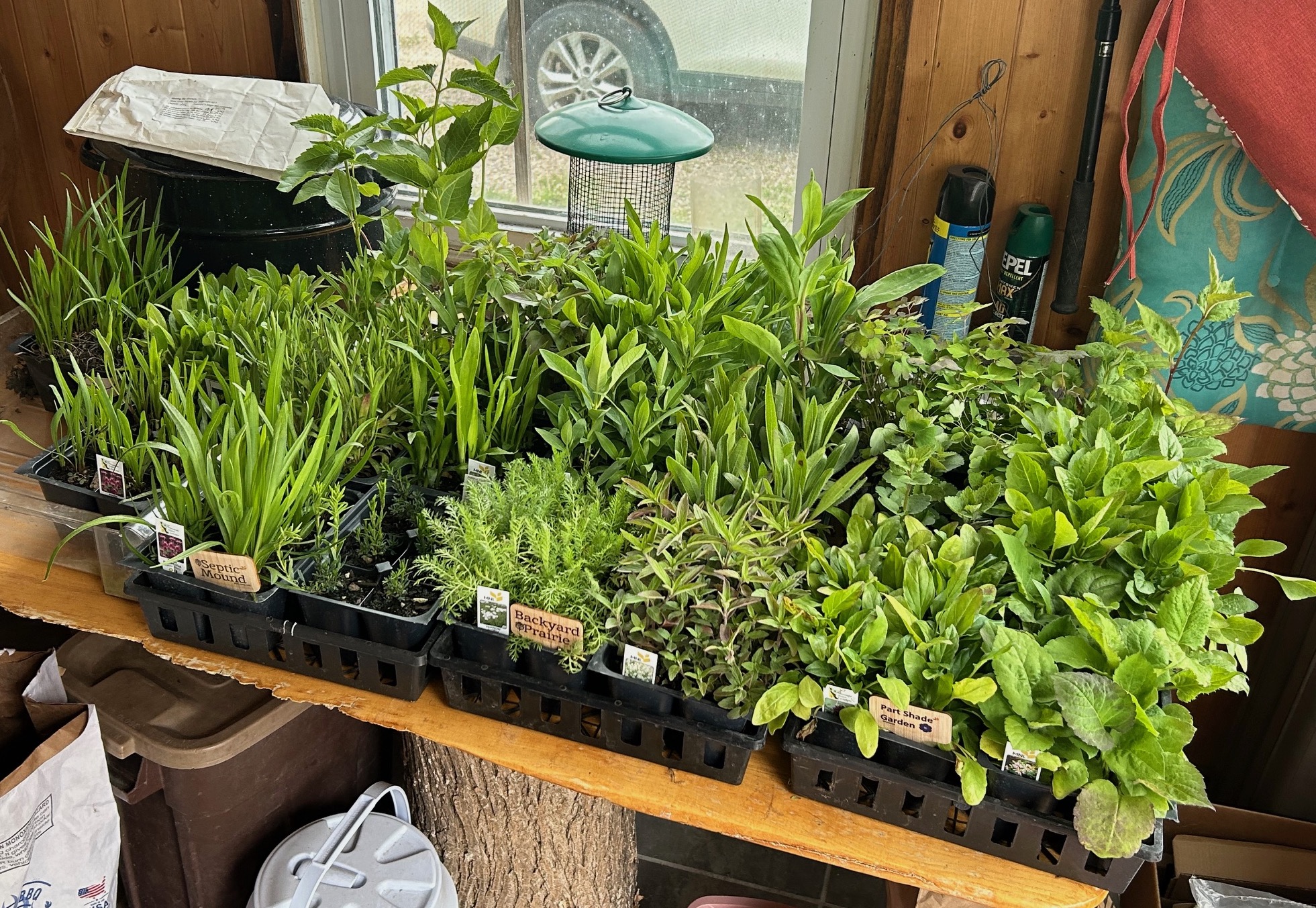
About this time another friend, Rhyan Schicker with the neighboring county SWCD had a prairie plant offering for three different pollinator groups … full sun, partial shade and septic mound. We took one of each, and in total it came to 190 plants. Three flats of 54 plants, plus three, nine-plant “gifted” flats of of our choosing.

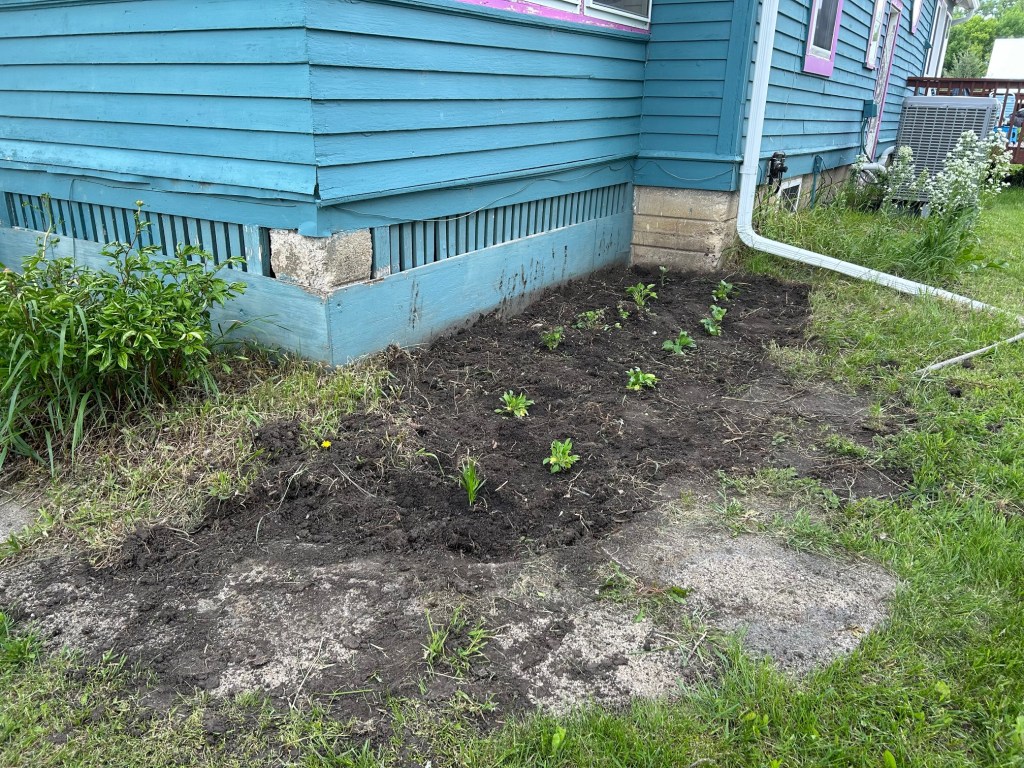
Where it all started! An overwhelming portrait of hope and, yes, hard work!

On our pick up day in nearby Madison, we drove down to retrieve the flats with what suddenly became an “oh, gosh, what now?” moment. We brought them home and placed them on the table of the mudroom as we gathered our thoughts. I would start with the partial shade thanks to having several volunteer red columbines hugging the side the house. Originally my goal was to plant an area above a rock terrace garden facing the road. Those columbines, though, offered quite an argument, so I grabbed a shovel and started digging out the grass and weeds while keeping the original columbines.

While it was hard work clearing the space, the planting came easy. The whole process took most of the day on a Saturday. That left 108 more plants in the two flats, plus the three “gifts” still to plant. We marked out a space between the studio and house we would plant the full sun plants, an area with heavy lawn, and I couldn’t see my surviving digging away to the bare ground. 

A call was placed to a good friend, Wanda Berry, who is renowned for her horticultural skills around town. On her visit she offered a plan: “Why don’t you cover the grass with cardboard, cut holes to dig in the plants, then cover the whole thing with a heavy mulch,” she suggested. “It’d be much easier than clearing away all that grass with a shovel.”

Placing the mower at its lowest level, I went over the area to clear away as much of the grass depth as possible. Fortunately I had ample cardboard thanks to the shipment of my canvasses from my canvas printer in Minneapolis. Don’t ask why they were saved in the first place, and if I hadn’t had a wild hair about cleaning my studio about six months ago I could have completed both of the two remaining plots. 

Then the work began — laying down the cardboard, tacking it into place with lawn “staples,” cutting the holes, digging a deep enough hole, and finally, placing in the root plug and replacing the dirt snuggly around the plug. It was still hard work with lots of knee time and getting up and down — a lot of exercise for a guy my age.

It took much of two days to finish the full sun tray along with the extra 27 plants in the “gift” sets. That left the septic mound, which left me puzzled for nearly a week. My original thought was to somehow space the plants far enough apart to cover the entire mound. Frankly, there just didn’t seem to be enough plants and by then I was out of cardboard. Fortunately the plants were looking really strong and healthy thanks to the care Roberta was giving them.

By now I had used up all of the mulch we had bought and was in need for a supply of cardboard, which was gifted by another friend, Greg Lockwood. After a trip to the nursery to buy more mulch, I stopped by Greg’s store for the cardboard, came home and started on the mound. Like with any endeavor involving boring detailed work, you soon develop some sort of system or rhythm. I started cutting three or four holes through the cardboard before using a triangular garden spade to cut through the grassy duff before digging the hole. Then  would finally stand to retrieve the plant plugs. Less wear and tear on the body, and went much faster!

What I had started on late Monday afternoon was completed before a noon rain on Tuesday. Up close the site seemed huge, although from a distance it was easy to see just how much of the mound would be left to plant. We would need at least five more 54-plant trays to completely cover the entire mound, which I hope to do in the future.

As I laid the last couple of plants in their holes I had that thought of how the plants might feel, and I listened closely for any sighs of relief. It was difficult to hear them with all the bird chatter around me. Mourning doves, chickadees, sparrows, a yellow warbler and even our resident pheasants were having at it, filling the prairie skies with hopeful chatter. Joe Pye was laying nearby, and Roberta had returned from town with a box of lawn staples we needed to hold the last piece of cardboard in place. Peace on the planet!

It’s said it takes a community, and I’ve had a great one. Rhyan, Wanda, Greg, Roberta and even Sally Finzel from her native prairie Morning Sky Nursery had a hand in this pollinator work. Just after we finished, farmer friend Travis Sandburg showed up with his disc to prepare the former horse pasture and orchard for a pollinator pasture!

In the end, though, it’s hard to say who is happier … Roberta and I, or those rather soft-spoken plants of the prairie. Now it’s up to them, and eventually the pollinators we hope they attract. It’s all part of our little effort in keeping a planet healthy. 

Skyscapes

Sometimes I wonder why I’ve never left what author and essayist Bill Holm called the “horizontal grandeur.” Our move some 32 years ago to the prairie served two purposes … getting out from the depths of debt caused by briefly owning houses both on the riverine banks of the Mississippi and from where we had moved in Denver, and in continuing a career that had seemed to dead-end after an unhappy stint at an advertising agency. 

To Holm, the prairie was about function more so than form, a place that “requires time and patience to comprehend.” And, a staunch home country if there ever was one.

He had an eagerness to compare this horizontal horizon with both encompassing trees and mountains. “Prairies, like mountains,” he wrote, “stagger the imagination not in detail but size.” He complained about being surprised by storms he couldn’t see coming in a forest, for trees were synonymous with jail bars, and mountains were high rather than offering something wide — a horizontal grandeur. 

Looking up from planting, here is the storm above the prairie in early afternoon.

Holm wasn’t alone in his thoughts. A writer named Don Young wrote of the prairie, “A single Monarch butterfly dances around the prairie, searching for an elusive bit of pollen; the silent gliding of a Cooper’s Hawk searching for anything that moves; prairie grass roots searching deeper and deeper for moisture; and me, searching for solitude, inspiration and a photo opt or two.” Sounds familiar.

Technically we’re speaking of land form, for actual prairies, those seas of grasslands, are no more. Nor are there many potholes. Commodity agriculture took care of both decades ago. Then this happened a few days ago while working to plant at least a part of our lawn to pollinator-friendly native forbs, an effort interrupted not by Hal Borland’s “homeless winds” that seem forever on the move, but by rain. A fast and furious downpour. When I looked up from the perch of my knees I noticed the sky, and later, while chasing the ever changing skyscape, I realized a bit of what Holm had written about concerning time and patience: a prairie sky as a palette of color, form and mysterious intrigue.

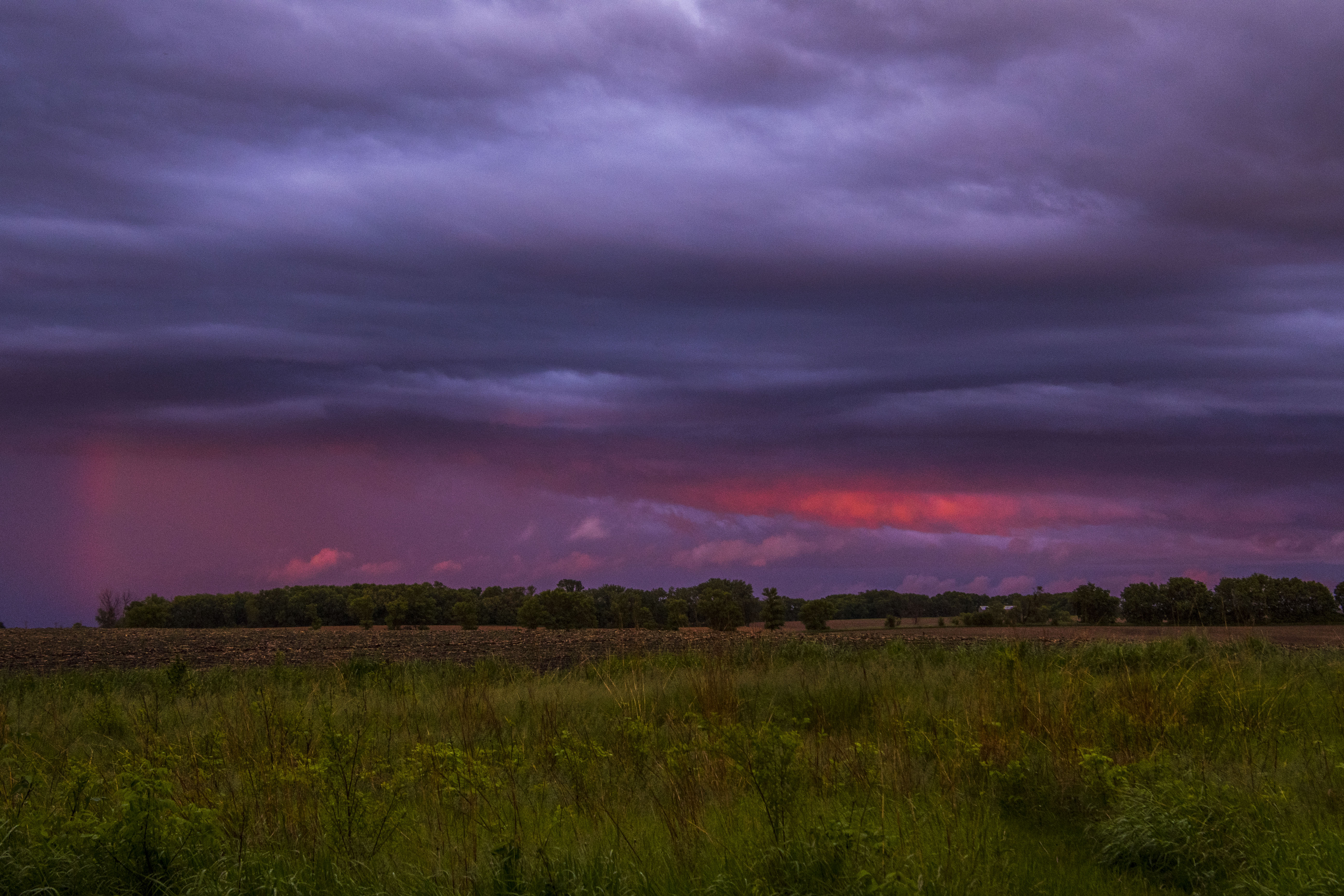
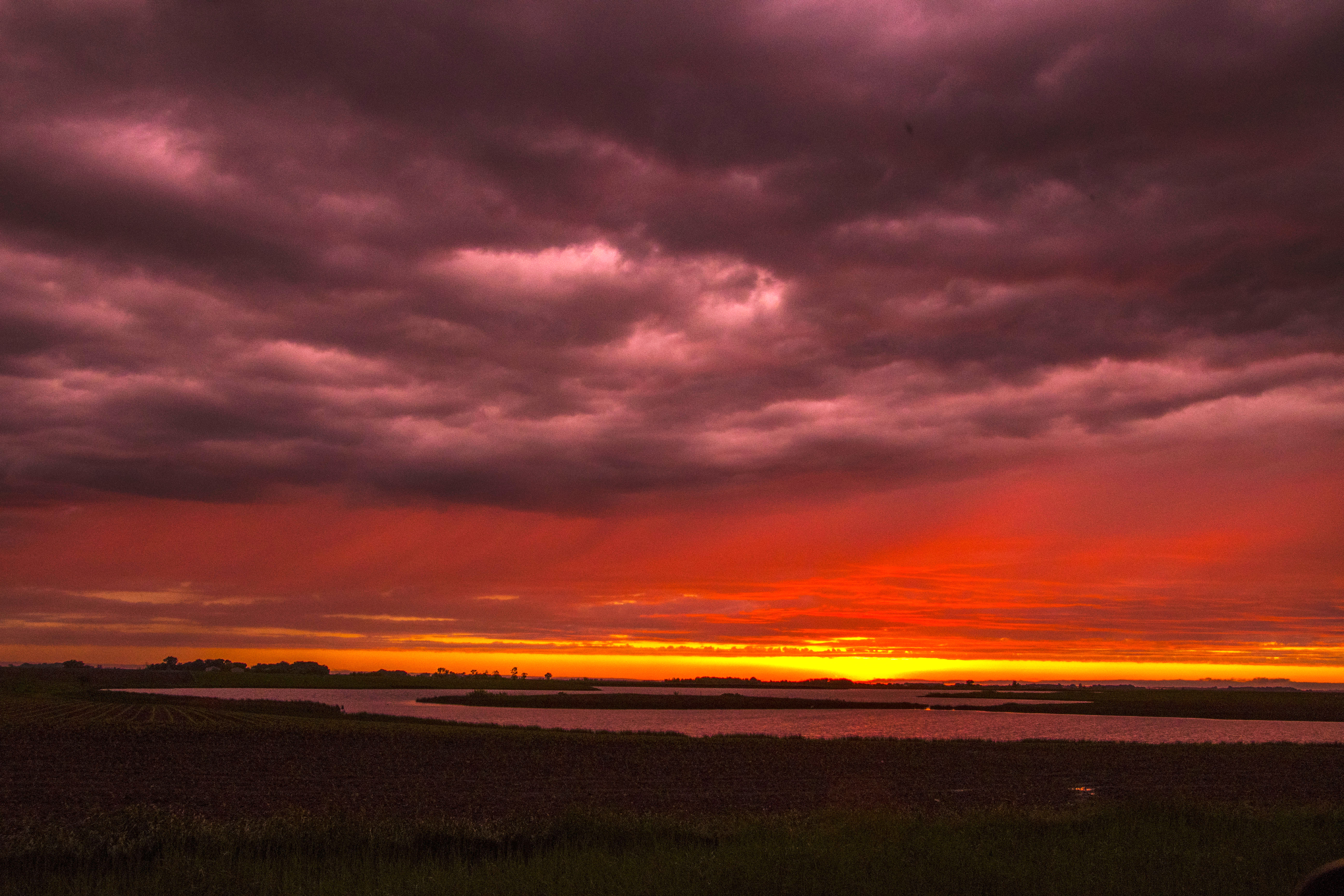
Nearly the same view at sunset, with the ambient colors to the east.

After rising quickly from the planting, I rushed into my studio for my camera. Sandwiched between the rueful blackness of both an overhead storm cloud and the darkened color of our restored prairie, a cumulative white bank of distant clouds fluttered within basically four different levels of threatening storm clouds, all offered as an interesting visual sandwich offering both drama and color.

And it would only become ever more interesting hours later as evening approached. Within a half hour of nightfall that palette offered several different painted skyscapes, and I couldn’t stop attempting to capture them. I suddenly realized what Holm had suggested, and that through time and patience, it was this horizontal skyscape that has allowed me to settle in, to find “home” within an landform and ecosystem so unlike any I had lived in previously. 

The aftermath of the sunset over a nearby wetland. Still the same afternoon.

Yes, I grew up in the wooded hillsides of northeast Missouri, and spent years living along the Mississippi and even in the hills of the Driftless. More than a dozen years were spent in the Rockies of the west, years when I wrote and photographed happenings throughout the mountain communities for the Denver Post, and later traveled from Colorado to the Pacific Coast as a magazine freelance journalist.

When we left our rural home south of the Twin Cities to move to a small town where I would become a “country editor”, our goal was to give it two years at most. Yet, we raised our sons in the small town, then my wife died, and through it all I’m still here in what remains of the original Prairie Pothole Biome. In some ways I feel the influence of Monet, who featured ever changing palettes of color and intrigue in his paintings be they of haystacks, lily-padded ponds or quaint city streets. It was through my love and study of his work that I learned the beauty not of a sunset itself, but rather of the surrounding ambient colors, the drama and intrigue offered by these prairie skyscapes.

Almost as captivating as the afternoon image, again facing to the east.

Nowadays I wish I could once again visit with Holm. Our first of three conversations came after his speech and ragtime piano performance at Prairie Edge Casino not long after his publication of his horizontal grandeur essay. We had teased one another over our respective loves of prairie and woodlands. Now, as this land or skyscape has evolved to grow on me, I could offer a more aware perspective in the conversation, and perhaps we might have had more of a basis for friendship than simply a friendly bantering. Of which we never evolved.

Regrets aside, no longer is there a quest for moving or living elsewhere. Besides that ever loving and changing palette of a skyscape, I’ve come to thoroughly appreciate the solitude and rhythms of seasonal change, of the surrounding nature that has over time developed into various seasonal expectations thanks to both the interesting feathered drop-ins from the flyway to the poking up of overlooked prairie forbs through prairie grasses. 

A final image, all in an afternoon and evening of the same day, all interesting skyscapes!

Someone recently asked if there was a “fall back” position or plan considering my age along with possible prospects of a decline in health, and I simply couldn’t think of one. I guess this horizontal grandeur and an ever interesting skyscape makes this close to being home, and an interesting one as one can possibly find. We’re not being ravaged by affects of global climate conditions as we might be further south, and going back to the mountains might now be limiting age-wise. 

And, as my dear friend, the artist and musician Lee Kanten has suggested, you simply cannot find a better place for observing both sunrises and sunsets. Come dawn or dusk. Ah, yes, those beautiful ambient colors where the likes of Monet could settle in next door and happily place a blank canvas on his easel; where he, Holm, the Kantens and ourselves could sit around sensing the smoke from the grill over mugs of wine as the skyscapes surrounding us become painted with another intriguing image.

Calls of the Wild

As soon as the distinctive call echoed across the wood-rimmed rolling hills, I rolled to my side and glanced toward the sky my camera ready. So familiar, so beautiful. Vivid, yet hidden. A mystery, yet none at all. They were there. Somewhere. A few years back I was sitting a mere few feet from where I was prone when the same sounds broke over the prairie and I was fortunate to capture one of my favorite images of sandhill cranes in flight, one that so portrayed their Pliocene existence. They seemed so prehistoric in flight.

Would I be so fortunate once again?

We had ventured here to the Lake Johannas Esker to once again mingle with the prairie smoke wildflowers that flourish on this rise come May. Years ago Morris naturalist Dave Jungst introduced me to the esker at a time when the white pussytoes and reddish-pink prairie smoke comprised a sparkling carpet of alternate colors on the rounded prairie rise below the husky shoulders of the prominent esker, and since I’ve made point to revisit annually. While once again impressive, there has not been a view quite so compassing as found on that first May visit so many years ago.

Yes, I’m a prairie smoke addict, and these blooms always captivates me.

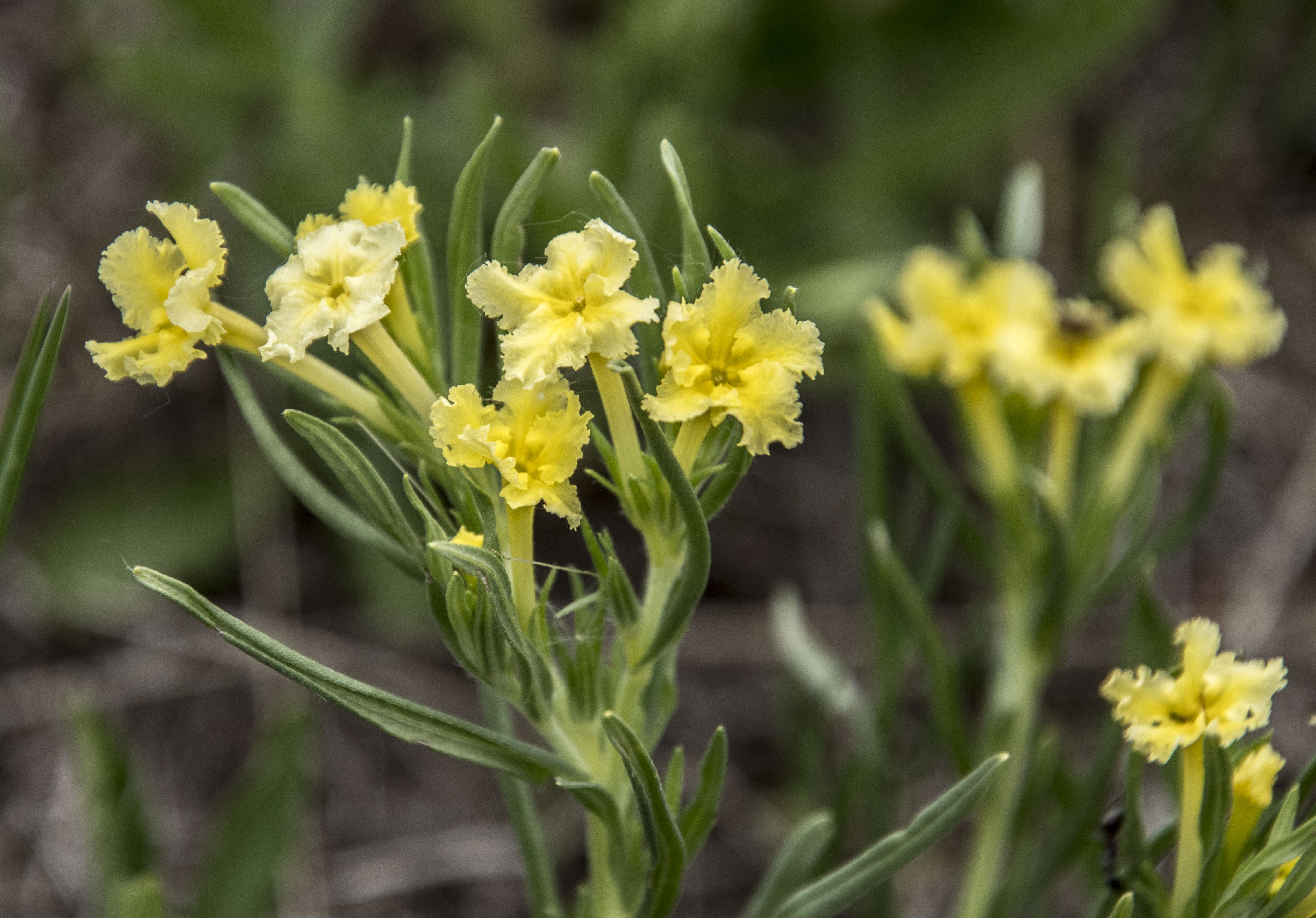
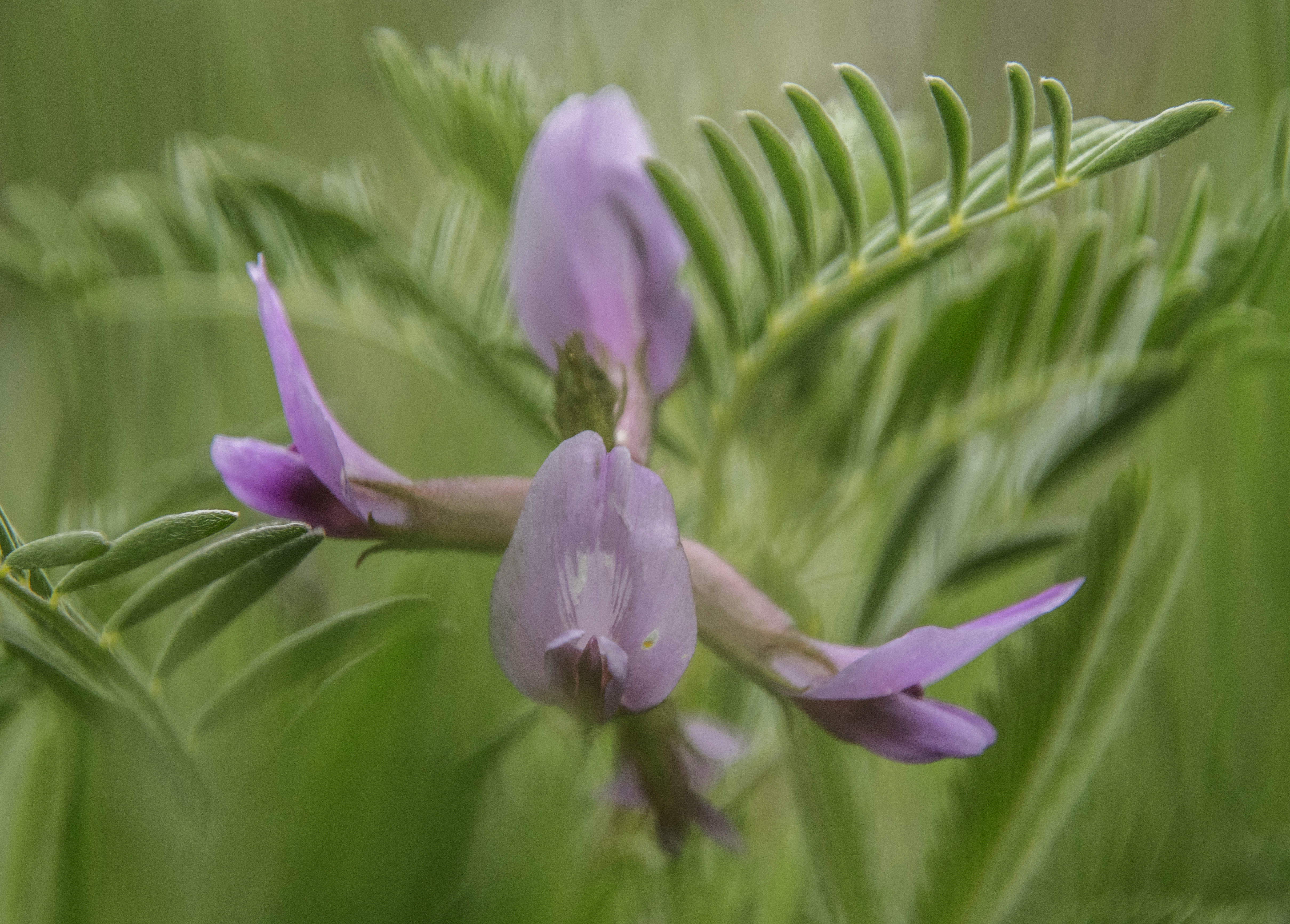
Yet we were once again surrounded by beautiful spring prairie flowers. Those glorious yellow blossoms of fringed puccoon poked a welcomed greeting from the dried sage and dormant grasses, along with brilliant chickweed that seemed so white that it beaconed from the prairie. A whiteness smiling with glee. Tucked away was the purplish ground plum, blossoms not unlike the explosion of a sky high fireworks that peeked through the grasses. All of that plus the prairie smoke offered us a mounded prairie of brilliant color. How could one not be impressed?

Distant to the north of us stood the tall esker, an abandoned glacial stream bed now cloaked by sodded grasses and brush. A snake-like ridge offering a staunch backbone to the lower prairie, rising high in the distance. Here a few years ago as I sat in rest and reflection on the esker itself, a wild turkey popped up from behind a sage bush not five feet away before attempting to secretly sly away. Our brief glances seemed as much a surprise to the turkey as it did to me.

As we ambled up the rise the first patch of prairie smoke appeared, tendrils yielding to the wind. Closer to the esker we came upon a carpet of smoke, a quilt of blossoms in all stages of maturity. Laying low with my lens focusing through the offerings, it could have been mistaken for a forest of reddishness, with the smoky tendrils reaching out from the star-like blooms, many pointing downward while others defied gravity. All stages of the plant’s life cycle seemed evident.

There is little that is more interesting to me than laying on my stomach and focusing a long telephoto through that foot high jungle of pinkish beauty in search for interesting imagery. It was there where years ago I heard the calls from the Pliocene, Aldo Leopold’s “trumpet in the orchestra of evolution.” Hearing the sandhills brought on a whole new level of energy and excitement, a complete jumble of creative focus. From that point forward I would continually peek from the smoky forest to glance over my shoulder in anticipation of a possible flight. Sandhill cranes will do that to me.

Aiming my large telephoto through the “forest” offers a wide gallery of imagery.

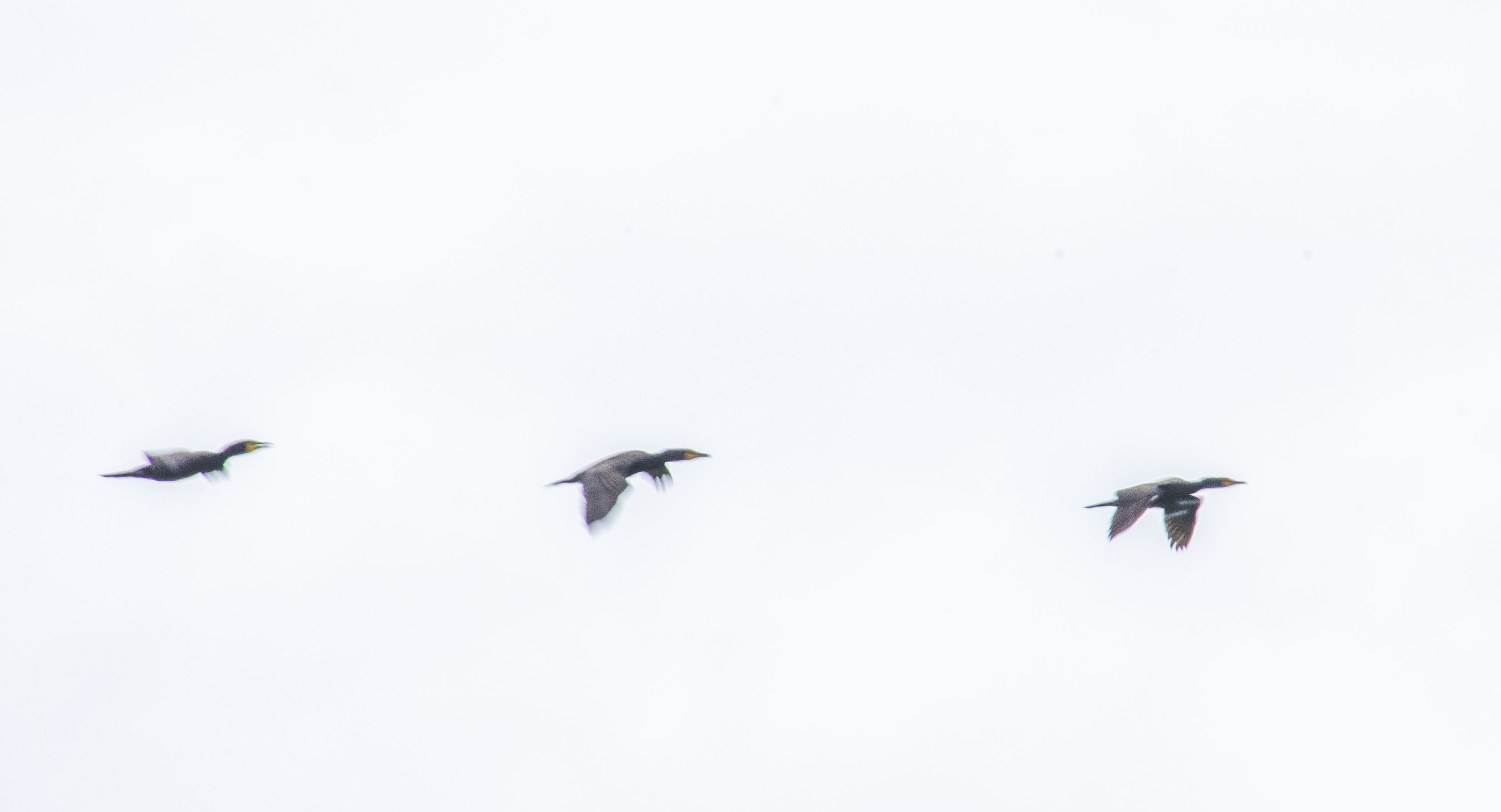
Eventually we would have a brief flyover … of cormorants rather than cranes. They were noticed thanks to my hopeful glances for the sandhills, and I rolled to focus as quickly as possible. Were they from the nearby rookery? Just north of the esker, and beyond the adjacent Ordway Prairie, itself a feature of the Nature Conservancy, cormorants have commandeered a tree studded small island in Lake Johanna as a rookery. From the apex of the esker you can make out the collections of stick nests in the canopies of the denuded trees. With their hooked bills, which is quite a bonus for their fishing capabilities, cormorants look much more prehistoric to me than cranes. If one can make an argument about birds being evolutionary cousins of dinosaurs, cormorants could serve as photographic proof. Their rapid flyover hardly diminished such an argument!

Yes, my eyes were open for the sandhill cranes I heard calling before the cormorants did a flyover.

Still, we had come for the prairie smoke, and despite the welcomed interruptions, I would again be consumed with my intent of gazing through the grasses and the smoke searching for interesting angles and individual flowers. A search that never tires. Prairie smoke is one of my “seasons” of an emerging Spring. They are why I come to the esker much in the same vein as I make a drive to central Nebraska for the annual sandhill crane migration, or drive around Big Stone County’s numerous surviving potholes seeking huge drop-in flocks of snow geese. This is one of my rites of spring, and one I’ll continue until I’m unable.

My image of the sandhill crane flyover in 2019 at the esker.

No, the esker has never let me down. This 800-acre floral paradise is nestled some two miles east of the Ordway Prairie and is dominated by the serpentine rocky esker that rises some 70 feet above the prairie where I laid. Well hidden within the surrounding tree-lined hills between Brooten and Sunburg, it is also close to the Little Jo WMA and the Moe Woods. Driving to the esker acreage takes you through a tree-lined, graveled paradise of a road that includes a few hidden potholes and possible swan sightings.

Yet, once you’re at the esker you’ll find an expansive natural floral “garden” that will likely captivate your imagination. Such were among my thoughts as I lay prone with my long lens, focusing through the incredible color while listening and hopefully awaiting more calls and even a flyover from the evolutionary past. I can’t imagine spending a Sunday afternoon in a more delightful environment.