‘They’re Back!’

As I sauntered down the driveway toward the gravel road for my nearly daily walk, first came the “j-ha-weeep” call in the grove causing me to stop and scan the tree tops. Just as I spied them, two pair of Wood Ducks took flight. To no one but myself came my loudly spoken, “They’re back!”

Yes, this is a celebration of spring! How many of us are guilty of such excited exclamations? And, interestingly, this exclamation isn’t just about our feathered friends. Native forbs, and particularly Pasque Flowers, can create the same excitement. All signs of a changing of the seasons, and with certainty, winter is behind us!

4.24.2018 pasque3

Yes, even the Pasque Flowers are back … although slower than in the past few years.

Shufflling off the shrouds of winter, especially when the expected joys of a warming spring are seemingly pushed back by April blizzards, can be so frustrating. So our shouts of “They’re back!” are perhaps more meaningful now we’re starting to feel and see that Spring is “sprung.” Warmth is once again soothing the soul.

And with it comes almost a daily welcoming of migrating birds with even the most casual of bird lovers thrilled of their first sighting of a Robin, or the sighting of an expected spring flower. For the past few weeks I’ve driven to a hillside that is kissed by the warming sun which promotes the arrival of purplish Pasque Flowers. Some call these “May flowers” because of the blooms were often noted in May because of the long, Minnesota winters. Climate warming changed this, and reviewing my files these past few weeks prove that I have taken Pasque Flower photographs as early as mid-March. On my hill the Pasques were nowhere to be seen even last Saturday. On Tuesday, though, the blue natives were erupting over the crest of the hillside. And, yes, I said it. “They’re back!”

We each seem to have our own sighting of significance be it bird or flower. When my late wife, Sharon Yedo White, would greet me with her, “They’re back!”, she was speaking excitedly about Great Blue Herons. Some go with the poetic, lazy and poetically looking flight of White Pelicans. Color me guilty. Recently, as I was leaving the bank, a flock of a dozen or so seemed to hang in a brilliant blue sky like a luxurious mobile above the mouth of Big Stone Lake, showing alternate brilliant whites and stark blacks against that deep blueness. I had to pull aside, get out of the car and watch for several minutes. “They’re back!” I said to a bank patron as he walked past toward his car. “They’re something to watch,” he said, turning momentarily to watch the seemingly effortless glide.

4.16.2018 pelican1

Like a mobile in the sky, the White Pelicans seemed to hang in the air above Big Stone Lake.

Within the past few days a dear friend spoke of seeing her first Bluebird, and several of us have seen the spindly Yellow Legs. American Avocets are mentioned. Friends who share their wooded deck with wrens mark their return as a sign of spring. Loons are now appearing further north, and yes, one mid-morning last week walking over to the studio a group of five Sandhill Cranes flew over. I recognized the sound and looked up immediately, and there they were, just like we had seen them in the Grand Island, NE, area several weeks ago.

This year, with a lingering winter and what we now consider unseasonable late snows, it seems more than usual that we humans have our eyes pealed to the sky seeking individual sightings of an avian spring. Perhaps that was the impetus for taking in the awesome experience of the Sandhill Crane migration. We were among thousands, many of whom make this trip to central Nebraska an annual pilgrimage. For us it was a quick, three-day road trip, and one we’ll never forget.
4.24.2018 woodduck3

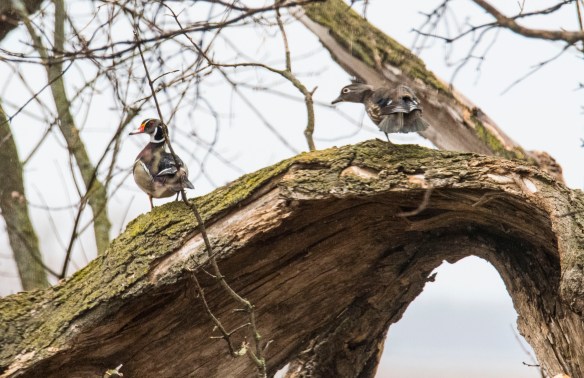
Although their favored nesting tree partially collapsed in a winter wind, the Wood Duck couple came to once again scout the grove for nesting sites.

We are fortunate in this part of the state to be part of the western edge of the Mississippi Flyway, and thanks to the many wetlands and the various prairie rivers, we have a field guide bonanza. Indeed, Big Stone Lake is simply a wide and long portion of the Minnesota River, as is Marsh Lake further downriver, and below that, Lac qui Parle Lake. Marsh Lake contains one of the largest White Pelican rookeries in the nation, so the pelicans we see around here have likely flown from that next widening of the Minnesota River.

And, we have enough restored native prairie around us that we can see two increasingly rare birds thanks to the demise of their grassland habitat, the Meadowlarks and Bob-o-Links … the upside down bird. And, yes, people have expressed their “They’re back!” for both species in the past few days.

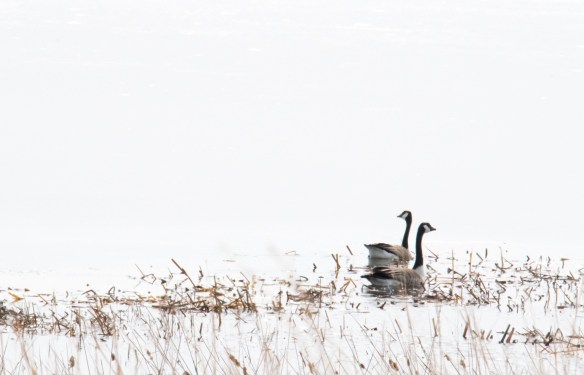
Some bird species are simply passing through. That vast family of warblers among them. Others, though, are now here and seeking nesting sites. Several of the muskrat mounds in the wetlands have been scouted and claimed by paired Canada Geese.
4.18.2018 Wednesday3

Many of the Canada Geese have paired up and searching the shallow wetlands for nesting possibilities.

Since the first sighting in the grove the other morning I’m now watching one pair of the Wood Ducks scouting the trees. Half of the tree they used in the past topped over in one of our winter winds. Perhaps enough of it remains that they’ll reclaim it for nesting. We’ll see. Moments ago a pair was standing on the bent trunk surveying the neighborhood. I can only hope.

Thanks to both the woody grove and restored prairie, we’re fortunate to have many species of birds and native prairie flowers both returning and staying for much of the summer. Prairie Smoke is perhaps our next debutante forb, and the leaves are just breaking through. Another sign of spring as we await the first sightings of the colorful Orioles and Rose Breasted Grosbeaks. For them all I can barely wait to say, “They’re back!”

War on Water

Apparently the war on water has escalated. On both surface and subsurface waters. This is a battle much time and effort has been spent in the past, and involves such tactics as canoeing with board members of the state’s corn growers association, being a 12 year board member of a river advocacy group, and even having been awarded the coveted Riverkeeper award … an honor I certainly don’t take lightly.

Now with the continued assault of our natural resources by the Republican Party on apparently all levels of government, mining and other industry, Big Ag and our so-called president, I’m asking for your help. For the past few months I’ve been trying to decide just when and where I should go to complete a photography project I began last summer, and fear I can wait no longer.

Minnesota River, 2017

Waters from a “protected” stream enters the muddy Minnesota River in Renville County, taken in the summer of 2017. 

This information came through on Tuesday: On Monday, April 16, the Minnesota House of Representatives voted 69-56 to pass a bill that will block the state’s Groundwater Protection Rule from going into effect without legislative approval. The rule would have regulated farmers’ use of nitrogen fertilizer in areas where groundwater is sensitive to nitrate contamination.

Followed by this from my state representative, the very same man who blamed goose shit as the main culprit  for polluting our troubled surface waters: “We also object to author Rep. Jeff Backer’s claims that agricultural producers were ‘blindsided’ by the proposed rule. The draft rule is the product of a planning and rule making process that began in 2010, and has been the subject of nearly unprecedented public outreach and engagement by the Minnesota Department of Agriculture.” This was reported by Friends of the Mississippi River.

St.Croix.Mississip

An aerial image of the confluence of the clean St. Croix River with the Mississippi, where most of the dirtiness comes from the Minnesota River upstream.

My project has a pre-published title of “Art of Impairment.” It is an effort to use photojournalism to highlight our state’s impaired waterways, and I’ve attached some of the images so readers can see where I’m headed with this.

This effort follows my earlier “Art of Erosion” project, which was jointly sponsored by CURE (Clean Up the River Environment) and the Minnesota Master Naturalist program. As a Master Naturalist, I was humbled that they would agree to partially sponsor the 20-canvas show with about ten “pull outs” explaining the cautionary story of what erosion is costing us. And CURE stepped up immediately to volunteer its sponsorship after viewing the initial images, an effort to portray the ugliness of the loss of life-sustaining top soils in an artistic and beautiful manner.

Big Stone County Wetland, 2017

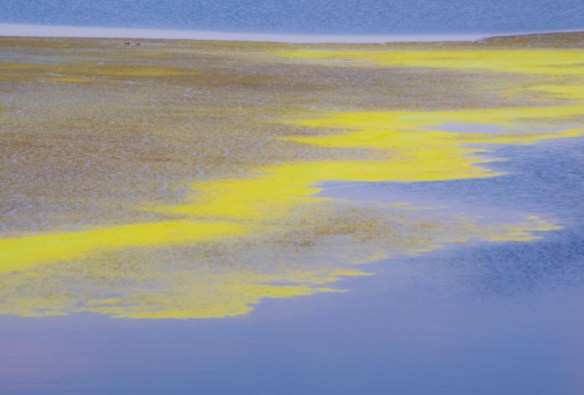
Birds walk on the matted algae on a Big Stone County wetland adjacent to a small dairy. No, this is not a manure lagoon. 

The Art of Erosion has been hung at various conferences in two states, including meetings of the Sustainable Farming Association, at least three University of Minnesota Extension Service sponsored events, MOSES (the largest organic farming meeting in the U.S.), and others. It was also a part of the Smithsonian Institutes’s traveling Water Ways exhibit, and has hung in two one-person exhibits. Pieces of that display have been loaned for use in other educational exhibits. I can only hope that the Art of Impairment will reach as many people, if not more,  upon its completion.

My hope is to portray ample examples of impaired waters that are being polluted by runoff and drainage. Algae-choked waters, for example. Please address emails at jsjawhite@yahoo.com/ to explain what you have witnessed, and where, and I’ll make an attempt to get there as soon as humanly possible. One image I envision is an underwater closeup of micro-organisms of a lethal algae bloom.

Minnesota River Backwater, 2015

Algae chokes a backwater of the upper Minnesota River. 

Wholly a third to a half of the entire state of Minnesota’s waterways are impaired by unhealthy farming practices and urbanization. That includes all the rivers, lakes and wetlands basically south of I-94 to the Iowa border. Lethal algae blooms have killed pets, and few, if any, of the aforementioned waterways are safe for swimming. Many of the fish and game harvested from many of the waters carry advisory warnings. Yet, people like Jeff Backer and others are intent in continuing to reduce and/or prevent protective legislative actions to even halt the continued polluting of the waterways. Not just statewide, but nationally as well. Our natural resources are under attack, and as such, our existence on the planet is at stake.

Backer’s political party, and the nation’s president, seem intent (if not, content) on eliminating all safeguards for both our surface and groundwater sources. It’s as if they simply do not care.

9.12.17 roadside4a

Algae found typically on a prairie wetland … this in Big Stone County. 

Mine is only a small part to hopefully bring these issues to light. I don’t believe humanity is ready to completely poison the planet, and most particularly the lifeblood of our existence … water. In so many ways we’re at war over our rights of protecting both surface and subsurface waters.

I’m asking for, and need, your help.

A Calming of the Sea

During our recent trip to Juneau, our host, Rob Murphy, spent considerable time watching the waves on the fjord just past the bay framed by their expansive living room windows. We had dropped crab pots into the surf in about 75 feet of water on our first morning, and on three of the six mornings the surf was too roiled to check the pots. Rob, however, had a bigger goal in mind.

On one side of one of the huge islands distant in the fjord was a sea lion rookery, and the former son of the prairie was intent on showing us a slice of nature we might consider unique. There seemed to be two constants involving their bay and the nearby fjord. Their immense collection of tide chart booklets (along with cell phone aps!), and the continued monitoring of the waves.

4.10.2018 alaska104

A few hundred of the Steller Sea Lions nestled in a rocky rookery near Juneau.

Yes, we have waves of our bluestem prairies, and some hearty winds. Yet there on the visual fjord white caps ruled the waterways most of the week, and on some days the rollers were rougher than on others. Rarely did we see a sea without white caps. One afternoon we visited a popular beach where we sat to watch the deep rollers of the open fjord as the tide came in, smashing rocks with clarity and purpose, sending spray high in to the air. Earlier we had debated on whether to bring a picnic dinner to the beach, and thought we were wise in eating lunch before we set off for the jaunt up the highway.

On our last morning Rob and I headed into the fjord on calmer seas to check the pots and bring them back to his shop, and we happily caught three “dungy’s” that were of legal size. We would add steamed crab legs to our brunch, with the leftovers going into Kaye’s incredibly delightful and delicious Cioppino, a tomato-based fish stew.

4.10.2018 alaska75

The sound was incredible, a cross between the loud murmur of a huge ball stadium and, oh, a Nebraska feedlot, with mooing and cooing mixed with barks. 

“I think we can go … if the seas remain calm,” Rob had said as we headed back from collecting the pots. Later in the morning we headed to his workshop to clear the path to his cruiser, which we would ease into the water a few hundred years distant.

Obviously I know so little about the sea. No, there weren’t whitecaps, yet the sea was in constant movement, rolling easily across the horizon. Rob took us on a long boat ride up the coast, bouncing from wave top to wave top, past the little island with the lighthouse, and even the beach where we had watched the rough seas the day before. “Some of this,” he said of the sea, “is residual effects from the roughness yesterday. It takes some time for it to calm down.”

4.10.2018 alaska103

They were amazing climbers, crawling up the cliff face like legless goats. 

After a while, he turned the boat and headed more westward and away from the mainland before slowing the boat and pointing to the windy side of a steep and wooded island. It took awhile to realize we were not seeing tan and gray rocks. Ah, yes, the rookery. Using a zoom that reached out to 600 mm, it was nearly impossible to focus and shoot. We were rolling, up and down, even lurching at times, and some of my images were of sky, others of water, and yet still enough to have captured some of the Steller Sea Lions. These are more common in the northern waters.

My dear friend, Mary Gafkjen, Rob’s sister, suggested I crawl into the hold and stand up through a deck port for a freer view. We were a few hundred yards out from the steep little island, yet the sounds were incredibly unique, and windblown for a rather eerie effect. A few weeks ago we were in Nebraska to witness the annual Sandhill Crane migration, and the sounds of the birds was simply unforgettable. Years ago I spent a late afternoon and evening in the Sabine National Wildlife Refuge in western Louisiana and came home with memories of a deep, mental audio imprint. And, now, with the Sea Lions, I witness my third such imprint.

4.10.2018 alaska77

Their climbing is much like that of a caterpillar, by raising their mid-body up on their front and back fins, then inching forward. 

Not to diminish this experience, but it seemed the overwhelming sound was almost like a cross of a huge Nebraska feedlot, with “mooing” or “cooing,” to the loud murmur of a crowded ballpark, all with intermittent barking. The “barks,” I’m told, were those of the California Sea Lions that have migrated this far north.

Then there was the visual, and especially seeing mammals that seemed so awkward out of the sea, climb so high into the rocks along the steep cliffs of the rookery. Apparently their climb is similar to a caterpillar crawl, where they lift themselves up on the front and rear flippers to scoot forward or up.

Here is some information gleaned from an Alaskan Fish and Game website:

“Steller sea lions use rookeries and haulouts on land to rest and suckle their young. Adult females must continue foraging while nursing their pups, and the pups’ bodies are well-adapted to fast while females are hunting prey during 1-2 day trips. By their first spring, pups are able to reach similar diving depths as adults but do not do so as frequently. As pups grow older, their swimming and diving patterns grow to resemble that of older sea lions. The behavior of older juveniles and adults appears to track the behavior of their prey; for example, deep diving as prey move deeper during daylight, a focus on night-time behavior while prey are shallow and the gathering of many sea lions at places with seasonal runs of forage fish. Foraging trips are usually within a few tens of miles off haulouts, but the longest recorded continuous foraging trip was 550 miles (900 km) into the Bering Sea. Older juvenile sea lions can dive to at least 1500 feet (500 meters) and stay underwater for over 16 minutes. When swimming, Steller sea lions use their front flippers for propulsion and their back flippers to steer. When moving on land, they use a “rolling walk” on all four flippers by pulling their hind flippers under their body. Steller sea lions are capable climbers, often found high above the water on cliff faces.”

4.10.2018 alaska87

It’s impossible to capture the true magic of the moment, not from the sounds of the Sea Lions nor the roll of the sea.

Fortunately there was ample time for us to simply roll with the waves to watch and listen. The Sea Lions paid no attention to our smallish boat bobbing in the sea. This was truly a remarkable experience, and for me, one that was quite unique. Rob and Mary kept asking if I had captured anything, for focusing and shooting was a complete “crap shoot.” Honestly, I cannot take credit for how the photo imagery turned out, for many of the images were in sharp detail, thanks to advanced modern photography technology.

Sometimes such imagery is magical, and other times the images pale to an actual experience in the field. I can vouch that this was the case, for I cannot capture for an audience all of the true magic. Not from the Sabine. Not from the cranes along the North Platte. Nor from the sounds of the Sea Lions and the roll of the sea. Then, again, who can?

Restoring the Soul

As we sat in the plywood blind, mere feet from the slow swirl of the shallow North Platte River, my dear friend and travel mate, Mary Gafkjen, quietly marveled at the crowded and loud “gurgle” of the thousands of Sandhill Cranes a hundred yards distant from us and whispered, “This is simply amazing. We’re witnessing a ritual that dates back for thousands of years.”

Yes, a migration that Aldo Leopold described in his essay, “Marshland Elegy,” as “the ticking of the geologic clock.” Since the Eocene, he surmised, an evolutionary time dating from 56 to 34 million years ago.

3.14.2018 crane10a

A songbird appears to watch, as many of us did, as thousands of Sandhill Cranes dot the skies.

Leopold wasn’t the only notable scientist and essayist lured by the Sandhill Cranes. British primatologist, anthropologist and chimpanzee protectionist, Jane Goodall, who apparently returns to Central Nebraska annually for the spring ritual, says, “The cranes restore my soul.”

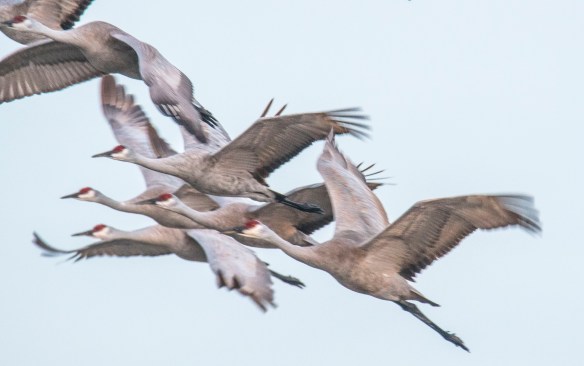
One can only guess at how long the cranes have descended on this stretch of the North Platte. Maps at Crane Trust indicate an hourglass effect that funnels an estimated half million Sandhill Cranes — an estimated 80 percent of the world’s population — and yes, a few of the quite rare Whooping Cranes, from wide stretches of Mexico and Texas to the south through these several miles of flat Nebraska riverine terrain for rest and recharging before spreading out once again from Minnesota to Manitoba and points beyond.

3.14.2018 crane21a

Leopold calls it the migration the “ticking of the geologic clock.”

This ritualistic migration has long been of personal interest. For years in my little basement workshop, hours passed with carving knives, a fly tying vise, a scroll saw and other assorted tools for the idle mind, taped on the wall was a yellowed full page article from some newspaper rallying the mind around a trip to the North Platte for the spring Sandhill migration.

So, yes, this has long been a dream of mine … a dream enhanced by an encounter years ago back in the San Luis Valley of Colorado when a farmer friend and I crouched quietly along a sandy bottom of a drainage ditch to his organic barley field where we spied on a huge flock of Sandhills gathered for a mid-day meal. They are vocal birds, and my bird book calls it a ‘rolling, guttural bugling.” I’d suggest it as an “alto gurgling of river riffles.”

3.14.2018 crane116

Ambient colors from the setting sun provided another layer to an already magical experience. As my friend Mary said, “This is simply amazing. We’re witnessing a ritual that dates back for thousands of years.” Indeed!


Leopold’s take: “When we hear his call we hear no mere bird. We hear the trumpet in the orchestra of evolution.”

It is a call like no other, and was heard through the night as a softened accompaniment. Around dawn the intensity rose once again in a crescendo as the sun edged closer to the horizon. Groups of birds suddenly burst from the river, coursing overhead in poetic and vocal flight. I’ll remember this sound in the same way I still recall a visit some 30 years ago to the Sabine National Wildlife Refuge in western Louisiana, sounds that are both unique and deeply imprinted in the mind.

Yet, it was their picturesque flight I yearned for in our drive into the Platte River Valley along the old Lincoln Highway the day before. My hopes had begun to dwindle as we neared Grand Island late in the afternoon for I had expectations of the skies being clouded with birds. Later as we shared dinner with friends, I kept sneaking looks out the windows of the club in hopes of seeing the telltale V’s of poetic flight. Our hopes improved significantly the next morning as we drove south toward I-80 and came upon a huge flock in a prairie field. Mary got a little nervous as I pulled off on the shoulder and grabbed my camera.

mating

An ever hopeful Sandhill Crane began his mating dance in front of our blind early in the morning, and eventually attracted a bird to join him.

Later in the morning we touched base with the headquarters of the Crane Trust (9325 S Alda Road, Exit #305, Wood River, Nebraska 68883) and our education began. We watched a short film and viewed a nice artistic display along the walls of an adjacent hallway. A volunteer named Catfish held court in the lounge where we learned that the cranes really don’t travel far from the river to forge, that this is a holding area between their wintering areas in the south and their upper continent summer range. Also interesting is that they basically gather and fly in family units.

3.14.2018 crane85a

At dusk the Sandhills came in directly across from our blind, sometimes a hundred or so at a time, sometimes in small groups.

After lunch we drove a bit south along the river where we joined birders from around the nation along the highway, photographing several thousand Sandhills gathered in a prairie field. We made it back to Crane Trust for a final packing of our gear and a ride to one of three overnight photographic blinds. Bruce, our driver, cautioned us that the birds had started holding up around the bend and downriver from the blinds. “Maybe,” he said, “you’ll be lucky.”

3.14.2018 crane109b

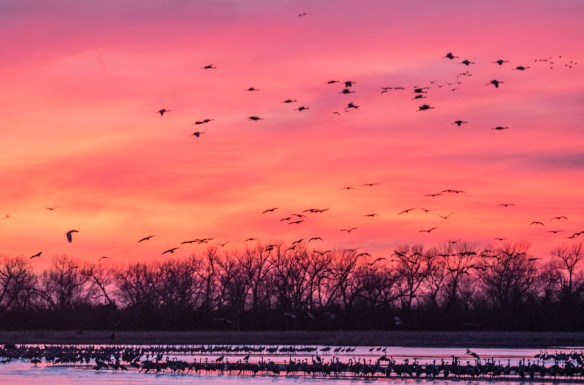
And, indeed, we were lucky, for as dusk settled in birds began arriving from east of us to settle down right in front of our blind.

Once we made camp we settled into a couple of comfortable counter-top styled chairs to await the birds. We didn’t have to wait long, for in the distance … yes, around the bend and downriver … thousands of Sandhills flew in from over the canopy of cottonwoods in a steady fly-in from the adjoining farm fields. After a couple of hours of watching and taking distant shots we surmised that we weren’t going to be lucky. To fill time I posted a picture of Mary on a social network site and mused about our seeming misfortune. That prompted my author friend, Tom Watson, back in Minnesota, to suggest that we simply relax and be patient, to enjoy the unique sounds and the experience.

Patience took us almost through the sunset as more and more cranes continued to land just around the bend. “None of them seem to be coming from the east,” Mary whispered hopefully. Hardly had the words been spoken  when the first flock of perhaps a hundred birds suddenly eased over the cottonwoods directly across the river from us to touch down right in front of the blind. And they continued to come. By the hundreds. Way too many to count. Suddenly the sound was deafening. We were quickly enveloped in a magical cocoon of evolutionary time and experience. Yes, a restoration for the soul.

3.14.2018 crane118

As dawn broke, groups of Sandhills suddenly rose from the shallow Platte, headed for nearby fields of forage.

Once again I must turn to Leopold: “Our ability to perceive quality in nature begins as in art with the pretty. It expands through successive stages of the beautiful to values as yet uncaptured by language. The quality of cranes lies, I think, in this higher gamut, as yet beyond the reach of words.”

To the Women …

Well, now, it’s International Women’s Day and the celebration is flooding social media sites. All of this encouraged me to think back on the many influences I’ve had over the years. There are many, and I won’t remember them all.

It would be easy to name those who have influenced you from afar, such as Harper Lee or Rachel Carson. Carson’s book, Silent Spring, had a major influence on me as a youth, that perhaps there were sides of stories we were not being told. This was as much a start of my interest in journalism as was artist Georgia O’Keefe was in different ways of looking at nature.

However, I prefer to think of influential women closer to home. This starts with my mother, Mary Laurele Dunham White, who was just as sharp mentally at 100 as she was when I was a child. She was the first in our family to earn an advanced degree, and upon finishing college hit the road with three of her closest female friends for a road trip before WWII. Women just didn’t take road trips back then, not in 1939. Her sister, Helen, followed her to college and was eventually part of the team for the Manhattan Project.

Mom taught me about fishing, and perhaps most of all, insisted we always have a hand hobby. “If you use your mind, you’ll need to use your hands to relax,” she said. She encouraged curiosity and individualism … to not be concerned with what the neighbors thought. Her mother, who died of a stroke before I started school, was said to be very independent … the entire family, from my grandmother’s generation though mine, and the girls and now women of the more recent generations have that same trait. More than once I’ve said that if all women had grown up in our family, no one would have heard of Gloria Steinem.

After high school I ran into a completely unexpected influence, one whose name has long passed me by. We grew up in a small town in segregated times. If you were black you knocked on the back doors of stores for entry, and you weren’t served at the lunch counters. A year before I started high school the board desegregated the senior high, and my black classmates were more seen than heard. Immediately after graduation I went into basic training, and was stationed at Fort Sheridan in the motor pool, ran by a boisterous and quite confident black woman. She was extremely outgoing and confident, and she ran the office with complete authority. She was an eye opener for me, and to say I was influenced is putting it mildly.

DSC_0056

Me and my late wife, Sharon, who taught me so much about caring for the disadvantaged and disabled.

Moving on …  here are some others:

Susan Beloit Thompson, my college sweetheart, who taught me to how to find joy in the small and common stuff, that everyone has a story and usually a good one. She found immense joy in running a small town weekly.

Jodi Cobb was one of the first women photojournalists and a colleague at the Denver Post, and later was a National Geographic mainstay. Yes, she could shoot with the best of us, without fear, and with a damned fine eye.

Sharon Yedo White, my late wife, who despite her personal demons of depression had a heart the size of Texas, and a love for anyone disadvantaged in any way.

Kylene Olson, a dear friend, who showed me how you could successfully blend activism with policy, and sell those ideas to those who might disagree with you.

Asa Fanelli showed many of us that you can lead with love and compassion despite a corporate “bottom line.”

women1

Asa Fanelli, former president of EF Foundation, showed us that you can be a leader with love an compassion in spite of a corporate bottom line.

Audrey Arner moved into the prairie and showed us how to combine art with farming, and that no horizon was too distant to reach. She was instrumental in developing one of the area’s first permaculture farms.

CJ Ford, along with her late husband, Chuck Weibel, proved you could convert a strange idea of growing vegetables in the middle of the winter, in Minnesota, by using passive solar and making it work even as a CSA. They published a book that eventually led to forming of a state-wide organization.

women1 copy

Clockwise from upper left, Kylene Olson (right); CJ Ford and Audrey Arner; Julia Ahlers and Amy Rager.

Amy Rager championed a way to develop a program called the Minnesota Master Naturalists, borrowed from the Master Gardener program, that has trained thousands of volunteers in three distinct ecosystems on how to volunteer and educate others on the necessity of natural quiet places in nature. Now her program is being used in many other states.

Julia Ahlers has introduced me to the incredible depths of spirituality, and the broad underlying necessity of recognizing and listening to the unspoken.

fishingpartner1

On one of her last days of fishing, due to the affects of macular degeneration, we caught some nice fish in a farm pond. With my son, Aaron.

Oh, there are so many women who have inspired me through my lifetime, so many there is hardly time to remember and recognize them all, and yet, I’m ever grateful. Through it all it goes back to my mother, who taught me to be open minded, curious and adventurous … that people of any race or gender have something to share, and your role as a human is to be open and accepting of that generosity.