Unknown's avatar

About John G. White

Somewhat retired after a long award-winning career in newspapers (Wisconsin State Journal, Dubuque Telegraph-Herald, Denver Post and a country weekly, the Clara City Herald). Free lance photographer and writer with credits in more than 70 magazines. Editor with various Webb Publishing magazines in St. Paul, and a five year stint as editorial director at Miller Meester Advertising.

Wind Games

Back at an age when mother-pleasing was something boys seven or eight find easy was perhaps when the concept of wind first entered my consciousness. We were in the midst of one of those sultry 90-90 Missouri summer afternoons without air conditioning with no hint of a comforting breeze.

“Don’t worry,” I told my mother. “I’ll make the wind start.”

We had a young elm, or so it seemed. I scampered up the tight bark, grabbed a long and low hanging limb to pull myself further into the heart of the canopy. Using my arms and legs I started pushing limbs and jumping on the branches with all my might. If I could just get some air moving, I thought, the wind would begin. A passerby might have slowed at the vigorous movement in the center of the tree … until one of the branches holding me aloft snapped and I was sent sliding down into the yard.

“Nice try,” said my mother with a smile once she realized there was no broken bones. “But you can’t start the wind.”

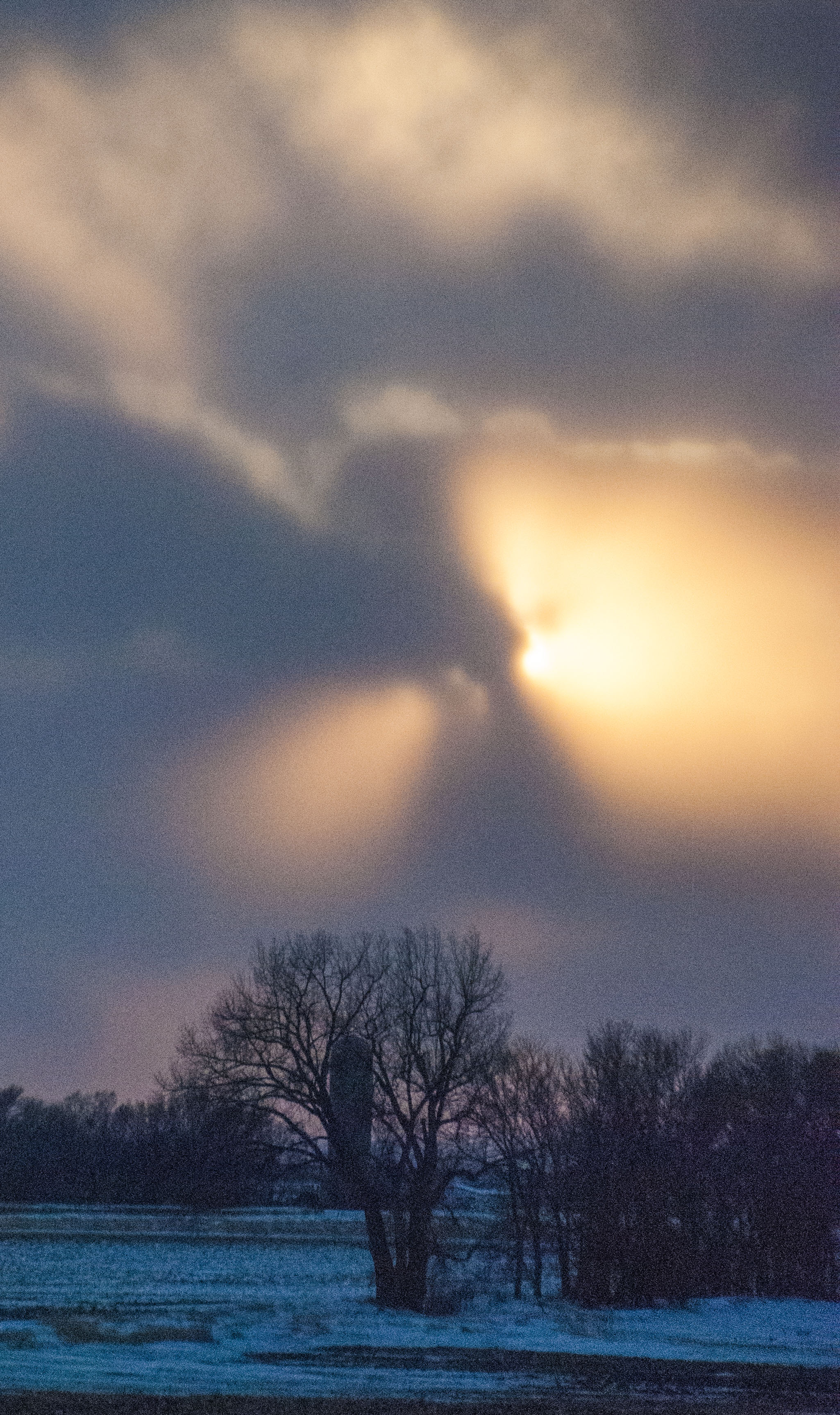
Wind-blown snow creates a halo effect on a prairie wetland.

Wind-blown snow creates a halo effect on a prairie wetland.

This was the beginning of my being haunted by the wind. From the slight, calming breezes that sooth the soul to the extreme of feeling and hearing of the forces of a 300 mph plus trauma of wind that swirled around the circumference of a thunderous storm cell to propel a six-seater cloud seeding plane above the Northeastern Colorado plains. Now, living here in the open prairie, wind is nearly a constant companion. It rumbles, sometimes like low thunder, from all directions, often deep into the night. It may tingle our wind chimes, or produce a wild, Beethoven-ish symphony clanging from the ash and oaks in the yard. Sometimes when you try to take a step into it out on North Meadowbrook, a northwesterly will stand you straight to halt you in mid-step. Wind has moved hundreds of tons of topsoil this winter, yet has delicately written “poems” in soft snow using prairie grasses as cursive “pens.”
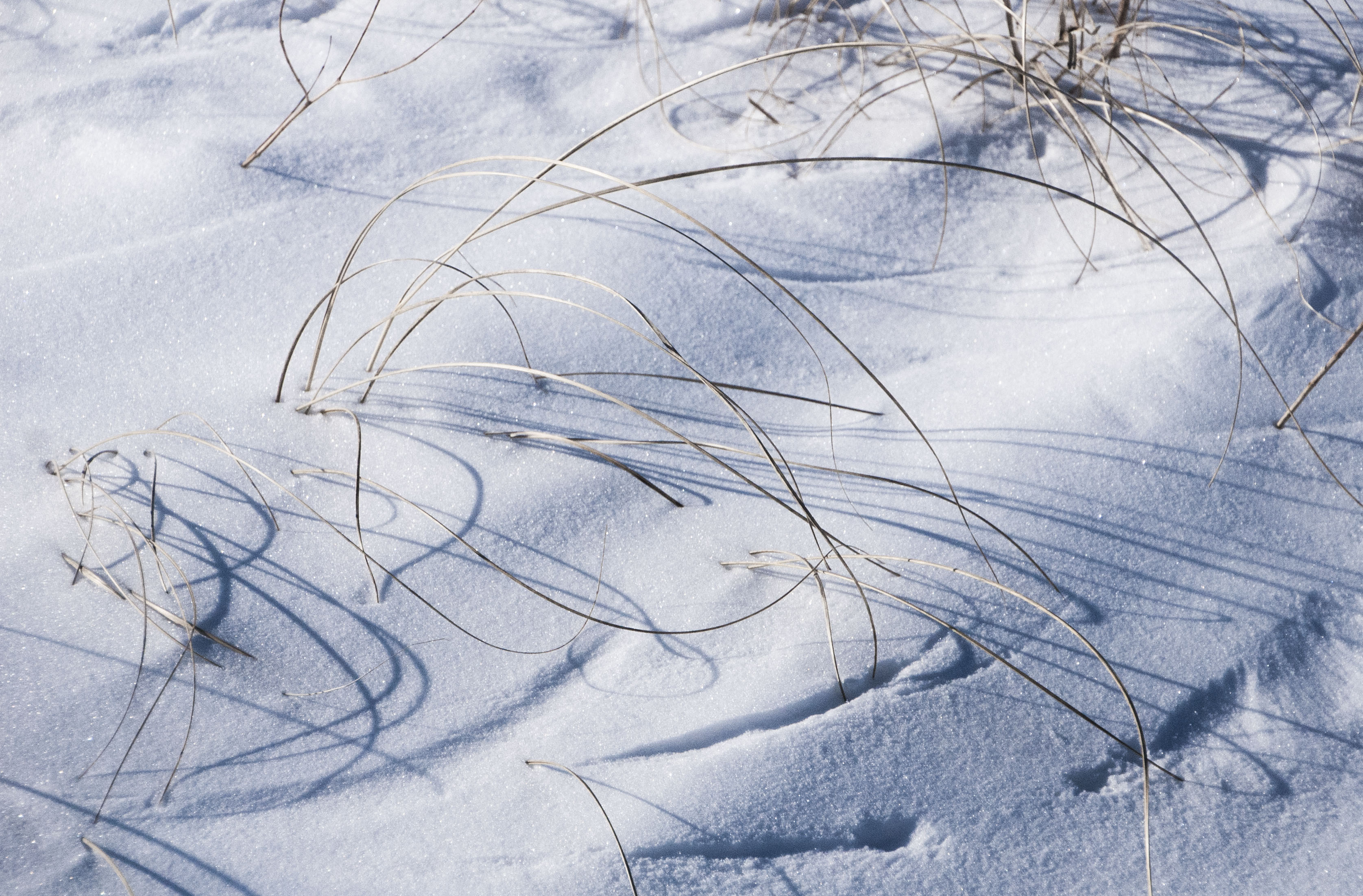
Tips of prairie grass leave wind-etched "poems" in the winter snow.

Tips of prairie grass leave wind-etched “poems” in the winter snow.

This haunting caused a friend to recently tease me of how I could happily forgo watching commercial television programming for cultural media awareness in order to follow my passion for making images of prairie grasses in the wind.

“You must realize that watching prairie grasses blowing in the wind isn’t for everyone,” she chided.
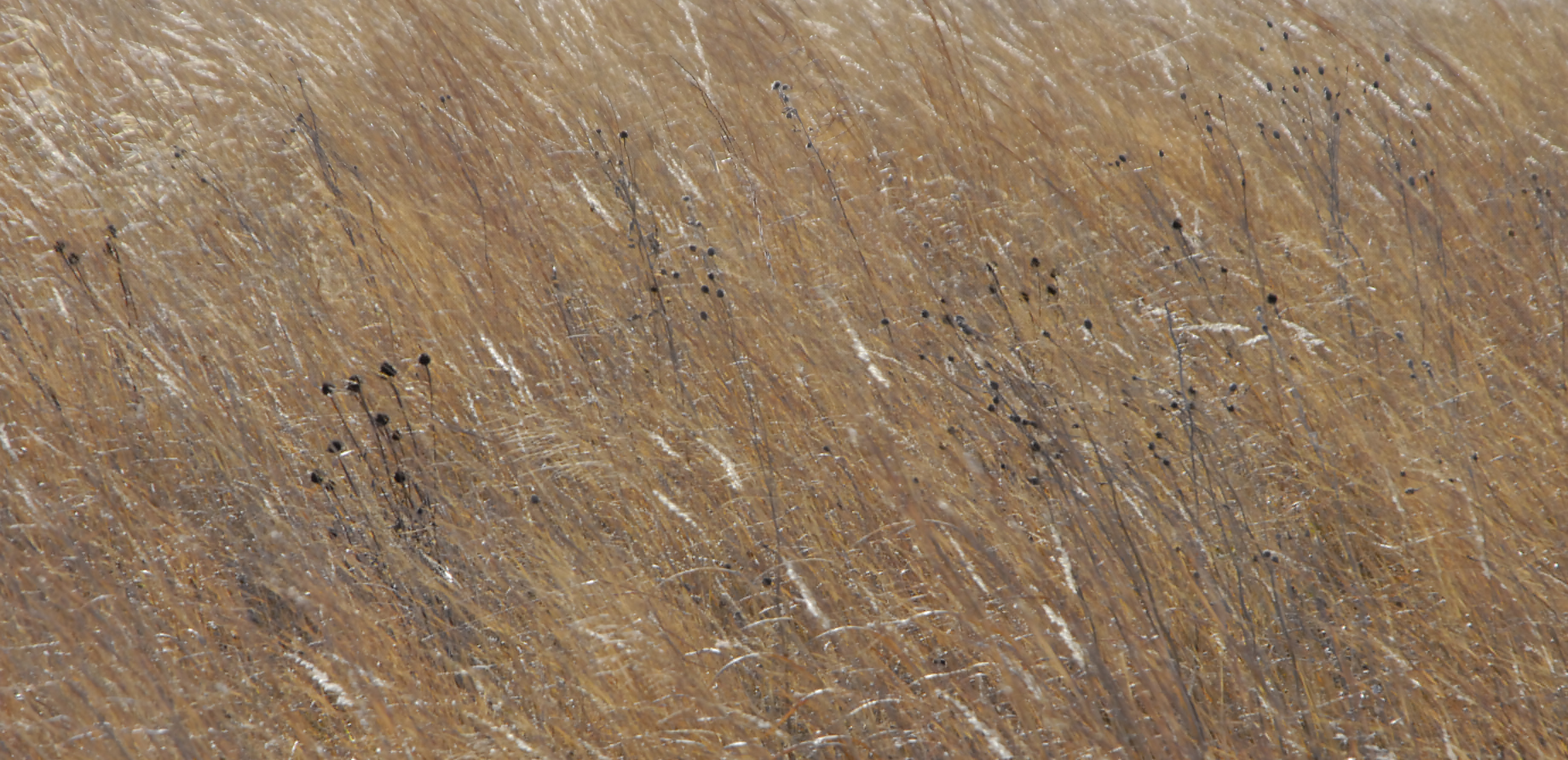
Indian Grasses dance in a prairie wind.

Indian Grasses dance in a prairie wind.

Wind is my weakness. There was that late fall evening in the 1970s in an old farmhouse outside of the Newton, IA, home of the teenage boy who’s letter prompted Pope John Paul II to visit Iowa, when I asked the family while I was doing his story if I could spend a few moments alone in an upstairs bedroom just to hear the whistling of the wind. They smiled as I backed into the room and turned off the light to sit on the bed. It had been years since I’d heard that whistle and whine of the wind in the sleeping porch of my parent’s old Missouri farmhouse. It whispered a momentary meditation.

So, yes, I have many wind stories. Last weekend as I sat alone in my canvas ice fishing “clam,” a ferocious wind whipped and snapped the canvas during a Severe Winter Warning with a -45 degree wind chill, bringing  many wind moments to life as I fought off the bone chilling cold. Wind games, if you will, playing with the mind and the numbing elements.

Sportsmen around here have given ample warnings about these Big Stone Lake winds that howl down this 26 mile long corridor of water, and now, ice. “Never get far from shore in your kayak,” they’ve warned in the warmer months. “You never know when the wind will come up, and remember, there isn’t anything out there to slow it down.”

Many tell tales of friends being caught, or of themselves being in instant peril, being stranded miles from a boat launch or pushed against a distant shore, of being capsized and adrift. This time on the ice was as close as I have come to feeling the heed of their warnings.

Despite the side flaps of the canvas panels being buried beneath ample ice chips and snow, the canvas snapped and popped with incredible and forceful energy. I was afraid of standing, fearful of the clam blowing away down the length of the lake. As I watched the undulating sides of canvas I was visited with another wind game, from of all places, the Caribbean somewhere outside of Road Town, BVI. I suddenly visualized being on the deck of the 210 ft. barquentine I was fortunate enough to help sail in the late 1970s. As we maneuvered the big square-rigged sailer into open seas, the huge sails filled with wind, snapping and popping the sailcloth just like it was my ice fishing canvas on Big Stone. Indeed, these were the only sounds as the antique naval training ship listed slightly and cut a magnificent wake in the azure sea.

I could only wish the mental images of the blue Caribbean skies had been more warming, as had the few jumbo perch pulled up through the ice. This would be another day dominated by prairie winds sweeping in from the Saskatchewan Plains, winds that once again lifted loam and snow into the skies up on the prairie and rattled old windows.

Indian Grass and heads of cone flowers moved by prairie winds.

Indian Grass and heads of cone flowers moved by prairie winds.

Through the night gusts rumbled through like a distant freight train, warded off by solidly insulated walls and a bevy of quilts made by the mother of her modern day Don Quixote, a man who has come to realize he can neither start nor end a wind … even he might wish to.
Grove CSI: Owl Strike

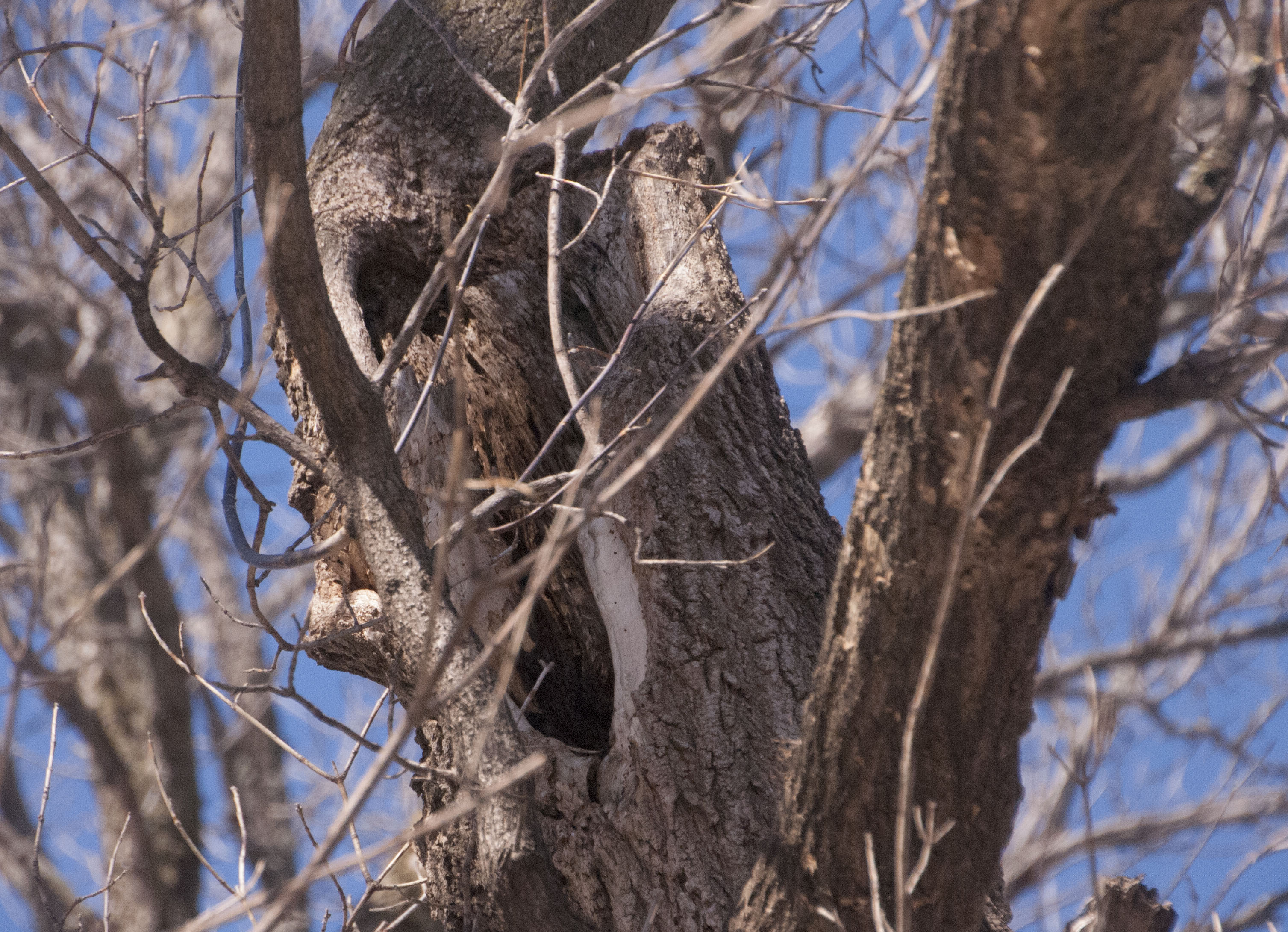
Neither of us have seen the owls, although there might have been a distant sighting of one earlier in the winter. After the winds had ripped the last of the leaves from the trees in the grove we witnessed what seemed to be a silhouette reminiscent of a stately owl on a limb of the huge cottonwood that stands as a sentinel on the far northeast corner of our stand of trees. My binoculars made the darkened dot a little larger, enough so that it might resemble what you envision as a great horned owl. That is as close as we have come to seeing one.

The cottonwood is high enough to give an owl a vantage point view of both our eight acres of prairie and a wetland just over the rise of the hill on the other side of the road.   

We know owls are around us for we can hear them hooting. First one, then another. One closer, the other more distant. Just a quarter mile to the west of our farm is another good sized woodland … good sized in Minnesota prairie terms. Perhaps five acres in all, right along the gravel road. The distant hoot could come from there if the closer one is in our grove. 

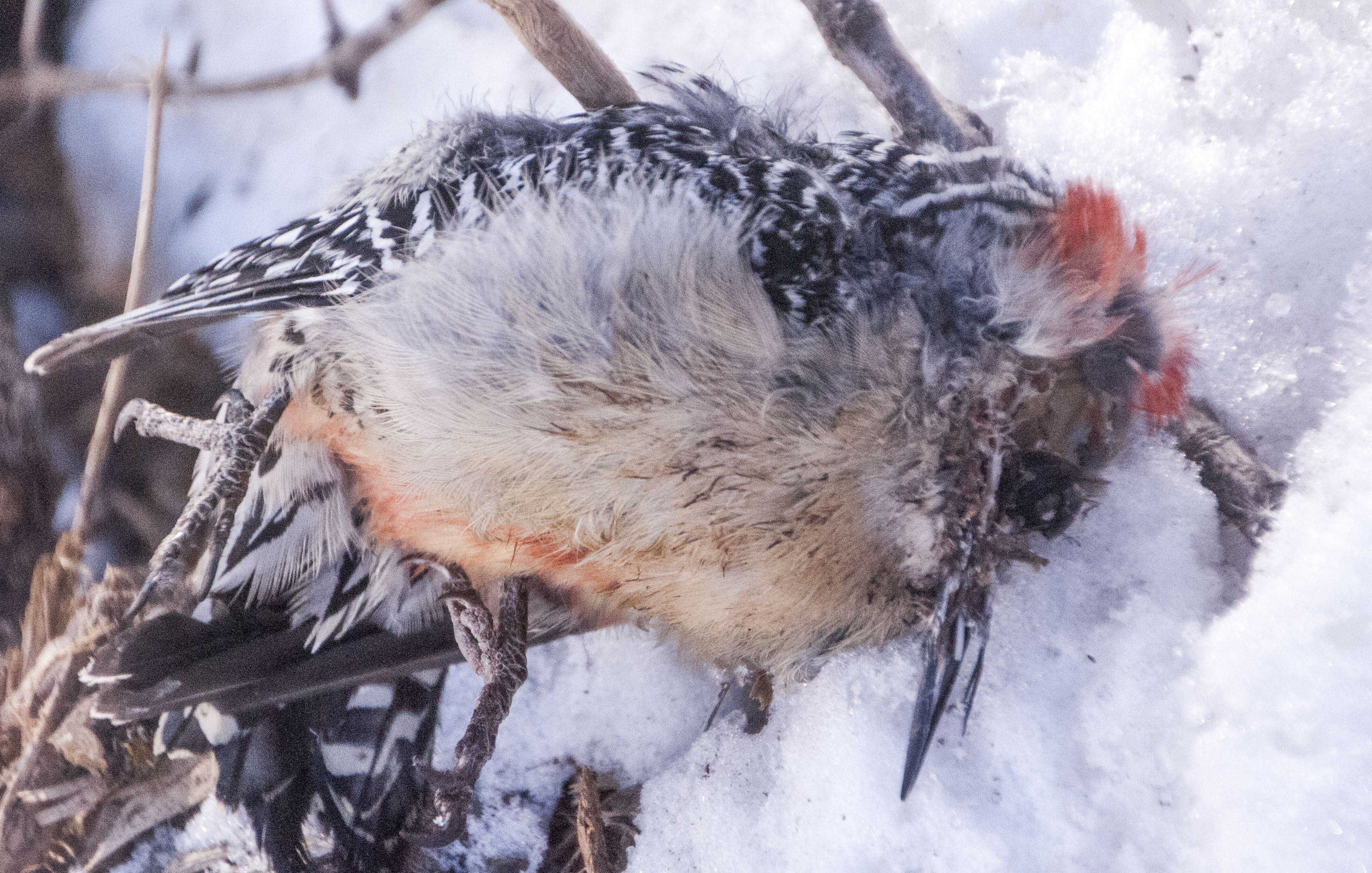
Rather convincing evidence that owls are near greeted me on my return from the mailbox the other evening. Laying beneath the canopy of our recently cleaned grove was the carcass of a red bellied woodpecker with the upper skull eaten away. Perhaps this was the one I’ve been stalking with my camera. A red bellied was one of the first species to find our feeder once we got around to filling it with the ever popular black sunflower seeds.  

In my quest to capture an image of this beautiful bird I’ve set up my blind to no avail, and my luck using a remote shutter release wasn’t much better. This was one camera shy bird, unlike some of the other species coming to the feeder. The smallest woodpecker, the downy, and the larger hairy woodpeckers, have joined the bluejays and nuthatches in my digital cache of photographs, but not the red bellied.

Finding the carcass seemed to answer why the sightings of the red bellied had suddenly become so scarce. We’ve missed that telltale swoop down to the small tree the holds the squirrel-proof feeder, for the red caught your eye especially on those gray or whitish mornings. It would land low on the base of the tree and skitter up the trunk to where it was just a short hop over to the feeder. Once a seed was secured, off it would fly over the solarium porch back to the grove.

Image

Seeing the red bellied in the grove earlier in the fall keyed our decision to keep a number of what we called our “woodpecker trees” among the ash and other trees too immature for the saw. As we worked around one tree in particular, one with obvious pecked holes in the long dead wood of the trunk, the woodpecker had briefly peeked out at us. We assumed this was where the red bellied was returning with its seed. When the hairys return to the grove with their seeds they alight on our “lightning” tree, crawling up ever higher before breaking open the seed. Not the red bellied, for it typically flew deeper into the grove to its tree. That flash of red wasn’t good for keeping secrets. Not from us, nor apparently from the owl.

When I found the carcass, most of the head and that telltale identifying red stripe on the crown was gone. Eaten away in a meal of nature. 

Image

It was on a canoeing trip years ago on the Chippewa River that made me instantly think the culprit in the demise of the red bellied was an owl. We had just paddled around a bend when we came upon a noisy confrontation. Perched on a staunch limb just below the protective outreach of the canopy was a great horned owl, and scurrying all around it was a murder of crows, diving and cawing, threatening the much larger and dangerous bird of prey with pronounced racket and mayhem.   

“Accusations,” suggested my paddling and fishing friend, Wes Konzin as we slowed the canoe. “I think it all comes down to beheadings.”

Sometimes you can sneak into the inner workings of the natural world in a canoe, or it may materialize beside you while quietly waiting in a deer tree stand. We were completely unheeded as we drifted by, intently watching the confrontation. Surprisingly, the owl suddenly bolted from the tree, hastily beating its wings to escape just over us in that supremely hush of owl flight with the murder close behind, cawing, some deftly diving at its head, to land again inside of an outstretched canopy of a tree just down river. There the murder of crows continued their relentless attack.   

The birds know. So the beheading of the red bellied was a circumstantial CSI moment in the grove perhaps.   

After finding the carcass, calls were made to a couple of naturalists who both confirmed that the red bellied woodpecker had likely met its fate at the beak of an owl, that the eating of the head was indeed a significant clue.

Death is often sad, especially for those who remember a certain specialness. For the shy woodpecker, we’ll miss that flash of red swooping into our little square window to the outside world, its hopping up the narrow trunk of the tree, at how nervously it looked around in a search of danger, the quick stab for a single sunflower seed, then just as quickly, the flash of red disappearing back toward a hideaway in the grove. One of those flights was its last.

All in the realm of nature.

Through Our Windows

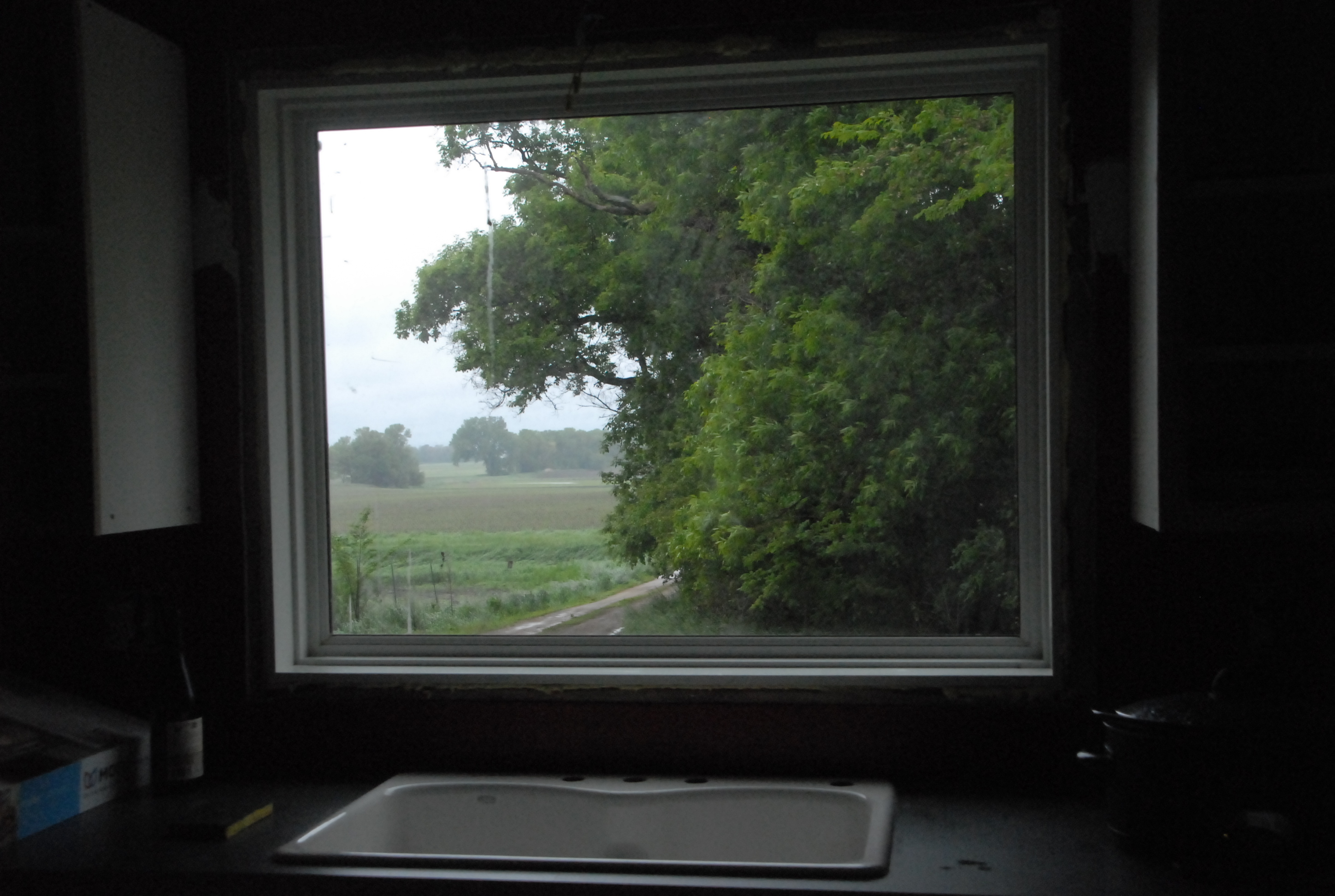
Making dinner around here is so much fun. We rarely layer noodles with soups from Campbell’s’, and usually have a glass of wine within reach. One of us will usually stake ourself across the room chatting with whoever has opted to cook. Often we’ll walk around the center island to glance out the big kitchen window to take in what is typically a postcard worthy view. This happened again last night with a startling sunset.

Sunset from the kitchen window.

Sunset from the kitchen window.

“Startled” might be considered a bit extreme, and “surprise” might be closer to an appropriate reaction to when we first entered this kitchen where we spend so much of our quality time. This was my reaction on first looking at two double-hung windows with blurring screens found above the kitchen sink. “If we buy the house,” I said as we began our first look around, “these windows have to go. We must have a big plate glass window in here.”

Rebecca and Steve Bruns talking in the kitchen during the remodeling phase. The double hung windows are behind Steve.

Rebecca and Steve Bruns talking in the kitchen during the remodeling phase. The double hung windows are behind Steve.

Rebecca was no stranger to the house and especially in this kitchen where she recalled having numerous meals with her friends, the previous owners. If she was taken back by my comment, she hid it well.

Roger Albright and Steve Bruns bringing the new kitchen window up to install.

Roger Albright and Steve Bruns bringing the new kitchen window up to install.

The kitchen window after installation.

The kitchen window after installation.

Windows have long been a fascination. Whether visiting an old farm house like ours, a hospital or motel room, or even a European castle, I always find myself looking through the windows to see what there is to see. You know, “If I were king I’d put a window right here” sort of thing. I’ve never understood blocking a window view with a lamp, or even curtains. This has caused a few arguments and awkward moments through the years, and usually I’ll back down on the curtains.

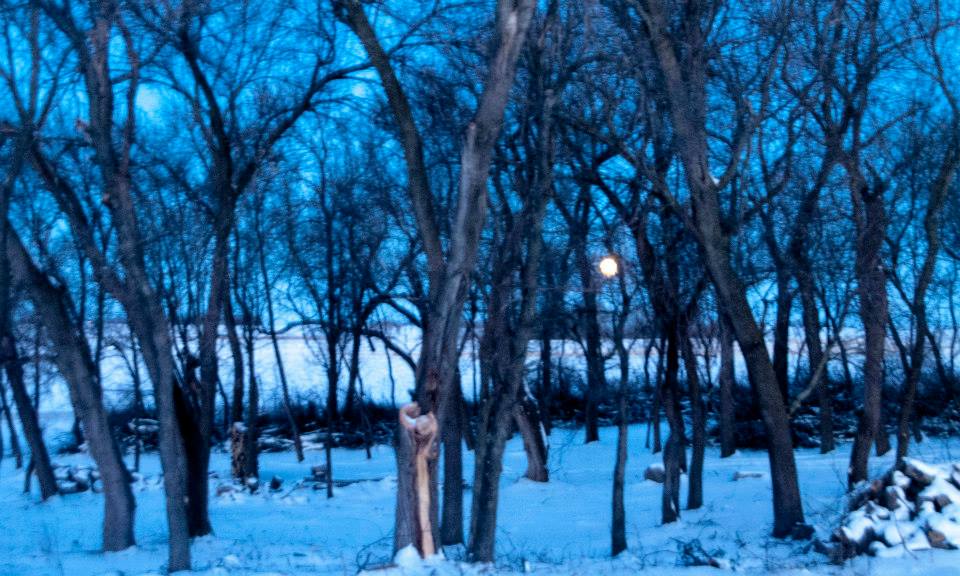
Moon set from kitchen window.

Moon set from kitchen window.

Windows can showcase a larger world much like a picture frame. Through the years I’ve seen some fascinating views through the windows of others. So, in our pending purchase I simply couldn’t consider having all that wood framing and grayish screens blocking such an incredible view of the wooded grove, the nearby prairie or that distant farm site, views that seemingly are varied with each sunrise and setting sun, by cloud patterns, by rain, fog and blizzardy snow. These views never tire.

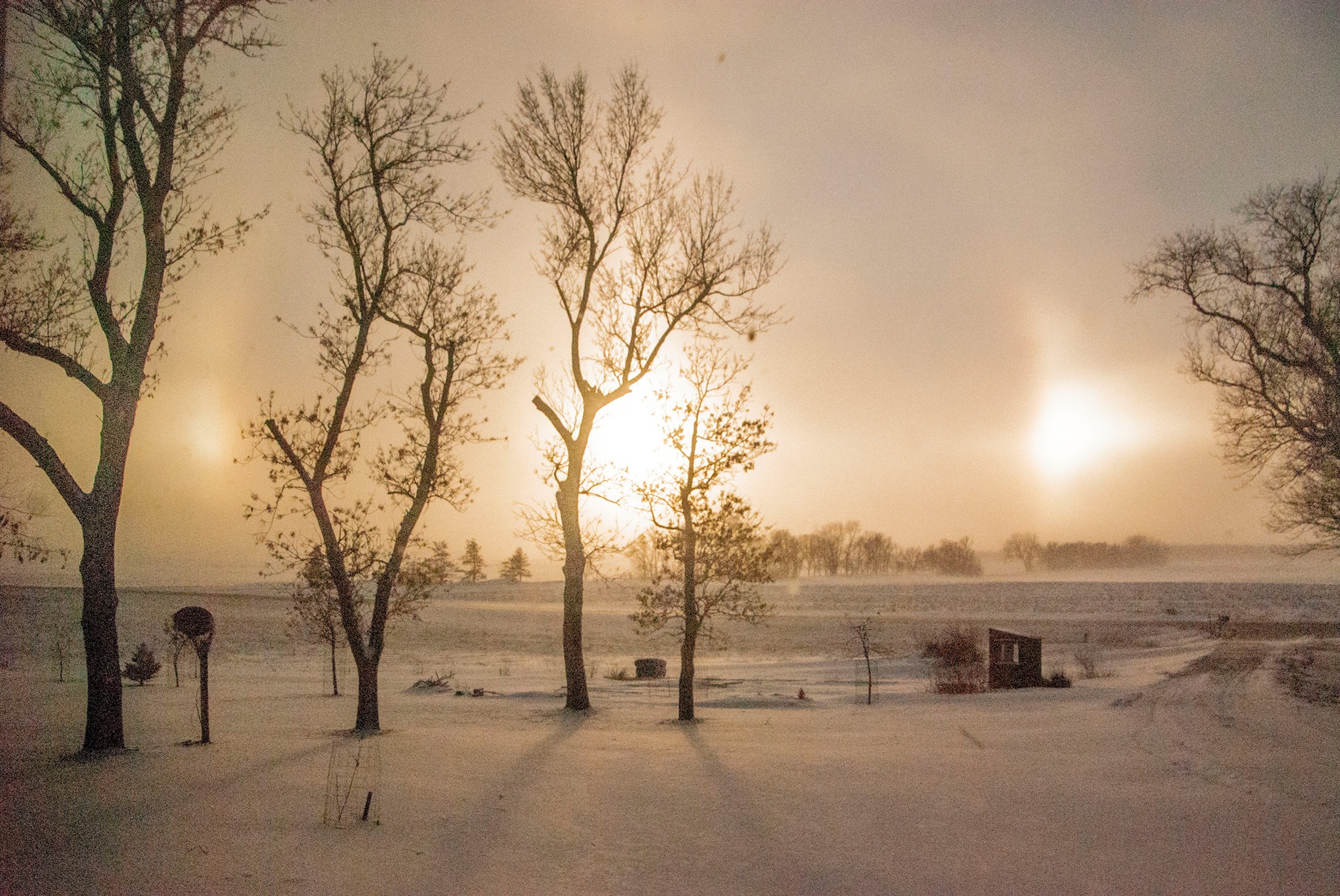
Sun dog from our kitchen window.

Sun dog from our kitchen window.

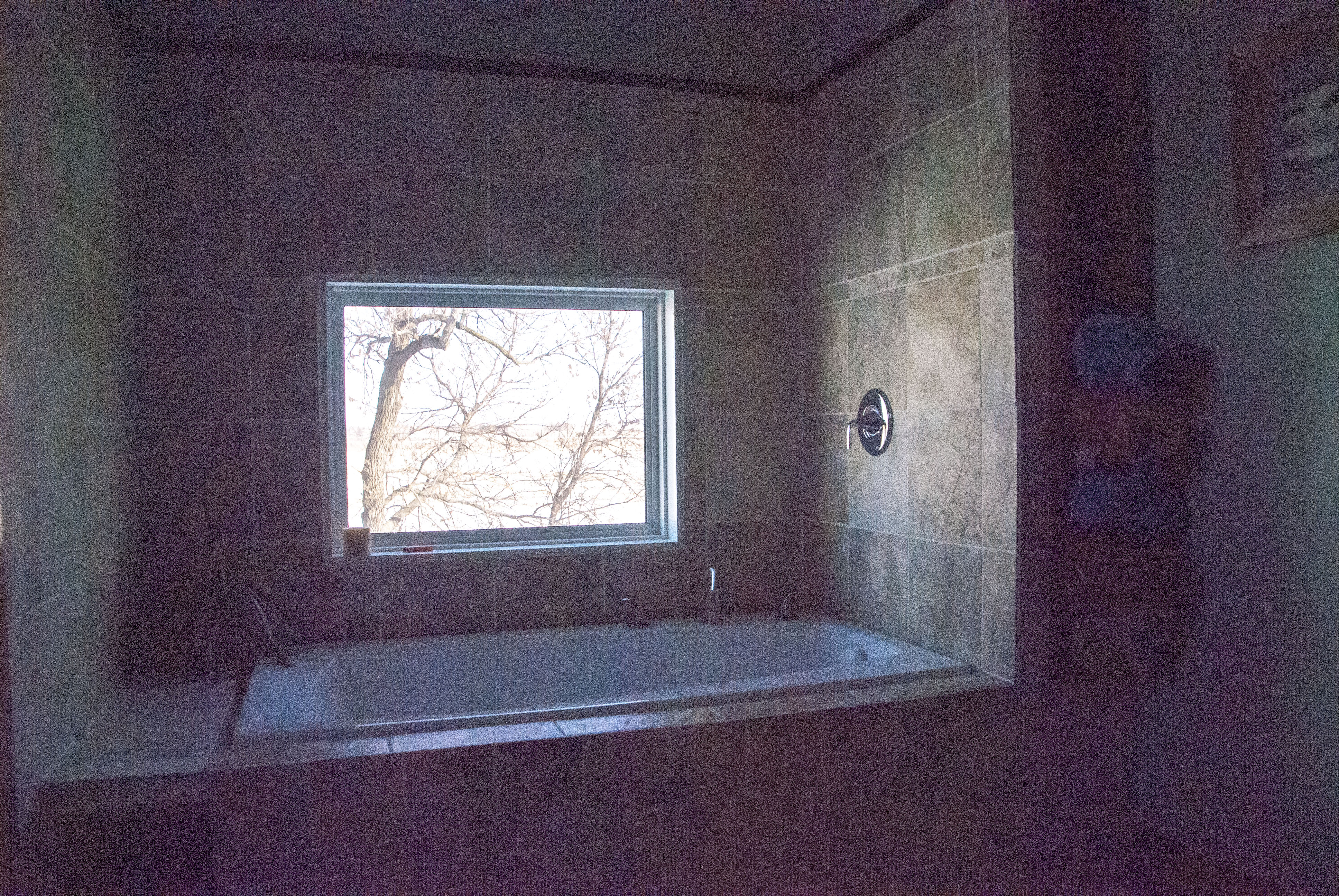
This kitchen window was one of two major window decisions we would make in remodeling the house. The other was in the upstairs bathroom where there was no window at all in the East wall. We had decided rather early to completely redo that room. Along that wall was a wide vanity. A toilet was placed up against the adjoining inside wall and was in plain view of the door opening to the hallway. There was no shower nor bath. We would eventually do a complete reworking of the room by removing enough of the floor to move the toilet across the room behind the door, to install a smaller vanity and sink where the toilet originally sat, and by adding a spa bath where the old vanity had been. It while I was framing in the tub surround that I thought of adding a window, to bring in more light, and to add a view.

Removing the cut out for the bathroom window.

Removing the cut out for the bathroom window.

Tile would be added across the entire floor and as a shower surround. And in that bare wall we cut a hole to add a modest plate glass window we had hoped would give us a nice view of the prairie and nearby wetland while sitting in the bath. That, we’ve since discovered, won’t happen since neither of us have the height of a NBA basketball player. Our view from the toilet, however, has no equal!

bathroom window

Fortunately this house has many windows and wonderful views from all angles. Our front porch solarium has a surround of windows on three sides, and the large windows from our office and family room offer views from the inside out into the solarium.

My muse for the kitchen began while doing a story on the husband of a former colleague who had a stately old house on the outskirts of Maynard. When they remodeled their kitchen they replaced double hung windows with a large open window above the sink that looked out onto their grove and picturesque pond garden. Their new window transformed a rather tired and forgettable kitchen into an exciting and comfortable room, inviting you into the world beyond. The window added life to a nearly barren room, a place where you could easily imagine planting your elbows on the kitchen counter to stare at an enticing outdoor landscape. It wasn’t hard to imagine having the same effect in our new home.

Sun rise through the bathroom window.

Sun rise through the bathroom window.

As we progressed in our remodeling I found myself anxiously awaiting the removal of the double-hungs. When it finally happened I could barely contain my excitement. It was the same when we finally lifted a ladder to cut through the outside wall for the new bathroom window. I don’t know if my co-workers on the remodeling project were all initially sold on cutting through the wall for that window, but afterwards they were equally as pleased and excited. Especially when we had finished with the tiling that framed the window from the inside.

Those two windows are my favorite places in our new home, framing views worthy of the Louvre every morning and evening. We couldn’t have made better decisions, nor could we be more blessed.

River Truck

Image

(Luise Hille and I pose with my River Truck after kayaking on the Minnesota River. 

I can’t remember the color of my “original” River Truck. It still had some miles left in it when the heater died in the dead of winter. A repair of the heater edged the beater into what insurance adjusters call “totaled.” So I drove onto a used car lot just to see what was around.

You’ll occasionally see a car slowly meandering through a dealership as the driver rubber necks at those rows of discarded dreams. One of those was me. Nothing stood out, yet I parked and ventured inside to talk with the saleslady. This is a huge undertaking since I’ve long suffered a sense of trepidation after a car salesman at a St. Paul nightspot laughed and said people like him love it when people like me walk through the doors.

“We can spot guys like you a mile away,” he laughed, tipping his long-neck bottle against mine in a friendly gesture. “You’re easy. Guys like you we call ‘marks.’”

Unlike at the city lots, my saleslady friend has treated me with respect and fairness.

“You really, really loved that old Explorer, didn’t you?” she said, with honest concern.

Indeed. That kayak/canoe rack on the top looked and fit just right, and it was easy to lower half of the backseat down to lay out a pad and sleeping bag. A portable ice fishing shack fit easily in the back, too. Bluegill flies that drifted from the boxes weren’t blown away in that 60 mph draft. Gosh, I could go on and on about the pluses.

“Did you see that blue one out there?” she asked.

Somehow I’d passed it by.

“Just got it in. Owned by a woman banker down by Sacred Heart. She drove it to work on the bad snow days. Not a lot of miles on it. Want to take a look?”

“Does the heater work?” I asked.

It was only a year younger and had just under 50,000 on the odometer. I hadn’t realized we’d had that much snow. Mine was tickling 200,000. I’d driven all over western Minnesota, and made several trips down to the farm in Missouri. There were all those jaunts to the BWCA, too. She shot me a price. Fortunately what I’d already had transferred from savings for a decent down payment on a newer car or truck more than covered the price. For the first time ever I drove off the lot with a loan-free vehicle. Not just a vehicle, but a new River Truck! All the gauges and dashboard gizmo’s were exactly alike, and I now had a CD player. Plus, one of the mechanics had helped transfer the kayak racks and ice fishing gear.

That was a decade and some 100,000 miles ago. I still carry the kayaks up on the rack and my seasonal gear fits easily in the back. Missing is the radio antenna. The fellow at the car wash I ran it through at least annually showed me how to remove it with a crescent wrench so it wouldn’t catch in flappers, a trick that came in handy one day at an entry point near Ely. I took it off so it wouldn’t break taking the shotgun side kayak off the top, then laid it on the back bumper after it had rolled off the hood onto the ground. Must have happened a second time. That was about four years ago.

The cab doors used to be tighter, and the hatch door on the back won’t shut completely. By now I’ve replaced the shocks, tires and ball joints. The heater still works, and you can even take a snow drift at 50 without it breaking all apart like my delicate new little foreign car.

That’s the car I bought a couple years ago for better fuel economy. The fill ups actually arrive at about the same places. The kicker is that the River Truck holds just over 23 gallons of gas bone dry compared to not quite 11 for the little car. Same difference, but twice the cost for a fill up.

I was relying more and more on my little car until I tried plowing through a snow drift near the farm late last winter and tore off part of the plastic undercarriage near the bumper. My River Truck sputtered, as it does even in the heat of summer, but eventually started, and the little car was parked until the thaw.

This winter I’ve relied more heavily on my River Truck. I should have used it the other evening when I went to shoot pictures of the full moon rising over the prairie. The little car was warm and handy, plus I was just driving a mile or so down the road to an oak savanna. Unfortunately the trees were nowhere near the rising moon, so I quickly sped off down a lesser used road toward a nearby WMA. I saw the drift coming up, and frankly, it didn’t look all that solid. Darkness does that to a fellow, I guess. There wasn’t a whole lot of give to that icy, glazed-over drift. There was, however, a horrible crunching sound when I landed about 30 feet further down the gravel road. My seat belt no doubt saved a concussion. I’ll call the body shop after the melt.

After surveying the damage I realized the truth once again. Like I told Rebecca: “Should have taken the River Truck.”

Utility and a working heater help define a good River Truck. So does having dependable landing gear.

Wind Poems

What though the radiance
which was once so bright
Be now for ever taken from my sight,
Though nothing can bring back the hour
Of splendor in the grass …

Image
My windshield and passenger windows often offer dreamy drive-time visualizations of what a sea grass of prairie might have looked like. They say the big bluestem grew so high and thick that it wore through the toes of a horseman’s boots in a season of riding. Such landscapes, those vast seas of grasses, are no more.

Nor can you photographically capture a horizon of a wide prairie sky with a native prairie stretching toward focal infinity. More common is a foreground of 20 to 40 acre remnant with a mix of Indian grass, side oat gamma, big bluestem and seasonal forbs with a field of row-cropped acres draped across the horizon.

A friend dismisses the entirety by saying, “It is what it is.” Crops and cropland are necessary, yet so is a balance that is missing in this altered ecology that is slowly being eroded away.

I’m new at this prairie watching. Yes, it is big sky and horizon. Most days you can see the very top of a grain elevator in some rural railroad town a dozen miles in the distance. Maybe even a water tower at half that distance. A prairie also offers views that are close and personal. Yet it is a prairie without prairie, a land mass naked of its namesake.

When photographer Brian Peterson was working on his book, “Voices for the Land,” he admitted struggling to find a way to photographically define this vastness. One day he felt he had captured a sense of it not through an image of big sky and horizon, but rather in a photo of a small ant climbing the stalk of a cone flower. Yes, there is sky, along with four other cone flowers in the photograph, yet he focused on a small, intimate detail to define an undefinable landscape. Some claim it is practically impossible to accurately portray the vastness of the prairie, to portray that vastness in contrast to individual insignificance. Perhaps they’re right.

So we look at parts of the whole, at ants on cone flowers, or other symbols.

A prairie is not just defined by the grasses, but also the winds that ruffle and bend them. Ah, the wind. Curators of the area county museums can usually put their fingers on letters from the wives of sod busters describing how the wind became so unbearable, of how someone, perhaps the letter writers themselves, “had lost their mind” from the constant wail of the wind when there was so little to stop it. Especially in the dead of winter, a mind lost while huddled for warmth in sod huts and remote farm houses.

Image

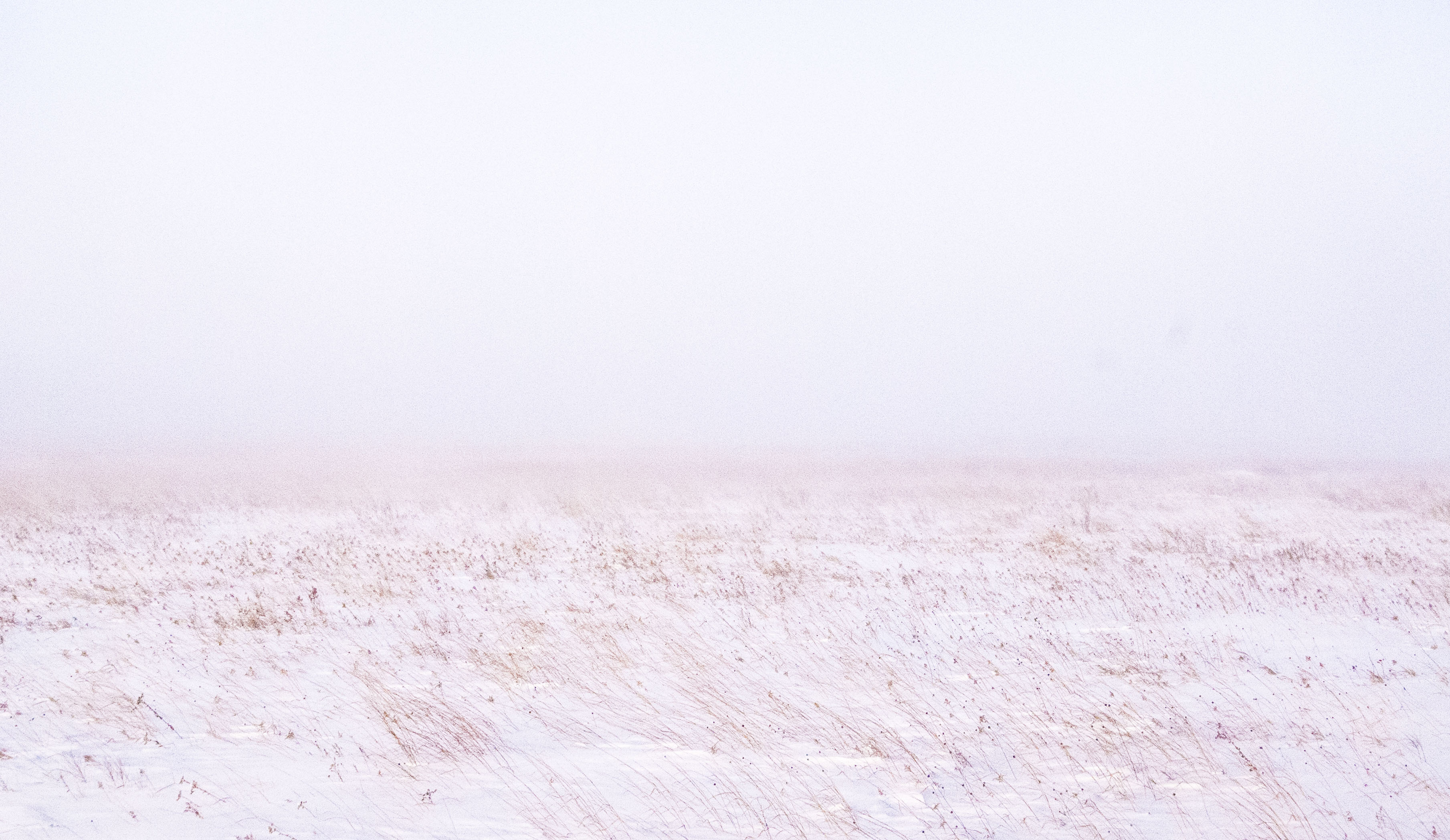
Yes, there is that rumble and roar of blizzards, but there is also a hush when grasses rise through the snow as in defiance of that rumble and roar. My wish has been to get a feel for the prairie when winter it isn’t quiet, when raging winds whip grasses with a vengeance. Then again, to return to portray the hush.

Although we have lived on this dispatched ecosystem for 22 years, this is my first to really concentrate on the prairie in winter. Twice I’ve driven off the farm yard during wind-whipped white outs to two different restored prairie remnants, including a Wildlife Management Area (WMA), to take pictures. In the scheme of seasons, winter is supposedly a quiet time, a rest perhaps, for the prairie. In winter, green isn’t evolving through dead and dormant grasses, nor is there a punctuation of color from blooming forbs in a blanket of green, nor are the acres of golden grasses painted by the fall sun being whipped and bent by autumn winds. So in that sense, winter is the season of rest despite the turmoil of arctic winds.

On one of those forays, with the sun muted by driven snow, the grasses of the Clinton prairie yielded to the winds, yet captured enough snow to create sea-like drifts. Enough snow was being captured that you could see a depth of perhaps a hundred yards … which was impossible on adjacent tilled fields. It was a wild moment in the “rest” — a wail that could cause one to lose their mind with a long exposure, for this blow continued for two to three continuous days. Cold and continuous.

Image

A week or so later, on a late afternoon, the hush of both the prairie and wind had returned. There on a clear and windless day, in the captured depths of snow, in both stem and shadow, were wind poems that spoke of silent secrets.

Image

Perhaps if we listen closely these poems may speak an endless and epic story, one our cultures of settlers, sod busters and industrial farmers have failed to silence. If you look close enough to find wind poems, and take time to listen close enough to hear those silent secrets. Take a moment, however long, and be quiet, however silent, and  simply listen.

Mayflowers

“Ah, the Mayflower!” sighed dear friend Kylene Olson, who probably is as close to a native prairie flower expert as you can find. “This flower has been ingrained in my memory and in my family traditions since I was two years old.”

This was a new term for me, yet it made sense. She was looking at a photograph made a few years ago on a Sunburg prairie of a pasque flower. There is a hidden story here, however, and a good lesson.

mayflower1

It has to do with a recent conversation with a prairie photographer artist friend who admitted she sometimes lacked motivation, especially after nearly two decades of portraying elements within the few remnants of remaining native prairie. “How many images do I really need of big bluestem?” she asked rhetorically, smiling, while also noting that her children are now taking precedent as they reach junior high age.

Indeed. My children are reared and into lives of their own, and my life has changed significantly in the meantime. Yet, after all these years motivation is not yet an issue. I’m easy. About all it takes for inspiration is for someone to smile and tell me they have enjoyed one of my images, like Kylene has. I’ll admit, though, there are still times when I weaken and wonder, “How many images do I really need of a big bluestem?” Or, of pasque flowers, for that matter.

Last year was my first at skipping over the blooming season of this stout little harbinger of spring. I neither found, nor sought, the opportunity. Photographers and others involved in different medium of the arts often struggle to find the motivation to capture new images of an old subject.

Our work is defined by how we “capture light” in terms of subject matter and composition. We may work for weeks to pull those three adverse criteria — light, subject matter and composition — together to create a perceived image. Sometimes we’re simply lucky. In photojournalism this is called “having an eye.” Composition becomes, in Hemingway’s words, “a movable feast.” You train yourself to see and capture an image on the run. Two ends of a photographer’s spectrum, perhaps, that may sometimes work in concert.

An example: Back in June when the delicate prairie rose was in bloom I scanned the late afternoon skies searching for just the right hue for an idea that is much easier to visualize than to actually describe. On a scouting trip with Rebecca, we spied what we thought were some fine specimens in a Wildlife Management Area about ten miles southeast of our farm. Finally one evening a rich, cranberry hue seemed promised by the evolving sunset and I promptly set off with my camera, barreling down country roads toward the site. Light conditions change rapidly late in the afternoon, and especially as sunset nears, so there was an urgency.

When I rolled up and rushed toward the flowers to work with the light I realized this was an entirely different plant with blue flowers. Scouting at 50 mph is highly overrated, especially around dusk when we made the original discovery. On the trip home on this perfectly calm night, as that crimson-y hue became even more vibrant across the sky, I passed a lone white pelican fishing solo on a mirror-like wetland. My trip was not made in vane. I returned home with a very pleasing yet unexpected image — the movable feast.
September

As for the prairie rose, the idea still simmers on the proverbial back burner.

When I first discovered the plight of our vanished prairie years ago I felt an urgency for capturing such “icons” as the pasque flower, prairie smoke, lady slippers and cone flowers, among others. I’d also found my way into taking a Minnesota Master Naturalist course that included a field trip to one of the most compelling stretches of native prairie in Western Minnesota. Steve Harms, who claims title to this hilly moraine of prairie near Sunburg with his wife, Robin Freese, told us that the pasque flowers were in full bloom and had virtually laid claim to the hillsides. “This is the best we seen for many years,” he said.

At the time my focus was still more in details than horizons, and I captured an image I liked well enough to put into my next calendar. When I shared my pasque flower image this past week with Kylene, she quickly created an entirely new wave of inspiration and motivation with her response.
pasqueflower

She said, “This flower (Anemone patens, or Pulsatilla patens or Pulsatilla nuttalliana, appears to have three Latin titles) is my earliest memory of a prairie flower. My friend Laurie Denbrook recently asked, ‘Remember picking bags full of Mayflowers?’ Her sister was my best childhood girlfriend. We would pick paper bags full (before the dreaded plastic grocery bags) and walk around Watson, knock on doors (mostly the older women in town) and sell them a large handful for a nickel, every spring. We picked them ‘on the hill,’ which at the time was our horse pasture before becoming the infamous Champion Hill, noted in the not too distant past as the ‘sledding hill’ in Watson! Even after all my older sisters and I grew up and moved away and came home for Easter, it was a tradition to go to Champion Hill and search for Mayflowers. We were rarely disappointed. It seemed that no matter how early or late spring came, or how early or late Easter, Mayflowers were always blooming that weekend — amazing. Each spring my older sisters still ask if I had checked for Mayflowers.”

Added another friend, Lynn Lokken, “I grew up picking them as well. Great memories of my grandma teaching me about them. They bloom, we get snow, and they survive! In fact, we’ve done prairie burns and they pop up through that, too.”

I have no such childhood memories of pasque flowers, yet it is pleasing when an image brings pleasure and memories for others. Good fuel for motivation, I’d say.

A Road Being Taken

“Conservation is getting nowhere because it is incompatible with our Abrahamic concept of land. We abuse the land because we regard it as a commodity belonging to us. When we see land as a community to which we belong, we may begin to use it with love and respect. There is no other way for land to survive the impact of mechanized man.” Aldo Leopold

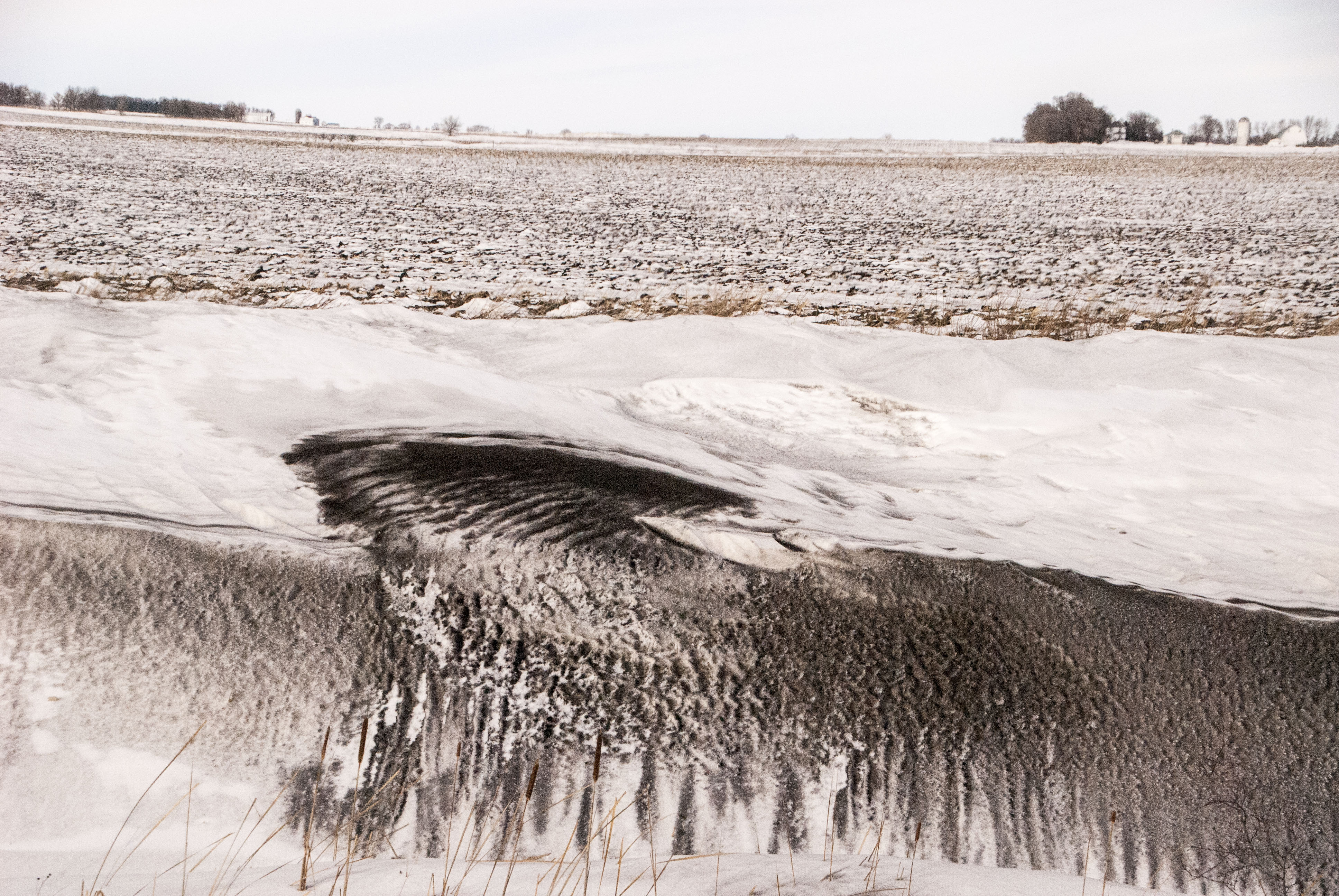
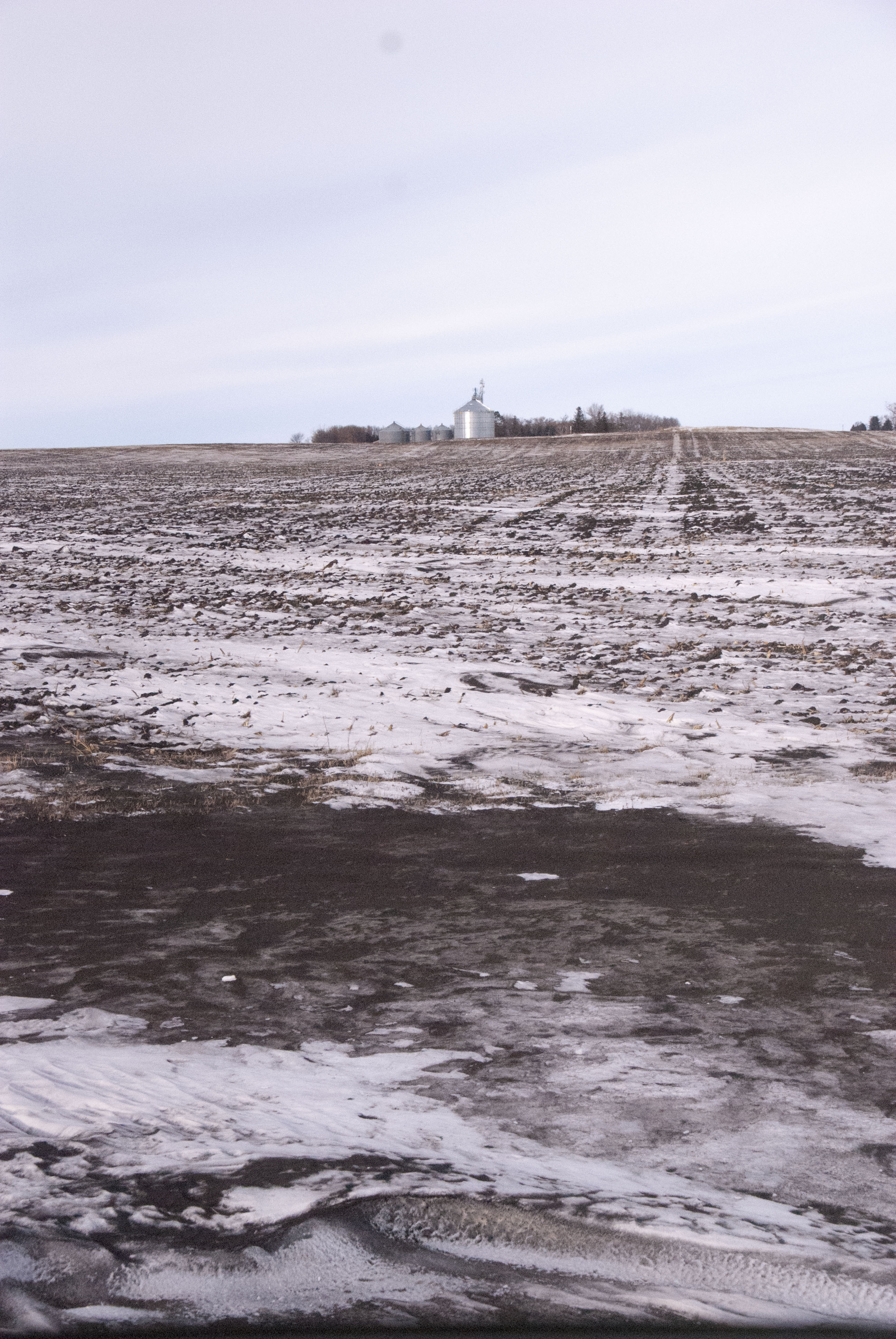
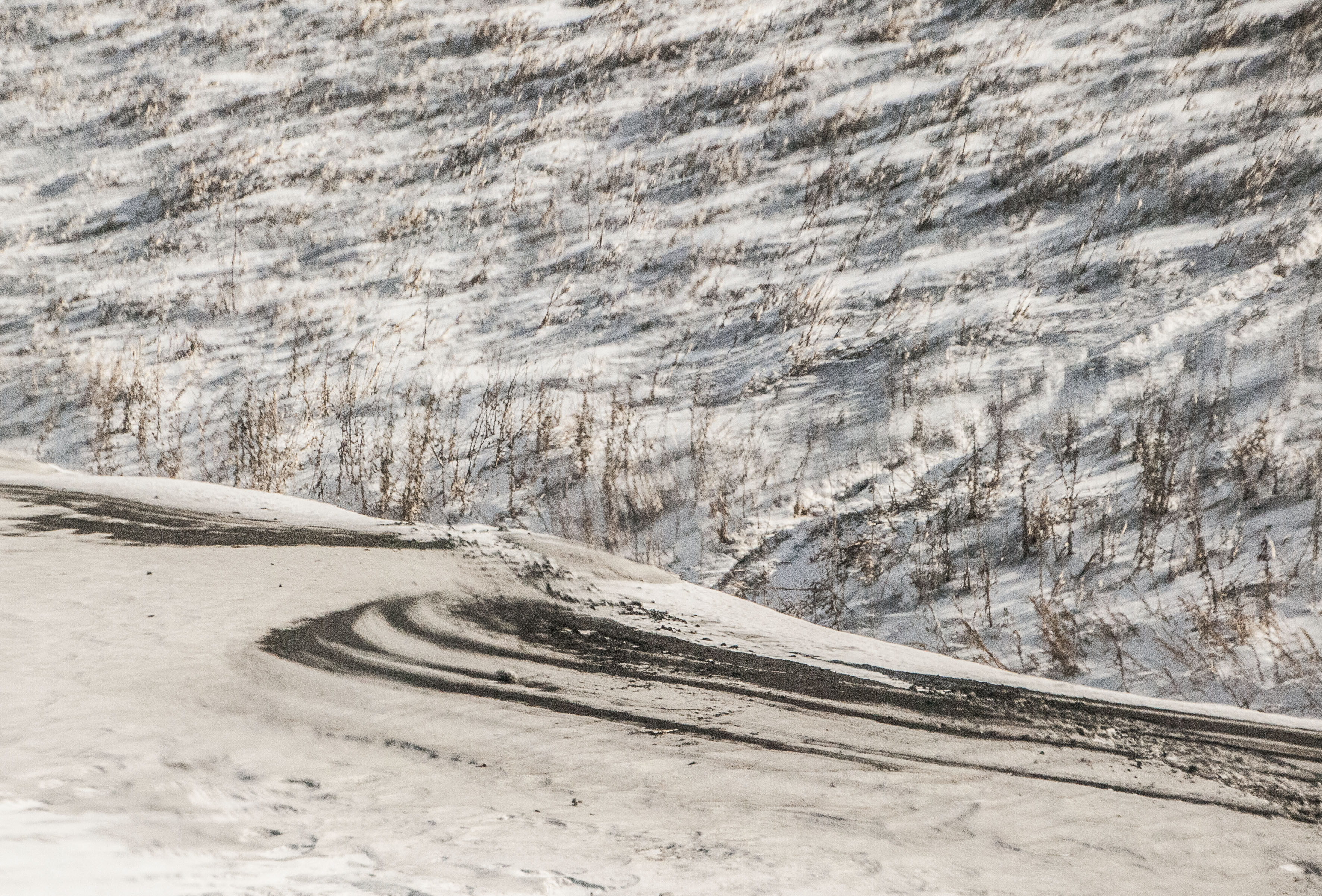
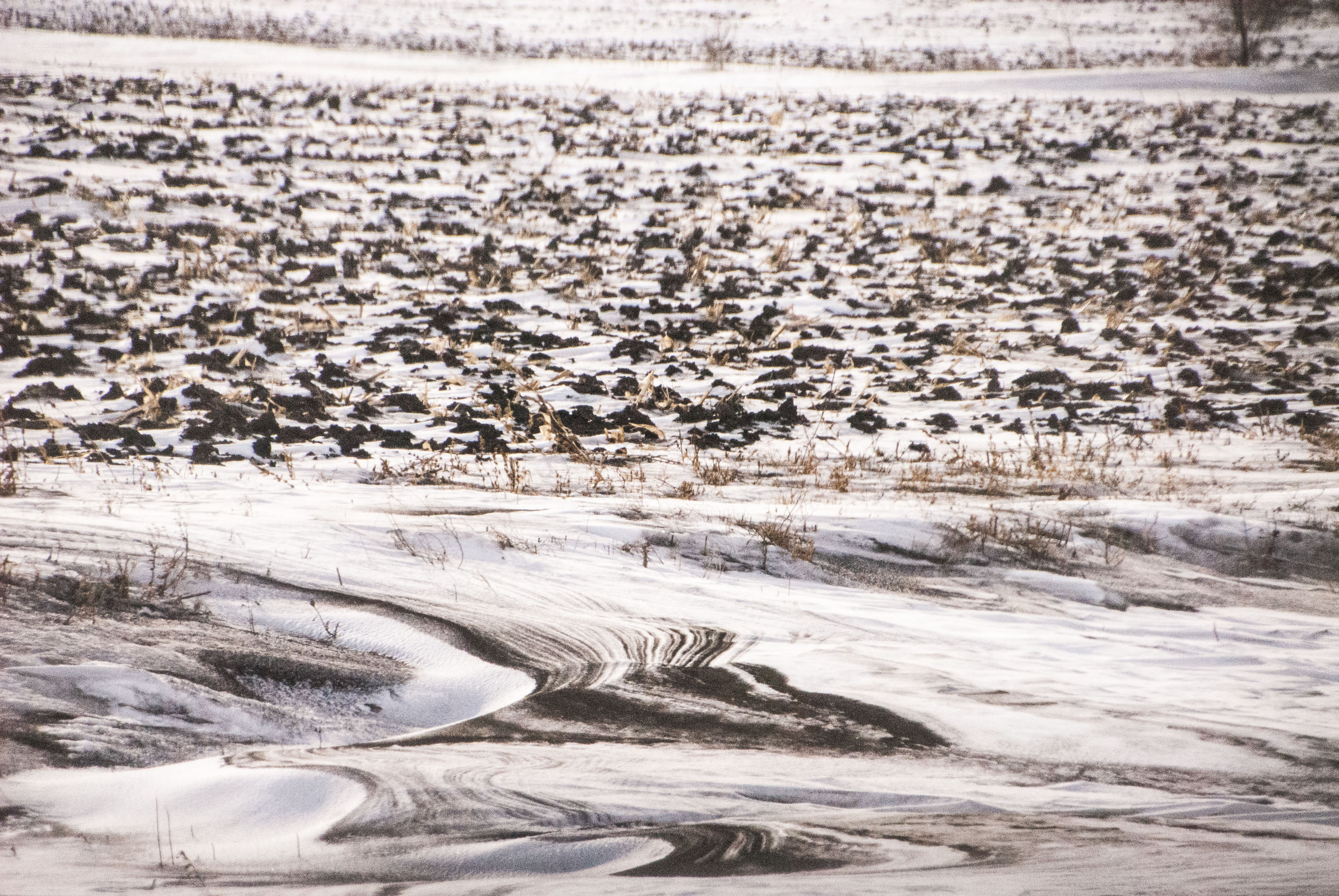
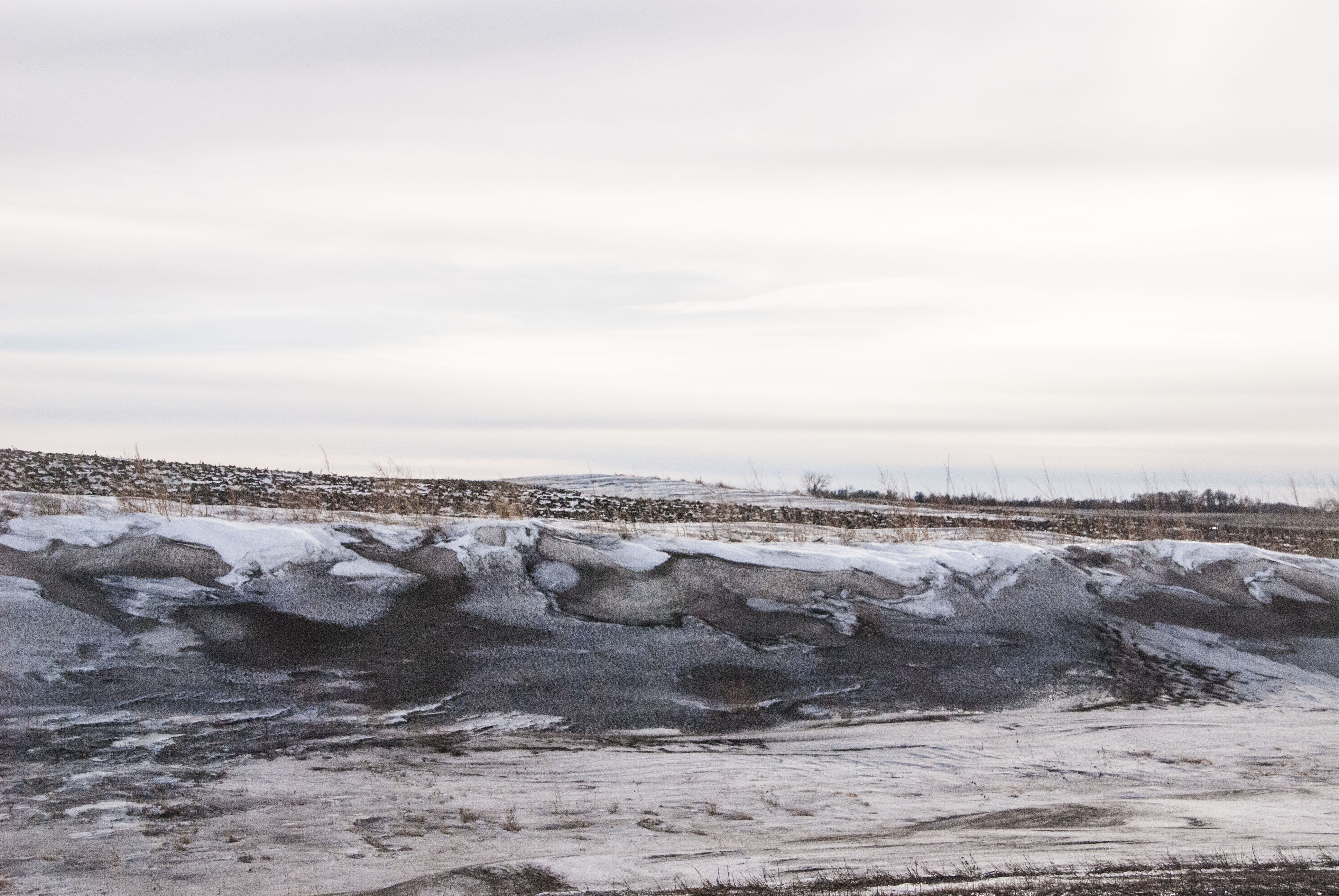
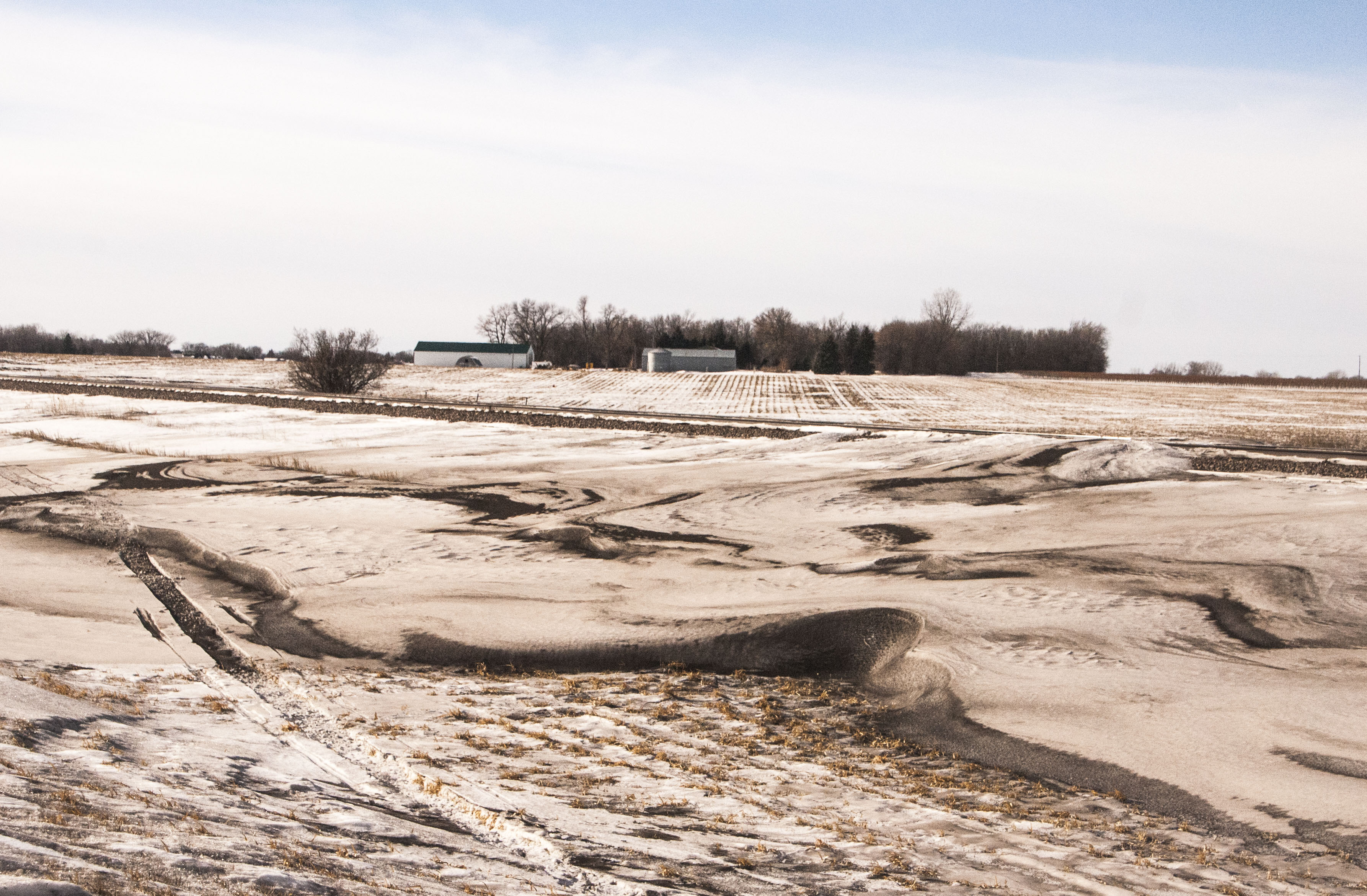
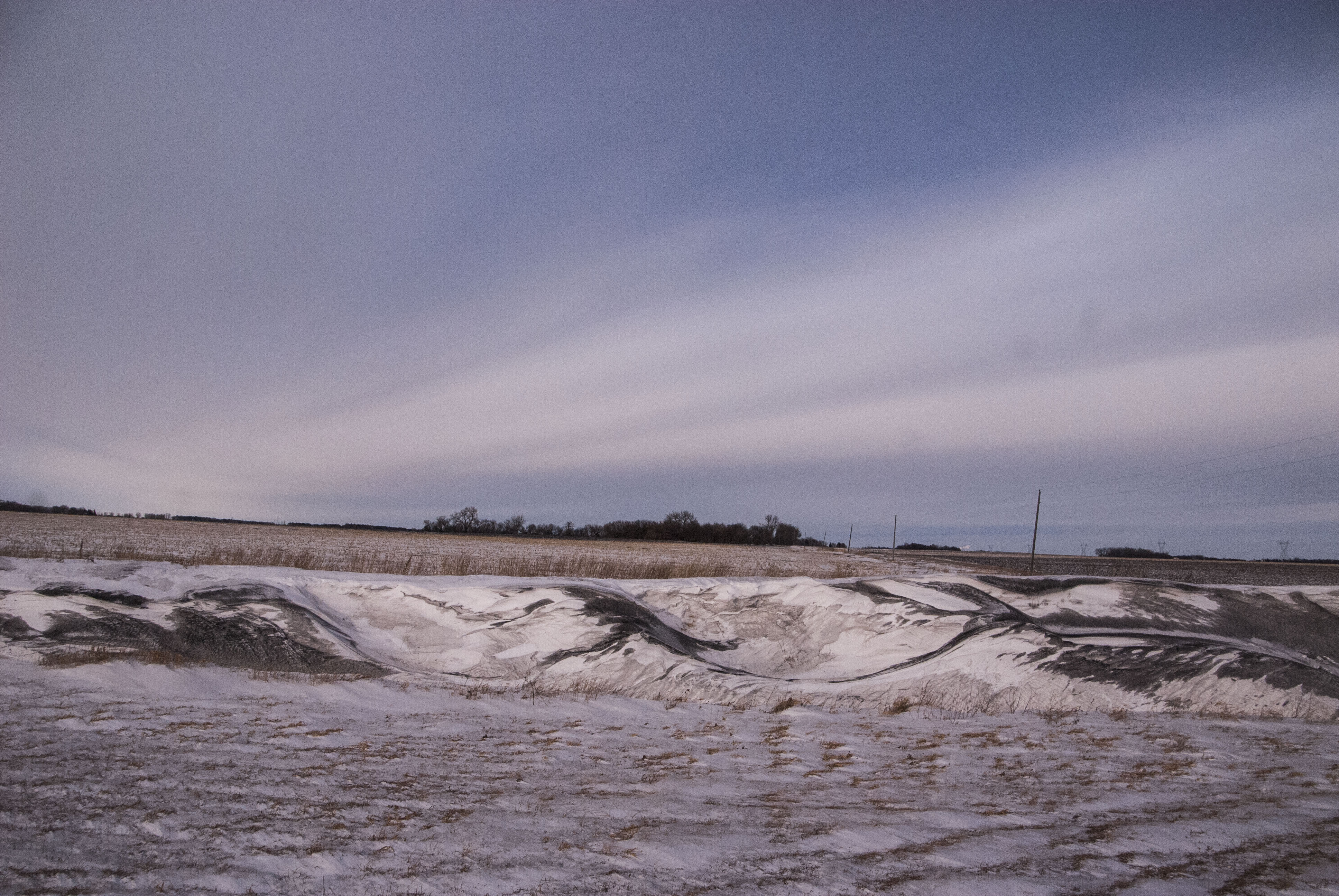
Although our recent drive to the ROC at the University of Minnesota-Morris for a pollinator presentation was artistic in a way, this wouldn’t be a good day for America’s “Original Conservationists.” This is a self-chosen term our farm brethren speak with pride when speaking at environmental proceedings and politicians like to use at farm shows. You have to wonder if these self proclaimed “Original Conservationists” or “True Environmentalists” — as some of billboards broadcast — see the effect prairie winds have on their prized investment. Those winds have created sastrugi-like snow waves, or perhaps you would prefer calling them snow dunes, along the roadways and almost all of them were highlighted with swirls and patches of fine particles of dirt.

snirt9 snirt12 As we drove we continued to gaze at the miles upon miles of snow ridges and waves accented by prairie dirt along the fall-plowed fields, interrupted here and there by a few farmsites, patches of restored prairie, or in the rare fields where corn stalk residue was still standing. Only on those few select areas were drifts the color of snow. There was a sad but unique beauty where the dune edges carried outlines of soil-paint blackness as if applied by a makeup artist.

snirt2 Soils are taking a beating throughout the broad Mississippi River Basin it seems. On a drive home from a recent visit to Missouri most of the fields from northeast Missouri through Iowa and into Minnesota had telltale evidence of snirt (“sn” from snow, and the “irt” from dirt). Tons of topsoil. A field near Raymond, Minnesota, had lost so much wind-blown soil that only the tracks of the Burlingon-Santa Fe Railroad provided border between the shoulder of Highway 23 and the actual field. Land Grant Universities and other sources, from Kansas to Canada, and from Indiana to Montana and the Dakotas, are publishing emergency actions for farmers that include mulching with straw and manure, or by some form of mid-winter tillage. It’s much too late for sensible cover crop options, or in leaving crop residue in place.

snirt7 Those “conservationists” typically will blame a lack of snow cover for the wind blown erosion rather than take personal responsibility for making sensible preventive measures.

snirt1 One of those soil specialists, Dave Franzen, of North Dakota State University said in an article published in Farm Progress Magazine, “I am astonished how many growers think that most of the (soil lost from) wind erosion ends up in their ditch, and all they need to do is scrape it out and put it back onto the field. The ditch silt is only a small fraction of the soil lost. Most of the soil lost to wind travels for hundreds and thousands of miles. Ocean researchers track the buildup of sediment on the ocean floor over time. Wonder where the sediment comes from? Your fields.”

snirt13_1 Franzen expressed dismay that farmers were taking out field wind breaks, especially if they don’t plan to leave a lot of residue on the surface of their fields in the future. Such is the case in the Minnesota prairie where miles of piles of former field windbreaks and groves await burning. While more land is laid open for more corn to be planted, little is left to prevent wind erosion.

snirt8 Between the snirt and the demise of bees and other pollinators because of a changing plant profile due to commodity mono-cropping and the use of Bt-flavored GMO crops with built-in systemic insecticides, our “original conservationists” would take a major beating on this cold, windblown day. Conservation-minded people would care more for their topsoil and for the bees and other pollinators absolutely necessary for growing their crops. Yet we saw no cover crops and very little crop residue left from the fall harvest. Winds were rumbling across the prairie in gusts to 40 mph, lifting particles of exposed topsoil in their wake. When this settles, the snirt we saw will be covered by more snow and topsoil.

snirt5

With land being sold for more than $8,000 an acre you would think our Original Conservationists and True Environmentalists would care more for their investments. You would think they would also care about leaving precious topsoil for a future generation … like the next one, if not for those who come after.

As for the bees and other pollinators, this is a topic for another discussion.

snirt14 “The nation that destroys its soil destroys itself.” Franklin D. Roosevelt

Tears of a Prairie Goddess

     When I re-entered the gym full of crafters back in December, my neighbor to my right with the scroll saw art was hovered over my table of framed prairie prints and calendars.
    “I’m so sorry,” he said as I walked up. “I just brushed against this and it fell from the table and your frame broke.”
    He was frantically working to re-glue one of the four framed images on which I had not had time to install the corner stabilizers. Fortunately the glass hadn’t shattered. When I turned it over to see which of my images would obviously have to be pulled from the show, there was barely any surprise. My Penstemon grandiflorus, or giant beardstongue.
    This plant and I have an odd history of sorts, one that began a few years ago in my attempt at bringing to life a native prairie garden in back of my home in Clara City. My garden was like a very special Christmas; gifts that were startling visual, were “presented” for almost daily unwrapping, and were usually quite interesting.
    These gifts usually came near dawn as I habitually took my first cup of morning tea by making a slow walk around this garden I’d planted in the disturbed spoils of soil resulting from the installation of a geothermal heating system. My previously beautiful “glacial till” was now mixed with subterranean gravel, probably not perfect for a prairie and less so for many other offerings this side of Phoenix. Yet, my little prairie was setting root in many interesting and surprising ways.
    When Sally Finzel of Morning Sky Greenery provided a list of native prairie plugs of grasses and forbs for the garden it was like looking at a list of words from a foreign language–Latin, to be exact. Over the years I had grown fond of wind-swept prairie grasses, especially Indian grass, and like many I adored coneflowers. All those other plugs we pried into the rocky mixture of clay and till were what offered all those many Christmas-y-like surprises — changing from day to day, and as I would learn later, year to year, as prairies do.
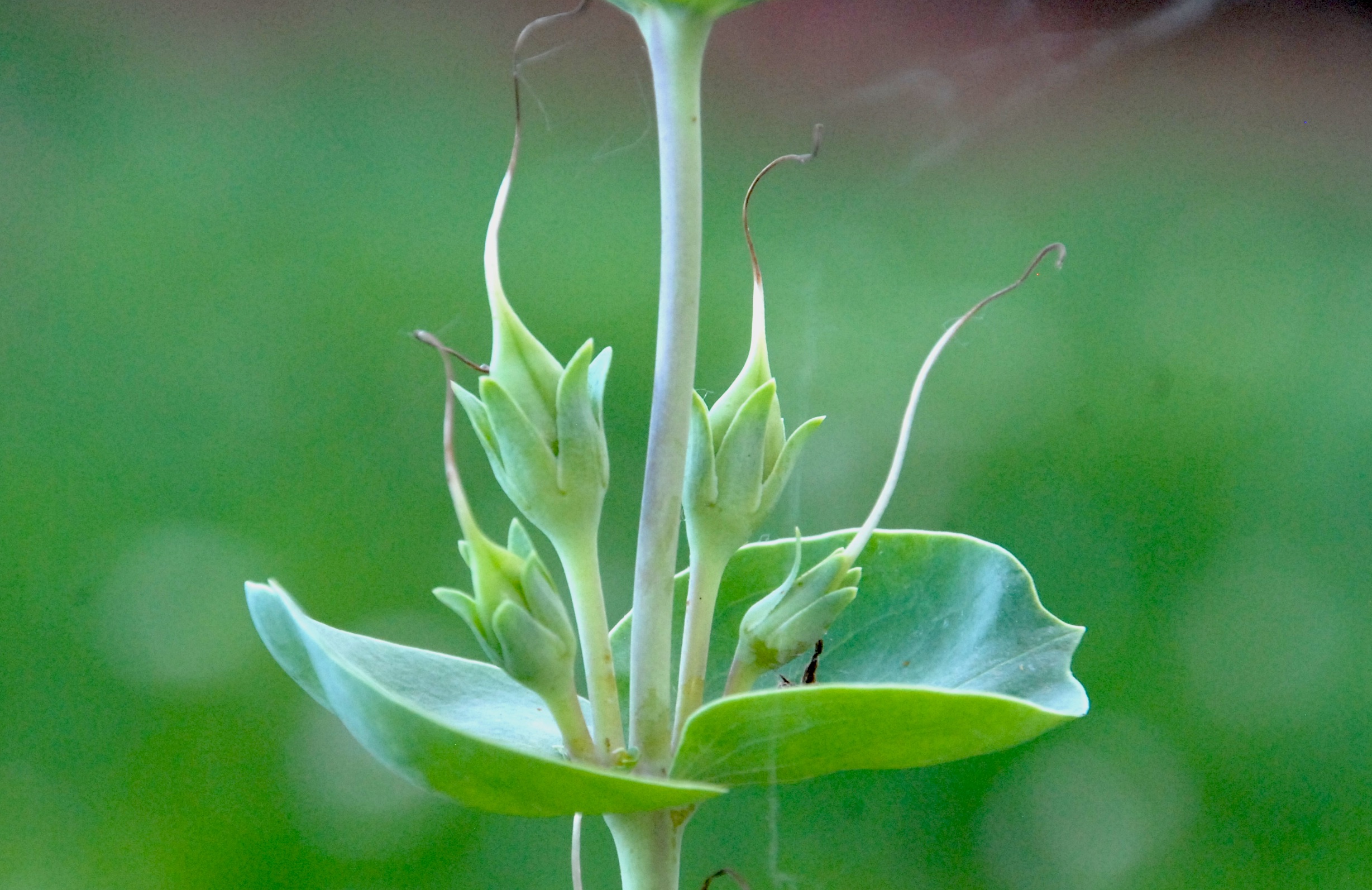
    One sleepy early morning in late May as I slowly made my way around the rock perimeter of the little prairie garden I came to a sudden stop to stare in disbelief of what appeared to be a scene straight from a sci-fi movie. There, between cupped sturdy leaf shelves, were four to five regally crowned stalks, each looking as if they had magically and perfectly captured giant green teardrops from a tall prairie goddess, each trailing a curly tail reaching toward the heavens. These “platforms” of magical teardrops stair-stepped their way up the smooth, green stalks.

Image
    With what had become an almost daily occurrence, down went the teacup as I fetched my camera. My focus was on this unworldly beauty, of these magical characteristics of this unknown plant. This image has intrigued me ever since. My intention was to place the image in my next prairie calendar. My only trepidation was in not actually knowing what plant offered this visual magic.
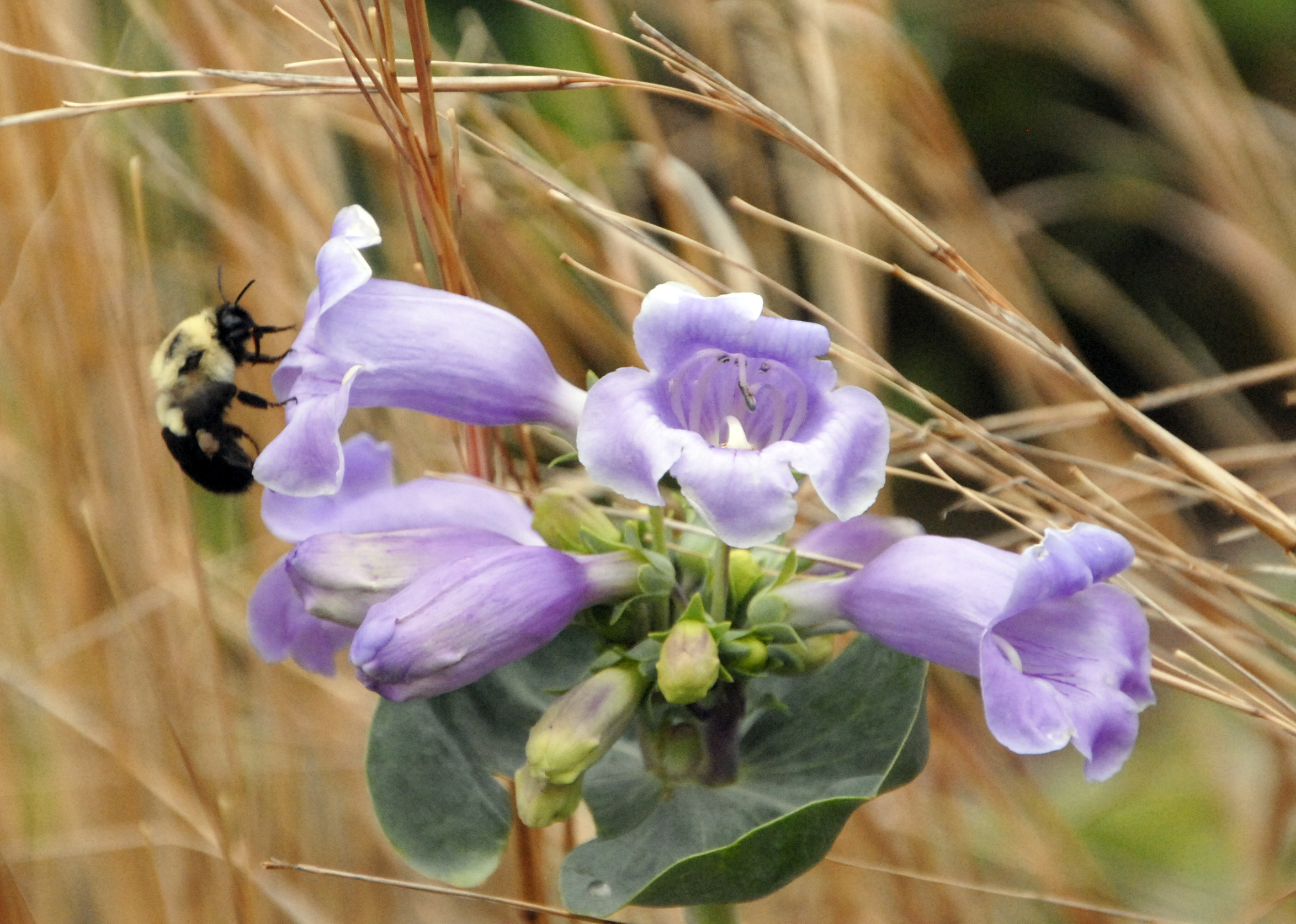
    Later in June of the same summer I photographed bumble bees bullying their way deep into lavender  blossoms that were at least in inch or two in length, much like a child does while crawling into a parent’s sleeping bag. The burly bees would simply disappear inside the blossoms for long moments before budging back out to fly away.
    Images of the bees and the unworldly sci-fi plant were among the possible calendar images I was showing my artist cousin and my wife last August when we noticed that the waxy, egg-shaped leaves in both images were identical. Another friend with immense knowledge of prairie plants immediately identified the plant. “Oh, that’s giant beardstongue,” she said.

Image

    A moment of research indicates that the plant is rather common to native prairies, though it is seemingly more common to the High Plains than the warm grass prairies. It is found in the more rocky areas of Minnesota where the glacial moraine apparently stopped,  and along the Minnesota River valley. As the beardstongue was telling me, I was beginning to discover there was a whole lot about the prairies of the past I either didn’t know, hadn’t realized or even noticed despite so much time spent afield.
    My intentions were seemingly always trumped by more colorful or timely images, so when the possibility came for putting together an exhibition at Java River in Montevideo of my photographic series of Ghosts of the Prairie, the magical beardstongue image was among one of the first I sought to print. The time had arrived to move this image from bridesmaid to bride.
    Less than a month before the show this was among the framed prints I took to the show in Maynard, and it was hardly surprising to find this image as the one to have been nudged from the table. My crafter friend was quite apologetic and was intently using what he called his magical glue to put the frame back together.
    “I’ve tried that glue before,” I told him, “and it just won’t hold. So, really, don’t worry about it.”
    Before the doors opened for the little craft show, I took the broken frame and the photograph of those magical green teardrops of the mysterious prairie goddess back to the car.
    Her time would come. That is how it is with magic.   

What’s in a Name?

She wasn’t real fond of “Kale Yes Acres.” Nor did “Pleasant Pheasant Farm” get the nod.

What’s a man to do?

Frankly, I hadn’t given much thought to the naming of our farm. Didn’t see much need. Yet, my dear Belle of Vermont believed we needed a name for the farm. “What about this?” she would say. Perhaps it was the form of my smile.

My suggestions contained more Teflon than Velcro it seemed.

“Maybe we should just have a naming dinner party,” she suggested as we sipped wine one night, which sent us into an impromptu brainstorming moment on who of our many friends might be of the best help. While we couldn’t agree on a farm name, nor the best gathering of brainstormers, we did agree on who we would want as a facilitator.

This went on for weeks. Often in the kitchen after one of my walks, or when she came in from her work in the garden … after quiet muse time.

The Belle had a farm with a name down in Vermilion, SD. Flying Tomato Farm. She had no desire to move the name north. She held forth that naming our farm was important, and that cute, pun-like names, which happens to be my forte, just wouldn’t work. Naming a farm provides an image, perhaps even a brand. “Farms need names,” she insisted.

Back home in the 1950s my father went through some trepidation himself before settling on Meadowview Farm as its name. Our family farm was split almost equally between crop and grazing land, although the plan was seemingly to have just enough corn to sustain his cattle through the winter months, with the other crops grown for rotational purposes. His love was beef cattle, and his relaxation was saddling up on summer evenings to ride alone through the hilly back country to check on the herd. So the name was equally poetic and appropriate.

We have no hills here on our 14 acre spread. Of those, only eight acres are considered tillable. We made an easy and early decision between us to place those acres into native prairie with help from the local Pheasants Forever chapter and the SWCD. My guess is that about another acre will be devoted to the Belle’s vegetable farming after the spring thaw. Our eye is on a permaculture-like existence, with perhaps a farm stay or artist’s retreat with our out buildings — which might even include a yurt.

scape10
We have many dreams for such a small spot of earth. We find it exciting to see what shakes out. So naming our farm does carry a significance. One recent afternoon the Belle strode into our office with a purpose, grabbed a marker and wrote a name onto her faithful flip chart. “Listening Stones Farm,” it read.

Hmmmm.

There is a history here on the farm. When our friend, Kurt Arner, came to clear our grove of buckthorn and a half century of deadwood, he suggested a trail be cut through the upper half. Since we had discussed doing this beforehand, it was an easy decision. His  traversing trail concluded with a wooded loop at the far end.

I asked if he could cut one of those trees into a bench. He did, and we called it our “listening bench” in honor of Sigurd Olson’s “Listening Point.” Not just a title for a book, but Listening Point was an actual point on 26 acres on the shores of Burnside Lake near Ely. Here “he could look out over the wide-open spaces of the lake, listen to the birds, watch the sunset, and regain some balance in a life that had become more and more hectic at a time when most people begin to think about retirement,” reads a dedicated website.

Listening bench_1
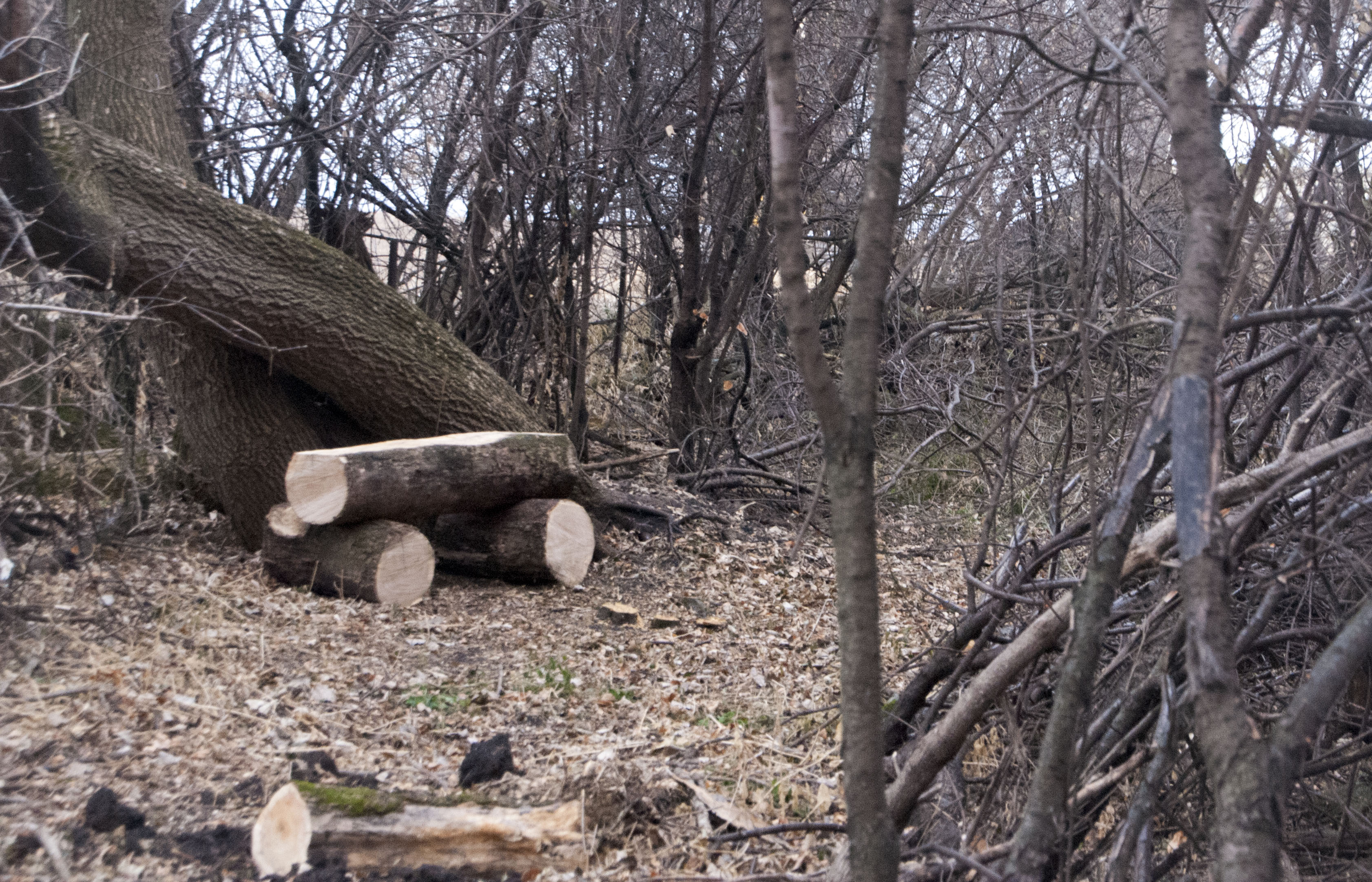
Our bench is comprised of two portions of a log Kurt V-ed before centering a portion of the same weathered trunk into the grooves. He then sliced off the top third to create the bench, which abutted another fallen tree for a natural staunch backing. No wide open spaces, nor a view of a lake, yet it is a fine place to escape what life can throw at you at times, surrounded on all sides by trees and a protective canopy.

Also on our farm were two outbuildings long past saving. We found an excavator who brought in a large machine to dig a hole where he could deposit the spoils of the two buildings for burning. Embedded in the foundation beneath the century-old granary — yes, we found hand scrawled messages on the painted red barn wood that read, “Changed oil July 1911” — were several boulder-sized glacial stones he set to the side beneath the canopy of a tree we had saved from the saw.

These stones were, I believe, her inspiration, and a fine inspiration at that. Our farmland lies on the cusp of the moraine of the last glacier, and the rocks likely came from this land. Several similar sized boulders were unearthed in the cleared grove. Rocks, or stones, form the name of this county, and are a prominent physical feature of the river valley.

“Stones are what brought us together,” said the Belle. “People talk about Big Stone Lake, and of the soil. Stones just don’t get a fair shake.”

So, what’s in a name? For us, the eons of heritage of our small, appropriately named farm.