Unknown's avatar

About John G. White

Somewhat retired after a long award-winning career in newspapers (Wisconsin State Journal, Dubuque Telegraph-Herald, Denver Post and a country weekly, the Clara City Herald). Free lance photographer and writer with credits in more than 70 magazines. Editor with various Webb Publishing magazines in St. Paul, and a five year stint as editorial director at Miller Meester Advertising.

In Transition

A sense of nervousness has settled in here at Listening Stones Farm. This sense of affairs began shortly after our return from our trip north to Ely for our yearly break from routine. This “settling” has been by a series of degrees — literally. Our overnight weather report for Friday took it over the edge.

As Rebecca said, “Thirty-four is too close for comfort.”

With 75 tomato plants in her lower garden, plus the raised beds and tall green arches of produce she has out there, she is creating strategy while rationalizing her anticipated losses. Perhaps “our losses” would be more accurate, although there is both a sense of ownership and privacy involved in her near acre of produce farming. Those tomatoes are in the heart of the freeze zone since they’re located in perhaps the lowest level of our garden and yard — a location, she informs me, that makes it quite difficult to protect.
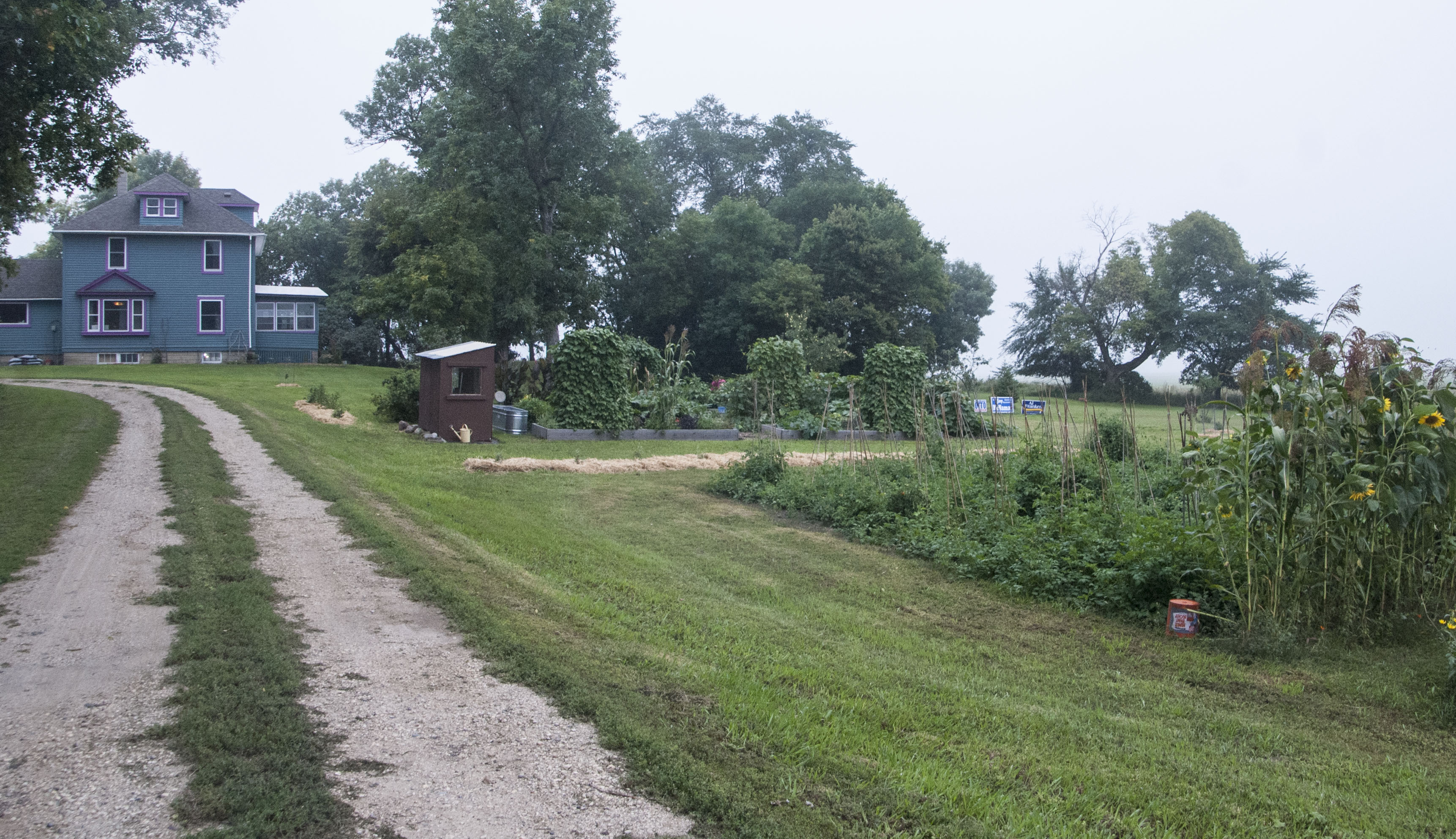
Rebecca's low hanging tomato plants on the right side of the picture are particularly vulnerable because of their location.

Rebecca’s low-lying tomato garden on the right side of the picture is particularly vulnerable because of its location.

The signs of this transition from summer to fall have been evident since we returned from up north. On Monday morning, our last day of warmth, my labor included working on frames for my Meander photographs. Many trips were made between the house and the workshop. Whenever I entered the workshop I was accosted by any number of swallows, as has been the custom all summer long. Later that afternoon as we shared our daily glass of wine on the deck, Rebecca spoke of her observation, “Well, the swallows are gone.”

“Can’t be. They were all over me all morning.”

“Listen. Look around. Do you see or hear them?” Indeed, while the prairie was still buzzing with dragonflies there wasn’t a single swallow in sight. None on the rooftop awnings of the workshop. None on the clothesline. The air was empty of the acrobatic fliers.

In the distant rise of the prairie we noted the short flights of ducks from one wetland to another. Yes, the ducks are coming through, and the geese are now gathering. Murmurations of blackbirds are beginning to fill the treetops in the grove. At night, as the sun sets and the coolness sets in, coyotes begin their night songs nearby, offering voice to the musical concert provided by the slight wind music from the chimes scattered around the trees in the yard. All of this nature is alluring and alive and you feel blessed to be a part of it.

Yellowheaded blackbirds by the hundreds gathered along Highway 75 near Bellingham.

Yellowheaded blackbirds by the hundreds gathered along Highway 75 near Bellingham.

Earlier this week was the rising of the harvest moon. I ran for my camera and was able to make a fun image of the last of the yellow flowers in the prairie. Yes, our prairie that was bursting with yellow just a few weeks ago, as it has all summer, is now mostly a dull green turning brown. We anticipate with pleasure the brownish beauty of a more mature prairie, which we see in patches around us, where the winds that make music with my chimes provides a dance for the Indian grasses and spindly bluestem. While the wind gives the prairie grasses a freedom to dance, those same grasses give face for the winds. And, yes, the browns are beginning to dominate those prairie patches. Bluestem is now in turkey-track stage, and the other native grasses shimmer in the glow light of autumn.
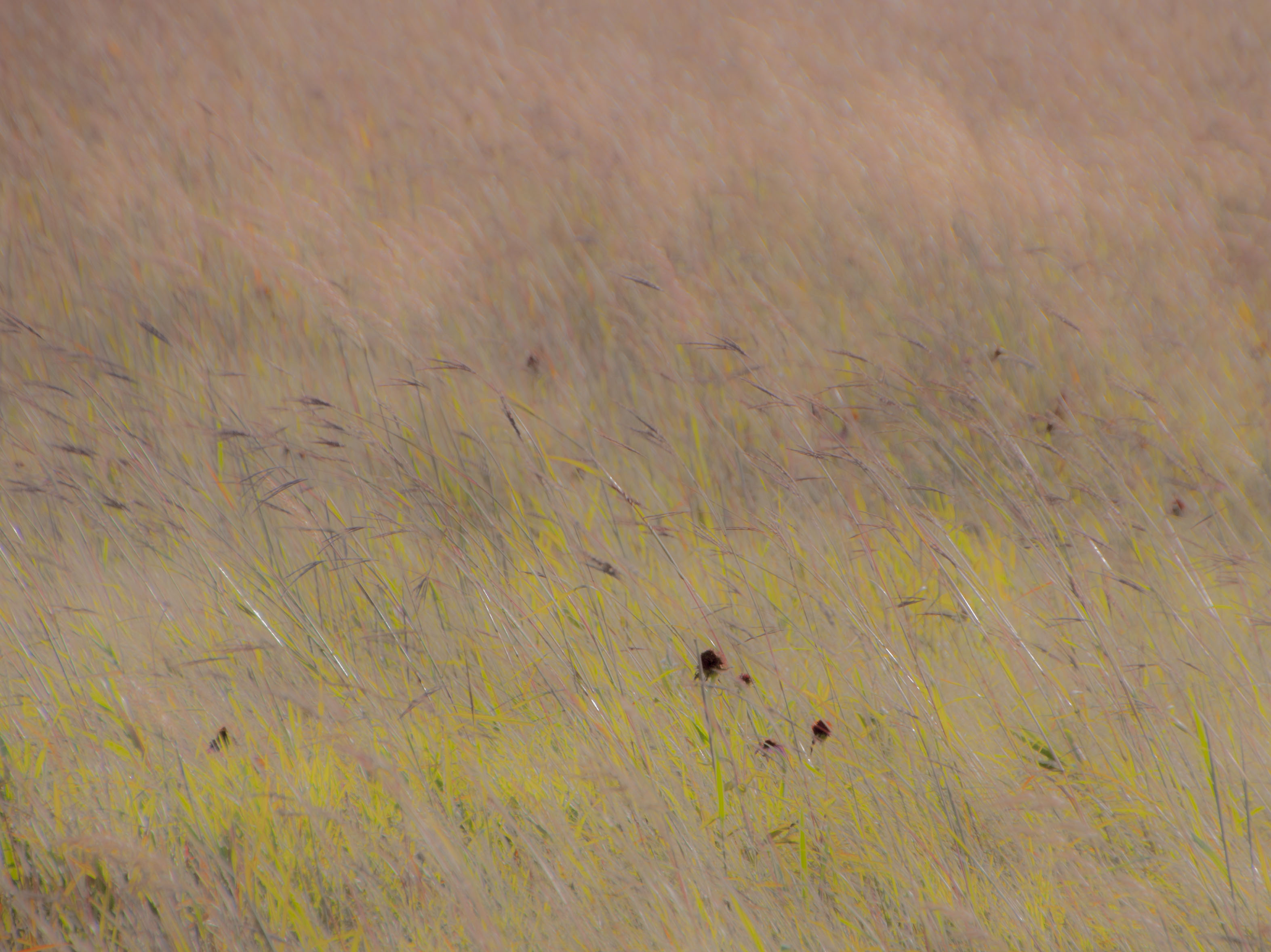
Bluestem in a prairie wind this week near Hermann.

Bluestem in a prairie wind this week near Hermann.

While there are no survivors of the original prairie pothole biome, my imagination is often taxed in trying to visualize an actual prairie. For years I’ve stared at horizons and tried, trying to replace the sea of corn with bluestem, to visualize those seas of grasses so spoken of; of bluestem so thick it could wear away the toes of the boots of horseback riders seems impossible to imagine. I’ve tried imagining murmurations of blackbirds so thick in coolish September afternoons that they blackened the skies, sometimes completely shielding the sun … if you can believe reports of ancient storytellers, both from the letters of settlers and the passed along stories of the native elders. These are among the images I just can’t seem to pull off. Far easier to picture, though, are the long wingspan of V’s from the geese flying high overhead, often at different strata. These are all pieces of a grand puzzle, though many with the edges worn and the hooking circles of the pieces torn.

The prairie is no more. More than 99 percent of it is gone, and more remnants are plowed as glacial rocks are pried from the soil with heavy construction equipment. The last field of glacial litter between Correll and Appleton was being scraped clean last week, a vivid image that needs no imagination. Nor is the continued mining of the topsoil of the former prairie that took nearly 12,000 years to form and less than 200 years of plowing, from the first settlers through the evolving of industrialized farming, to mine. Poor tillage practices and even greed prevents a protection of the soils from blowing in those eight or so months of bareness, or of trickling away with the seasonal rains as more and more acres of yellowish clay peak through where thick layers of topsoil once laid. Farmers are no different in this mindset than other “miners” of the earth’s resources, all part of a world-wide population reeking with indifference.

Whether we speak of cropland or the reservoirs of fossil remnants we boast as endless beds of fuel, we seem intent in using up all of the earth we can. It is an interesting concept that we can use up the resources of the earth and still survive, and when the time comes, and it will, the silence will be deafening — like our barn the afternoon the swallows left.

Harvest moon over our prairie now seems like a harbinger of the change in weather.

Harvest moon over our prairie now seems like a harbinger of the change in weather.

That is a decided winter for future times. As we scurry for blankets — how can we cover 75 low-lying tomato plants? — to protect what we can, the approaching autumn will not be ignored. A frost is imminent. We in that transition of autumn toward winter, and with much of the canning and freezing of Rebecca’s garden done, we hang on to what is left as best we can. We’ve had a lovely growing season, and some of our work is unbeatable — our smoked eggplant and tomato sauce is about as perfect a testament to the summer season as you can find. The apples are about ready for harvest and sacks of walnuts are hanging in the shed. We work hard, just as the squirrels around the grove are doing, preserving the last of what we can for the months ahead.

This transition into autumn is interesting, and becomes more so each day. We look toward the rest we know is coming. In some ways it can’t come soon enough. In other ways, we want to put this transition off as long as we possibly can.

Poetic Injustice

Just a few feet away … just past the wireless internet connections and my hot-shot photo printer, and the window, of course … stand tall spheres of pinkish hollyhocks. That they’re there is nothing short of poetic injustice.

Last year I was accused of mowing these very same plants at grass height. In all honesty, my goal was to protect the plant next to them, the delightfully pungent horseradish. Those funny shaped leaves of what I since have learned was that of hollyhock rather than pigweed were left unmowed this spring and summer, and now they’re in full, strident bloom just outside my office window.

Poetic injustice? You see, I have this reputation of being a hollyhock hater. My mowing them down, as I did in my former backyard, only added to the reputation. That these were planted right outside the office window is seemingly just that, a poetic injustice even if this claim of hollyhock hatred is a mite unfair in my humble estimation. There is a story, as you might have guessed.

Buzzing hummingbirds are frequent visitors, a buzz that attracts the ear as much as the swaths of pink in the prairie breezes catch the eye.

Buzzing hummingbirds are frequent visitors, a buzz that attracts the ear as much as the swaths of pink in the prairie breezes catch the eye.

It starts with my former neighbor, a well meaning elderly woman who tried fostering her will and hollyhocks on others. This nose-against-the-window woman initially garnered our rapt attention when she, with the help of her long-suffering husband, tore into our asparagus with a spade to plant raspberries in their place. This was on our property, mind you, and without our permission. “I just wondered if you noticed that we dug out those horrible weeds and planted raspberries,” she said to me one sunny Saturday morning.

“I noticed. Those weren’t weeds,” I responded, reining in my anger … quite successfully I must add, “those were our asparagus.”

“There are so many things you can make with raspberries,” came her smiling retort without a hint of either hearing nor remorse.

Raspberries aside, we went to great expense and labor to plant a native prairie garden in our backyard. Our intent was twofold. One to reduce the use of a gas-sucking lawnmower, and two, to bring to life an entire biome of plants her generation had successfully denuded from the prairie. Oh, it became a beautiful garden. At the base were little and giant bluestem, Indian grass and side-oat grama. Inserted throughout were native forbs that included different varieties of coneflowers, wild onion, blazingstar and scores of other native flowers, blended in design for a summer-long show by Sally Finzel, of Morning Sky Nursery near Morris.

For those unfamiliar with prairie gardens, most are at best a three year project to enjoy that first full year of prairie ambiance. Year one is spent in preparation by controlling weeds through either chemical or mechanical means. Mechanical is more touchy, for when you rid the space of one species you disturb and give growth to the latent seeds of another. Year two is in the planting, and we planted expensive plugs we bought from the nursery. With luck, that third year is when the grasses and forbs are mature enough to actually resemble a patch of native prairie. This is when you can finally sit back in a hammock and enjoy the wind-blown grasses and sprinklings of color, along with all the birds and pollinators the patch attracts.

We always welcome pollinators to the farm, even on hollyhocks.

We always welcome pollinators to the farm, even on hollyhocks.

So, what does all of this have to do with hollyhocks? That third year in the lower corner we noticed what appeared to be a rather strange looking plant. Broad, light green three-fingered leaves began poking up through the grasses. It didn’t take long to recognize that these leaves were quite similar … actually, the leaves matched perfectly … to a wide swath of hollyhocks planted on the bank of the adjacent Hawk Creek. Along the backyards of all three households, and was such a source of joy for our meddling neighbor lady.

No matter how much digging I did with a spade, nor “painting” with the horrid Roundup herbicide, there was no ridding my patch of prairie of the hollyhocks where she admittedly dumped the seeds the previous late summer or fall. “Why,” I asked, “would you do that?”

“Hollyhocks are so pretty. They’ll look good and add color to your new garden!” she exclaimed, holding her folded hands over her bossom. It was obvious she didn’t understand, and would stomp off to her house when I went to attack the spindly devils.

It was in the midst of ridding my prairie garden of the hollyhocks when my relationship began with Rebecca, so it’s easy to see why I would have earned this sort of reputation. Hollyhocks were weeds in that prairie setting, and there was just no way of ridding them. In that “ribbing,” though, we have had some fun. Her mother sent us a pack of hollyhock seeds where she wrote in fine penmanship, “No Mow Hollyhocks!” Rebecca has “sneaked” in plantings around the outbuildings here on the farm and quite possibly had a hand in those just outside the office window. She has certainly chided me by noting that mine is the only real view of them. Poetic justice? Hardly!

She is also prone to drop in some historical tidbits such as that in the distant past hollyhocks were planted next to outhouses so visitors could say, “Oh, my! What beautiful hollyhocks you have!” before ambling off toward personal moments of relief. No one would follow along as they might for a garden tour, for “hollyhock” was “universal code” of excusing oneself for a toilet break.

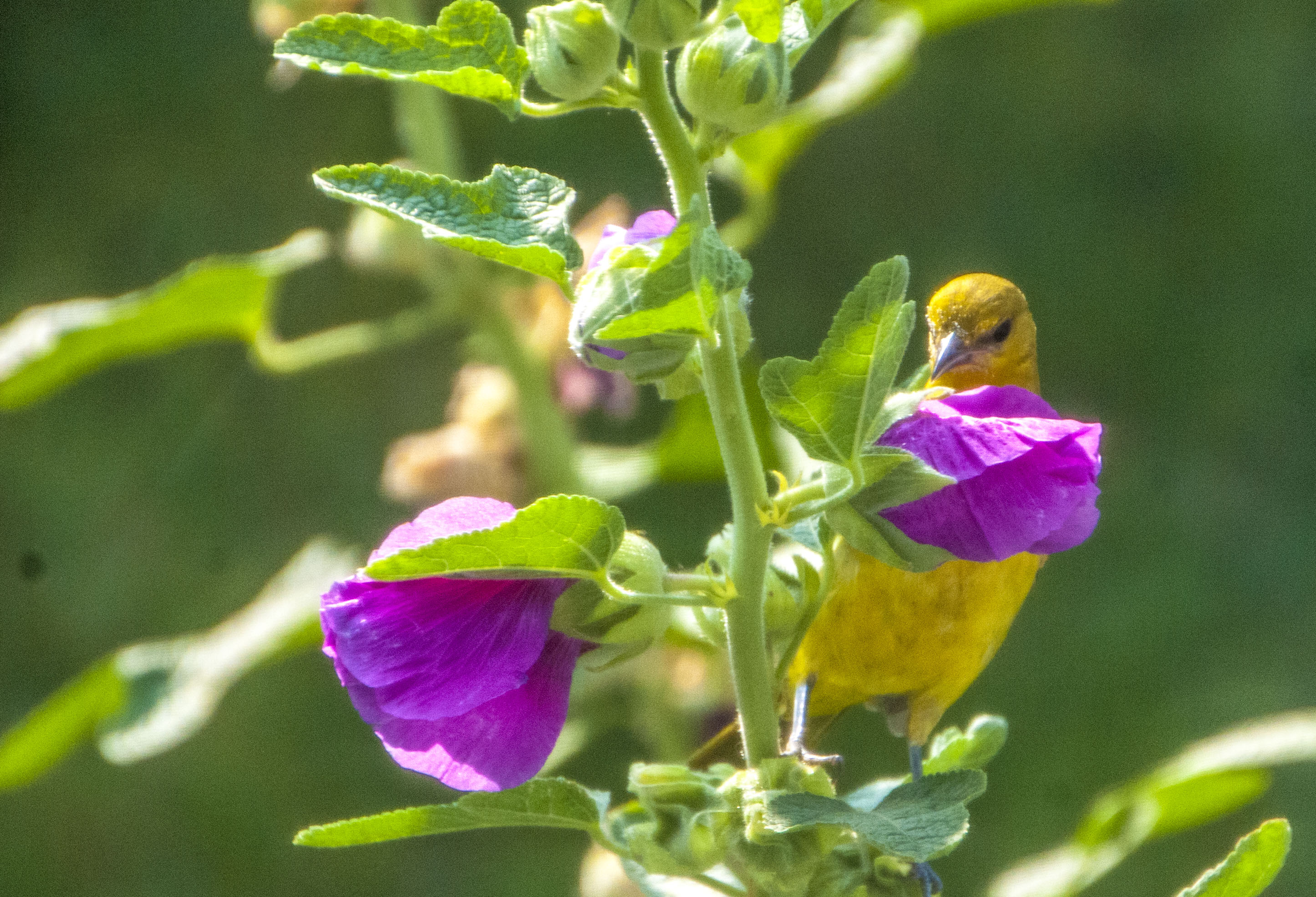
The female oriole was a surprise visitor to the hollyhock.

The female oriole was a surprise visitor to the hollyhock.

You might say my resolve is eroding just a bit. As many friends and neighbors say when the story of my hollyhock hatred is told, “But, they’re my favorite flower. They’re so beautiful.” One even reminisced about using the big blossoms to make skirts for her play dolls as a little girl on her Iowa farm. I’ll begrudgingly admit they can be pretty … in their place, and that a prairie garden is not that place.

Outside my office window those air swaths of pink frequently catch my eye when the prairie breezes blow, and I can hear the hum of the hummingbirds that come for a poke. Bees, which are somewhat of a rarity around here, buzz around the blossoms. And, a female oriole surprisingly plopped herself onto the hollyhocks one morning this week, and indeed, all three made an appearance over a ten minute stretch. That, in itself, was pretty special, so, yes, my resolve is eroding … despite this poetic injustice!

Flying Lessons

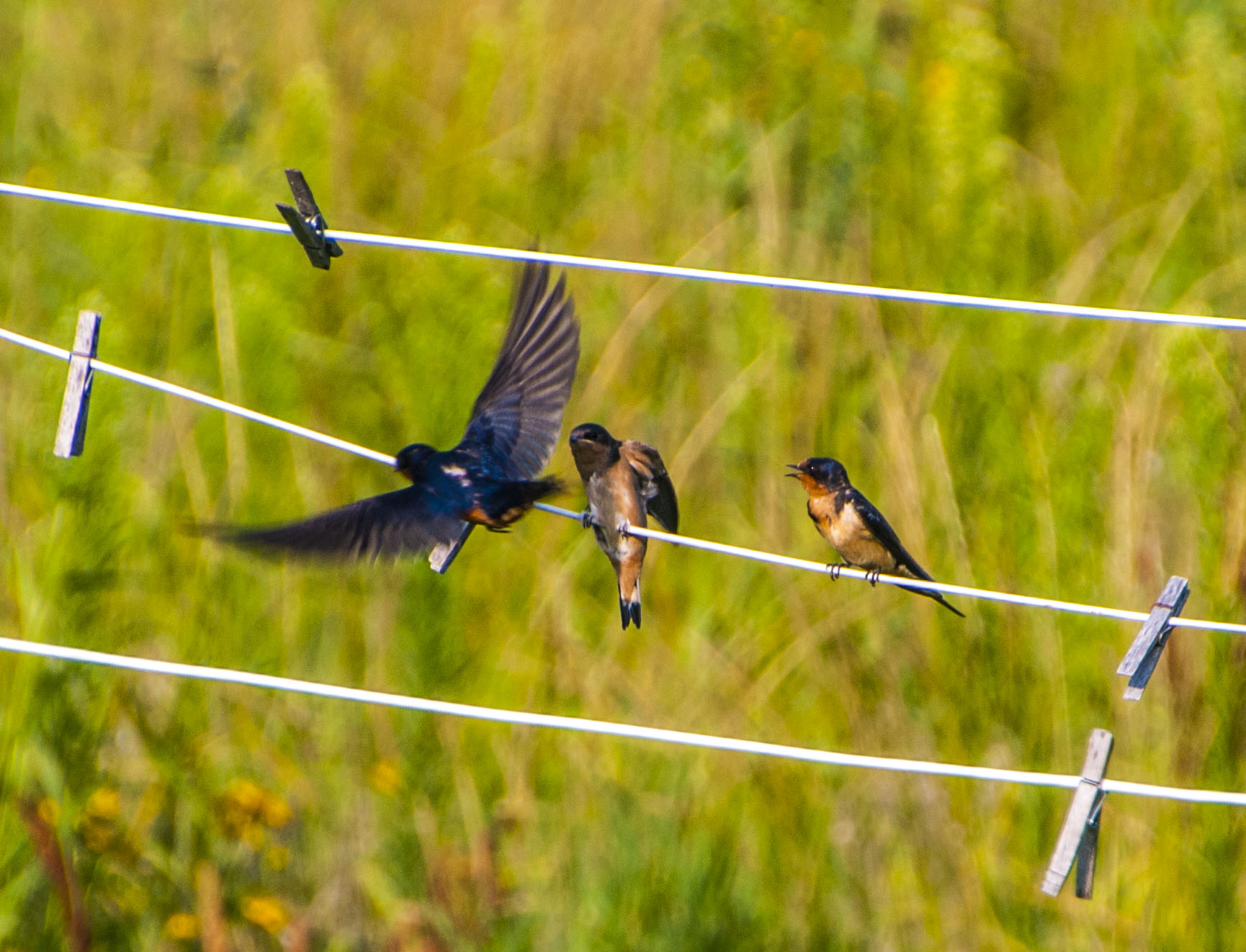
Today was one of significance on our Listening Stones Farm. While vacuuming the upstairs bath this morning I happened to look out the window to find a half dozen barn swallows clinging to the roof. At first I didn’t recognize that these were the chicks, if that’s what they’re called. Then the parents came flying in with full cheeks to feed the chicks, which appeared to have been pushed from their nests and were clinging onto the shingles for dear life.

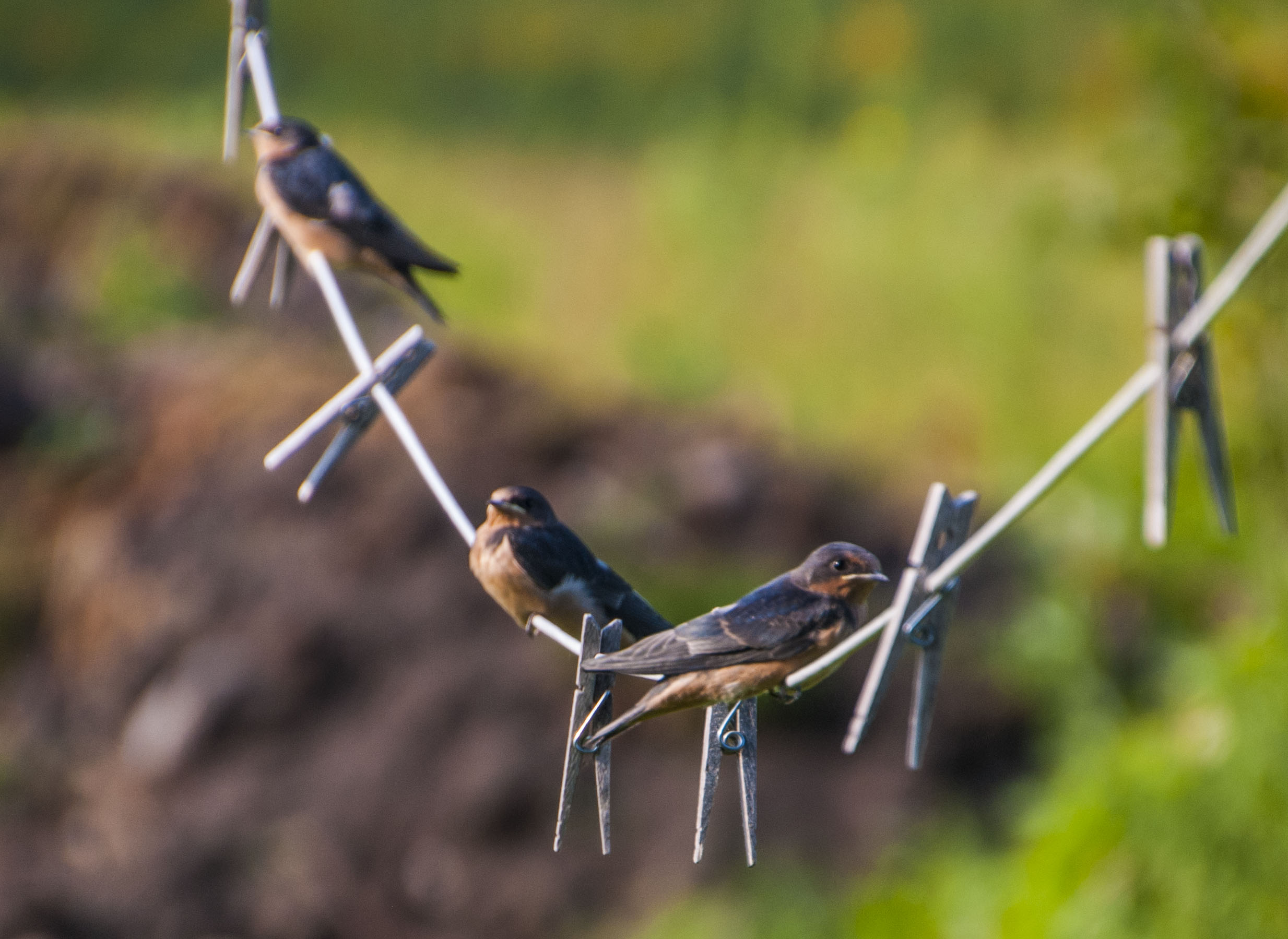
Three swallow chicks await dinner.

Three swallow chicks await dinner.

If you’ve watched little kids on the rim of a pool on their first day of swimming lessons, then you have a reasonable idea of the roof top situation. Ever once in a while, one of the chicks would push off for a short flight, circling around between the distant elm, clothesline, and back to the rooftop where the landing was less than poetic. You might describe it as more awkward than that of a crash landing. Yes, the chicks were getting their first flying lessons.

Another if: If you’ve watched swallows fly, then you know they are acrobatic, athletic and poetic in flight. Same for this most recent generation as they swept through the air with such incredible ease. You could sense the weakness, though, as they would launch themselves into the air and make a couple of circular swoops before coming back to the relative safety of the roof, sometimes actually tumbling in landing. It was frankly a little too humbling to be funny, although had I taken a short video with my cell phone and posted it on Facebook, I’m sure people would have found humor. What happens on the rooftop, however, stays on the rooftop!

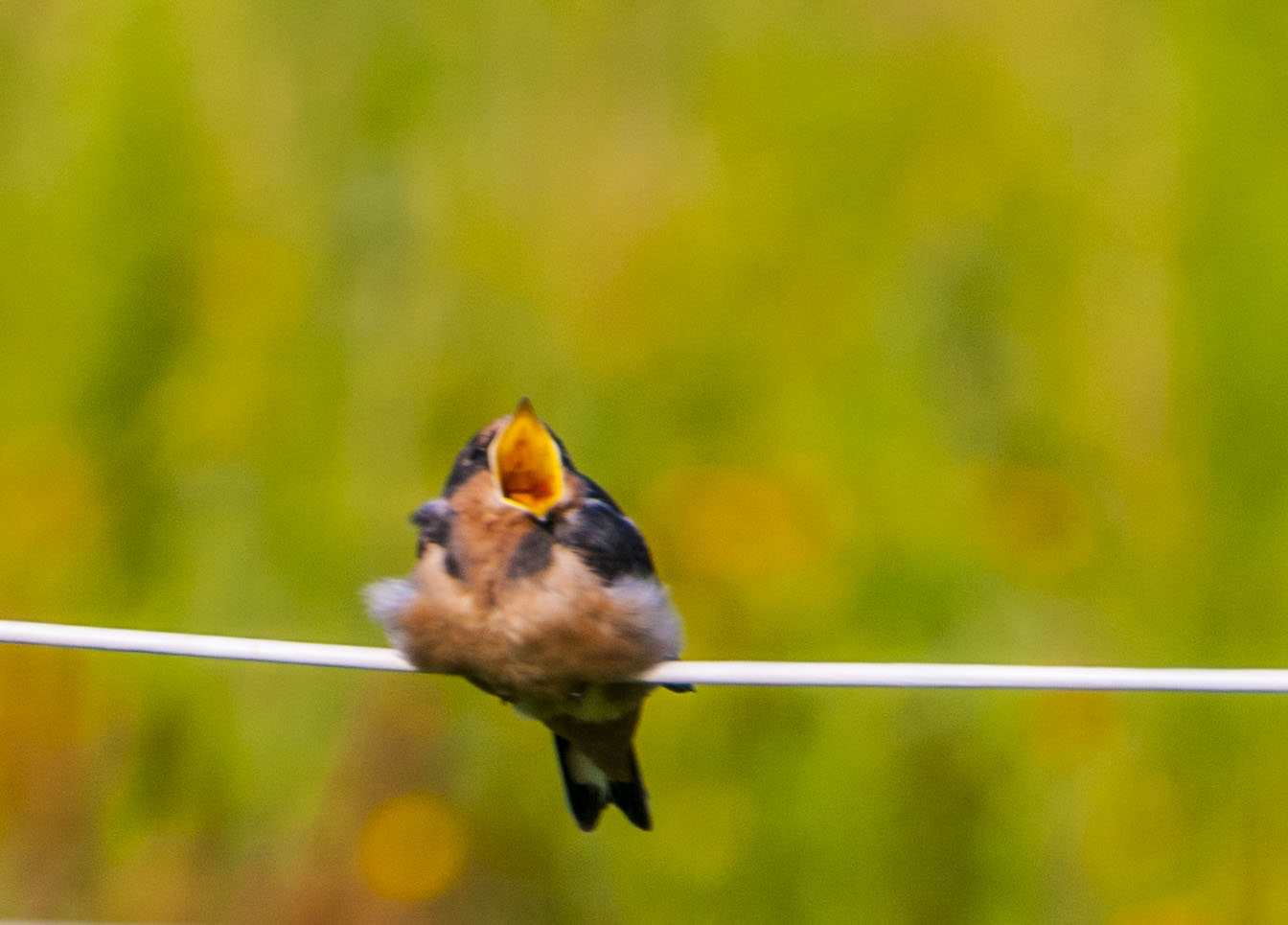
Someone is hungry!

Someone is hungry!

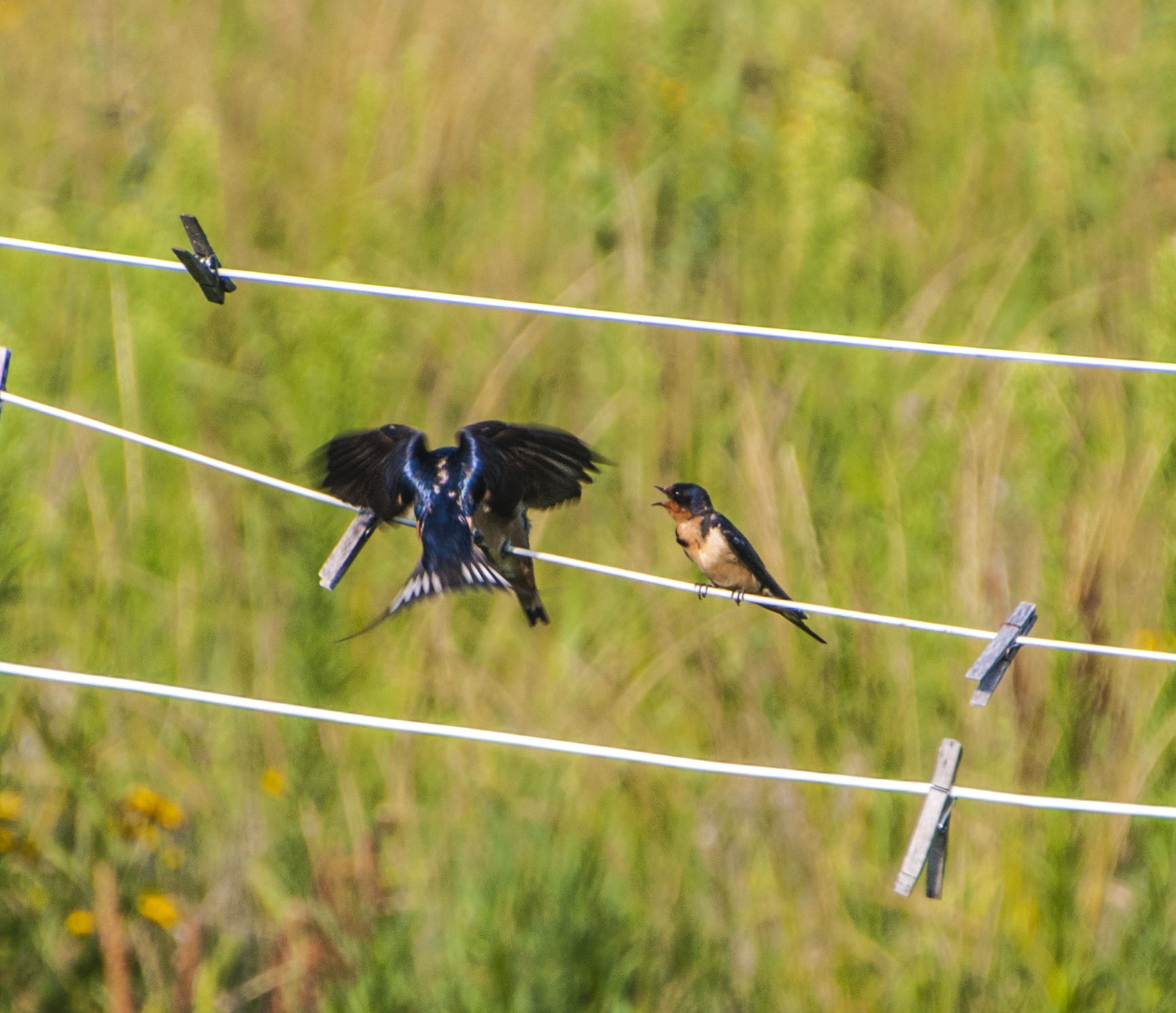
Later this evening when Rebecca and I took our standard evening wine on the deck after our work and before going inside to prepare dinner, some of the little ones were perched precariously on the clothesline, preening and awaiting meals. After watching for several moments I came in for the camera. Sure enough one of the parent swallows swept in, braked incredibly and instantly, passed food from beak to beak, then with such beautiful and intricate wing control, swooped off toward the prairie for more insects.

What a fascinating evening. Watching swallows fly is a favored pastime here on the farm. Yes, they dirty the barn and we’ll find droppings on our sheets hanging to dry on the one, yet they more than make up for their messiness with the mesmerizing latent lyrics they write on the prairie sky.

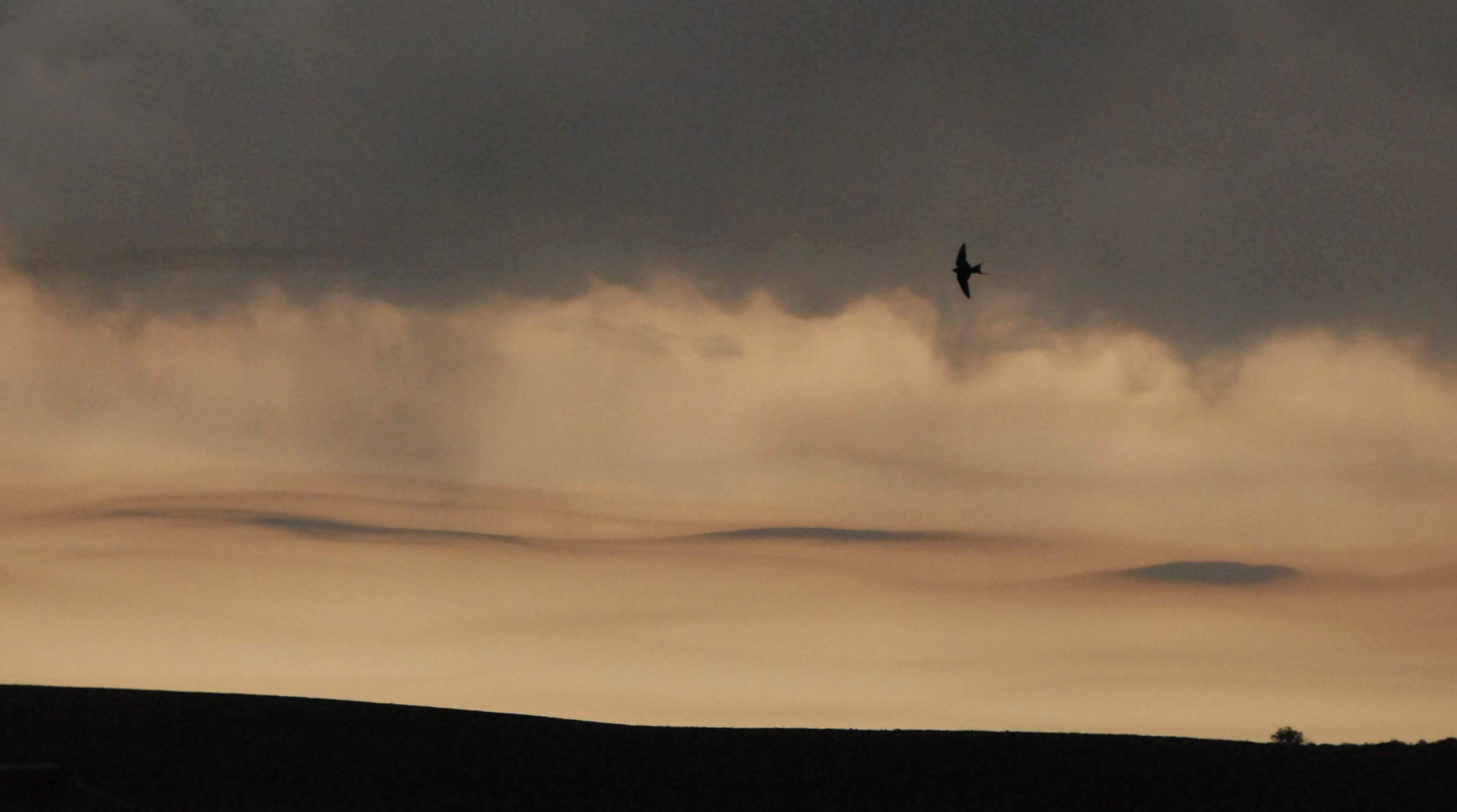
In an instant, with deft wing control, the swallow stops in midair, feeds the young, then as quickly, flies off.

In an instant, with deft wing control, the swallow stops in midair, feeds the young, then as quickly, flies off.

Off for another flight over the prairie.

One of the entertaining rituals happens after letting the cats outside, when the swallows dive bomb the cats as they cross the lawn. Our little hunter, Olive, can’t resist the occasional yet deadly serious flip and leap at the diving birds. So far she has come up completely empty. On the other hand, Silver just is too cool to be bothered. As the birds swoop in he just saunters along as if nothing is happening, seemingly in a world all his own.

Last year he wasn’t so calm. Same with Olive, who would simply try find safety in the grass as the swallows came in from several directions. It was their first year on the farm and the diving swallows bothered them both, and especially bothered was my son, Aaron’s, cat. Those swallows seemed to sense the differences between the cats. Poor Finnegan, who was both old and apparently quite sick, the swallows would come close enough to have pulled fur if they so wished. Not so with the other, younger cats. Now a year older, and with Finnegan in what we call “a better place,” the swallows will come decidedly closer to the cool Silver, yet keep a respectful distance with the little hunter.

It’s hard to say how much longer we’ll have the swallow chicks holding close to the porch top and clothesline. Size wise, mistaking a chick with a full grown parent is already difficult. Some of the difference is in the plumage, and with the nearly constant preening, that will change quickly. The little ones are just as adept at the acrobatic flight as their parents already, although they can’t stay aloft as long. As they gain strength and more mature plumage, our “edge of the pool” sightings will quickly come to an end.

Swallow flight is one of the joys of living on the farm.

Swallow flight is one of the joys of living on the farm.

Swallows are fun to watch regardless. I’ve often said I’d love to soar like one of the white pelicans we see around here almost daily. As comely as they are on land, in flight white pelicans have few rivals And, after years of watching the dives of night hawks in the cities where I’ve lived, I’ve also dreamed of what it must be like to do a complete free fall of such blinding speed, yet with the dexterity to suddenly sweep back toward the heavens. But, like I was telling Rebecca just a few nights ago, I’d just once like to transpose myself into the body of a swallow for a quick flight around the farm. For overall beauty and control of flight, I cannot think of another bird that comes close to such perfection.

As I looked out on the rooftop this morning, watching the little ones making their first flights, I couldn’t help being envious. They were just days away from having that endless and seemingly flawless and acrobatic ability to fly.

Just once. Just once to have such freedom of maneuverability and poetry. Just once.

Kawishiwi Calling

Our planning and packing for our annual jaunt from Listening Stones Farm to our cabin near Ely is gearing up. Pork ribs are smoked, and we’re thinking of dinners to share, of our favorite fishing spots, of which books to pack, and perhaps even wondering what new memories we’ll be bringing home with us.

Some 28 years ago our first trip was made to Kawishiwi Lodge & Outfitters, a rustic collection of cabins located on a National Forest cove near the entry point of Lake One in the Boundary Waters Canoe Area. Our first trip down that long, single-lane gravel road was certainly adventurous as we kept a lookout for the buildings pictured in an obscure brochure we had picked up at an outdoors sports show months earlier.

Following a duck in the morning haze.

Following a duck in the morning haze.

Further up the drive, past what was then a fresh clear cutting of timber that in years since has regrown, was a sawmill. “You sure this is the place?” asked my wife, Sharon. We chose this as a compromise between a quest for a wilderness experience and convenience due to our oldest son, Jacob, because of his physical and mental disabilities. He was then eight years old, and his brother, Aaron, was three. To prepare for the trip we had listened to a wilderness tape featuring loon calls, which Aaron had somehow voice perfected. We brought along a babysitter who would watch the boys on the few nights Sharon and I would take off into the wilderness with a camping permit.

While unpacking our gear from the car into the cabin that first afternoon, I stopped for a few moments on the weathered, wooden dock to cast a fly on the fiberglass fly rod I had bought as a teenager some 20 years earlier. As I retrieved the fly, a denizen of the deep, a northern pike with a head the size of a mature alligator, suddenly eased in behind the fly. In my panic, and subsequent casting, my old rod snapped just above the handle. Such was our introduction to Lake One, Kawishiwi Lodge & Outfitters, and the BWCA!

Sunrise on a quiet morning.

Sunrise on a quiet morning.

Over those years we stayed in four or five of the cabins around the lake. In time we would settle into Cabin One … and we renew it every year. As transplanted Minnesotans this has become our “lake cabin” complete with an old, native lumber dock on a channel that meanders through the granite outcrops between Lake One and shallow bays toward the entry point. It was off this dock that we spread Sharon’s ashes after her unexpected and untimely death a few years ago, making this more than just a summer lake cabin.

Rebecca and I were only a few weeks into our relationship when she joined us for the first trip up after Sharon’s death. We’ll again be joined by my cousins, Mick and Nancy Burke. Two of their three children have come up over the years, as have many of our exchange students. Luise Hille, of Germany, has been here for two different weeks over the years, and when her parents were last in the States, their whole family came for a stay across the lake in one of the newer cabins. I was able to join them for a few days of their stay, which meant I was able to stay and fish twice within two months that year. Life doesn’t get much better than that!

When not in the kayak or canoe, we spend time on the airy porch reading and visiting.

When not in the kayak or canoe, we spend time on the airy porch reading and visiting.

Oh, the memories. Two years running a group of pickers rented a row of three of the cabins. Each evening they gathered around a fire pit and played well into the darkness. One year the woman scientist who broke the Alar pesticide study on Washington apples stayed with her husband and boys in the adjoining cabin. Aaron and her boys played in the outcrops behind the cabins all week long. We even met a former high school classmate of my brother from back in Missouri. There was the summer when Sharon came shortly after her knee operation and couldn’t canoe, so the manager and his brother … Mike and Jim … took us to a motor lake so she could go fishing. We caught enough for a shore lunch. A few nights later the boys came knocking. “We’re taking John and going fishing,” said Mike. They placed me in the “king’s seat” and paddled out into the lake, where as we were jigging for walleyes and sipping “illegal” beer a sudden and incredible display of Northern Lights began dancing in the sky. Mike and Jim, and their “shady” helper, Diamond, are long gone, and the son of the dentist who owned the place, Frank Udovich, and his wife, Nicole, took over and have made some subtle yet remarkable improvements on all of the cabins, and they have significantly increased the outfitting side of the business.

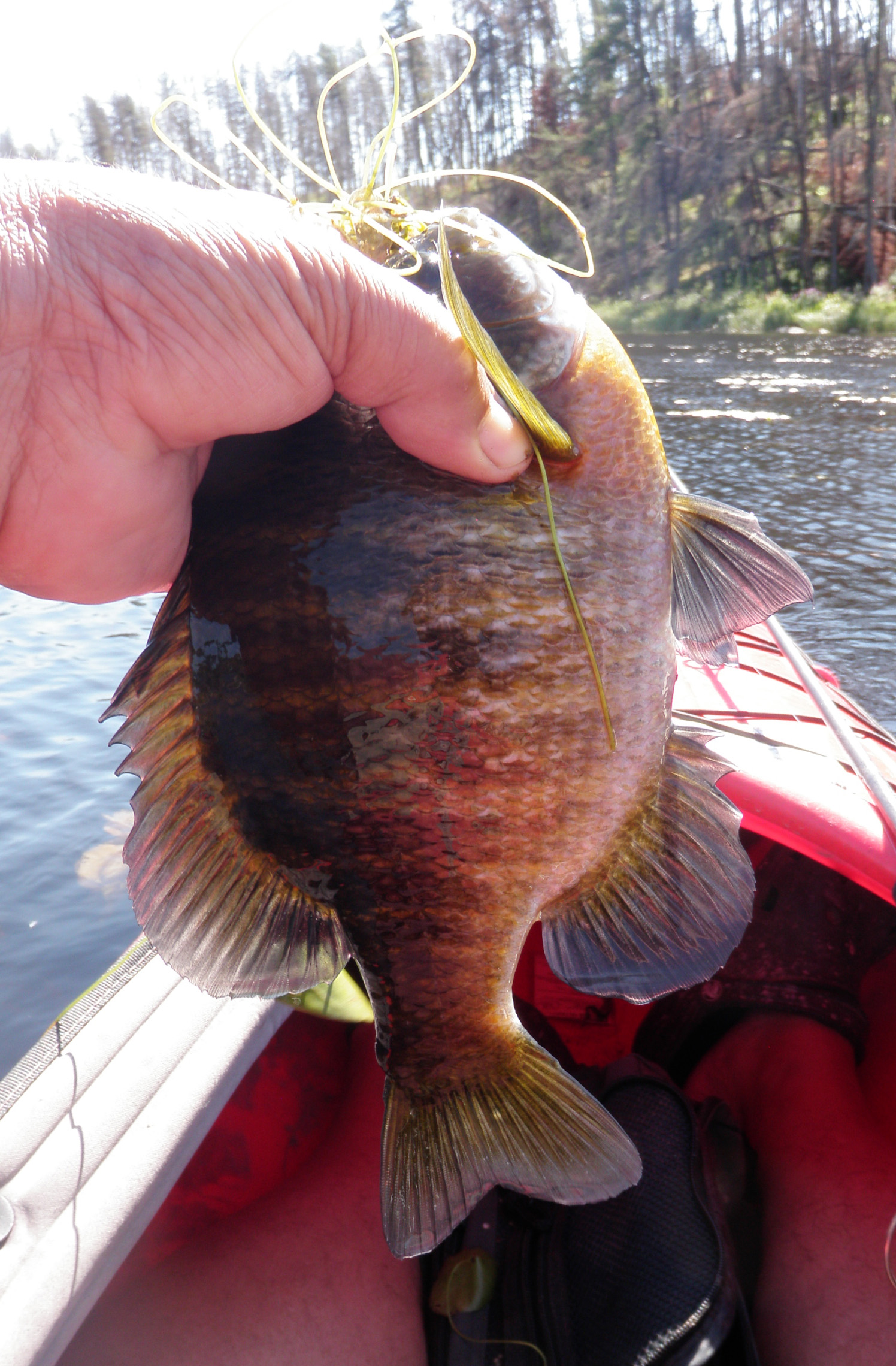
A Pagammi Creek bluegill.

A Pagammi Creek bluegill.

Here was where Mick caught his first smallie, a mighty three pounder. Ah, those moments fishing are always fine. One dusky evening we were paddling back to the cabin when a huge beaver swam beneath the canoe, keeping pace with us. At the other end of the lake, Pagammi Creek has provided us with many bigger-than-a-whole-hand bluegill and some scrumptious shore lunches on a nearby rocky island that served as escapes for Aaron when a canoe became too confining. Pagammi was where a fire started on the Saturday we were packing out two summers ago, a fire apparently started by lightning that burned thousands of acres and put a scare into the Ely community before finally being controlled. Last year a natural succession had already greened the hillsides, and the bluegill hungrily grabbed a Gill Buster tipped with a leech as my kayak was put adrift by the constant wind.

We’ve shared dinners and campfires along with many nights around the big table as son Jake rolls the dice for another game of Zilch. Since the remodeling, the breezy porch, now with floor to ceiling screens to abate the mosquitoes, welcomes all of us readers, and in the heat of the day, the dock and lake beckons us as swimmers. In all directions the wilderness beckons, and the canoes, kayaks and fishing rods are always steps away.

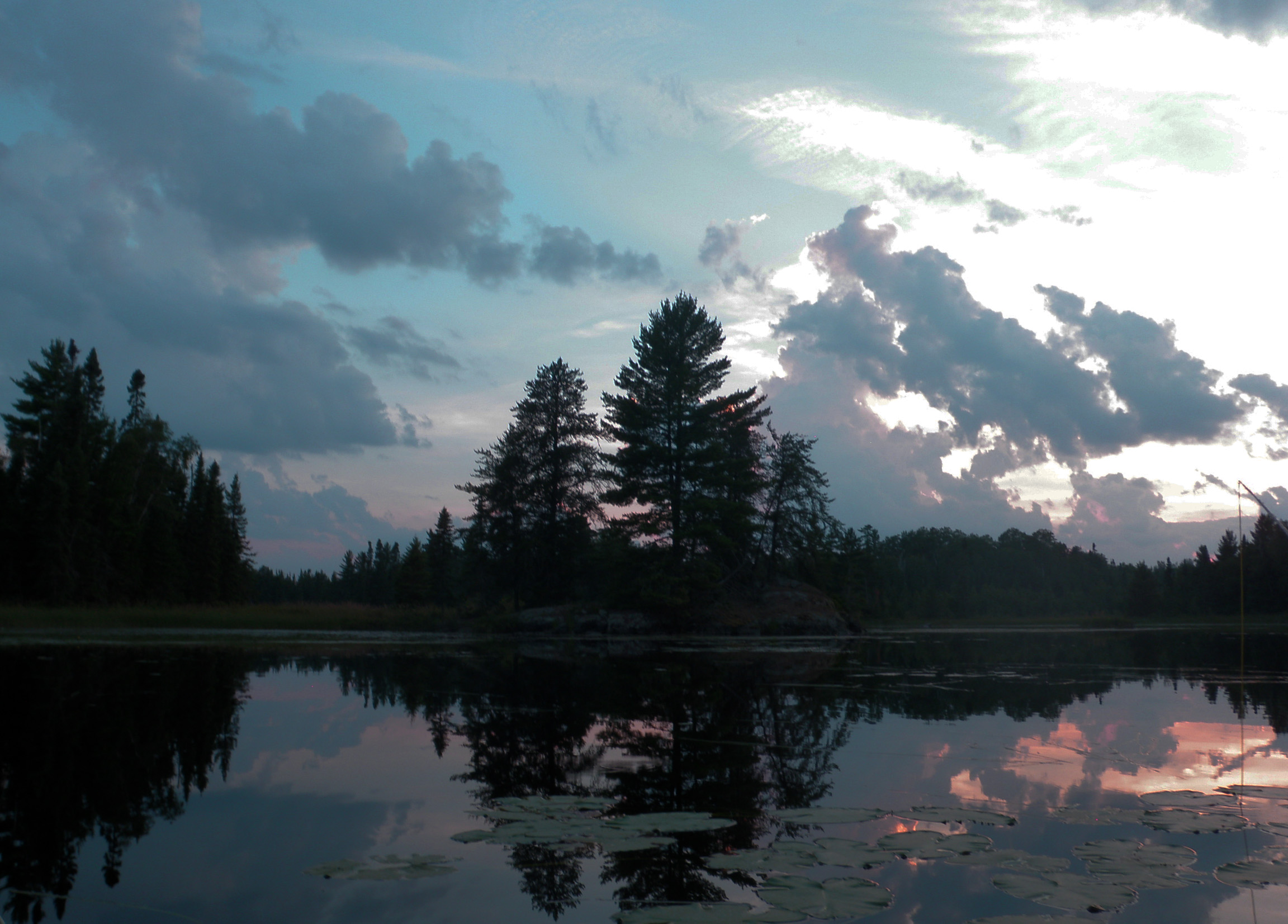
Sunsets are wonderful here, too.

Sunsets are wonderful here, too.

Nowadays, after all these years, I’ll sometimes simply slip out before breakfast … even before the sun rises … in a kayak with my fly-rod and camera, paddling around the shallow bays casting for smallmouth and bluegill. Sometimes I actually go for the fishing. Other times it is simply for reflection and reminiscence. Remembering family and friends we have shared time with here over the years, those good years with Sharon before her depression became so overwhelming, and since her death, the times with Rebecca and our cousins, the Burkes. Once again I can hear Kawishiwi calling. Our trips have become like those penciled height markings on a door jam; each darkened line marking memories of my mature years.

Beyond Yellow

A yearling White Tail walks through our dominate yellow prairie.

A yearling White Tail walks through our dominate yellow prairie.

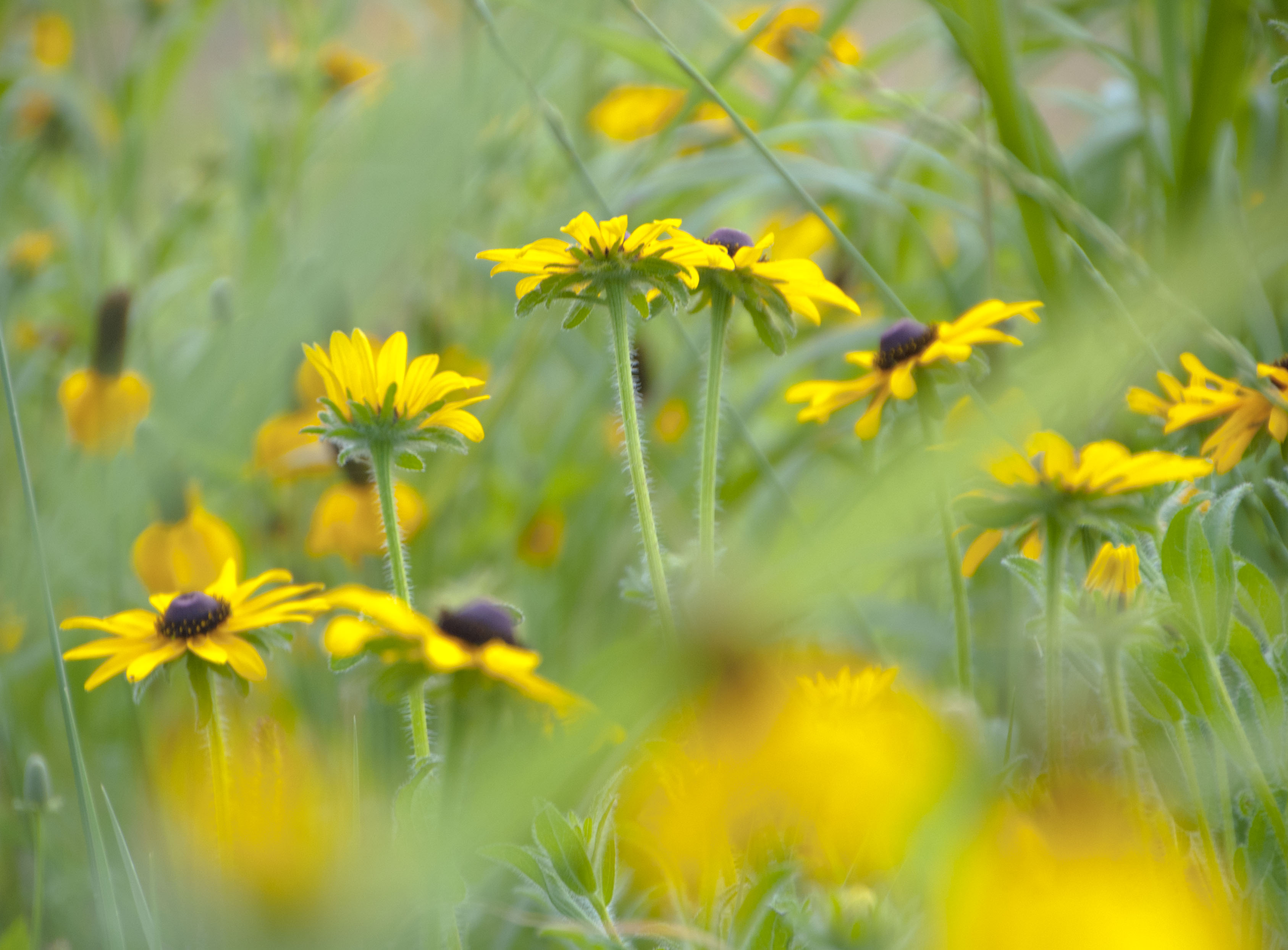
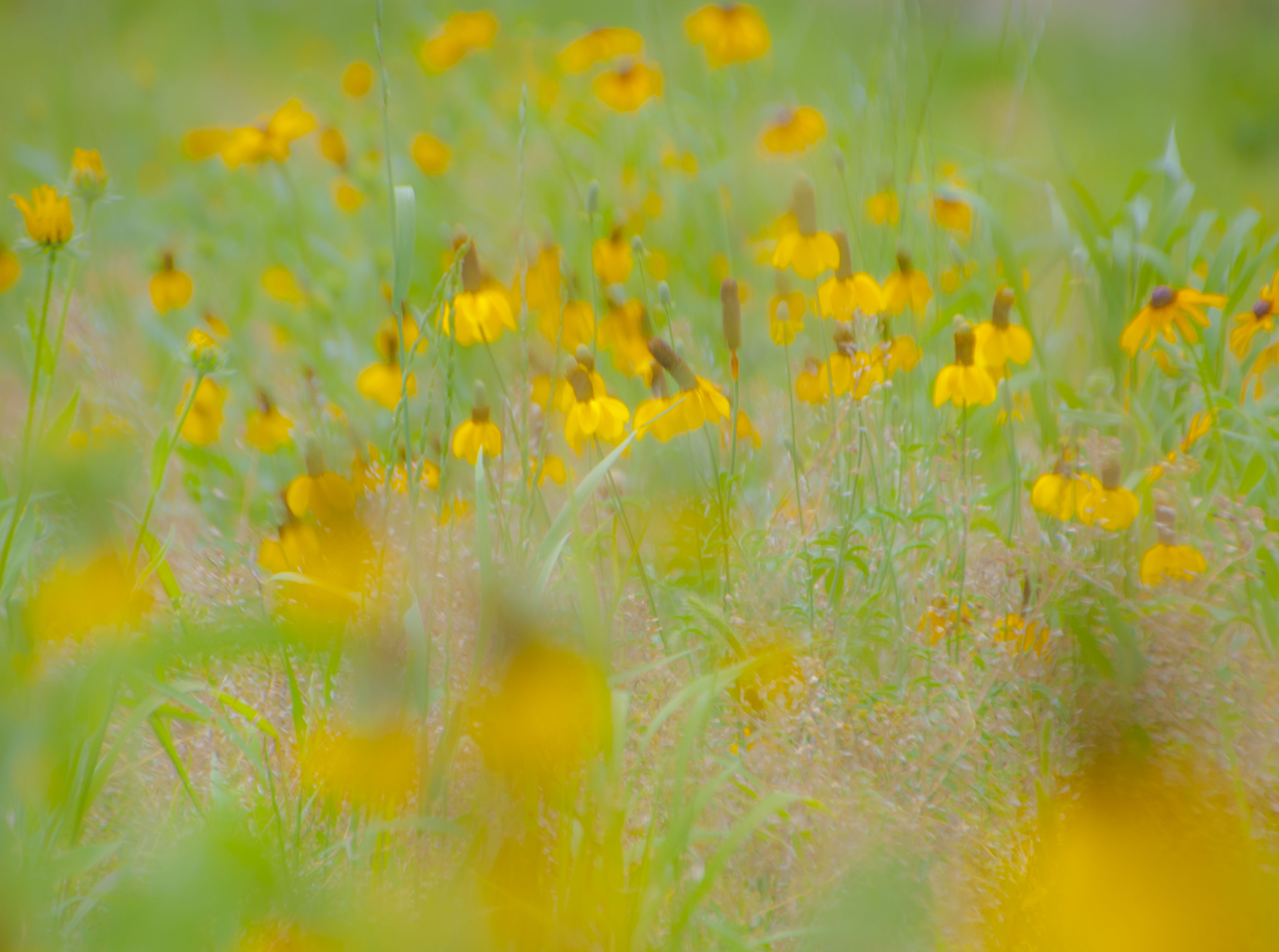
With a nice little breeze tickling our prairie the other evening, I smothered myself in DEET and took my camera into the our fledgling wild and native grasses and forbs. Once inside the grassy “jungle” a realization hit rather quickly (besides the mosquitoes that were seemingly unimpressed by the supposed deterrent): We are immersed in a sea of yellow! Yellow Cone Flowers. Yellow Wild Sunflowers. yellow this and yellow that. Every direction, all 360 degrees of them, are beaming with yellow.

Browsing through my recent archives of images from our eight acres of prairie starting from about a month ago, yellow has been a dominate theme. Not just with the flowers, either, for Rebecca’s garden was flush with yellow warblers for awhile and the gold finches, which are really more yellow than gold, are constant visitors to the feeders and tree branches around our solarium. Out in the prairie, almost every blooming forb to date is some form of yellow. Impressively, the yellow comes at you from all angles, shapes, sizes and hue. Corporate Kodak would be impressed!

Yellow, yellow .. everywhere is yellow!

Yellow, yellow .. everywhere is yellow!

As much as yellow is welcomed, we are quite pleased when we see a few native Purple Prairie Clover heads sticking up here and there, which have added some charm and variety. We are in desperate search for other differing colors. Rebecca found a couple of lavenderlish Bee Balms blooming, and in a corner by her garden, her Cardinal Plant is showing off some vividly red blossoms. Otherwise, it’s all yellow … with the exception of the green, warm season native prairie grasses.

The following morning Rebecca suggested we go on yet another hike through the prairie. We make a trek almost daily. This time it was upstairs first for a long sleeved white tee-shirt and long pants … anything to keep the mosquitoes at bay. With the sordid heat and a naked sun pounding down on us, we were fortunate that the pesky pests were snuggled in tightly to the bases of the plants. We started at the garden and made a big wide looping circle around the house and grove before coming back in through the road ditch to the driveway. In that “awkward” portion of the grove we also checked on three of our elm tree plantings and found they are doing quite well. I’ve not looked them since many of the bushes and trees in that area, including two other elms, were destroyed by a skunk or coon digging in after the smelly fish-based fertilizer we used. The animal was quite efficient in digging out and laying the bare root plantings at the edges of the holes as it went clear to the base in search of a dead fish.

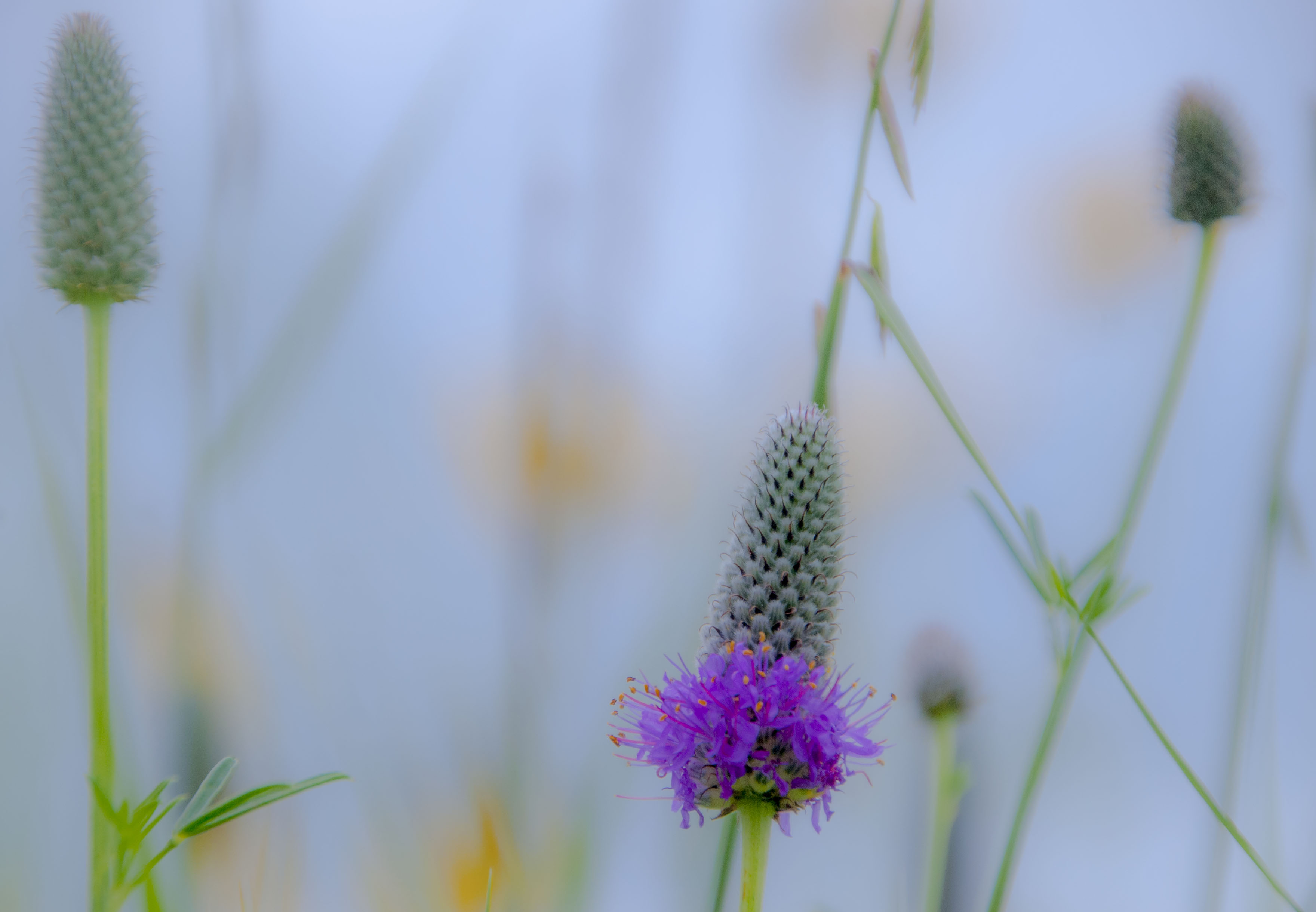
Side Oat Grama is emerging, and is seen here with a couple of Native Purple Clover.

Side Oat Grama is emerging, and is seen here with a couple of Native Purple Clover.

If given a report card on our tree and shrub plantings we would come out looking quite well. Besides those few we lost to the smelly fertilizer, our only other losses included the four grape vines and one of the plum trees in the orchard. All to standing water after the days upon days of rain. All the other trees and shrubs seem to be doing well thanks to those same rains where we had better drainage. Rebecca’s garden and the other shrubs and trees we planted last year are doing well … with exception of the one apple tree in the yard that our resident white-tailed buck debarked scratching velvet from his stately rack last fall.

Then there is our prairie, all eight acres of it, all awash in bright yellows amidst the stark greens of the native prairie grasses. My goal on our walk on this morning was simple: to find anything out there to photograph beyond yellow.

We were very hopeful of finding more that the two or three Bee Balm plants, and yes, we found many clumps of the Purple Prairie Clover and a few of the white variety. Both were far from being considered dominant.

Some of the earlier forbs have begun to wither and head into dormancy as new successions come forth in this constant march of summer. Since this is our first real summer when the prairie looks like, well, a prairie, it will mature and change with time and climate conditions. Although we have been  dropping new sneaked wild forb seeds here and there, and even wedging in a few of our favorite forbs such as the Cardinal Plant and a flat of Prairie Smoke, we may be a year or two away from seeing any results.

Almost coral-like, this purplish plant going into dormancy stood out simply because of the color.

Almost coral-like, this purplish plant going into dormancy stood out simply because of the color.

Years ago our dear friend and prairie maven, Kylene Olson, executive director of the Chippewa River Watershed Project, told me to never assume that a prairie will look the same two years in a row. With that in mind, perhaps we should simply enjoy our bright sea of prairie yellows without complaint, for rarely is a color so warming to the soul. How can one maintain even a hint of madness with such gay day brighteners all around?

Our “Mysterious” Prairie

An overview of the prairie shows patches of grass and forbs. It certainly is far from being a mature prairie.

An overview of the prairie shows patches of grass and forbs. It certainly is far from being a mature prairie.

Beau Peterson, from the NRCS, was out Monday morning for a walk over our prairie, then asked if he could use our land as an example to show others who might be inspired to go native or who are considering converting commodity land into CRP. We were equally humbled, honored and pleased.

This is my second prairie planting, although the first might be excused since it was only a small, backyard native garden. This one covers eight acres of good farming ground with what Rebecca calls “good seed stock” for when nature eventually reclaims the prairie.

We have some patches of willowy foxtail, of which we have differing opinions.

We have some patches of willowy foxtail, of which we have differing opinions.

We put a call into Beau because neither of us could find one of the prime grasses in our mix, Side-Oats Grama, along with other native plants we were expecting. About two steps into the prairie Beau stopped and pointed to a sliver-thin stem of hiding Side-Oats and explained that it was one of the later grasses to emerge. He thought the prairie was coming along quite nicely.

He should have been here a year ago when pigweed and lambsquarter dominated our eight acres. We took our Cub Cadet to the prairie twice, and Beau’s predecessor brought in a prairie-friendly farmer with a brush hog to top off the pigweed as it was coming into the seed stage. After this cutting some patches of grass were emerging in places, and much to our surprise, we were told that the prairie was coming along nicely. Apparently it takes some practice to read a prairie.

Purple wild clover peaks up here and there for a beautiful contrast.

Purple wild clover peaks up here and there for a beautiful contrast.

Our experience here hasn’t been radically different than it was in my backyard planting. Late that fall years ago we received plugs of grasses and forbs and frantically went to work planting what we could. We were told that establishing grasses first was key in providing a base or foundation, so those plugs went in first. Starting early one morning I worked diligently to dig them in before a forecasted blizzard was expected. By mid afternoon I was scraping away snow to dig in the last plugs of Bluestem, Indian Grass and Side-Oats Grama … and none of the forbs were even touched. Fortunately Sally Finzel, of Morning Sky Greenery, said she would overwinter the plugs if I brought them back to Morris.

The following spring weeds completely overwhelmed the garden, which was thoroughly discouraging. Toward the middle of June she called and asked if I was ever going to come for my seedlings. “Why? The garden is shot. Pigweed has taken it over.” Sally encouraged me to come for them regardless, finally using a very sound economic argument: “It’s your money.”

We love these "little dancers."

We love these “little dancers.”

After returning with the forbs, I took a deep breath and took a hand spade to the weeds and discovered something rather interesting — beneath that pigweed canopy was a very healthy stand of prairie grasses — not unlike what we have experienced here. Two very long, hot and humid days later, the wilting weeds were piled to the side and all the forbs were planted save for five wild onion plugs. They would go in later since they continued to grow and eventually bloomed right in the seed tray.

This beauty dominated the prairie in the early succession.

This beauty dominated the prairie in the early succession.

That little garden also offered some interesting obervations about prairies: Never expect the same look two years in a row, since different conditions may favor different plants, and that prairies mature differently; burning a prairie will encourage a bountiful flush especially in the first year; and, that native prairies offer very interesting moments in their cycles of life, presenting an ever-changing profile through the seasons, so keeping a camera handy is paramount.

"Mexican hats" or yellow coneflowers are rampant.

“Mexican hats” or yellow coneflowers are rampant.

Our larger prairie has followed form from my backyard experience, and we are both having such fun discovering what the prairie offers from day to day. Right now the prairie is awash in yellow blossoms. Golden Alexanders have given way to Blanket Flowers, Common Ox-eye and Yellow Coneflowers or “Mexican Hats,” to name a few. More and more flowers will be blooming as we move through the green season, and our grasses are maturing nicely, too. Interesting, as well, is that what we see growing seems different than our prescribed seeding plan, and some of what appears on the seeding plan has not yet appeared in the prairie. And, the reason we called Beau. Ah, but what a fascinating mystery!

ourprairie5

We find ourselves walking through the prairie almost daily looking at both fading and new wonders. You might find me laying in the prairie with my camera seeking new and hopefully interesting images. Among our plantings were a few cottonwoods and burr oaks, which were planted in two different areas to simulate an oak savanna. On one of our walks we spooked a fawn. As it bounded through the belly-high growth it was hard to say which of us was most surprised. We have heard pheasants “barking” out there, too, which is a bonus … although neither of us are hunters. We have yet to attract meadowlarks or bob-o-links, although both species nest in the nearby Clinton Prairie.

We are quite pleased that our little prairie at Listening Stones Farm can be counted among the beautiful native prairie features of Big Stone County. Besides the National Wildlife Refuge, two diverse areas of Big Stone State Park, the Clinton Prairie along with a number of federally protected wildlife and waterfowl management areas, several farmers have left their original wetlands undrained. Thankfully they take great care and add time to their hectic farming schedules to protect them.

Yellow dominates the prairie right now.

Yellow dominates the prairie right now.

Indeed, we sometimes find ourselves in debate on whether Big Stone, Lac qui Parle or Yellow Medicine Counties have the most devoted prairie acres, and to be honest, one of the selling points for us when we bought our Listening Stones Farm 18 months ago was the close proximity of two active wetlands, our large and overgrown grove, plus the eight plus acres of tillable we now enjoy as prairie, thanks to the help of Pheasants Forever and the local NRCS. Our prairie adventures are really just beginning.


Bygone Ethics

Recent rains have given us a rare opportunity to revisit the long-gone prairie potholes that were part of the original, post-glacial landscape.

Recent rains have given us a rare opportunity to revisit the long-gone prairie potholes that were part of the original, post-glacial landscape.

Recently a friend who happens to be a farmer asked, “When did you become so anti-farmer?”

After my initial surprise and denial, and later, after subsequently rolling through the countryside, I began to realize how my comments and rants could be taken in that manner. My growing up as a child and teenager was in a different era, when having a thick thatch of grass growing where water could create rills of erosion in a field was not only expected, but common. Also common was leaving a swath of anchoring vegetation along riverine embankments. I can also remember my father’s concern when Earl Butz, as Secretary of Agriculture, began preaching his “fence row to fence row” philosophy.

“That will ruin farming,” my father said. He meant the land, although it has also altered farming into a Catch 22 cash chase.

A recently "refurbishes" grassland where the rocks were removed and the trees cut and piled.

A recently “refurbishes” grassland where the rocks were removed and the trees cut and piled.

Realize, please, that my father and I had many rifts and disagreements, politically and otherwise. Despite that, I grew to firmly respect his attention to real conservation farming practices as well as his trepidation on the Butz preamble.

My father lived long enough to watch as neighboring farms grew quite large over the hills of northeast Missouri where grass and grazing was a better ecological fit. He watched as abandoned farmsteads were leveled, burned and the ashes buried, and he watched as hedge rows were dozed along with tree lines and windbreaks. Fences were pulled, wires rolled, and posts, mainly hedge, burned. Forty acre fields became 80’s, and 80’s 160’s, causing him to sadly shake his head. Folks back in my home country now call this “Minnesota farming.”

Where's the grass? Tons of soils have washed off fields where rills and gullies were created by heavy rains and moisture.

Where’s the grass? Tons of soils have washed off fields where rills and gullies were created by heavy rains and moisture.

Yes, this is precisely the treatment of the land we see all around us. Industrial road grading equipment is used to extract glacial rocks from fields (which are then stored for sale in faraway cities to landscapers), and groves and farmsteads dozed and burned. Sod and prairie grasses, CRP land … all being plowed. Painstaking efforts are made with a blade to cut just enough of a two-foot deep furrow through fields to aid in the rapid flush of water. In many cases these furrows are too shallow to qualify as a legal ditch, meaning a mandate for buffer strips, and once cut, are carefully skirted by tillage equipment and planters. Cattails are allowed to grow … until hit by contact killing Roundup.

In fields already tiled, new and more efficient patterned tile systems are being installed. Although the technology is readily available that would allow farmers better water table management, the devices have been a tough sell despite years of positive presentations at many winter meetings. At least one watershed project had staffers basically begging farmers and landowners for a single demonstration installation … to no avail. Flush is seemingly the norm for managing water tables, not the holding back or storage of melt nor rain.

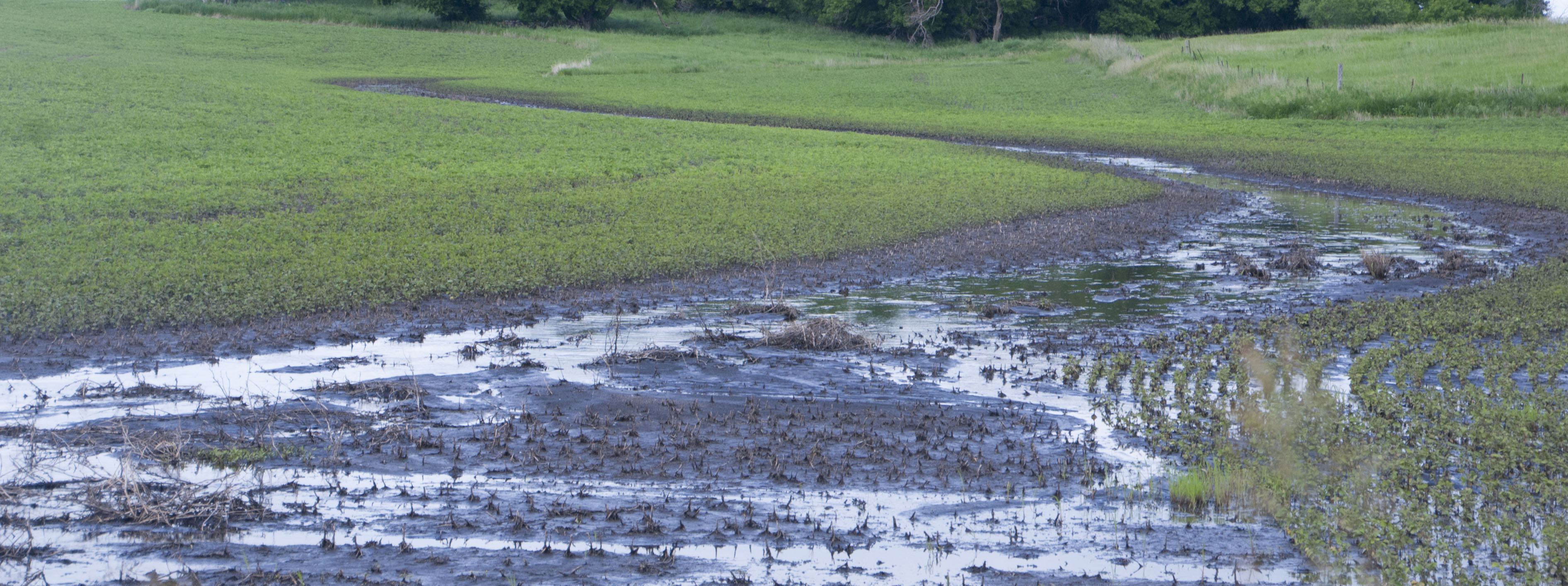
Shallow water "escape routes" are cut in fields that won't technically qualify as a drainage ditch, therefore not mandated for buffer strips.

Shallow water “escape routes” are cut in fields that won’t technically qualify as a drainage ditch, therefore not mandated for buffer strips.

Hilly lands that should never have been tilled stretch for miles with no regard for erosion. In wet springs and early summers, like we’re having again this year, runoff water carries tons upon tons of soil off the higher land. We passed a field with corn nearly two feet tall in the valleys with spindly, four-to-six inch stalks poking up on the rest of the acres. “That’s where all the good soil has washed off to,” said Rebecca. Typically, 20 percent of a field has the healthy stalks. The rest? Will it qualify for USDA emergency subsidies?

Indeed, an observer can easily see the change in soil color and tilth … light tans compared to a rich darkness … in field after field, mile after mile. A keen observer can also tell that many are ignoring either the advice or statutes that call for grassed buffer strips along artificial drainage ditches, and any thought of a grass “waterway” would be considered absurd! Most of us know by now that 99 percent of the wetlands are drained, with a like percentage of native prairie tilled. Where is the rage you see with the distant Brazilian rain forest?

The banks have held and the buffer strips on either side have kept both the field and the drainage ditch in good condition.

The banks have held and the buffer strips on either side have kept both the field and the drainage ditch in good condition.

Driving through the rural byways in the winter months can just be sickening with mile upon mile of “snirt” — that dirty combination of snow and dirt. Overwinter cover crops are rarely planted, and any thought of leaving stalks to hold soils in place is basically unheard of. Our food supply is threatened in that one day fields will be barren of healthy prairie dirt. Realtor’s will be challenged to barker farms with no soil left to sell.

One wonders where the crops will be grown, of how subsequent landowners and farmers will continue to “feed the world.” Have we become so selfish as farmers that we can only think of today, of mining the soil for the most cash possible with crops with little direct food value and staunch government policy support? If we’re blaming policy for the woes and goals of the tractor jockeys, then perhaps some teeth should be placed into the policy smile … a net zero erosion factor as a qualification for any USDA commodity benefits ­— mandated buffer strips on all riparian waters, including drainage ditches; grassed waterways; winter cover crops, especially following soybeans and sugar beets; an actual crop rotation that includes nitrogen fixing legumes; banning practices that threaten pollinators; and so forth.

Common to many ares around the prairie are "ghosts" of the old prairie potholes — wetlands — that perhaps should not have been drained.

Common to many ares around the prairie are “ghosts” of the old prairie potholes — wetlands — that perhaps should not have been drained.

Am I anti-farming? Or, am I simply someone concerned about a future that appears ever more ominous for a climate challenged earth that will be incredibly feeble environmentally for our children and grandchildren — indeed, for all future generations.

Am I anti-farming, or am I someone who simply wishes for the bygone ethics of conservation farming practices that promotes soil health and keep earth’s dirt in place?

Am I anti-farming, or someone who wishes to keep our people, our land and our rivers healthy, and in place for future generations. Surely this answers your question.

A beautiful buffer found in Chippewa County.

A beautiful buffer found in Chippewa County.


Seeking Self Forgiveness

We were to flip a coin. Heads we drive around the lake to a favored restaurant on the South Dakota side, or tails for the Italian place in Morris? When the quarter landed in my palm, I hid it from Rebecca.

“So, when it was in the air, how did you want it to land?”

She smiled. “Bello Cucina.”

As we piled into the car after changing clothes, I considered running back for my camera. Nope, we were just going for dinner and would likely be home before the good light descends on the countryside. Take a deep breath and leave with thoughts of “no regrets.”

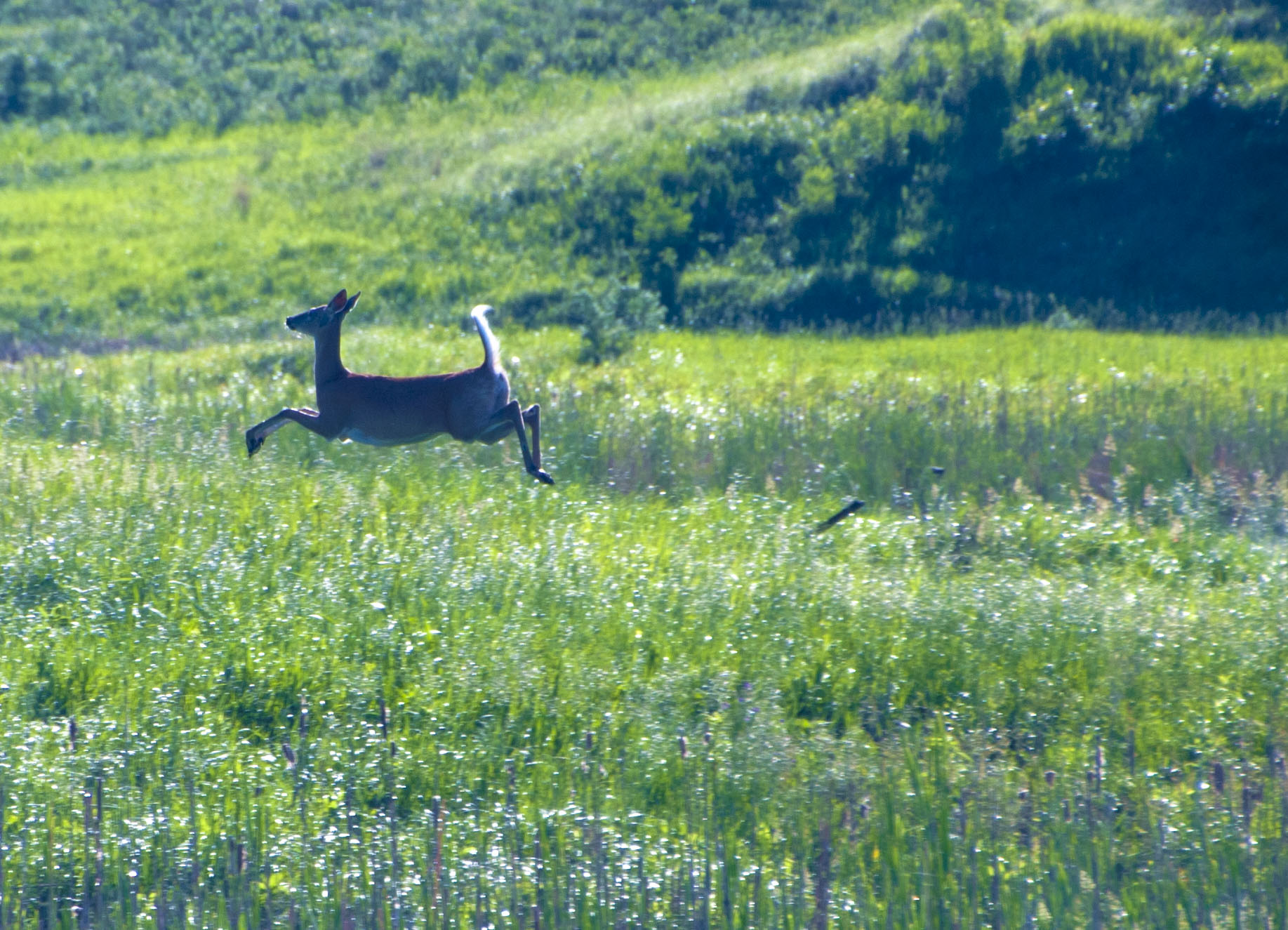
A doe in dewy grass.

A doe in dewy grass.

After a great dinner of some excellent pasta dishes — mine a wild mushroom and shrimp affair — we took a stroll around the block before starting home. A stop was also made to fill the tank. All of which pushed us into several miles of squinting into the lowering sun. What a relief it was when we turned south toward the “Clinton Road” just before reaching Chokio. When we turned back toward the west, an intense and colorful light graced the prairie. This is a favored beautiful and interesting stretch of highway hosting several restored patches of prairie, WMAs, a two-section wide federal waterfowl management area, and perhaps even some remnants of native prairie. When we passed a grassy wetland with a perfectly calm, mirror-like surface, my groan was audible. “Wow!” came the grouse. “That would have made a great picture.”

“Cell phone?”

“It fell under the seat and I can’t reach it.”

Just a few more miles further down the highway it happened again. There in a “ghost of prairie” wetland in a flooded corn field, a doe and her fawn waded in knee deep water lit by a perfectly intense glow of soft reddish purple light. Not a single ripple disturbed the surface as the doe nuzzled her fawn, and my moan was no doubt sickening.

“Hey,” Rebecca said, instantly recognizing my angst and trying to soothe my obvious disappointment, “we got to see it. It was a beautiful moment  and we got to see it with our own eyes. We and no one else.”

A startled doe, and a twin fawn I hadn't seen.

A startled doe, and a twin fawn I hadn’t seen.

Yes, but as a photographer, and especially as a recent nature photographing junkie, it was a missed image that will haunt me for several months if not years. Photographers who have missed such moments can identify with Hall of Fame pitchers like Bert Blyleven and the late Warren Spahn, the latter who told me (minus his frequent f-bombs) during an after-game interview when he was managing a Triple A team in the 1970s, “You remember the losses. The homers the jerks hit off you. Straight curves. That’s what you remember.” Blyleven has admitted as much during broadcasts of Minnesota Twins’ baseball games.

I'm pleased with my image of two deer at dusk, although this isn't the picture in the wetland I missed.

I’m pleased with my image of two deer at dusk, although this isn’t the picture in the wetland I missed.

Ah, the losses … those missed opportunities. Wild turkey toms facing off right after dawn just down the road. The trio of white-tails who were in ballet-like sync rounding the edge of a hill in the late afternoon light … also just down the road. And, now, the doe and fawn. All while “driving naked.” Each time my camera was back at the house. In fact, I still remember cresting a hill somewhere northwest of Dubuque in 1968 just as a farmer driving his tractor was silhouetted in a huge, bright red “sun ball” that was perfect for a 300 mm lens. I was speeding to a grass fire and didn’t stop. The next day I told my managing editor, Jim Galedis, about the near miss. “And you didn’t stop? Always shoot the picture. Always. Fires either get better or they’re nothing but ash. Always shoot the picture.”

Key to his advice, of course, is to never leave home without your camera.

After all these years I should know better.

And, there is this: A photographer never forgets, nor is there self forgiveness. You live, and will most likely die, remembering the misses, all of those “perfect” latent images.


After Thoughts

Martin Anderson was all smiles on the boat ride up the Minnesota River.

Martin seemed to enjoy his boat ride up the Minnesota River.

After an evening of interesting hill hugging lightning to the west of Glacial Lakes State Park, and a downpour that broke while in the depths of sleep, we were packing out a day earlier than we expected. More rain was forecast, and all of our gear was soaked after leaving open the largest “window” of the tent for some cross ventilation. So, yes, we can sleep through a storm in the grand outdoors.

Across the site Wes Konzin talked in a low murmur to his grandkids as another downpour drenched the campsite, meaning our breakfast would wait a little longer. It was my turn to cook breakfast, a treat of thick pepper bacon from Pastures of Plenty and a dozen eggs from our Listening Stones Farm that I would break into the peppery bacon grease.

Once breakfast was served and the soaked gear packed, stepson Martin and I left for home. As we weaved our way through the curvy road of the state park, he looked up and smiled. “I had fun, but I think when I look back on it I’ll have had more fun than I actually had.”

Martin is an indoorsy boy, so our camping out was definitely outside of his comfort zone. His “zone” would be challenged again a few days later when another river rat, Willie Rosin, boated us upriver from Waterman’s on a catfishing outing. What’s a boy to do when he has a stepfather river rat who viewed being indoors at Martin’s ripe young age of 11 as comparable to being stranded in a prison cell? I disliked inside as much as Martin does the outdoors.

The late afternoon sun kisses the grasses of an oak savanna ... the only sun we saw on the camping trip.

The late afternoon sun kisses the grasses of an oak savanna … the only sun we saw on the camping trip.

To his credit, Martin is adjusting — although he was rather quick and vocal when asked if he would like to join me on another fishing trip this past weekend. Martin reminds me of a cousin on my father’s side back when I was growing up who preferred reading to anything outside … until the day he somehow discovered fly fishing. Joe’s mother, perhaps my mother’s best friend, knew of how I had become completely immersed in the sport at about Martin’s age, and asked if I would help him get started. By then I was of driving age, so heading to farm ponds all around the area with my cousin was welcomed.

Since I was self-taught through the pages of Outdoor Life, Field & Stream, Sports Afield along with the iconic Herter’s, Inc., catalogs, Joe didn’t exactly have legendary fly caster Joan Wulff as his tutor. Those lessons went fine until an errant, wind influenced fly, snagged my poor cousin in the ear. Fortunately that didn’t deter his passion, for as an adult he became a hydrologic engineer with the Corps of Engineers when he wasn’t casting the long rod.

Fly fishing has a way of attracting the intelligent kids like the Joe’s and Martin’s of the world for it’s cerebral nature. Interestingly, people will ask about “fly fishing lessons” with an eye toward the casting rather than the line control and various retrieves necessary for successful fishing. This isn’t unlike learning the mechanical features of a camera and thinking this alone will make you a good photographer. Both the casting and the mechanical camera lessons are essential for reaching positive end results, though neither will be mistaken for the art of either.

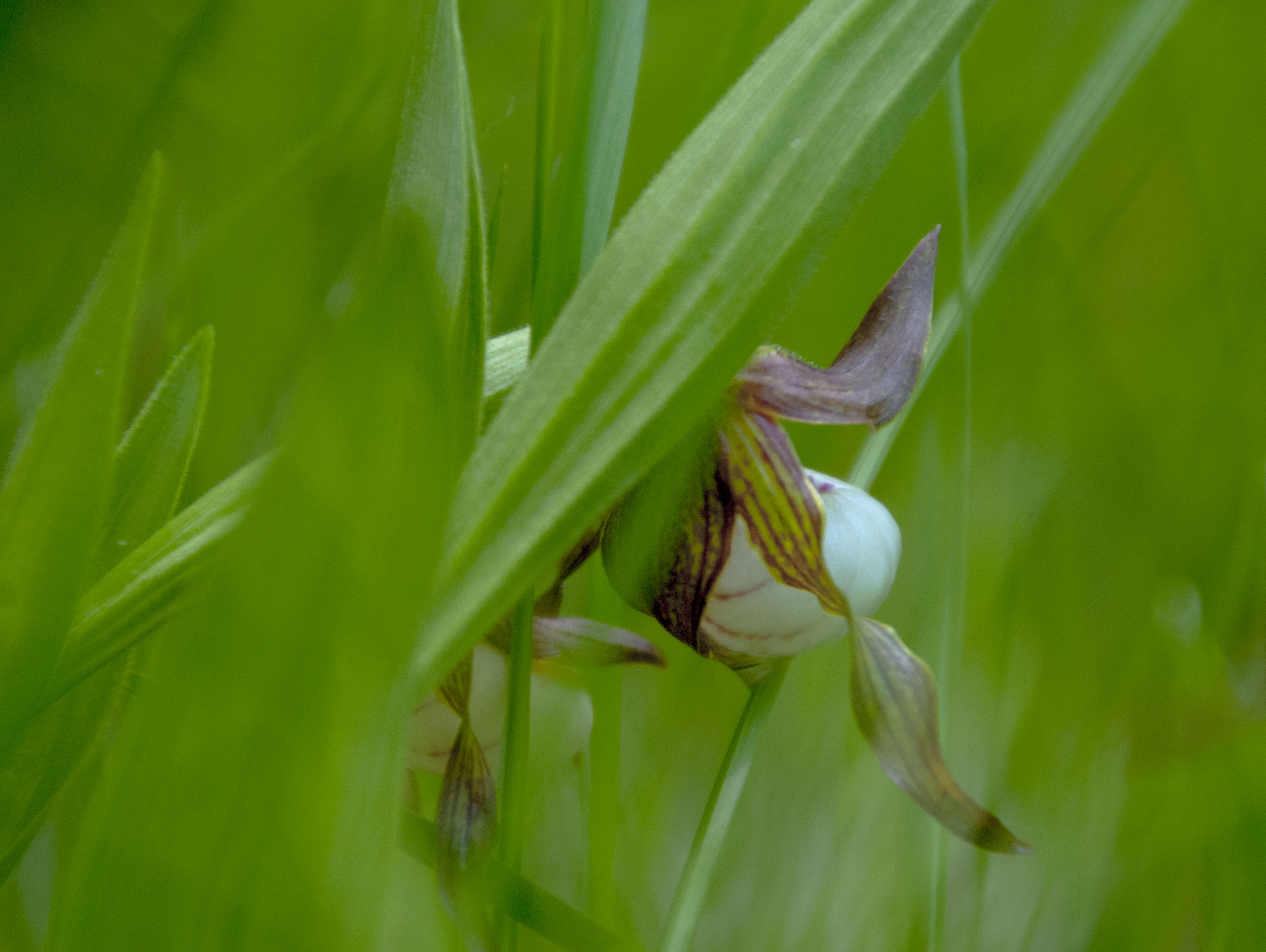
Martin’s few weeks with us have been an adventure. He has really tried, and for that he deserves credit. He was mystified when his mother eagerly agreed to come on a one hour, one way jaunt to a swampy woodland savanna to see white prairie lady slippers. “All this way just for wild flowers?” He had balked, though gave in, to going on a few earlier trips to the nearby Clinton Prairie as I took pictures of prairie smoke.

One of the Prairie White Lady Slippers we found on our foray.

One of the Prairie White Lady Slippers we found on our foray.

Yet, when I’m looking at my results at my computer after an outing Martin will often look over my shoulder to offer comments and compliments on the images. Yes, he had a good time on our camping trip and willingly took his seat along with Wes’ grandkids on their story telling stump. On one of our photography forays he asked if he could use my camera to make a picture. And, after the trip with Willie, Martin asked for a fillet knife to help clean the catfish we had caught. I hesitate to mention how proud he was for catching more fish than his stepfather.

His becoming a passionate outdoorsman may be way too much to expect, although we have taken a few baby steps into that odd universe we call a “comfort zone.” Like Kermit the Frog said, “It isn’t easy being green.” Martin was also right in his comment: “I had fun, but I think when I look back on it I’ll have had more fun than I actually had.”

What outdoorsman hasn’t said that at least a dozen times? Yes, the journey has begun.

A wetland, as we were leaving.

A wetland, as we were leaving.