That Hue of Blue

Several years ago while driving toward Blackbird Trail, that winding sweetheart of a drive through the Tamarac National Wildlife Refuge near Detroit Lakes, my eye caught a lone beauty of an interesting flower that I couldn’t believe was either “native” or “wild.” Yet there stood a beautiful lone blue iris, radiating and standing tall against the greenish nearby native marshy plants … with exception of the adjacent gangly cattails.

Was this some sort of garden remnant? Did someone luckily hoist a bulb into the marsh from the graveled road? 

After returning home a little research confirmed the identification, noting that Minnesota actually has two closely related “Blueflags” or native blue irises with territories divided on a loose geographic border drawn horizontally across the state from our largest city. Iris versicolor is the northern and predominant species from the Twin Cities up into Canada while Iris virginica similarly reaches from the Twin Cities south toward the Texas coast. 
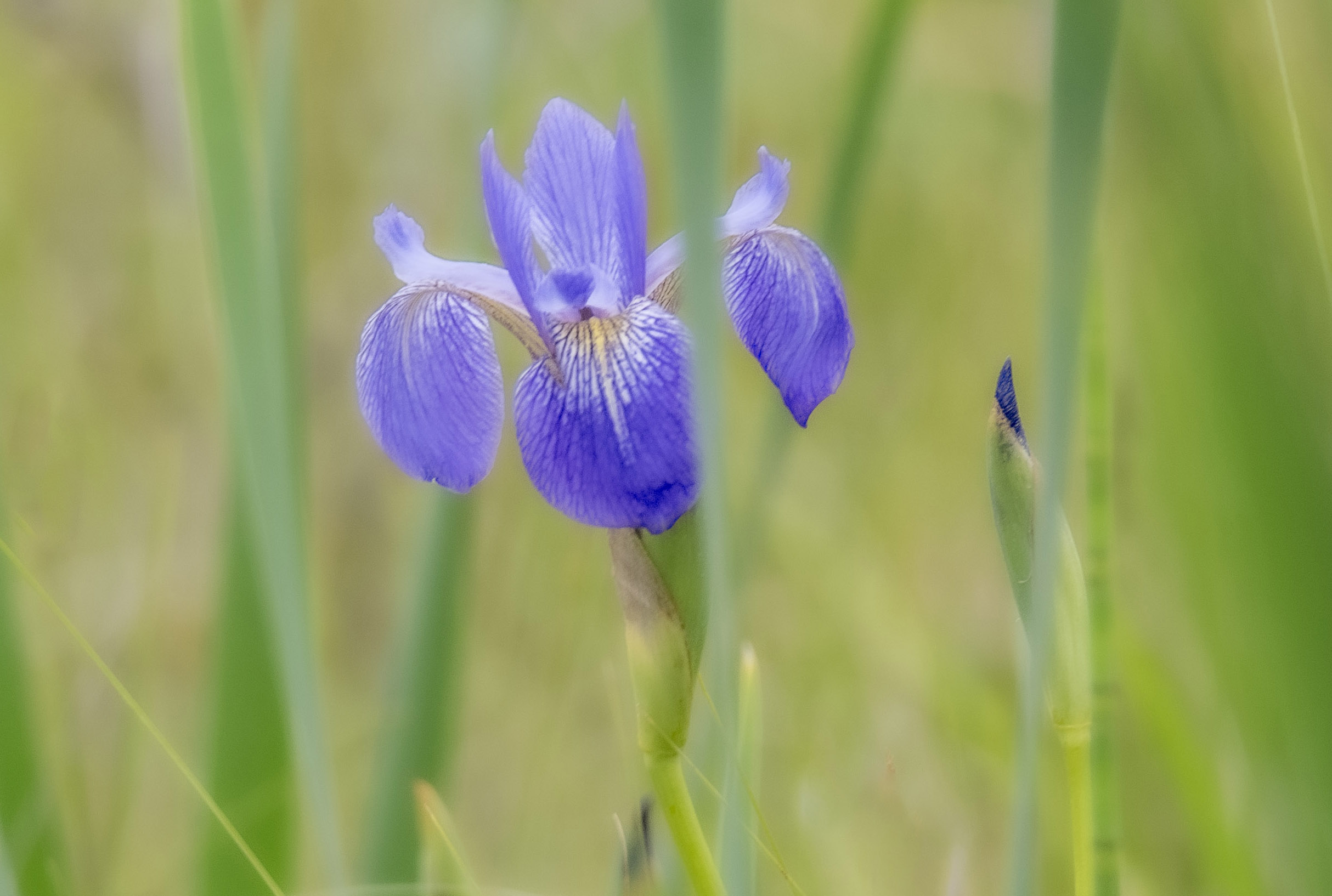
According to the scientific explanation the upstate species is typically more richly pigmented on the outer sepal edges, fading lighter towards the “throat” with veins prominently tinted toward a faded greenish yellow. While microscopic characteristics might cause a botanist to giggle, the northern iris is typically a darker blue than its faded cousin. There! Science has spoken. 

Now here is a bit of poetry, thanks to Margaret Atwood’s “The Handmaid’s Tale” — “Then we had the irises, rising beautiful and cool on their tall stalks, like blown glass, like pastel water momentarily frozen in a splash, light blue, light mauve, and the darker ones, velvet and purple, black cat’s ears in the sun, indigo shadow, and the bleeding hearts, so female in shape it was a surprise they’d not long since been rooted out.” 

Science, or blown glass like a pastel splash of velvity water, these beauties stand awash in the nearby greenery of Tamerac, catching a wandering eye like a thin metal washer drawn instantly to a demanding magnet.

While we had a free day and a will of once again hopefully capturing blooms of both the yellow and showey ladyslippers that bless this northern refuge, I also held hope that we might catch the wild blue of irises in bloom. All three wild flowers came through splendidly along with a host of other colorful wild flora. We were blessed. 

Not so much by the fauna, however. Not one songbird, including the fluttering and shy warblers, allowed me a moment. While the swans were cooperative, we had some near misses along the way: a grouse with three chicks slithered like spies deep into the trail grasses before scooting out to escape my hungry lens into the dense woods. This was just moments before I caught sight of a beaver in my rear-view mirror tugging a six foot willow branch by the clamp of his teeth while charging across the motor trail in a beaverish waddle. Like the spy-like grouse, it dragged the branch through the dense woody underbrush while successfully remaining obscured by the leafy branches. We then came over a rise to find a bald eagle posed perfectly on a branch of a dead tree. I quickly raised the camera although apparently not rapidly enough. My image was of the perfectly weathered grayish branch, a bunch of blue sky and the feet and butt of the rising raptor. Ah, but those wild irises!

It was in the midst of all that commotion that we finally came across the irises. In three distinct locations, each marshy, each different and distinct from the other. On our last sighting a broad curved broad grassy looking leaf of a plant would have made a nice arc over two near perfect younger blossoms. Without hip boots, though, my idea of making an image with a composition of the plants beneath the arc of leaf simply didn’t work. A thought of wading into the marsh with the hordes of mosquitoes was as much of a deterrent as was the possibility of sinking knee deep into the muck. Even laying onto the gravel didn’t provide the angle I envisioned. It was what it was. Welcome to nature. And those were the last of the dozens of irises we came across.

Our first batch was quite numerous, and I actually let out an exclamation of delight when they initially came into view. Time had played a role in their aging, however, with spent blossoms hanging blackish along with those struggling to grasp their fading beauty. What can one do when faced with these situations in nature? You simply do what you can. Between this incredible array of blossoms and those arching above the arc, we found another set that hadn’t aged so distinctly. Being partially shaded, it seemed, might have helped. This batch allowed me to play with light and depth of field, those tools of our odd trade. Perhaps too much time was spent attempting to create a bit of art from such a wonderful blessing of nature.
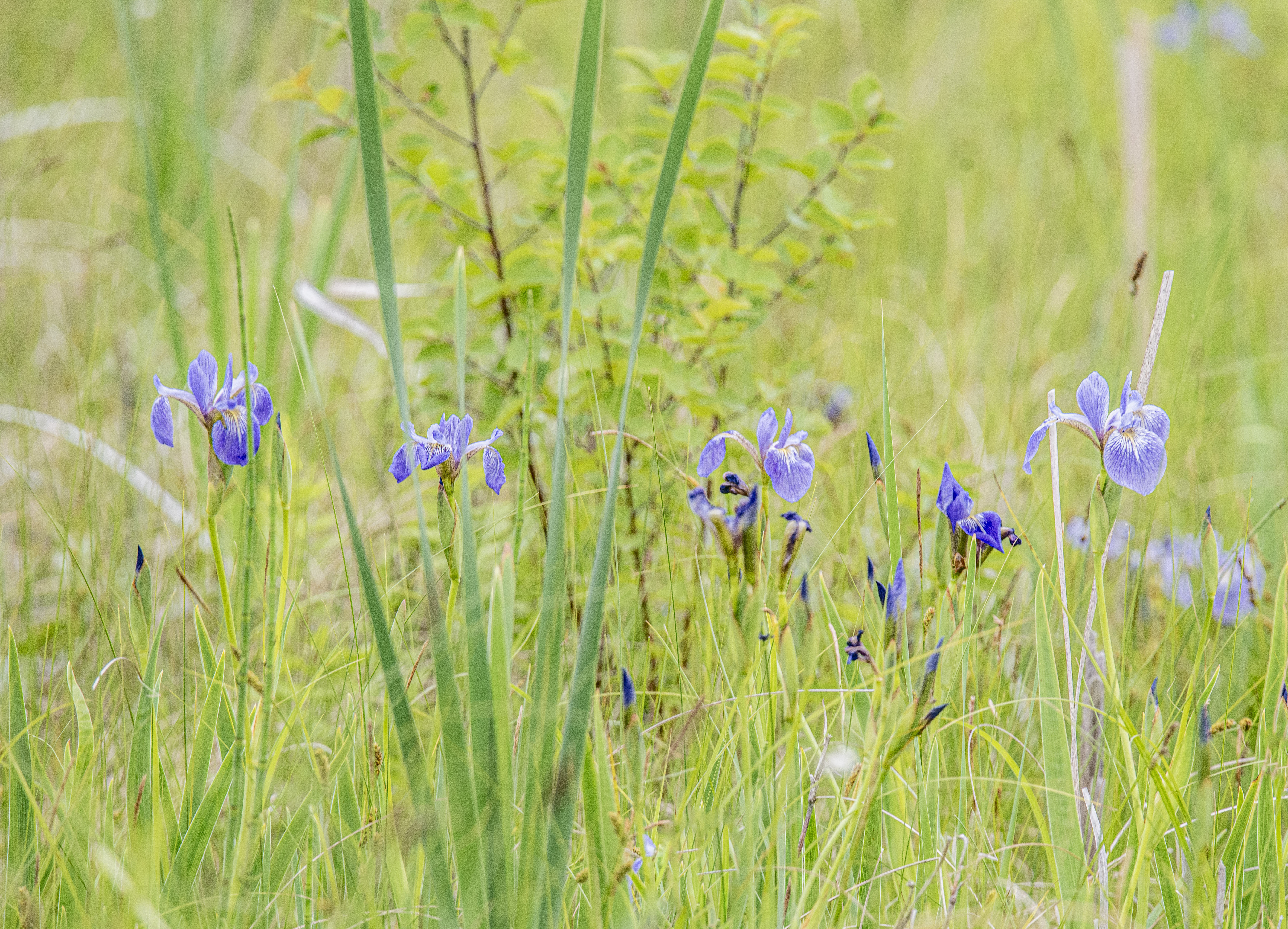
Yes, it was delightful to once again see the rich blues of the irises, along with the white and pink of the showeys. Those vivid colors of the yellow ladyslippers and the bright crimson of the columbines added joy as well. My partner, Roberta, suggested on our way home that I was smiling. Internally there was certainly a sense of peace and joy, that those six hours of drive time had been well worth the effort. 

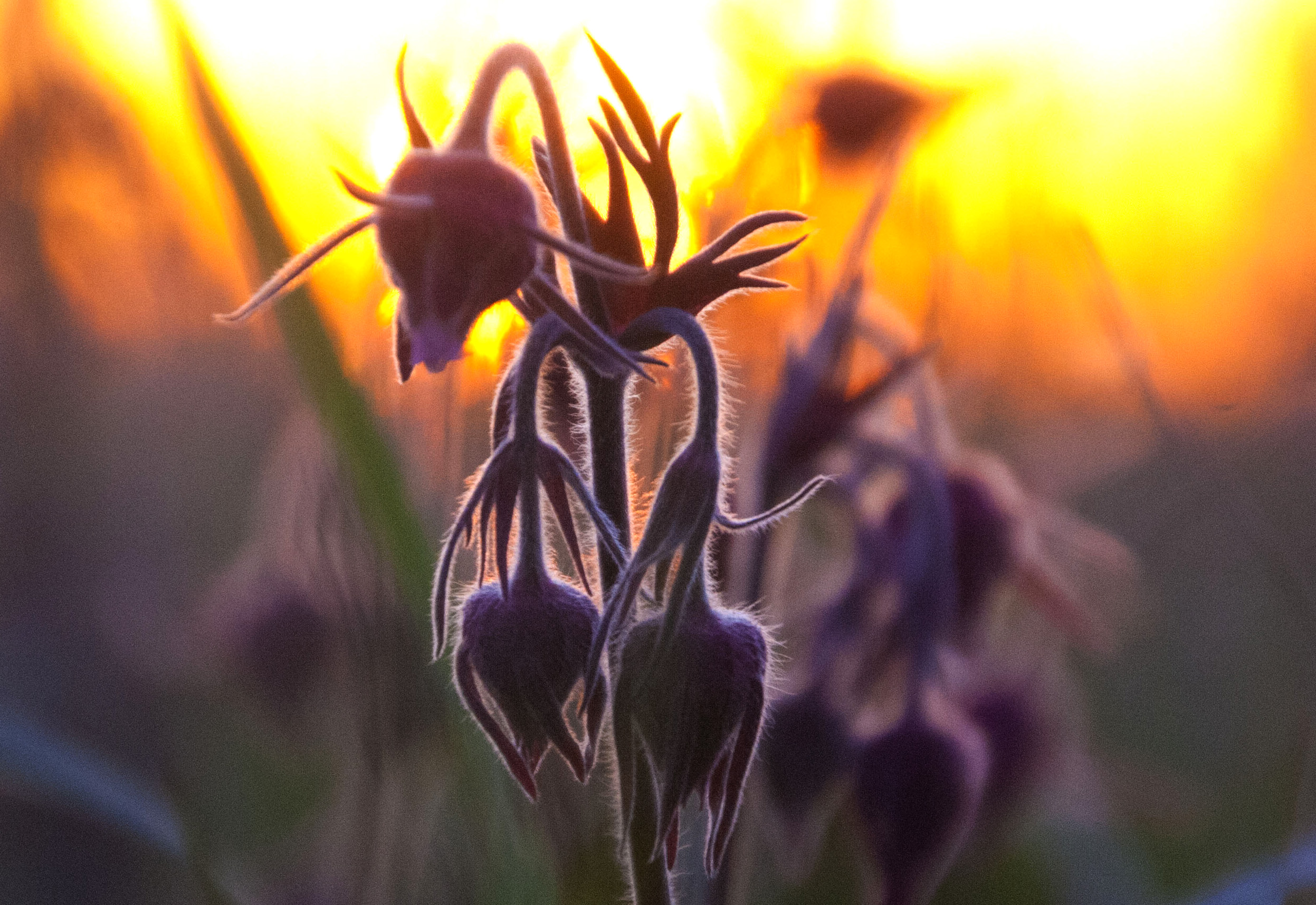
Sometimes these seasons I photograph, be they birds, trees, prairie grasses or native flowers, help me check off a mental list. Do I need more images of wild turkeys fluffed in sexual desire, or the first poking of pasque flowers through dormant grasses after another long and dreary winter, or of those lady slippers I chase from the prairie to the northern woods as was the reason for this drive, or even the pastel waters of little black cat’s ears in the sun? As a naturalist and photographer, though, these are seasons of life, of nature, of the knowledge that for one more year all is surviving nicely in the natural world. Myself included. So yes, I was smiling! 

A Letter of Love

Dear Audrey and Asa:

Although you don’t know one another you have more in kinship than you perhaps realize. Ties with Italy comes to mind, although I write of a deeper kinship appreciation for each of you. Audrey, you blessed me years ago with the sense of hope that is celebrated on the shortest day of the year, while you, Asa, convinced me of the joy in celebrating the gift of life on summer’s longest day. Two solstices a half year apart. 

Believe me, you two strong and beautiful women of commitment, grace and joy, who have devoted both your private lives and careers to the betterment of all mankind and our planet, for you have each humbled me. Through the years I’ve tried to honor your gifts by capturing imagery to express those two necessities of life.

2025

You, Audrey, came as a prairie activist offering a glimpse and an appreciation of a geological past that now haunts us deeply … if we are simply aware enough to pay heed to the mere ghosts of a distant geological past. Back when grasslands stretched across the lands of what is now a vast nationwide patchwork of commodity crops, back when meadowlarks and bobolinks were as common as household sparrows, when visions of bison and antelope seemed on par with today’s white-tailed deer, and when prairie wetlands dotted the landscape as numerous as the clouds they reflect on days of perfectly calm waters. Yet, it was even a deeper past that touches me in the darkness of Decembers … that of light, of a pagan celebration that acknowledges the coming of days of longer light, of hope. 

You and Richard Handeen have religiously built huge bonfires on your rural Montevideo organic farm where we hovered besides burning logs to roast thin slices of venison and huddled close to the flames reaching skyward into the vast darkness. Usually you provided us with two large fires. One near your warm summer kitchen, often filled with music being created, and one deeper into the woods where we sat on straw bales with mugs of Cabernet and glanced through naked tree limbs for glimpses of the moon or those telling stars of Orion. Over the years as my sons grew into adulthood, your Winter Solstice bonfires and camaraderie rivaled Christmas.

2024

Certainly the celebration of hope on this long, dark night grasped my interests long before meeting Asa. I now marvel of how well you two could be sisters, each aiming for hope while reaching for a clearer and better world despite the many obstacles, of how you each give tokens to both the openness and closures of the light of life. 

Asa, you came to us when we were regional coordinators for EF Foundation for Foreign Studies, a non-profit that brought high school aged exchange students to the States, of providing a sharing of family life with a stranger from another culture as if the teenager was one of our own. That’s what happened, time after time. And it was during this time, especially during the heady summer work of finding willing and suitable host families that you invited us to EF’s Boston headquarters for encouragement and, yes, a celebration of your dear Swedish Mid Summer tradition. That nod to light and joy. The Summer Solstice! Most of those celebrations were held in the EF headquarters along the Charles River and across the bridge from downtown Boston. One memorable summer you took us to your home where Rufus did the culinary honors. 

2013

A Summer Solstice comes just a few days before the anniversary of the passing of Sharon, my wife of 32 years. For me there seemed a link between the two and I started looking back at those celebrations with both joy and admiration while seeking a deeper awareness of light. Sharon would have loved those Mid Summer moments when chairs replaced hay bales, and sunshine held off darkness as glasses were clinked and smiles and fellowship were shared with friends from around the world. So I thank you, Asa, for that correlation, for that way of celebrating not just the light and joys of life, but also the memories of the brightness of being.

Nowadays I make an effort to honor the Summer Solstice in much the same manner as I have the Winter Solstice. For both I find myself “chasing” light to in some way capture the essence of light and nature in a form of positive joy.; to create an image I believe you each might want to hold for a moment, to perhaps smile and offer a word of grace and fellowship between that light, nature and mankind. 

2021

Hopefully in a some small way this capturing of light, the essence of our sun, comes across pleasantly and with the joy intended. Rarely do I begin my effort with a particular image in mind, although my Summer Solstice this year began with a lone tree on a prairie hillside. Would the sun lower in a way that would create an interesting image? Would the composition work? Would the stand alone tree be bathed with joyful light? Would joy be portrayed?

While all that might seem strange I can recall at least two instances when trying to capture light for a Winter Solstice came down to a momentary and sudden glimpse of colorful light mere moments before the darkening dusk. Struggles have occurred with the Summer Solstice imagery, too. A grouping of hovering swallows were caught in a near circle above the Minnesota River to save one day, and over the year storms have entered the pictures. But, isn’t that something you might expect in life? Despite all of our will to celebrate? Be it hope or joy? That there are storms?

2015

It has been a long while since I attempted a “love” letter, and this one is perhaps a measly attempt at one. Yet I feel I owe you each an appreciation for your individual efforts for the betterment of our lonely planet, especially in these times of national and international turmoil. I feel I owe you each a great deal of gratitude for making me notice a need to appreciate and celebrate both hope and joy. Aren’t those are what the celebrations of the two solstices are about?

Sincerely,

Your Friend Forevermore

Flirting With Destiny

Was destiny in the cards? Serendipity? On a morning when I felt it best I be out of the house I ended up in familiar digs, leaving a favored fishing spot to raise my camera once again in nature. Funny how that works. This venture began with an eye toward an eagle’s nest near the Marsh Lake dam, one I’ve photographed a few times over the past several weeks. This is a haunting setting, a nest built high within the branches of a weathered and whitened row of cottonwoods alongside the wetland. Weathered and whitened cottonwoods line both sides of the slough.

Although the rain hampered the vision somewhat it was still easy to see the eaglets that are now perhaps as large as their parents. Both were hopping on the gigantic wooded nest, stretching their broad wings high and wide. Briefly I wondered if one would actually take flight. Across the wetland the parents were perched side by side keeping eyes on the youngsters across the way.

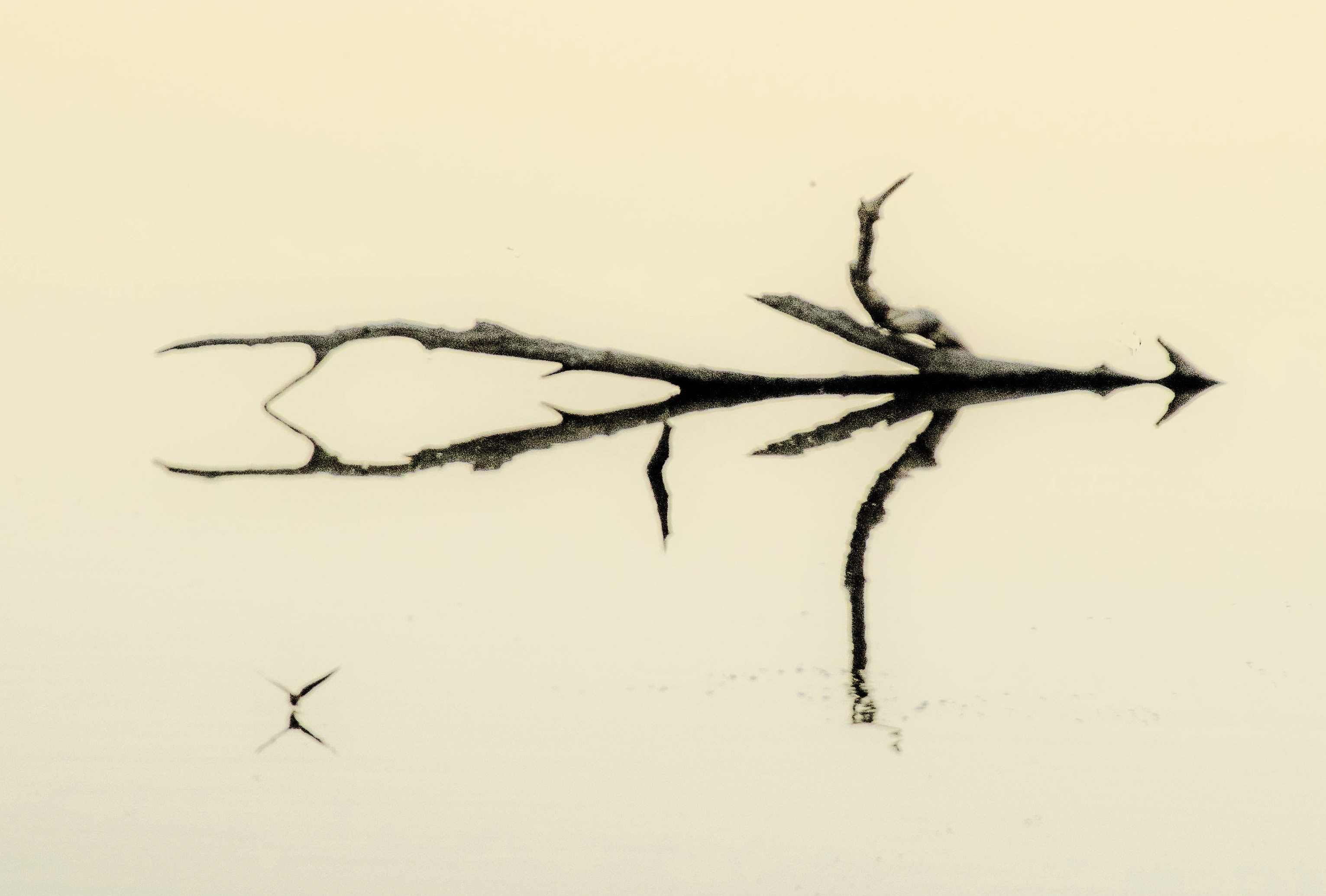
Swallows were buzzing around, and I loved the old log and its reflection. Would a swallow do a dip? Yes! `Stark and simple.

Then it was to the dam itself where I quickly became engrossed in trying to capture Black Terns dipping their beaks into the surface of the Minnesota River. A few weeks ago at the Sand Lake NWR I just missed capturing a swallow doing the same. In the midst of working the terns a glance skyward caught a huge pod of white pelicans gliding gracefully overhead toward Marsh Lake. Trying to capture an image from inside the cab of the pickup tested my recent lack of yoga. 

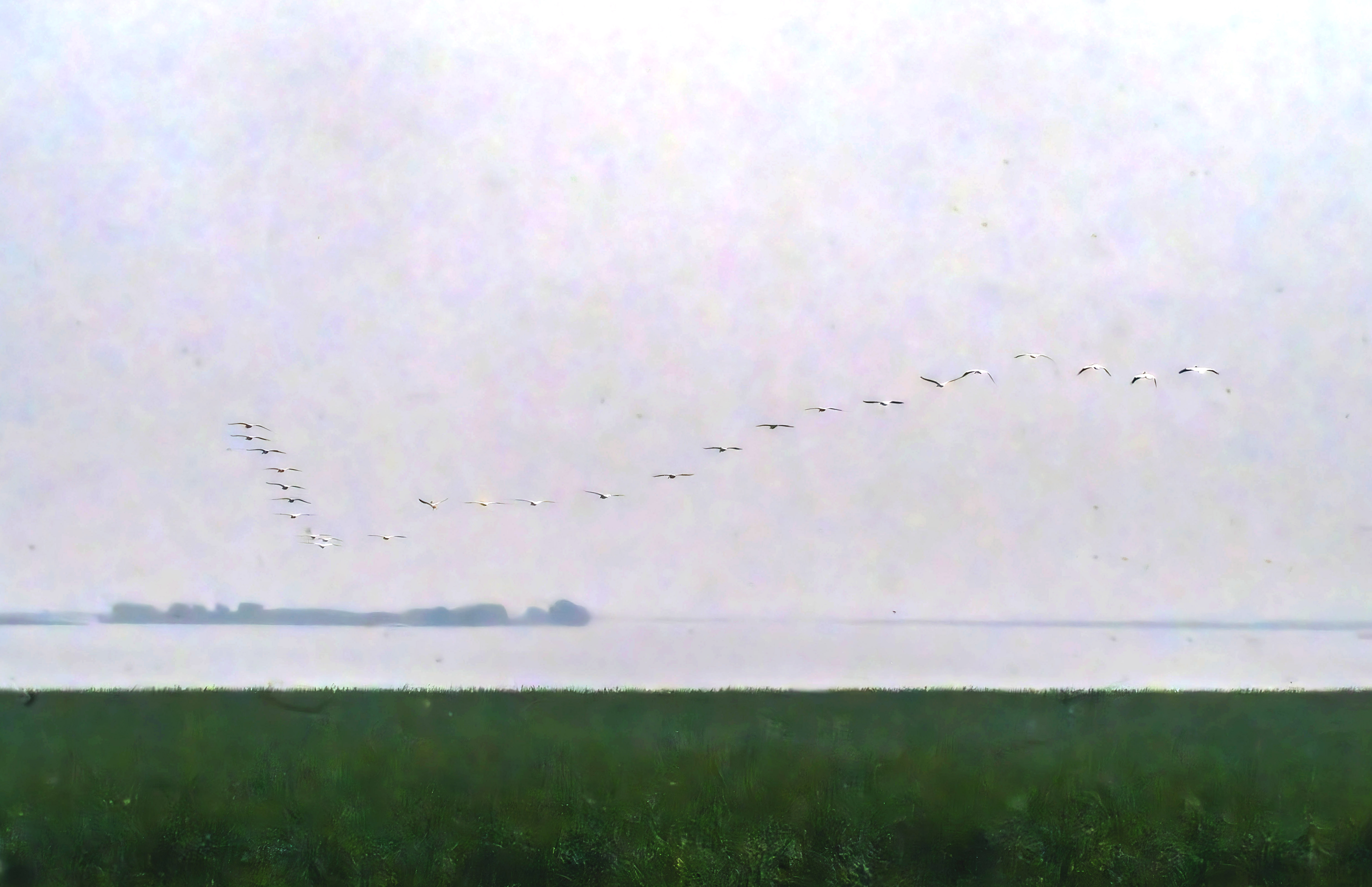
An umbrella of densely packed clouds were joined by rain pelting the windshield as I headed up the rise toward the fish-bone-surfaced gravel road. A quick glance across the lake revealed a vast horizon of acres of deep green vegetation stretching across the formerly carp infested shallow waters. A shrouded haze stretched across the vegetated waters as my thoughts turned to capturing a long string of gliding pelicans, their white bodies and black wing tips easing across this plain of aquatic flora, contrasting with the green foliage and bluish haze.

It was author Shiva Negi in his “Freedom of Life” who suggested that intention determines destiny. Would this be the time and place?

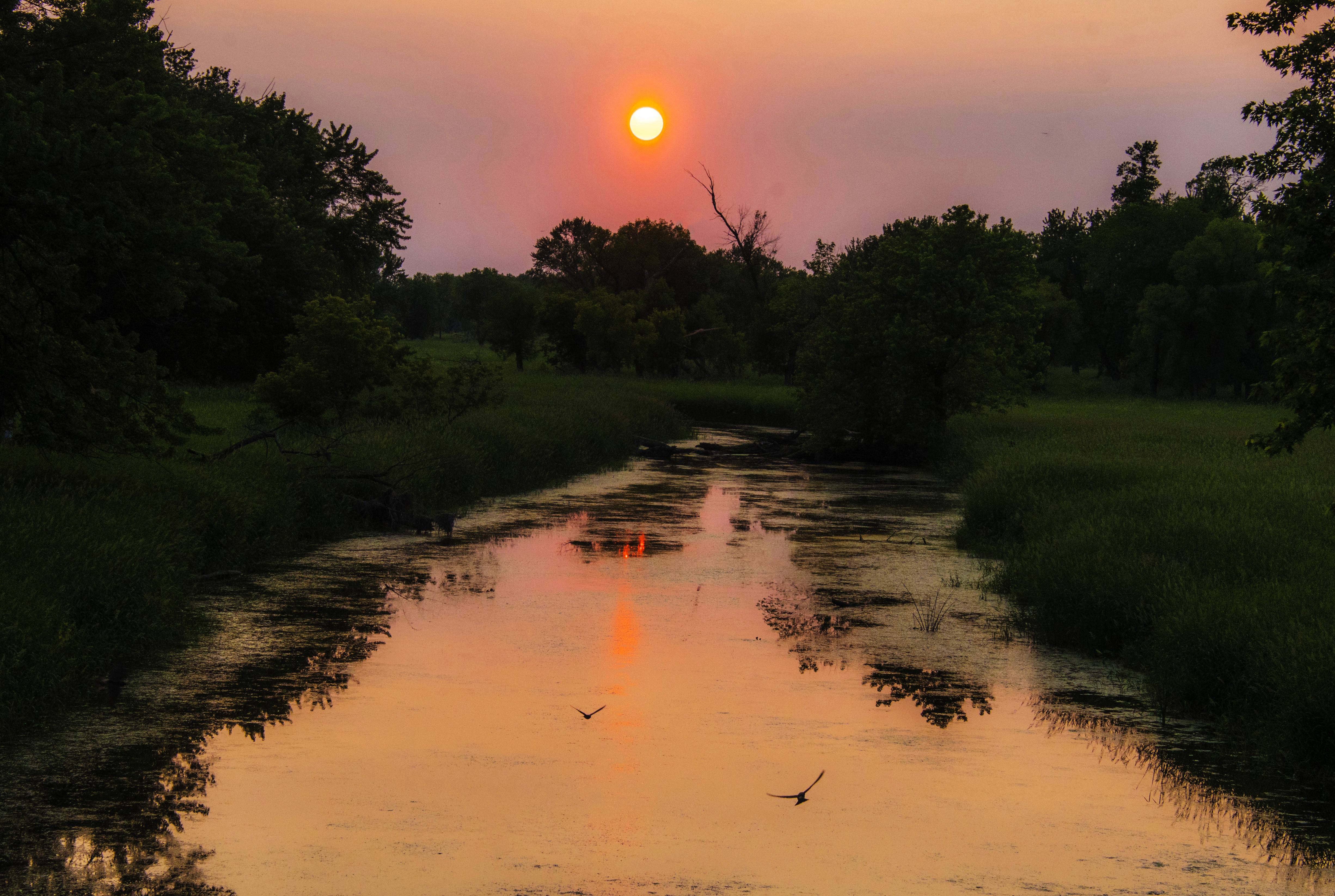
A sunset over the headwaters of the Minnesota River was blessed by two swallows, an anxious wait since the sun was sinking quickly.

While holding that thought I tucked tail and headed past the eagles toward down the county gravel. Thanks to my dear partner, Roberta, and her desire for “new roads,” I took a left at the “T” thinking I might be closer to the highway home than if I took my normal route. It was a dead end, so I maneuvered the pickup around and headed back toward the Marsh Lake road. Does intention determine destiny? There it was again, so I turned back onto the dam road to see if perhaps another pod of pelicans might glide across the lake toward the island they inhabit. That mix of stark green and bluish haze was just too strong to pass up. After  arriving at the dam, I backed the truck down the pathway on the dike and eased the window down to wait.

Within moments another long and sweeping pod of pelicans came easing across the windshield, stretching long across the horizon just as I had imagined. And, yes, they were headed up the lake in a near perfect composition. Destiny? Serendipity? Nature in perfect symmetry and harmony; an image that spoke of natural poetry!

Serendipity, for this was simply a beautiful surprise finding the swallows so perfectly placed!

Moments later, as I was heading home, thoughts of how various species of birds have blessed my images over the years by inexplicably turning mundane landscapes toward a higher level. Each time, I recalled, it was a matter of melding the natural composition with the help of some natural avian enhancement. Over the years I’ve had great help from swallows. Twice near the headwaters of the Minnesota River, and again on a foggy morning over Stoney Creek just east of Ortonville. 

Two old photojournalism adages came to mind: Animals, be they human, birds or otherwise, are creatures of habit, so if they do something once they most likely will do so again; and, always be prepared by planning your image around available light and composition. Those pelicans were a case in point, but so was focusing on a floating log believing a swallow would once again dip to sip nearby. Could I await the cruising swallows during a beautiful and calm sunset at the headwaters of the Minnesota River?

Serendipity? I believe this differs from destiny because it is typically just blind luck. Which brings me to the sweet swallows that somehow miraculously appeared in my Stoney Creek image. It wasn’t until I was back home processing a morning shoot that I actually noticed two swallows perfectly situated within the image. Even without their help, the composition, lighting, snaky fog hovering over the bend of this shallow creek would have made a fine image. That pair of swallows took it to another level. Pure luck!

Destiny? As if Negi was correct on his definition of the word, the pelicans appeared to ease across the Marsh Lake horizon!

That, I believe, is the difference between the two. There isn’t much you can do about serendipity while destiny requires knowledge, patience and a will to succeed. Certainly there is some luck involved. Would another pod of pelicans come back over Marsh Lake that morning? Having seen two different pods fly in that direction gave me hope that another on might come through. I was more than willing to wait awhile, and truthfully, it was less than a minute after I’d parked. This was one time when patience wasn’t needed. I knew the image I wanted and had placed myself in position if and when it might happen. 

Just as Negi had proposed. My intentions had won out resulting in a pleasing image. No, this wasn’t the first time where my feathered friends have helped me create an image that I’d mentally conceived, and I can’t thank Mother Nature enough for all these gifts and blessings she has granted me through the years. Certainly I’ll take serendipity when offered, yet I’ll opt for destiny when intensions are warranted. 

Hope Within Mourning

This wasn’t an intentional gathering of us “brothers from different mothers,” although we were together to honor the passing of a special woman we considered as one of the “mothers” of our shared advocacy and love of a muddy and polluted Minnesota River. We stood in the commons area of the church, some in our jeans and worn, aged shirts probably scanned an hour beforehand to see if they were stain free. 

Several moments into our mutual greetings and acknowledgments of our few fishing stories, Audrey Arner, another long time clean river advocate, walked up to suggest,  “Guys, this is like old home week.” Indeed, we were a familiar bunch, had been for years. All around us were so many others who have been part of the advocacy.

Among them was Butch Halterman, a long time “river rat” who was well respected as a Montevideo senior high science teacher for his unrelenting knowledge, spirit and resolve; a man who for several years escorted groups of high schoolers in canoes from the headwaters all the way to its confluence with the Mississippi. 

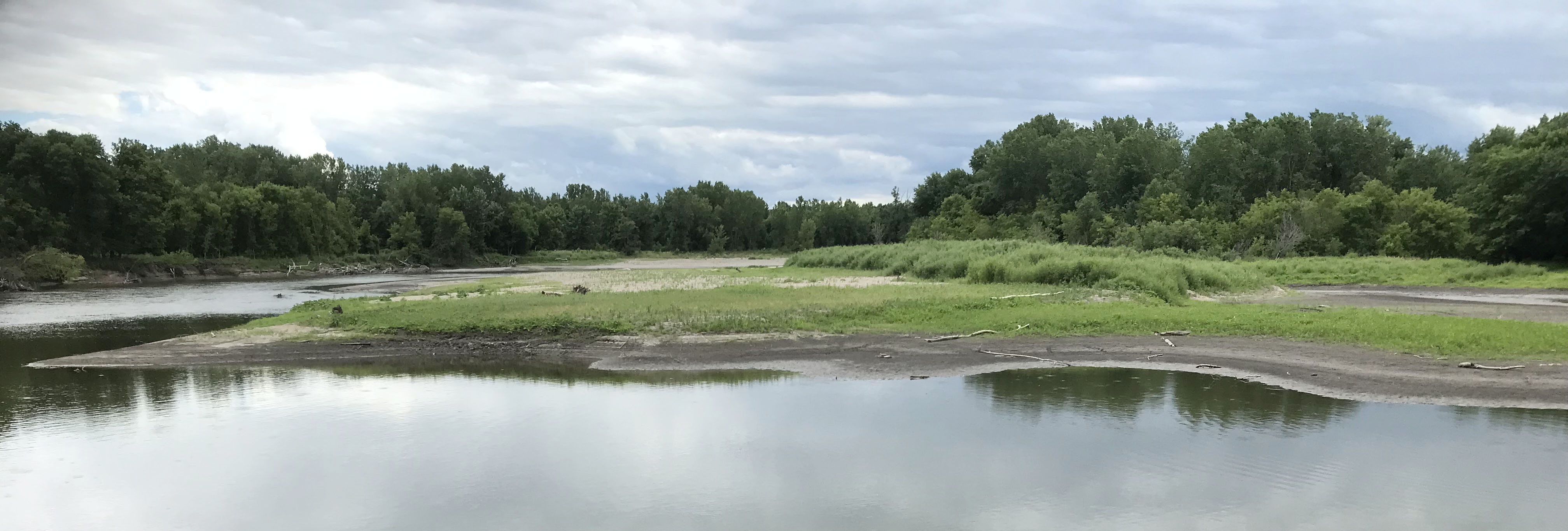
An overview of the siltation from both Hawk Creek and Yellow Medicine rivers that have choked off the original channel to the right, leaving a deep siltation between that and the new channel to the left.

There was Ron Hanson, who has written a few tough songs he must be persuaded to play, who lives alone in the nearby prairie where he grows some impressive long-thorned cactus plants. A narrow but simple path snakes through the rooms and narrow hallway past the seemingly hundreds of evil looking cacti, and a dire warning that this isn’t a place to bend over emerging from a bath.

Up from New Ulm was Scott Sparlin, who was instrumental in organizing a clean river group called the Coalition for a Clean Minnesota River. Butch, Ron and I had at one point served on the board of a sister river cleanup non-profit called Clean Up the Minnesota River (CURE). Noticeably absent on this day of mourning was its long time CURE leader back in the day, Patrick Moore, who recently had moved to Montana with his wife to be close to the families of their two daughters and grandchildren. 

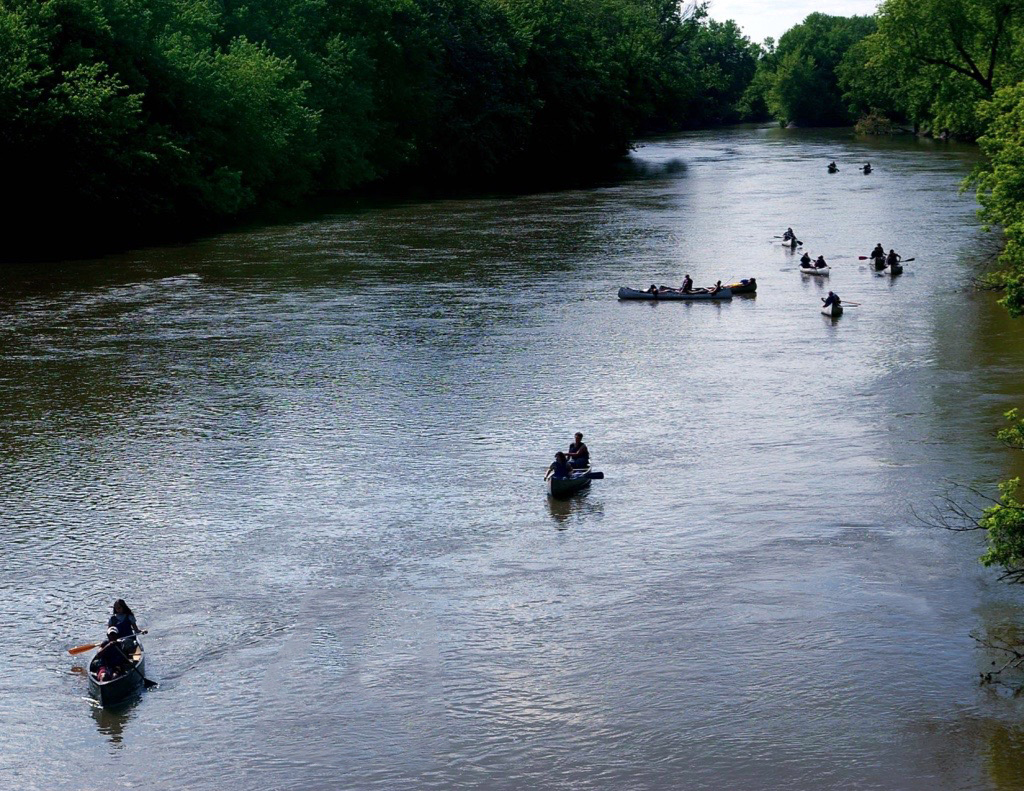
Back in the “old days” when dozens of canoes and kayaks were on the prairie rivers in May.

Our church gathering was to honor the late Shirley Werhspann, wife of Del. Collectively they were as responsible and as active with the Minnesota River cleanup efforts as the rest of us. Moore actually credited Del as the muse for creating CURE, initially under the auspices of the Land Stewardship Project. All this organizing came in conjunction with a ten-point action agenda to save a threatened river offered by then Gov. Arne Carlson. It was a heady and strong effort for more than 20 years.

“I no longer feel apart of the river,” Butch admitted, although he still has a cabin of sorts and a landing just downriver from Preen’s Landing. Yes, he still fishes both in the open currents and on the ice. “Used to be a brotherhood, a family of us, and we were all on the river. No more.” 

Nowadays, not so much. Perhaps age is part of it, moves another. So has the politics and change in the direction of CURE. “It’s now electric cars,” he laments. “Not so much about the river.” 

An evening of catfishing on a bend of the Minnesota River.

Indeed, not much has improved since all this started back in the early 1990s. Indeed, the river seems to face even greater threats. At Skalbakken County Park, for one example, standing in the picnic shelter back then would have seen the river channel ripe against the tree-lined north bank to the far right of the shelter. Heavy boulder riprap was peppered along the bank beneath the shelter to protect the park from being washed away by the incoming flow. Thanks to some extremely wet years, patterned tiling and an insistence on flushing spring melt from fields of commodity crops, the channel is now to the far left as siltation several feet deep has closed off the original channel. Between the former and present channels, this thick “island” of silt now has emerging willows and prairie weeds sprouting. Further down river the increase of flow has sliced a new channel through the riverine prairie, speeding waters past many of the former serpentine bends to create shallow oxbows.  

So much change, so rapidly, that Heraclitus’ statement, “No man ever steps in the same river twice, for it’s not the same river, and he’s not the same man” rings both too close and truthful. Yes, the river has changed and so have we, as we, individually, enter the last one percent of humanity. In a few words, “We’ve grown old.”

“River rat” buddy, Tom Kalahar, fishing on a Minnesota River sandbar.

There we stood, the group of us along with some other grayed river advocates, awaiting an official mourning of a woman known as an “animal whisperer” and forceful advocate of a cleaner river and environment. Our little group had met numerous times in her kitchen talking river politics over her delicious home baked cookies, of how to better our efforts and how to remain strong while surrounded by a seemingly uncaring and unbending agricultural community. At one point she worked on Congressman David Minge’s statewide staff working as a local organizer and scheduler. Shirley was as strong politically as she was so kind hearted to us, and to her horses and other pets. For years she and Del ran a boarding kennel that was highly praised thanks to her tender and loving care.

Minge, it should be noted, helped craft perhaps the strongest soil conservation program along with Iowa Senator, Tom Harkin, called the Conservation Reserve Enhancement Program that placed nearly a million acres of vulnerable farm land into perpetual retirement. He was also on the original CURE board of directors.

A closeup image of clean water from a protected tributary as it enters the muddy Minnesota River.

In time we ambled in for her last rites, taking seats, singing hymns and offering prayers. Later, in the church basement over a lunch of a tatter-tot hotdish, our conversations continued. Among them came the offerings of new promise, of a river wide conference scheduled in Mankato, where the muddy and polluted river takes a severe turn northeast toward the confluence with the Mississippi. Like in the past, the “old” Butch, Audrey and Richard Handeen were all encouraging us to once again to join together with Scott and the downriver folks to inspire change and better conservation efforts — some 35 or so years since the first such efforts.

While the effort is hopeful, is there still enough fight and resolve to make a difference? Perhaps Scott Sparlin has a new youthful grouping than we found in the church that morning. In the old days, when we were young, those resolves weren’t even a consideration. We simply made up our minds and took to the river, in canoes, in meetings, gatherings at various county parks, and group paddles on not just the “mother river” but also the five tributaries. We fought with protests and in the courts, and we took our battle to St. Paul. We worked with other down river groups all the way to Lake Pepin on the Mississippi.

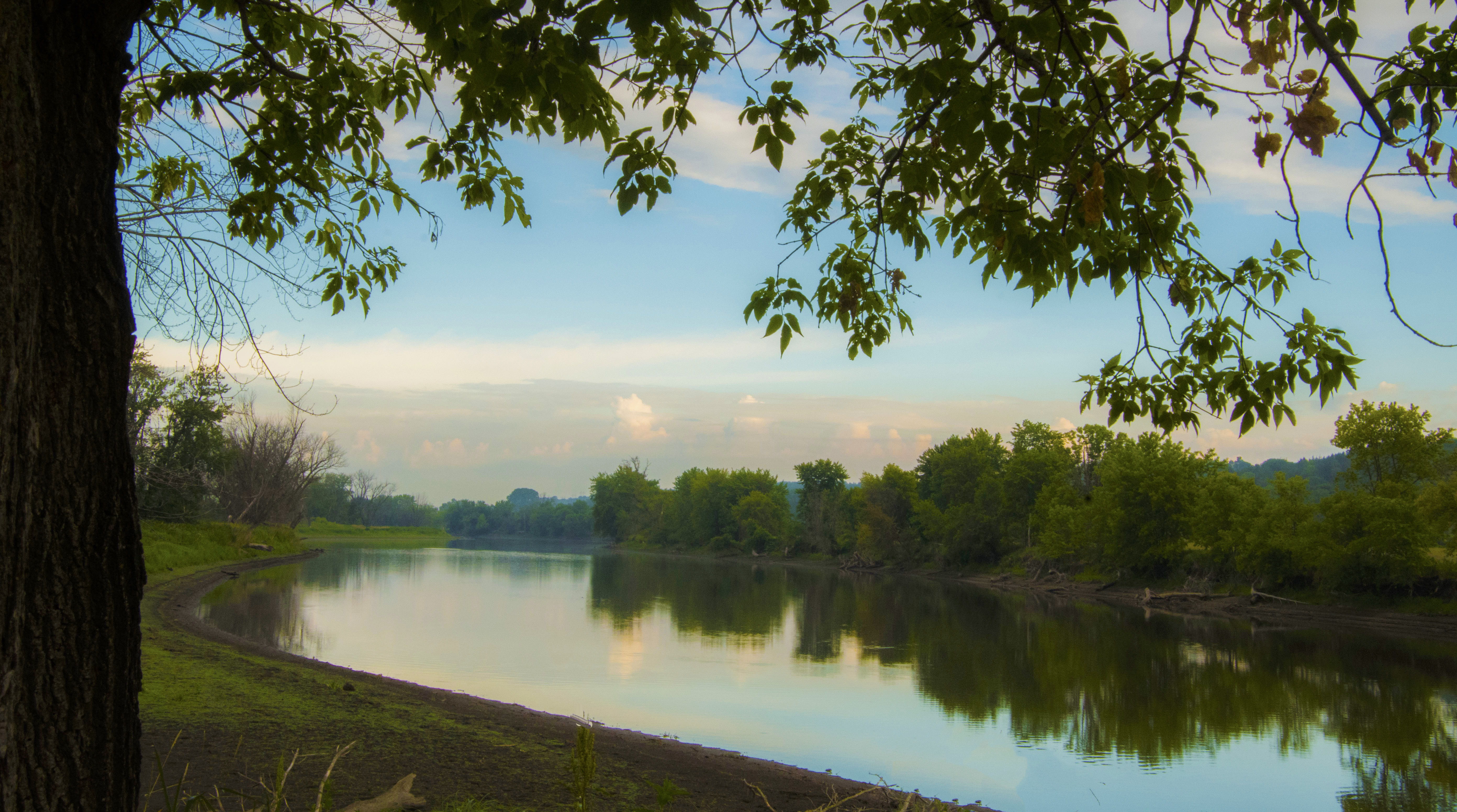
An evening moment on a quiet bend of the Minnesota River.

Back home on the rivers, my late wife, Sharon Yedo White, one of our exchange students (Luise “Lucy” Hille of Germany) and I all earned our “Prairie Paddlers” patch then granted by CURE — a colorful cloth patch signifying that we had successfully paddled all six of the upper prairie rivers.

Those were the days. On a single weekend in May we would gather in dozens of canoes and kayaks to paddle the rivers, then in September we would close the paddling season with a relaxed fall trip just as the leaves would be coloring, which they seem to do earlier close to the river, when the air would be a bit crisp with the approaching waters reflecting a blueness and sense of clarity we all hoped would someday be normal. Back when the river was a part of each of us. Now, perhaps, a new hope will emerge.

On Thursday, June 12, the 17th Annual  Minnesota River Congress will meet at the Kato Ballroom in Mankato starting at 6 p.m. Sparlin continues the batttle as the facilitator of the event, which besides two strong panels will feature Joseph Barisonzi, Minnesota state vice president of the Izaak Walton League, as a speaker. His topic: “The River Can’t Wait.” Barisonzi also is curator of the chapter’s Kouba Gallery in Bloomington, MN, where my current exhibit, “Haunted by Waters” is now on display — a fitting coincidence. 

Grasping Joy

Can someone find joy in the South Dakota mudflats? It was Dutch theologian Henri J.M. Nouwen who suggested that joy doesn’t simply happen, rather that is it is something we must choose. Or, find. This thought surfaced recently and caused me to think of what in nature could give me joy. Nature is where I typically turn when that spark of joy is necessary for soothing the soul. 

This thought happened to occur in the midst of a conversation about American Avocets I was having with our head librarian, Jason Frank, who is a dedicated birder and naturalist when he’s away from the stacks. We were chatting about my inability to find one of my favorite shorebirds when he suggested the mudflats around Sand Lake NWR about two hours west in NE South Dakota. With an empty afternoon ahead of us, we headed west.

First came the Avocets, which we found in a flooded field depression not far from Houghton just a few miles from the Sand Lake Refuge. That pair would be the first of a beautiful handful of shorebirds that would occupy our afternoon, and yes, all contributed to blissful joy.

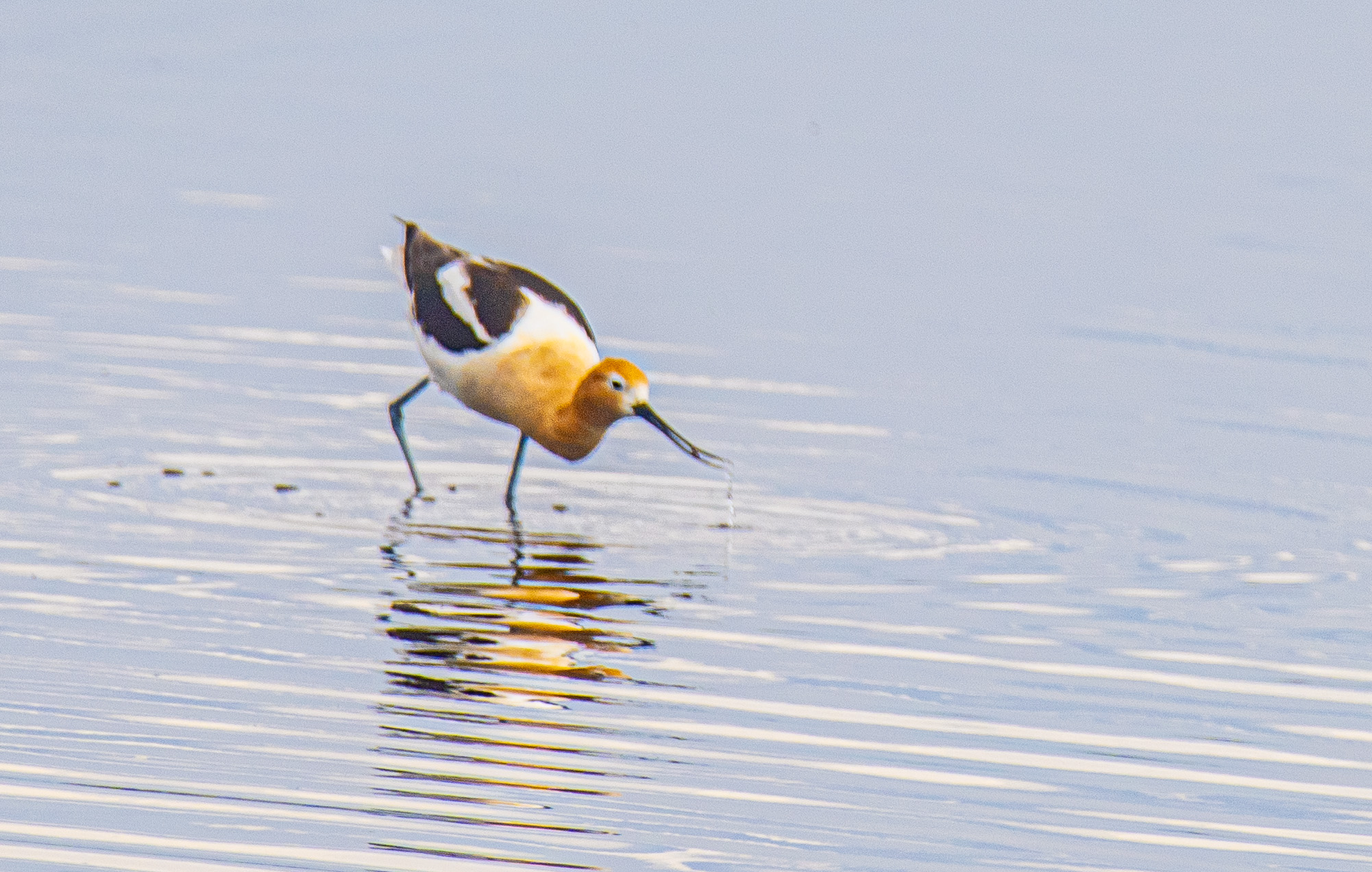
Ah, an American Avocet — our target in the search for joy!

Yet, it was the Avocets that drew us across the prairielands. I’d been missing them. Literally. Earlier this spring there was a brief gathering at the Big Stone NWR where Frank had spotted and photographed a flock he found wading alongside the river. Knowing my love, he had alerted me the following afternoon with his photographs and pinpointed where they were wading. I rushed to the Refuge only to find a locked gate and smoke rising from the thousands of acres of prairie grassland. A spring burn was underway, and continued for the next day or two … just enough time for the flock to fly elsewhere.

Refuge biologist Brandon Semel noted a week or so later that we are actually on the very eastern edge of their natural territories. This was after I had spent a few trips searching the area wetlands where I’d photographed them last summer. Which led me to this more recent conversation with Frank. Like, “Where can I find Avocets?”

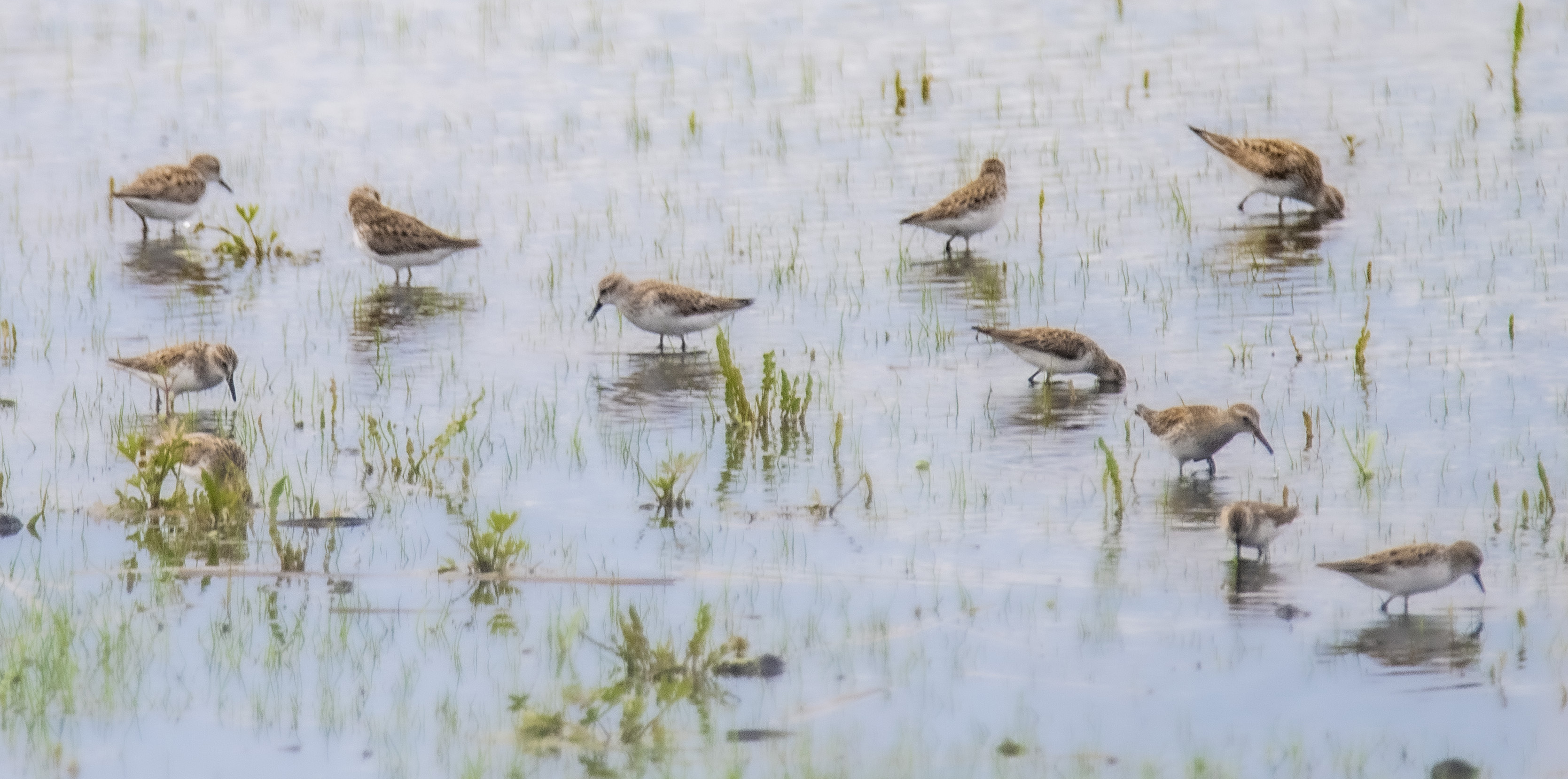
Nearly all the flats had sandpipers.

My attraction to these beautiful waders is a strange love story. Back when I was in a forgettable career stretch with a Minneapolis-based ad agency, I found a piece of cottonwood at the studio of a wood artist friend, procured a few wood carving tools and went to work whittling away both wood and ad agency aggravation — whittling away the late night hours when I should have been sleeping. It was during this hobby moment I came upon photographs of this brown-headed beauty of a shorebird with the thin, upcurved bill. My carving was of a rather non-nondescript assemblage of a shorebird and nowhere close to an Avocet. One slip of the knife would have quickly made their narrowest of bills another shaving.

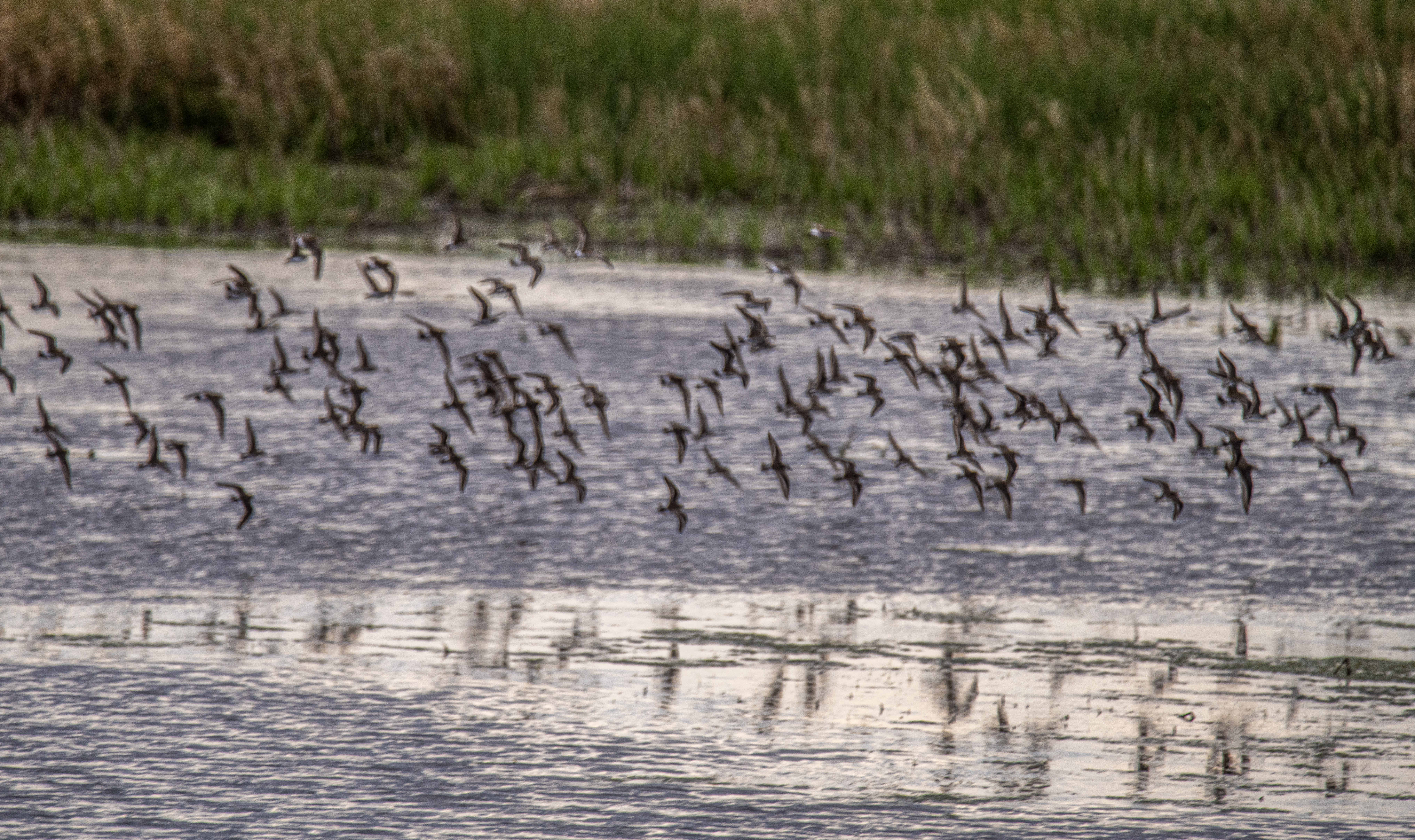
The sandpipers continued to fly first one way, then back.

It wasn’t until a couple of years ago while on the annual Salt Lake Birder’s Tour that I saw my first real life Avocet, thanks to Lac qui Parle SWCD manager Rhyan Schicker. Just before the annual kickoff breakfast she told me there were several wading in a flooded farm field just east of Marietta, home of the annual birding mecca. I rushed out and there they were, even more beautiful in person than in the guide books and magazines. I returned over the next few days for more photographs. Then, the next couple of summers they hovered around here, particularly near some mudflats up by Barry, MN. Not this year, though. We’ve had no rain so the lowlands are bone dry.

Frank suggested the Sand Lake possibility. Over the years this interesting refuge has yielded some nice images, although many hours of stalking the “teapot” flying Woodcocks went sorely unfulfilled. Although our little afternoon foray started with a bit of disappointment when we discovered a formerly quite active Blue Heron rookery abandoned. Finding the Avocets turned the tide. Fortunately no highway patrol came upon us, and that the motorists who whizzed by were so understanding and kind. We had parked as close to the road ditch as possible with my lens sticking out the window, yet half the car was still in the road.

Finding this Black-necked Stilt was an unexpected joy!

Our luck and joy would continue. As we came upon the eastern edge of the Sand Lake Refuge we found different flocks of Sandpipers, each being skitterish and prone for quick flights and returns. Then we happened upon a solitary Black-necked Stilt. Far more common to the American Southwest, the guidebook offers only a pencil thin width of territory this far east. We were in it. Joy!

Between the Stilt and the Sandpipers we were enjoying all the offerings as we crept along the shallow waters. When Sandpipers can wade without the water touching their bellies, they’re wading in quite shallow waters. With the taller birds like the Stilt and Avocets it’s difficult to judge the depths. So we merrily wiled away the afternoon before we happened upon pair of White-faced Ibis further down the road. 

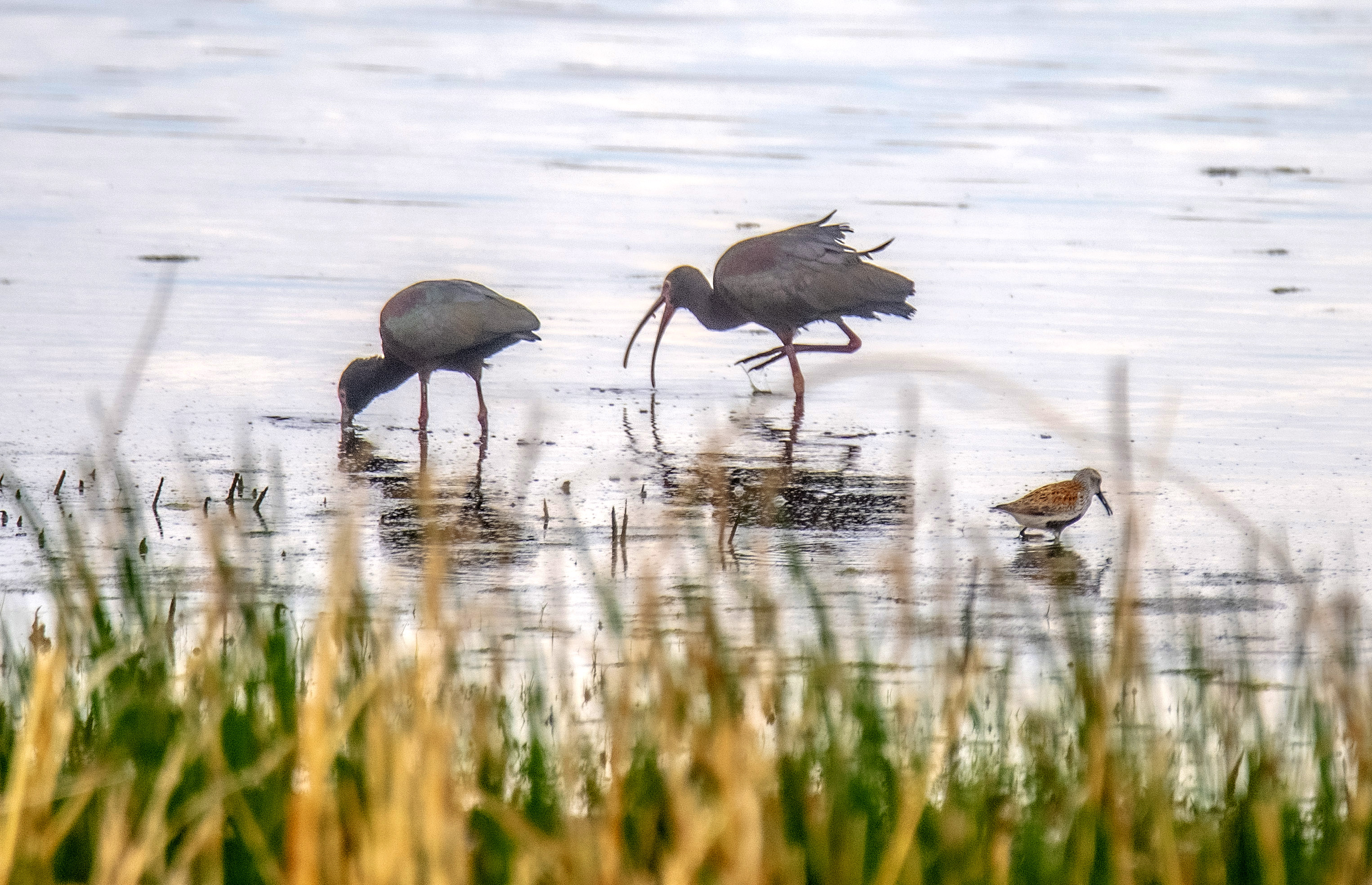
As a final capture were the White-Faced Ibis, sharing a mudflat with a sandpiper.

With our past years of wet spring weather the Ibis seemed fairly comfortable around our area of Minnesota. On that Salt Lake tour a few years ago numerous Ibis were seen at several sites, their bills, unlike the Avocets curved  downward. They flew in mini-V formations from one standing water site to another. This  year? Not a single sighting until we happened upon them in the Dakota mudflats, where they meandered thoroughly unconcerned with the odd guy with the long bazooka of a lens sticking through the car window. Nor was the solitary Sandpiper keeping them company.

Perhaps it would have made wonderful sense to stick around until sunset. However we decided to move on toward home and leave the birds behind in their shallow mudflats. We had been greeted by an Avocet prelude and given benediction by the Ibis, which might mean very little to many. For us sitting in our car on this roadside nave, there was a thorough sense of joy within the high skies of this prairieland “cathedral.” As Nouwen had suggested in his writing, we had chosen our sense of joy and had gone to find it.