Touching the Dream

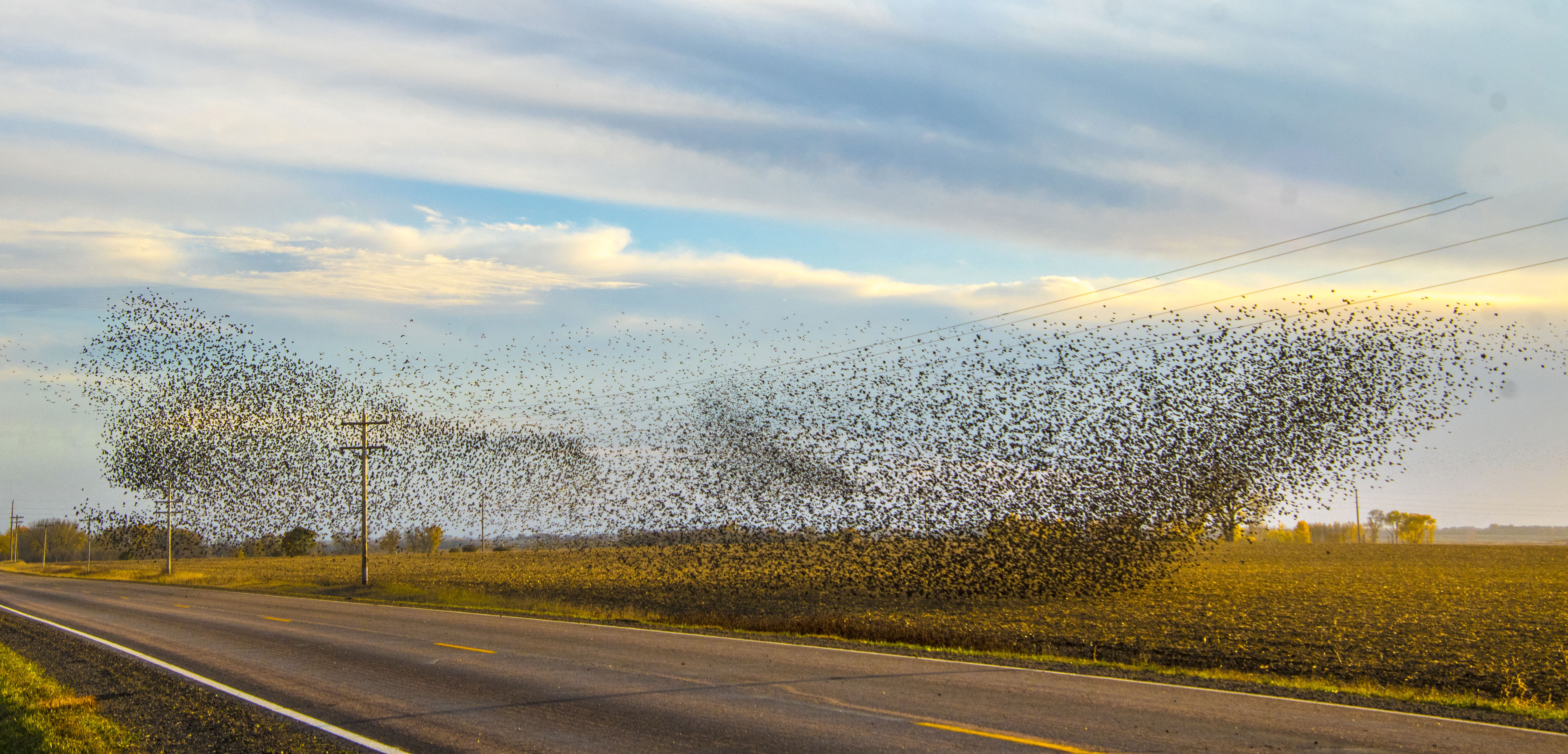
Ah, the beauty of nature, of how when you least expect a gift of the natural world something magically appears  … even on a stretch of state highway alongside a freighter track. We were returning from a shopping trip miles from home, rolling alongside the BNSF tracks west of Appleton, MN, when we were suddenly engulfed by a murmuration of thousands of red-winged blackbirds, and an old dream, a visualization of a lifetime, suddenly came to life. 

Few remain alive to recall such moments nowadays, although some of the old guys of the prairie will talk about how their fathers and grandfathers spoke of red-winged murmurations so thick the collective birds would block out the sky. One of those guys, in his sixties at the time, was in our Master Naturalist’s class back in 2012, and as our small group worked together on a capstone project the conversation drifted toward murmurations, for it was spring and we were starting to see some come through our region of the prairie. “When I was a kid,” he said, “old timers around Redwood would talk about seeing clouds of redwings so thick they would blacken the sky.”
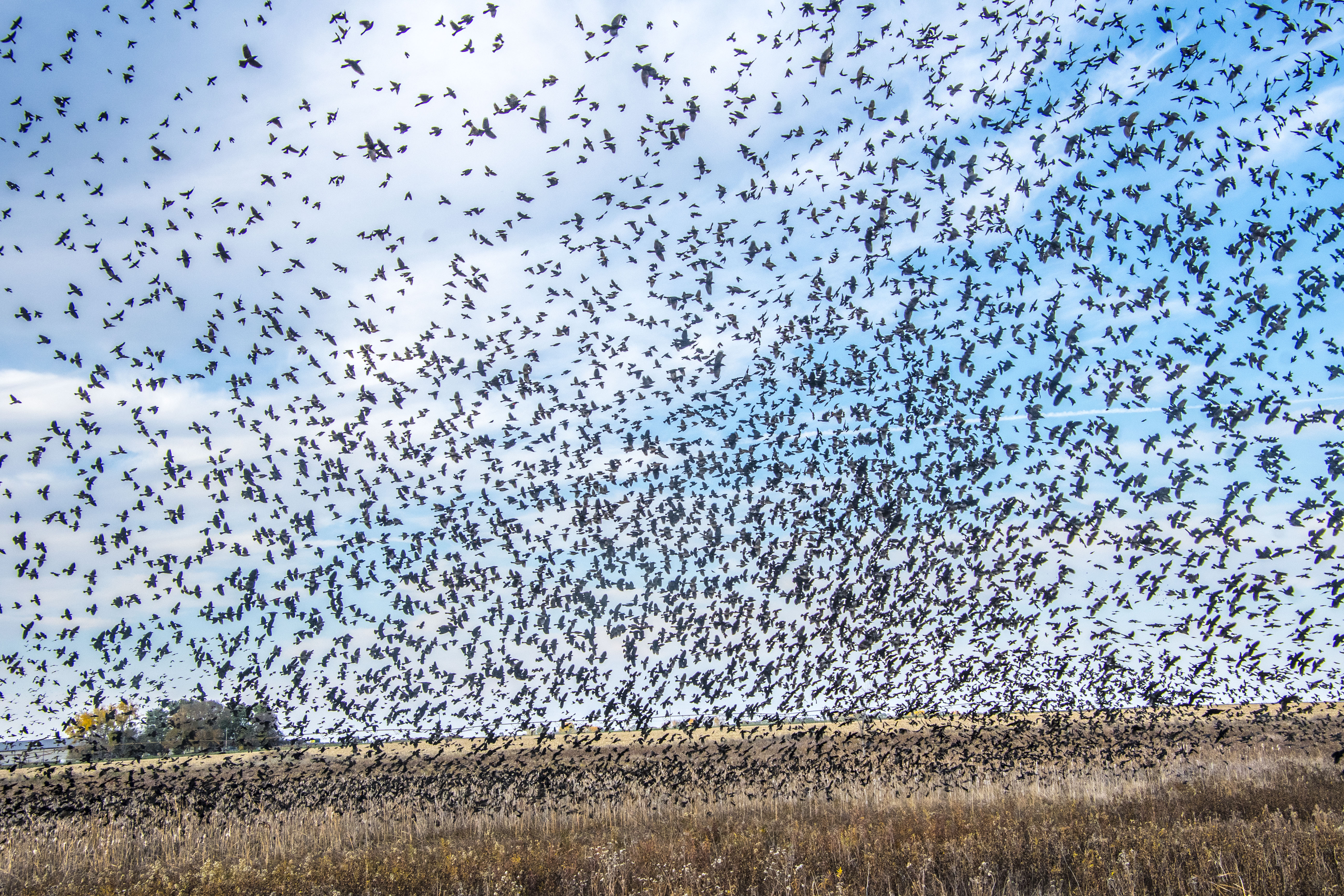
Was this a moment from prairie’s past? Perhaps, though we have no way of knowing.

Such times were back when there was more than one percent of the wetlands remaining in the now extinct “prairie pothole biome.” Another old timer, back about 30 years ago when he was an aged county commissioner, spoke of similar times when he chastised me for my writing positive commentary about the “sloughs”, by saying, “You don’t have any idea of what it was like before ditching and draining. No way to farm. Nothing but damned mud and mosquitoes. You couldn’t get away from either.”

There were also birds. Millions of birds, from waders to grassland species like bob-o-links and meadowlarks, all adding color and song to the then wide open prairie. Red-winged blackbirds were there, too. Millions of them. That was then … back then before the numbers of all of the prairie birds began shrinking due to the destruction of the grass-blessed prairie and wetlands, red-winged included. Back then, come migration, murmurations formed with hundreds of thousands of birds, and when rising from the wetlands and prairie. they would block out the sun, the sky and the clouds. I’ve dreamed of having that visualization come to life ever since that conversation at the meeting and figured there would never be such an opportunity. Then this happened. On a state highway. Alongside a railroad track. A magical moment of nature.
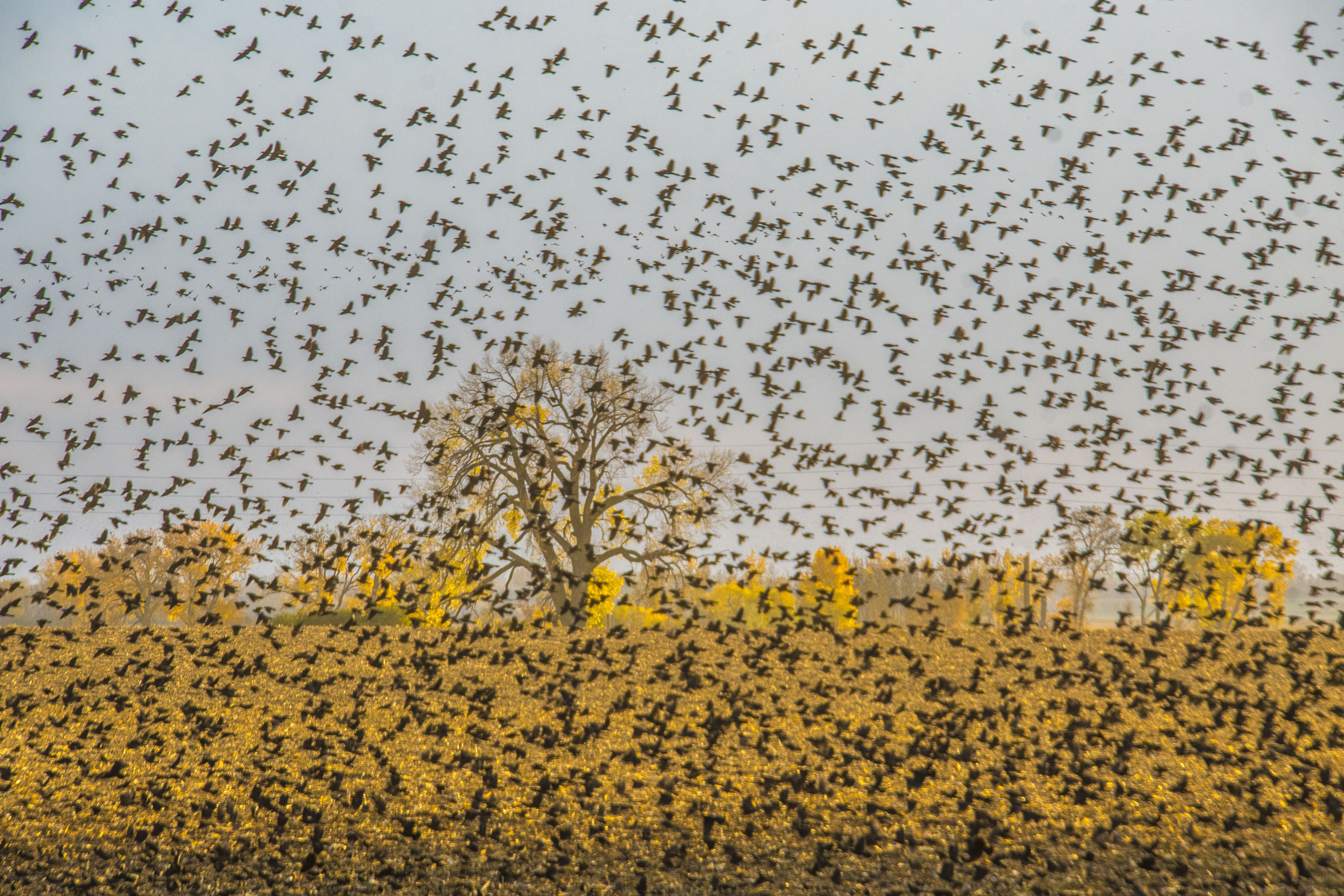
Often the landscape and even the sky was obliterated.

Did they block out the sun, sky and clouds? At times, perhaps. Enough that the visualization held promise.

I’ve witnessed some huge murmurations around Listening Stones and due south about an hour or so, though hardly a flock as close and huge as this one — until this surprise nature offered us the other day, a gathering of the colorful epaulet-patched blackbirds so thick they seemingly blackened the sky.

How do you even count so many birds? If we guessed a half million we might have been close, or perhaps, even short by a few hundred thousand. Here, just west of Appleton, along a stretch of State Highway 7, balanced between some shallow wetlands with numerous cattails, a recently harvested grain field, numerous and spacious trees and a semblance of the old prairie. Yes, perhaps even a glance back to those undrained and unditched patches of prairies of old. If this hadn’t been real it would have been a mirage. A dream. Yet, I have photographic and witnessed proof.
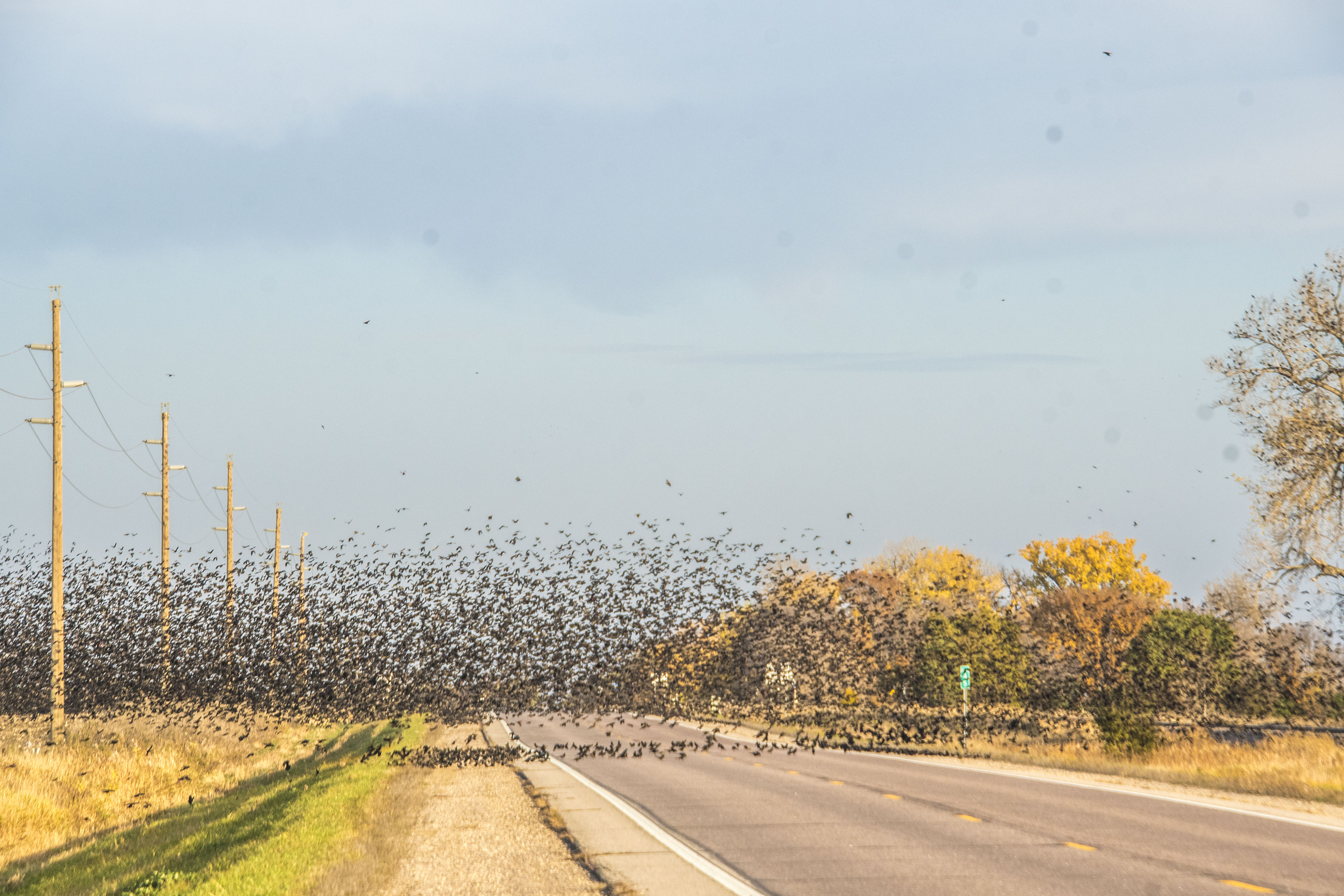
Can you see the car? Yes, it’s in there slowly moving through the curtain of red-winged blackbirds.

We stopped to both watch and take pictures for nearly an hour before deciding to head on home. Then, about ten miles down the road, I pulled over and suggested to Roberta that we return just to hopefully catch the birds in the sunset about an hour or so distant. “We don’t have anything else going,” she said, “so let’s do it.” A u-turn later we were back on the other side of Correll on the way toward Appleton. The murmuration hadn’t left, seemingly nervously rising and settling, then rising as an uncountable curtain of birds. Depths of blackness, with some quite close, and through them in the distances, thousands upon thousands more. It was like a dream come true, and I thought of those who through the years have shared this odd dream of mine.

At one point several hundred landed on the highway surface, temporarily halting traffic until one brave motorist decided enough was enough and slowly crept through the birds causing them to rise once again. This caused them to then turn north along the graveled Ct. Rd 51, and we followed as closely as we could. At times it felt as if we could simply reach through the window and touch one or more of the birds since the flights were so close. Over the years I’ve seen many pictures of distant choreographic-like flight patterns of murmurations, and was hoping that might happen in a colorful sky. We wouldn’t be so fortunate. While we captured images of the distant murmuration dances, none were captured as it might have been with video. 
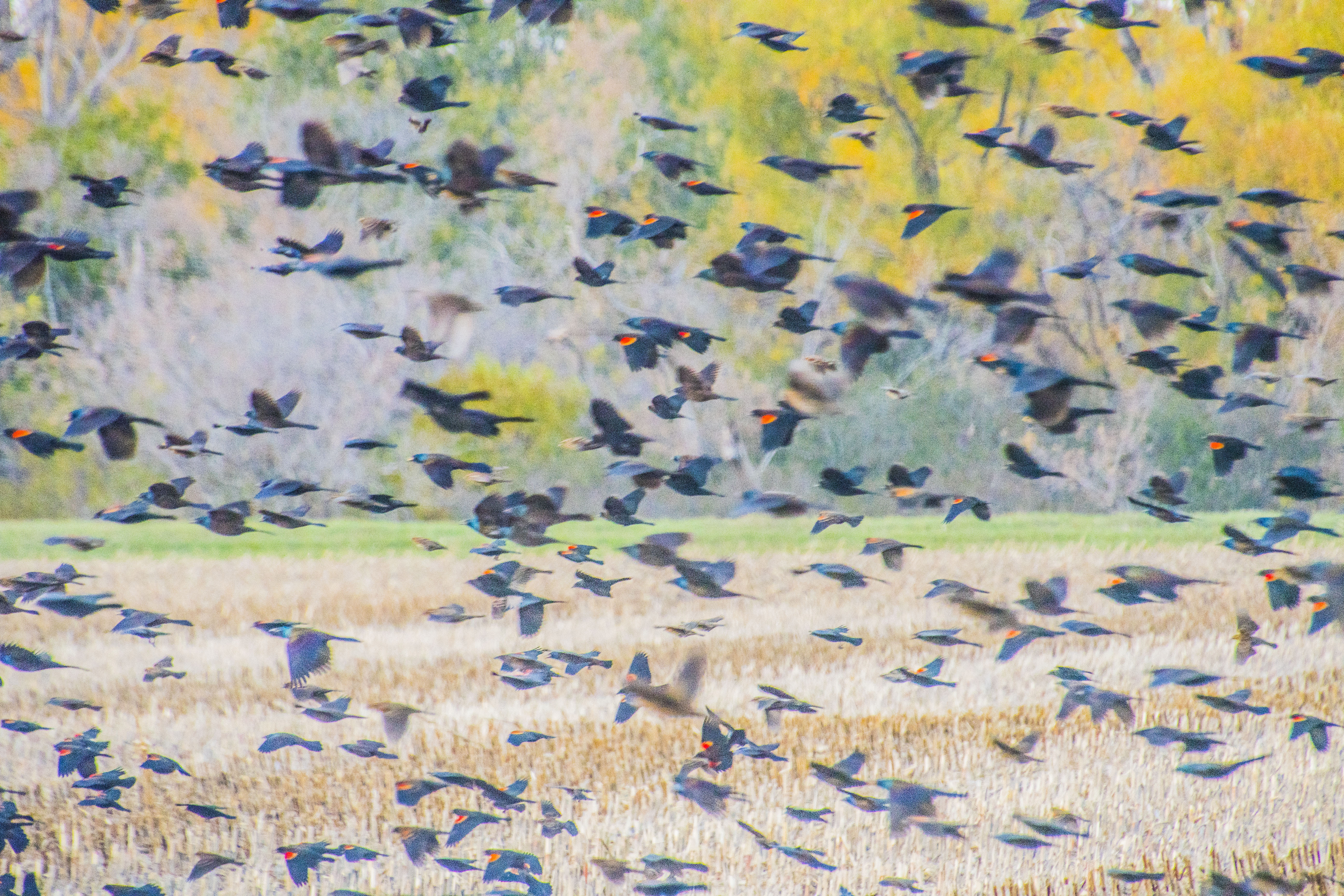
At first it was difficult to identify the birds, then this happened. Along the county road they seemed so close you felt you could reach out and touch them.

“Imagine what you are seeing are sandhill cranes rather than redwings,” I suggested to Roberta. “Huge birds, coming in around sunset over the Platte. This is like the crane migrations in miniature.”

Twice through those few hours highway patrol officers passed by our car as we sat with our hazard lights blinking along the highway, and one even slowed before offering a knowledgeable wave and continuing along toward Appleton. Yes, I’ve been warned before about the illegality of stopping along a highway to take pictures, so perhaps he was aware of the magic in the sky. Maybe he wished he could stop and watch, too. Yet, he waved and moved on eastward.

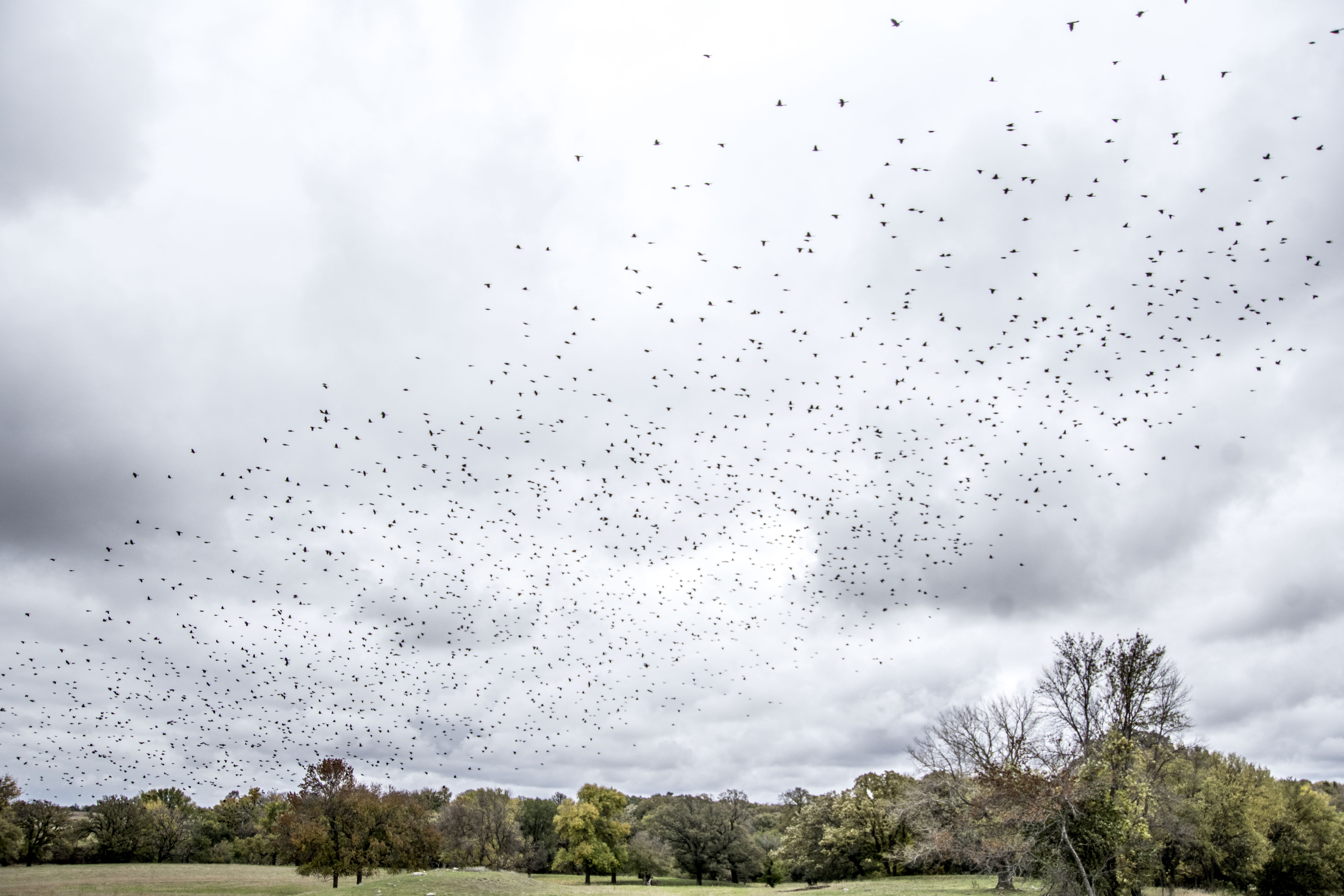
Not only had we parked along the highway, we were often outside standing either in front of or behind the car gazing at the sky, watching as the birds lifted in gigantic clouds from the prairie and trees, seemingly exploding up into the sky as a unit though there were umpteen thousands rising at once. Dancing in movement as though they might touch the clouds, before swooping low to kiss the spine of the prairie, or laterally as if they alone owned the heavens. Clusters thick with points of blackness, each a bird. Yes, it was magical.
Only a portion of the choreographic flights around us.

Eventually the sun began to slide behind the evening clouds as the sky dance continued above us, and around us, blackened dots of red-winged blackbirds dancing in choreographic feathery clouds as nightfall claimed the prairie. Sometimes we are blessed with the pleasures nature offers us, and perhaps the secret is that we notice.
Waves Goodbye

An old fly fishing friend, Rick Nelson, penned this “original Haiku” earlier this week:

Migrating birds

Autumn’s sad farewell

Spring’s cheerful hello 

While Rick acknowledged it might not ring true to purists of the Haiku world, it sums up both of our thoughts of late as we watch and listen to yet another winged species speed south through the flyway.

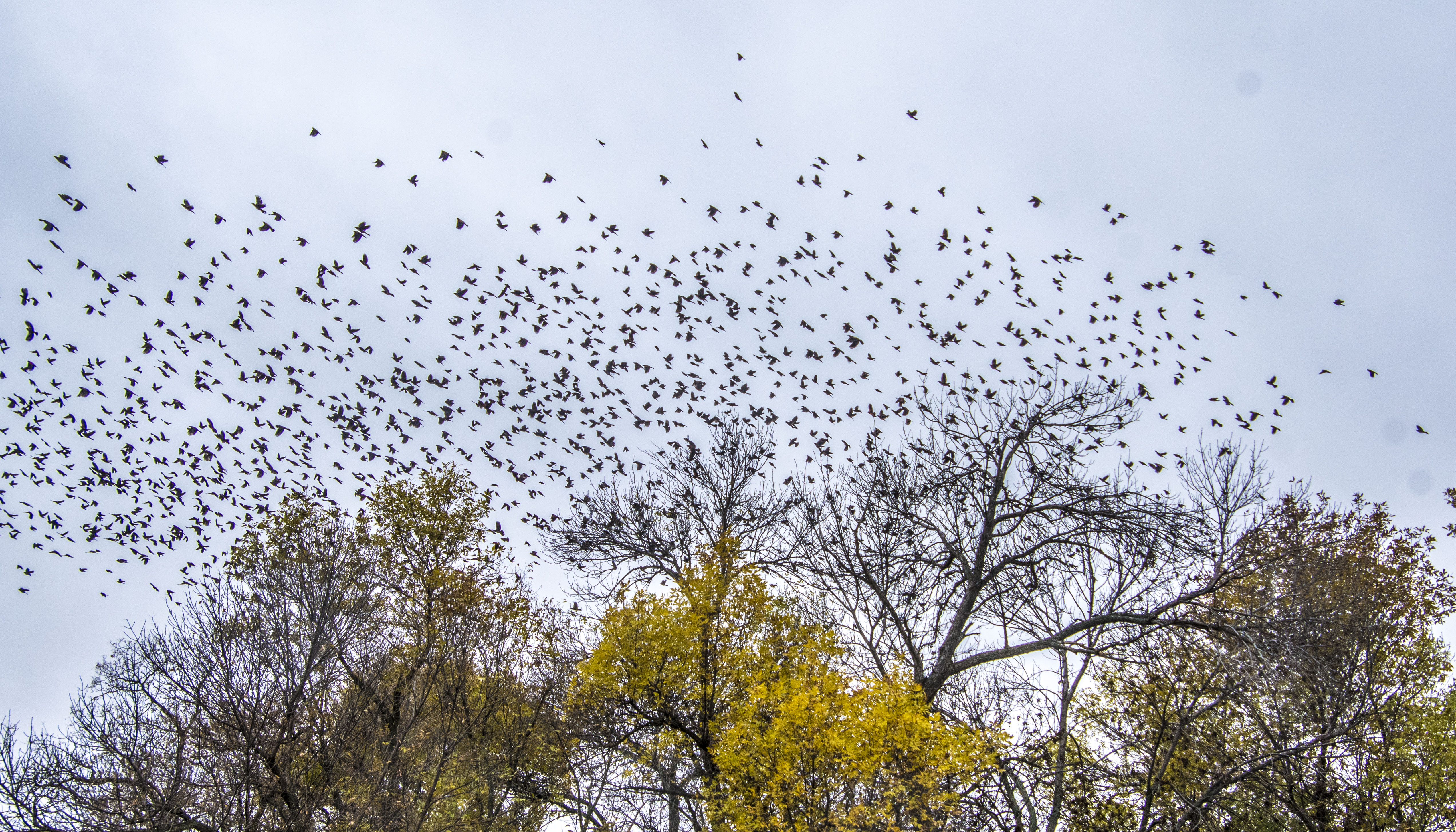
Another murmuration had settled in earlier yesterday morning, ever briefly, in the woods surrounding our home and studio. Leaning against the studio door to listen, the sound is much like what you might hear in a large stadium before a game as voices intermingle into a tangled and indiscernible murmur. This was at least our fourth murmuration of autumn, yet none were as large a massive one with thousands of birds we passed over the weekend nearly 90 minutes south on the King of Highways along the Yellow Medicine River outside of Ivanhoe, MN.

This shows only a fraction of a huge murmuration along the Yellow Medicine River south of Ivanhoe.

Our’s was large enough, so on the way in for lunch I came with the camera, stopping to watch for several moments has they rustled in the treetops of the grove. Suddenly, for some inexplicit reason, they seemed to rise as one, lifting from the depth of trees into the air to fly high over the house before making a wide ranging loop before returning directly overhead to once again fill the same treetops. It was a loud and anxious sounding murmur … until an hour later it was suddenly gone. The silence they left behind was deafening. 

A few days before it was a huge group of ring-bill gulls. I had stepped out of the studio for a brief break and saw several hundred high above the house, seemingly circling as if undecided on which way to fly. Then, suddenly, they veered toward the east and the large wetland just over the rise of our prairie. Wave after wave. By mid-afternoon they were gone. Not a gull in sight.

Part of the murmuration in our Listening Stones Farm grove earlier this week.

A few weeks before there was an uncountable number of white pelicans in the west pool of the Big Stone National Wildlife Refuge grouped together for what seemed like a quarter mile in length. Stacked up against one another so thickly they created what seemed like a feathery bridge some 50 feet across and stretching for a good 400 yards along the tall, marshy grasses. We’re fortunate to have the pelicans here through the summer, and I suspected as I photographed their collective long trough of a feeding frenzy that I was witnessing a pre-migratory feeding. By the next morning there wasn’t a single white pelican, save a straggler or two, to be seen. They were gone.

About the same time we observed a migratory grouping of great egrets at the Refuge, many standing tall on branches of a canopy of trees. Others lined the shallows stalking for a meal. By nightfall they had left the refuge, shallow waters and all.

This represents about a fourth of the long line of white pelicans holed up in the west pool at the Big Stone National Wildlife Refuge.

Swallows and other species have lined the high wires next to harvested grain fields, sometimes bunched in a line that stretches for several hundred feet. We had left for some business downriver and found dozens of such gatherings on power lines from here to Montevideo. They were gone by the time we returned a couple of hours later. 

It seems like those wings of flight were waves goodbye. One species after another, taking to the skies en masse. There seems to still be much mystery concerning migrations. Those swallows, for example, will cover much of North America throughout the summer “breeding” period before suddenly leaving to cover most of South America during the summer of the southern hemisphere. Is the clue of mass migration dependent on the hours of dwindling daylight? Rarely is it available food, according the writing of Donald R. Griffin in his book, “Bird Migrations.” Often, due in part to climate change, there often remains plentiful food around when the migration occurs.

Great egrets grasp a canopy in the Big Stone National Wildlife Refuge for a migratory rest.

We have learned to track migrations with radar and other observatory and tracking tools of science, although there is no instance of delving into the brains of birds. How can you? Among my wonders is how birds of a certain species suddenly begin to congregate? Where? How is the collective decision to suddenly leave communicated? How much has global climate change affected both the summer and winter site selections? Some suggest migration routes are several thousands of years in the making, yet in many instances those routes have changed. How do they find a helpful, high atmospheric wind current to boost a migration across a vast majority of the Midwest basically overnight? With so many birds that the migration is tracked by radar? It’s all a great wonder. A tantalizing mystery that dates back to Aristotle who correctly recognized some aspects of bird migration in his Historia Animalium in the 4th century, BC.

Ring-billed gulls fill the sky above Listening Stones Farm earlier in the week.

As amazing as it is to watch those skyward skeins and poetic dances of murmurations, those symbolic “goodbye waves” of the collective wingtips, there is this vast silence these migrating birds leave behind … voices full of energy, and perhaps even wonder. My woods seem incredibly empty once the last of the stragglers have flown away to join an orchestrated movement toward often a quite distant wintering home. I then wonder if another will happen through here yet this autumn, or will this be the silence that takes us into winter. 

About Rick’s Haiku, the naturalist and thoughtful fly fisherman says, “I know it doesn’t follow strict Haiku rules. But I was reading an article on Haiku this spring and the premise was, “Write a three line poem about something that touches you.” Rick was touched deeply by the migrations through his Bismarck homeland as I am here home on my Listening Stones prairie as we await “spring’s cheerful hello.”

A Haunting

(Writer’s Note: This piece was written as an exercise this past weekend at Douglas Wood’s “Writers in the Woods” workshop held at Osprey Wilds Environmental Learning Center near Sandstone, MN.)

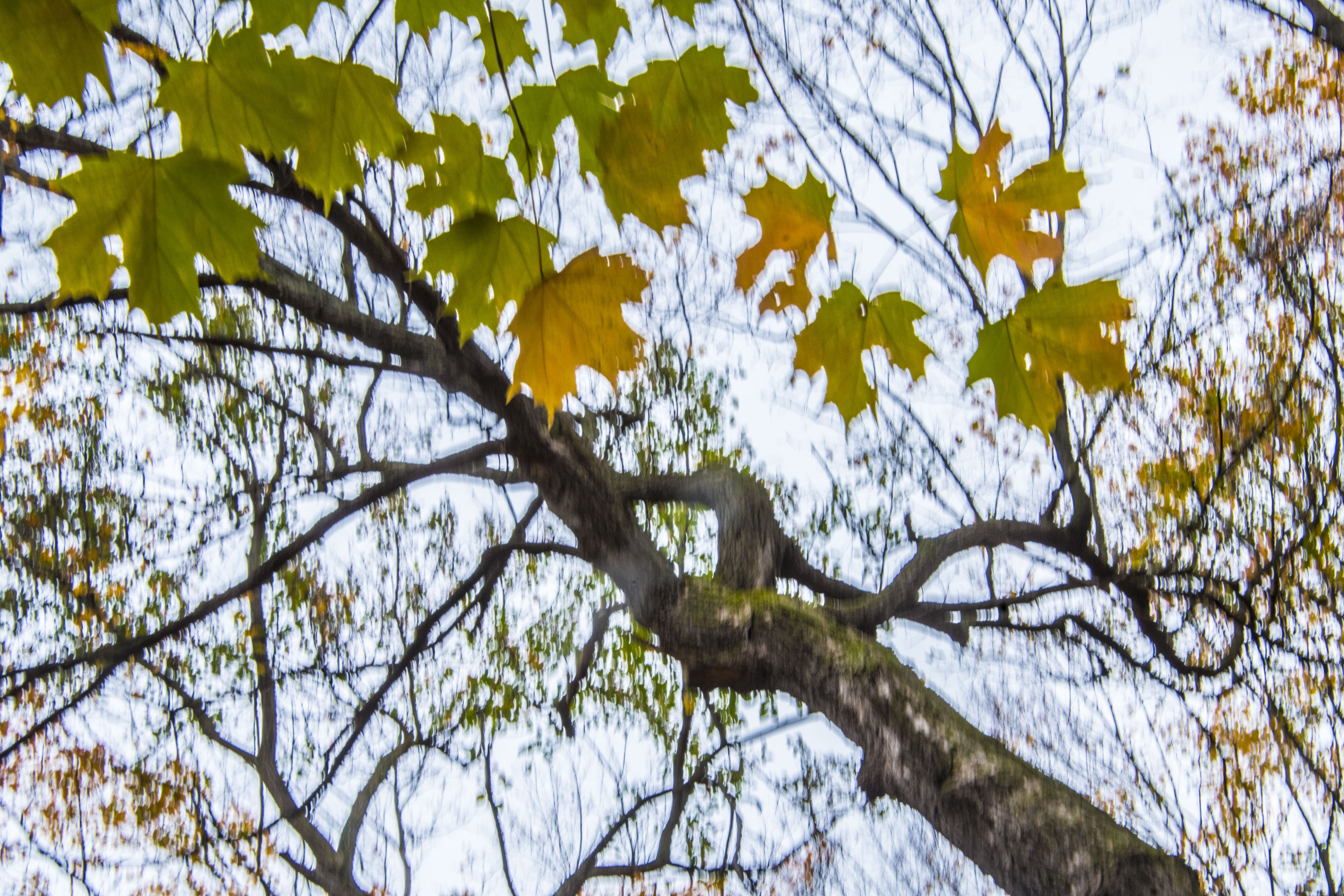
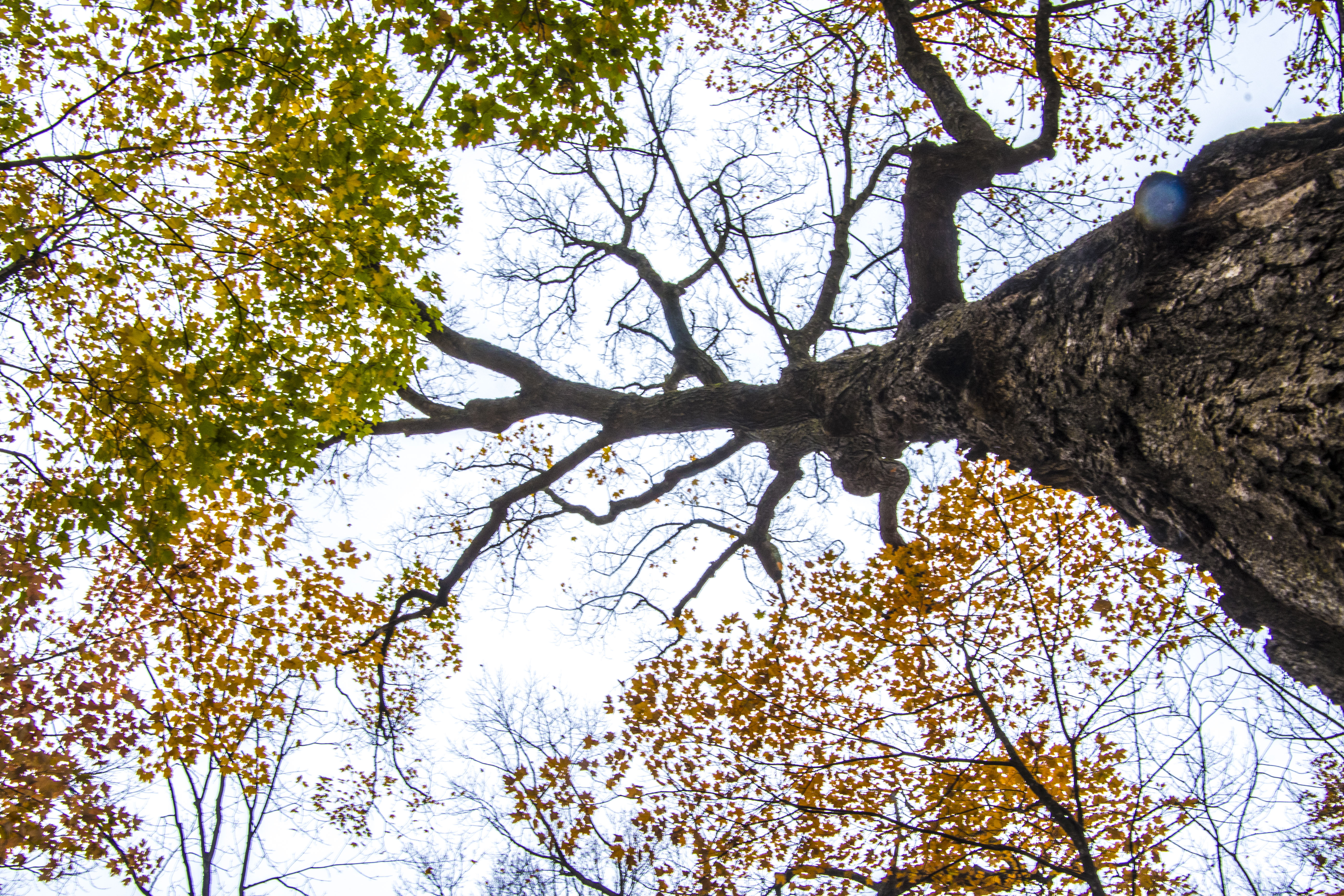
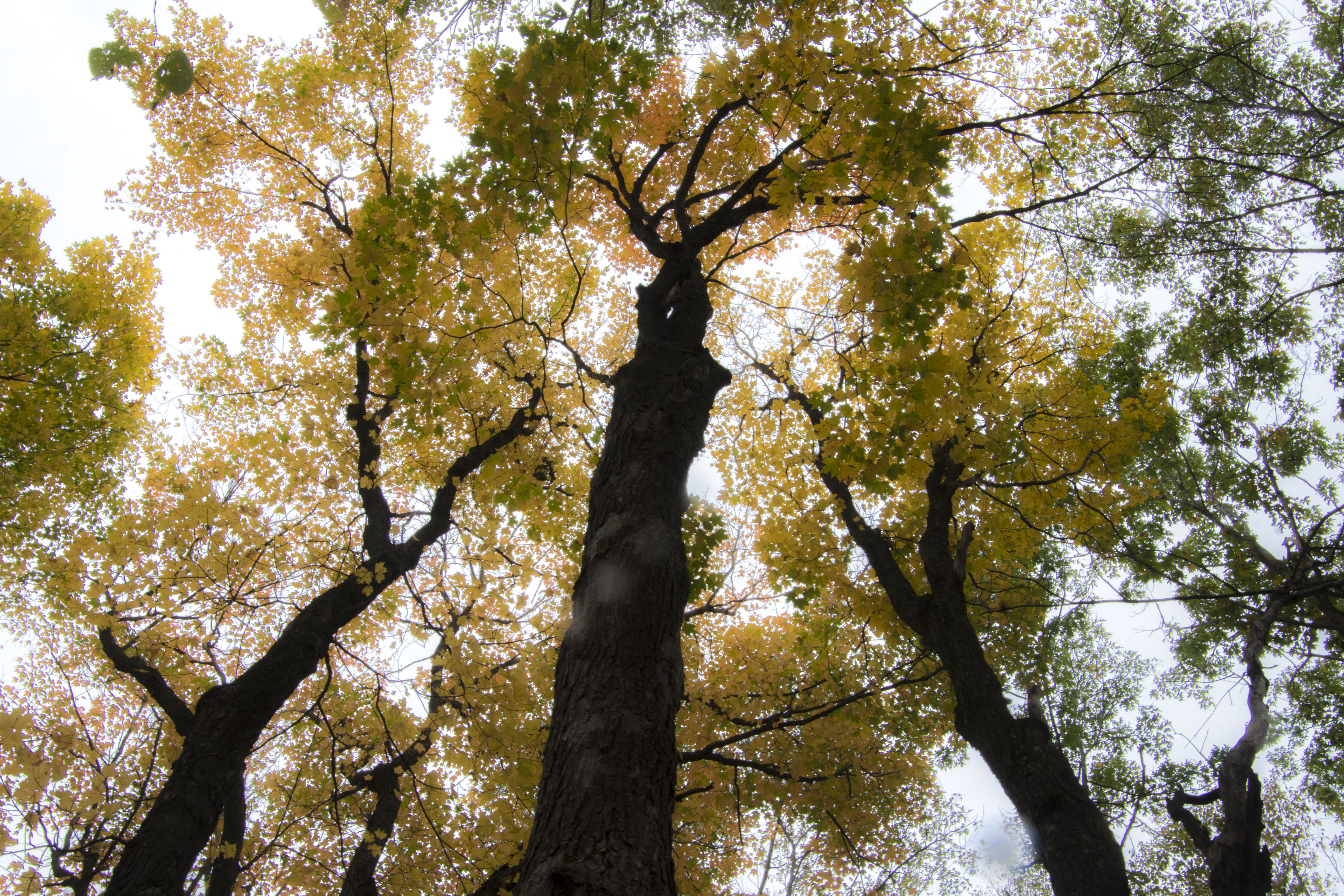
I am haunted by old trees; trees that reach skyward with form and grace. Darkened, aged arms like that of a classical ballerina; poetic, and for some, reaching through thick canopies in search of their last leafy breaths of life.

Around their gnarly, roughened old trunks, or around broken branches easing biologically into the forest duff, an under story has already come to life. Perhaps seedling offspring from years of dropping acorns or other seeds.

Yet there they stand, defying the supple youth surrounding them, with a grace and form that attracts me, especially now as I am about to enter my eighth decade.

Perhaps my haunting is in hoping I can finish my own life with as much grace and form, with such strength.

These thoughts began a few weeks ago in Norway when I slipped on a slick slope above a rolling river, banging the back of my head on a rock with such force that my glasses flew off along with both hearing aids. My camera lens was shattered along with any sense of youthful verve. My diagnosis was a Class One concussion. Where I almost always felt agile with some semblance of youth, I’ve since found my being in the wild now filled with fear and awkwardness. I have a vulnerability I’ve rarely felt.

Recently as I walked an uneven and somewhat rugged and hilly trail along the lively and rushing waters of the Kettle River in Banning State Park, I found myself constantly struggling in search of safe passage, of reaching for rocks and nearby trees to keep myself upright and safe. Even with slow and deliberate effort to climb down an incline for a photograph, I felt so alone and found fear I had seldom felt before that fall in Norway. I was aware of my aloneness and continued to search the nearby trails for others in the event of another fall.

Along with this vulnerability, I’ve felt as if I had lost my sense of adventure and wonder, and despite the multiple comments of “you don’t move like someone your age” and similar shared thoughts of loved ones and friends, there it was. Where my mobility had rarely been a concern, I was now frightful and even scared in the uneven terrain. I was feeling old, an age showing itself in my gait. 

Then this morning I awoke more rested, and en route to breakfast we ambled along another rocky, uneven path. Although the path didn’t offer many of the same adventurous and challenging features of the Banning trail, I slowly began to feel perhaps righted in a way, less frightened. Perhaps it helped being near others.

Then came our assignment: to head into the nearby nature and return with perhaps something to write about. While many headed toward a trail meandering through a big woods, instead I found myself ambling alone through the remnants of an old forest nearby, one with old trees. Aged trees. Gnarly trees. Trees with character and graceful form. Trees still with shimmering leaves, golden in the morning sunlight. Trees that had grown old and stood brazenly strong among both seedlings and younger brothern, with sturdy trunks and long, well defined poetic limbs still reaching ever skyward toward the heavens with both beauty and grace. They were holding course and standing their ground despite their obvious age.

There came a smile, and a deep breath or two. I was among friends.