Once again the wind is blowing. Gale force? Perhaps not, since that would be in a range between 34 knots (39 mph) to 47 knots (54 mph). At least not consistently. Yet the sound and feel is such that it is surely lifting soil and blowing dirt, and thanks to the recent thaw, not much of this continual erosion will be visible since snow provides a convenient contrast. Rest assured, though, that dirt is shifting and that some of it will blow into the adjacent road ditch and perhaps even the distant ditch across the road.
There are ample examples all across the western prairie region.
Down the road apiece, just past our little eight acre prairie, we have evidence of displaced dirt. Between the field and the edge of the road blown dirt covers what little snow that has yet to melt. Driving through the “black desert” — basically within the Hawk Creek Watershed in Chippewa and Renville Counties — dirt covered ditches on either side are a common sight on both highways 7 and 40.

Unfortunately wind-blown dirt erosion is far from centralized since friends traveling beyond our state borders have witnessed “snirt” … a word that combines “sn” of snow with the “irt” of dirt … in Iowa, Nebraska and Kansas. Recently some have taken to calling the eroded dirt “snoil” that combine snow with soil. Whatever the moniker, it is a tragic loss for now and especially for future generations who may be dependent on whatever soil is left to grow food.
One of my long time friends, Kurt Lawton, former editor of Soybean Digest magazine, suggests that every farmer and land owner should be required to read “Dirt: The Erosion of Civilizations” by David R. Montgomery. It’s a telling and fascinating book of non-fiction that describes the many “civilizations” that have been ruined and lost because of the erosion of dirt dating back before the birth of Christ. He also points out and warns that we are now farming (growing food, and yes, ethanol) in the “last frontier” of tillable soils, and adds quite pointedly that we’re still “treating our soils like dirt.”

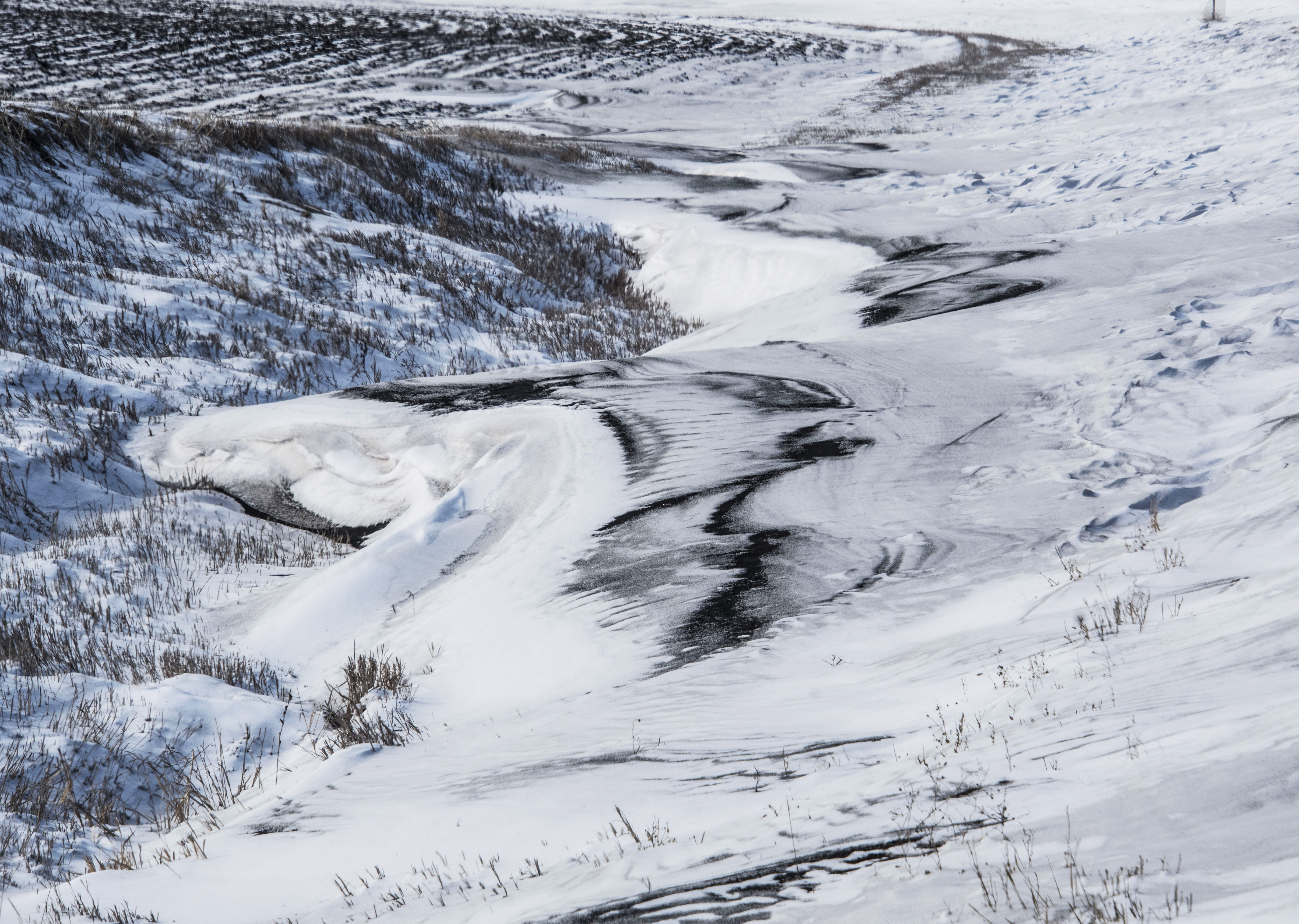
It was after reading Mongomery’s book in 2014 that I began to collect roadside images of wind blown eroded dirt on snow that led to creating my Art of Erosion exhibit, which has now been in numerous exhibitions around the states of Minnesota and Wisconsin, from the annual MOSES (Midwest Organic and Sustainable Education Service that is now called Marbleseed) gathering in La Crosse, WI, to being included in the Water Works traveling exhibition from the Smithsonian. Add a few gallery walls and conferences to the list. A commonly heard comment in those varied exhibitions is, “ … this is so beautiful yet so ugly.”
Initially my images were centered around erosion in Big Stone, Lac qui Parle, Chippewa and Renville Counties of SW Minnesota. Since, more images have been added from Stevens, Swift and Yellow Medicine Counties. Some of my earlier images have been pulled from the original 24 as newer and perhaps more compelling ones have been gathered. There is seemingly no end to the addition of more imagery. A few year ago it I included a white farm cat clustered with dirt along with dirt-crusted, in-town Christmas decorations and stairways. Last year I framed a multi-image collection from dirt blown from a single field at graduated distances ranging from 100 to 400 meters, along with a second image where “waves” of dirt had cascaded down a hillside from a fall-tilled field from just over the rim. Little imagination was needed to view it as waves of an ocean beach.
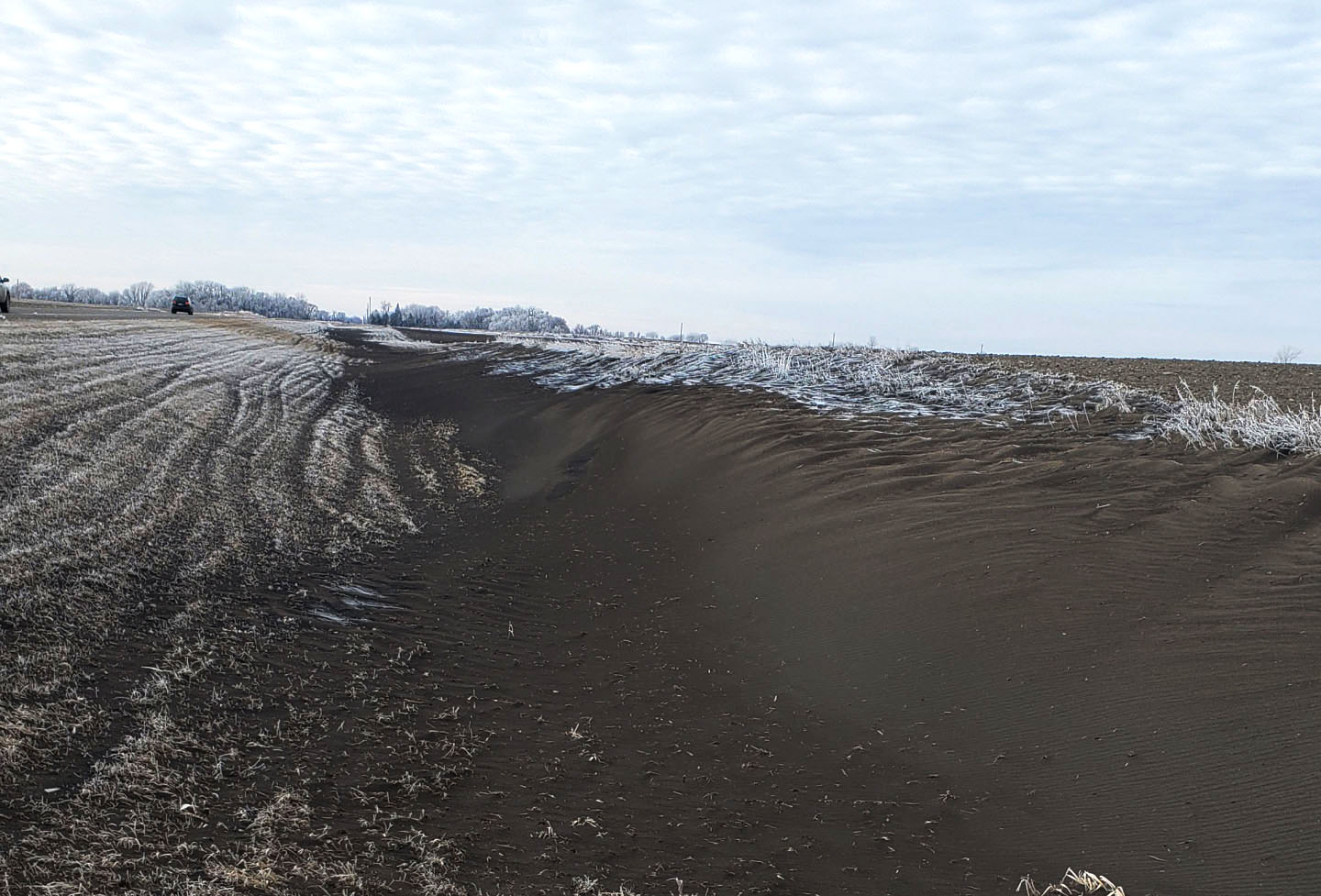
More images have been added already this winter and it’s only February, with nearly four months to go before seedlings are high enough to provide modest protection. A handful of these images were captured on a recent trip to my credit union in Dawson. Sadly, these poor farming practices continue, and perhaps even sadder is that apparently those farming the soils where I can count on gathering images every winter rarely do much about it. Are they blind to it? Overlooking or ignoring the damage being caused? As if soil is an unlimited resource?
Viewers of the Art of Erosion have asked about changes in the farm program that might mitigate the issues, or question why such tillage practices are continually being used. They worry, as do I and others, including Montgomery, about feeding future generations if the erosion continues. They ask about cover crops, which can be challenging to plant when considering both a compressed harvesting season and a shortened possible growing season for the cover. However, more and more farmers have noticed and are working to find creative solutions to keeping their soils in place including turning to crops like kernza, a commercially available and economically viable perennial grain crop that is a suitable ingredient for bread, cereals, beer, whiskey, and even ice cream.
Perennials are a favorite of Jim VanDerPol, author of “Conversations with the Land,” who bemoans both the loss of perennials overall and the grazing of farm animals that would better protect our soils. His family farm, now being transitioned to his grandson, is a green isle in the midst of the aforementioned Black Desert. Poor animal prices, however, won’t convince so many who are dependent on the USDA farm program to switch their 24 row planters and combines for a patch of grass and a herd of cattle.
Perhaps the most inexpensive means is to simply leave the residue from the previous harvest standing. Untilled. Farmers, though, seem to balk at this by arguing that come planting season new issues might arise including a late winter or a very wet spring. Yet, what about the soil? “The soil is being eroded 100 times faster than it’s forming. And that kind of situation can burn right through the soil profile,” says UMass Amherst geoscientist Isaac Larsen. Those who have studied the erosion seem to unanimously conclude that this is unsustainable.

There is a cost involved. Jodi DeJong-Hughes, University of Minnesota Extension regional education specialist, sampled the top inch of snirt in ditches along Minnesota Highway 40, yes, the same one mentioned above, that through laboratory analysis and math revealed that this field lost $51.30 in nitrogen, $7.80 worth of phosphorus and $23.50 in potassium per inch of ditch acre. In other words, $82 plus change per ditch acre. These figures do not even include the most valuable soil components of topsoil (clay particles) that blow away before heavier particles settle into the nearby ditch. How do you assign a value to valuable soil organic matter, microbes and minerals that lie in a ditch? Yes, it’s dirt. It is also money. Anna Cates, a University of Minnesota soil scientist, says: “Every farmer who changes (tillage practices) references erosion as a motivator.”
Snirt, or snoil, is a perplexing and costly issue that likely remains in the hands of individual farmers to recognize and rectify. It seems unlikely that an abrupt change will come from the USDA. Some Farmers have changed practices, yet it seems a majority have either ignored looking at their ditch banks or even considered the costs of erosion both in terms of crop inputs and actual loss of soil. I would hope it isn’t due to a complete lack of care, for this is it; this is our last remaining farmable topsoil on planet earth.
 Listening Stones Farm