A quick peak through the window after rising before dawn Saturday morning offered a view of what prairie people call a “short world.” Fog shrouded the farm. In a half hour the plan was to meet up with (John) Palmer at the Big Stone Lake State Park office where we would cover our pie-shaped assignment for the annual Audubon Christmas Bird Count (CBC). It could have been worse. Just a year ago the CBC, which would have been my first, was pretty much canceled due to a heavy overnight snow with drifts halfway up my garage doors.
After a tasty mug of my smoky Lapsang Souchong tea, my binoculars were fetched and I headed to the car. My camera and 600 mm lens were already packed. Five minutes later I pulled in behind Palmer’s car and we were off on what we both believed would be a slow morning of identifying and counting various bird species. Would the chilly fog cause birds to hide deep in the prairie grasses and trees? Would we actually be able to see well enough to even count and identify whatever birds we might see or hear? Truthfully, we were heading off with more concern than confidence.
Palmer is new to the area having just completed his first summer as assistant manager at the state park. Many of the roads we were to cover were unknown to him, and some would be new even to me if we canvassed accurately. We were responsible for an area between Big Stone Lake and U.S. 75, and from the Clinton road down to and including the city limits of Ortonville. We would have five hours to complete our task before the volunteers, under the direction of Jason Frank and Brandon Semel, biologist with the Big Stone National Wildlife Refuge, would meet at Lingonberries for the summary.
Each piece of the circular pie was fairly well defined. Joining us on the hunt for an elusive Bobwhite Quail (the inside joke, for the group I would later learn) and other species of note would be Douglas Pierzina, Brandon Semel, Curt and Sara Vacek, Allison Parker, Gena Leksche, Jason Frank along with me and Palmer. Bill Frank and Meg Scholberg were on feeder watches.
Palmer and I skirted the very top of our pie first, taking what we would later learn wouldn’t be frowned upon as a quick spin down the paved county road in search of a flock of shoulder-hugging Horned Larks or Snow Buntings. Typically both are prevalent along the country roads about now, and birds I had seen recently, yet there wasn’t a one to be found. In Clinton, Lake Eli was frozen over and the Swans that were here a few weeks ago had migrated. We saw no Crows or even Sparrows in our drive through town.
We took the first left once we sped past Clinton’s infamous Zero Street into the countryside to turn onto a marvelous gravel road I had driven past hundreds of times and never driven. It was a treasure with numerous wetlands on either side along with a few Wildlife Management Areas (WMA) that seemed inviting. Some with enough woods for Wild Turkeys and all with ample prairie grasses for Pheasants. While Palmer could hear some activity, we didn’t see anything until we spotted an owl on a power pole after leaving our last WMA on the road. Our first bird! Palmer, in a better position than me, spotted “horns” through his binoculars so we counted it as a Great Horned Owl. It was a brief sightings for once the Owl spied us looking, it flew off for a distant hazy clump of trees. But, it was a bird! Our first of the count!

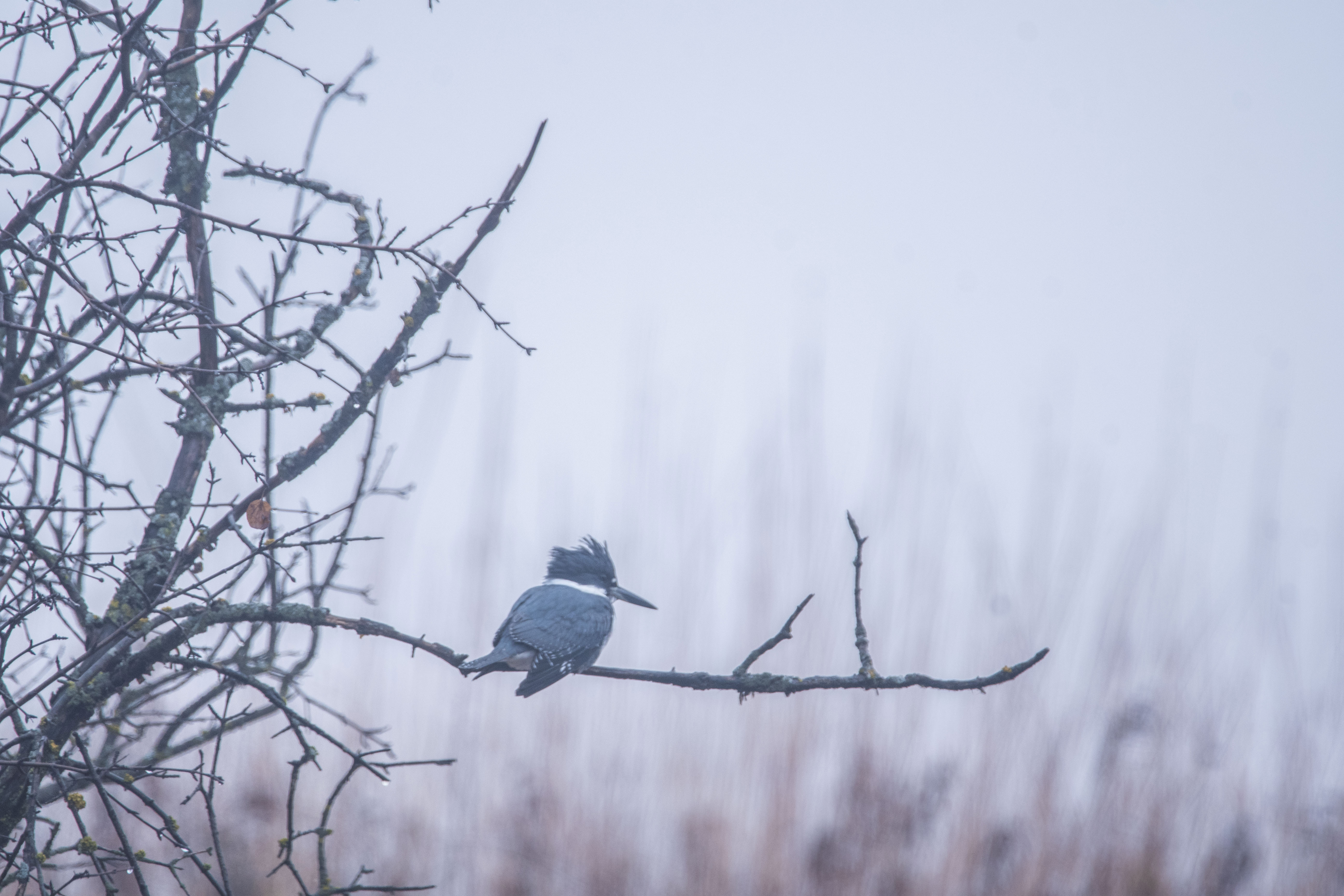
We traversed the upper end of our pie going from one gravel road to the next, slowing along tree lined fence rows. We could have stopped at Listening Stones Farm and upped the count significantly thanks to our bird feeders. This wasn’t a contest about who could count the most birds. Rather, it was to catch an accurate, one day glimpse of the overall species of our circled countryside along with the approximate numbers of each. By and by we followed the ravine back to the state park and passed a flock of Starlings along the road that I had photographed the day before. We then counted a solitary Belted Kingfisher in a splice of open water next to the big lake.
“What’s it doing here at this time of year?” Neither of us had an answer. A later check indicated that most do migrate to warmer climates, although a few birds will stay if they have a source of open water.
We drove down several lake access roads en route to Ortonville, often slowing with the windows down, sometimes turning off and getting outside of the car to look and listen, pulling binoculars to peer into the grayness in search of whatever sound might come, or to simply slowly glide along a treeline in hopes of seeing signs of bird life. We backtracked from the golf course to some WMAs north of town, then back down the eastern flank of the links. I pointed out wetlands where last spring we counted numerous White-faced Ibis, which Palmer had never seen. We then canvased the town parks, ravines and shoreline. The wetlands along the dike road. Parts of the Minnesota and Wetstone Rivers and their backwaters. I feel we were rather thorough despite the handicap of the fog.

We were picking off one or two of the few species we could find, with the highest numbers being the flock of Starlings and a larger grouping of Juncos in the recently “freed” tree canopy on the ridge above the Lake Road. Among our finds were a few Pheasants, a lone Mallard and Canada Goose, and on the drive back toward Lingonberries from a gas fill up, a Pileated Woodpecker. Palmer and I were rather excited about the Owl, Pileated Woodpecker and especially the Kingfisher.
When we gathered for the count the overall results were rather surprising for me with 49 total species counted, according to Semel’s tally, with a compilation of 13,000 total birds. “The fog wasn’t ideal,” he said. “I don’t think any of our sightings were particularly unusual, yet it was fun.” Jokes were made about the Quail no one was able to mark on their lists.

Although this was my first CBC, this was an Audubon effort to promote conservation by counting rather than hunting birds, and was initiated in 1900 by Frank Chapman and 26 other conservationists. Some counts have been running every year since then and now happens in over 20 countries in the western hemisphere. Official 15 mile radius circles are pinpointed, with our’s centered around Ortonville. Our circle included parts of South Dakota as well as the Big Stone National Wildlife Refuge and Big Stone Lake State Park.
After a quick lunch and friendly greetings, Palmer and I headed back to the state park as the fog slowly and finally eased into gloomy daylight. As we motored up the Lake Road, a few Crows and various other birds would sometimes swoop across the highway and we wondered where they had been during our official count. And, where were the three groupings of Wild Turkeys with staked territories we thought we would surely pass along both the ravines and the Lake Road? And, those numerous skeins of Canada Geese we’ve watched fly overhead for weeks? Nuthatches are quite common and we didn’t count a single one, nor did we happen upon commonly seen Downy or Hairy Woodpeckers. Palmer and I wholeheartedly blamed it all on the fog. Oh, and like the others involved in the count, the ever elusive Bobwhite Quail exited our circled “stage” laughing once again!
 Listening Stones Farm