Ah, November. Come on, surprise us. Give us some glimmer of hope heading into the depths of winter.
Your staunch wind had settled in causing the blueish smoke from my smoker to tangle within the breeze rather than dancing wistfully above the port holes, yet inside the small salmon slabs seemed to be taking it well. This followed an evening attempt to catch a Northern Lights display which we ditched within moments at the top of our prairie, for the clouds even curtained off the moonlight. After tending the smoker this came from a friend from Ely who wrote, “What’s up with this month? Sun never shines. November is dull. But like the ‘moose turd pie joke’, I love November.”
I don’t know the joke, and I grasp to find much love for this dullness, lack of sunlight and the ever present wind, for as Edwin Way Teale pinned, “How sad would be November if we had no knowledge of the spring.”

Yes, November is our prelude of winter. Medical folks claim January is the toughest month for us mentally here in the North Country, although I could offer a strong argument for November after such a colorful October. At best November could be considered a subtle month, a time when you seek even the tiniest glimmer of color and hope. Our colorful leaves have long blown away into the prairie grasses by those sturdy and seemingly relentless winds, and those gray skies seem empty now that most of the bird migrations have sped through our neck of the prairie. Yes, we still have some ring-billed gulls adding a glitter-like whiteness and beautiful glides through this otherwise muted grayness.
Then, this happened. Like an unexpected peak of the sun and an umbrella of blue overhead, we were overjoyed when notified by friend, Lisa Thorson, that a 100 or so swans had descended one gray and chilly evening onto nearby Lake Eli. Swans? On Lake Eli? Was this our surprise?
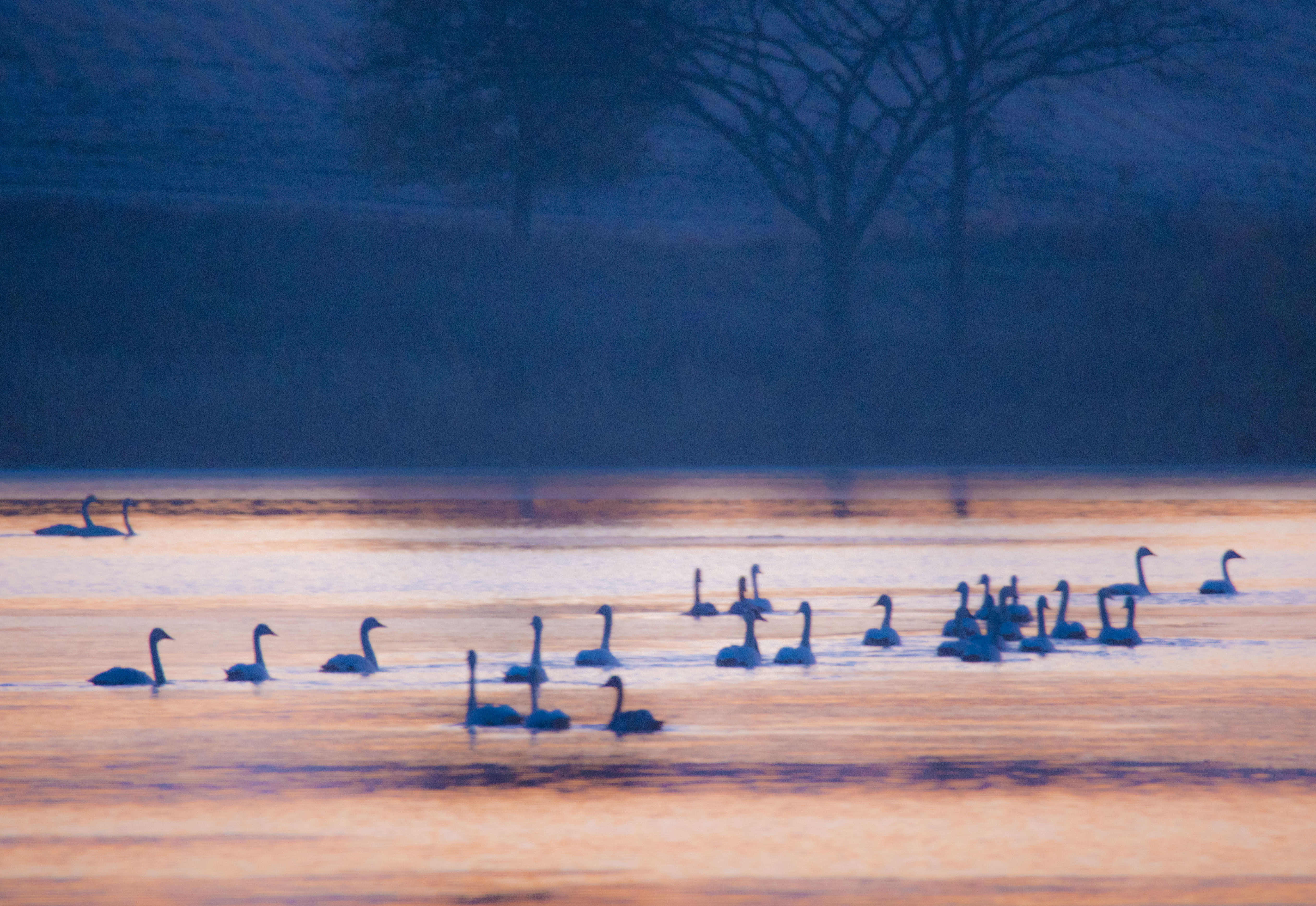
Lake Eli, located on eastern defining edge of nearby Clinton, seems rather unencumbered by canoes or kayaks, so yes, the swans came as an exciting and welcomed surprise, for not much seems to happen around here outside of the annual county fair and hosting what townsfolk call the “world’s longest lasting ice golf tournament” on the shallow lake, one that has been held annually ongoing for 30 some years and draws a few times more than the town’s population each January. For their Arctic Open, holes are drilled via ice auger, then marked by recycled Christmas trees instead of poled golf green flags.
Yet, there they were. A hundred or so swans offering us both grace and beauty by dropping from the migratory sky to cheer us on a chilly November weekend. We jumped from bed early Sunday morning to hopefully catch the swans in a prairie “sunrise” — for if our sun had broken through between two dense banks of clouds that would have been considered quite a blessing in itself.
As it was, the sun was held captive for at least another hour while the swans held forth in the misty morning. Their collective squawking filled an otherwise quiet morning sky, swan music accented by a few sudden departures that came across as brushed cymbals on a soft jazz piece as long white wings slapped the cold surface of the 160 acre lake when a few select family units lifted from the frigid waters.

While such a migratory moment wouldn’t garner much attention on the other side of Minnesota, here in the prairie this was wonderfully unexpected, for Lake Eli is not Weaver Bottoms in the Mississippi River. There thousands of swans migrate to the open water each autumn thanks to the bountiful feeding areas in the backwater shallows. Lake Eli, with an average depth of five feet, can offer similar meals for the migratory waterfowl before freeze up. Around here many of the smaller wetlands are already coated with a layer of ice, and both Eli and Big Stone Lake will soon follow suit. By then the last of the swans and other waterfowl will be headed elsewhere leaving behind a stilled silence as we head deeper into winter.
We arrived as dawn settled in to find a large flank of the flock floating across and along the distant bank, much too far for my lens even in decent photographic-friendly light. Not in this low light, dawn-ish haze. Further up the highway we found a good number clustered against the edged water next to the highway. As we neared, though, they began easing away, meandering into the heart of Eli in clusters, some in small select family units or as a larger grouping, their long necks gracefully rising and turning to watch as they sought safety from a rogue photographer. A few took to the air to fly down the length of the lake or overhead.
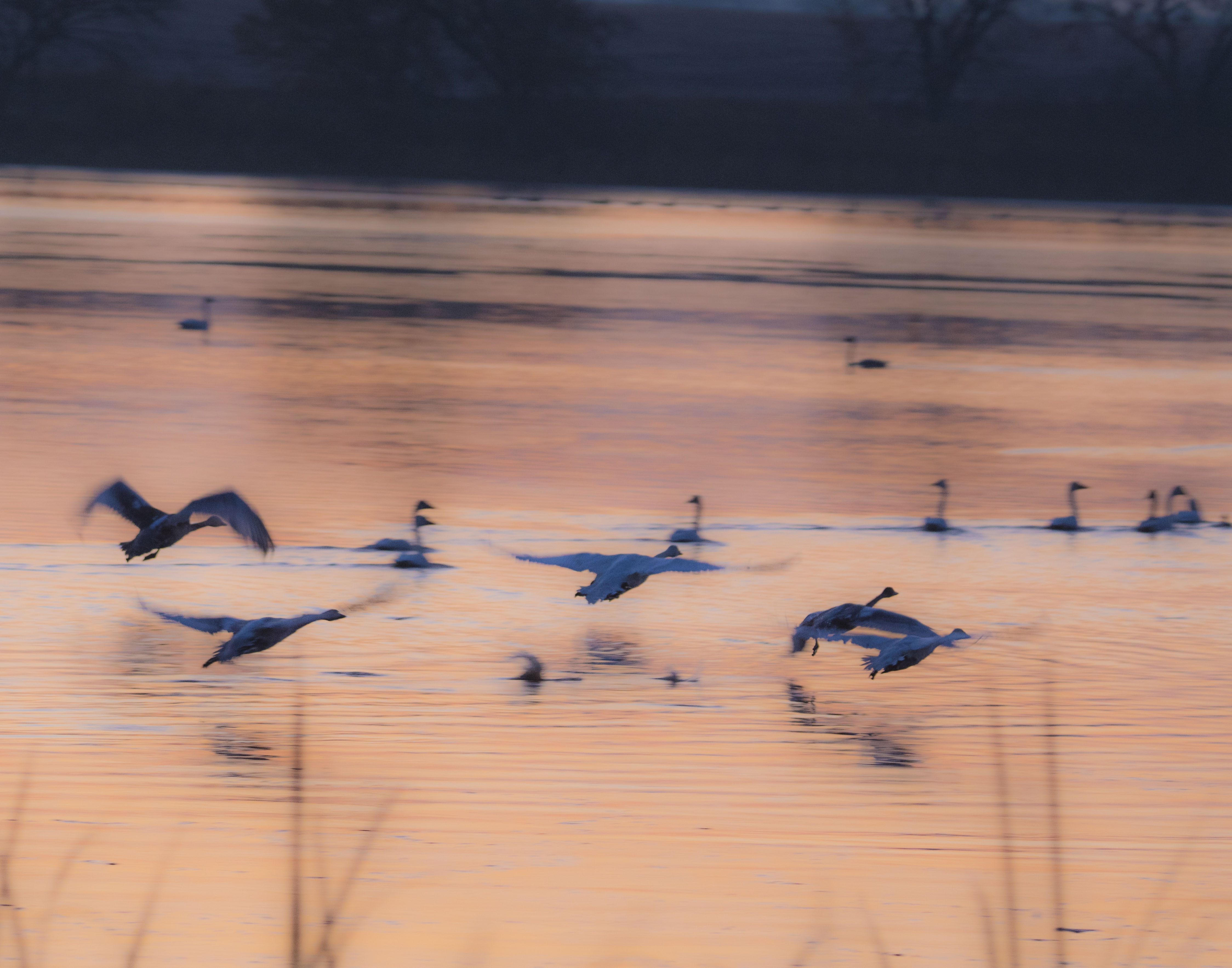
As the early morning light grew ever brighter the birds with their beauty and sounds were fine fuel for the soul. Ambient colors began to tint the mostly stilled surface waters. All those thoughts of a gloomy, cold gray November morning seemed to ease away as deep breaths came naturally. How can such a moment seem both calming and exhilarating? Especially as a cold November morning?
I couldn’t help but wonder, though, where the swans will go from here once the lake freezes over? If they even stay around that long? Perhaps to my home state of Missouri, where a couple of Novembers ago en route to our family Thanksgiving we detoured off the Interstate into the Loess Bluffs National Wildlife Refuge in northwestern corner of the state where we were pleasantly surprised to see swans by the thousands supposedly overwintering in the backwaters of the Missouri River. Swans and snow geese, both, and it was a breathtaking sight.

For now, though, they’re floating on small Lake Eli, where on a cold January morning volunteers will trudge onto the iced-over surface to drill holes for the Arctic Open before motoring down Zero Street and the other streets and avenues in town to retrieve discarded Christmas trees. Although the swans will be long gone we’ll remember how they so unexpectedly came to give us, as poet Mary Oliver wrote, “an armful of white blossoms” — reminders of the beauty of life on an otherwise cold and blustery November morning.
 Listening Stones Farm