An old fly fishing friend, Rick Nelson, penned this “original Haiku” earlier this week:
Migrating birds
Autumn’s sad farewell
Spring’s cheerful hello
While Rick acknowledged it might not ring true to purists of the Haiku world, it sums up both of our thoughts of late as we watch and listen to yet another winged species speed south through the flyway.
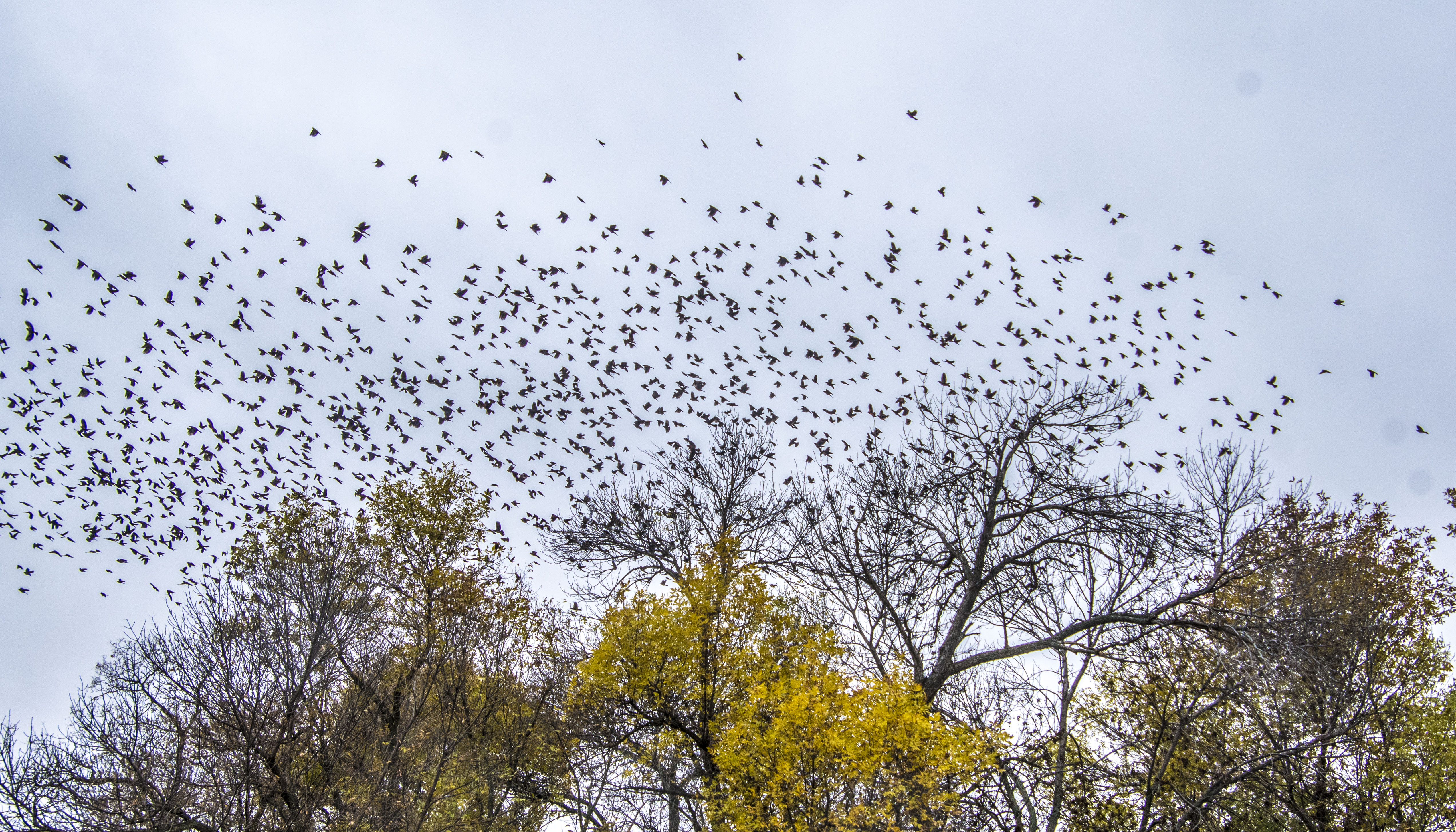
Another murmuration had settled in earlier yesterday morning, ever briefly, in the woods surrounding our home and studio. Leaning against the studio door to listen, the sound is much like what you might hear in a large stadium before a game as voices intermingle into a tangled and indiscernible murmur. This was at least our fourth murmuration of autumn, yet none were as large a massive one with thousands of birds we passed over the weekend nearly 90 minutes south on the King of Highways along the Yellow Medicine River outside of Ivanhoe, MN.
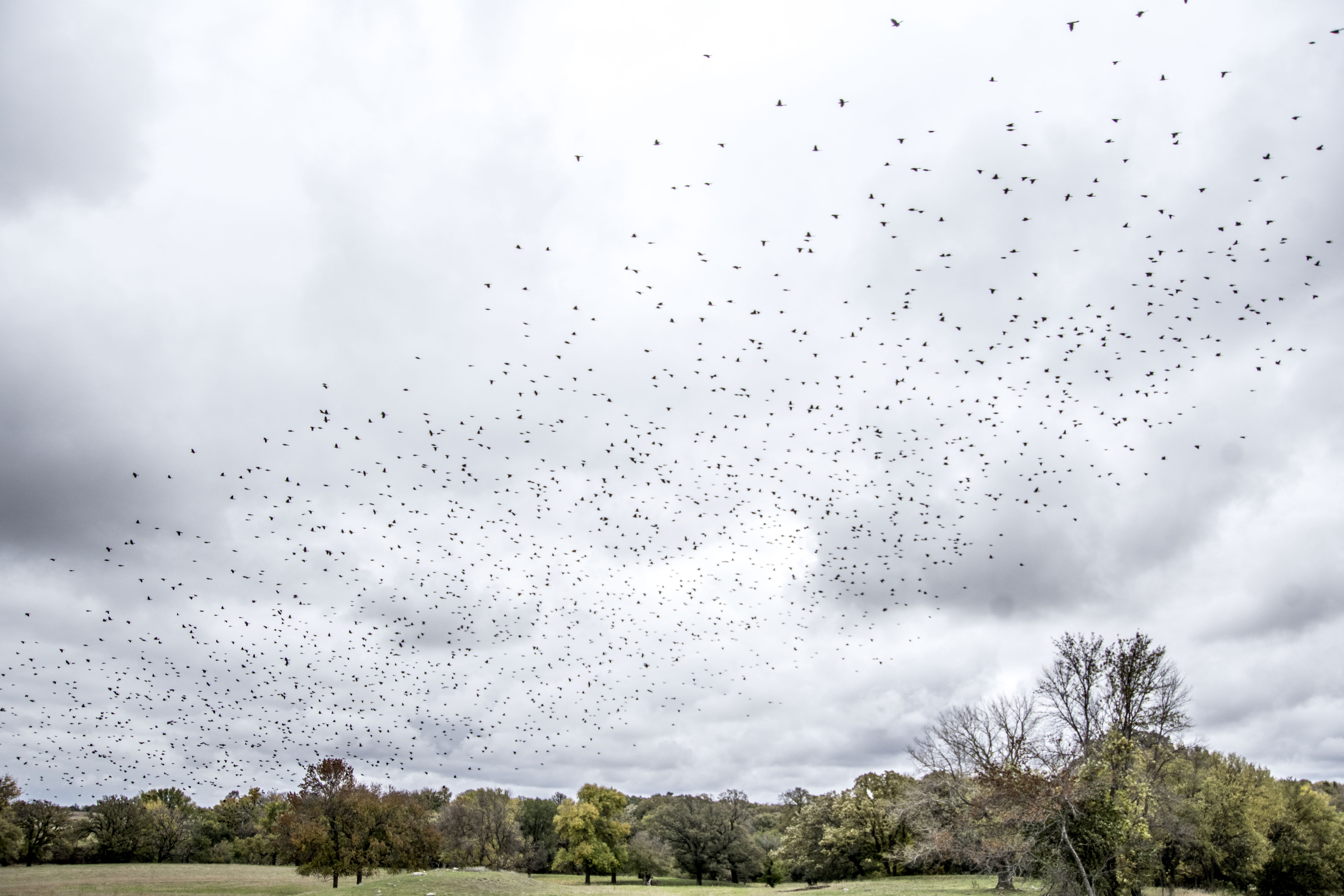
Our’s was large enough, so on the way in for lunch I came with the camera, stopping to watch for several moments has they rustled in the treetops of the grove. Suddenly, for some inexplicit reason, they seemed to rise as one, lifting from the depth of trees into the air to fly high over the house before making a wide ranging loop before returning directly overhead to once again fill the same treetops. It was a loud and anxious sounding murmur … until an hour later it was suddenly gone. The silence they left behind was deafening.
A few days before it was a huge group of ring-bill gulls. I had stepped out of the studio for a brief break and saw several hundred high above the house, seemingly circling as if undecided on which way to fly. Then, suddenly, they veered toward the east and the large wetland just over the rise of our prairie. Wave after wave. By mid-afternoon they were gone. Not a gull in sight.
A few weeks before there was an uncountable number of white pelicans in the west pool of the Big Stone National Wildlife Refuge grouped together for what seemed like a quarter mile in length. Stacked up against one another so thickly they created what seemed like a feathery bridge some 50 feet across and stretching for a good 400 yards along the tall, marshy grasses. We’re fortunate to have the pelicans here through the summer, and I suspected as I photographed their collective long trough of a feeding frenzy that I was witnessing a pre-migratory feeding. By the next morning there wasn’t a single white pelican, save a straggler or two, to be seen. They were gone.
About the same time we observed a migratory grouping of great egrets at the Refuge, many standing tall on branches of a canopy of trees. Others lined the shallows stalking for a meal. By nightfall they had left the refuge, shallow waters and all.

Swallows and other species have lined the high wires next to harvested grain fields, sometimes bunched in a line that stretches for several hundred feet. We had left for some business downriver and found dozens of such gatherings on power lines from here to Montevideo. They were gone by the time we returned a couple of hours later.
It seems like those wings of flight were waves goodbye. One species after another, taking to the skies en masse. There seems to still be much mystery concerning migrations. Those swallows, for example, will cover much of North America throughout the summer “breeding” period before suddenly leaving to cover most of South America during the summer of the southern hemisphere. Is the clue of mass migration dependent on the hours of dwindling daylight? Rarely is it available food, according the writing of Donald R. Griffin in his book, “Bird Migrations.” Often, due in part to climate change, there often remains plentiful food around when the migration occurs.

We have learned to track migrations with radar and other observatory and tracking tools of science, although there is no instance of delving into the brains of birds. How can you? Among my wonders is how birds of a certain species suddenly begin to congregate? Where? How is the collective decision to suddenly leave communicated? How much has global climate change affected both the summer and winter site selections? Some suggest migration routes are several thousands of years in the making, yet in many instances those routes have changed. How do they find a helpful, high atmospheric wind current to boost a migration across a vast majority of the Midwest basically overnight? With so many birds that the migration is tracked by radar? It’s all a great wonder. A tantalizing mystery that dates back to Aristotle who correctly recognized some aspects of bird migration in his Historia Animalium in the 4th century, BC.

As amazing as it is to watch those skyward skeins and poetic dances of murmurations, those symbolic “goodbye waves” of the collective wingtips, there is this vast silence these migrating birds leave behind … voices full of energy, and perhaps even wonder. My woods seem incredibly empty once the last of the stragglers have flown away to join an orchestrated movement toward often a quite distant wintering home. I then wonder if another will happen through here yet this autumn, or will this be the silence that takes us into winter.
About Rick’s Haiku, the naturalist and thoughtful fly fisherman says, “I know it doesn’t follow strict Haiku rules. But I was reading an article on Haiku this spring and the premise was, “Write a three line poem about something that touches you.” Rick was touched deeply by the migrations through his Bismarck homeland as I am here home on my Listening Stones prairie as we await “spring’s cheerful hello.”
 Listening Stones Farm