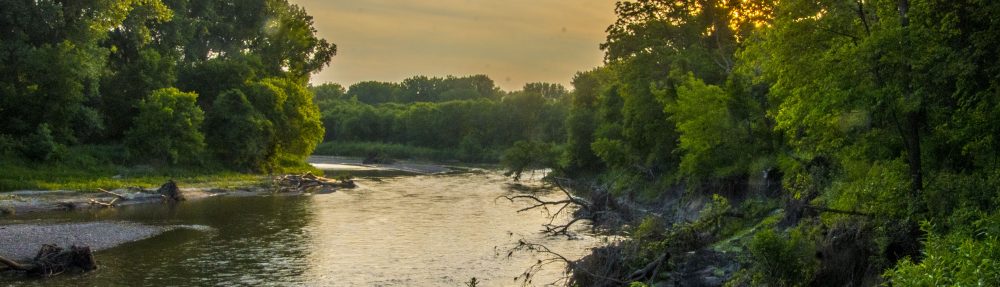
At first I thought she might be joking; that I could be so clever and imaginative, that I could come up with something as ever reaching as “forest bathing.” Now I wish of having had my camera at hand to capture the look on Roberta’s face when former exchange student, Lucy Hille, grew suddenly excited about the possibility of doing some forest bathing like she does on occasion in her native Germany. My suggestion was meant as a possible highlight on a forthcoming saunter along the lake-side trail in the Bonanza portion of Big Stone Lake State Park.
“Really?” Roberta asked in surprise. “You have forest bathing in Germany?”
“Oh, yes,” Lucy answered. “In German we call it waldbaden. It’s where you can get away from the city to go into the woods to meditate away from fast life and noise.” She backed that up by saying it was being practiced by cultures around the world thanks to the Japanese practice they call “shinrin-yoku.” Of course, this has nothing to do with a bar of soap, nudity (although that is certainly possible) or fluffy towels. It is most simply a mind game.

So waldbaden, or forest bathing, is learning to meditate in nature, and became part of our beautiful, sunny summertime morning. Next to us the waters of the 26 mile long Big Stone Lake were calm, with very little boat traffic. A slight breeze seemed to ease through the trees although there was a calmness to the lake surface. We were barely into the woods, yet far enough along that the car wasn’t visible through the leaves, when I brought our little progression to a brief halt.
That is when I stopped us to suggest we simply close our eyes and breath deeply, to push aside any tension we might feel, to ease it down our spine and backbones, to let any troubles we might be feeling to ease over our ribs like water trickling through a rocky stream. A yoga instructor used that visual metaphor nearly 50 years ago and I still use this mental image in my meditation. Although hearing is my weakest sense and sight my strongest, sometimes I fail to bring out sensory touch and smell. “Taste,” I teased, “will happen back home with a round of chocolate chip and mint cookies.”
Lucy, of course, thought that would be a wonderful closure of her brief visit prior to venturing off to a week in the BWCA, her fourth visit to the wilderness mecca.
On this saunter we began channeling in sound, sight and touch, with special thanks to feeling the breeze. Although sights on this trail were tampered significantly with the derecho last summer with so much dead and decaying oak trees, it is still a beautiful hike. Along the way a tree that had been battered by a pileated woodpecker was pointed out, and the wren “compound” that was defended so feverishly just weeks before, was incredibly quiet as we passed by. Indeed, silence seemed to dominate both in the timber and in the lake. Typically bird songs from the overreaching canopy escorts you through the entire lakeside trail. Not on this morning. Perhaps the migration was further along than we had noticed.
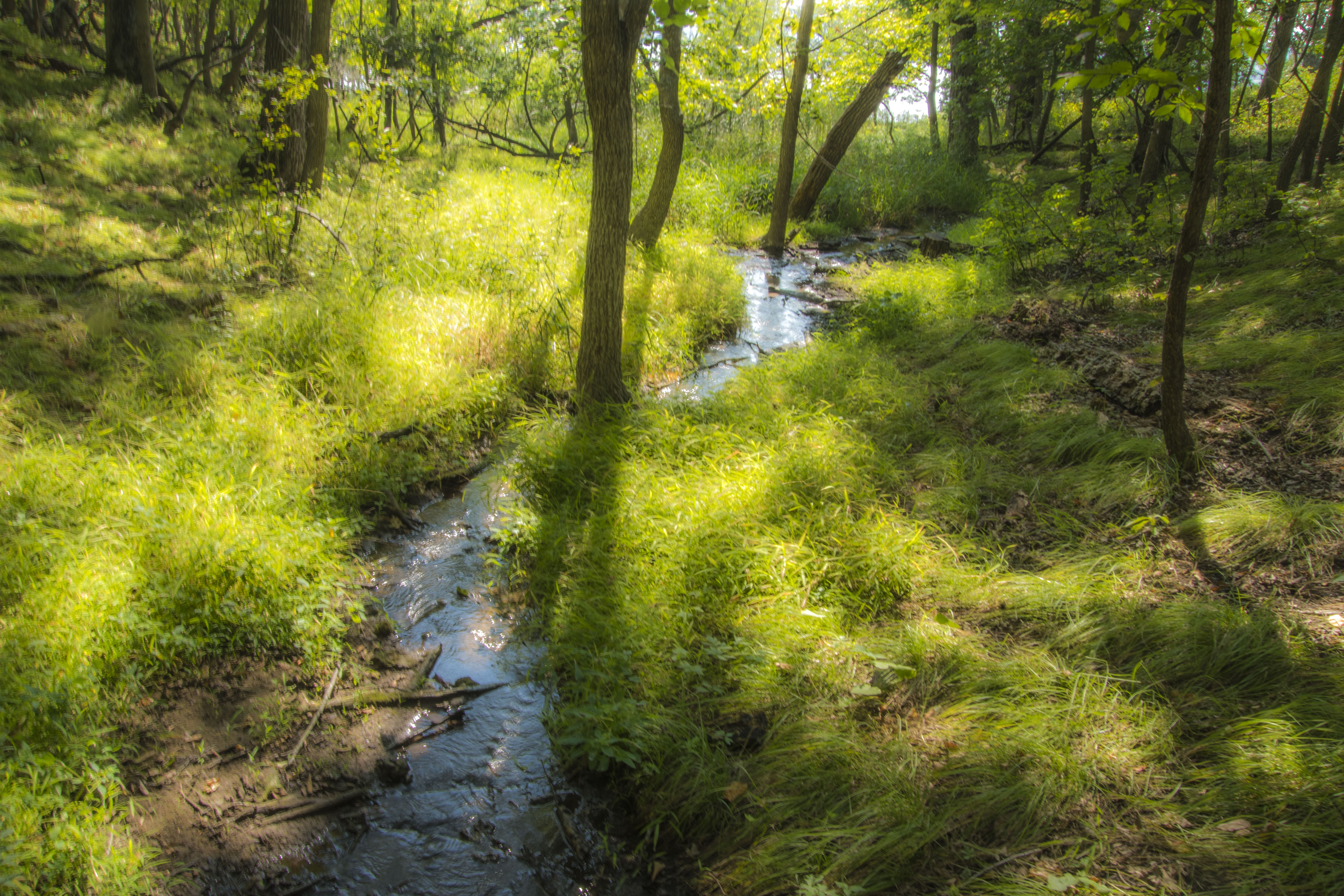
Ah, but the other sounds came to us. A small rivulet that typically stops us even in the depths of a frigid winter morning did so once again. Roberta sat on the small wooden bridge as the spring-fed waters waxed poetically beneath her feet, and we all seemed to close our eyes to soak in the soothing sound. If my introduction to our bathing had been dismissed, here it was vivid and beautiful. Like ocean waves, the small spring-fed rivulet seemed to ease the soul.
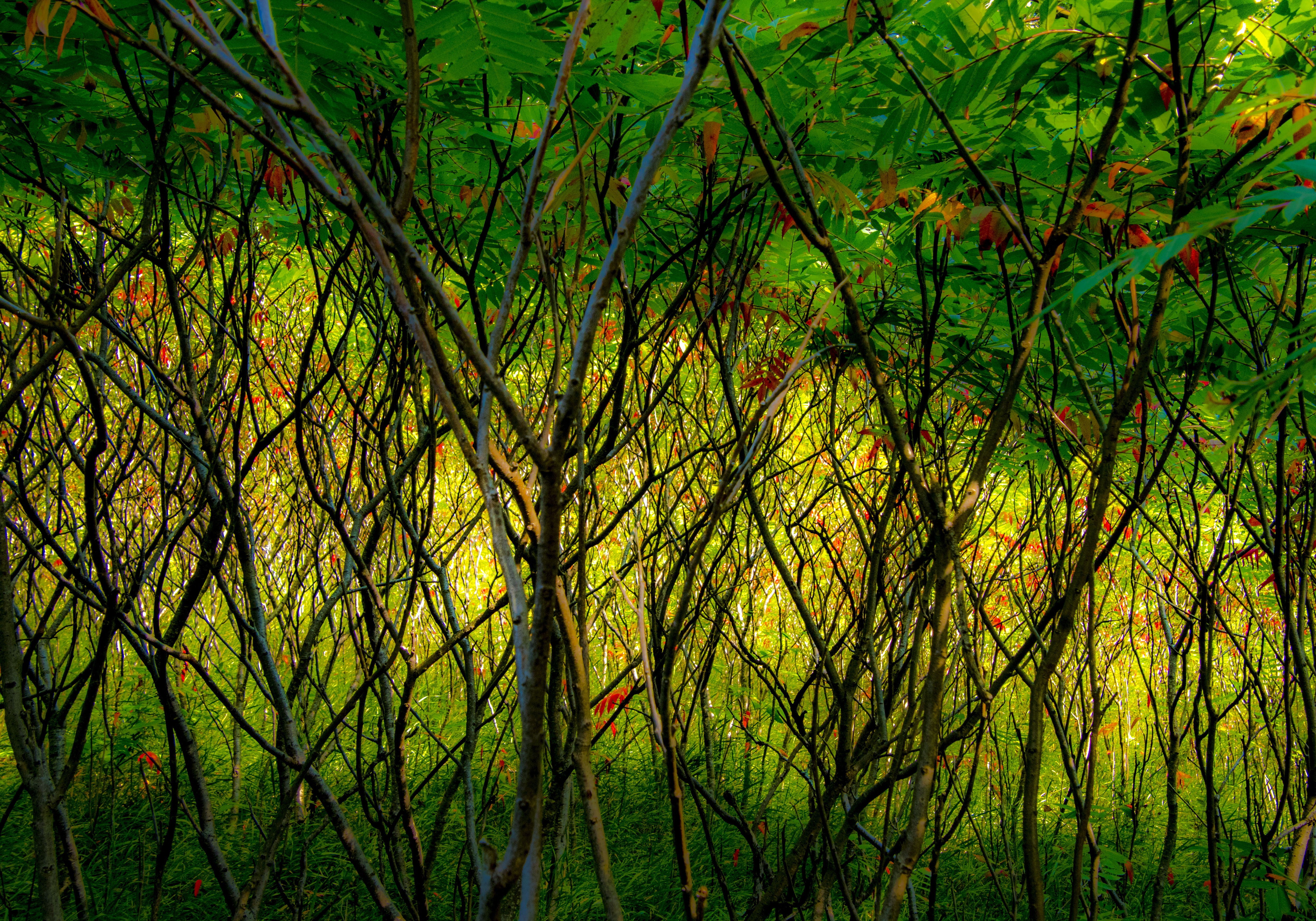
Elevating out of the ravine and up a steep hillside, we then encountered a huge acreage of invasive staghorn sumac. Lucy and I stopped to pull seeds from a remnant seed head to roll the tiny balls of succulent flavor in our palms with our fingers. The outer testa coatings eased from the seeds and were caught in the breeze to leave the hard seeds in our palms. Had we wished we could have ran our fingers over roughened tree trunks and broken limbs, yet the sumac seeds seemed to do the trick.
As for our other senses, one would have needed to bend to catch any aroma from the few mushrooms we encountered, or from the few blossoming flowers along the trail. Overwhelming the sense of smell was the scent of algae along the nearby shore. When we reached the upper end of the trail to sit momentarily on a picnic table, the algae scent was quite strong.
I took a moment to remind us to once again close our eyes and renew our deep breathing. Doing so never hurts when you’re deep in the woods and bringing alive so much of the sensory options around you. Mentally resetting tends to take you even deeper into the meditation, and when I’m alone forest bathing I often stop to “re-set” the meditation.

As we began our saunter back down the trail the momentary conversations were done so quietly, almost under breath, it seemed. Since my familiarity with this trail was so vivid I was sorry for the near utter silence, for hearing the songs of birds seem so typical of such hikes and this time it seemed the popping of stepped on acorns dominated. Such moments reminds me of the quote attributed to Heraclitus, “No man ever steps in the same river twice, for it’s not the same river and he’s not the same man.”
That was our trail for this moment in time, and Lucy and Stepan were there for their first time. For Roberta, perhaps her second or third such saunter. Sometimes you have to remind yourself of such truths, and truthfully, over the years no two saunters have ever been the same. Different things to see and hear, to smell and touch, along with our individual levels of meditation.
 Listening Stones Farm