When artist and bird photographer extraordinary, Terri Robichon, suggested Sherburne I doubt if either of us anticipated a spiritual experience. It began innocently enough when she recently posted some nice images of sandhill cranes near her New London home, and being a crane chaser myself, I reached out to Terri who was kind enough to offer an idea of where to find them near a lake close to her home. “You might have better luck at Sherburne, though,” she said.
Ah, Sherburne National Wildlife Refuge. Yes, Sherburne has long been a summertime home for the sandhill cranes and the idea of driving over seemed like a real possibility, even if it was six hours and counting for a round trip. A few years ago I made the trip for the same reason only to find the gates to the seven mile Prairie’s Edge Wildlife Drive shut and locked. That drive was late in the season, early November in the midst of the Covid pandemic, and near fall migration. Although birders had posted pictures on a social media birder’s page, there were thoughts that it would all work out. It didn’t.
Back in real time: when Terri posted an image of a pair of sandhills with their colts, the name given to their newly hatched offspring, my quest revved up significantly. As if fate has a hand in the land of the fortunate, Roberta and I were headed to the St. Paul suburb of White Bear Lake over the weekend for the 50th birthday of her son. “What if on the way back we head through Sherburne to see if we can find sandhill cranes?” I asked.

Since she seems to enjoy our photographic forays it was a go, so mid-afternoon on the way home we veered off onto a connecting highway, a winding adventure through numerous road closures and small towns to reach Sherburne. Once we pulled onto the wildlife drive around four in the afternoon, we stopped to organize the car seats and camera equipment and immediately found some interesting clumps of purple vetch and butterfly weed to photograph.
Then, not 100 meters further down the road we spotted our first pair of sandhill cranes slowly ambling through the prairie. What a great start, and not even a quarter mile into the 7.3 mile nature drive. This was a nice prelude since it would become even better with dozens of other birds and wildflowers awaiting us. This was the Sherburne I envisioned.
The huge 30,000 acre refuge is between the Twin Cities and St. Cloud within the St. Francis River Valley. Established in 1965, it includes numerous wetlands, oak savannas and open prairie. The vast majority of the refuge is off limits to the public and is designated as a wildlife sanctuary to allow an amazing array of wildlife the freedom to breed and raise their young without human disturbance. Only the wildlife drive, the numerous hiking trails and a designated canoe route are open to the public.
Our forays are often stop and go affairs, and our Sherburne drive was no different. Having one goal in mind … continuing my seemingly endless chasing of the cranes … was taken care of even before we reached the first observation deck less than a mile from the entrance. That pair was only the beginning for there would be much more, and amazingly so. We would also happen upon a green heron stalking reeds and cattails of a marsh. A cowbird, brown crown and all, posed for us. Flycatchers, sparrows, warblers and even an operatic dickcissel added to the mix. Not to mention the wildflowers, including Roberta’s first viewing of wild purple iris.
Yet the stars of the show were the numerous swans and sandhills. Seemingly around every nook and corner. Swans sat stationary as if on nests, paddled poetically across stilled surfaces, and some were with cygnets. These were ample artistic moments filled with grace and beauty. Meanwhile we were cautiously on the lookout for those telltale lumps of brown, and fate was certainly on our side as those “lumps” were most often bent and feeding sandhills. This was certainly a “rush and miss” adventure as evidenced by the number of cars passing by us.
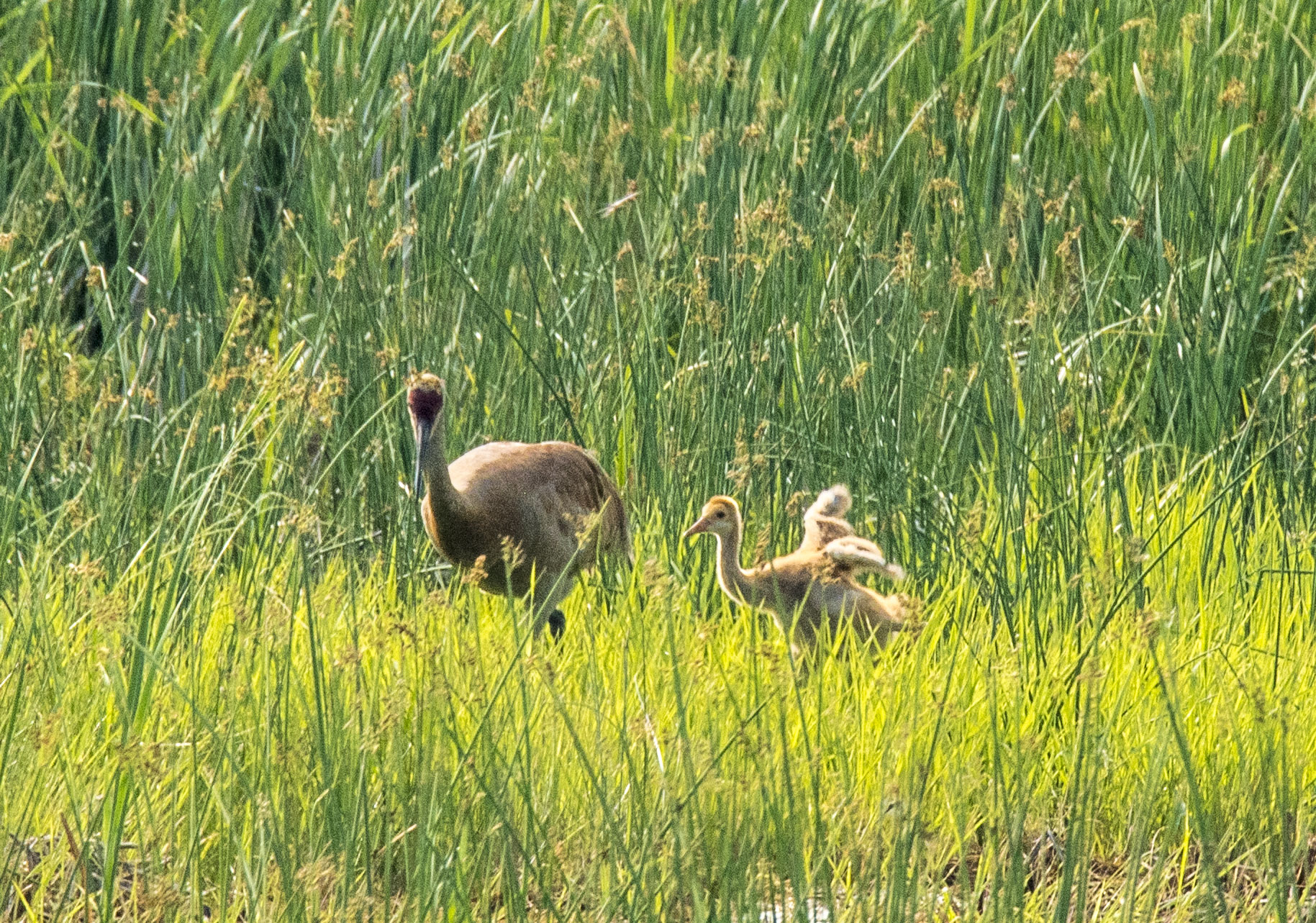
At one wetland we came upon a pair with their colts, slowly feeding along the reedy edge. At one point one of the colts broke free and acted its age, although the parent bird continued to pace along, head down, grabbing food. Its mate seemed to be teaching two other colts the available menu.
Eventually we moved along only to stop less than a mile away when I heard that telltale bugling sound that the late naturalist and essayist Aldo Leopold called the “trumpet in the orchestra of evolution.” When you hear the unique call, you must stop and search for the birds. And, we did.
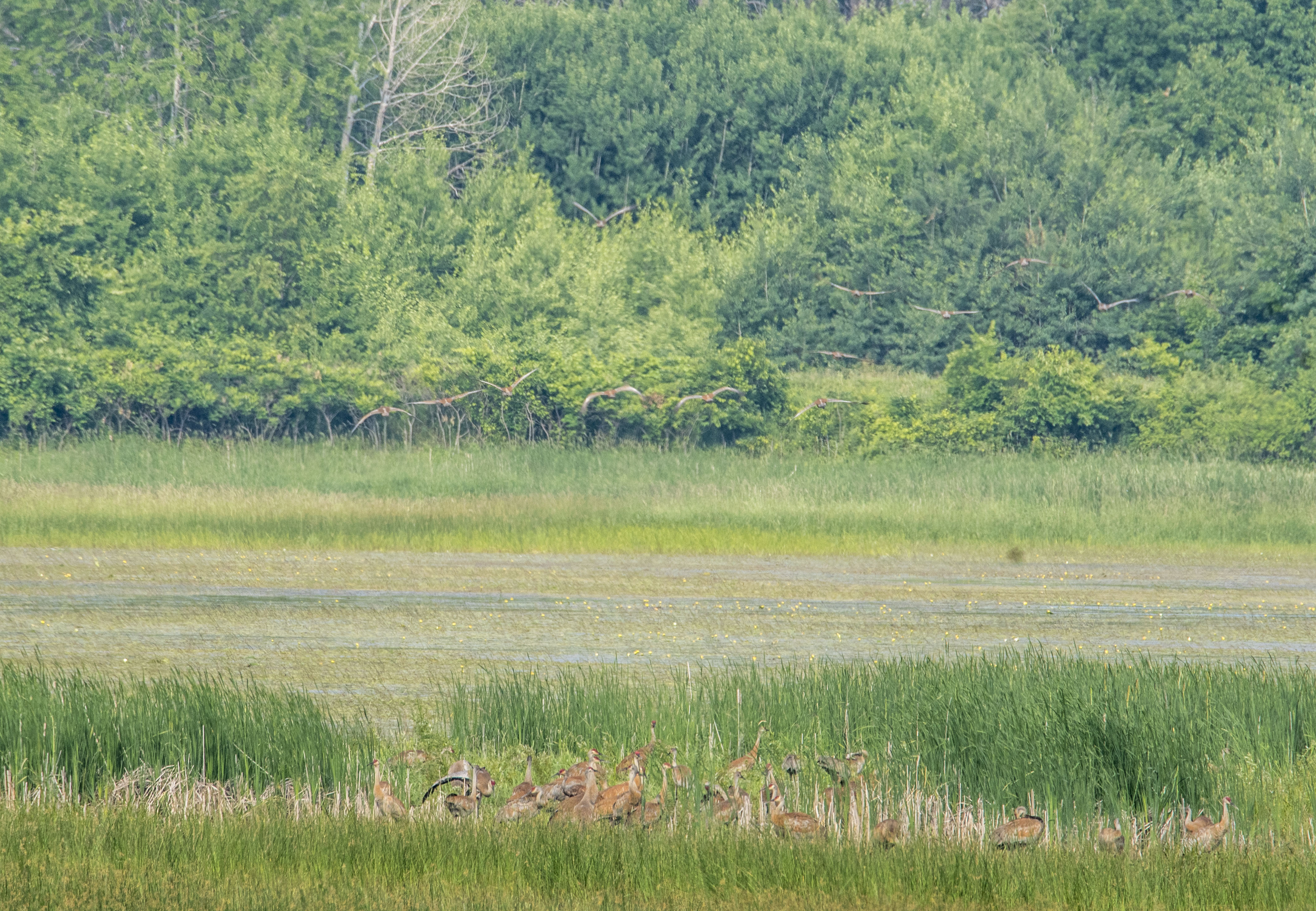
It took a bit before we found a pair nearby, then another, although looking around the panoramic view of this vast wetland we spied other solitary singles and pairs. And swans. The view was a living diorama an artist could never emulate at the Bell Museum. More of “church” than you may find in any building despite the artistry of Gaudi. As I looked around I found myself being drawn to a huge brownish patch where the long lens revealed dozens of sandhills grouped together. While it wasn’t March in Nebraska, we were facing into a very large gathering of sandhills. Fortunately for us we had been patient and curious, and I give Roberta credit for her appreciation of those traits.

This was a truly spiritual moment for me, and caused me to think of Leopold’s quote from his Marshland Elegy: “Our ability to perceive quality in nature begins as in art with the pretty. It expands through successive stages of the beautiful to values as yet uncaptured by language. The quality of cranes lies, I think, in this higher gamut, as yet beyond the reach of words.”
How true, and perhaps the grasp of my quest.
Lest I forget, here is the full contest of Leopold’s earlier quote: “When we hear his call we hear no mere bird. We hear the trumpet in the orchestra of evolution. He is the symbol of our untamable past, of that incredible sweep of millennia which underlies and conditions the daily affairs of birds and men.”

Moments like these bring to life my devotion to Leopold and his Sand County Almanac, a book of his poetic essays I first read back in college in the 1960s … a copy I still own. Which might explain the roots of my passion of chasing the cranes, a passion I rarely find tiresome. Especially on this little seven mile “wildlife drive” through Sherburne. While we didn’t head to Sherburne with spirituality in mind, you could hardly not feel it at that moment in that particular vast panorama of wetland and prairie.
If the cranes offered the trumpets, the swans granted us an uncommon grace. Adding to this was the colorful blossoming popping from the prairie-land grasses and varied songs aired by the dickcissel and assorted warblers. As much as I struggle to adequately describe the feeling, I realize fully that there is a higher gamut beyond the reach of words.
 Listening Stones Farm